Markets
News
Analysis
User
24/7
Economic Calendar
Education
Data
- Names
- Latest
- Prev



Signal Accounts for Members
All Signal Accounts
All Contests


France 10-Year OAT Auction Avg. YieldA:--
F: --
P: --
Euro Zone Retail Sales YoY (Oct)A:--
F: --
P: --
Brazil GDP YoY (Q3)A:--
F: --
P: --
U.S. Challenger Job Cuts (Nov)A:--
F: --
P: --
U.S. Challenger Job Cuts MoM (Nov)A:--
F: --
P: --
U.S. Challenger Job Cuts YoY (Nov)A:--
F: --
P: --
U.S. Initial Jobless Claims 4-Week Avg. (SA)A:--
F: --
P: --
U.S. Weekly Initial Jobless Claims (SA)A:--
F: --
P: --
U.S. Weekly Continued Jobless Claims (SA)A:--
F: --
P: --
Canada Ivey PMI (SA) (Nov)A:--
F: --
P: --
Canada Ivey PMI (Not SA) (Nov)A:--
F: --
P: --
U.S. Non-Defense Capital Durable Goods Orders Revised MoM (Excl. Aircraft) (SA) (Sept)A:--
F: --
U.S. Factory Orders MoM (Excl. Transport) (Sept)A:--
F: --
P: --
U.S. Factory Orders MoM (Sept)A:--
F: --
P: --
U.S. Factory Orders MoM (Excl. Defense) (Sept)A:--
F: --
P: --
U.S. EIA Weekly Natural Gas Stocks ChangeA:--
F: --
P: --
Saudi Arabia Crude Oil ProductionA:--
F: --
P: --
U.S. Weekly Treasuries Held by Foreign Central BanksA:--
F: --
P: --
Japan Foreign Exchange Reserves (Nov)A:--
F: --
P: --
India Repo RateA:--
F: --
P: --
India Benchmark Interest RateA:--
F: --
P: --
India Reverse Repo RateA:--
F: --
P: --
India Cash Reserve RatioA:--
F: --
P: --
Japan Leading Indicators Prelim (Oct)A:--
F: --
P: --
U.K. Halifax House Price Index YoY (SA) (Nov)A:--
F: --
P: --
U.K. Halifax House Price Index MoM (SA) (Nov)A:--
F: --
P: --
France Current Account (Not SA) (Oct)A:--
F: --
P: --
France Trade Balance (SA) (Oct)A:--
F: --
P: --
France Industrial Output MoM (SA) (Oct)A:--
F: --
P: --
Italy Retail Sales MoM (SA) (Oct)A:--
F: --
P: --
Euro Zone Employment YoY (SA) (Q3)--
F: --
P: --
Euro Zone GDP Final YoY (Q3)--
F: --
P: --
Euro Zone GDP Final QoQ (Q3)--
F: --
P: --
Euro Zone Employment Final QoQ (SA) (Q3)--
F: --
P: --
Euro Zone Employment Final (SA) (Q3)--
F: --
Brazil PPI MoM (Oct)--
F: --
P: --
Mexico Consumer Confidence Index (Nov)--
F: --
P: --
Canada Unemployment Rate (SA) (Nov)--
F: --
P: --
Canada Labor Force Participation Rate (SA) (Nov)--
F: --
P: --
Canada Employment (SA) (Nov)--
F: --
P: --
Canada Part-Time Employment (SA) (Nov)--
F: --
P: --
Canada Full-time Employment (SA) (Nov)--
F: --
P: --
U.S. Personal Income MoM (Sept)--
F: --
P: --
U.S. Dallas Fed PCE Price Index YoY (Sept)--
F: --
P: --
U.S. PCE Price Index YoY (SA) (Sept)--
F: --
P: --
U.S. PCE Price Index MoM (Sept)--
F: --
P: --
U.S. Personal Outlays MoM (SA) (Sept)--
F: --
P: --
U.S. Core PCE Price Index MoM (Sept)--
F: --
P: --
U.S. UMich 5-Year-Ahead Inflation Expectations Prelim YoY (Dec)--
F: --
P: --
U.S. Core PCE Price Index YoY (Sept)--
F: --
P: --
U.S. Real Personal Consumption Expenditures MoM (Sept)--
F: --
P: --
U.S. 5-10 Year-Ahead Inflation Expectations (Dec)--
F: --
P: --
U.S. UMich Current Economic Conditions Index Prelim (Dec)--
F: --
P: --
U.S. UMich Consumer Sentiment Index Prelim (Dec)--
F: --
P: --
U.S. UMich 1-Year-Ahead Inflation Expectations Prelim (Dec)--
F: --
P: --
U.S. UMich Consumer Expectations Index Prelim (Dec)--
F: --
P: --
U.S. Weekly Total Rig Count--
F: --
P: --
U.S. Weekly Total Oil Rig Count--
F: --
P: --
U.S. Consumer Credit (SA) (Oct)--
F: --
P: --
China, Mainland Foreign Exchange Reserves (Nov)--
F: --
P: --


No matching data
Latest Views
Latest Views
Trending Topics
Top Columnists
Latest Update
White Label
Data API
Web Plug-ins
Affiliate Program
View All

No data
One month after unexpectedly sliding into contraction for the first time in 2025, moments ago the S&P Manufaturing PMI even more unexpectedly soared from 49.8 to 53.3, not only smashing expectations of another decline to 49.7 and printing well above the highest economist forecast and in fact printing 7-sigma above the median estimate...
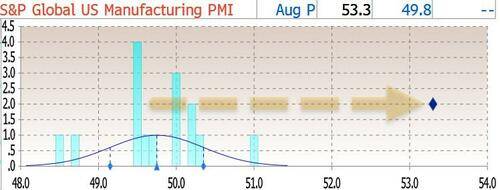
... but was the highest print since May 2022! According to S&P's PMI report, the surge signaled "a renewed improvement of factory business conditions after a brief deterioration in July."
At the same time the S&P Services PMI declined from last month's red hot 55.7 to 55.4, but still beat estimates of 54.2. As a result, the composite PMI of US business activity grew at the fastest rate recorded so far this year in August, rising to 55.4 from 55.1, matching the previous post-covid high from Dec 2024 and adding to signs of a strong third quarter. Output has now grown continually for 31 months, with the latest two months seeing the strongest back-to-back expansions since the spring of 2022.
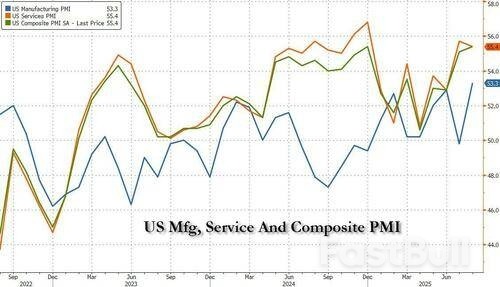
According to the report, growth was seen across both manufacturing and service sectors of the economy. Hiring also picked up. Most notably, job creation reached one of the highest rates seen over the past three years as companies reported the largest build-up in uncompleted work since May 2022.
There was more good news when it comes to jobs: employment rose for a sixth successive month, with the pace of job creation hitting the highest since January (and one of the strongest rates seen for over three years). Service providers took on staff at the fastest pace for seven months while factory job gains reached the highest since March 2022. Companies largely took on additional staff in response to rising backlogs of work. Uncompleted orders rose for a fifth consecutive month, rising in August at a pace unsurpassed since May 2022 reflecting stronger demand and near-term capacity constraints at some companies.
There were some concerns on the price side, with tariffs reported as the key driver of further cost increases in August. Companies across both manufacturing and service sectors collectively reported the steepest rise in input prices since May and the second-largest increase since January 2023. Rates of increase accelerated in both sectors. While the manufacturing cost rise was especially large, being the second-steepest since August 2022, the service sector increase was the second-highest since June 2023. Average prices charged for goods and services rose at the sharpest rate since August 2022 as firms passed higher costs on to customers. Although goods price inflation cooled slightly for a second month in a row, it remained among the highest seen over the past three years. Service sector price inflation meanwhile was the sharpest since August 2022.
Business confidence in the outlook also improved but remained much weaker than seen at the start of the year as companies reported ongoing concerns over the impact of government policies, especially in relation to tariffs. Tariffs were again widely cited as the principal cause of sharply higher costs, which in turn fed through to the steepest rise in average selling prices recorded over the past three years.
Commenting on the report, Chris Williamson, Chief Business Economist at S&P Global Market Intelligence said that the "strong flash PMI reading for August adds to signs that US businesses have enjoyed a strong third quarter so far. The data are consistent with the economy expanding at a 2.5% annualized rate, up from the average 1.3% expansion seen over the first two quarters of the year."
“Companies across both manufacturing and services are reporting stronger demand conditions, but are struggling to meet sales growth, causing backlogs of work to rise at a pace not seen since the pandemic-related capacity constraints recorded in early 2022. Stock building of finished goods has also risen at a survey record pace, linked in part to worries over future supply conditions."
“While this upturn in demand has fueled a surge in hiring, it has also bolstered firms’ pricing power. Companies have consequently passed tariff-related cost increases through to customers in increasing numbers, indicating that inflation pressures are now at their highest for three years."
As a result, the economist concludes that the "rise in selling prices for goods and services suggests that consumer price inflation will rise further above the Fed’s 2% target in the coming months. Indeed, combined with the upturn in business activity and hiring, the rise in prices signaled by the survey puts the PMI data more into rate hiking, rather than cutting, territory according to the historical relationship between these economic indicators and FOMC policy changes.”
In other words, the report coming unexpectedly strong, may be just an attempt by the traditionally anti-Trumpian S&P to pressure the Fed into maintaining a hawkish bias even as the labor market - at least as measured by most other 3rd parties - continues to deteriorate.
Japan's core inflation slowed for a second straight month in July but stayed above the central bank's 2% target, keeping alive market expectations for another interest rate hike in the coming months.
The nationwide core consumer price index (CPI), which excludes fresh food items, rose 3.1% in July from a year earlier, government data showed on Friday, faster than a median market forecast for a 3.0% gain.
The rise was smaller than the 3.3% increase in June, due largely to the base effect of last year's rise in energy prices, which came from the termination of government subsidies to curb fuel bills.
A separate index that strips away both fresh food and fuel costs - closely watched by the BOJ as a measure of domestic demand-driven prices - rose 3.4% in July from a year earlier after increasing by the same rate in June.
Rising food and raw material costs have kept Japan's core inflation above the Bank of Japan's 2% target for well over three years, causing some BOJ policymakers to worry about second-round price effects.
The BOJ last year exited a decade-long, massive stimulus and raised short-term interest rates to 0.5% in January on the view Japan was close to durably hitting its 2% inflation target.
While the bank revised up its inflation forecasts last month, Governor Kazuo Ueda has stressed the need to tread cautiously on further rate hikes, due to an expected hit to the economy from U.S. tariffs.
The Japanese economy has been showing resilience even though sweeping U.S. tariffs are dragging down exports.
Last week's unexpectedly strong second-quarter gross domestic product data, combined with a U.S.-Japan trade deal struck last month, has fuelled market expectations that a tariff-driven recession will be averted - bolstering the case for another rate hike later this year.
Some analysts also point to Washington's pressure for more rate hikes, following rare and explicit comments from U.S. Treasury Secretary Scott Bessent who said the BOJ was "behind the curve" on policy.
The latest Reuters poll showed 63% of economists surveyed this month expect the central bank to raise base borrowing costs to at least 0.75% from 0.50% by the end of this year, an increase from 54% in last month's poll.
Federal Reserve Bank of Chicago President Austan Goolsbee said while some recent inflation readings have come in better than expected, he hopes one “dangerous” data point is just a blip.
“We’ve had some inflation reports that came in milder than we expected, and I was feeling good,” Goolsbee said Thursday in an interview with Bloomberg Television on the sidelines of the Fed’s annual conference in Jackson Hole, Wyoming.
“The last inflation report that came in, where you saw services inflation — which is probably not driven by the tariffs — really start shooting up,” he said. “It’s a dangerous data point, I’m hoping that that’s bit of a blip.”
The Fed’s September policy gathering “feels to me like it’s a live meeting,” he said.
The central bank has held interest rates steady this year, citing elevated uncertainty over the impact of tariffs on the economy. Fed Chair Jerome Powell will deliver a much-anticipated speech Friday, and investors will be listening for any hints on what policymakers may do next month.
Earlier this month, Goolsbee said the economic outlook remained mixed, and the bank would need to wait for more data before adjusting interest rates. He is a voting member on the FOMC this year.
Goolsbee’s comments come as the Fed faces heightened scrutiny from the Trump administration amid public calls to lower interest rates. The president called this week for Fed Governor Lisa Cook to resign, amid allegations that she committed mortgage fraud. Cook has said she won’t be bullied into stepping down.
In a separate interview with the Wall Street Journal, Boston Fed President Susan Collins suggested it might be appropriate to cut interest rates in September if labor market conditions weakened more than inflation risks increased.

White Label
Data API
Web Plug-ins
Poster Maker
Affiliate Program
The risk of loss in trading financial instruments such as stocks, FX, commodities, futures, bonds, ETFs and crypto can be substantial. You may sustain a total loss of the funds that you deposit with your broker. Therefore, you should carefully consider whether such trading is suitable for you in light of your circumstances and financial resources.
No decision to invest should be made without thoroughly conducting due diligence by yourself or consulting with your financial advisors. Our web content might not suit you since we don't know your financial conditions and investment needs. Our financial information might have latency or contain inaccuracy, so you should be fully responsible for any of your trading and investment decisions. The company will not be responsible for your capital loss.
Without getting permission from the website, you are not allowed to copy the website's graphics, texts, or trademarks. Intellectual property rights in the content or data incorporated into this website belong to its providers and exchange merchants.
Not Logged In
Log in to access more features

FastBull Membership
Not yet
Purchase
Log In
Sign Up