Markets
News
Analysis
User
24/7
Economic Calendar
Education
Data
- Names
- Latest
- Prev


Signal Accounts for Members
All Signal Accounts
All Contests


France Trade Balance (SA) (Oct)A:--
F: --
Euro Zone Employment YoY (SA) (Q3)A:--
F: --
Canada Part-Time Employment (SA) (Nov)A:--
F: --
P: --
Canada Unemployment Rate (SA) (Nov)A:--
F: --
P: --
Canada Full-time Employment (SA) (Nov)A:--
F: --
P: --
Canada Labor Force Participation Rate (SA) (Nov)A:--
F: --
P: --
Canada Employment (SA) (Nov)A:--
F: --
P: --
U.S. PCE Price Index MoM (Sept)A:--
F: --
P: --
U.S. Personal Income MoM (Sept)A:--
F: --
P: --
U.S. Core PCE Price Index MoM (Sept)A:--
F: --
P: --
U.S. PCE Price Index YoY (SA) (Sept)A:--
F: --
P: --
U.S. Core PCE Price Index YoY (Sept)A:--
F: --
P: --
U.S. Personal Outlays MoM (SA) (Sept)A:--
F: --
U.S. 5-10 Year-Ahead Inflation Expectations (Dec)A:--
F: --
P: --
U.S. Real Personal Consumption Expenditures MoM (Sept)A:--
F: --
U.S. Weekly Total Rig CountA:--
F: --
P: --
U.S. Weekly Total Oil Rig CountA:--
F: --
P: --
U.S. Consumer Credit (SA) (Oct)A:--
F: --
China, Mainland Foreign Exchange Reserves (Nov)A:--
F: --
P: --
Japan Trade Balance (Oct)A:--
F: --
P: --
Japan Nominal GDP Revised QoQ (Q3)A:--
F: --
P: --
China, Mainland Imports YoY (CNH) (Nov)A:--
F: --
P: --
China, Mainland Exports (Nov)A:--
F: --
P: --
China, Mainland Imports (CNH) (Nov)A:--
F: --
P: --
China, Mainland Trade Balance (CNH) (Nov)A:--
F: --
P: --
China, Mainland Exports YoY (USD) (Nov)A:--
F: --
P: --
China, Mainland Imports YoY (USD) (Nov)A:--
F: --
P: --
Germany Industrial Output MoM (SA) (Oct)A:--
F: --
Euro Zone Sentix Investor Confidence Index (Dec)A:--
F: --
P: --
Canada National Economic Confidence IndexA:--
F: --
P: --
U.K. BRC Like-For-Like Retail Sales YoY (Nov)--
F: --
P: --
U.K. BRC Overall Retail Sales YoY (Nov)--
F: --
P: --
Australia Overnight (Borrowing) Key Rate--
F: --
P: --
RBA Rate Statement
RBA Press Conference
Germany Exports MoM (SA) (Oct)--
F: --
P: --
U.S. NFIB Small Business Optimism Index (SA) (Nov)--
F: --
P: --
Mexico 12-Month Inflation (CPI) (Nov)--
F: --
P: --
Mexico Core CPI YoY (Nov)--
F: --
P: --
Mexico PPI YoY (Nov)--
F: --
P: --
U.S. Weekly Redbook Index YoY--
F: --
P: --
U.S. JOLTS Job Openings (SA) (Oct)--
F: --
P: --
China, Mainland M1 Money Supply YoY (Nov)--
F: --
P: --
China, Mainland M0 Money Supply YoY (Nov)--
F: --
P: --
China, Mainland M2 Money Supply YoY (Nov)--
F: --
P: --
U.S. EIA Short-Term Crude Production Forecast For The Year (Dec)--
F: --
P: --
U.S. EIA Natural Gas Production Forecast For The Next Year (Dec)--
F: --
P: --
U.S. EIA Short-Term Crude Production Forecast For The Next Year (Dec)--
F: --
P: --
EIA Monthly Short-Term Energy Outlook
U.S. API Weekly Gasoline Stocks--
F: --
P: --
U.S. API Weekly Cushing Crude Oil Stocks--
F: --
P: --
U.S. API Weekly Crude Oil Stocks--
F: --
P: --
U.S. API Weekly Refined Oil Stocks--
F: --
P: --
South Korea Unemployment Rate (SA) (Nov)--
F: --
P: --
Japan Reuters Tankan Non-Manufacturers Index (Dec)--
F: --
P: --
Japan Reuters Tankan Manufacturers Index (Dec)--
F: --
P: --
Japan Domestic Enterprise Commodity Price Index MoM (Nov)--
F: --
P: --
Japan Domestic Enterprise Commodity Price Index YoY (Nov)--
F: --
P: --
China, Mainland PPI YoY (Nov)--
F: --
P: --
China, Mainland CPI MoM (Nov)--
F: --
P: --


No matching data
Latest Views
Latest Views
Trending Topics
Top Columnists
Latest Update
White Label
Data API
Web Plug-ins
Affiliate Program
View All

No data
U.S. equity funds saw a significant drop in net investments in the week through July 9 on caution over President Donald Trump's threats of fresh tariffs on trading partners, even though stocks surged to new records on rising demand in the artificial intelligence sector.
Investors acquired just $2.1 billion worth of U.S. equity funds during the week when compared with a robust $31.6 billion worth of net accumulations in the prior week, data from LSEG Lipper showed.
President Trump this week extended the tariff deadline until August 1 to facilitate trade negotiations, but announced noticeably higher duties for some key trading partners including Japan, South Korea, Canada and Brazil alongside a 50% tariff on copper.
U.S. multi-cap funds saw the first weekly net investment in four weeks to the tune of $1.8 billion. Large-cap, mid-cap and small-cap funds, meanwhile, suffered net outflows of $2.83 billion, $785 million and $472 million, respectively.
Sectoral funds saw net purchases extended into a second successive week, with approximately $1.28 billion flowing into these funds. Tech drew in $1.7 billion but healthcare saw net outflows of $874 million.
U.S. money market funds faced a net $9.78 billion weekly outflow, ending two weeks of buying.
Inflows into U.S. bond funds, meanwhile, cooled to a three-week low of $4.34 billion.
Short-to-intermediate investment-grade funds received $1.76 billion with weekly net investments dropping by 57% over the week. General domestic taxable fixed income funds received just $634 million compared with a net $3.03 billion purchase in the prior week.
Short-to-intermediate government and treasury funds, meanwhile, attracted $982 million, the largest amount in four weeks.
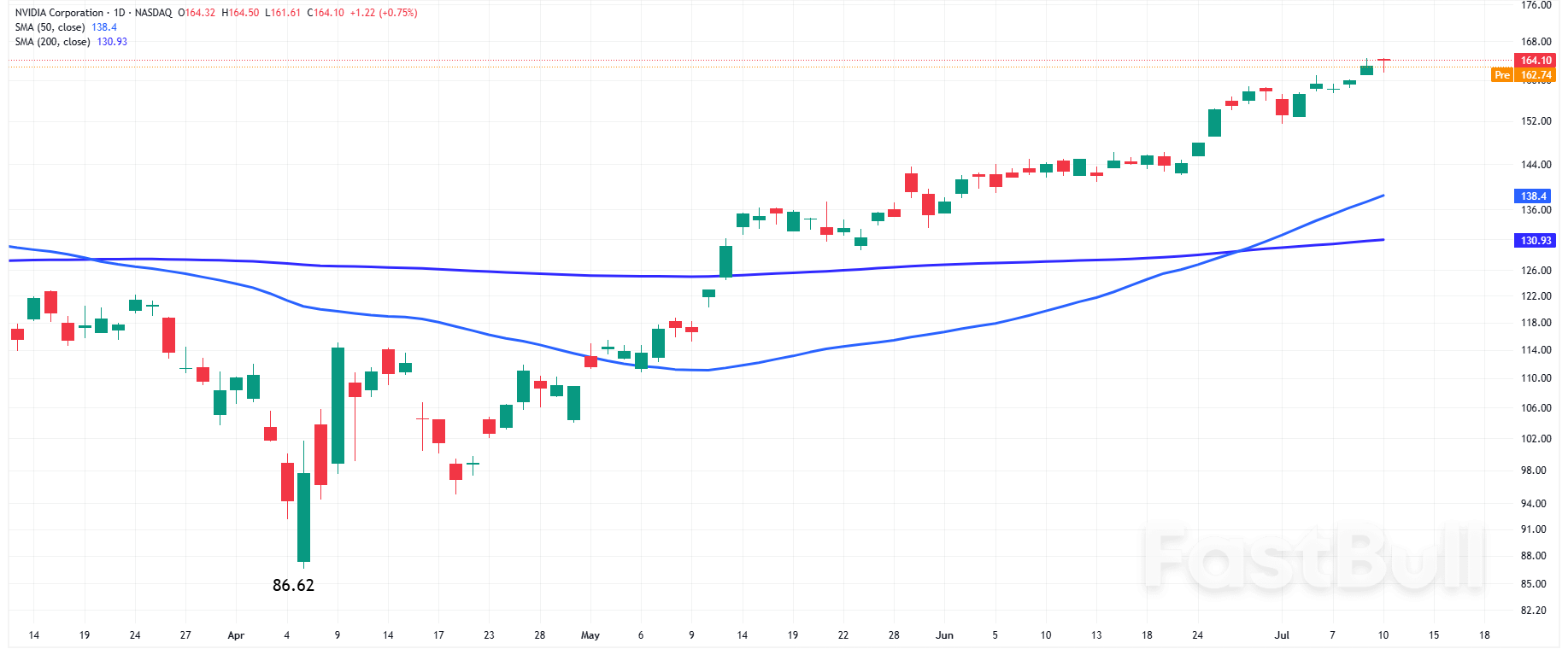
Daily NVIDIA CorporationVietnam’s leadership was caught off guard by US President Donald Trump’s announcement last week that it agreed to a 20% tariff, and the Southeast Asian nation is still seeking to lower the rate, according to people familiar with the matter.
Straight after last Wednesday’s call with Trump, Vietnam’s party chief To Lam told his negotiating team to keep working to bring the tariff rate down, the people said, asking not to be identified as the talks are confidential. The 20% figure came as a surprise as Vietnam believed it had secured a more favorable tariff range, the people said.
Before the call, Vietnam had been pushing for a tariff in the 10%-15% range.
There’s been little mention of the 20% tariff in Vietnam’s state media. In a government memo seen by Bloomberg News, which was sent to local press, it gives instructions not to post content that is unclear or speculative in nature and without consensus between Vietnam and the US.
Subscribe to the Bloomberg Daybreak Podcast on Apple, Spotify and other Podcast Platforms.
Vietnam’s Ministry of Foreign Affairs didn’t immediately respond to a request for comment.
The Southeast Asian nation, an export powerhouse that last year had the world’s third-biggest trade surplus with the US, was only the second country after the UK that Trump has announced a trade agreement with. Trump has been issuing tariff letters to dozens of trading partners since then, slapping duties as high as 50% ahead of an Aug. 1 deadline.
The day after Trump’s Truth Social post on Vietnam, in which he called Lam “an absolute pleasure” to deal with, the country’s Ministry of Foreign Affairs said trade negotiators were still coordinating with their US counterparts to finalize the details of the agreement.
Since then, Vietnam’s leaders have skirted the issue in official comments. Prime Minister Pham Minh Chinh instead focused on Vietnam’s efforts to diversify export markets and supply chains to adapt to the new tariff policy and his comments were echoed a few days later by a deputy trade minister.
Trump’s announced rate of 20% would replace the current 10% baseline, but still add on to some other pre-existing levies such as ‘Most Favored Nation’ tariffs, according to a US official who requested anonymity to discuss the matter. That would push the typical total average effective rate above 20%. US sectoral tariffs, such as on automobiles and steel, are separate from the 20% rate but not cumulative — importers pay one or the other.
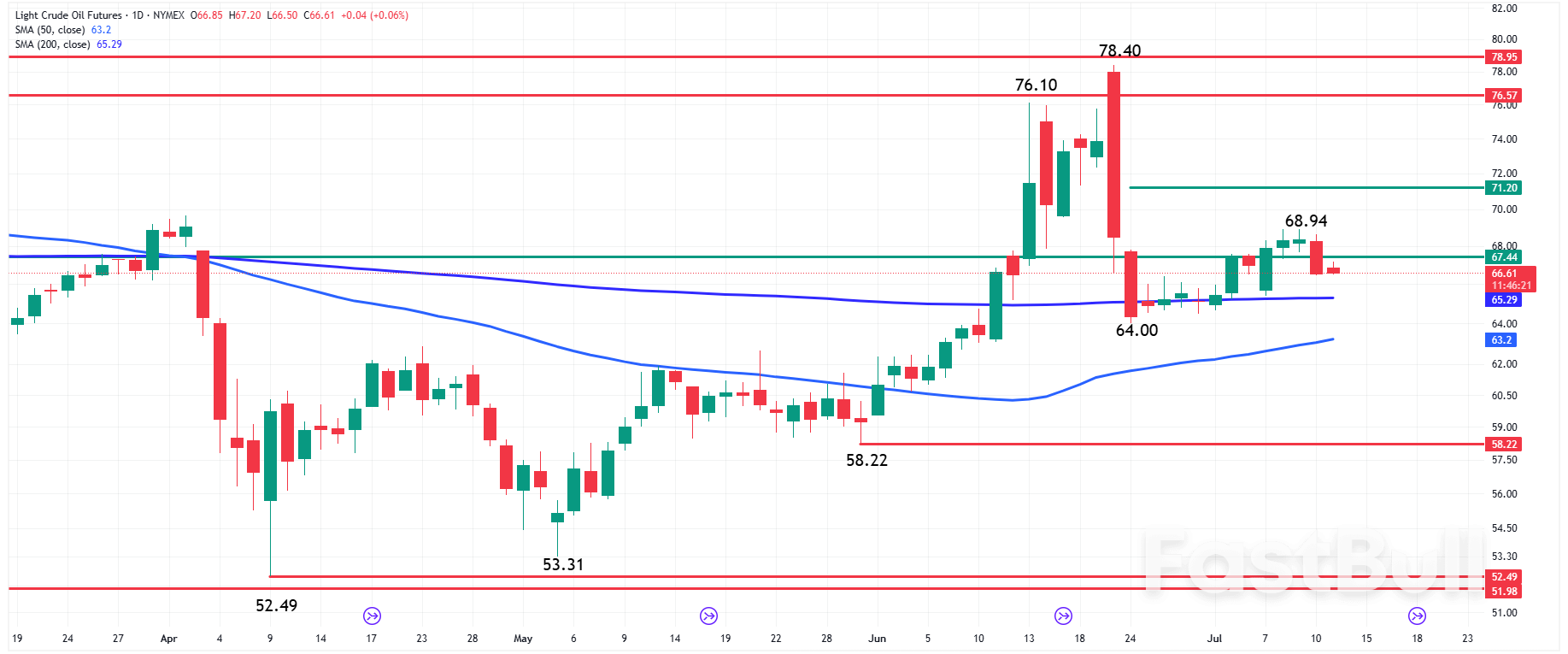
Daily Light Crude Oil FuturesThere’s a common notion that since Trump’s initial round of China tariffs in his first administration, the US has become drastically less reliant on the Asian nation. Headline data certainly suggests that, with the US share of imports from China falling in just a few years to about 13% in 2024 from nearly 22% in 2017.
But the reality is far less clear-cut. In a new paper from researchers including those at the World Bank and International Monetary Fund, that figure should actually be higher, closer to 16%.
Analysts computed the headline trade figures in addition to estimates of transshipments, when an item goes to the US from China through a third country, and de minimis shipments, or those packages that were exempt from duties if under $800. In other words, China is not being replaced to the degree we all think.
Another reason for companies being unable to leave China is playing out now globally for thousands of businesses — it’s just too good at making stuff. Haley Pavone, the founder and chief executive officer of Pashion Footwear, faced an $80,000 tariff bill in April because all her products are imported from China. Despite that steep fee, she’s sticking with her Chinese supplier.
She ran through the numbers one evening via Zoom from her office in California: a $50,000 up-front cost for moving production to Vietnam. A higher minimum order in places including Brazil. And nowhere are workers skilled enough to make her shoes, which convert from heels to flats and require some engineering know-how.
“No one is as optimized as China,” the 29 year-old former Shark Tank contestant said.
It underscores how Trump’s tariff policy may not end up kicking the world’s reliance on China — even the US — and how in some cases they may even backfire. The current reciprocal tariff rates threatened on much of Southeast Asia are currently higher than China’s, which makes it even less appealing for companies like Pavone’s to leave.
With European Union officials still in talks with the US, a paper published this week by the Kiel Institute for the World Economy highlights how services shouldn’t be ignored in the ongoing negotiations, considering how its size is similar to trade in goods, and grows much faster.
The US had a services trade surplus of €148 billion ($173 billion) with the EU last year — about three quarters of its goods trade deficit, researchers Frank Bickenbach, Holger Görg and Wan-Hsin Liu wrote, citing figures from Eurostat, the bloc’s statistics agency.
“The EU can go for a carrot-and-stick approach with respect to services trade,” they argue. That could involve offering to remove barriers and make market access easier for US digital services providers, while threatening to tighten competition, data protection and privacy rules or even introduce an EU digital services tax.
Aside from Trump ignoring services in his reasoning on tariffs, the researchers highlight another big caveat: US data don’t match up with the EU’s. Compared with numbers from Eurostat, the Bureau of Economic Analysis reported a services trade surplus with the bloc of less than half, and a goods deficit more than 10% larger.
White Label
Data API
Web Plug-ins
Poster Maker
Affiliate Program
The risk of loss in trading financial instruments such as stocks, FX, commodities, futures, bonds, ETFs and crypto can be substantial. You may sustain a total loss of the funds that you deposit with your broker. Therefore, you should carefully consider whether such trading is suitable for you in light of your circumstances and financial resources.
No decision to invest should be made without thoroughly conducting due diligence by yourself or consulting with your financial advisors. Our web content might not suit you since we don't know your financial conditions and investment needs. Our financial information might have latency or contain inaccuracy, so you should be fully responsible for any of your trading and investment decisions. The company will not be responsible for your capital loss.
Without getting permission from the website, you are not allowed to copy the website's graphics, texts, or trademarks. Intellectual property rights in the content or data incorporated into this website belong to its providers and exchange merchants.
Not Logged In
Log in to access more features

FastBull Membership
Not yet
Purchase
Log In
Sign Up