• Trade
  • Markets
  • Copy
  • Contests
  • News
  • 24/7
  • Calendar
  • Q&A
  • Chats
Trending
Screeners
SYMBOL
LAST
BID
ASK
HIGH
LOW
NET CHG.
%CHG.
SPREAD
SPX
S&P 500 Index
6816.52
6816.52
6816.52
6861.30
6801.50
-10.89
-0.16%
--
DJI
Dow Jones Industrial Average
48416.55
48416.55
48416.55
48679.14
48283.27
-41.49
-0.09%
--
IXIC
NASDAQ Composite Index
23057.40
23057.40
23057.40
23345.56
23012.00
-137.76
-0.59%
--
USDX
US Dollar Index
97.890
97.970
97.890
98.070
97.740
-0.060
-0.06%
--
EURUSD
Euro / US Dollar
1.17530
1.17538
1.17530
1.17556
1.17457
-0.00001
0.00%
--
GBPUSD
Pound Sterling / US Dollar
1.33762
1.33770
1.33762
1.33799
1.33543
-0.00001
0.00%
--
XAUUSD
Gold / US Dollar
4307.92
4308.36
4307.92
4309.51
4305.14
+2.80
+ 0.07%
--
WTI
Light Sweet Crude Oil
56.478
56.520
56.478
56.503
56.393
+0.073
+ 0.13%
--

Community Accounts

Signal Accounts
--
Profit Accounts
--
Loss Accounts
--
View More

Become a signal provider

Sell trading signals to earn additional income

View More

Guide to Copy Trading

Get started with ease and confidence

View More

Signal Accounts for Members

All Signal Accounts

Best Return
  • Best Return
  • Best P/L
  • Best MDD
Past 1W
  • Past 1W
  • Past 1M
  • Past 1Y

All Contests

  • All
  • Trump Updates
  • Recommend
  • Stocks
  • Cryptocurrencies
  • Central Banks
  • Featured News
Top News Only
Share

Australia's S&P/ASX 200 Index Up 0.4% At 8670.10 Points In Early Trade

Share

Ukraine President Zelenskiy: Security Guarantees Are Not At Framework Stage: It Is Detailed Document And Still Needs Work

Share

Ukraine President Zelenskiy: Energy Ceasefire Is Option

Share

Ukraine President Zelenskiy: Ukraine, USA Support Merz's Idea Of Christmas Ceasefire

Share

Ukraine President Zelenskiy: Ukraine Will Ask USA For More Weapons If Russia Rejects Peace Plan

Share

Ukraine President Zelenskiy: Ukraine Is Counting On Alternative Funding If Reparation Loan Scheme Fails

Share

Ukraine President Zelenskiy: If Hostilities Stop Money To Be Used For Restoration

Share

Ukraine President Zelenskiy: Ukraine Is Counting On 45 Billion Euro For Defence Support Per Year If War Continues

Share

Ukraine President Zelenskiy: Deterrence Package For Ukraine's Defence Was Discussed During Talks

Share

Ukraine President Zelenskiy: Ukraine Will Not Recognize Donbas As Russian Either De Jure Or De Facto

Share

Ukraine President Zelenskiy: There Will Be No 'Free Economic Zone' In Donbas Under Russian Control

Share

Ukraine President Zelenskiy: He Hopes To Meet Trump When Finalized Framework For Peace Is Ready

Share

Ukraine President Zelenskiy: We Are Really Close To 'Strong Security' Guarantees

Share

SPDR Gold Trust Reports Holdings Down 0.14%, Or 1.43 Tonnes, To 1051.68 Tonnes By Dec 15

Share

Ukraine President Zelenskiy: There Is Agreement That Security Guarantees Should Be Put To Vote In Congress

Share

Ukraine President Zelenskiy: USA Wants To Proceed Quickly To Peace, Ukraine Needs To Ensure Quality Of This Peace

Share

Ukraine President Zelenskiy: There Is Still No 'Ideal Peace Plan' As Of Now, Current Draft Is 'Working Version'

Share

On Monday (December 15), In Late New York Trading, S&P 500 Futures Fell 0.15%, Dow Jones Futures Fell 0.03%, NASDAQ 100 Futures Fell 0.47%, And Russell 2000 Futures Fell 0.83%

Share

On Monday (December 15) At The Close Of New York Trading (05:59 Beijing Time On Tuesday), The Offshore Yuan (CNH) Was Quoted At 7.0433 Against The US Dollar, Up 99 Points From The Close Of New York Trading On Friday. The Yuan Traded In The Range Of 7.0586-7.0394 During The Day, And Kept Approaching The High Of 6.9713 On September 26, 2024

Share

U.S. Treasury Secretary Bessenter Discussed The Stock Market, Reiterating That Members Of Congress Must Stop Stock Trading

TIME
ACT
FCST
PREV
Japan Tankan Large Non-Manufacturing Outlook Index (Q4)

A:--

F: --

P: --

U.K. Rightmove House Price Index YoY (Dec)

A:--

F: --

P: --

China, Mainland Industrial Output YoY (YTD) (Nov)

A:--

F: --

P: --

China, Mainland Urban Area Unemployment Rate (Nov)

A:--

F: --

P: --

Saudi Arabia CPI YoY (Nov)

A:--

F: --

P: --

Euro Zone Industrial Output YoY (Oct)

A:--

F: --

P: --

Euro Zone Industrial Output MoM (Oct)

A:--

F: --

P: --

Canada Existing Home Sales MoM (Nov)

A:--

F: --

P: --

Canada National Economic Confidence Index

A:--

F: --

P: --

Canada New Housing Starts (Nov)

A:--

F: --

P: --
U.S. NY Fed Manufacturing Employment Index (Dec)

A:--

F: --

P: --

U.S. NY Fed Manufacturing Index (Dec)

A:--

F: --

P: --

Canada Core CPI YoY (Nov)

A:--

F: --

P: --

Canada Manufacturing Unfilled Orders MoM (Oct)

A:--

F: --

P: --

U.S. NY Fed Manufacturing Prices Received Index (Dec)

A:--

F: --

P: --

U.S. NY Fed Manufacturing New Orders Index (Dec)

A:--

F: --

P: --

Canada Manufacturing New Orders MoM (Oct)

A:--

F: --

P: --

Canada Core CPI MoM (Nov)

A:--

F: --

P: --

Canada Trimmed CPI YoY (SA) (Nov)

A:--

F: --

P: --

Canada Manufacturing Inventory MoM (Oct)

A:--

F: --

P: --

Canada CPI YoY (Nov)

A:--

F: --

P: --

Canada CPI MoM (Nov)

A:--

F: --

P: --

Canada CPI YoY (SA) (Nov)

A:--

F: --

P: --

Canada Core CPI MoM (SA) (Nov)

A:--

F: --

P: --

Canada CPI MoM (SA) (Nov)

A:--

F: --

P: --

Federal Reserve Board Governor Milan delivered a speech
U.S. NAHB Housing Market Index (Dec)

A:--

F: --

P: --

Australia Composite PMI Prelim (Dec)

A:--

F: --

P: --

Australia Services PMI Prelim (Dec)

A:--

F: --

P: --

Australia Manufacturing PMI Prelim (Dec)

A:--

F: --

P: --

Japan Manufacturing PMI Prelim (SA) (Dec)

--

F: --

P: --

U.K. 3-Month ILO Employment Change (Oct)

--

F: --

P: --

U.K. Unemployment Claimant Count (Nov)

--

F: --

P: --

U.K. Unemployment Rate (Nov)

--

F: --

P: --

U.K. 3-Month ILO Unemployment Rate (Oct)

--

F: --

P: --

U.K. Average Weekly Earnings (3-Month Average, Including Bonuses) YoY (Oct)

--

F: --

P: --

U.K. Average Weekly Earnings (3-Month Average, Excluding Bonuses) YoY (Oct)

--

F: --

P: --

France Services PMI Prelim (Dec)

--

F: --

P: --

France Composite PMI Prelim (SA) (Dec)

--

F: --

P: --

France Manufacturing PMI Prelim (Dec)

--

F: --

P: --

Germany Services PMI Prelim (SA) (Dec)

--

F: --

P: --

Germany Manufacturing PMI Prelim (SA) (Dec)

--

F: --

P: --

Germany Composite PMI Prelim (SA) (Dec)

--

F: --

P: --

Euro Zone Composite PMI Prelim (SA) (Dec)

--

F: --

P: --

Euro Zone Services PMI Prelim (SA) (Dec)

--

F: --

P: --

Euro Zone Manufacturing PMI Prelim (SA) (Dec)

--

F: --

P: --

U.K. Services PMI Prelim (Dec)

--

F: --

P: --

U.K. Manufacturing PMI Prelim (Dec)

--

F: --

P: --

U.K. Composite PMI Prelim (Dec)

--

F: --

P: --

Euro Zone ZEW Economic Sentiment Index (Dec)

--

F: --

P: --

Germany ZEW Current Conditions Index (Dec)

--

F: --

P: --

Germany ZEW Economic Sentiment Index (Dec)

--

F: --

P: --

Euro Zone Trade Balance (Not SA) (Oct)

--

F: --

P: --

Euro Zone ZEW Current Conditions Index (Dec)

--

F: --

P: --

Euro Zone Trade Balance (SA) (Oct)

--

F: --

P: --

Euro Zone Total Reserve Assets (Nov)

--

F: --

P: --

U.K. Inflation Rate Expectations

--

F: --

P: --

U.S. Unemployment Rate (SA) (Nov)

--

F: --

P: --

U.S. Retail Sales MoM (Excl. Gas Stations & Vehicle Dealers) (SA) (Oct)

--

F: --

P: --

U.S. Retail Sales MoM (Excl. Automobile) (SA) (Oct)

--

F: --

P: --

Q&A with Experts
    • All
    • Chatrooms
    • Groups
    • Friends
    Connecting
    .
    .
    .
    Type here...
    Add Symbol or Code

      No matching data

      All
      Trump Updates
      Recommend
      Stocks
      Cryptocurrencies
      Central Banks
      Featured News
      • All
      • Russia-Ukraine Conflict
      • Middle East Flashpoint
      • All
      • Russia-Ukraine Conflict
      • Middle East Flashpoint
      Search
      Products

      Charts Free Forever

      Chats Q&A with Experts
      Screeners Economic Calendar Data Tools
      Membership Features
      Data Warehouse Market Trends Institutional Data Policy Rates Macro

      Market Trends

      Market Sentiment Order Book Forex Correlations

      Top Indicators

      Charts Free Forever
      Markets

      News

      News Analysis 24/7 Columns Education
      From Institutions From Analysts
      Topics Columnists

      Latest Views

      Latest Views

      Trending Topics

      Top Columnists

      Latest Update

      Signals

      Copy Rankings Latest Signals Become a signal provider AI Rating
      Contests
      Brokers

      Overview Brokers Assessment Rankings Regulators News Claims
      Broker listing Forex Brokers Comparison Tool Live Spread Comparison Scam
      Q&A Complaint Scam Alert Videos Tips to Detect Scam
      More

      Business
      Events
      Careers About Us Advertising Help Center

      White Label

      Data API

      Web Plug-ins

      Affiliate Program

      Awards Institution Evaluation IB Seminar Salon Event Exhibition
      Vietnam Thailand Singapore Dubai
      Fans Party Investment Sharing Session
      FastBull Summit BrokersView Expo
      Recent Searches
        Top Searches
          Markets
          News
          Analysis
          User
          24/7
          Economic Calendar
          Education
          Data
          • Names
          • Latest
          • Prev

          View All

          No data

          Scan to Download

          Faster Charts, Chat Faster!

          Download App
          English
          • English
          • Español
          • العربية
          • Bahasa Indonesia
          • Bahasa Melayu
          • Tiếng Việt
          • ภาษาไทย
          • Français
          • Italiano
          • Türkçe
          • Русский язык
          • 简中
          • 繁中
          Open Account
          Search
          Products
          Charts Free Forever
          Markets
          News
          Signals

          Copy Rankings Latest Signals Become a signal provider AI Rating
          Contests
          Brokers

          Overview Brokers Assessment Rankings Regulators News Claims
          Broker listing Forex Brokers Comparison Tool Live Spread Comparison Scam
          Q&A Complaint Scam Alert Videos Tips to Detect Scam
          More

          Business
          Events
          Careers About Us Advertising Help Center

          White Label

          Data API

          Web Plug-ins

          Affiliate Program

          Awards Institution Evaluation IB Seminar Salon Event Exhibition
          Vietnam Thailand Singapore Dubai
          Fans Party Investment Sharing Session
          FastBull Summit BrokersView Expo

          US Dollar: How to Trade Key Jobs and CPI Releases in the Week Ahead

          Adam

          Forex

          Summary:

          The US dollar remains under pressure as softer US jobs data, dovish Fed signals, and expectations of a Bank of Japan rate hike shift focus to upcoming US jobs and CPI releases.
          The US dollar has weakened in recent days mainly because US monetary policy looks more supportive and less restrictive. Signals from growth and employment data suggest that interest rate advantages in the US are fading. As a result, the US dollar Index (DXY) fell to around 98.35, its lowest level in several weeks, showing that markets now expect further rate cuts ahead.
          The pressure on the US dollar does come from the Federal Reserve, but it also comes from abroad. The yen has strengthened as investors expect a rate hike in Japan. This stronger yen has added to the pressure on the US dollar and has limited any recovery.
          Post Fed Pricing: Rate Cut, Message ’Data Dependent’
          The Fed cut interest rates by 25 basis points to a range of 3.50% to 3.75% at its December 11 to 12 meeting, and the first reaction was negative for the US dollar. The updated language saying future moves will depend on incoming data led some investors to think the Fed may pause for some time. Even so, the overall message still felt supportive rather than restrictive.
          Powell said policy has reached an appropriate level and the Fed now has room to watch the data. This reinforced the view that the period of rate tightening has already passed. While the Fed’s projections for 2026 show only one rate cut, which signals more caution than markets expect, bond yields and the US dollar both fell after the meeting. That reaction shows markets read the Fed’s tone as dovish.
          The key takeaway is that the Fed left the door open for more easing at some point, without signaling faster cuts. This means the US dollar index is likely to move back and forth in the near term, guided closely by economic data.
          US Data: Softening Employment Signal Pressures the US dollar
          On the macro side, the biggest talking point was the sharp rise in weekly jobless claims. Applications jumped to 236,000, up by 44,000, which raised concerns about cooling demand for labor, even though seasonal factors were highlighted. These signals reduce the US dollar’s appeal at a time when the Fed has left room for possible rate cuts ahead.
          Michigan consumer confidence improved to 53.3, which helps sentiment at the margin. Even so, the level remains low and shows that domestic demand remains fragile. As a result, the market focus has shifted away from headline US growth numbers toward a broader view that growth remains steady, policy has turned more accommodative, and the US dollar’s interest advantage continues to fade.
          Japan Factor: BoJ’s Possible Rate Hike Second Pressure on DXY
          One of the key focus areas this week is Japan. Expectations that the Bank of Japan may raise interest rates from 0.50% to 0.75% at its December 18 to 19 meeting have strengthened the yen against the US dollar. The Tankan index also supported this view, showing an improvement in large manufacturers as the reading rose to plus 15. This reinforces the idea that the BoJ may continue tightening policy.
          Because the yen carries a heavy weight in the DXY basket, the pullback has pushed the US dollar index lower. In simple terms, while US yields eased after the Fed rate cut, rising expectations of policy normalization in Japan are working against the US dollar and weighing on the DXY.
          Stabilizing Effect of Europe and the UK
          The ECB’s view that policy is in a good place and its lack of urgency to cut rates are helping support the euro. This, in turn, puts downward pressure on the US dollar index. In the UK, the possibility of a rate cut could weaken the pound and offer some limited support to the DXY.
          Even so, the main driver for markets this week clearly remains the interaction between the US and Japan.
          Technical Outlook for the US Dollar
          US Dollar: How to Trade Key Jobs and CPI Releases in the Week Ahead_1
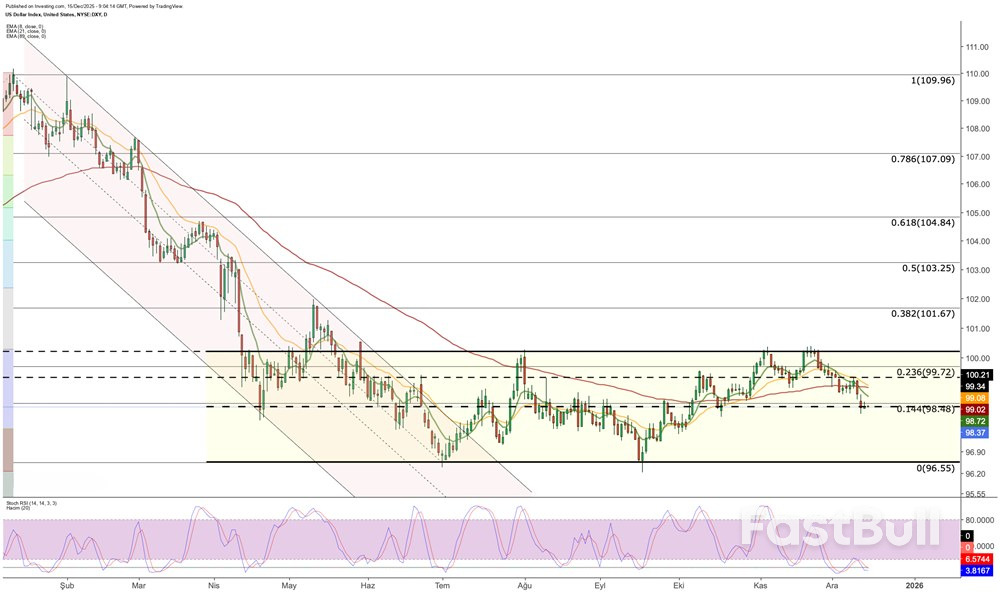
          The DXY chart shows that after a sharp fall in the first half of the year, the index has moved mostly sideways in the second half. The latest rebound stalled near 99.72, a key Fibonacci level, and then slipped back toward support around 98.48. In the short term, lower highs and fading momentum suggest that downward pressure is building.
          Short-term moving averages are clustered between 99 and 99.3. This area has become a strong resistance zone. Any bounce toward this range is likely to face selling unless the index can clearly move back above it. The way these averages are compressing and sloping lower also points to continued weakness in the near term.
          If we summarize the current levels for DXY;
          98.48 is the main short-term support. A daily close below this level could trigger stronger selling.
          If 98.48 breaks, the next downside level to watch is 96.55, which marks the base of the prior consolidation.
          99.72 is the first upside hurdle. Daily closes above this level are needed for a recovery to take shape.
          If 99.72 holds, the next major resistance level stands at 101.67.
          Momentum indicators show that the Stoch RSI has moved into oversold territory. This suggests a short-term bounce is possible. Still, this alone does not confirm a bottom. For a clearer signal, the price needs to hold above 98.48 and move back into the 99 to 99.3 zone.
          If upcoming US inflation or jobs data turns out weak, markets may believe the Fed has more room to ease policy. That would increase the risk of a break below 98.48. If this also comes alongside a more hawkish Bank of Japan and a stronger yen, any bounce in the DXY may stay limited to the 99 to 99.72 range.
          On the other hand, if US data comes in strong, yields rise again, and expectations for tighter policy in Japan ease, the DXY could see a healthier recovery. In that case, a move toward 99.72 and then 101.67 would be possible.
          The DXY is currently waiting for clues from surprises in US data and the interest rate gap between the US and Japan. Technically, a bounce is likely if 98.48 holds. If it breaks below that, the next target could be 96.55. The broader uptrend cannot be considered back until the index climbs above 99.72.

          Source: investing

          Risk Warnings and Disclaimers
          You understand and acknowledge that there is a high degree of risk involved in trading. Following any strategies or investment methods may lead to potential losses. The content on the site is provided by our contributors and analysts for information purposes only. You are solely responsible for determining whether any trading assets, securities, strategy, or any other product is suitable for investing based on your own investment objectives and financial situation.
          Add to Favorites
          Share

          EU Tightens Sanctions On Belarus After US Moves Woo Minsk

          Justin

          Economic

          The European Union expanded sanctions against Belarus, just days after the US said it would lift restrictions on exports of potash from the country, underscoring diverging approaches to the close ally of Russia.

          "If the Belarus regime doesn't change its behavior, we might be both at different speeds and at different directions with the US," Lithuanian Foreign Minister Kestutis Budrys said Monday in Brussels.

          The new EU sanctions on the regime of President Alexander Lukashenko target individuals seeking to undermine democratic institutions, economies or public infrastructure of the bloc and its member states, according to a statement.

          The European move comes amid a series of incursions by weather balloons which drifted into the airspace of Lithuania, a NATO and EU member state. The government of the Baltic nation called those incidents, which disrupted hundreds of flights, a deliberate provocation by neighboring Belarus.

          It also follows a visit by a US envoy to Minsk last week, leading Washington to announce it would lift sanctions on the country's potash industry. Hours later, Lukashenko released 123 political prisoners, pushing high-profile opponents into exile.

          It's another example of divisions in the Trans-Atlantic alliance over dealing with Russian President Vladimir Putin. US President Donald Trump has pushed to reset relations with Belarus, which was instrumental in abetting Russia's full-scale invasion of Ukraine.

          In contrast, many EU nations take a dim view of any moves to engage with Lukashenko, who has ruled Belarus since 1994 and imprisoned hundreds of dissidents. Lithuanian leaders have repeatedly said that the Belarusian leader is not an independent actor and seeks approval from Putin before taking any steps on reengaging with the West.

          Previous visits to Minsk by US envoys this year led to the release of other political dissidents, as well as the removal of some US sanctions on Belarusian state airline Belavia.

          Potash is one of Belarus's key exports and its only abundant mineral resource, with Belaruskali, Russia's Uralkali and North American producers Nutrien and Mosaic the four largest global suppliers. After the US sanctioned Belaruskali in 2021, Belarus redirected potash sales through Russia, increasing Lukashenko's economic dependence on the Kremlin.

          Source: Bloomberg Europe

          To stay updated on all economic events of today, please check out our Economic calendar
          Risk Warnings and Disclaimers
          You understand and acknowledge that there is a high degree of risk involved in trading. Following any strategies or investment methods may lead to potential losses. The content on the site is provided by our contributors and analysts for information purposes only. You are solely responsible for determining whether any trading assets, securities, strategy, or any other product is suitable for investing based on your own investment objectives and financial situation.
          Add to Favorites
          Share

          Gold: Bulls Are Still Swinging but the Ceiling Isn’t Giving Up Easily

          Adam

          Commodity

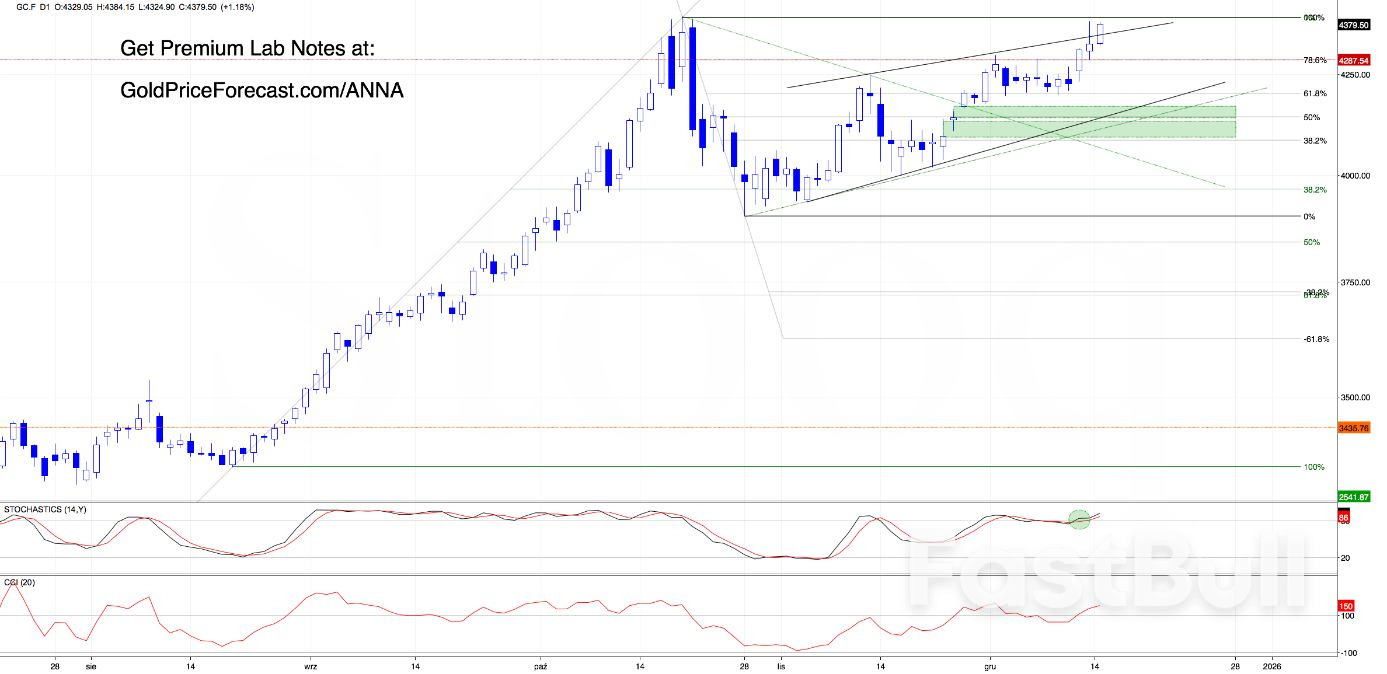
          With higher-timeframe resistance directly overhead, today is all about whether buyers can finally break through or whether we set up for another reset.

          Daily Chart: Rejection… but Not Defeat

          Gold: Bulls Are Still Swinging but the Ceiling Isn’t Giving Up Easily_1
          Even though bulls managed to break above the upper border of the black rising wedge, the proximity of the October highs, combined with two bearish engulfing patterns, proved too heavy on Friday. Price pulled back and closed the day (and the entire week) back inside the wedge.
          What does that mean?
          Momentum is there, but conviction isn’t yet strong enough to take out major resistance. The market hesitated, however, not reversed.
          But today, buyers refused to stay defensive. Gold climbed back above the wedge, signaling that another attempt to challenge the resistance zone is underway, which means Friday’s upside targets remain in play:
          If gold manages to hold above the upper border of the black rising wedge on the daily chart, the odds increase for an attack on October highs and potentially a new all-time high.
          From a target perspective:
          First target: upper border of the green rising channel on H4, currently crossing above 4400
          Second target: 4415 -> the 161.8% Fibonacci extension of the November 13-18 move
          Above that? The psychological 4500 level enters the conversation
          H4: Target Hit, Reaction Delivered
          Gold: Bulls Are Still Swinging but the Ceiling Isn’t Giving Up Easily_2
          As we wrote in the last Lab Note:
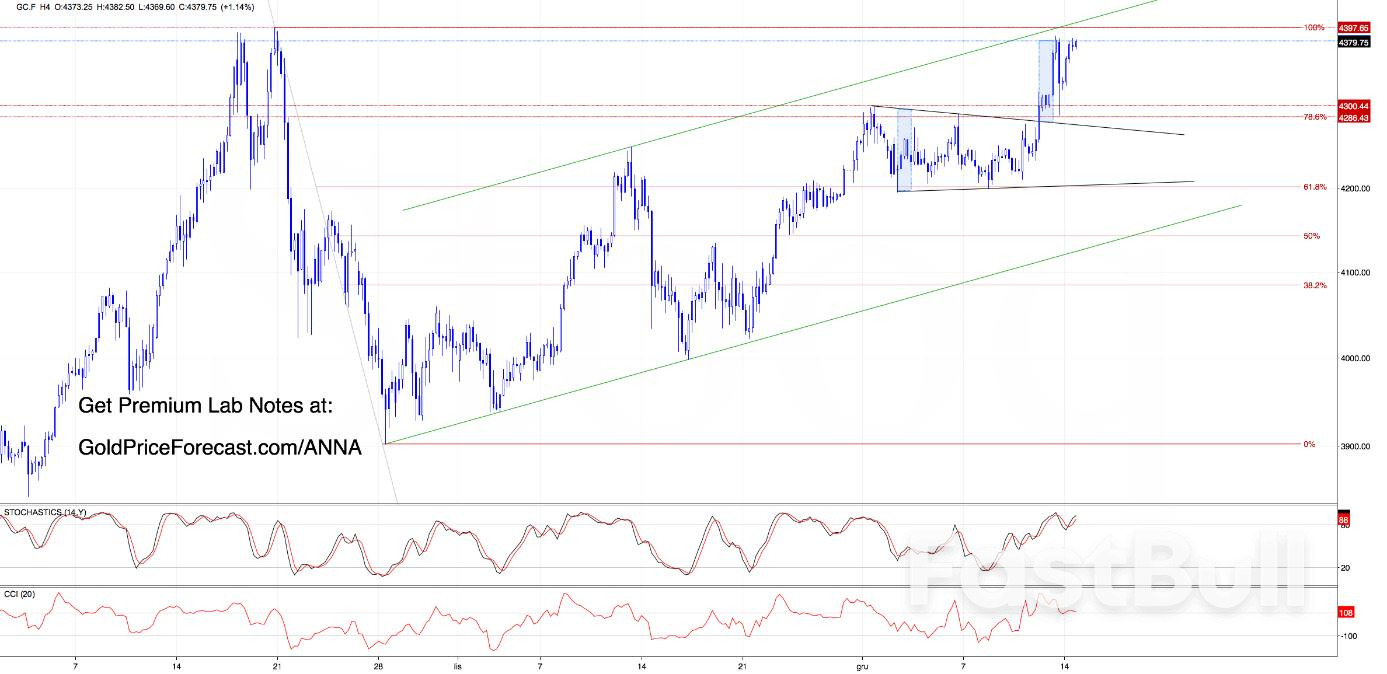
          “That breakout opened the door toward 4380, where the upside move equals the height of the triangle.”
          Not only did gold reach that level, but it also printed a daily high at 4387. Huge congratulations to traders who caught that move. Clean structure, clean breakout, clean follow-through. Exactly what we want to see.
          That rally, combined with the cluster of resistance discussed in the daily section, attracted sellers. The correction dragged gold back toward the December 5th high – the top of the double-bottom formation we mentioned on Thursday (Lab Note #38).
          Bulls stepped in again, and we’re now trading right back near Friday’s peak.
          Indicators remain overbought, but without any confirmed sell signals yet. In strong trends, overbought is a condition, not a command. The burden is still on sellers to prove themselves.
          Worth noting on H4:
          The upper boundary of the green rising channel now sits around 4406, making it the first area to watch closely if gold pushes through 4400.

          Lab Takeaway: What Matters Today

          Gold keeps coming back for another try, and that alone tells us plenty. This is not a market to short purely because it “feels extended,” but it’s also not a market to chase blindly into multi-layer resistance.
          Today’s job is simple:
          – let price show whether it can hold above the wedge– watch how buyers behave in the 4400-4406 area– respect momentum, but don’t ignore location:
          If bulls can absorb selling pressure above 4400, upside targets remain active
          If they can’t, the market will reset and give a cleaner opportunity later
          Patience here isn’t passive… it’s strategic.
          Stay sharp and let the daily candles speak.

          Source: fxempire

          Risk Warnings and Disclaimers
          You understand and acknowledge that there is a high degree of risk involved in trading. Following any strategies or investment methods may lead to potential losses. The content on the site is provided by our contributors and analysts for information purposes only. You are solely responsible for determining whether any trading assets, securities, strategy, or any other product is suitable for investing based on your own investment objectives and financial situation.
          Add to Favorites
          Share

          Commodity wrap: gold, silver rally while oil drops on oversupply and peace talk hopes

          Adam

          Commodity

          Gold prices were hovering below the $4,400-per-ounce mark as safe-haven buying increased, while the dollar slipped against major currencies.
          Silver prices on COMEX also rose more than 3% on Monday, with the metal shy of Friday’s record high.
          Meanwhile, oil prices were in the red as a potential peace deal between Russia and Ukraine weighed on sentiment.
          Gold climbs 1%
          The price of gold rose by 1% on Monday, settling near a seven-week peak as a weaker dollar, anticipation of interest rate reductions, and safe-haven investments fueled by current geopolitical instability buoyed the market.
          Gold priced in the greenback became more accessible to international purchasers as the dollar, which makes the precious metal more affordable for overseas buyers, remained near the two-month low it hit last week.
          Benchmark 10-year US Treasury yields also experienced a slight decline.
          Last week, the US Federal Reserve reduced its interest rate by 25 basis points, following a divided vote.
          Any additional easing of monetary policy will be contingent upon the future performance of the labour market and inflation levels.
          Markets are currently pricing in two US rate cuts next year, with investors eyeing this week’s US nonfarm payrolls report for further clues on monetary policy.
          “Gold demand looks likely to increase should the dollar come under further downside pressure,” said David Morrison, senior market analyst at Trade Nation.
          But gold could also turn lower should the dollar start to pick up again, particularly if the Dollar Index were to retest resistance around 100.00 on a cash basis.
          Meanwhile, silver’s price increased by 3.2%, reaching $63.955 per ounce.
          This follows a volatile session on Friday, where it hit a record high of $64.65 before dropping significantly by the close.
          Following a sharp retreat from fresh record highs on Friday, silver experienced a strong overnight rebound, surging approximately 2% and regaining its bullish momentum.
          “The price action highlights silver’s heightened sensitivity to positioning and sentiment, with sharp swings likely to persist after its recent explosive run,” Morrison said.
          Oil falls
          At the time of writing, the price of West Texas Intermediate crude oil was at $56.96 per barrel, down 0.5%, while Brent was at $60.87 per barrel, down 0.4%.
          A projected worldwide oil surplus in 2026 caused both contracts to drop over 4% last week.
          Venezuela’s oil exports have significantly declined following the US seizure of a tanker and the imposition of new sanctions on shipping companies and vessels involved in trade with the Latin American oil producer.
          The intensifying US pressure on President Nicolas Maduro, which includes reported plans by Reuters for America to intercept more ships carrying Venezuelan oil, is being closely monitored by the market for its potential impact on global oil supply.
          Talks between Ukrainian President Volodymyr Zelenskiy and US envoys in Berlin concluded after five hours on Sunday, with negotiations scheduled to resume on Monday.
          During the discussions, President Zelenskyy proposed abandoning Ukraine’s ambition to join the NATO military alliance.
          While US envoy Steve Witkoff stated that “a lot of progress was made,” no further details were released.
          A potential peace agreement resulting from these talks could lead to an increase in Russian oil supply, which is currently subject to sanctions by Western nations.
          According to JPMorgan Commodities Research in a Saturday note, oil surpluses are anticipated to broaden further through 2026 and 2027, following expected widening in 2025.
          This projection is based on global oil supply being forecast to increase at three times the rate of demand growth through 2026, thus outpacing it.
          “Oversupply fears continue to dominate the longer-term narrative while global demand growth continues to slow,” Morrison said.
          It’s worth pointing out that lower oil prices have the potential to wreck Russia’s economy.

          Source: invezz

          Risk Warnings and Disclaimers
          You understand and acknowledge that there is a high degree of risk involved in trading. Following any strategies or investment methods may lead to potential losses. The content on the site is provided by our contributors and analysts for information purposes only. You are solely responsible for determining whether any trading assets, securities, strategy, or any other product is suitable for investing based on your own investment objectives and financial situation.
          Add to Favorites
          Share

          President Trump Claims Inflation Is Neutralized

          Devin

          Economic

          President Trump Claims Inflation Is Neutralized

          On December 14, 2025, President Trump claimed that inflation is 'totally neutralized,' amid his administration's efforts to reduce inflation to an average of 2.7% during his second term.

          The claim highlights ongoing economic strategies, but lacks a direct correlation to cryptocurrency markets, although broader economic improvements can indirectly influence risk assets.

          President Donald Trump announced earlier today that inflation is "totally neutralized," according to a speech reported on December 14, 2025. Economic details in a recent White House statement show inflation has been reduced to 2.7% during his term. Donald J. Trump, President of the United States, remarked, "inflation has been cut by more than half" and is "working to bring it down further."

          Trump's statement was not directly attributed to any social media post. The White House article highlights Trump's economic strategy, mentioning spending cuts and tariff adjustments to tackle inflation challenges.

          The broader economic impact is significant, with wage growth approaching 4% and gas prices declining nationwide. These figures illustrate the potential benefits felt across various sectors and household budgets. Shelter inflation also reached a four-year low, according to White House data.

          Experts like Federal Reserve Governor Steven I. Miran recognize improved goods inflation prospects due to deregulation. In his Columbia University speech, Miran highlighted factors driving positive economic momentum, without directly addressing Trump's inflation neutralization claims.

          Current cryptocurrency markets have not shown any direct response to these announcements, with no on-chain data indicating shifts. Experts haven't linked changes in crypto assets such as ETH or BTC to inflation claims.

          The path forward for financial and regulatory outcomes may hinge on prolonged economic measures. Analysts believe inflation reductions could influence risk assets, though direct impacts on cryptocurrency remain speculative. Historical patterns and economic trends provide vital context for ongoing analysis.

          Source: CryptoSlate

          To stay updated on all economic events of today, please check out our Economic calendar
          Risk Warnings and Disclaimers
          You understand and acknowledge that there is a high degree of risk involved in trading. Following any strategies or investment methods may lead to potential losses. The content on the site is provided by our contributors and analysts for information purposes only. You are solely responsible for determining whether any trading assets, securities, strategy, or any other product is suitable for investing based on your own investment objectives and financial situation.
          Add to Favorites
          Share

          Market navigator: week of 15 December 2025

          Adam

          Economic

          What happened last week

          Third consecutive cut from Fed: The Federal Open Market Committee (FOMC) voted to reduce policy rates by 25 basis points (bps) with three dissenting voices. One member advocated for a 50bps reduction, while two voted to maintain rates unchanged. The dot plot median projection indicates only one cut next year as the committee anticipates improved growth prospects (from 1.8% to 2.4%) and inflation moderating more rapidly than expected. Risk assets rallied on enhanced policy clarity and resilient economy.
          China's deflation challenge persists: November's consumer price index (CPI) year-on-year (YoY) growth accelerated to 0.7% from October's 0.2%, driven by elevated food prices. However, producer price index (PPI) contracted for the 38th consecutive month, deepening to 2.2% YoY from 2.1% in October, indicating persistent deflation amid intense price competition and subdued domestic demand.
          Chinese policy priorities emerge: The Politburo designated domestic demand as the paramount priority for 2026, reducing dependence on exports. Monetary and fiscal policies will remain 'moderately loose' and 'proactive', though policy wordings suggest stimulus will not exceed this year's levels. Addressing involution represents another priority.
          RBA stays put: Australia's easing cycle may be coming to an end as the Reserve Bank of Australia (RBA) holds for the third consecutive meeting amid elevated inflation. While the new monthly CPI data series might have exaggerated the situation, the RBA believes there is an upside risk to inflation. The board did not consider rate cuts, instead focusing on factors that would warrant increases next year.

          Markets in focus

          AI bubble concerns drive US equity volatility
          The S&P 500 and Dow Jones indices established fresh all-time highs last Thursday following the Federal Reserve's (Fed) rate decision, before retreating on Friday amid renewed concerns over artificial intelligence (AI) sector valuations. The Nasdaq 100 bore the brunt of the selloff, declining 1.9% for the week, while the S&P 500 retreated 1.1%. The Dow Jones demonstrated relative resilience, advancing 1.0%.
          Oracle's fiscal second quarter results catalysed the latest wave of AI stock selling pressure. The AI cloud infrastructure provider missed revenue expectations and failed to alleviate investor concerns regarding its mounting debt burden. Capital expenditure projections for fiscal year 2026 surged 40% to $50 billion, triggering a 13% weekly decline in Oracle's share price. Broadcom encountered similar headwinds despite exceeding top and bottom-line expectations. Insufficient clarity regarding order backlog combined with warnings of gross margin compression prompted investors to liquidate positions, driving an 11% decline following a 75% year-to-date rally preceding quarterly results.
          Conversely, Warner Bros Discovery shares surged 15% after Paramount Sykdance submitted a $108.4 billion acquisition proposal, following Netflix's $83 billion merger agreement.
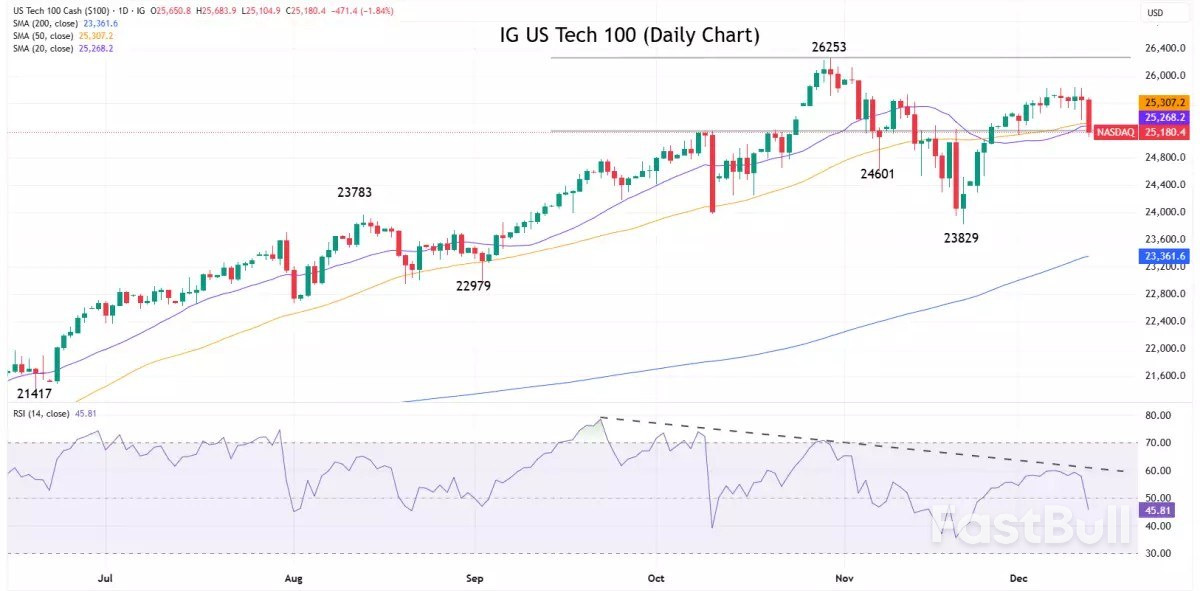
          Despite record highs across other major US indices, the US Tech 100 index continues to exhibit subdued momentum, evidenced by a descending relative strength index (RSI) trajectory. The benchmark currently trades at support established by prior resistance near 25,200. A rebound from this level would signal near-term bullish momentum towards 26,253, while failure to hold support could prompt testing of the next level near 24,250.
          Figure 1: US Tech 100 index (daily) price chart

          Market navigator: week of 15 December 2025_1as of 14 December 2025. Past performance is not a reliable indicator of future performance.

          Hang Seng Index trades sideways
          The Hang Seng Index (HSI) maintained a sideways trajectory, delivering a modest decline of 0.4% last week. Trading volume on the Hong Kong Exchange main board continued to remain subdued despite enhanced clarity on 2026 global economic prospects from the FOMC. Investors continued to realise profits as the year draws to a close. Southbound net flows turned negative last week, a development not observed for at least six months.
          The FOMC's hawkish cut is generally supportive of global banking stocks performance. HSBC Holdings was the best performing Hang Seng Index constituent, surging 6% to a 17-year high last week. Meanwhile, Chinese insurers are benefiting from a steepening Chinese government bond yield curve and a structural transformation in society, as Chinese households diversify their deposit and investment allocation beyond traditional banking channels. Ping An Insurance was a notable outperforming stock last week, delivering 5% in returns.
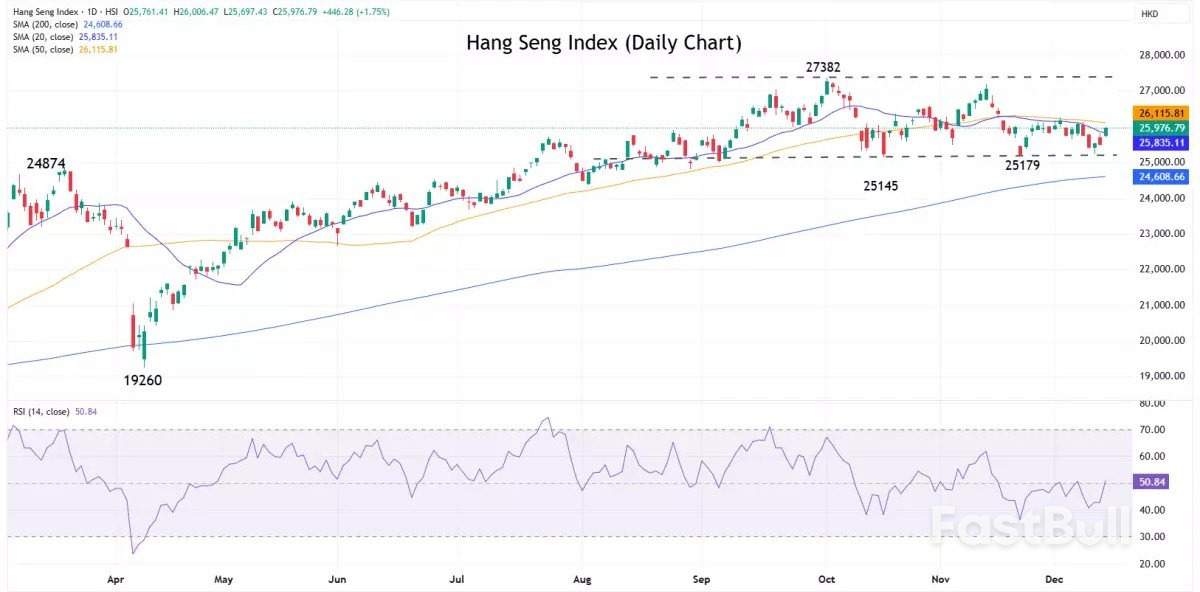
          The 20-day moving average (MA) on the HSI daily chart continued to trend downward after failing to form a golden cross with the 50-day MA in mid-November, revealing sluggish momentum. The index appears positioned to trade within the 25,150 to 27,400 range in the near term. The short-term moving averages will likely present resistance around 26,100 while November's low establishes support near 25,180.
          Figure 2: Hang Seng Index (daily) price chart

          Market navigator: week of 15 December 2025_2as of 14 December 2025. Past performance is not a reliable indicator of future performance.

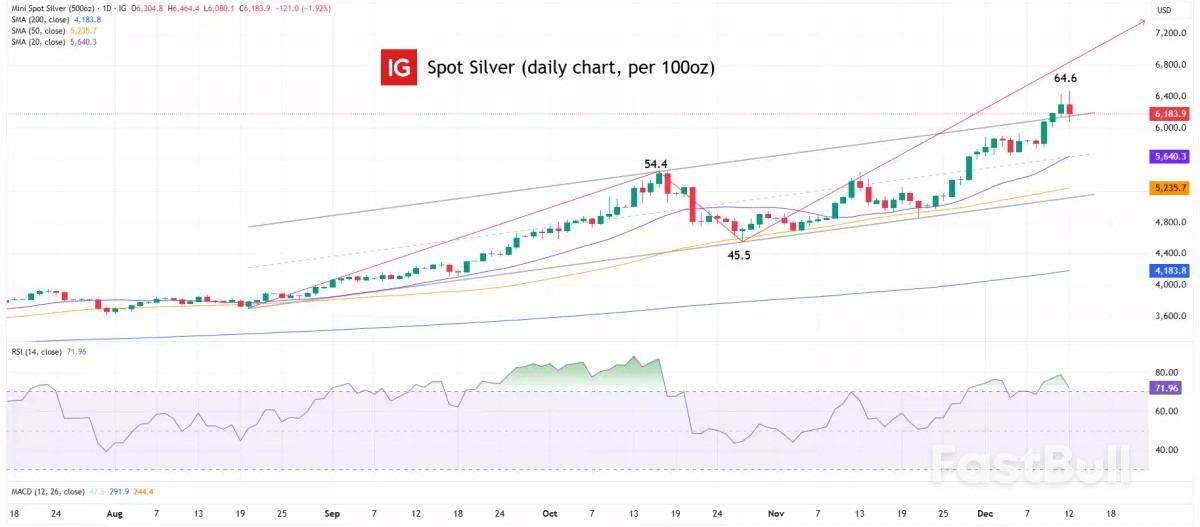
          Silver price breaks record high
          Silver surged to a historic record above $64 per ounce last week, marking an extraordinary breakout that has captured renewed attention from both institutional and retail investors. Year-to-date, the white metal has delivered 115% in returns, significantly outpacing gold's performance, demonstrating its higher volatility characteristic and amplifying the precious metals rally.
          Multiple forces have converged to drive silver's exponential surge. The prospect of the Fed's loosening monetary policy following softer US economic data has weakened the dollar and compressed real yields, creating favourable conditions for non-yielding assets. Traditional safe-haven demand amid geopolitical uncertainties was also a key supporting factor of precious metal demand this year. Additionally, industrial consumption remains robust. Silver's unmatched conductivity makes it indispensable for solar panel production, electric vehicle components and AI infrastructure build-out. These overlapping industrial trends have created sustained demand that supply has struggled to match.
          The technical picture reveals strong bullish momentum, with spot silver prices surging above the upper boundary of the ascending channel since mid-August. However, RSI readings suggest overbought conditions, indicating potential near-term consolidation before the uptrend resumes. 4 December's low at $56.4 should provide immediate support for any pullback, while a 161.8% Fibonacci extension of the upward move from 20 August to 16 October provides a medium-term target of $73.6.
          Figure 3: Spot silver (daily) price chart

          Market navigator: week of 15 December 2025_3as of 14 December 2025. Past performance is not a reliable indicator of future performance.

          The week ahead

          China's economic momentum takes centre stage Monday with industrial production, housing prices, retail sales and fixed asset investment figures for November. Markets anticipate industrial production growth to accelerate to 5% YoY from 4.9%, while retail sales are expected to hold at 2.9%. These releases assume heightened significance following November's CPI report, with investors seeking confirmation that China's recovery from deflationary pressures represents a sustainable trend. Stronger-than-expected readings would validate recent equity market optimism, while disappointment could ignite concerns about Beijing's stance of refraining from ramping up stimulus measures.
          November's US labour market data arrives Tuesday with the non-farm payrolls report subdued following September's modest 119,000 gain. Markets expect the unemployment rate to hold at 4.4%. Thursday's November year-on-year inflation data is anticipated to remain roughly at current levels. These releases will influence the Fed's trajectory for 2026 and determine whether there will be a prolonged pause in the cutting cycle.
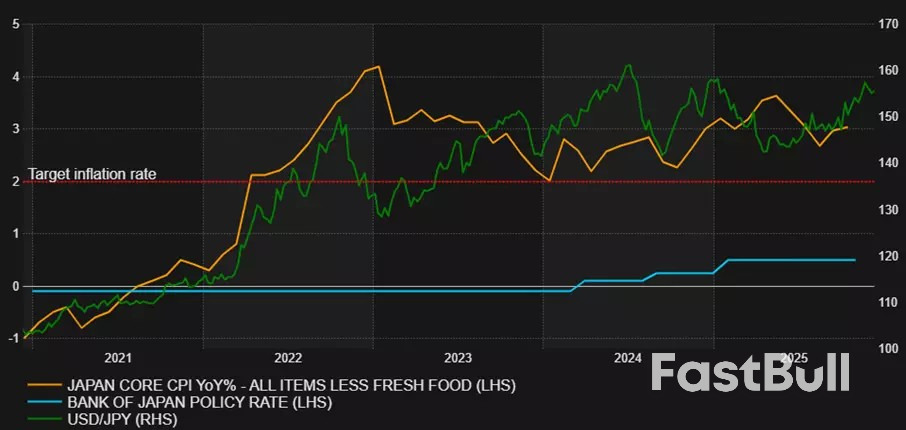
          Central bank meetings dominate the second half of the week, with the European Central Bank (ECB), Bank of England (BOE) and Bank of Japan (BOJ) all convening. The ECB is widely expected to keep its deposit facility rate at 2% on Thursday, while the BOE is likely to deliver a quarter-point cut to 3.75% unless Wednesday's inflation reading complicates matters. The BOJ's Friday decision commands particular attention. Markets are pricing in nearly 80% probability of a rate increase from 0.5% to 0.75%, marking the central bank's first move since January. The recent hawkish pivot partly reflects concerns over yen weakness, with USD/JPY almost reaching 158. Should Governor Ueda signal additional tightening ahead, the currency pair could retreat towards 154 levels, though this would likely pressure Japanese equities. The path forward remains highly uncertain, with BOJ communication critical for market positioning.
          Figure 4: Yen volatility and inflation pressure strengthens case for BOJ hike
          Market navigator: week of 15 December 2025_4

          Source: ig

          To stay updated on all economic events of today, please check out our Economic calendar
          Risk Warnings and Disclaimers
          You understand and acknowledge that there is a high degree of risk involved in trading. Following any strategies or investment methods may lead to potential losses. The content on the site is provided by our contributors and analysts for information purposes only. You are solely responsible for determining whether any trading assets, securities, strategy, or any other product is suitable for investing based on your own investment objectives and financial situation.
          Add to Favorites
          Share

          Mexico Sees Small Inflation Impact From Tariffs On Chinese Goods

          Daniel Carter

          Economic

          Mexico's government calculates that new tariffs on Asian goods will only impact inflation by 0.2 percentage points and won't significantly affect prices of cars imported from nations like China.
          Economy Minister Marcelo Ebrard provided the inflation estimate at a government press conference on Monday, adding that the tariffs are needed to protect some 350,000 jobs concentrated in Mexico's automotive, textile and metals sectors. They should only affect about 8% of the Latin American country's total trade, he added.
          President Claudia Sheinbaum's ruling party last week muscled through the new import duties in a break from years of favoring free trade policies, broadly matching the approach championed by the US, by far Mexico's top trading partner.
          Speaking at Sheinbaum's regular morning press conference, Ebrard stressed that the levies will reduce Mexico's lopsided trade deficit with Asian economies.
          "We import 10 times what we export to Asia," he said.
          After three months of often heated debate, lawmakers approved the tariffs on goods from Asian countries that don't have in place a trade deal with Mexico, including China, South Korea and India. The bill will impose tariffs of between 5% and 50% on more than 1,400 categories of products beginning in January.
          For her part, Sheinbaum insisted that the tariff policy is country-neutral.
          "We are taking measures that are not directed against any country, but rather aim to prevent further job losses," she said, pointing out that the levies should add around 30 billion pesos ($ 1.7 billion) per year to state coffers.
          Opponents of the measure, including from Sheinbaum's Morena party, expressed fears for inflation as well as a possible impact on trade relations with China, the world's second-biggest economy.
          Ebrard noted that private sector lobbying achieved changes to the original plan, including relaxing some levies on hard-to-substitute auto parts as well as selected steel and aluminum products.

          Source: Bloomberg Europe

          To stay updated on all economic events of today, please check out our Economic calendar
          Risk Warnings and Disclaimers
          You understand and acknowledge that there is a high degree of risk involved in trading. Following any strategies or investment methods may lead to potential losses. The content on the site is provided by our contributors and analysts for information purposes only. You are solely responsible for determining whether any trading assets, securities, strategy, or any other product is suitable for investing based on your own investment objectives and financial situation.
          Add to Favorites
          Share
          FastBull
          Copyright © 2025 FastBull Ltd

          728 RM B 7/F GEE LOK IND BLDG NO 34 HUNG TO RD KWUN TONG KLN HONG KONG

          TelegramInstagramTwitterfacebooklinkedin
          App Store Google Play Google Play
          Products
          Charts

          Chats

          Q&A with Experts
          Screeners
          Economic Calendar
          Data
          Tools
          Membership
          Features
          Function
          Markets
          Copy Trading
          Latest Signals
          Contests
          News
          Analysis
          24/7
          Columns
          Education
          Company
          Careers
          About Us
          Contact Us
          Advertising
          Help Center
          Feedback
          User Agreement
          Privacy Policy
          Business

          White Label

          Data API

          Web Plug-ins

          Poster Maker

          Affiliate Program

          Risk Disclosure

          The risk of loss in trading financial instruments such as stocks, FX, commodities, futures, bonds, ETFs and crypto can be substantial. You may sustain a total loss of the funds that you deposit with your broker. Therefore, you should carefully consider whether such trading is suitable for you in light of your circumstances and financial resources.

          No decision to invest should be made without thoroughly conducting due diligence by yourself or consulting with your financial advisors. Our web content might not suit you since we don't know your financial conditions and investment needs. Our financial information might have latency or contain inaccuracy, so you should be fully responsible for any of your trading and investment decisions. The company will not be responsible for your capital loss.

          Without getting permission from the website, you are not allowed to copy the website's graphics, texts, or trademarks. Intellectual property rights in the content or data incorporated into this website belong to its providers and exchange merchants.

          Not Logged In

          Log in to access more features

          FastBull Membership

          Not yet

          Purchase

          Become a signal provider
          Help Center
          Customer Service
          Dark Mode
          Price Up/Down Colors

          Log In

          Sign Up

          Position
          Layout
          Fullscreen
          Default to Chart
          The chart page opens by default when you visit fastbull.com