• Trade
  • Markets
  • Copy
  • Contests
  • News
  • 24/7
  • Calendar
  • Q&A
  • Chats
Trending
Screeners
SYMBOL
LAST
BID
ASK
HIGH
LOW
NET CHG.
%CHG.
SPREAD
SPX
S&P 500 Index
6827.42
6827.42
6827.42
6899.86
6801.80
-73.58
-1.07%
--
DJI
Dow Jones Industrial Average
48458.04
48458.04
48458.04
48886.86
48334.10
-245.98
-0.51%
--
IXIC
NASDAQ Composite Index
23195.16
23195.16
23195.16
23554.89
23094.51
-398.69
-1.69%
--
USDX
US Dollar Index
97.950
98.030
97.950
98.500
97.950
-0.370
-0.38%
--
EURUSD
Euro / US Dollar
1.17394
1.17409
1.17394
1.17496
1.17192
+0.00011
+ 0.01%
--
GBPUSD
Pound Sterling / US Dollar
1.33707
1.33732
1.33707
1.33997
1.33419
-0.00148
-0.11%
--
XAUUSD
Gold / US Dollar
4299.39
4299.39
4299.39
4353.41
4257.10
+20.10
+ 0.47%
--
WTI
Light Sweet Crude Oil
57.233
57.485
57.233
58.011
56.969
-0.408
-0.71%
--

Community Accounts

Signal Accounts
--
Profit Accounts
--
Loss Accounts
--
View More

Become a signal provider

Sell trading signals to earn additional income

View More

Guide to Copy Trading

Get started with ease and confidence

View More

Signal Accounts for Members

All Signal Accounts

Best Return
  • Best Return
  • Best P/L
  • Best MDD
Past 1W
  • Past 1W
  • Past 1M
  • Past 1Y

All Contests

  • All
  • Trump Updates
  • Recommend
  • Stocks
  • Cryptocurrencies
  • Central Banks
  • Featured News
Top News Only
Share

US Envoy Witkoff Says A Lot Of Progress Was Made At Berlin Talks On Russia/Ukraine War

Share

Syria's President Sharaa Sends Condolences To Trump Over Killing Of USA Soldiers In Syria - Syrian Presidency

Share

ECOWAS Commission President: ECOWAS Rejects Guinea-Bissau Junta Transition Plan, Demands Return To Constitutional Order

Share

On Sunday (December 14), The Bangladesh DSE Broad Index Closed Down 0.62% At 4932.97 Points

Share

US President Trump: A New Federal Reserve Chairman Will Be Chosen Soon

Share

US President Trump: Inflation Is “completely Offset” And You Don’t Want To See Deflation

Share

Trump: Will Be A Lot Of Damage Done To The People That Attacked Troops In Syria

Share

Trump: Terrible Attack In Bondi Beach

Share

Interior Ministry - Syria Arrests Five Suspects In Shooting Of USA And Syrian Troops In Palmyra

Share

France Says Conditions For EU Vote On MERCOSUR Deal Not Yet Met, Despite Recent Progress — Prime Minister's Office

Share

CEO: Tokyo Gas To Steer More Than Half Of Overseas Investments To US In Next 3 Years

Share

In The Past 24 Hours, The Marketvector Digital Asset 100 Small Cap Index Fell By 2.63%, Holding Steady Near The Daily Low Of 3868.93 Points Refreshed At 23:32 Beijing Time, And Has Continued To Fluctuate Downwards Since 12:00

Share

White House National Economic Council Director Kevin Hassett: Economic Data Indicates That The U.S. CPI Is Moving Toward The Federal Reserve's 2% Target

Share

Hamas Says Israel's Killing Of Senior Commander Threatens Ceasefire

Share

Source: Germany's Merz Greets Zelenskiy, Umerov, Kushner, Witkoff At Chancellery In Berlin

Share

[Over 20 Automakers, Including Jike, Xiaomi, And Wenjie, Announce Purchase Tax Guarantee, Saving Up To 15,000 Yuan] Starting January 1, 2026, The Purchase Tax For New Energy Vehicles Will Be Reduced From Full Exemption To A 50% Reduction. Currently, The Vehicle Purchase Tax Is 10%, And The 50% Reduction For New Energy Vehicles Means An Effective Tax Rate Of 5%. The Tax Exemption Cap Will Also Decrease From 30,000 Yuan To 15,000 Yuan. Faced With The Certain Increase In Costs And Uncertain Subsidy Details, The Market Has Proactively "jumped The Gun." Over 20 Automakers, Including Jike, Xiaomi, And Wenjie, Have Launched "purchase Tax Guarantee" Policies, Promising To Make Up The Tax Difference For Customers Who Place Orders Before The End Of The Year And Have Them Delivered Next Year, With A Maximum Amount Of 15,000 Yuan

Share

South Korea Imports 10.8 Million T Of Crude In November Versus 11.3 Million T Year Ago

Share

Qatar's Al Mana Holding Launches $200 Million Project To Produce Sustainable Aviation Fuel In Egypt's Ain Sokhna - Egypt Statement

Share

Israeli Foreign Ministry: One Israeli Citizen Among Dead In Australia Shooting Attack

Share

Israeli Prime Minister Netanyahu: He Warned Australia Prime Minister About Antisemitism

TIME
ACT
FCST
PREV
U.K. Trade Balance (Oct)

A:--

F: --

P: --

U.K. Services Index MoM

A:--

F: --

P: --

U.K. Construction Output MoM (SA) (Oct)

A:--

F: --

P: --

U.K. Industrial Output YoY (Oct)

A:--

F: --

P: --

U.K. Trade Balance (SA) (Oct)

A:--

F: --

P: --

U.K. Trade Balance EU (SA) (Oct)

A:--

F: --

P: --

U.K. Manufacturing Output YoY (Oct)

A:--

F: --

P: --

U.K. GDP MoM (Oct)

A:--

F: --

P: --

U.K. GDP YoY (SA) (Oct)

A:--

F: --

P: --

U.K. Industrial Output MoM (Oct)

A:--

F: --

P: --

U.K. Construction Output YoY (Oct)

A:--

F: --

P: --

France HICP Final MoM (Nov)

A:--

F: --

P: --

China, Mainland Outstanding Loans Growth YoY (Nov)

A:--

F: --

P: --

China, Mainland M2 Money Supply YoY (Nov)

A:--

F: --

P: --

China, Mainland M0 Money Supply YoY (Nov)

A:--

F: --

P: --

China, Mainland M1 Money Supply YoY (Nov)

A:--

F: --

P: --

India CPI YoY (Nov)

A:--

F: --

P: --

India Deposit Gowth YoY

A:--

F: --

P: --

Brazil Services Growth YoY (Oct)

A:--

F: --

P: --

Mexico Industrial Output YoY (Oct)

A:--

F: --

P: --

Russia Trade Balance (Oct)

A:--

F: --

P: --

Philadelphia Fed President Henry Paulson delivers a speech
Canada Building Permits MoM (SA) (Oct)

A:--

F: --

P: --

Canada Wholesale Sales YoY (Oct)

A:--

F: --

P: --

Canada Wholesale Inventory MoM (Oct)

A:--

F: --

P: --

Canada Wholesale Inventory YoY (Oct)

A:--

F: --

P: --

Canada Wholesale Sales MoM (SA) (Oct)

A:--

F: --

P: --

Germany Current Account (Not SA) (Oct)

A:--

F: --

P: --

U.S. Weekly Total Rig Count

A:--

F: --

P: --

U.S. Weekly Total Oil Rig Count

A:--

F: --

P: --

Japan Tankan Large Non-Manufacturing Diffusion Index (Q4)

--

F: --

P: --

Japan Tankan Small Manufacturing Outlook Index (Q4)

--

F: --

P: --

Japan Tankan Large Non-Manufacturing Outlook Index (Q4)

--

F: --

P: --

Japan Tankan Large Manufacturing Outlook Index (Q4)

--

F: --

P: --

Japan Tankan Small Manufacturing Diffusion Index (Q4)

--

F: --

P: --

Japan Tankan Large Manufacturing Diffusion Index (Q4)

--

F: --

P: --

Japan Tankan Large-Enterprise Capital Expenditure YoY (Q4)

--

F: --

P: --

U.K. Rightmove House Price Index YoY (Dec)

--

F: --

P: --

China, Mainland Industrial Output YoY (YTD) (Nov)

--

F: --

P: --

China, Mainland Urban Area Unemployment Rate (Nov)

--

F: --

P: --

Saudi Arabia CPI YoY (Nov)

--

F: --

P: --

Euro Zone Industrial Output YoY (Oct)

--

F: --

P: --

Euro Zone Industrial Output MoM (Oct)

--

F: --

P: --

Canada Existing Home Sales MoM (Nov)

--

F: --

P: --

Euro Zone Total Reserve Assets (Nov)

--

F: --

P: --

U.K. Inflation Rate Expectations

--

F: --

P: --

Canada National Economic Confidence Index

--

F: --

P: --

Canada New Housing Starts (Nov)

--

F: --

P: --

U.S. NY Fed Manufacturing Employment Index (Dec)

--

F: --

P: --

U.S. NY Fed Manufacturing Index (Dec)

--

F: --

P: --

Canada Core CPI YoY (Nov)

--

F: --

P: --

Canada Manufacturing Unfilled Orders MoM (Oct)

--

F: --

P: --

Canada Manufacturing New Orders MoM (Oct)

--

F: --

P: --

Canada Core CPI MoM (Nov)

--

F: --

P: --

Canada Manufacturing Inventory MoM (Oct)

--

F: --

P: --

Canada CPI YoY (Nov)

--

F: --

P: --

Canada CPI MoM (Nov)

--

F: --

P: --

Canada CPI YoY (SA) (Nov)

--

F: --

P: --

Canada Core CPI MoM (SA) (Nov)

--

F: --

P: --

Canada CPI MoM (SA) (Nov)

--

F: --

P: --

Q&A with Experts
    • All
    • Chatrooms
    • Groups
    • Friends
    Connecting
    .
    .
    .
    Type here...
    Add Symbol or Code

      No matching data

      All
      Trump Updates
      Recommend
      Stocks
      Cryptocurrencies
      Central Banks
      Featured News
      • All
      • Russia-Ukraine Conflict
      • Middle East Flashpoint
      • All
      • Russia-Ukraine Conflict
      • Middle East Flashpoint
      Search
      Products

      Charts Free Forever

      Chats Q&A with Experts
      Screeners Economic Calendar Data Tools
      Membership Features
      Data Warehouse Market Trends Institutional Data Policy Rates Macro

      Market Trends

      Market Sentiment Order Book Forex Correlations

      Top Indicators

      Charts Free Forever
      Markets

      News

      News Analysis 24/7 Columns Education
      From Institutions From Analysts
      Topics Columnists

      Latest Views

      Latest Views

      Trending Topics

      Top Columnists

      Latest Update

      Signals

      Copy Rankings Latest Signals Become a signal provider AI Rating
      Contests
      Brokers

      Overview Brokers Assessment Rankings Regulators News Claims
      Broker listing Forex Brokers Comparison Tool Live Spread Comparison Scam
      Q&A Complaint Scam Alert Videos Tips to Detect Scam
      More

      Business
      Events
      Careers About Us Advertising Help Center

      White Label

      Data API

      Web Plug-ins

      Affiliate Program

      Awards Institution Evaluation IB Seminar Salon Event Exhibition
      Vietnam Thailand Singapore Dubai
      Fans Party Investment Sharing Session
      FastBull Summit BrokersView Expo
      Recent Searches
        Top Searches
          Markets
          News
          Analysis
          User
          24/7
          Economic Calendar
          Education
          Data
          • Names
          • Latest
          • Prev

          View All

          No data

          Scan to Download

          Faster Charts, Chat Faster!

          Download App
          English
          • English
          • Español
          • العربية
          • Bahasa Indonesia
          • Bahasa Melayu
          • Tiếng Việt
          • ภาษาไทย
          • Français
          • Italiano
          • Türkçe
          • Русский язык
          • 简中
          • 繁中
          Open Account
          Search
          Products
          Charts Free Forever
          Markets
          News
          Signals

          Copy Rankings Latest Signals Become a signal provider AI Rating
          Contests
          Brokers

          Overview Brokers Assessment Rankings Regulators News Claims
          Broker listing Forex Brokers Comparison Tool Live Spread Comparison Scam
          Q&A Complaint Scam Alert Videos Tips to Detect Scam
          More

          Business
          Events
          Careers About Us Advertising Help Center

          White Label

          Data API

          Web Plug-ins

          Affiliate Program

          Awards Institution Evaluation IB Seminar Salon Event Exhibition
          Vietnam Thailand Singapore Dubai
          Fans Party Investment Sharing Session
          FastBull Summit BrokersView Expo

          US Consumer Prices Increase As Expected In June

          Thomas

          Economic

          Summary:

          U.S. consumer prices picked up in June, likely marking the start of a long-anticipated tariff-induced increase in inflation that has kept the Federal Reserve cautious about resuming its interest rate cuts.

          U.S. consumer prices picked up in June, likely marking the start of a long-anticipated tariff-induced increase in inflation that has kept the Federal Reserve cautious about resuming its interest rate cuts.

          The Consumer Price Index increased 0.3% last month after edging up 0.1% in May, the Labor Department's Bureau of Labor Statistics said on Tuesday. That was the largest gain since January. In the 12 months through June, the CPI advanced 2.7% after rising 2.4% in May.

          Economists polled Reuters had forecast the CPI would climb 0.3% and increase 2.6% on a year-over-year basis.

          Inflation readings came in on the low side in February through May, leading to demands by President Donald Trump for the U.S. central bank to lower borrowing costs. Economists said inflation has been slow to respond to the sweeping import duties Trump announced in April because businesses were still selling stock accumulated before the tariffs came into effect.

          Trump last week announced higher tariffs would come into effect on August 1 for imports from a range of countries, including Mexico, Japan, Canada and Brazil, and the European Union effective August 1, raising the effective tariffs rate. Economists expect higher goods prices to prevail through the summer.

          Excluding the volatile food and energy components, the CPI rose 0.2% in June after edging up 0.1% in the prior month. In the 12 months through June, core CPI inflation increased 2.9% after rising 2.8% for three straight months.

          Strong price increases for goods, however, could be somewhat offset by moderate rises in services costs, and ease concerns of a broad-based rise in inflationary pressures. Soft demand has limited price increases for services-related categories like air fares as well as hotel and motel rooms.

          The Fed tracks different inflation measures for its 2% target. The central bank is expected to leave its benchmark overnight interest rate in the 4.25%-4.50% range at a policy meeting later this month. Minutes of the central bank's June 17-18 meeting, which were published last week, showed only "a couple" of officials said they felt rates could fall as soon as the July 29-30 meeting.

          Goldman Sachs is forecasting monthly core CPI inflation increases of between 0.3%-0.4% over the next few months, reflecting tariff-related increases in the prices of consumer electronics, autos and apparel. The investment bank expects limited near-term impact on core services inflation.

          Source: Reuters

          To stay updated on all economic events of today, please check out our Economic calendar
          Risk Warnings and Disclaimers
          You understand and acknowledge that there is a high degree of risk involved in trading. Following any strategies or investment methods may lead to potential losses. The content on the site is provided by our contributors and analysts for information purposes only. You are solely responsible for determining whether any trading assets, securities, strategy, or any other product is suitable for investing based on your own investment objectives and financial situation.
          Add to Favorites
          Share

          Canada Inflation Quickens; Core Measures Increase To Above 3%

          Damon

          Economic

          Canadian consumer prices accelerated for the first time in four months and underlying price pressures firmed, likely keeping the central bank from cutting interest rates later this month.

          The consumer price index rose at a 1.9% yearly pace in June, accelerating from 1.7% in May, Statistics Canada data showed Tuesday. On a monthly basis, the index edged up 0.1%. Both figures matched the median projections in a Bloomberg survey of economists.

          Headline inflation rose at a faster pace because gasoline prices fell to a lesser extent in June, while passenger cars and furniture saw tariff-driven price increases on the month. Excluding energy, the index was up 2.7% from last year.

          The Bank of Canada’s two preferred core inflation measures accelerated slightly, averaging 3.05%, up from 3% in May, and above economists’ median projection. The three-month moving annualized average of the core rates surged to 3.39%, from 3.01% previously.

          There’s also another important sign of firmer price pressures: The share of components in the consumer price index basket that are rising by 3% or more — another key metric the central bank’s policymakers are watching closely — expanded to 39.1%, from 37.3% in May.

          Governor Tiff Macklem and Bank of Canada officials kept policy rate at 2.75% for the past two meetings, citing concerns over firmer core inflation and uncertainty around US trade policy. They’re trying to assess how tariff-driven prices and a slowing economy would interact and shape inflation path ahead.

          In June, the economy added over 83,000 jobs and the unemployment rate eased to 6.9%, suggesting the broader job market is holding up well in the face of mounting trade uncertainty.

          US President Donald Trump’s new round of tariff threats against trading partners, including a new 35% rate for Canada, injected new uncertainty to the outlook. Combined with firm core inflation pressures and surprisingly robust jobs data, the Bank of Canada is likely to the sidelines again on July 30.

          In June, trade and tariff uncertainties appeared to already drive up prices as businesses facing higher costs passed down those increases to consumers. Prices for durable goods grew 2.7%, up from 2%.

          Passenger vehicle prices rose 4.1% from a year ago in June, compared with May’s 3.2% increase. Tighter inventories also led to a 1.7% spike in prices for used cars, which was the first year-over-year increase in 18 months.

          Furniture prices soared 3.3%, a much faster pace than 0.1% in May, while prices for clothing and footwear rose 2%, up from 0.5%.

          Canadians continue to pay less at the pump, however, with prices dropping 13.4% in June. They’re also seeing slower price gains for food purchased from stores, which rose 2.8% from a year ago, following a 3.3% increase in May. The deceleration was largely a result of lower prices for onions and cucumbers.

          Out of 10 Canadian provinces, eight saw prices rising at a faster year-over-year pace in June compared with May. Only British Columbia experienced a slower pace of price growth, and the inflation rate in Alberta wasn’t changed.

          Source: Bloomberg Europe

          To stay updated on all economic events of today, please check out our Economic calendar
          Risk Warnings and Disclaimers
          You understand and acknowledge that there is a high degree of risk involved in trading. Following any strategies or investment methods may lead to potential losses. The content on the site is provided by our contributors and analysts for information purposes only. You are solely responsible for determining whether any trading assets, securities, strategy, or any other product is suitable for investing based on your own investment objectives and financial situation.
          Add to Favorites
          Share

          U.S. stock futures mostly higher; CPI, bank earnings awaited

          Adam

          Stocks

          stock index futures traded mostly higher Tuesday, with investors awaiting the release of major bank earnings as well key consumer inflation data.
          At 05:30 ET (09:30 GMT), Dow Jones Futures fell 30 points, or 0.1%, while S&P 500 Futures rose 24 points, or 0.4%, and Nasdaq 100 Futures gained 140 points, or 0.6%.
          The main averages on Wall Street ticked up in the prior session, as a slate of artificial intelligence-related headlines helped to soothe worries over fresh U.S. threats of punishing tariffs on Europe and Mexico.

          Banks lead second-quarter earnings season

          The attention of investors is set Tuesday to shift from U.S. President Donald Trump’s various uttering on trade to Wall Street, where a host of big U.S. lenders are expected to report before the opening bell.
          These quarterly reports could provide a glimpse into how companies see returns evolving in the coming months against a backdrop of rising international trade tensions.
          Banking giants JPMorgan Chase (NYSE:JPM), Wells Fargo (NYSE:WFC), Citigroup (NYSE:C) and Bank of New York Mellon (NYSE:BK) will report their second quarter earnings later in the session, while Bank of America (NYSE:BAC) and Goldman Sachs (NYSE:GS) will report on Wednesday.
          Other Wall Street majors, including Microsoft (NASDAQ:MSFT), BlackRock (NYSE:BLK), Johnson & Johnson (NYSE:JNJ), United Airlines (NASDAQ:UAL), Netflix (NASDAQ:NFLX), American Express (NYSE:AXP), and 3M Company (NYSE:MMM) are also set to report earnings this week.
          Elsewhere, Nvidia (NASDAQ:NVDA) will also be on the spotlight after the AI leader said it will resume the sales of its H20 chip in China, and also announced a new graphical processing unit for Chinese markets.
          The move comes as CEO Jensen Huang visits China after recently meeting with top U.S. officials, and follows an improvement in U.S.-China trade relations, after Washington recently lifted several chip technology export restrictions against China.

          U.S. CPI due

          Beyond earnings, a new test of price pressures in the U.S. is on today’s docket.
          Economists predict that the consumer price index for the twelve months to June will come in at 2.6%, accelerating slightly from 2.4% in May. Month-on-month, the number is set to come in at 0.3%, faster than a previous reading of 0.1%.
          So-called "core" CPI, which strips out volatile items like food and fuel, is seen at 3.0% year-over-year and 0.3% on a monthly basis.
          The Federal Reserve has warned of the effects of Trump’s tariffs on domestic prices, with sticky inflation likely to keep the central bank from cutting interest rates in the near-term.

          Crude stabilizes

          Oil prices stabilized after falling late Monday as Trump’s announced a 50-day deadline for Russia to end the Ukraine war and avoid sanctions, easing immediate supply concerns.
          At 05:30 ET, Brent futures climbed 0.6% to $69.29 a barrel, and U.S. West Texas Intermediate crude futures rose 0.1% to $67.03 a barrel.
          Oil prices had climbed at the end of last week on speculation that the U.S. president was set to impose steep tariffs on Russia, having expressed frustration with Russian President Vladimir Putin due to the lack of progress in ending the war in Ukraine.
          However, his milder stance has eased fears of an immediate supply crunch, resulting in selling late Monday.

          Source:investing

          Risk Warnings and Disclaimers
          You understand and acknowledge that there is a high degree of risk involved in trading. Following any strategies or investment methods may lead to potential losses. The content on the site is provided by our contributors and analysts for information purposes only. You are solely responsible for determining whether any trading assets, securities, strategy, or any other product is suitable for investing based on your own investment objectives and financial situation.
          Add to Favorites
          Share

          London Midday: Stocks Flat as FTSE Breaches 9,000; US Earnings Eyed

          Warren Takunda

          Economic

          Stocks

          London stocks were still steady by midday on Tuesday, with the top-flight index breaching the 9,000 mark for the first time as investors welcomed better-than-expected Chinese GDP data despite US tariffs.
          The FTSE 100 was flat at 9,000.06, having hit an intraday high of 9,016.98.
          Kathleen Brooks, research director at XTB, said: "The FTSE 100 has passed a key milestone and is above the 9,000 level for the first time, proving how resilient the UK index has been to economic uncertainty, tariff risks and a weaker dollar.
          "US CPI will be released later this afternoon, along with a raft of US earnings reports from top tier banks, including JP Morgan, Citigroup and Wells Fargo."
          Brooks also said that news the US has relaxed restrictions on exports of Nvidia’s H20 chip to China has boosted risk sentiment.
          "This is huge news for the company and could lead to a raft of earnings upgrades for the second half of this year," she said. "It may also benefit the US semiconductor space more broadly, as hopes rise that export restrictions to China get lifted for more than just Nvidia."
          Data released earlier by China’s National Bureau of Statistics showed the economy grew faster than expected in the second quarter despite pressure from US tariffs.
          GDP expanded by 5.2% in the three months to June, beating estimates of 5.1%, but slower than the first quarter’s 5.4%.
          On home shores, industry figures showed that retail sales jumped in June, fuelled by demand for summer foods and electric fans as shoppers tried to beat the heat.
          According to the latest data from the British Retail Consortium and KPMG, UK total retail sales rose 3.1% year-on-year last month, compared to June 2024’s 0.2% slip.
          Within that, food sales jumped 4.1%, while non-food sales - which fell 1.9% a year earlier - rose 2.2%.
          The BRC said sales of electric fans and of sports and leisure equipment did especially well, boosted by the hot weather and start of key summer sporting events such as Wimbledon.
          The hike in food sales was partially attributed to the recent rise in grocery inflation, which has been rising steadily through 2025.
          Helen Dickinson, chief executive of the BRC, said: "Retail sales heated up in June, with both food and non-food performing well. The soaring temperatures increased sales of electric fans.
          "Food sales remained strong, though this was in part driven by food inflation."
          Looking forward and she sounded a note of caution, however: "The outlook is not all bright and sunny. Retailers are watching [the] government closely for details of the upcoming business rates reform. If it includes shops within the new higher rates threshold, many retailers will be forced to rethink investment plans."
          In equity markets, Experian jumped to the top of the FTSE 100 as it posted a 12% increase in first-quarter revenue, with 10% growth in North America, which accounts for 67% of group revenue.
          IntegraFin surged as the Transact owner hailed a strong third quarter, with net inflows surpassing £1.2bn for the second consecutive quarter and up 84% on the same period a year earlier.
          Trustpilot rallied as it upgraded full-year margin guidance following a solid first-half performance, while animal genetics firm Genus rose after a full-year trading update.
          Currys gained as Citi reiterated its ‘buy’ rating on the shares and lifted the price target to 150p from 121p, saying that iD Mobile and buybacks are set to provide material upside.
          On the downside, Barratt Redrow tumbled as the housebuilder warned that both profits and completions would be lower this year. Updating on trading for the year to 29 June, the company said it had been a "solid performance", despite a "challenging" market backdrop.
          However, looking to the current year, and the firm warned that homebuyer confidence remained "fragile", with total home completions likely to be down year-on-year, in the range of 17,200 to 17,800. It also said profits would take a £98m hit, due to new safety charges.
          Peers fell sharply, with Persimmon, Berkeley Group, Taylor Wimpey, Bellway and Vistry all lower.
          Convatec shares slid after the Centers for Medicare & Medicaid Services in the US suggested in a draft payment proposal to cut spending on skin-substitute products, citing "abusive pricing practices".
          Convatec said in a statement that if the proposal is implemented in its current form, the potential year-on-year headwind to FY26 revenue could be approximately 1-2% of group revenue. Convatec makes InnovaMatrix, a porcine placental-derived extra-cellular matrix for treatment of chronic, surgical and trauma wounds.
          Elsewhere, discount retailer B&M European Value Retail also suffered heavy losses as its first-quarter results missed expectations.

          Source: Sharecast

          To stay updated on all economic events of today, please check out our Economic calendar
          Risk Warnings and Disclaimers
          You understand and acknowledge that there is a high degree of risk involved in trading. Following any strategies or investment methods may lead to potential losses. The content on the site is provided by our contributors and analysts for information purposes only. You are solely responsible for determining whether any trading assets, securities, strategy, or any other product is suitable for investing based on your own investment objectives and financial situation.
          Add to Favorites
          Share

          Singapore Central Bank Flags Slower Growth Ahead Amid Global Trade Turmoil

          Gerik

          Economic

          Strong Start, Cautious Outlook

          Singapore’s economy grew 4.3% year-on-year in Q2 2025, outperforming expectations, largely attributed to the front-loading of exports during a pause in U.S. tariff enforcement. However, this early momentum may be short-lived. The Monetary Authority of Singapore (MAS) cautioned that the remainder of the year is expected to reflect slower global activity and subdued external demand. Managing Director Chia Der Jiun emphasized that this is consistent with the central bank's earlier downgraded GDP forecast for 2025, now expected to range from 0% to 2%, down from 1% to 3%.
          One of the central risks to Singapore’s outlook is escalating global trade tension. U.S. President Donald Trump recently notified over 20 countries of new tariffs ranging from 20% to 50%, effective from August 1. While Singapore hasn’t yet received a direct notification in this round, its exports continue to face a baseline 10% tariff introduced in April. Chia noted that uncertainty remains high, not just about tariff levels but also about the durability of trade agreements and the potential for retaliatory measures that could further destabilize global trade.

          Softening Domestic Drivers Expected

          Beyond external risks, internal economic conditions are also expected to weaken. “Consumption and investment will likely soften in the months ahead,” Chia stated, signaling concerns over domestic demand and capital expenditure in the face of a cooling global economy. These developments raise the risk of stagnation in what is typically one of Asia’s most open and trade-reliant economies.
          Despite macroeconomic headwinds, Singapore's financial system remains a bright spot. MAS reported a net profit of S$19.7 billion (US$15.38 billion) in the 2024/25 fiscal year. Assets under management (AUM) in the city-state surpassed S$6 trillion for the first time, marking a 12.2% annual increase. This underscores Singapore’s continued appeal as a stable and well-regulated financial hub.
          However, the central bank also showed its willingness to enforce compliance. In response to a high-profile S$3 billion money laundering scandal in 2023, MAS fined nine financial institutions, including Citibank, UBS, and Julius Baer, a combined S$21.5 million. Chia reaffirmed that Singapore will remain “tough on suspicious and illegitimate monies, but welcoming and efficient to legitimate wealth.”
          Singapore’s economic performance in the first half of 2025 may offer a brief reprieve, but the MAS expects turbulence ahead due to global trade disruptions and softening domestic fundamentals. While the country’s financial sector remains robust, the broader economy is now caught between geopolitical trade risks and internal demand pressures, with policymakers bracing for a more cautious trajectory through year-end.

          Source: Reuters

          To stay updated on all economic events of today, please check out our Economic calendar
          Risk Warnings and Disclaimers
          You understand and acknowledge that there is a high degree of risk involved in trading. Following any strategies or investment methods may lead to potential losses. The content on the site is provided by our contributors and analysts for information purposes only. You are solely responsible for determining whether any trading assets, securities, strategy, or any other product is suitable for investing based on your own investment objectives and financial situation.
          Add to Favorites
          Share

          Fed Faces Inflation Reality as Tariffs Begin to Lift U.S. Consumer Prices

          Gerik

          Economic

          Tariffs Begin to Show in CPI Data

          The June CPI report, to be released Tuesday morning, is anticipated to show a 3% annual rise in core inflation (excluding food and energy), slightly above May’s figure. This uptick, driven in part by higher import costs, could signal the beginning of several months of inflation acceleration. Economists such as Gregory Daco from EY-Parthenon stress the delayed but inevitable pass-through of tariffs into consumer prices as businesses exhaust pre-tariff inventories and face rising input costs.
          Fed Chair Jerome Powell previously identified this summer as the key period to evaluate whether tariffs are materially impacting inflation. While early rounds of levies had minimal effect, upcoming tariffs potentially reaching 30% or higher on trading partners like Mexico, Canada, and the EU, are expected to push inflation further above the Fed’s 2% target.

          Implications for Fed Policy and Rate Outlook

          The Fed’s preferred inflation gauge, the Personal Consumption Expenditures (PCE) index, stood at 2.7% annually in May and is projected to rise to 3.1% by year-end. JP Morgan’s Michael Feroli estimates that the newest tariffs could raise the PCE index by 0.2 to 0.3 percentage points even with limited pass-through, arguing for a cautious Fed stance. This challenges market expectations of a rate cut in September and raises the likelihood that interest rates will remain in the 4.25%-4.50% range following the July 29–30 FOMC meeting.
          Investor hopes for a rate cut this month may be extinguished if inflation hits 3% or higher. As Pantheon Macroeconomics’ Samuel Tombs notes, retailers are already raising prices to recover tariff-related costs particularly in goods like electronics, furniture, and recreational equipment. These trends confirm Powell’s June remarks that inflationary effects are emerging in categories such as electronics and outdoor tools.

          Sector-Specific Price Increases Signal Broader Inflation

          Economists are observing divergent price behaviors across various categories. Household furnishings, which had previously seen deflationary trends, began rising in spring. Recreational commodities, including toys and audiovisual products, heavily sourced from China, are also now showing signs of price increases.
          Retailers have started transferring rising input costs to consumers, leading to an uptick in consumer prices across import-reliant segments. This broadening of inflationary effects underscores the Fed's concerns about tariff-driven, rather than demand-driven, inflationary pressure a dynamic that complicates monetary policy responses.
          The June CPI report may mark a turning point for U.S. inflation, with tariffs beginning to take a measurable toll on consumer prices. As businesses adjust and pass costs through to consumers, the Federal Reserve is left in a bind: face growing inflationary risks or risk curbing growth prematurely through delayed rate adjustments. With Powell’s earlier warnings materializing, the inflation debate is now fully at center stage, and monetary policy may remain on hold unless clearer evidence of moderation appears.

          Source: Reuters

          To stay updated on all economic events of today, please check out our Economic calendar
          Risk Warnings and Disclaimers
          You understand and acknowledge that there is a high degree of risk involved in trading. Following any strategies or investment methods may lead to potential losses. The content on the site is provided by our contributors and analysts for information purposes only. You are solely responsible for determining whether any trading assets, securities, strategy, or any other product is suitable for investing based on your own investment objectives and financial situation.
          Add to Favorites
          Share

          US Dollar Index : A Closer Look at the Its Role and Recent Volatility

          Balogun Opeyemi

          US Dollar Index : A Closer Look at the Its Role and Recent Volatility

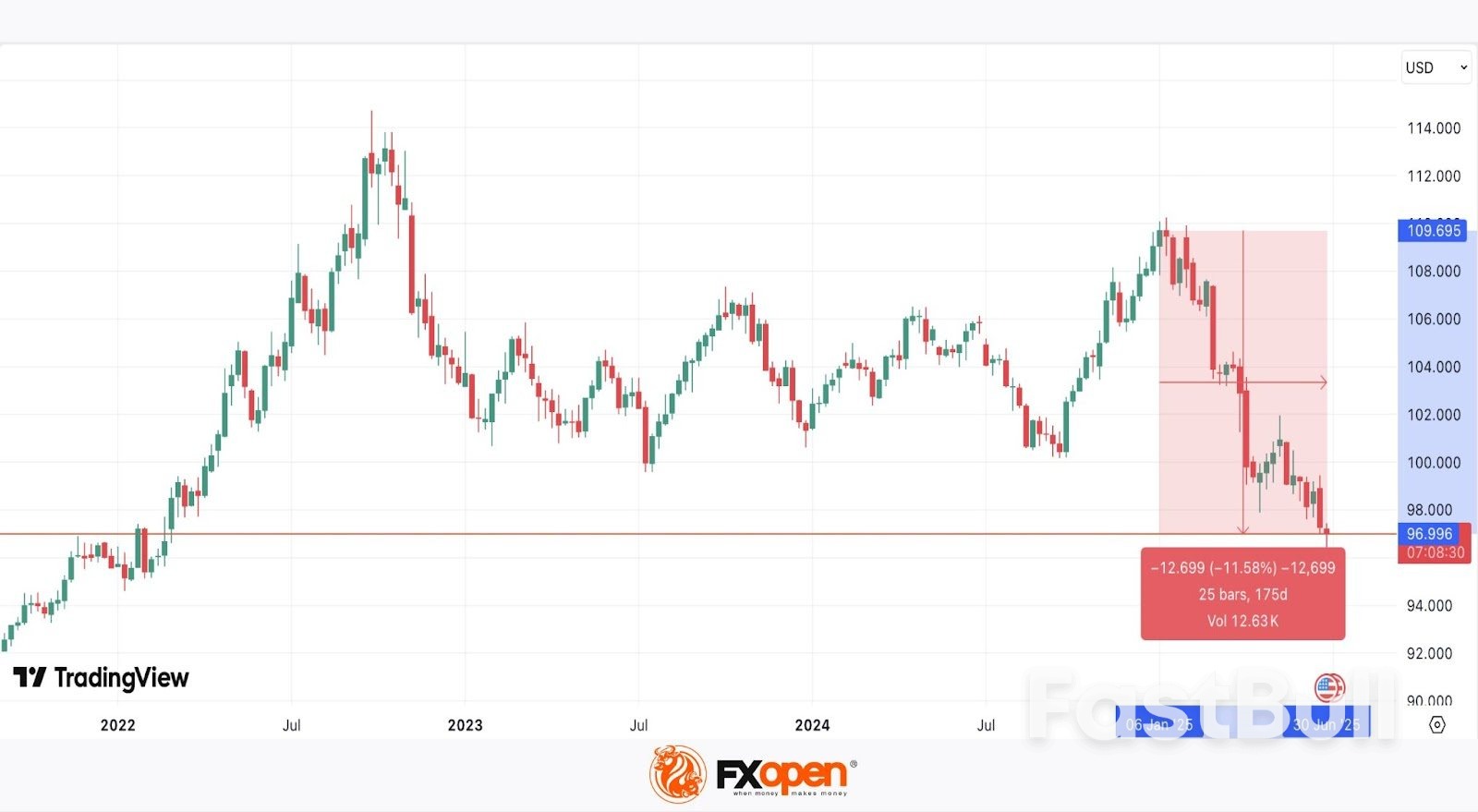
          he US Dollar Index (DXY) is now available to trade via CFDs at FXOpen. We don’t even need to say that it’s one of the most influential benchmarks in global currency markets. The index, which measures the value of the US dollar against a basket of six major currencies, experiences heightened volatility and presents potential opportunity.

          Understanding the DXY: A Macro Lens on the Dollar

          The DXY tracks the relative strength of the US dollar versus a weighted currency basket including the euro, Japanese yen, British pound, Canadian dollar, Swedish krona, and Swiss franc. Although the euro comprises nearly 58% of the index, the DXY reflects broad USD strength or weakness across global markets, not just against a single currency.
          Traders and analysts use the DXY as a key macro indicator—to track policy divergence between central banks, to hedge USD exposure, and to assess broader market sentiment. Rising DXY levels often signal tightening US policy or global risk aversion, while declines may reflect weakening growth expectations, dovish Fed policy, or geopolitical stress. In volatile environments like 2025, the DXY serves as a real-time barometer of global confidence in the US economy and dollar-based assets.

          Recent Price Swings: Tariffs & Policy Uncertainty Shake the Dollar

          Since April, the US Dollar Index has faced one of its most volatile stretches in years, driven by a convergence of Federal Reserve policy uncertainty and new trade tariffs announced by President Trump.

          April: “Liberation Day” Tariffs Trigger Market Shock

          On 2 April, the announcement of sweeping “Liberation Day” tariffs—10% on nearly all imports, with higher duties on selected countries—jolted currency markets. The DXY fell over 2% in a single day. In the following weeks, the index continued to decline as business confidence deteriorated and early signs of recession risk emerged.

          May–June: Policy Headwinds Compound Dollar Weakness

          As the tariff package took effect, the dollar extended its slide—marking a ~10% drop from its late‑2024 peak, the worst first-half performance in over 50 years. Investors reassessed US growth prospects amid the pressures of trade friction. The Fed responded with a hawkish pause, while President Trump publicly urged for rate cuts, further muddying the policy outlook and pressuring the dollar.

          July: Uncertainty Builds

          By early July, the DXY had fallen below 97, tallying an approximate 11% year-to-date decline. Analysts cite a “perfect storm” of expanding fiscal deficits, erratic trade decisions, and growing doubts over US policy credibility as key reasons for the dollar’s fall from favour.
          US Dollar Index : A Closer Look at the Its Role and Recent Volatility_1

          Even if the index is falling, with FXOpen you can trade it regardless of its direction as you don’t need to own the underlying asset. CFDs allow traders to place buy and sell orders depending on their market outlook.

          Why DXY Matters Now More Than Ever

          The DXY has become a real-time gauge of market confidence in US policy stability. The dollar’s sharp decline in 2025 underscores how fragile that confidence can be in the face of aggressive trade measures and uncertain monetary direction.
          The introduction of Trump’s tariffs has raised structural concerns among investors:
          Growth expectations have been cut due to higher input costs and supply chain friction.The so-called safe-haven appeal of the USD has eroded, with flows shifting to the euro, Swiss franc, and gold.Foreign demand for dollar assets has softened, as fears of a prolonged trade conflict and fiscal indiscipline mount.
          In this climate, the DXY has evolved into a barometer for geopolitical tension, inflation fears, and investor sentiment towards US leadership.

          来源:FXOpen

          Risk Warnings and Disclaimers
          You understand and acknowledge that there is a high degree of risk involved in trading. Following any strategies or investment methods may lead to potential losses. The content on the site is provided by our contributors and analysts for information purposes only. You are solely responsible for determining whether any trading assets, securities, strategy, or any other product is suitable for investing based on your own investment objectives and financial situation.
          Add to Favorites
          Share
          FastBull
          Copyright © 2025 FastBull Ltd

          728 RM B 7/F GEE LOK IND BLDG NO 34 HUNG TO RD KWUN TONG KLN HONG KONG

          TelegramInstagramTwitterfacebooklinkedin
          App Store Google Play Google Play
          Products
          Charts

          Chats

          Q&A with Experts
          Screeners
          Economic Calendar
          Data
          Tools
          Membership
          Features
          Function
          Markets
          Copy Trading
          Latest Signals
          Contests
          News
          Analysis
          24/7
          Columns
          Education
          Company
          Careers
          About Us
          Contact Us
          Advertising
          Help Center
          Feedback
          User Agreement
          Privacy Policy
          Business

          White Label

          Data API

          Web Plug-ins

          Poster Maker

          Affiliate Program

          Risk Disclosure

          The risk of loss in trading financial instruments such as stocks, FX, commodities, futures, bonds, ETFs and crypto can be substantial. You may sustain a total loss of the funds that you deposit with your broker. Therefore, you should carefully consider whether such trading is suitable for you in light of your circumstances and financial resources.

          No decision to invest should be made without thoroughly conducting due diligence by yourself or consulting with your financial advisors. Our web content might not suit you since we don't know your financial conditions and investment needs. Our financial information might have latency or contain inaccuracy, so you should be fully responsible for any of your trading and investment decisions. The company will not be responsible for your capital loss.

          Without getting permission from the website, you are not allowed to copy the website's graphics, texts, or trademarks. Intellectual property rights in the content or data incorporated into this website belong to its providers and exchange merchants.

          Not Logged In

          Log in to access more features

          FastBull Membership

          Not yet

          Purchase

          Become a signal provider
          Help Center
          Customer Service
          Dark Mode
          Price Up/Down Colors

          Log In

          Sign Up

          Position
          Layout
          Fullscreen
          Default to Chart
          The chart page opens by default when you visit fastbull.com