Markets
News
Analysis
User
24/7
Economic Calendar
Education
Data
- Names
- Latest
- Prev


Signal Accounts for Members
All Signal Accounts
All Contests


U.K. Trade Balance Non-EU (SA) (Oct)A:--
F: --
P: --
U.K. Trade Balance (Oct)A:--
F: --
P: --
U.K. Services Index MoMA:--
F: --
P: --
U.K. Construction Output MoM (SA) (Oct)A:--
F: --
P: --
U.K. Industrial Output YoY (Oct)A:--
F: --
P: --
U.K. Trade Balance (SA) (Oct)A:--
F: --
P: --
U.K. Trade Balance EU (SA) (Oct)A:--
F: --
P: --
U.K. Manufacturing Output YoY (Oct)A:--
F: --
P: --
U.K. GDP MoM (Oct)A:--
F: --
P: --
U.K. GDP YoY (SA) (Oct)A:--
F: --
P: --
U.K. Industrial Output MoM (Oct)A:--
F: --
P: --
U.K. Construction Output YoY (Oct)A:--
F: --
P: --
France HICP Final MoM (Nov)A:--
F: --
P: --
China, Mainland Outstanding Loans Growth YoY (Nov)A:--
F: --
P: --
China, Mainland M2 Money Supply YoY (Nov)A:--
F: --
P: --
China, Mainland M0 Money Supply YoY (Nov)A:--
F: --
P: --
China, Mainland M1 Money Supply YoY (Nov)A:--
F: --
P: --
India CPI YoY (Nov)A:--
F: --
P: --
India Deposit Gowth YoYA:--
F: --
P: --
Brazil Services Growth YoY (Oct)A:--
F: --
P: --
Mexico Industrial Output YoY (Oct)A:--
F: --
P: --
Russia Trade Balance (Oct)A:--
F: --
P: --
Philadelphia Fed President Henry Paulson delivers a speech
Canada Building Permits MoM (SA) (Oct)A:--
F: --
P: --
Canada Wholesale Sales YoY (Oct)A:--
F: --
P: --
Canada Wholesale Inventory MoM (Oct)A:--
F: --
P: --
Canada Wholesale Inventory YoY (Oct)A:--
F: --
P: --
Canada Wholesale Sales MoM (SA) (Oct)A:--
F: --
P: --
Germany Current Account (Not SA) (Oct)A:--
F: --
P: --
U.S. Weekly Total Rig CountA:--
F: --
P: --
U.S. Weekly Total Oil Rig CountA:--
F: --
P: --
Japan Tankan Large Non-Manufacturing Diffusion Index (Q4)--
F: --
P: --
Japan Tankan Small Manufacturing Outlook Index (Q4)--
F: --
P: --
Japan Tankan Large Non-Manufacturing Outlook Index (Q4)--
F: --
P: --
Japan Tankan Large Manufacturing Outlook Index (Q4)--
F: --
P: --
Japan Tankan Small Manufacturing Diffusion Index (Q4)--
F: --
P: --
Japan Tankan Large Manufacturing Diffusion Index (Q4)--
F: --
P: --
Japan Tankan Large-Enterprise Capital Expenditure YoY (Q4)--
F: --
P: --
U.K. Rightmove House Price Index YoY (Dec)--
F: --
P: --
China, Mainland Industrial Output YoY (YTD) (Nov)--
F: --
P: --
China, Mainland Urban Area Unemployment Rate (Nov)--
F: --
P: --
Saudi Arabia CPI YoY (Nov)--
F: --
P: --
Euro Zone Industrial Output YoY (Oct)--
F: --
P: --
Euro Zone Industrial Output MoM (Oct)--
F: --
P: --
Canada Existing Home Sales MoM (Nov)--
F: --
P: --
Euro Zone Total Reserve Assets (Nov)--
F: --
P: --
U.K. Inflation Rate Expectations--
F: --
P: --
Canada National Economic Confidence Index--
F: --
P: --
Canada New Housing Starts (Nov)--
F: --
P: --
U.S. NY Fed Manufacturing Employment Index (Dec)--
F: --
P: --
U.S. NY Fed Manufacturing Index (Dec)--
F: --
P: --
Canada Core CPI YoY (Nov)--
F: --
P: --
Canada Manufacturing Unfilled Orders MoM (Oct)--
F: --
P: --
Canada Manufacturing New Orders MoM (Oct)--
F: --
P: --
Canada Core CPI MoM (Nov)--
F: --
P: --
Canada Manufacturing Inventory MoM (Oct)--
F: --
P: --
Canada CPI YoY (Nov)--
F: --
P: --
Canada CPI MoM (Nov)--
F: --
P: --
Canada CPI YoY (SA) (Nov)--
F: --
P: --
Canada Core CPI MoM (SA) (Nov)--
F: --
P: --


No matching data
Latest Views
Latest Views
Trending Topics
Top Columnists
Latest Update
White Label
Data API
Web Plug-ins
Affiliate Program
View All

No data
The U.S. Congress returns on Tuesday with less than a month left to perform one of its core functions - keeping federal agencies funded and averting a partial government shutdown - a job that it has struggled to perform in recent years.
The chamber's bitter partisan divides have hardened in the first year of President Donald Trump's new administration, which has angered Democratic lawmakers by deciding not to spend some money previously approved under bipartisan deals, as well as the July passage of a tax-cut bill that nonpartisan analysts said could cause more than 10 million low-income Americans to lose healthcare coverage.
Lawmakers' work on agreeing on the roughly $1.8 trillion in discretionary spending in the $7 trillion federal budget will be further complicated by expected fights over the release of information related to the late convicted sex offender Jeffrey Epstein, a former friend of Trump's, and the administration's surge of federal agents and National Guard into the capital.
There have been 14 partial government shutdowns since 1981, most of which lasted only a day or two. The most recent stretched over 34 days in December 2018 into January 2019 during Trump's first term.
Trump's Republicans hold a 219-212 majority in the House of Representatives and a 53-47 edge in the Senate, though that chamber's rules require 60 votes to pass most bills, meaning that seven Democrats' support would be needed to pass a funding bill. A preemptive blame game started this summer over which party would be faulted if Congress fails and a partial government shutdown occurs.
Before Republicans approved Trump’s request for a $9 billion cut to foreign aid and public media, Senate Minority Leader Chuck Schumer in July said the majority should not expect Democrats to “act as business as usual” in the bipartisan appropriations process due to the party cutting back on funding already approved by Congress.
Schumer faced howls of outrage from some in his party in March after providing the votes for a continuing resolution to keep the government funded, arguing at the time that allowing a government shutdown would have been more damaging.
The Democrats’ full strategy this time around has not yet been defined, but the Democratic leaders have requested a meeting with their Republican counterparts to discuss the deadline. Some Democrats want assurances by Republicans that they will not unilaterally cut funding if more requests are made by the administration.
Schumer on Tuesday accused Trump of "waging an all-out war against Congress’ Article I authority and the constitutional balance of power," adding, "Senate Republicans must decide: stand up for the legislative branch or enable Trump’s slide toward authoritarianism."
In an earlier floor speech, Senate Majority Leader John Thune said: “I hope that the process will continue in a bipartisan way as we move toward the September deadline."
Some Democrats, including Senator Elizabeth Warren, are betting the conservatives would be blamed and that the funding deadline should be used as leverage.
“In September, the Republicans are going to need to get a budget through to keep the government open and to do that they are going to need some Democratic votes,” Warren said at an August rally in Nebraska. Referring to the sweeping tax-cut bill, she added, “You want my vote -- and I hope the votes of the rest of these Democrats – then by golly, you can restore healthcare for 10 million Americans!”
The U.S. federal debt is $37.25 trillion, according to the Treasury Department. It has continued to grow under Republican and Democratic administrations as the U.S. Congress continues to authorize the federal government to spend more money than it takes in.
Global bond markets came under pressure in European session, led by a sharp selloff in long-dated UK gilts. Yield on UK 30-year surged past 5.65% to its highest in 27 years, breaking above the peak set in April. Investors are increasingly concerned that Prime Minister Keir Starmer’s government may abandon fiscal discipline ahead of the upcoming Budget.
French bonds also came under strain, with the 30-year yield climbing to its highest since 2009 as Prime Minister François Bayrou scrambles to shore up parliamentary support ahead of next week’s confidence vote. U.S. Treasury yields are climbing in tandem, with the 30-year approaching 5%—a level last seen in July.
The catalyst in the UK was Starmer’s reshuffle of his Downing Street team, including the appointment of Darren Jones as chief secretary to the Treasury to manage delivery of priorities. The changes, intended to strengthen economic governance ahead of the Budget, have instead rattled markets, with traders worried about a lack of coherent strategy to revive growth while borrowing continues to swell.
Adding to the unease, speculation has resurfaced that Chancellor Rachel Reeves could be sidelined. Markets have been sensitive to such risks before—when questions arose over Reeves’ position in July, gilt yields spiked on fears she might be replaced by a more left-leaning figure less committed to fiscal prudence. The latest political maneuvering has revived those anxieties.
The immediate market reaction suggests little confidence in the government’s direction. Investors are interpreting the moves as paving the way for more gilt issuance, higher inflation, and weaker commitment to fiscal rules. Expectations are building that the Budget could lean heavily on borrowing to fund spending promises rather than tax hikes, amplifying the pressure on long-dated debt.
In currency markets, Sterling has been the weakest performer of the day, weighed down by fiscal and political concerns. Yen and New Kiwi followed on the downside, while Ddollar rebounded on support from rising Treasury yields. Loonie and Swiss Franc also gained, while Euro and Aussie traded mid-pack.
In Europe at the time of writing, FTSE is down -0.60%. DAX is down -1.57%. CAC is down -0.31%. UK 10-year yield is up 0.077 at 4.831. Germany 10-year yield is up 0.044 at 2.794. Earlier in Asia, Nikkei rose 0.29%. Hong Kong HSI fell -0.47%. China Shanghai SSE fell -0.45%. Singapore Strait Times rose 0.52%. Japan 10-year JBG yield fell -0.019 to 1.606.
ECB Executive Board member Isabel Schnabel pushed back against further monetary easing, telling Reuters that policy maybe already “mildly accommodative” and that she sees no case for another rate cut at present. She noted that the economy has held up better than expected, underpinned by robust domestic demand and bolstered by a “significant fiscal impulse” from Germany’s investment plans in infrastructure and defense.
Schnabel also argued that global tariffs imposed by the Trump administration are likely “on net inflationary”, even without EU retaliation. “If you have an increase in input prices globally due to tariffs, and these propagate through global production networks, this will increase inflationary pressures everywhere,” she said.
Schnabel also dismissed concerns that a stronger Euro might weigh heavily on price dynamics. She said currency appreciation tied to improving Eurozone growth prospects would have a more limited pass-through, adding, “I am less concerned about exchange rate developments.” She stressed that she sees little chance of inflation expectations de-anchoring to the downside after years of price overshoots.
Looking forward, Schnabel warned that a more fragmented world with tighter supply chains, higher fiscal spending, and aging populations is structurally inflationary. In such an environment, she argued, “central banks around the world start to hike interest rates again may come earlier than many people currently think.”
Eurozone headline inflation inched higher in August, with the flash CPI rising to 2.1% yoy from 2.0% yoy, in line with expectations. The increase came largely from a slower drag in energy prices, though food and services inflation moderated slightly from July levels.
Core CPI, excluding food, energy, alcohol, and tobacco, remained unchanged at 2.3% yoy, defying expectations of a slight dip to 2.2% yoy. The measure has now held steady since May.
By component, food, alcohol and tobacco continued to drive the highest annual inflation rate at 3.2%, followed by services at 3.1%. Non-energy industrial goods stayed muted at 0.8%, while energy prices fell -1.9% from a year earlier. The data suggest inflation continues to stabilize near the ECB’s 2% target.
BoJ Deputy Governor Ryozo Himino warned in a speech today that U.S. trade policies are likely to weigh on Japan’s economy, with overseas slowdowns and weaker corporate profits feeding through domestically. While accommodative financial conditions should cushion the hit, Himino said the baseline scenario is for Japan’s growth to “moderate,” with downside risks from tariffs deserving greater attention.
Looking further ahead, Himino said Japan’s growth should eventually recover as overseas economies return to a more stable expansion path. But in the near term, the tariff shock remains the key uncertainty, with the risk of a “larger-than-expected impact” now seen as more pressing than the chance of a mild outcome.
On inflation, Himino noted that headline prices remain above the BoJ’s 2% target, by a “considerable margin”, due in part to surging rice prices and spillovers to other goods. However, he stressed headline inflation is expected to “decline in due course” as food-related effects fade. Underlying inflation, meanwhile, remains below target but is steadily rising, despite some potential “temporary halts”, supported by a wage–price feedback loop.
Summing up, Himino said the BoJ’s baseline scenario assumes headline inflation will cool, while core prices continue to edge toward 2%. If that path holds, it would be appropriate for the central bank to keep raising rates gradually, fine-tuning monetary accommodation in line with improving economic activity and stable price gains.
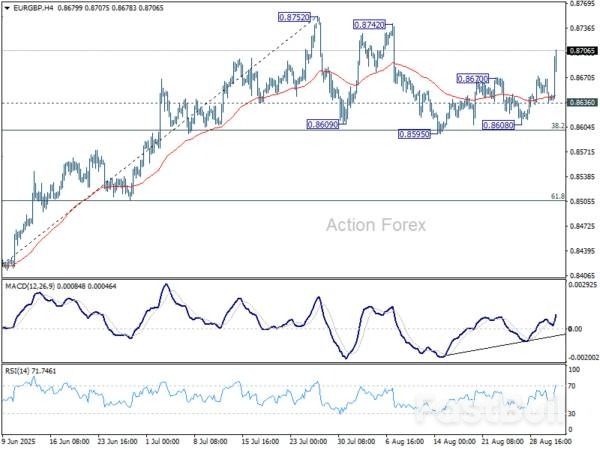
Daily Pivots: (S1) 0.8632; (P) 0.8652; (R1) 0.8665;
EUR/GBP’s strong rally today solidifies the case that corrective pattern from 0.8752 has completed at 0.8595. Intraday bias is back on the upside for retesting 0.8752. Firm break there will resume whole rally from 0.8221. Next target is 0.8867 fibonacci level. For now, further rise is expected as long as 0.8636 support holds, in case of retreat.

In the bigger picture, the structure from 0.8221 medium term bottom are not impulsive enough to suggest that it’s reversing the down trend from 0.9267 (2022 high). But even if it’s a correction, further rise could still be seen to 61.8% retracement of 0.9267 to 0.8221 at 0.8867. Nevertheless, sustained trading below 55 W EMA (now at 0.8513) will argue that the pattern has completed and bring retest of 0.8221 low.
Rothschild & Co. is set to take over the United Arab Emirates subsidiary of the Liechtensteinische Landesbank, bolstering its presence in one of the world’s hottest markets for wealth management.The so-called referral agreement with LLB will add assets worth about 1 billion Swiss francs ($1.2 billion) to Rothschild’s Dubai-based franchise, according to a statement on Tuesday. LLB will focus on its locations in Liechtenstein, Switzerland, Austria and Germany, while recommending Rothschild & Co. to clients in the United Arab Emirates.
“In recent years, we have experienced continuous strong growth in our global Wealth Management and Middle East businesses,” Rothschild & Co. Executive Chairman Alexandre de Rothschild said in a separate statement. The latest deal “represents our high conviction in the UAE’s potential, given the increasing concentration of both regional and global wealth here.”The Paris-based bank opened a wealth management office last year in Dubai, where it will have about 25 employees after the agreement with LLB. The move will help the firm step up its regional offerings across public and private markets, as well as corporate advisory.
Other global firms have also bolstered their presence in the region in the past few years to capitalize on the burgeoning market for the ultra-rich. Citigroup Inc., Deutsche Bank AG, UBS AG and JPMorgan Chase & Co. have recruited private bankers while Azura Partners, a wealth manager founded by a former Julius Baer Group Ltd., is relocating its headquarters to Abu Dhabi from Monaco.Rothschild’s move is also another sign that major banks have shrugged off the geopolitical instability that marked the region in previous months. The world’s richest people and their wealth managers continue to flock to the region, lured by low taxes, business-friendly regimes and year-round sunshine.
Still, some firms have faced issues in the region, including HSBC Holdings Plc. Its Swiss private bank is ending relationships with wealthy Middle Eastern clients as part of efforts to lower its exposure to individuals it deems high-risk, Bloomberg News has reported.
White Label
Data API
Web Plug-ins
Poster Maker
Affiliate Program
The risk of loss in trading financial instruments such as stocks, FX, commodities, futures, bonds, ETFs and crypto can be substantial. You may sustain a total loss of the funds that you deposit with your broker. Therefore, you should carefully consider whether such trading is suitable for you in light of your circumstances and financial resources.
No decision to invest should be made without thoroughly conducting due diligence by yourself or consulting with your financial advisors. Our web content might not suit you since we don't know your financial conditions and investment needs. Our financial information might have latency or contain inaccuracy, so you should be fully responsible for any of your trading and investment decisions. The company will not be responsible for your capital loss.
Without getting permission from the website, you are not allowed to copy the website's graphics, texts, or trademarks. Intellectual property rights in the content or data incorporated into this website belong to its providers and exchange merchants.
Not Logged In
Log in to access more features

FastBull Membership
Not yet
Purchase
Log In
Sign Up