Markets
News
Analysis
User
24/7
Economic Calendar
Education
Data
- Names
- Latest
- Prev


Signal Accounts for Members
All Signal Accounts
All Contests


U.K. Trade Balance Non-EU (SA) (Oct)A:--
F: --
P: --
U.K. Trade Balance (Oct)A:--
F: --
P: --
U.K. Services Index MoMA:--
F: --
P: --
U.K. Construction Output MoM (SA) (Oct)A:--
F: --
P: --
U.K. Industrial Output YoY (Oct)A:--
F: --
P: --
U.K. Trade Balance (SA) (Oct)A:--
F: --
P: --
U.K. Trade Balance EU (SA) (Oct)A:--
F: --
P: --
U.K. Manufacturing Output YoY (Oct)A:--
F: --
P: --
U.K. GDP MoM (Oct)A:--
F: --
P: --
U.K. GDP YoY (SA) (Oct)A:--
F: --
P: --
U.K. Industrial Output MoM (Oct)A:--
F: --
P: --
U.K. Construction Output YoY (Oct)A:--
F: --
P: --
France HICP Final MoM (Nov)A:--
F: --
P: --
China, Mainland Outstanding Loans Growth YoY (Nov)A:--
F: --
P: --
China, Mainland M2 Money Supply YoY (Nov)A:--
F: --
P: --
China, Mainland M0 Money Supply YoY (Nov)A:--
F: --
P: --
China, Mainland M1 Money Supply YoY (Nov)A:--
F: --
P: --
India CPI YoY (Nov)A:--
F: --
P: --
India Deposit Gowth YoYA:--
F: --
P: --
Brazil Services Growth YoY (Oct)A:--
F: --
P: --
Mexico Industrial Output YoY (Oct)A:--
F: --
P: --
Russia Trade Balance (Oct)A:--
F: --
P: --
Philadelphia Fed President Henry Paulson delivers a speech
Canada Building Permits MoM (SA) (Oct)A:--
F: --
P: --
Canada Wholesale Sales YoY (Oct)A:--
F: --
P: --
Canada Wholesale Inventory MoM (Oct)A:--
F: --
P: --
Canada Wholesale Inventory YoY (Oct)A:--
F: --
P: --
Canada Wholesale Sales MoM (SA) (Oct)A:--
F: --
P: --
Germany Current Account (Not SA) (Oct)A:--
F: --
P: --
U.S. Weekly Total Rig CountA:--
F: --
P: --
U.S. Weekly Total Oil Rig CountA:--
F: --
P: --
Japan Tankan Large Non-Manufacturing Diffusion Index (Q4)--
F: --
P: --
Japan Tankan Small Manufacturing Outlook Index (Q4)--
F: --
P: --
Japan Tankan Large Non-Manufacturing Outlook Index (Q4)--
F: --
P: --
Japan Tankan Large Manufacturing Outlook Index (Q4)--
F: --
P: --
Japan Tankan Small Manufacturing Diffusion Index (Q4)--
F: --
P: --
Japan Tankan Large Manufacturing Diffusion Index (Q4)--
F: --
P: --
Japan Tankan Large-Enterprise Capital Expenditure YoY (Q4)--
F: --
P: --
U.K. Rightmove House Price Index YoY (Dec)--
F: --
P: --
China, Mainland Industrial Output YoY (YTD) (Nov)--
F: --
P: --
China, Mainland Urban Area Unemployment Rate (Nov)--
F: --
P: --
Saudi Arabia CPI YoY (Nov)--
F: --
P: --
Euro Zone Industrial Output YoY (Oct)--
F: --
P: --
Euro Zone Industrial Output MoM (Oct)--
F: --
P: --
Canada Existing Home Sales MoM (Nov)--
F: --
P: --
Euro Zone Total Reserve Assets (Nov)--
F: --
P: --
U.K. Inflation Rate Expectations--
F: --
P: --
Canada National Economic Confidence Index--
F: --
P: --
Canada New Housing Starts (Nov)--
F: --
P: --
U.S. NY Fed Manufacturing Employment Index (Dec)--
F: --
P: --
U.S. NY Fed Manufacturing Index (Dec)--
F: --
P: --
Canada Core CPI YoY (Nov)--
F: --
P: --
Canada Manufacturing Unfilled Orders MoM (Oct)--
F: --
P: --
Canada Manufacturing New Orders MoM (Oct)--
F: --
P: --
Canada Core CPI MoM (Nov)--
F: --
P: --
Canada Manufacturing Inventory MoM (Oct)--
F: --
P: --
Canada CPI YoY (Nov)--
F: --
P: --
Canada CPI MoM (Nov)--
F: --
P: --
Canada CPI YoY (SA) (Nov)--
F: --
P: --
Canada Core CPI MoM (SA) (Nov)--
F: --
P: --


No matching data
Latest Views
Latest Views
Trending Topics
Top Columnists
Latest Update
White Label
Data API
Web Plug-ins
Affiliate Program
View All

No data
Markets are thirsty for oil because they are absorbing Opec+ production increases without building inventories, United Arab Emirates Energy Minister Suhail al-Mazrouei said on Wednesday.
Opec+, which pumps about half of the world's oil, has been curtailing production for several years to support the market. But it has reversed course this year to regain market share and as US President Donald Trump demanded the group pump more to help keep gasoline prices lower.
Opec+ began to unwind cuts of 2.17 million barrels per day in April with a boost of 138,000 bpd. Hikes of 411,000 bpd followed each month in May, June and July. On Saturday, the group approved a 548,000-bpd jump for August.
Mazrouei said he was not worried about supply overhang even after the latest production rises.
"You can see that even with the increases for several months we haven’t seen a major buildup in inventories, which means the market needed those barrels," he said.
"What we want is stability and you cannot be short-sighted just by looking at the price. We need the price to be right for investments to happen," he said, adding that many countries with large oil reserves were still not investing enough.
Mazrouei was speaking on the sidelines of a biennial Opec seminar, which brings together ministers and executives from oil majors.
Opec has withheld media access to reporters from Reuters and several other news organisations to cover the seminar, reporters and several people familiar with the matter said. Opec declined to comment on why it was curbing media access to the seminar.
Saudi Energy Minister Prince Abdulaziz bin Salman spoke at the seminar about the need for a flexible energy transition guided by data and technology, including oil and gas and not at the cost of affordability, participants told Reuters.
Opec+ will likely approve an increase of around 550,000 bpd for September when it convenes on August 3, sources told Reuters.
That will complete the return to the market of 2.17 million bpd of voluntary cuts from eight Opec+ members and allow the UAE to also complete an additional 300,000 bpd output jump.
Opec+ still has separate cuts of 3.65 million bpd in place, consisting of 1.65 million bpd in voluntary cuts by eight members and some two million bpd across all members. The cuts expire at the end of 2026.
Crude oil prices have now risen in the past three days, although with waning momentum as macro concerns linger. But with oil trading at its highest levels in about two weeks, when there is so much bearish news out there, you might be wondering what has supported prices? After all, bearish speculators argue, there was a larger-than-expected OPEC+ increase for the month of August just at the weekend.
Despite this urgency to bring back more supplies online, oil prices have stopped falling further since that sharp de-escalation in the conflict between Israel and Iran a couple of weeks ago. What’s driving prices, and what’s in for the months ahead?
One explanation behind the recent recovery in oil prices can be attributed to the fact that there were worries about demand owing to trade concerns hurting the global economy. Instead, trade fears have receded sharply, judging by the reaction in equity markets in the last couple of months (we saw benchmark stock indices surge from their April lows to hit record highs).
Granted, tariff uncertainty could flare up with Trump now saying he won’t extend deadlines beyond August 1 again. Meanwhile, inflation hasn’t picked up either, as had been feared due to the higher tariffs, and many central banks have been cutting rates in recent months.
At the same time, the US has passed a big budget and tax bill into law, which should boost economic output in the short term, all else being equal, even if it ultimately adds trillions to the national debt, which is probably not in the interest of the economy in the long term.
In the US, they are also nearing peak driving season when demand for gasoline surges. According to Reuters, citing travel industry statistics, a record number of Americans were set to travel for the Fourth of July holiday by road and air. Ahead of peak driving season, we have seen several sharp drawdowns in US oil stocks, pointing to strong demand.
Globally, the macro backdrop hasn’t been too great, but the fact that Saudi Arabia raised the August price for its flagship Arab Light crude to a four-month high for Asian customers at the weekend, this goes to shows that demand for oil remains strong there.
So, the crude oil has been supported in part because of receding fears about demand. But this alone won’t be enough to sustain higher prices. Supply is the main factor driving oil prices.
The OPEC+ agreed to raise production by 548,000 barrels per day in August. This was more than the 411,000-bpd hikes they made for the earlier three months. As a result, the group has returned nearly half of the 2.2 million-bpd voluntary cuts from eight OPEC producers back into the market. Further production hikes are expected for September, which, according to Goldman Sachs, will amount to 550,000 bpd.
The key question is whether this was the right move and in the best interest of OPEC+. Clearly, the group doesn’t want to lose market share to non-OPEC producers. In fact, the US hasn’t been able to ramp up production meaningfully in recent months and therefore looks set to produce less oil in 2025 than previously expected.
That’s according to the Energy Information Administration, which forecasts the world’s largest oil producer to pump 13.37 million barrels per day of oil this year instead of last month’s forecast of 13.42 million bpd. In part, this due to the lower oil prices discouraging drilling activity.
Indeed, the number of oil and natural gas rigs have been plunging according to energy services firm Baker Hughes (NASDAQ:BKR). The latest data from the company shows rig counts falling to 425 from around 780 rigs in 2022’s peak, marking a dramatic reversal and the lowest since October 2021.
It can be argued, therefore, that this might be the perfect opportunity for the OPEC+ to raise output as much as possible while the US drilling is not “drill-baby-drill”-ing.
However, in the longer run, supply growth will need to be matched by equally strong demand growth to allow for sustainably higher prices. Given that Iran is now allowed to export more freely and the OPEC+ is ramping production, and Trump urging US producers to pump more oil, the long-term outlook remains bearish, which means the upside should be limited from here on, barring another supply-side shock.
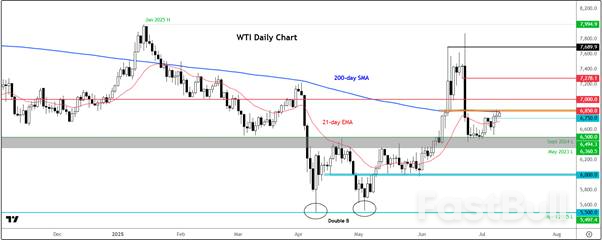
WTI has bounced back from the neckline of the double bottom pattern between $63.60 to $65.00 area (shaded in grey on the chart). This area remains crucial for long-term support, given that the lows of May 2023 and September 2024 were previously formed here, and now we are above it. Should WTI break back below this zone, the technical outlook would turn negative once again, which could encourage fresh selling below that zone.

One short-term support above this zone worth pointing out is now seen at $67.50, marking resistance from last week.
At the time of writing, WTI was now testing potential resistance in the $68.50 region. As well as former support, the 200-day moving average also comes into play here, making it a key battleground. Above this zone, the next potential resistance is the psychologically important handle of $70.00.
All told, WTI is bang in the middle of its range, which should keep both the bulls and bears interested. In this sort of trading environment, trading oil from level to level makes most sense to me, rather than applying a swing strategy.
Sterling was little changed on Wednesday, as investors digested the Bank of England's half-yearly report on financial stability and assessed the potential impact of trade disputes on global economic growth.
The pound was little changed against the U.S. dollarand was last at $1.35, while against the euroit firmed 0.17% to 86.14 pence.
Sentiment globally was one of caution after U.S. President Donald Trump widened his trade war by saying he would impose a 50% duty on imported copper and unveil levies on semiconductors and pharmaceuticals.
Trump said there would be announcements on Wednesday regarding "a minimum of 7 countries having to do with trade," a day after he told 14 nations that they would face sharply higher tariffs from a new deadline of August 1.
The pound has been among the top beneficiaries from a selloff in the U.S. dollar on expectations that a global trade war could also hurt the U.S. economy. The UK was also the first economy that signed a trade deal with the U.S., making it less likely to face fresh tariffs, according to analysts.
However, market participants were taken aback after last week's UK welfare bill raised expectations that the government is faced with either increasing borrowing or imposing growth-denting taxes to balance public accounts at its Autumn budget.
"Nearer term, the UK government has got itself into a fiscal mess," said Derek Halpenny, head of research, global markets EMEA & international securities at MUFG.
"Without a credible big step measure, a credibility gap will persist and risk further dangerous market disruptions. Sharp Gilt sell-offs, like recently, will be pound negative and potentially very disruptive."
The pound has gained nearly 9% against the dollar this year and is on track for its biggest annual rise since 2017. However, fiscal worries have limited gains recently and the currency is down more than 1.4% from a 2021 high it hit earlier in the month.
Meanwhile, the Bank of England released its half-yearly assessment of threats to financial stability, where it flagged that risks to financial markets remain high against the backdrop of U.S. tariffs.
Policymakers also loosened the cap on lending to riskier borrowers after a call by the government for regulators to look for ways to encourage economic growth, without risking the stability of the financial system.
China's June new yuan loans tripled compared with a month ago, likely supported by front-loaded public funding and strength in corporate loans against the backdrop of a sustained trade truce between China and the United States.
Chinese banks are estimated to have issued 1.8 trillion yuan ($250.69 billion) in net new yuan loans last month compared with the 620 billion yuan distributed in May, according to 19 economists polled by Reuters.
Loan appetite could have been steady since mid-May when China and the United States struck a trade truce until Aug. 12, temporarily halting a bruising tariff war and rolling back most of the triple-digit levies heaped on each other's goods.
Both countries also reached a framework in London last month, under which China would remove restrictions on rare earth minerals exports, while the U.S. would lift curbs on chip design software for China.
Front-loaded government bond issuance is expected to be a key driver for June and July while corporate loans still exceed household loans, Morgan Stanley had flagged in a research note last month.
But the world's second-largest economy is on an uncertain footing.
China's manufacturing activity shrank for a third consecutive month in June while producer deflation deepened to its worst level in almost two years, revealing muted business sentiment and weak domestic demand curbing economic growth.
Even after a raft of monetary easing measures introduced in May, policymakers remain under pressure to roll out more support measures to spur consumption amid a global trade war.
Broad M2 money supply, which measures cash in circulation, and a set of deposits, including time deposits to corporates, plus household savings, is expected to have increased 8.1% last month, up from the 7.9% in April.
June outstanding yuan loans were seen slowing to 7.0% from May's 7.1%, according to the poll.
A broad measure of credit and liquidity that is Total Social Financing (TSF) likely grew to 3.65 trillion in June, up from 2.29 trillion yuan in May, the poll showed. Any acceleration in government bond issuance could help boost growth in TSF.
The measure includes off-balance-sheet forms of financing that exist outside the conventional bank lending system, such as initial public offerings, loans from trust companies and bond sales.
When President Donald Trump last rolled out tariffs this high, financial markets quaked, consumer confidence crashed, and his popularity plunged.
Only three months later, he's betting this time will be different.
When Trump announces a new round of tariffs this week, he is betting that import taxes will deliver factory jobs and stronger growth in the US. Many economists are nonetheless predicting the opposite, forecasting that duties will stoke inflation and usher in an economic slowdown.
On Tuesday, Trump told his Cabinet that past presidents who hadn't aggressively deployed tariffs were "stupid". Ever the salesman, Trump added that it was "too time-consuming" to try to negotiate trade deals with the rest of the world, so it was just easier to send them letters, as he's doing this week, that list the tariff rates on their goods.
The letters mark a change from his self-proclaimed 2 April "Liberation Day" event. Speaking in the White House's Rose Garden earlier this year, the president held posterboards with the rates displayed. The display led to a brief market meltdown and a subsequent 90-day tariff pause, which brought about 10% baseline duties, that will end on Wednesday.
"It's a better way," Trump said of his letters. "It's a more powerful way. And we send them a letter. You read the letter. I think it was well crafted. And, mostly it's just a little number in there: You'll pay 25%, 35%. We have some at 60, 70."
When Trump made those comments, he had yet to issue a letter with a tariff rate higher than 40%, which he levied Monday on Laos and Myanmar. He plans to put 25% tariffs on Japan and South Korea, two major trading partners and allies deemed crucial for curbing China's economic influence. Leaders of the 14 countries who have received tariffs so far hope to negotiate over the next three weeks — before the higher rates kick in.
"I would say that every case I'm treating them better than they treated us over the years," Trump said.
The president said on Tuesday evening on Truth Social that he would be releasing letters to "a minimum of 7 Countries" on Wednesday morning, with additional letters coming out in the afternoon.
Trump's approach is at odds with how major trade agreements have been produced over the last 50 years. Typically, this involved detailed sessions, with nations often taking years to work out complex differences.
There are three possible outcomes to the president's political and economic wager, each of which could drastically reshape international affairs and Trump's legacy.
White Label
Data API
Web Plug-ins
Poster Maker
Affiliate Program
The risk of loss in trading financial instruments such as stocks, FX, commodities, futures, bonds, ETFs and crypto can be substantial. You may sustain a total loss of the funds that you deposit with your broker. Therefore, you should carefully consider whether such trading is suitable for you in light of your circumstances and financial resources.
No decision to invest should be made without thoroughly conducting due diligence by yourself or consulting with your financial advisors. Our web content might not suit you since we don't know your financial conditions and investment needs. Our financial information might have latency or contain inaccuracy, so you should be fully responsible for any of your trading and investment decisions. The company will not be responsible for your capital loss.
Without getting permission from the website, you are not allowed to copy the website's graphics, texts, or trademarks. Intellectual property rights in the content or data incorporated into this website belong to its providers and exchange merchants.
Not Logged In
Log in to access more features

FastBull Membership
Not yet
Purchase
Log In
Sign Up