• Trade
  • Markets
  • Copy
  • Contests
  • News
  • 24/7
  • Calendar
  • Q&A
  • Chats
Trending
Screeners
SYMBOL
LAST
BID
ASK
HIGH
LOW
NET CHG.
%CHG.
SPREAD
SPX
S&P 500 Index
6827.42
6827.42
6827.42
6899.86
6801.80
-73.58
-1.07%
--
DJI
Dow Jones Industrial Average
48458.04
48458.04
48458.04
48886.86
48334.10
-245.98
-0.51%
--
IXIC
NASDAQ Composite Index
23195.16
23195.16
23195.16
23554.89
23094.51
-398.69
-1.69%
--
USDX
US Dollar Index
97.950
98.030
97.950
98.500
97.950
-0.370
-0.38%
--
EURUSD
Euro / US Dollar
1.17394
1.17409
1.17394
1.17496
1.17192
+0.00011
+ 0.01%
--
GBPUSD
Pound Sterling / US Dollar
1.33707
1.33732
1.33707
1.33997
1.33419
-0.00148
-0.11%
--
XAUUSD
Gold / US Dollar
4299.39
4299.39
4299.39
4353.41
4257.10
+20.10
+ 0.47%
--
WTI
Light Sweet Crude Oil
57.233
57.485
57.233
58.011
56.969
-0.408
-0.71%
--

Community Accounts

Signal Accounts
--
Profit Accounts
--
Loss Accounts
--
View More

Become a signal provider

Sell trading signals to earn additional income

View More

Guide to Copy Trading

Get started with ease and confidence

View More

Signal Accounts for Members

All Signal Accounts

Best Return
  • Best Return
  • Best P/L
  • Best MDD
Past 1W
  • Past 1W
  • Past 1M
  • Past 1Y

All Contests

  • All
  • Trump Updates
  • Recommend
  • Stocks
  • Cryptocurrencies
  • Central Banks
  • Featured News
Top News Only
Share

USA Embassy In Lithuania: Maria Kalesnikava Is Not Going To Vilnius

Share

USA Embassy In Lithuania: Other Prisoners Are Being Sent From Belarus To Ukraine

Share

Ukraine President Zelenskiy: Five Ukrainians Released By Belarus In US-Brokered Deal

Share

USA Vilnius Embassy: USA Stands Ready For "Additional Engagement With Belarus That Advances USA Interests"

Share

USA Vilnius Embassy: Belarus, USA, Other Citizens Among The Prisoners Released Into Lithuania

Share

USA Vilnius Embassy: USA Will Continue Diplomatic Efforts To Free The Remaining Political Prisoners In Belarus

Share

USA Vilnius Embassy: Belarus Releases 123 Prisoners Following Meeting Of President Trump's Envoy Coale And Belarus President Lukashenko

Share

USA Vilnius Embassy: Masatoshi Nakanishi, Aliaksandr Syrytsa Are Among The Prisoners Released By Belarus

Share

USA Vilnius Embassy: Maria Kalesnikava And Viktor Babaryka Are Among The Prisoners Released By Belarus

Share

USA Vilnius Embassy: Nobel Peace Prize Laureate Ales Bialiatski Is Among The Prisoners Released By Belarus

Share

Belarusian Presidential Administration Telegram Channel: Lukashenko Has Pardoned 123 Prisoners As Part Of Deal With US

Share

Two Local Syrian Officials: Joint US-Syrian Military Patrol In Central Syria Came Under Fire From Unknown Assailants

Share

Israeli Military Says It Targeted 'Key Hamas Terrorist' In Gaza City

Share

Rwanda's Actions In Eastern Drc Are A Clear Violation Of Washington Accords Signed By President Trump - Secretary Of State Rubio

Share

Israeli Military Issues Evacuation Warning In Southern Lebanon Village Ahead Of Strike - Spokesperson On X

Share

Belarusian State Media Cites US Envoy Coale As Saying He Discussed Ukraine And Venezuela With Lukashenko

Share

Belarusian State Media Cites US Envoy Coale As Saying That US Removes Sanctions On Belarusian Potassium

Share

Thai Prime Minister: No Ceasefire Agreement With Cambodia

Share

US, Ukraine To Discuss Ceasefire In Berlin Ahead Of European Summit

Share

Incoming Czech Prime Minister Babis: Czech Republic Will Not Take On Guarantees For Ukraine Financing, European Commission Must Find Alternatives

TIME
ACT
FCST
PREV
U.K. Trade Balance Non-EU (SA) (Oct)

A:--

F: --

P: --

U.K. Trade Balance (Oct)

A:--

F: --

P: --

U.K. Services Index MoM

A:--

F: --

P: --

U.K. Construction Output MoM (SA) (Oct)

A:--

F: --

P: --

U.K. Industrial Output YoY (Oct)

A:--

F: --

P: --

U.K. Trade Balance (SA) (Oct)

A:--

F: --

P: --

U.K. Trade Balance EU (SA) (Oct)

A:--

F: --

P: --

U.K. Manufacturing Output YoY (Oct)

A:--

F: --

P: --

U.K. GDP MoM (Oct)

A:--

F: --

P: --

U.K. GDP YoY (SA) (Oct)

A:--

F: --

P: --

U.K. Industrial Output MoM (Oct)

A:--

F: --

P: --

U.K. Construction Output YoY (Oct)

A:--

F: --

P: --

France HICP Final MoM (Nov)

A:--

F: --

P: --

China, Mainland Outstanding Loans Growth YoY (Nov)

A:--

F: --

P: --

China, Mainland M2 Money Supply YoY (Nov)

A:--

F: --

P: --

China, Mainland M0 Money Supply YoY (Nov)

A:--

F: --

P: --

China, Mainland M1 Money Supply YoY (Nov)

A:--

F: --

P: --

India CPI YoY (Nov)

A:--

F: --

P: --

India Deposit Gowth YoY

A:--

F: --

P: --

Brazil Services Growth YoY (Oct)

A:--

F: --

P: --

Mexico Industrial Output YoY (Oct)

A:--

F: --

P: --

Russia Trade Balance (Oct)

A:--

F: --

P: --

Philadelphia Fed President Henry Paulson delivers a speech
Canada Building Permits MoM (SA) (Oct)

A:--

F: --

P: --

Canada Wholesale Sales YoY (Oct)

A:--

F: --

P: --

Canada Wholesale Inventory MoM (Oct)

A:--

F: --

P: --

Canada Wholesale Inventory YoY (Oct)

A:--

F: --

P: --

Canada Wholesale Sales MoM (SA) (Oct)

A:--

F: --

P: --

Germany Current Account (Not SA) (Oct)

A:--

F: --

P: --

U.S. Weekly Total Rig Count

A:--

F: --

P: --

U.S. Weekly Total Oil Rig Count

A:--

F: --

P: --

Japan Tankan Large Non-Manufacturing Diffusion Index (Q4)

--

F: --

P: --

Japan Tankan Small Manufacturing Outlook Index (Q4)

--

F: --

P: --

Japan Tankan Large Non-Manufacturing Outlook Index (Q4)

--

F: --

P: --

Japan Tankan Large Manufacturing Outlook Index (Q4)

--

F: --

P: --

Japan Tankan Small Manufacturing Diffusion Index (Q4)

--

F: --

P: --

Japan Tankan Large Manufacturing Diffusion Index (Q4)

--

F: --

P: --

Japan Tankan Large-Enterprise Capital Expenditure YoY (Q4)

--

F: --

P: --

U.K. Rightmove House Price Index YoY (Dec)

--

F: --

P: --

China, Mainland Industrial Output YoY (YTD) (Nov)

--

F: --

P: --

China, Mainland Urban Area Unemployment Rate (Nov)

--

F: --

P: --

Saudi Arabia CPI YoY (Nov)

--

F: --

P: --

Euro Zone Industrial Output YoY (Oct)

--

F: --

P: --

Euro Zone Industrial Output MoM (Oct)

--

F: --

P: --

Canada Existing Home Sales MoM (Nov)

--

F: --

P: --

Euro Zone Total Reserve Assets (Nov)

--

F: --

P: --

U.K. Inflation Rate Expectations

--

F: --

P: --

Canada National Economic Confidence Index

--

F: --

P: --

Canada New Housing Starts (Nov)

--

F: --

P: --

U.S. NY Fed Manufacturing Employment Index (Dec)

--

F: --

P: --

U.S. NY Fed Manufacturing Index (Dec)

--

F: --

P: --

Canada Core CPI YoY (Nov)

--

F: --

P: --

Canada Manufacturing Unfilled Orders MoM (Oct)

--

F: --

P: --

Canada Manufacturing New Orders MoM (Oct)

--

F: --

P: --

Canada Core CPI MoM (Nov)

--

F: --

P: --

Canada Manufacturing Inventory MoM (Oct)

--

F: --

P: --

Canada CPI YoY (Nov)

--

F: --

P: --

Canada CPI MoM (Nov)

--

F: --

P: --

Canada CPI YoY (SA) (Nov)

--

F: --

P: --

Canada Core CPI MoM (SA) (Nov)

--

F: --

P: --

Q&A with Experts
    • All
    • Chatrooms
    • Groups
    • Friends
    Connecting
    .
    .
    .
    Type here...
    Add Symbol or Code

      No matching data

      All
      Trump Updates
      Recommend
      Stocks
      Cryptocurrencies
      Central Banks
      Featured News
      • All
      • Russia-Ukraine Conflict
      • Middle East Flashpoint
      • All
      • Russia-Ukraine Conflict
      • Middle East Flashpoint
      Search
      Products

      Charts Free Forever

      Chats Q&A with Experts
      Screeners Economic Calendar Data Tools
      Membership Features
      Data Warehouse Market Trends Institutional Data Policy Rates Macro

      Market Trends

      Market Sentiment Order Book Forex Correlations

      Top Indicators

      Charts Free Forever
      Markets

      News

      News Analysis 24/7 Columns Education
      From Institutions From Analysts
      Topics Columnists

      Latest Views

      Latest Views

      Trending Topics

      Top Columnists

      Latest Update

      Signals

      Copy Rankings Latest Signals Become a signal provider AI Rating
      Contests
      Brokers

      Overview Brokers Assessment Rankings Regulators News Claims
      Broker listing Forex Brokers Comparison Tool Live Spread Comparison Scam
      Q&A Complaint Scam Alert Videos Tips to Detect Scam
      More

      Business
      Events
      Careers About Us Advertising Help Center

      White Label

      Data API

      Web Plug-ins

      Affiliate Program

      Awards Institution Evaluation IB Seminar Salon Event Exhibition
      Vietnam Thailand Singapore Dubai
      Fans Party Investment Sharing Session
      FastBull Summit BrokersView Expo
      Recent Searches
        Top Searches
          Markets
          News
          Analysis
          User
          24/7
          Economic Calendar
          Education
          Data
          • Names
          • Latest
          • Prev

          View All

          No data

          Scan to Download

          Faster Charts, Chat Faster!

          Download App
          English
          • English
          • Español
          • العربية
          • Bahasa Indonesia
          • Bahasa Melayu
          • Tiếng Việt
          • ภาษาไทย
          • Français
          • Italiano
          • Türkçe
          • Русский язык
          • 简中
          • 繁中
          Open Account
          Search
          Products
          Charts Free Forever
          Markets
          News
          Signals

          Copy Rankings Latest Signals Become a signal provider AI Rating
          Contests
          Brokers

          Overview Brokers Assessment Rankings Regulators News Claims
          Broker listing Forex Brokers Comparison Tool Live Spread Comparison Scam
          Q&A Complaint Scam Alert Videos Tips to Detect Scam
          More

          Business
          Events
          Careers About Us Advertising Help Center

          White Label

          Data API

          Web Plug-ins

          Affiliate Program

          Awards Institution Evaluation IB Seminar Salon Event Exhibition
          Vietnam Thailand Singapore Dubai
          Fans Party Investment Sharing Session
          FastBull Summit BrokersView Expo

          Tussle For A Gold Mine May Shake Western Investors

          Jason

          Economic

          Commodity

          Summary:

          The fate of one of the world’s biggest gold mines hangs in the balance.

          A court in Bamako is due to decide if Mali’s military government can take over operations at Barrick’s Loulo-Gounkoto complex. The hearing is set for Monday after being postponed five times — likely a reflection of the sensitivities of the case and its wider implications.

          While the junta running the West African nation has aggressively renegotiated revenue-sharing terms with all major mines, it’s only the Canadian company that’s on the verge of losing control of its asset — at least temporarily.

          The government escalated its standoff with Barrick last month, asking a judge to appoint an interim administrator to manage the site that produced 723,000 ounces of gold in 2024. It wants to restart operations at the mine that were suspended in January following the Malian authorities’ move to block bullion exports.

          A key question is whether the government wants to seize Loulo-Gounkoto or is trying to force Barrick into a settlement.

          For its part, the Toronto-based firm — which has initiated international arbitration proceedings against Mali — says it’s already agreed several accords, only for the government to backtrack.

          The high-stakes brinkmanship over such a significant asset is being monitored closely in neighboring nations, where rulers are devising plans to generate better returns from their minerals.

          Burkina Faso (also run by the military) has nationalized some smaller mines and junta-led Guinea has revoked a slew of permits. Ivory Coast is revising legislation governing the sector, while Senegal is reviewing oil and gas contracts.

          Meanwhile, the mine that last year was the No. 2 contributor in Barrick’s portfolio — spanning from Nevada to Papua New Guinea — is stranded at a time of record gold prices.

          Its travails may be a warning to Western firms mulling investment in the coup-prone region.

          Key stories and opinion:Barrick Says Mali’s Bid to Take Over Gold Mine Lacks Legal Basis Guinea Takes Endeavour Gold Permits in Latest Round of Removals Barrick CEO Vows to Defend Rights as Mali Junta Seeks More Money Mali Junta Leader Gets Backing to Serve as President Until 2030What’s Driving the Coups Across Sub-Saharan Africa?: QuickTake

          China plans to remove tariffs on imports from almost all African countries to further cement close relations with the continent as it deals with the fallout of US President Donald Trump’s trade wars. The 53 African nations that have diplomatic ties with China — Eswatini has allied with Taiwan — will be accorded “zero-tariff treatment for 100% tariff lines,” according to a letter issued to foreign ministers. South Africa sees scope to ease its dispute with Washington over agricultural trade tariffs and regulations.

          The International Monetary Fund is seeking more clarity on a $7 billion fiscal hole discovered under Senegal’s previous administration before it can discuss a fresh program with the new government. The Washington-based lender is awaiting a final audit outcome following an earlier review that found former President Macky Sall’s administration misreported debt and budget-deficit data. Separately, the IMF wants to see the ZiG “fully becoming a national currency” as it weighs whether to place Zimbabwe on a staff-monitored program.

          East African finance chiefs increased planned spending to a record to sustain economic growth and mitigate the effects of geopolitical risks and cuts in foreign aid. Kenya, Rwanda, Tanzania and Uganda plan to boost expenditure by a combined $5.5 billion in the 12 months through June 2026 compared with the year before, despite rising debt payments and limited room to lift taxes. Kenyan police used teargas to disperse protesters in the capital, Nairobi, ahead of Treasury Secretary John Mbadi’s speech. Also, columnist Justice Malala looks at how democracy is dimming in the region.

          A World Bank-linked climate fund has backed South African plans to cut its reliance on coal, unlocking up to $2.6 billion in financing and giving its energy transition an unexpected boost. The decision rescues support that looked to be in peril after the government asked in September to alter an agreement originally endorsed in 2022, and after the US halted other projects. Meanwhile, diplomats in Washington working to repair frayed relations with Trump are confronting an additional headache: South Africa’s embassy was inundated by storm water and raw sewage, leaving it partially inoperable.

          In one of Mali’s oldest towns, poverty and climate change are eroding the resolve of residents to safeguard a slice of the planet’s architectural heritage. Djenné’s iconic mud buildings were designated a World Heritage Site in 1988, meaning they can’t be destroyed or modified. But in recent years, extreme rains have made the buildings harder to maintain, while political turmoil and safety fears have diminished the town’s appeal to tourists. Some local people say the UNESCO designation is a burden they’re struggling to bear.

          African students are increasingly applying to MBA programs in the US. But the Trump administration’s anti-international-student stance could soon put a stop to this. In 2019, African students averaged just 4% of total international applications to two-year MBA programs in America and by last year the share ballooned to 27%. Nearly a quarter of programs report that the largest source of foreign applicants came from either Nigeria or Ghana.

          Source: Bloomberg Europe

          To stay updated on all economic events of today, please check out our Economic calendar
          Risk Warnings and Disclaimers
          You understand and acknowledge that there is a high degree of risk involved in trading. Following any strategies or investment methods may lead to potential losses. The content on the site is provided by our contributors and analysts for information purposes only. You are solely responsible for determining whether any trading assets, securities, strategy, or any other product is suitable for investing based on your own investment objectives and financial situation.
          Add to Favorites
          Share

          Pound-to-Dollar: Return of the Safe Haven Posterboy

          Warren Takunda

          Economic

          Sure, the Dollar is under pressure as markets downgrade their view on the U.S. economy in 2025, but it remains a global safe haven as unfolding events confirm.
          The Dollar is bid after Israel's air force launched a major attack on Iran early on Friday morning, striking Iran's nuclear facilities and leaders.
          General Hossein Salami, the head of Iran’s Islamic Revolutionary Guard Corps, and Mohammed Bagheri, the chief of staff of Iran’s armed forces, were among those killed.
          Pound-to-Dollar: Return of the Safe Haven Posterboy_1

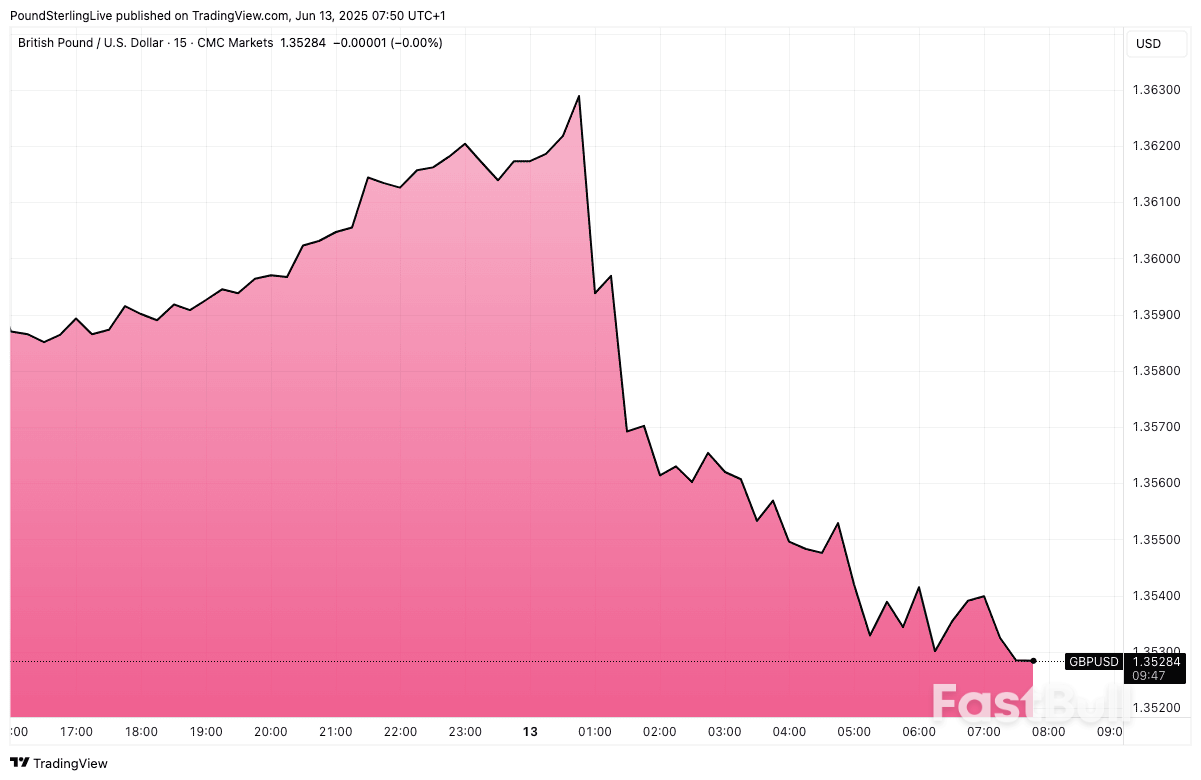
          Above: GBP/USD hit a two-year high, then dropped sharply as news of Isralie attacks filtered through.

          Ayatollah Ali Khamenei, Iran’s supreme leader, said Israel will receive "harsh punishment" for its attacks. Iran has since launched around 100 drones against Israel in response.
          If the Greenback's safe-haven status was ever in doubt, it won't be now: it has risen sharply as investors respond to news that Israel attacked key Iranian nuclear facilities and leadership. Iran has already responded.
          "The increase in the USD gives weight to our view that the USD still carries its safe haven status despite some of the trust being eroded in recent months by President Trump’s erratic policy making," says Kristina Clifton, FX strategist at Commonwealth Bank.
          Oil and gold are up, stocks are down and high-beta currencies such as the AUD and NZD are struggling. The Pound to Dollar exchange rate dropped to 1.3535 from a fresh two-year high at 1.3631 (down 0.56% on the day). The Pound is also lower against the Euro.
          The problem for a lot of currencies is that oil price: as oil prices rise, so too does the USD as oil is denominated in USDs.
          FX markets could therefore become increasingly sensitive to oil unless prices fall back soon. Commonwealth Bank's Commodities Strategist, Vivek Dhar, says a significant escalation of tension in the region would put $US80/bbl on the table for Brent futures in the near term.
          This would mean USD must appreciate sharply. "Higher oil prices typically support USD because the US is a net energy exporter," explains Clifton.
          Amarpreet Singh, a commodities specialist at Barclays, warns oil can go a lot higher from here:
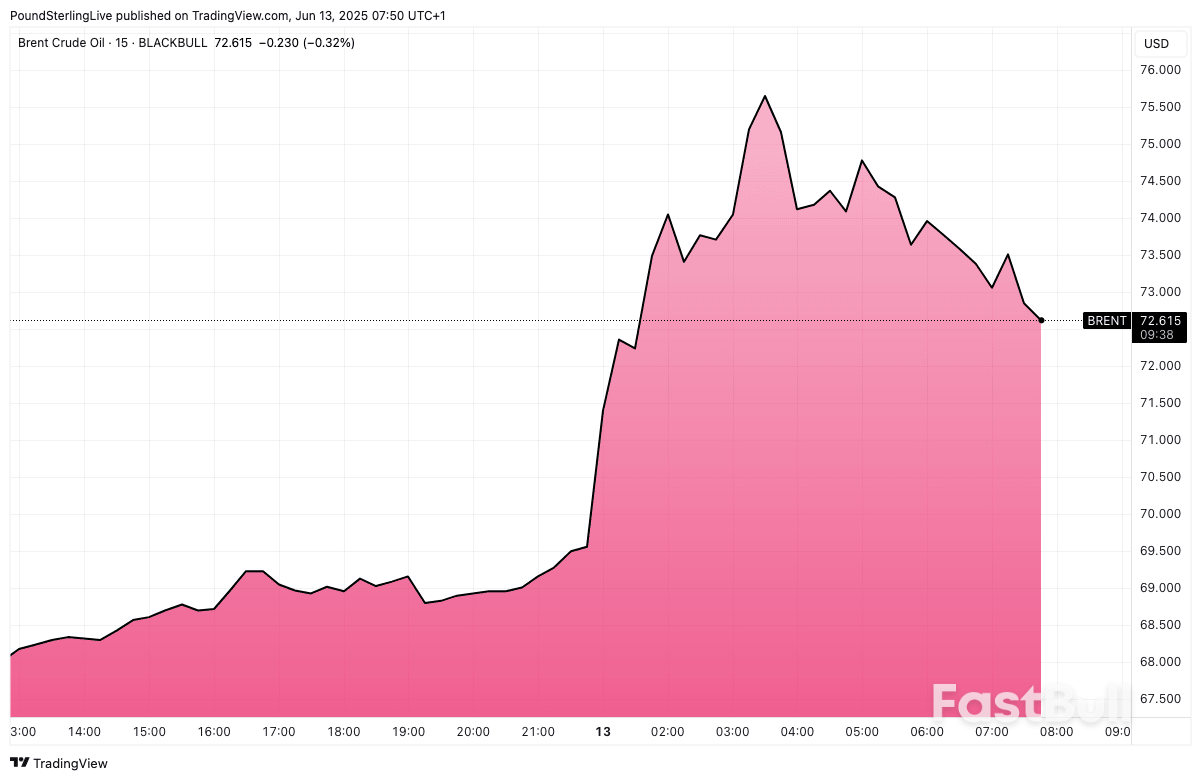
          "Oil markets have been alarmed by reports of Israeli attacks on Iranian nuclear and ballistic missiles infrastructure. Despite the ~10/b move higher in prices over the past three days, the worst case outcome is far from being in the price, in our view."
          Pound-to-Dollar: Return of the Safe Haven Posterboy_2

          Above: Brent crude oil prices jump

          Israel did not hit any of Iran's oil facilities, which would suggest a strong influence from the U.S., as successive U.S. presidents simply can't tolerate higher oil prices on the domestic scene.
          "So far, these attacks have had no effect on oil market fundamentals but the risk of that eventuality has obviously increased," says Singh. "In a worst-case scenario, the conflict could expand to other key oil and gas producers in the region, and shipping."
          The analyst says even a potential 1 mb/d drop in Iranian production is likely not fully reflected in the price yet, let alone an escalation that could involve disruption to energy flows through the Strait of Hormuz.
          The hope now is that the U.S. will lead a strong diplomatic push to end the burgeoning conflict, which is to be expected as President Trump fancies himself as a bringer of peace.
          The weekend will certainly see concerted behind-the-scenes pushes for peace.
          If successful, Friday's moves will be rapidly reversed on Monday, and the Dollar will be back on the depreciation path.
          "We have been confronted with a similar situation a few times since October 2023, and on each one of those occasions, cool heads have prevailed," says Singh.

          Source: Poundstrerlinglive

          To stay updated on all economic events of today, please check out our Economic calendar
          Risk Warnings and Disclaimers
          You understand and acknowledge that there is a high degree of risk involved in trading. Following any strategies or investment methods may lead to potential losses. The content on the site is provided by our contributors and analysts for information purposes only. You are solely responsible for determining whether any trading assets, securities, strategy, or any other product is suitable for investing based on your own investment objectives and financial situation.
          Add to Favorites
          Share

          Iran to Continue Nuclear Activities Amid Israeli Airstrikes

          Michelle

          Political

          Middle East Situation

          Iran announced it will continue its nuclear activities following airstrikes by Israel, a move confirmed by Iran's state television. The airstrikes have heightened tensions in the region, drawing international attention.

          This development underscores the continuing geopolitical tensions between Iran and Israel, potentially impacting global diplomacy and markets.

          Iran's Nuclear Path Presses on Despite Israeli Strikes

          Iran's commitment to its nuclear program remains steadfast. This declaration comes despite Israeli airstrikes targeting Iranian facilities, as reported by ChainCatcher news. The Atomic Energy Organization of Iran (AEOI), led by Mohammad Eslami, plays a crucial role in managing these activities, often emphasizing Iran's right to pursue nuclear advancements.

          The geopolitical landscape faces uncertainty as regional and global actors weigh responses. The E3, consisting of France, Germany, and the UK, maintain focus on possible repercussions, including sanctions that may disrupt traditional financial pathways. The Iranian military has issued warnings of retaliation against Israel and the United States, adding to the crisis's complexity.

          Iran will hold nuclear defense exercises at nuclear facilities in Iran on February 26 and 27. — Mohammad Eslami, Head of the Atomic Energy Organization of Iran

          Market and community reactions reflect anxiety over potential broader conflicts. Crypto markets, historically volatile during geopolitical crises, show no direct impact according to the latest data. However, stakeholders remain cautious, closely watching for any shifts that may disrupt financial stability or investor sentiment.

          Bitcoin's Subtle Market Moves Amid Iran-Israel Crisis

          Did you know? During previous Iran-Israel tensions, Bitcoin trading volumes often spiked as investors sought safe-haven assets, highlighting geopolitical impacts on crypto markets.

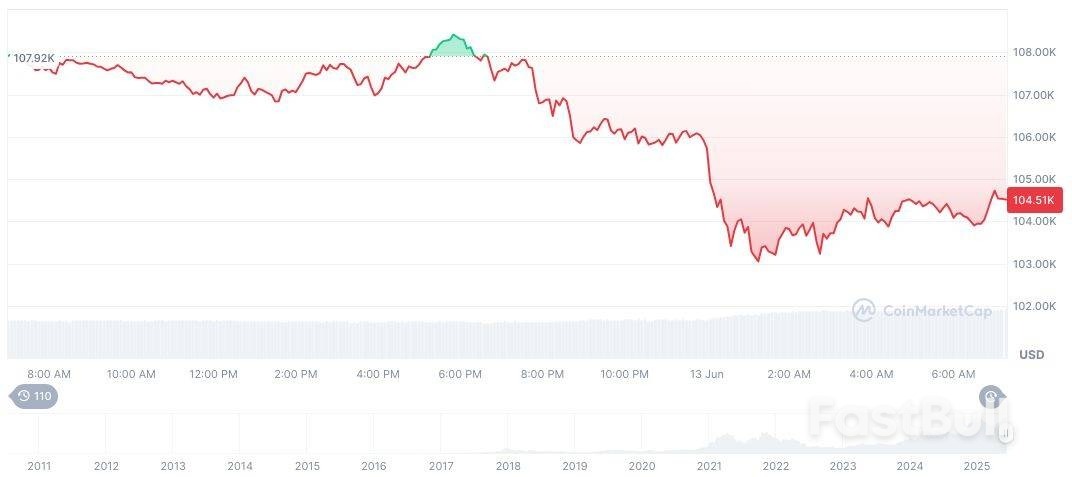
          According to CoinMarketCap, Bitcoin (BTC) trades at $105,029.34 with a market cap of $2.09 trillion, maintaining dominance at 63.86%. Data reflects a 2.17% dip over 24 hours but a 1.22% increase over the past week. The 24-hour trading volume of $72.05 billion represents a 36.31% change, showcasing significant market activity.

          Bitcoin(BTC), daily chart, screenshot on CoinMarketCap at 12:44 UTC on June 13, 2025. Source: CoinMarketCap

          Source: CryptoSlate

          Risk Warnings and Disclaimers
          You understand and acknowledge that there is a high degree of risk involved in trading. Following any strategies or investment methods may lead to potential losses. The content on the site is provided by our contributors and analysts for information purposes only. You are solely responsible for determining whether any trading assets, securities, strategy, or any other product is suitable for investing based on your own investment objectives and financial situation.
          Add to Favorites
          Share

          Trump’s One Big Beautiful Bill Act Mortgages America’s Economic Future

          Glendon

          Economic

          Forex

          The falling out between US President Donald Trump and Elon Musk, a onetime fixture at the White House, has abated for now. But one of the key factors that sunk the relationship remains: the One Big Beautiful Bill Act (‘OBBB’), condemned by Musk as an ‘abomination’ that will result in ‘crushing’ debt, is proceeding through Congress.

          Proponents tout the bill as the most consequential in US history, but Musk is right to point out its risks. His focus on fiscal irresponsibility is warranted, but only illuminates part of the lasting damage the OBBB could cause to US economic foundations.

          As written, the bill delivers or extends expansive tax cuts, including campaign promises on tip and overtime income. It also launches new child savings accounts, and bolsters immigration enforcement and military spending. Offsetting its price tag are unprecedented benefit cuts that will strip millions of health coverage and nutritional support. All told, the OBBB in its current form renders the poorest Americans worse off while funnelling the bulk of its benefits to the top quintile, and disproportionately to the richest.

          Beyond this accounting, however, other facets of the bill deserve special scrutiny. Its fiscal cost, the threat it presents to foreign investment, and the clean energy rollback it pursues threaten lasting damage to US economic dynamism and competitiveness.

          The debt ‘bomb’

          The OBBB’s immense debt burden – $2.4 trillion over a decade – has elicited concern across the ideological spectrum, even as the White House argues it strengthens the nation’s fiscal trajectory.

          Even before the OBBB, the US spent more on interest payments – over $1 trillion last year – than national defence. Adding lavishly to the national debt when interest rates are high and unemployment low is deeply irresponsible and could push the fiscal burden to alarming heights, increasing borrowing costs for consumers and businesses. The OBBB is, in the words of Republican Congressman Thomas Massie, a ‘debt bomb ticking’. But many of his peers remain unconvinced, instead holding fast to expectations of an economic boom.

          The crux of the fiscal debate is the recurring claim that tax cuts spur adequate economic activity to pay for themselves. OBBB’s proponents have embraced this notion, disproven time and again, even as reputable independent analyses find to the contrary. With the World Bank trimming the outlook for the US economy due to policy uncertainty and trade barriers, achieving the promised growth is increasingly improbable.

          Investor unease

          This fiscal expansion lands amid investor unease. Moody’s May downgrade of US debt and April’s bond market jitters add to other warning signs that investors are reconsidering the appeal and safety of dollar assets. Heightened fiscal pressures will leave the nation vulnerable to external shocks and hamstring its capacity to make transformational economic and security investments.

          An obscure provision, Section 899, threatens to further alienate foreign investors by creating a retaliatory tax on individuals and entities from nations imposing ‘unfair’ digital services or profit-shift taxes – countries supplying more than 80 per cent of US foreign direct investment (FDI).

          Foreign investors’ expansive US holdings – roughly 20 per cent of equities, 30 per cent of Treasuries, 30 per cent of corporate credit, and significant FDI – catalyse US job creation, growth, and innovation. The OBBB threatens this advantage, risking outflows that would harm US businesses, workers, and investors.

          Treasury Secretary Scott Bessent maintains that Section 899 empowers the US to reassert tax sovereignty where other countries overreach. But, in the context of the administration’s unilateral economic agenda (including tariffs), it looms as another coercive tool that could ‘transform a trade war into a capital war’. Even if the tax is never imposed – let alone reciprocal retaliation – its passage could chill investment, by calling into question the fundamental openness of the US system.

          Clean energy rollback

          A final threat to US competitiveness is the OBBB’s rollback of clean energy incentives as US energy demand surges.

          Hobbling clean energy development could needlessly constrain supply and force suboptimal policy decisions, especially given the huge energy demands of AI and data centres. Indeed, Trump’s eagerness to strike deals during his May visit to the Gulf attests to energy’s strategic potency in the AI context.

          Panned by its detractors as market-distorting giveaways, the Biden administration’s 2022 Inflation Reduction Act subsidies sparked a wave of energy investments, with the bulk of projects located in Republican-held districts.

          But the OBBB threatens incentives for businesses and households alike, including those for EVs, which Musk reportedly fought to save. By repealing and restricting tax credits for clean electricity production and investment, the bill undermines renewable energy development and financing. Complex restrictions on relationships with foreign entities would further harm investment.

          The current administration has sidelined climate priorities. But ensuring energy security and domestic production remain paramount, especially as US oil and gas producers face challenging market dynamics. The administration acknowledges as much, in particular in its push to build nuclear energy, which has a crucial role to play. But even an aggressive buildout would take years to bring substantial new capacity online.

          In the intervening years, undermining rapid deployment of renewables could constrain energy supply and drive up energy costs.

          Likewise, withdrawing support from nascent sectors like enhanced geothermal is profoundly short-sighted, allowing rivals to seize a strategic advantage as China did with solar production, sacrificing US deployment prospects and future export leadership. The rollback pulls against the administration’s own energy dominance objectives and chills innovation, with ripple effects into other sectors.

          Congressional jockeying is far from over. The OBBB’s reliance on ‘reconciliation,’ which allows Republicans to pass a bill without Democratic support, means a small group of legislators can wield outsize influence. Consternation is building within the Republican caucus and lobbying groups, and tweaks are likely to emerge on energy subsidies and Section 899, which could mitigate some risk.

          Material changes to the fiscal impact, however, will be difficult given factional disputes over various tax and benefit provisions, though some lawmakers have signalled opposition that could delay the bill.

          Still, the OBBB’s general shape is set. With pressure for a legislative victory mounting, it is a must-pass politically for Republicans. Failure to do so before the expiration of Trump’s first term tax cuts would lead to higher rates.

          It is also a must-pass for another urgent reason – the need to lift the fast-approaching debt ceiling and avoid default. Absent action to do so, the Treasury will no longer be able to meet its obligations in the coming months, inviting unprecedented catastrophe. Even approaching the deadline could spook markets.

          Ultimately, the OBBB’s fiscal irresponsibility, discouragement of foreign investment, and damage to energy innovation would sap American economic strength. As Congress wrangles over the bill’s details and Trump and Musk’s feud fades, it remains to be seen what of consequence will endure, and at what cost to whom. All eyes are now on the Senate, to see if it tempers the bill’s most reckless excesses.

          Source: Chatham House

          To stay updated on all economic events of today, please check out our Economic calendar
          Risk Warnings and Disclaimers
          You understand and acknowledge that there is a high degree of risk involved in trading. Following any strategies or investment methods may lead to potential losses. The content on the site is provided by our contributors and analysts for information purposes only. You are solely responsible for determining whether any trading assets, securities, strategy, or any other product is suitable for investing based on your own investment objectives and financial situation.
          Add to Favorites
          Share

          Trump Pressures Iran to Make Nuclear Deal as Israel Intensifies Strikes

          Gerik

          Middle East Situation

          A Dire Warning from Trump as Conflict Deepens

          In the aftermath of Israel’s unprecedented aerial assault on Iran’s nuclear facilities and military figures, President Trump used social media to urge Iran to return to the negotiating table to avoid further violence. His message comes as Israel claims to have deployed 200 aircraft in strikes across multiple Iranian cities, targeting more than 100 strategic locations including the Natanz nuclear site. The U.S. President warned that additional attacks had already been planned and could be even more destructive if Iran failed to make concessions swiftly.
          Trump’s statements mark a shift from his earlier commitment to diplomacy. Just one day prior, he had emphasized a desire for peaceful resolution, suggesting his administration was “committed to a Diplomatic Resolution.” However, he now frames the situation as a choice for Iran between escalation or negotiation.

          Iran Retaliates as Regional Tensions Spike

          In response, Iran launched waves of drones toward Israel, with some intercepted over Jordan, and more retaliation anticipated. Israeli sources indicated expectations of ballistic missile attacks as well. The strikes resulted in several explosions in Tehran, Natanz, and other cities, with Iranian media confirming the deaths of top military leaders including IRGC commander Hossein Salami and Chief of Staff Mohammad Bagheri.
          Despite the destruction, the International Atomic Energy Agency (IAEA) reported no signs of radiation leakage from the Natanz facility, suggesting that Israel’s attacks, while significant, may not have compromised the fortified core of Iran’s nuclear stockpile.

          Diplomacy at a Breaking Point

          The scheduled nuclear talks in Oman now hang in the balance. Iran’s Supreme Leader Ayatollah Khamenei vowed revenge, warning that Israel would “pay a very heavy price.” Meanwhile, Arab nations such as Oman, Saudi Arabia, the UAE, and Qatar criticized Israel’s actions, labeling them as reckless and threatening to regional stability.
          European leaders, including UK Prime Minister Keir Starmer, also urged de-escalation. Yet diplomatic progress appears fragile, especially with rising public and political pressure within Israel and Iran to maintain a hardline stance.

          Markets React: Oil, Gold, and Treasuries Surge

          Markets reflected the geopolitical shock, with Brent crude spiking over 8% to $75 per barrel before stabilizing. Investors also poured into traditional safe havens like gold and U.S. Treasuries, underscoring broader fears of a prolonged and unpredictable conflict in the Middle East.
          Despite Iran stating that its oil infrastructure was undamaged, fears of supply chain disruptions contributed to the volatility. As the world’s fifth-largest oil producer, Iran’s energy sector remains a critical node in global price stability.

          Strategic and Political Ramifications for the U.S.

          While Trump denied direct U.S. involvement in the strikes, Secretary of State Marco Rubio confirmed American forces were on alert and warned Iran against retaliating against U.S. personnel or assets. Notably, some U.S. embassy staff in Baghdad were ordered to evacuate, anticipating spillover risks.
          Republican lawmakers mostly backed Israel’s move, calling it a justified preemptive strike, while Democrats such as Senator Jack Reed criticized the action as reckless and called for urgent diplomatic intervention.
          The airstrikes represent a dramatic escalation compared to previous Israeli actions, which had avoided nuclear targets. For the first time, Israel has directly attacked sites central to Iran’s uranium enrichment program—long regarded as red lines due to their existential threat potential.

          Iran’s Nuclear Program at a Crossroads

          Tehran insists its nuclear ambitions are peaceful, aimed at civilian energy needs. However, uranium enrichment has expanded rapidly since Trump withdrew from the 2015 nuclear agreement. Last week, Iran revealed plans for a new enrichment facility, prompting criticism from the IAEA and paving the way for potential U.N. sanctions.
          This deepening crisis not only threatens diplomatic progress but also sets the stage for a renewed debate over how best to prevent nuclear proliferation in the region—through military deterrence, economic sanctions, or revived multilateral talks.
          The Israeli strikes, coupled with Trump’s ultimatums, may corner Iran into a binary choice between negotiation and intensified conflict. However, the regional fallout and lack of a coordinated diplomatic path forward pose severe risks. As military action expands and trust erodes, the window for peaceful resolution narrows—leaving the Middle East, and global energy markets, exposed to a volatile summer ahead.

          Source: Bloomberg

          Risk Warnings and Disclaimers
          You understand and acknowledge that there is a high degree of risk involved in trading. Following any strategies or investment methods may lead to potential losses. The content on the site is provided by our contributors and analysts for information purposes only. You are solely responsible for determining whether any trading assets, securities, strategy, or any other product is suitable for investing based on your own investment objectives and financial situation.
          Add to Favorites
          Share

          Gold Price Sharply Higher Following Israeli Attacks on Iran

          Michelle

          Commodity

          Political

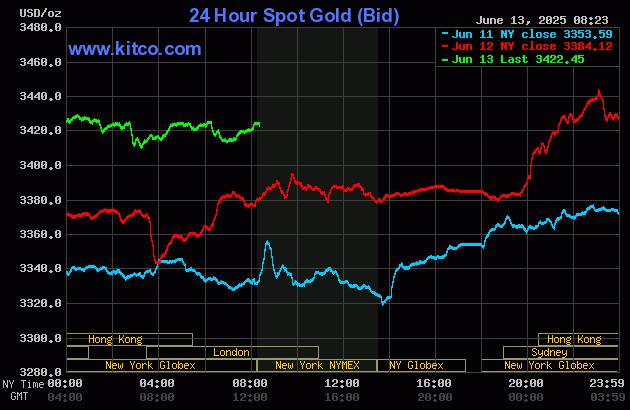
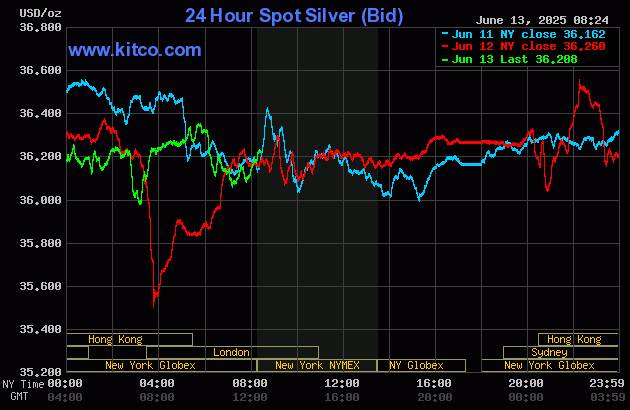
          Gold prices are solidly up and hit a five-week high in early U.S. trading Friday, on strong safe-haven demand following the overnight Israeli attacks on Iran that are being called major. Silver prices are modestly up. August gold was last up $41.90 at $3,444.30. July silver prices were last up $0.095 at $36.39.

          Risk aversion in highly elevated Friday amid the most severe military escalation between Israel and Iran in decades. Targeted Israeli airstrikes overnight killed several of Iran’s top generals and nuclear officials, paralyzing Tehran’s command structure and leaving the regime reeling. Israel said it is preparing for further military action.

          Gold prices rose to a five-week high and crude oil prices surged after Israel launched a wave of military strikes against Iranian nuclear and missile sites, raising fears of a broader Middle East conflict that could severely disrupt global energy supplies.

          In a post on Truth Social, Trump declared, “Iranian leaders didn’t know what was about to happen. They are all DEAD now, and it will only get worse! There has already been great death and destruction, but there is still time to make this slaughter, with the next already planned attacks being even more brutal, come to an end. Iran must make a deal, before there is nothing left, and save what was once known as the Iranian Empire.”Asian and European stocks were mostly lower overnight. U.S. stock indexes are pointed to sharply lower openings today in New York.

          The key outside markets today see the U.S. dollar index solidly up. Nymex crude oil futures prices are sharply higher, hit a five-month high and trading around $74.00 a barrel. The yield on the benchmark 10-year U.S. Treasury note is presently at 4.34%.

          U.S. economic data due for release Friday is light and includes the University of Michigan consumer sentiment survey.

          Technically, August gold futures bulls have the solid overall near-term technical advantage. Bulls’ next upside price objective is to produce a close above solid resistance at last week’s high of $3,427.70. Bears' next near-term downside price objective is pushing futures prices below solid technical support at $3,250.00. First resistance is seen at the overnight high of $3,467.00 and then at $3,477.30. First support is seen at $3,400.00 and then at Thursday’s low of $3,358.50. Wyckoff's Market Rating: 8.0.

          July silver futures bulls have the solid overall near-term technical advantage. Prices are trending higher on the daily bar chart. Silver bulls' next upside price objective is closing prices above solid technical resistance at $40.00. The next downside price objective for the bears is closing prices below solid support at $34.00. First resistance is seen at this week’s high of $37.03 and then at $37.50. Next support is seen at $36.00 and then at this week’s low of $35.58. Wyckoff's Market Rating: 7.5.

          Source: Kitco

          Risk Warnings and Disclaimers
          You understand and acknowledge that there is a high degree of risk involved in trading. Following any strategies or investment methods may lead to potential losses. The content on the site is provided by our contributors and analysts for information purposes only. You are solely responsible for determining whether any trading assets, securities, strategy, or any other product is suitable for investing based on your own investment objectives and financial situation.
          Add to Favorites
          Share

          U.S. Equity Outflows Slow as Inflation Cools and Trade Optimism Returns

          Gerik

          Economic

          Easing CPI and Trade Progress Stabilize Equity Fund Flows
          Investors showed signs of renewed confidence in U.S. markets, evidenced by the smallest weekly equity fund outflow in a month. According to LSEG Lipper data, U.S. equity funds saw net redemptions of just $212 million for the week ending June 11—a sharp improvement from previous weeks, driven largely by two key macroeconomic developments: cooler-than-expected consumer price index (CPI) figures for May and tentative progress on a U.S.-China trade accord.
          This shift marks a reversal from the significant equity sell-offs observed earlier in the year, reflecting reduced anxiety over potential interest rate hikes and protectionist shocks. The May CPI print helped ease fears of persistent inflation, reinforcing expectations that the Federal Reserve may stay on hold or even pivot to rate cuts later in the year.

          Sectoral Funds Lead with Targeted Inflows

          While overall equity fund flows remained slightly negative, U.S. sector-specific funds attracted considerable investor interest. Communication services, financials, and industrials led the gains, pulling in $529 million, $399 million, and $388 million, respectively. These sectors often perform well when economic sentiment stabilizes, as they tend to benefit from improved consumption, lending, and infrastructure activity.
          In contrast, broader market exposure through large-cap, mid-cap, and small-cap segments continued to experience net redemptions, with outflows of $2.65 billion, $1.35 billion, and $100 million respectively. This disparity suggests that investors are opting for more targeted exposure over general market allocation, possibly to mitigate perceived downside risks.

          Bond Funds and Yield-Hungry Investors Show Strength

          U.S. bond funds extended their winning streak to an eighth consecutive week, attracting $4.08 billion in net new capital. The inflows were concentrated in short-to-intermediate investment-grade corporate bonds ($2.37 billion), government and Treasury funds ($1.02 billion), and municipal debt ($523 million). The persistence of bond inflows points to investors continuing to seek relative safety and predictable income, particularly as expectations mount for potential Fed easing later this year.
          This trend is aligned with the view that bond markets are pricing in a plateau or even a decline in interest rates, particularly with inflation readings becoming more subdued. These allocations also highlight investor demand for assets with defensive characteristics in a still-uncertain macroeconomic landscape.

          Money Market Funds See Profit-Taking After Spike

          In a noteworthy shift, money market funds recorded net outflows of $15.18 billion, partially unwinding the massive $66.24 billion in inflows from the previous week. This suggests that investors may be reallocating capital from ultra-liquid holdings into higher-yielding or more opportunistic assets such as bonds and select equities. The move may also reflect positioning ahead of the upcoming Federal Reserve meeting, with some investors anticipating reduced short-term rate pressure.
          The combination of a softer inflation outlook and tentative trade stability appears to have triggered a pause in broader equity fund withdrawals. However, the uneven flows between general equity segments and specific sectors, along with robust bond inflows, suggest that investors remain cautious and selective. The upcoming Fed meeting will likely determine whether this cautious optimism turns into a more sustained rotation back into risk assets or if further defensive repositioning will be necessary.

          Source: Reuters

          To stay updated on all economic events of today, please check out our Economic calendar
          Risk Warnings and Disclaimers
          You understand and acknowledge that there is a high degree of risk involved in trading. Following any strategies or investment methods may lead to potential losses. The content on the site is provided by our contributors and analysts for information purposes only. You are solely responsible for determining whether any trading assets, securities, strategy, or any other product is suitable for investing based on your own investment objectives and financial situation.
          Add to Favorites
          Share
          FastBull
          Copyright © 2025 FastBull Ltd

          728 RM B 7/F GEE LOK IND BLDG NO 34 HUNG TO RD KWUN TONG KLN HONG KONG

          TelegramInstagramTwitterfacebooklinkedin
          App Store Google Play Google Play
          Products
          Charts

          Chats

          Q&A with Experts
          Screeners
          Economic Calendar
          Data
          Tools
          Membership
          Features
          Function
          Markets
          Copy Trading
          Latest Signals
          Contests
          News
          Analysis
          24/7
          Columns
          Education
          Company
          Careers
          About Us
          Contact Us
          Advertising
          Help Center
          Feedback
          User Agreement
          Privacy Policy
          Business

          White Label

          Data API

          Web Plug-ins

          Poster Maker

          Affiliate Program

          Risk Disclosure

          The risk of loss in trading financial instruments such as stocks, FX, commodities, futures, bonds, ETFs and crypto can be substantial. You may sustain a total loss of the funds that you deposit with your broker. Therefore, you should carefully consider whether such trading is suitable for you in light of your circumstances and financial resources.

          No decision to invest should be made without thoroughly conducting due diligence by yourself or consulting with your financial advisors. Our web content might not suit you since we don't know your financial conditions and investment needs. Our financial information might have latency or contain inaccuracy, so you should be fully responsible for any of your trading and investment decisions. The company will not be responsible for your capital loss.

          Without getting permission from the website, you are not allowed to copy the website's graphics, texts, or trademarks. Intellectual property rights in the content or data incorporated into this website belong to its providers and exchange merchants.

          Not Logged In

          Log in to access more features

          FastBull Membership

          Not yet

          Purchase

          Become a signal provider
          Help Center
          Customer Service
          Dark Mode
          Price Up/Down Colors

          Log In

          Sign Up

          Position
          Layout
          Fullscreen
          Default to Chart
          The chart page opens by default when you visit fastbull.com