

Markets
News
Analysis
User
24/7
Economic Calendar
Education
Data
- Names
- Latest
- Prev



Signal Accounts for Members
All Signal Accounts
All Contests
 Japan Tankan Small Manufacturing Outlook Index (Q4)
A:--
F: --
P: --
Japan Tankan Large Non-Manufacturing Outlook Index (Q4)A:--
F: --
P: --
Japan Tankan Large Manufacturing Outlook Index (Q4)A:--
F: --
P: --
Japan Tankan Small Manufacturing Diffusion Index (Q4)A:--
F: --
P: --
Japan Tankan Large Manufacturing Diffusion Index (Q4)A:--
F: --
P: --
Japan Tankan Large-Enterprise Capital Expenditure YoY (Q4)A:--
F: --
P: --
 U.K. Rightmove House Price Index YoY (Dec)
A:--
F: --
P: --
 China, Mainland Industrial Output YoY (YTD) (Nov)
A:--
F: --
P: --
China, Mainland Urban Area Unemployment Rate (Nov)A:--
F: --
P: --
 Saudi Arabia CPI YoY (Nov)
A:--
F: --
P: --
 Euro Zone Industrial Output YoY (Oct)
A:--
F: --
P: --
Euro Zone Industrial Output MoM (Oct)A:--
F: --
P: --
 Canada Existing Home Sales MoM (Nov)
A:--
F: --
P: --
Canada National Economic Confidence IndexA:--
F: --
P: --
Canada New Housing Starts (Nov)A:--
F: --
 U.S. NY Fed Manufacturing Employment Index (Dec)
A:--
F: --
P: --
U.S. NY Fed Manufacturing Index (Dec)A:--
F: --
P: --
Canada Core CPI YoY (Nov)A:--
F: --
P: --
Canada Manufacturing Unfilled Orders MoM (Oct)A:--
F: --
P: --
U.S. NY Fed Manufacturing Prices Received Index (Dec)A:--
F: --
P: --
U.S. NY Fed Manufacturing New Orders Index (Dec)A:--
F: --
P: --
Canada Manufacturing New Orders MoM (Oct)A:--
F: --
P: --
Canada Core CPI MoM (Nov)A:--
F: --
P: --
Canada Trimmed CPI YoY (SA) (Nov)A:--
F: --
P: --
Canada Manufacturing Inventory MoM (Oct)A:--
F: --
P: --
Canada CPI YoY (Nov)A:--
F: --
P: --
Canada CPI MoM (Nov)A:--
F: --
P: --
Canada CPI YoY (SA) (Nov)A:--
F: --
P: --
Canada Core CPI MoM (SA) (Nov)A:--
F: --
P: --
Canada CPI MoM (SA) (Nov)A:--
F: --
P: --
Federal Reserve Board Governor Milan delivered a speech U.S. NAHB Housing Market Index (Dec)--
F: --
P: --
 Australia Composite PMI Prelim (Dec)
--
F: --
P: --
Australia Services PMI Prelim (Dec)--
F: --
P: --
Australia Manufacturing PMI Prelim (Dec)--
F: --
P: --
Japan Manufacturing PMI Prelim (SA) (Dec)--
F: --
P: --
U.K. 3-Month ILO Employment Change (Oct)--
F: --
P: --
U.K. Unemployment Claimant Count (Nov)--
F: --
P: --
U.K. Unemployment Rate (Nov)--
F: --
P: --
U.K. 3-Month ILO Unemployment Rate (Oct)--
F: --
P: --
U.K. Average Weekly Earnings (3-Month Average, Including Bonuses) YoY (Oct)--
F: --
P: --
U.K. Average Weekly Earnings (3-Month Average, Excluding Bonuses) YoY (Oct)--
F: --
P: --
 France Services PMI Prelim (Dec)
--
F: --
P: --
France Composite PMI Prelim (SA) (Dec)--
F: --
P: --
France Manufacturing PMI Prelim (Dec)--
F: --
P: --
 Germany Services PMI Prelim (SA) (Dec)
--
F: --
P: --


No matching data

Latest Views
Latest Views
Trending Topics
Top Columnists
Latest Update
White Label
Data API
Web Plug-ins
Affiliate Program
View All
No data
U.S. President Donald Trump's rollback of some of the steep tariffs he has imposed has done little to lower the average import duty rate from the elevated levels to which his wave of levies had driven them, researchers from Yale University said on Thursday.
Trump on Wednesday unveiled a 90-day pause on the highest rates he had imposed under the two-tiered global tariffs he had announced a week earlier. Under the hiatus - meant to allow for countries to bargain for a permanently lower rate - import taxes on goods from most U.S. trading partners will reset to 10%. At the same time, though, he increased his retaliatory "reciprocal" rate on China to 125%, and 25% tariffs on many Canadian and Mexican imports and on imported autos, steel and aluminum also remain in effect.
"Consumers face an overall average effective tariff rate of 25.3%, the highest since 1909," the Yale Budget Lab wrote. "This is only slightly different from where the effective rate was before the late-April 9 announcement. Even after consumption shifts, the average tariff rate will be 18.1%, the highest since 1934."
The Budget Lab said its estimates reflect the effects all U.S. tariffs and foreign retaliation implemented in 2025 through April 9, including the revised April 9 tariffs.
(April 10): Oil prices retreated 2% on Thursday as fears of a deepening US-China trade war and a possible recession eclipsed earlier relief created by President Donald Trump's announcement of a 90-day pause on some tariffs against most countries.
Brent futures fell US$1.55, or 2.37%, to US$63.93 a barrel by 1027 GMT. While US West Texas Intermediate crude futures dropped US$1.51, or 2.42%, to US$60.84.
The retreat followed a volatile session on Wednesday, when crude benchmarks, which had tumbled as much as 7% earlier in the day, ended around 4% higher following Trump's announcement of a pause on reciprocal tariffs on most countries, though he maintained a baseline tariff rate of 10%.
However, the reprieve excluded China. Trump increased tariffs on Chinese imports to 125% from 104%, deepening a trade standoff with the world's second-largest economy and a leading consumer of crude.
The trade war between the US and China leaves significant uncertainty over oil demand growth with more risk to downside for prices, said Ashley Kelty, analyst at Panmure Liberum.
"Volatility remains high, and it remains tricky to see where oil prices may settle in near-term," said Kelty.
China also announced an additional import levy on US goods, imposing an 84% tariff from Thursday.
Despite the tariff pause, Ole Hansen, head of commodity strategy at Saxo Bank, said the world was still facing the most severe trade barriers since the 1930s.
"With a lot of uncertainty still existing, the prospect for a major rebound in crude is not possible at this stage when the market has to deal with the risk of weakening demand and rising production from Opec," said Hansen.
Analysts at ANZ Research warned that a deeper global slowdown could push prices lower still.
"In a worst-case scenario of a global recession (which is not our base case), there is scope for further weakness... for oil, we view US$50/bbl as a likely support level," the analysts said in a note.
Investors were eyeing mixed supply drivers as well.
The Keystone oil pipeline from Canada to the United States remained shut on Wednesday following an oil spill near Fort Ransom, North Dakota, while plans to return it to service were being evaluated, its operator South Bow said.
Elsewhere, the Caspian Pipeline Consortium resumed loading oil at one of two previously shut Black Sea moorings, it said on Wednesday, after a court lifted restrictions put on the Western-backed group's facility by a Russian regulator.
In the United States, crude inventories rose by 2.6 million barrels in the week to April 4, the Energy Information Administration said, nearly double the expectations in a Reuters poll for a 1.4-million-barrel rise.
Underlying US inflation cooled broadly in March, indicating some relief for consumers prior to widespread tariffs that risk contributing to price pressures.
The consumer price index, excluding often volatile food and energy costs, increased 0.1% from February, the least in nine months, according to Bureau of Labor Statistics data out Thursday. Compared with March of last year, the core CPI rose 2.8%, remaining the tamest in nearly four years.
The overall CPI declined 0.1% from a month earlier, the first decrease in nearly five years, and rose 2.4% on a year-over-year basis.
The CPI was helped by a decline in energy costs, used cars and airfares, as well as slower price growth in apparel.
Treasury yields slid and S&P 500 index futures remained lower and the dollar extended its decline on the day.
While the figures indicate some relief for consumers who have struggled with higher prices for years, the good news risks being short-lived after President Donald Trump put in place more expansive tariffs.
While Trump announced 90-day pause on higher reciprocal tariffs on Wednesday — less than 24 hours after they came into effect — imports from most countries are now subject to 10% duties. The US began collecting tariffs last month on imported steel and aluminum, and levies on China now stand at 125% after retaliation from Beijing earlier this week.
Some of the higher import costs will ultimately be passed on to the consumers, and companies from Target Co. to Volkswagen AG have warned higher prices are in store for Americans.
The uncertainty is keeping Federal Reserve officials in wait-and-see mode as they look for more clarity on the impact the levies will have on inflation — and the economy more broadly.
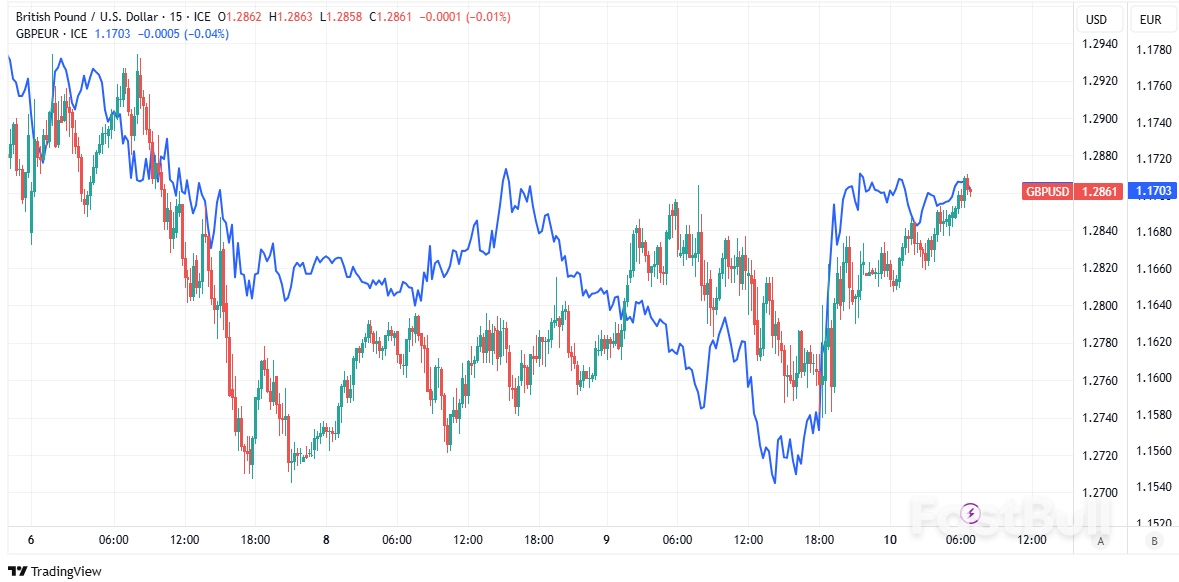 Above: Pound to Dollar rate shown at 15-minute intervals, with GBP/EUR. Click for closer inspection.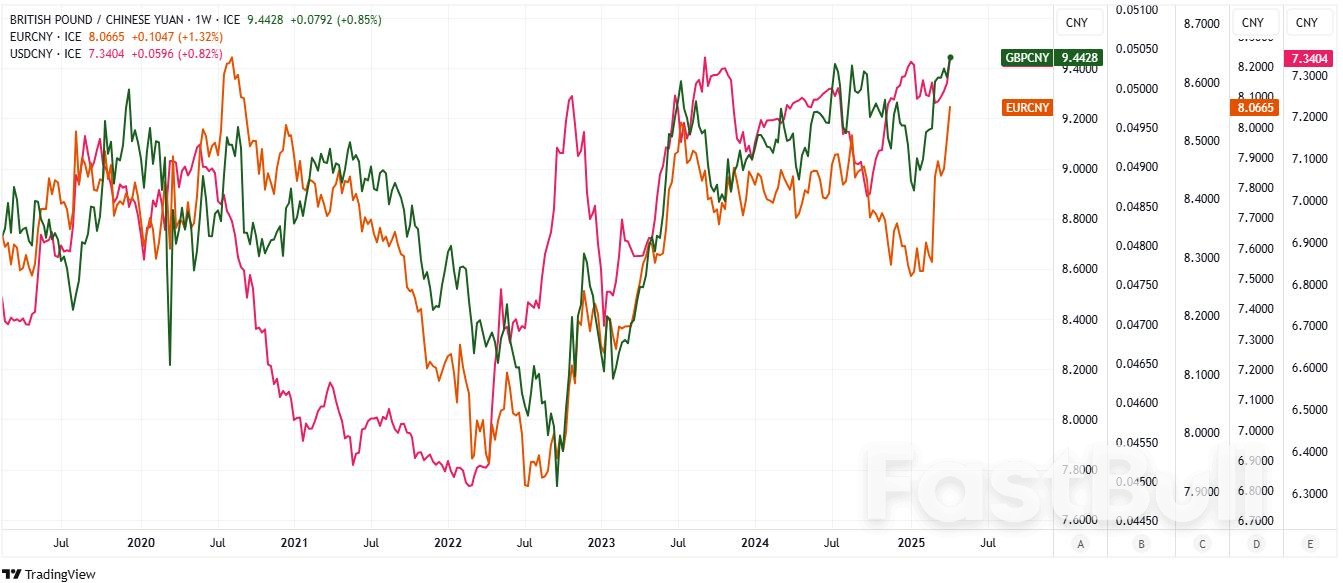
Gold rose again after posting its biggest one-day gain in 18 months, as confusion over US President Donald Trump’s tariff agenda drove investors to buy the precious metal as a haven.
Bullion climbed as much as 1.6% on Thursday and was trading less than $50 short of last week’s all-time high. That’s after it closed up 3.3% on Wednesday in a whipsaw day for markets. The precious metal has also been supported by a weaker greenback.
Gold’s initial surge in the previous session came after US tariffs on around 60 trading parters kicked in, fueling market upheavals and increasing worries about a global recession. Then Trump announced a 90-day pause to higher tariffs on 56 countries and the European Union, which will now be taxed at the 10% baseline rate.
“When you’re in a crisis and gold is selling off, that’s telling you you’ve got a liquidity problem,” Carlyle Group Inc.’s Jeff Currie told Bloomberg Television on Thursday. “Then boom, they came out with the reprieve, gold bounced back up which is telling you liquidity came back into the system,” he said.
Still, Trump also hiked duties on China to 125%, effective immediately, after Beijing announced plans to retaliate with an 84% tariff to start Thursday. Those moves are exacerbating concerns the world’s two biggest economies will become enmeshed in a crippling trade war.
Markets rallied after Trump’s tariff-pause announcement. US stocks had their best day since the financial crisis, with the S&P 500 soaring nearly 10%, after slumping to the fringe of a bear market in the past week.
The constant back-and-forth of the US administration’s tariff plan has rocked the world, as investors scramble to find direction and certainty. That’s generally been supportive for gold, which is up 19% this year. The metal has also been bolstered by hopes for more Federal Reserve monetary easing and central-bank buying.
“We remain quite positive for gold,” Dominic Schnider, head of commodities and Asia Pacific currencies at UBS Global Wealth Management, said on Bloomberg Television. “The next step is going to be, at some point, the Fed coming in — and that gives the next leg up for gold.”
728 RM B 7/F GEE LOK IND BLDG NO 34 HUNG TO RD KWUN TONG KLN HONG KONG


White Label
Data API
Web Plug-ins
Poster Maker
Affiliate Program
The risk of loss in trading financial instruments such as stocks, FX, commodities, futures, bonds, ETFs and crypto can be substantial. You may sustain a total loss of the funds that you deposit with your broker. Therefore, you should carefully consider whether such trading is suitable for you in light of your circumstances and financial resources.
No decision to invest should be made without thoroughly conducting due diligence by yourself or consulting with your financial advisors. Our web content might not suit you since we don't know your financial conditions and investment needs. Our financial information might have latency or contain inaccuracy, so you should be fully responsible for any of your trading and investment decisions. The company will not be responsible for your capital loss.
Without getting permission from the website, you are not allowed to copy the website's graphics, texts, or trademarks. Intellectual property rights in the content or data incorporated into this website belong to its providers and exchange merchants.
Not Logged In
Log in to access more features

FastBull Membership
Not yet
Purchase


Log In
Sign Up


