• Trade
  • Markets
  • Copy
  • Contests
  • News
  • 24/7
  • Calendar
  • Q&A
  • Chats
Trending
Screeners
SYMBOL
LAST
BID
ASK
HIGH
LOW
NET CHG.
%CHG.
SPREAD
SPX
S&P 500 Index
6857.13
6857.13
6857.13
6865.94
6827.13
+7.41
+ 0.11%
--
DJI
Dow Jones Industrial Average
47850.93
47850.93
47850.93
48049.72
47692.96
-31.96
-0.07%
--
IXIC
NASDAQ Composite Index
23505.13
23505.13
23505.13
23528.53
23372.33
+51.04
+ 0.22%
--
USDX
US Dollar Index
98.970
99.050
98.970
99.000
98.740
-0.010
-0.01%
--
EURUSD
Euro / US Dollar
1.16451
1.16459
1.16451
1.16715
1.16408
+0.00006
+ 0.01%
--
GBPUSD
Pound Sterling / US Dollar
1.33338
1.33345
1.33338
1.33622
1.33165
+0.00067
+ 0.05%
--
XAUUSD
Gold / US Dollar
4223.01
4223.35
4223.01
4230.62
4194.54
+15.84
+ 0.38%
--
WTI
Light Sweet Crude Oil
59.325
59.355
59.325
59.543
59.187
-0.058
-0.10%
--

Community Accounts

Signal Accounts
--
Profit Accounts
--
Loss Accounts
--
View More

Become a signal provider

Sell trading signals to earn additional income

View More

Guide to Copy Trading

Get started with ease and confidence

View More

Signal Accounts for Members

All Signal Accounts

Best Return
  • Best Return
  • Best P/L
  • Best MDD
Past 1W
  • Past 1W
  • Past 1M
  • Past 1Y

All Contests

  • All
  • Trump Updates
  • Recommend
  • Stocks
  • Cryptocurrencies
  • Central Banks
  • Featured News
Top News Only
Share

India's Forex Reserves Fall To $686.23 Billion As Of Nov 28

Share

Reserve Bank Of India Says Federal Government Had No Outstanding Loans With It As On Nov 28

Share

Lebanon Says Ceasefire Talks Aim Mainly At Halting Israel's Hostilities

Share

Russia Plans To Boost Oil Exports From Western Ports By 27% In December From November -Sources And Reuters Calculations

Share

Sberbank- Estimated Investment Of $100 Million In Technology, Team Expansion, And New Offices In India

Share

Sberbank Says Sberbank Unveils Major Expansion Strategy For India, Plans Full-Scale Banking, Education, And Tech Transfer

Share

India Government: Expect That Flight Schedules Will Begin To Stabilise And Return To Normal By Dec 6

Share

EU: Tiktok Agrees To Changes To Advertising Repositories To Ensure Transparency, No Fine

Share

EU Tech Chief: Not EU's Intention To Impose Highest Fines, X Fine Is Proportionate, Based On Nature Of Infringement, Impact On EU Users

Share

EU Regulators: EU Investigation Into X's Dissemination Of Illegal Content, Measures To Counter Disinformation Continues

Share

Ukraine's Military Says It Hit Russian Port In Krasnodar Region

Share

Jumped The Gun, Says Morgan Stanley, Reverses Dec Fed Rate Call To 25Bps Cut

Share

Lebanese President Aoun:Lebanon Welcomes Any Country Keeping Its Forces In South Lebanon To Help Army After End Of Unifil's Mission

Share

China Cabinet Meeting: Will Firmly Prevent Major Fire Incidents

Share

China Cabinet Meeting: China To Crack Down On Abuse Of Power In Enterprise-Related Law Enforcement

Share

[Shanghai Futures Exchange: Adjustment Of Margin Ratios And Price Limits For Fuel Oil And Other Futures Contracts] After Research And Decision, Effective From The Closing Settlement On Tuesday, December 9, 2025, The Margin Ratios And Price Limits Will Be Adjusted As Follows: The Price Limit For Fuel Oil And Petroleum Asphalt Futures Contracts Will Be Adjusted To 7%, The Margin Ratio For Hedging Positions Will Be Adjusted To 8%, And The Margin Ratio For General Positions Will Be Adjusted To 9%

Share

Lebanese President Aoun:Lebanon Opted For Negotiations With Israel To Avoid Another Round Of Violence

Share

Chile's Consumer Prices Up 0.3% Month-On-Month In November

Share

Standard Chartered: Settlement Was Deemed Appropriate In Bringing In 'Mercy Investment Services & Others V. Standard Chartered' Case To Close

Share

Reuters Poll - Bank Of Canada Will Hold Overnight Rate At 2.25% On December 10, Say 33 Economists

TIME
ACT
FCST
PREV
U.S. Challenger Job Cuts MoM (Nov)

A:--

F: --

P: --

U.S. Initial Jobless Claims 4-Week Avg. (SA)

A:--

F: --

P: --

U.S. Weekly Initial Jobless Claims (SA)

A:--

F: --

P: --

U.S. Weekly Continued Jobless Claims (SA)

A:--

F: --

P: --

Canada Ivey PMI (SA) (Nov)

A:--

F: --

P: --

Canada Ivey PMI (Not SA) (Nov)

A:--

F: --

P: --

U.S. Non-Defense Capital Durable Goods Orders Revised MoM (Excl. Aircraft) (SA) (Sept)

A:--

F: --

P: --
U.S. Factory Orders MoM (Excl. Transport) (Sept)

A:--

F: --

P: --

U.S. Factory Orders MoM (Sept)

A:--

F: --

P: --

U.S. Factory Orders MoM (Excl. Defense) (Sept)

A:--

F: --

P: --

U.S. EIA Weekly Natural Gas Stocks Change

A:--

F: --

P: --

Saudi Arabia Crude Oil Production

A:--

F: --

P: --

U.S. Weekly Treasuries Held by Foreign Central Banks

A:--

F: --

P: --

Japan Foreign Exchange Reserves (Nov)

A:--

F: --

P: --

India Repo Rate

A:--

F: --

P: --

India Benchmark Interest Rate

A:--

F: --

P: --

India Reverse Repo Rate

A:--

F: --

P: --

India Cash Reserve Ratio

A:--

F: --

P: --

Japan Leading Indicators Prelim (Oct)

A:--

F: --

P: --

U.K. Halifax House Price Index YoY (SA) (Nov)

A:--

F: --

P: --

U.K. Halifax House Price Index MoM (SA) (Nov)

A:--

F: --

P: --

France Current Account (Not SA) (Oct)

A:--

F: --

P: --

France Trade Balance (SA) (Oct)

A:--

F: --

P: --

France Industrial Output MoM (SA) (Oct)

A:--

F: --

P: --

Italy Retail Sales MoM (SA) (Oct)

A:--

F: --

P: --

Euro Zone Employment YoY (SA) (Q3)

A:--

F: --

P: --

Euro Zone GDP Final YoY (Q3)

A:--

F: --

P: --

Euro Zone GDP Final QoQ (Q3)

A:--

F: --

P: --

Euro Zone Employment Final QoQ (SA) (Q3)

A:--

F: --

P: --

Euro Zone Employment Final (SA) (Q3)

A:--

F: --

P: --
Brazil PPI MoM (Oct)

--

F: --

P: --

Mexico Consumer Confidence Index (Nov)

--

F: --

P: --

Canada Unemployment Rate (SA) (Nov)

--

F: --

P: --

Canada Labor Force Participation Rate (SA) (Nov)

--

F: --

P: --

Canada Employment (SA) (Nov)

--

F: --

P: --

Canada Part-Time Employment (SA) (Nov)

--

F: --

P: --

Canada Full-time Employment (SA) (Nov)

--

F: --

P: --

U.S. Personal Income MoM (Sept)

--

F: --

P: --

U.S. Dallas Fed PCE Price Index YoY (Sept)

--

F: --

P: --

U.S. PCE Price Index YoY (SA) (Sept)

--

F: --

P: --

U.S. PCE Price Index MoM (Sept)

--

F: --

P: --

U.S. Personal Outlays MoM (SA) (Sept)

--

F: --

P: --

U.S. Core PCE Price Index MoM (Sept)

--

F: --

P: --

U.S. UMich 5-Year-Ahead Inflation Expectations Prelim YoY (Dec)

--

F: --

P: --

U.S. Core PCE Price Index YoY (Sept)

--

F: --

P: --

U.S. Real Personal Consumption Expenditures MoM (Sept)

--

F: --

P: --

U.S. 5-10 Year-Ahead Inflation Expectations (Dec)

--

F: --

P: --

U.S. UMich Current Economic Conditions Index Prelim (Dec)

--

F: --

P: --

U.S. UMich Consumer Sentiment Index Prelim (Dec)

--

F: --

P: --

U.S. UMich 1-Year-Ahead Inflation Expectations Prelim (Dec)

--

F: --

P: --

U.S. UMich Consumer Expectations Index Prelim (Dec)

--

F: --

P: --

U.S. Weekly Total Rig Count

--

F: --

P: --

U.S. Weekly Total Oil Rig Count

--

F: --

P: --

U.S. Consumer Credit (SA) (Oct)

--

F: --

P: --

China, Mainland Foreign Exchange Reserves (Nov)

--

F: --

P: --

China, Mainland Exports YoY (USD) (Nov)

--

F: --

P: --

China, Mainland Imports YoY (CNH) (Nov)

--

F: --

P: --

China, Mainland Imports YoY (USD) (Nov)

--

F: --

P: --

China, Mainland Trade Balance (CNH) (Nov)

--

F: --

P: --

China, Mainland Exports (Nov)

--

F: --

P: --

Q&A with Experts
    • All
    • Chatrooms
    • Groups
    • Friends
    Connecting
    .
    .
    .
    Type here...
    Add Symbol or Code

      No matching data

      All
      Trump Updates
      Recommend
      Stocks
      Cryptocurrencies
      Central Banks
      Featured News
      • All
      • Russia-Ukraine Conflict
      • Middle East Flashpoint
      • All
      • Russia-Ukraine Conflict
      • Middle East Flashpoint
      Search
      Products

      Charts Free Forever

      Chats Q&A with Experts
      Screeners Economic Calendar Data Tools
      Membership Features
      Data Warehouse Market Trends Institutional Data Policy Rates Macro

      Market Trends

      Market Sentiment Order Book Forex Correlations

      Top Indicators

      Charts Free Forever
      Markets

      News

      News Analysis 24/7 Columns Education
      From Institutions From Analysts
      Topics Columnists

      Latest Views

      Latest Views

      Trending Topics

      Top Columnists

      Latest Update

      Signals

      Copy Rankings Latest Signals Become a signal provider AI Rating
      Contests
      Brokers

      Overview Brokers Assessment Rankings Regulators News Claims
      Broker listing Forex Brokers Comparison Tool Live Spread Comparison Scam
      Q&A Complaint Scam Alert Videos Tips to Detect Scam
      More

      Business
      Events
      Careers About Us Advertising Help Center

      White Label

      Data API

      Web Plug-ins

      Affiliate Program

      Awards Institution Evaluation IB Seminar Salon Event Exhibition
      Vietnam Thailand Singapore Dubai
      Fans Party Investment Sharing Session
      FastBull Summit BrokersView Expo
      Recent Searches
        Top Searches
          Markets
          News
          Analysis
          User
          24/7
          Economic Calendar
          Education
          Data
          • Names
          • Latest
          • Prev

          View All

          No data

          Scan to Download

          Faster Charts, Chat Faster!

          Download App
          English
          • English
          • Español
          • العربية
          • Bahasa Indonesia
          • Bahasa Melayu
          • Tiếng Việt
          • ภาษาไทย
          • Français
          • Italiano
          • Türkçe
          • Русский язык
          • 简中
          • 繁中
          Open Account
          Search
          Products
          Charts Free Forever
          Markets
          News
          Signals

          Copy Rankings Latest Signals Become a signal provider AI Rating
          Contests
          Brokers

          Overview Brokers Assessment Rankings Regulators News Claims
          Broker listing Forex Brokers Comparison Tool Live Spread Comparison Scam
          Q&A Complaint Scam Alert Videos Tips to Detect Scam
          More

          Business
          Events
          Careers About Us Advertising Help Center

          White Label

          Data API

          Web Plug-ins

          Affiliate Program

          Awards Institution Evaluation IB Seminar Salon Event Exhibition
          Vietnam Thailand Singapore Dubai
          Fans Party Investment Sharing Session
          FastBull Summit BrokersView Expo

          Trump’s Shift on China Tariff Threat Calms Markets Amid Escalating Tensions

          Gerik

          Economic

          Palestinian-Israeli conflict

          Summary:

          After a sharp market sell-off triggered by a potential 100% tariff on Chinese imports, U.S. futures rebounded when President Trump hinted he may reverse the decision...

          Market Rebounds Following Trump’s Unexpected Softened Rhetoric

          Following a steep decline on Friday, U.S. stock futures made notable gains Sunday evening, reversing the market’s previous pessimism. The Dow rose by 0.8%, the S&P 500 by 1.04%, and the Nasdaq by 1.34% as of 6:32 p.m. ET. This rebound followed President Donald Trump’s reassurances, including the vague but calming message on Truth Social: “It will all be fine!” which signaled a possible retreat from his earlier hardline stance on China.
          The volatility began with Trump’s announcement of a new 100% tariff on Chinese goods, scheduled to take effect on November 1. If implemented, this would increase overall tariffs on Chinese imports to 130%, approaching the 145% ceiling seen during the peak of the previous tariff conflict. This escalation led the S&P 500 and Nasdaq to record their worst single-day performances since April, while the Dow suffered its sharpest drop since May.
          The announcement ignited fears across global markets, as investors interpreted the threat as a revival of a full-scale trade war between the world’s two largest economies.

          Signals of De-escalation Provide Temporary Relief

          However, Trump’s comments on Sunday during a press briefing aboard Air Force One introduced a new tone. Referring to President Xi Jinping as “a great leader” and emphasizing their “great relationship,” Trump’s words suggested a renewed openness to dialogue. Although not a concrete reversal, the language offered a stark contrast to his earlier claim that China had become “very hostile.”
          The change in tone coincided with mounting pressure after Beijing tightened its export restrictions on rare earth minerals essential inputs for many U.S. tech and defense products. This action likely added complexity to Trump’s decision calculus, making an immediate imposition of tariffs less attractive.

          Beijing’s Response Reflects a Hardening Position

          Despite Trump’s softer rhetoric, China’s position remained firm. On Sunday, the Chinese Ministry of Commerce warned of countermeasures if Washington proceeds with its tariff plans. The ministry's statement emphasized that while China does not seek a tariff war, it remains fully prepared to respond to one. Their reaction signaled that any signs of U.S. hesitation might be viewed as an opportunity to maintain strategic leverage.
          Furthermore, China countered U.S. claims of being blindsided by the export restrictions. According to a ministry spokesperson, “relevant countries and regions” had indeed been notified a clear refutation of U.S. Trade Representative Jamieson Greer’s remarks on Fox News that the U.S. received no prior warning.

          Uncertainty Clouds the November 1 Deadline

          Despite market optimism, a deeper look reveals unresolved uncertainty. Trump’s statement, “Let’s see what happens,” when asked about the looming November 1 deadline, underscores the volatility inherent in this diplomatic standoff. Previous instances in Trump’s presidency have shown last-minute reversals or delays in similar tariff threats, creating a pattern of unpredictability that the market struggles to price in.
          This creates a correlation rather than a clear causation between Trump’s public statements and market movement: while his reassurances boost short-term sentiment, they do not guarantee long-term policy stability.
          The market's modest recovery reflects relief that the worst-case scenario may not materialize immediately. However, the fragile state of U.S.–China trade relations remains unchanged. Investors are likely to remain cautious until clearer signals are delivered regarding the implementation of the proposed tariffs. As diplomatic maneuvering continues, both the U.S. and China appear to be testing each other’s resolve in a geopolitical contest with real economic consequences. The balance between public diplomacy and strategic retaliation continues to shape investor confidence in real time.

          Source: CNN

          To stay updated on all economic events of today, please check out our Economic calendar
          Risk Warnings and Disclaimers
          You understand and acknowledge that there is a high degree of risk involved in trading. Following any strategies or investment methods may lead to potential losses. The content on the site is provided by our contributors and analysts for information purposes only. You are solely responsible for determining whether any trading assets, securities, strategy, or any other product is suitable for investing based on your own investment objectives and financial situation.
          Add to Favorites
          Share

          AUDUSD Wave Analysis

          Blue River

          Technical Analysis

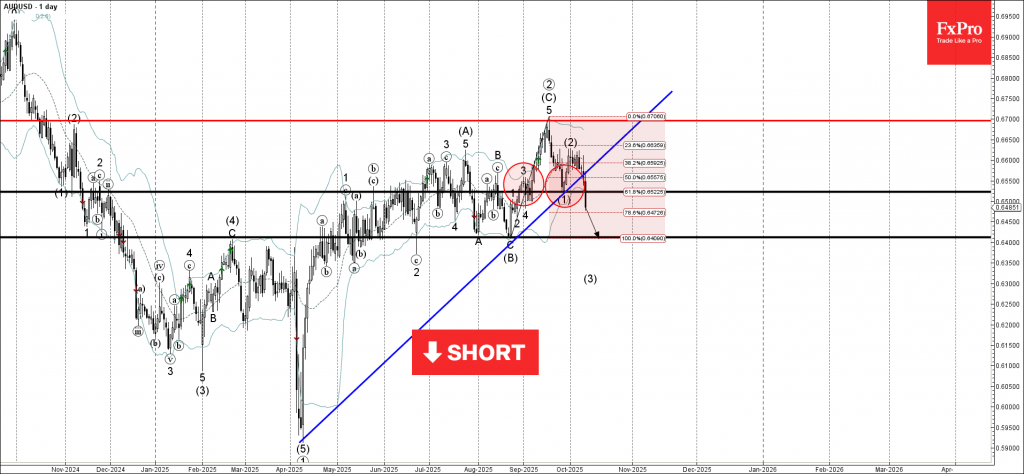
          AUDUSD: ⬇️ Sell

          AUDUSD currency pair recently broke the support zone between the support level 0.6525 (low of wave (1) from September), 61.8% Fibonacci correction of the upward impulse (C) from August and the support trendline from April.

          The breakout of this support zone accelerated the active intermediate impulse wave (3).

          Given the strongly bullish US dollar sentiment seen today, AUDUSD currency pair can be expected to fall to the next support level 0.6410 (former low of wave (B) from August).

          Source: ACTIONFOREX

          Risk Warnings and Disclaimers
          You understand and acknowledge that there is a high degree of risk involved in trading. Following any strategies or investment methods may lead to potential losses. The content on the site is provided by our contributors and analysts for information purposes only. You are solely responsible for determining whether any trading assets, securities, strategy, or any other product is suitable for investing based on your own investment objectives and financial situation.
          Add to Favorites
          Share

          Hungary Declares Political War on EU’s “Ukraine War Plan”

          Gerik

          Economic

          Political

          Orbán’s Campaign Against Brussels’ War Funding Plan

          On October 11, Prime Minister Viktor Orbán announced that Hungary would “declare war on Brussels’ war plan” through a nationwide petition drive. In a statement on Facebook, Orbán accused the EU of pursuing a long and costly conflict with Russia while leaving European citizens to “foot the bill.”
          “Europe pays, Ukrainians fight, and Russia is gradually weakened,” he wrote. “But no one tells us how long this will last or how much it will cost.” Orbán emphasized that Hungary “wants nothing to do with this plan,” declaring that the campaign would reach “every city and village” across the country.

          The Lone Dissenting Voice Inside the EU

          Viktor Orbán has long been seen as the EU’s most openly pro-Russian leader, maintaining close ties with the Kremlin despite the ongoing war in Ukraine. Since Russia’s invasion in 2022, Budapest has repeatedly blocked or delayed EU military aid packages for Kyiv and opposed sanctions targeting Moscow, arguing that such measures harm Europe more than Russia.
          Orbán’s government also continues to rely heavily on Russian gas, resisting Brussels’ efforts to diversify energy supplies. Analysts view his latest campaign not merely as foreign policy defiance but as part of a domestic political strategy to reinforce his populist message of “protecting Hungarian sovereignty” from foreign influence.
          Since taking power in 2010, Orbán’s administration has organized over a dozen so-called “national consultations” — government-backed surveys mailed to citizens, asking leading questions designed to justify his policies. While legally non-binding, these campaigns provide what Orbán calls “social legitimacy” for his political agenda.
          In a recent consultation held in June, 95% of respondents opposed Ukraine’s EU membership, though voter participation was low. Past campaigns have targeted EU migration policies, LGBTQ+ rights, and Brussels’ asylum plans — all framed as external threats to Hungary’s national interests.

          Tensions with Kyiv Escalate

          Relations between Hungary and Ukraine have grown increasingly strained. On October 6, Orbán publicly criticized Ukrainian President Volodymyr Zelensky, accusing him of using “moral blackmail” to pressure Budapest into supporting Ukraine’s EU accession.
          Orbán warned that admitting Ukraine into the bloc would force Hungary to “inherit someone else’s war.” This stance isolates Budapest within the EU, as most European and U.S. leaders continue to reinforce their commitments to Kyiv’s defense and reconstruction.
          Observers note that Orbán’s rhetoric is aimed not only at Brussels but also at Hungarian voters, blending anti-EU sentiment, war fatigue, and nationalist messaging to consolidate his domestic support. The move may also serve as a signal to Moscow of Hungary’s continued unwillingness to align fully with the West’s Ukraine strategy.
          Hungary’s open defiance of EU policy marks another escalation in its long-running clash with Brussels. By portraying the EU’s support for Ukraine as a “foreign war financed by European taxpayers,” Viktor Orbán seeks to position himself as the guardian of Hungarian interests against global elites.
          However, as the EU moves to deepen aid for Kyiv, Hungary’s growing isolation within the bloc could test the limits of Orbán’s balancing act — between his ties to Russia, his reliance on EU funding, and his populist domestic agenda.
          To stay updated on all economic events of today, please check out our Economic calendar
          Risk Warnings and Disclaimers
          You understand and acknowledge that there is a high degree of risk involved in trading. Following any strategies or investment methods may lead to potential losses. The content on the site is provided by our contributors and analysts for information purposes only. You are solely responsible for determining whether any trading assets, securities, strategy, or any other product is suitable for investing based on your own investment objectives and financial situation.
          Add to Favorites
          Share

          The Global “Rare Earth War”: A New Storm Threatening the Semiconductor Industry

          Gerik

          Economic

          Commodity

          China Tightens Rare Earth Exports, U.S. Strikes Back

          China’s latest export restrictions on rare earth elements mark one of its most assertive policy moves yet in leveraging its dominance over these strategic minerals. The new rules require foreign companies to obtain export licenses for any product containing even trace amounts of Chinese rare earths including chip components and AI-related technologies with potential military use.
          In retaliation, U.S. President Donald Trump announced plans to impose an additional 100% tariff on Chinese imports while introducing new controls on “critical software” exports to China. This escalation reignites tensions between the two superpowers, coming just months after a temporary easing of trade hostilities earlier in 2025.
          According to insiders, these measures could delay chipmaking equipment shipments from Dutch manufacturer ASML Holding NV, the world’s only supplier of advanced lithography machines. A senior U.S. semiconductor executive warned that rare earth magnet prices essential for precision tools and lasers in chip fabrication could surge sharply as supply bottlenecks worsen.

          Semiconductor Supply Chains Face Major Disruption

          The global semiconductor ecosystem, already under strain from years of trade restrictions, faces renewed uncertainty. Companies such as ASML and Applied Materials depend heavily on rare earth materials for their high-precision manufacturing systems. ASML insiders confirmed the firm is preparing for possible supply interruptions and lobbying both the U.S. and Dutch governments for alternative sourcing strategies.
          Meanwhile, U.S. chipmakers are racing to audit their supply chains for components containing Chinese-origin rare earths. Executives fear that delays in obtaining Chinese export licenses could halt production entirely if no substitutes are found.
          The scope of Washington’s new software restrictions remains unclear. The U.S. had previously lifted licensing requirements for chip design software in July 2025 as a gesture toward easing tensions. The reinstatement of tighter rules suggests a harder stance ahead of Trump’s expected Asia trip, where he is rumored to meet Chinese President Xi Jinping.

          Strategic Minerals as a Geopolitical Weapon

          China currently controls about 70% of global rare earth production and refining, giving it immense leverage over industries from defense to renewable energy and semiconductors. Gracelin Baskaran, Director of Strategic Minerals at the Center for Strategic and International Studies (CSIS), described the new restrictions as “the most stringent export controls China has ever implemented,” arguing that Beijing is using its mineral dominance as a geopolitical bargaining tool.
          Rare earth elements such as neodymium, dysprosium, and terbium are indispensable in manufacturing high-performance magnets, lasers, and optical components used in AI chips and advanced military systems. Even minimal disruption in supply could trigger cascading delays across the semiconductor value chain.

          Europe’s Response: Diversification and Concern

          In Europe, Germany the region’s industrial powerhouse has labeled China’s restrictions “a serious concern.” Berlin is coordinating with affected companies and the European Commission (EC) to develop a collective response and accelerate diversification of raw material sources.
          The EU has already identified rare earth independence as a strategic priority under its Critical Raw Materials Act, seeking partnerships with African and Latin American countries to reduce reliance on China.

          A Reignited Trade War with Global Consequences

          Rather than creating room for negotiation, Beijing’s export controls have reignited a full-blown trade war. Trump’s new tariffs will raise the total duty on Chinese goods to 130% starting next month, nearly matching the record-high 145% rate imposed earlier this year before talks resumed.
          The last round of rare earth tensions in early 2025 led to a temporary export freeze by China and retaliatory tariffs by the U.S., which were only resolved through a fragile truce. The current escalation threatens to undo months of diplomatic progress and push global chip supply chains already fragile from pandemic disruptions and sanctions into renewed turmoil.
          The world’s semiconductor supply chain is entering a dangerous phase of resource weaponization. As China leverages its rare earth dominance and the U.S. doubles down on trade and tech restrictions, the global chip industry faces unprecedented instability.
          What began as a race for technological supremacy has evolved into a geoeconomic confrontation one where access to a few grams of rare earths could determine the future of artificial intelligence, defense systems, and the balance of global power itself.
          To stay updated on all economic events of today, please check out our Economic calendar
          Risk Warnings and Disclaimers
          You understand and acknowledge that there is a high degree of risk involved in trading. Following any strategies or investment methods may lead to potential losses. The content on the site is provided by our contributors and analysts for information purposes only. You are solely responsible for determining whether any trading assets, securities, strategy, or any other product is suitable for investing based on your own investment objectives and financial situation.
          Add to Favorites
          Share

          From Urban Icon to “Ghost Mall”: The Decline of San Francisco Centre Reflects America’s Retail Meltdown

          Gerik

          Economic

          From Luxury Landmark to Empty Halls

          Located in the heart of downtown San Francisco, the San Francisco Centre was once a symbol of modern retail success, home to luxury brands like Nordstrom, Bloomingdale’s, Zara, Rolex, and Michael Kors. Spanning 1.5 million square feet (about 140,000 m²), it generated over $1,000 per square meter in annual sales during its peak years and served as a weekend gathering spot for locals and tourists alike.
          Today, the picture is starkly different. Nearly all its retail space lies vacant, its once-bustling food court eerily silent, and the departure of major anchor stores has left the complex hollow. The mall has become a case study in what Americans now call “ghost malls” vast commercial spaces abandoned by both tenants and shoppers.
          The Spiral of Decline: From Pandemic to Behavioral ShiftsThe collapse began with the COVID-19 pandemic, when prolonged lockdowns decimated foot traffic. As consumers embraced online shopping and remote work, the allure of indoor shopping centers faded rapidly.
          Compounding the problem, the area around the Centre has seen a surge in petty crime, drug use, and homelessness, deterring shoppers and tourists. The exodus of anchor stores like Nordstrom and Bloomingdale’s triggered a domino effect: smaller retailers, reliant on their customer traffic, soon closed too.
          Meanwhile, fixed costs maintenance, security, utilities, taxes remained high, pushing the mall deeper into operational losses.

          A Billion-Dollar Real Estate Collapse

          The financial damage has been staggering. Once valued at $1.2 billion in 2016, the San Francisco Centre is now worth roughly $195–200 million, a drop of over $1 billion. Multiple foreclosure auctions have been delayed due to legal complications and lack of buyers.
          Attempts to repurpose the property into offices, housing, or cultural space face daunting challenges: the structure lacks natural light for apartments, the land lease (held by a public education trust) restricts redevelopment, and renovation costs have soared amid high interest rates.

          America’s Broader Retail Reckoning

          San Francisco Centre’s plight is not unique. Across the U.S., indoor malls once the beating heart of suburban commerce in the 1980s and 1990s are collapsing under new consumer habits. The rise of e-commerce, outdoor “lifestyle centers,” and economic uncertainty have all accelerated the decline.
          Analysts estimate that up to 25% of traditional American malls could close or be abandoned within the next decade. What were once community gathering spaces are now financial liabilities for property owners and cities alike.

          A Symbol of Urban Decay

          On a recent afternoon, there were more security guards and janitors than shoppers. At Sole & Laces, one of only about 20 stores still open, staff said theft and encampments by the homeless were constant problems.
          “I came to buy cosmetics, but there’s nothing here,” said Emily Rawlins Struckmann, a tourist from Switzerland a remark that encapsulates the emptiness of what was once a vibrant commercial icon.
          The downfall of the San Francisco Centre mirrors the end of an era in American retail. As digital commerce, public safety concerns, and post-pandemic work patterns reshape urban life, America’s once-glamorous shopping malls face an existential question:Can they reinvent themselves or will they fade into the architectural ruins of consumer history?
          To stay updated on all economic events of today, please check out our Economic calendar
          Risk Warnings and Disclaimers
          You understand and acknowledge that there is a high degree of risk involved in trading. Following any strategies or investment methods may lead to potential losses. The content on the site is provided by our contributors and analysts for information purposes only. You are solely responsible for determining whether any trading assets, securities, strategy, or any other product is suitable for investing based on your own investment objectives and financial situation.
          Add to Favorites
          Share

          France’s Debt Crisis Deepens as Public Debt Surpasses GDP and Growth Slows to 0.8%

          Gerik

          Economic

          Public Debt Surpasses GDP: A Structural Fiscal Threat

          France’s debt burden has reached a critical threshold, becoming one of Europe’s most pressing fiscal risks. According to data from INSEE, the country’s public debt-to-GDP ratio rose to 113% in 2024, up from 109.8% the previous year. The fiscal deficit widened to 5.8% of GDP, nearly double the EU’s 3% limit, highlighting persistent structural imbalances between spending and revenue.
          At the same time, economic growth is losing momentum. The French economy valued at $3.16 trillion in nominal GDP is projected to expand by only 0.8% in 2025, down from 1.1% in 2024. This slowdown diminishes the government’s ability to stabilize the debt ratio through higher tax receipts, creating a negative feedback loop between weak growth and rising borrowing needs.

          Rising Borrowing Costs Amplify Fiscal Stress

          One of the most alarming trends is the rapid escalation of debt-servicing costs. In 2024, France spent €59 billion on interest payments; by 2029, this figure could exceed €100 billion, according to Reuters. This near-doubling in just five years would make debt servicing one of the largest single items in the national budget, surpassing many social and investment expenditures.
          The spike in costs stems from a combination of higher global interest rates, heavy issuance of new bonds, and investors demanding greater risk premiums amid political uncertainty. The yield on France’s 10-year government bonds climbed to 3.53%, the highest level since March 2025, following a sell-off in French debt triggered by renewed market anxiety.

          Political Gridlock Complicates Fiscal Consolidation

          Despite the clear need for fiscal correction, France’s fragmented political landscape has made policy implementation increasingly difficult. The government’s proposed roadmap aims to reduce the budget deficit to 5.4% of GDP in 2025 and reach 3% by 2029, in line with EU rules. Yet, efforts to cut spending or raise taxes are facing resistance from both opposition parties and segments of the public weary of austerity measures.
          The International Monetary Fund (IMF) has urged France to pursue a gradual but sustained fiscal adjustment, recommending spending cuts equivalent to 1.1% of GDP by 2026 and an average reduction of 0.9% of GDP per year thereafter. However, with social unrest still echoing from recent pension reforms, the political feasibility of such measures remains uncertain.

          Credit Ratings and Market Confidence Under Pressure

          Credit rating agencies have already signaled alarm. Fitch Ratings downgraded France’s sovereign credit rating from AA- to A+, citing persistent deficits and growing political risks. The downgrade reflects both quantitative deterioration in public finances and qualitative concerns about policymaking coherence.
          The downgrade, in turn, feeds into a self-reinforcing cycle: lower credit ratings raise borrowing costs, which worsen the deficit and further strain fiscal credibility. The Banque de France Governor warned that delaying debt reduction would make the eventual adjustment “more painful,” underscoring that fiscal procrastination could undermine economic stability for years.

          Macroeconomic Outlook: Limited Growth, Rising Vulnerabilities

          Although France remains the second-largest economy in the EU after Germany, its medium-term outlook is clouded by sluggish productivity, rigid labor markets, and constrained fiscal capacity. The country’s weak growth trajectory below 1% limits its ability to absorb external shocks or finance new policy initiatives without further borrowing.
          In economic terms, the relationship between debt accumulation and slow growth appears increasingly causal rather than coincidental: higher debt servicing crowds out productive investment, while tepid GDP expansion erodes the tax base, reinforcing dependence on deficit financing.
          France’s fiscal predicament highlights the delicate balance between sustaining economic growth and restoring budgetary discipline. With public debt now exceeding national output and interest obligations projected to double within five years, the country is entering a period of heightened vulnerability.
          Unless decisive fiscal reforms and credible growth policies are enacted soon, France risks drifting into a “debt overhang trap” where high borrowing costs, political paralysis, and stagnant growth collectively threaten long-term economic resilience and the stability of the eurozone itself.
          To stay updated on all economic events of today, please check out our Economic calendar
          Risk Warnings and Disclaimers
          You understand and acknowledge that there is a high degree of risk involved in trading. Following any strategies or investment methods may lead to potential losses. The content on the site is provided by our contributors and analysts for information purposes only. You are solely responsible for determining whether any trading assets, securities, strategy, or any other product is suitable for investing based on your own investment objectives and financial situation.
          Add to Favorites
          Share

          Indonesia to End Diesel Imports by 2026 with Nationwide B50 Biofuel Mandate

          Gerik

          Economic

          Commodity

          A Strategic Shift Toward Energy Sovereignty

          The Indonesian government has announced a sweeping transition to B50 biofuel, marking the end of diesel imports and a major milestone in the country’s long-term energy strategy. According to Energy and Mineral Resources Minister Bahlil Lahadalia, the B50 policy aims to secure national energy sovereignty and reduce reliance on imported fossil fuels. The program builds on the success of earlier initiatives such as B30 and B35, which have already demonstrated economic and environmental benefits.
          Between 2020 and 2025, Indonesia’s biodiesel program saved approximately $40.71 billion by cutting fuel imports. With the implementation of B50, the country expects to save an additional $10.84 billion per year, significantly improving its trade balance while redirecting funds toward domestic development.
          Leveraging Palm Oil to Power the EconomyIndonesia, the world’s largest producer of palm oil, plans to channel this agricultural advantage into energy production. Currently, the nation imports about 4.9 million kiloliters of diesel, accounting for 10.58% of total domestic demand. The introduction of B50 will eliminate this dependence, replacing it entirely with locally produced Fatty Acid Methyl Ester (FAME) derived from palm oil.
          To meet the new demand, the government will expand FAME production capacity from 15.6 million kiloliters in 2025 to 20.1 million kiloliters by 2026. This rapid scale-up is expected to create a ripple effect across multiple sectors, stimulating investment in refining facilities, logistics, and agriculture.

          Socioeconomic Impact and Employment Growth

          The B50 policy is not only an energy initiative but also a tool for inclusive economic growth. The palm oil and biofuel industries are projected to support around 2.5 million jobs in plantations and 19,000 in processing plants, particularly benefiting rural communities across Sumatra and Kalimantan.
          Minister Bahlil emphasized that the program represents a “new economic order” grounded in domestic resource utilization and renewable energy innovation. By valorizing palm oil as both a food and energy commodity, Indonesia aims to stabilize farmer incomes while reducing carbon emissions.

          Environmental and Economic Implications

          The shift to biofuels aligns with Indonesia’s National Energy Policy (KEN) and its commitment to achieving net-zero emissions by 2060. B50 is expected to reduce greenhouse gas emissions from the transportation sector while diversifying the national energy mix away from fossil fuels.
          Moreover, the transition reduces exposure to global oil price volatility, providing a buffer against external economic shocks. The government expects the biofuel sector to become a cornerstone of energy resilience, comparable in strategic importance to mining or manufacturing.
          Indonesia’s decision to end diesel imports through the B50 biofuel mandate marks a decisive step toward energy autonomy and green transformation. By leveraging its abundant palm oil resources, the country is turning a key export commodity into a pillar of domestic sustainability.
          If implemented efficiently, the B50 policy could serve as a model for emerging economies seeking to achieve both energy independence and low-carbon growth — positioning Indonesia at the forefront of the global bioenergy revolution.
          To stay updated on all economic events of today, please check out our Economic calendar
          Risk Warnings and Disclaimers
          You understand and acknowledge that there is a high degree of risk involved in trading. Following any strategies or investment methods may lead to potential losses. The content on the site is provided by our contributors and analysts for information purposes only. You are solely responsible for determining whether any trading assets, securities, strategy, or any other product is suitable for investing based on your own investment objectives and financial situation.
          Add to Favorites
          Share
          FastBull
          Copyright © 2025 FastBull Ltd

          728 RM B 7/F GEE LOK IND BLDG NO 34 HUNG TO RD KWUN TONG KLN HONG KONG

          TelegramInstagramTwitterfacebooklinkedin
          App Store Google Play Google Play
          Products
          Charts

          Chats

          Q&A with Experts
          Screeners
          Economic Calendar
          Data
          Tools
          Membership
          Features
          Function
          Markets
          Copy Trading
          Latest Signals
          Contests
          News
          Analysis
          24/7
          Columns
          Education
          Company
          Careers
          About Us
          Contact Us
          Advertising
          Help Center
          Feedback
          User Agreement
          Privacy Policy
          Business

          White Label

          Data API

          Web Plug-ins

          Poster Maker

          Affiliate Program

          Risk Disclosure

          The risk of loss in trading financial instruments such as stocks, FX, commodities, futures, bonds, ETFs and crypto can be substantial. You may sustain a total loss of the funds that you deposit with your broker. Therefore, you should carefully consider whether such trading is suitable for you in light of your circumstances and financial resources.

          No decision to invest should be made without thoroughly conducting due diligence by yourself or consulting with your financial advisors. Our web content might not suit you since we don't know your financial conditions and investment needs. Our financial information might have latency or contain inaccuracy, so you should be fully responsible for any of your trading and investment decisions. The company will not be responsible for your capital loss.

          Without getting permission from the website, you are not allowed to copy the website's graphics, texts, or trademarks. Intellectual property rights in the content or data incorporated into this website belong to its providers and exchange merchants.

          Not Logged In

          Log in to access more features

          FastBull Membership

          Not yet

          Purchase

          Become a signal provider
          Help Center
          Customer Service
          Dark Mode
          Price Up/Down Colors

          Log In

          Sign Up

          Position
          Layout
          Fullscreen
          Default to Chart
          The chart page opens by default when you visit fastbull.com