• Trade
  • Markets
  • Copy
  • Contests
  • News
  • 24/7
  • Calendar
  • Q&A
  • Chats
Trending
Screeners
SYMBOL
LAST
BID
ASK
HIGH
LOW
NET CHG.
%CHG.
SPREAD
SPX
S&P 500 Index
6932.04
6932.04
6932.04
6937.32
6904.90
+22.25
+ 0.32%
--
DJI
Dow Jones Industrial Average
48731.17
48731.17
48731.17
48771.32
48386.59
+288.77
+ 0.60%
--
IXIC
NASDAQ Composite Index
23613.30
23613.30
23613.30
23621.72
23527.97
+51.46
+ 0.22%
--
USDX
US Dollar Index
97.610
97.690
97.610
0.000
0
0.000
0.00%
--
EURUSD
Euro / US Dollar
1.17761
1.17809
1.17761
1.18077
1.17725
-0.00160
-0.14%
--
GBPUSD
Pound Sterling / US Dollar
1.34997
1.35134
1.34997
1.35338
1.34911
-0.00145
-0.11%
--
XAUUSD
Gold / US Dollar
4479.98
4480.39
4479.98
4525.79
4448.21
-4.18
-0.09%
--
WTI
Light Sweet Crude Oil
58.218
58.248
58.218
58.655
58.045
-0.171
-0.29%
--

Community Accounts

Signal Accounts
--
Profit Accounts
--
Loss Accounts
--
View More

Become a signal provider

Sell trading signals to earn additional income

View More

Guide to Copy Trading

Get started with ease and confidence

View More

Signal Accounts for Members

All Signal Accounts

Best Return
  • Best Return
  • Best P/L
  • Best MDD
Past 1W
  • Past 1W
  • Past 1M
  • Past 1Y

All Contests

  • All
  • Trump Updates
  • Recommend
  • Stocks
  • Cryptocurrencies
  • Central Banks
  • Featured News
Top News Only
Share

Bank Of Japan Governor Ueda: Wage Hikes Have Been Observed Across Broad Range Of Firm Sizes And Regions

Share

Japan Prime Minister Takaichi: Will Achieve Fiscal Sustainability By Promoting Positive Cycle Of Wage And Consumption, Corporate Profits

Share

Bank Of Japan Governor Ueda: Bank Of Japan Hopes To Firmly Support Corporate Activity From Financial Standpoint By Stably, Sustainably Achieving Our Price Target

Share

Bank Of Japan Governor Ueda: Japan Firms' Wage, Price-Setting Behaviour Has Shown Big Change

Share

Bank Of Japan Governor Ueda: Underlying Inflation Steadily Approaching 2%

Share

Bank Of Japan Governor Ueda: Prices Rising Not Just For Food But Other Goods And Services

Share

Bank Of Japan Governor Ueda: Firms Are Passing On Rising Wages, Input Costs Steadily

Share

Bank Of Japan Governor Ueda: Wages Likely To Remain Under Upward Pressure Unless Economy Hit By Big Shock

Share

Toyota: November Parent-Only Overseas Vehicle Production Down 3.4% Year-On-Year At 563546 Vehicles

Share

Bank Of Japan Governor Ueda: Adjusting Degree Of Monetary Support Will Allow US To Smoothly Achieve Our Price Target, Lead To Sustained Growth

Share

Bank Of Japan Governor Ueda: Bank Of Japan Likely To Keep Raising Rates If Our Baseline Projection Materialises In Accordance With Improvements In Economy, Prices

Share

Bank Of Japan Governor Ueda: Japan's Real Interest Rates Remain Very Low

Share

Bank Of Japan Governor Ueda: Likelihood Of Our Baseline Forecast Materialising Is Heightening

Share

Bank Of Japan Governor Ueda: Expect Mechanism In Which Wages, Inflation Rise Moderately In Tandem Likely To Be Sustained

Share

Bank Of Japan Governor Ueda: Firms' Active Wage-Setting Behaviour Likely Won't Be Disrupted

Share

Bank Of Japan Governor Ueda: Japan's Job Market Remains Tight, Corporate Profits Likely To Remain High Even When Taking Into Account Tariff Impact

Share

Bank Of Japan Governor Ueda: Downside Risk Surrounding USA Economy Receding

Share

Bank Of Japan Governor Ueda: Uncertainty Surrounding US Economy, Tariff Impact Remains But Receding

Share

Japan Prime Minister Takaichi: Would Like To Ask Businesses To Achieve Rises In Base Wages That Exceed Pace Of Inflation

Share

Blackstone: A Blackstone Managed Fund Has Acquired The Tokyo C-Nx Grade A Logistics Facility For More Than 100 Billion Yen

TIME
ACT
FCST
PREV
U.S. Core PCE Price Index Prelim YoY (Q3)

A:--

F: --

P: --

U.S. PCE Price Index Prelim YoY (Q3)

A:--

F: --

P: --

U.S. Annualized Real GDP Prelim (Q3)

A:--

F: --

P: --

U.S. Non-Defense Capital Durable Goods Orders MoM (Excl. Aircraft) (Oct)

A:--

F: --

P: --
U.S. Real Personal Consumption Expenditures Prelim QoQ (Q3)

A:--

F: --

P: --

U.S. Weekly Redbook Index YoY

A:--

F: --

P: --

U.S. Manufacturing Output MoM (SA) (Nov)

A:--

F: --

P: --

U.S. Manufacturing Capacity Utilization (Nov)

A:--

F: --

P: --
U.S. Industrial Output YoY (Nov)

A:--

F: --

P: --

U.S. Industrial Output MoM (SA) (Nov)

A:--

F: --

P: --

U.S. Capacity Utilization MoM (SA) (Nov)

A:--

F: --

P: --
U.S. Richmond Fed Manufacturing Shipments Index (Dec)

A:--

F: --

P: --

U.S. Richmond Fed Services Revenue Index (Dec)

A:--

F: --

P: --

U.S. Conference Board Consumer Expectations Index (Dec)

A:--

F: --

P: --

U.S. Conference Board Present Situation Index (Dec)

A:--

F: --

P: --

U.S. Richmond Fed Manufacturing Composite Index (Dec)

A:--

F: --

P: --

U.S. Conference Board Consumer Confidence Index (Dec)

A:--

F: --

P: --
Canada Federal Government Budget Balance (Oct)

A:--

F: --

P: --

U.S. 5-Year Note Auction Avg. Yield

A:--

F: --

P: --

U.S. Weekly Total Oil Rig Count

A:--

F: --

P: --

U.S. Weekly Total Rig Count

A:--

F: --

P: --

U.S. API Weekly Cushing Crude Oil Stocks

A:--

F: --

P: --

U.S. API Weekly Crude Oil Stocks

A:--

F: --

P: --

U.S. API Weekly Refined Oil Stocks

A:--

F: --

P: --

U.S. API Weekly Gasoline Stocks

A:--

F: --

P: --

Mexico Unemployment Rate (Not SA) (Nov)

A:--

F: --

P: --

U.S. MBA Mortgage Application Activity Index WoW

A:--

F: --

P: --

U.S. Weekly Continued Jobless Claims (SA)

A:--

F: --

P: --
U.S. Weekly Initial Jobless Claims (SA)

A:--

F: --

P: --

U.S. Initial Jobless Claims 4-Week Avg. (SA)

A:--

F: --

P: --

Japan Construction Orders YoY (Nov)

--

F: --

P: --

Japan New Housing Starts YoY (Nov)

--

F: --

P: --

Turkey Capacity Utilization (Dec)

--

F: --

P: --

Japan Tokyo CPI YoY (Excl. Food & Energy) (Dec)

--

F: --

P: --

Japan Unemployment Rate (Nov)

--

F: --

P: --

Japan Tokyo Core CPI YoY (Dec)

--

F: --

P: --

Japan Tokyo CPI YoY (Dec)

--

F: --

P: --

Japan Jobs to Applicants Ratio (Nov)

--

F: --

P: --

Japan Tokyo CPI MoM (Dec)

--

F: --

P: --

Japan Tokyo CPI MoM (Excl. Food & Energy) (Dec)

--

F: --

P: --

Japan Industrial Inventory MoM (Nov)

--

F: --

P: --

Japan Retail Sales (Nov)

--

F: --

P: --

Japan Industrial Output Prelim MoM (Nov)

--

F: --

P: --

Japan Large-Scale Retail Sales YoY (Nov)

--

F: --

P: --

Japan Industrial Output Prelim YoY (Nov)

--

F: --

P: --

Japan Retail Sales MoM (SA) (Nov)

--

F: --

P: --

Japan Retail Sales YoY (Nov)

--

F: --

P: --

India Deposit Gowth YoY

--

F: --

P: --

Russia Retail Sales YoY (Nov)

--

F: --

P: --

Russia Unemployment Rate (Nov)

--

F: --

P: --

Argentina Retail Sales YoY (Oct)

--

F: --

P: --

U.S. Weekly Treasuries Held by Foreign Central Banks

--

F: --

P: --

China, Mainland Industrial Profit YoY (YTD) (Nov)

--

F: --

P: --

India Industrial Production Index YoY (Nov)

--

F: --

P: --

India Manufacturing Output MoM (Nov)

--

F: --

P: --

Russia IHS Markit Manufacturing PMI (Dec)

--

F: --

P: --

India Manufacturing Output MoM (Nov)

--

F: --

P: --

India Industrial Production Index YoY (Nov)

--

F: --

P: --

France Unemployment Class-A (Nov)

--

F: --

P: --

Euro Zone Total Reserve Assets (Nov)

--

F: --

P: --

Q&A with Experts
    • All
    • Chatrooms
    • Groups
    • Friends
    X375WYL2N0 flag
    41 points spread
    X375WYL2N0 flag
    The platform I'm using has a spread of 9-16.
    Urek Mazino flag
    X375WYL2N0
    The platform I'm using has a spread of 9-16.
    @X375WYL2N0Yeah, it depends on the timeframe too, bro.
    Urek Mazino flag
    @X375WYL2N0I haven't joined any other platforms either, so I don't know
    CrissHu flag
    Urek Mazino
    @Urek Mazino eth
    Urek Mazino flag
    CrissHu
    @CrissHuIs ETH currently trading at around $2945 USD?
    Urek Mazino flag
    I'm not entirely sure about a strong breakout right now, as the volume hasn't really exploded yet
    DuangoKu flag
    you see ETH’s latest core dev call notes? the timing for the "merge" puzzle is getting wild
    GoldenWine flag
    DuangoKu
    you see ETH’s latest core dev call notes? the timing for the "merge" puzzle is getting wild
    @DuangoKu yeah, reading it now. they’re dancing around "difficulty bomb" delays again. pushing it back to December… feels like 2016 deja vu.
    DuangoKu flag
    true, but the testnet shadow forks are actually holding up. the bigger puzzle is the socio-economic aftermath
    GoldenWine flag
    idk
    DuangoKu flag
    X375WYL2N0
    Can I transfer USDT back to Binance and then repurchase it? Is it possible to trade 0.5 ETH? My funds were greatly reduced due to liquidation.
    @X375WYL2N0Did you manage to do it?
    LOMERI flag
    gold closed
    Urek Mazino flag
    LOMERI
    gold closed
    @LOMERIYes, provided there's no unexpected bad news, gold is likely to retest 4500-4550 soon buddy
    Urek Mazino flag
    @LOMERIIn fact, gold prices have really gone up this year, almost 70% already
    CrissHu flag
    Urek Mazino
    Yes
    Urek Mazino flag
    CrissHu
    @CrissHuIn my opinion, if BTC holds above 87k as it is now, then ETH could retest 3000-3100 soon
    Urek Mazino flag
    @CrissHuHowever, if there is a correction, support around 2800 is important friend
    Urek Mazino flag
    I see a slight risk from liquidation if the dip is deeper
    DuangoKu flag
    GoldenWine
    idk
    @GoldenWineSo, how are you doing?
    Type here...
    Add Symbol or Code

      No matching data

      All
      Trump Updates
      Recommend
      Stocks
      Cryptocurrencies
      Central Banks
      Featured News
      • All
      • Russia-Ukraine Conflict
      • Middle East Flashpoint
      • All
      • Russia-Ukraine Conflict
      • Middle East Flashpoint
      Search
      Products

      Charts Free Forever

      Chats Q&A with Experts
      Screeners Economic Calendar Data Tools
      Membership Features
      Data Warehouse Market Trends Institutional Data Policy Rates Macro

      Market Trends

      Market Sentiment Order Book Forex Correlations

      Top Indicators

      Charts Free Forever
      Markets

      News

      News Analysis 24/7 Columns Education
      From Institutions From Analysts
      Topics Columnists

      Latest Views

      Latest Views

      Trending Topics

      Top Columnists

      Latest Update

      Signals

      Copy Rankings Latest Signals Become a signal provider AI Rating
      Contests
      Brokers

      Overview Brokers Assessment Rankings Regulators News Claims
      Broker listing Forex Brokers Comparison Tool Live Spread Comparison Scam
      Q&A Complaint Scam Alert Videos Tips to Detect Scam
      More

      Business
      Events
      Careers About Us Advertising Help Center

      White Label

      Data API

      Web Plug-ins

      Affiliate Program

      Awards Institution Evaluation IB Seminar Salon Event Exhibition
      Vietnam Thailand Singapore Dubai
      Fans Party Investment Sharing Session
      FastBull Summit BrokersView Expo
      Recent Searches
        Top Searches
          Markets
          News
          Analysis
          User
          24/7
          Economic Calendar
          Education
          Data
          • Names
          • Latest
          • Prev

          View All

          No data

          Scan to Download

          Faster Charts, Chat Faster!

          Download App
          English
          • English
          • Español
          • العربية
          • Bahasa Indonesia
          • Bahasa Melayu
          • Tiếng Việt
          • ภาษาไทย
          • Français
          • Italiano
          • Türkçe
          • Русский язык
          • 简中
          • 繁中
          Open Account
          Search
          Products
          Charts Free Forever
          Markets
          News
          Signals

          Copy Rankings Latest Signals Become a signal provider AI Rating
          Contests
          Brokers

          Overview Brokers Assessment Rankings Regulators News Claims
          Broker listing Forex Brokers Comparison Tool Live Spread Comparison Scam
          Q&A Complaint Scam Alert Videos Tips to Detect Scam
          More

          Business
          Events
          Careers About Us Advertising Help Center

          White Label

          Data API

          Web Plug-ins

          Affiliate Program

          Awards Institution Evaluation IB Seminar Salon Event Exhibition
          Vietnam Thailand Singapore Dubai
          Fans Party Investment Sharing Session
          FastBull Summit BrokersView Expo

          Trump-Backed Asfura Wins Honduras Presidency After Weeks of Delays in Disputed Election

          Manuel

          Political

          Summary:

          The results were approved by two electoral council members and one deputy, as disputes continued over the razor-thin vote.

          Nasry Asfura, the conservative National Party candidate backed by U.S. President Donald Trump, has won Honduras' presidential election, the electoral body said on Wednesday as it finally declared a victor of the November 30 presidential election after weeks of delays, technical problems, and allegations of fraud.
          The electoral authority, known as the CNE, said Asfura had won 40.3% of the vote, edging out center-right Liberal Party candidate Salvador Nasralla who garnered 39.5%. The candidate of the ruling LIBRE party, Rixi Moncada, came a distant third.
          Results were so tight and the ballot processing system so chaotic that around 15% of the tally sheets comprising hundreds of thousands of ballots had to be counted by hand to determine the winner.
          The results were approved by two electoral council members and one deputy, as disputes continued over the razor-thin vote. The third council member, Marlon Ochoa, was not present in the video declaring the winner.
          "Honduras: I am ready to govern. I will not let you down," Asfura said in a post on X following the confirmation of the results.
          The head of the Honduran Congress rejected the CNE's declaration, however, describing it as an "electoral coup".
          "This is completely outside the law. It has no value," Congress president Luis Redondo, of the ruling LIBRE party, wrote on X.
          Trump threw his support behind Asfura, a 67-year-old politician and businessman who is the former mayor of the capital Tegucigalpa, writing in a Truth Social post before the election that he was the "only real friend of Freedom in Honduras" and urging people to vote for him.
          Trump also threatened to cut off U.S. financial support to Honduras if Asfura did not win and pardoned former President Juan Orlando Hernandez, also of Asfura's National Party, who had been serving a 45-year sentence in the U.S. on drug trafficking and weapons charges.
          Amid delays in the count, Trump weighed into the election again alleging fraud without providing evidence and saying there would be "hell to pay" if Honduras changed preliminary results that had put Asfura ahead.
          Trump's backing of Asfura, experts say, is part of his push to mold a conservative bloc across Latin America, stretching from Nayib Bukele in El Salvador to Javier Milei in Argentina.
          Both Nasralla and the ruling LIBRE party have decried Trump's comments as election meddling.
          Nasralla told Reuters that the last-minute interference from Trump had damaged his chances of winning.

          Source: Reuters

          Risk Warnings and Disclaimers
          You understand and acknowledge that there is a high degree of risk involved in trading. Following any strategies or investment methods may lead to potential losses. The content on the site is provided by our contributors and analysts for information purposes only. You are solely responsible for determining whether any trading assets, securities, strategy, or any other product is suitable for investing based on your own investment objectives and financial situation.
          Add to Favorites
          Share

          US Expands Northeast Energy Emergency on Plant Outage, Cold

          Manuel

          Political

          Energy

          The US government is extending an emergency trucking waiver in the Northeast as winter weather and a power outage at a major industrial plant tighten propane supplies. More states were also added to the measure.
          The Federal Motor Carrier Safety Administration on Tuesday extended an emergency declaration, originally set to expire midnight Friday, through Jan. 15. The measure waives regulations on how long drivers can be at the wheel without rest as they distribute heating fuels to thousands of customers in the Northeast.
          The waiver is aimed at making sure enough fuel is being transported to fill any gaps, with sufficient inventories helping to provide a cushion amid the plant disruption. The declaration applies to propane, natural gas and heating oil. While just a minority of houses in the Northeast rely on these fuels for residential heating, cold weather in the forecast means it’s critical to keep supplies flowing.
          The declaration was first issued Dec. 12 and applied to New York, New Jersey, Delaware and Pennsylvania. The expanded order now also waives trucking restrictions in Connecticut, Maryland, Massachusetts, New Hampshire and West Virginia.
          The issue stems from a Nov. 19 electrical incident at a transformer at Energy Transfer LP’s Marcus Hook terminal in Pennsylvania. The outage disabled the facility’s ability to load propane on trucks for three days and led the company to declare force majeure, according to a statement from the National Propane Gas Association.
          Energy Transfer customers were placed on allocation, meaning they could only collect a portion of their contracted purchases, and were receiving 70% of their loads, the association said.
          Energy Transfer hasn’t responded to multiple requests for comment since states began issuing emergency trucking waivers in early December.
          So far, fuel stockpiles and the ability for distributors to source propane from other plants have minimized the impact on consumers and prices.
          Propane inventories on the East Coast are in line with prior-year levels, and retail prices in the region are up about 5 cents since the outage began according to US Energy Information Administration data.
          Moderate weather during the Christmas holiday on the Eastern Seaboard will be swiftly followed by two cold shots — one on Dec. 26, and then into next week, said Sean Bratton, a meteorologist for Commodity Weather Group. A blast of cold air from Alberta will swoop down into the US Northeast on Friday and push down into the Mid-Atlantic states. The Tri-State area could see 2 to 5 inches (5 to 13 centimeters) of snow, with some areas potentially seeing even heavier bands dropping as much as 6 inches.

          Source: Bloomberg

          Risk Warnings and Disclaimers
          You understand and acknowledge that there is a high degree of risk involved in trading. Following any strategies or investment methods may lead to potential losses. The content on the site is provided by our contributors and analysts for information purposes only. You are solely responsible for determining whether any trading assets, securities, strategy, or any other product is suitable for investing based on your own investment objectives and financial situation.
          Add to Favorites
          Share

          Canadian Dollar Rises to Five-Month Gigh Despite Downbeat Factory Sales

          Manuel

          Forex

          Economic

          The Canadian dollar strengthened to a near five-month high against its U.S. counterpart on Wednesday as recent strength in commodity prices helped support the currency, offsetting preliminary domestic data that showed a steep decline last month for factory sales.
          The loonie was trading 0.1% higher at 1.3672 per U.S. dollar, or 73.14 U.S. cents, after touching its strongest intraday level since July 25 at 1.3666.
          "The broader softening in the USD over the past month has helped lift the CAD but narrower US/Canada spreads, positive economic data surprises - relative to US economic data outcomes - and recent gains in commodity prices are all helping lift CAD sentiment," Shaun Osborne and Eric Theoret, strategists at Scotiabank, said in a note.
          The price of oil, one of Canada's major exports, edged higher for a sixth straight day as investors weighed the risk of supply disruptions from Venezuela and Russia. U.S. crude futures were up 0.1% at $58.43 a barrel.
          The gap between Canada's 2-year yield and its U.S. equivalent has narrowed to 94 basis points in favor of the U.S. note from 120 basis points at the end of October, reducing the relative attractiveness of the U.S. currency.
          Minutes released on Tuesday of the Bank of Canada's latest interest rate decision on December 10 showed that policymakers found it hard to predict whether the central bank's next move would be a hike or cut.
          Domestic data added to recent evidence that has pointed to an economic slowdown in the current quarter after a stronger-than-expected increase in third-quarter GDP. According to a preliminary estimate, factory sales fell 1.1% in November from October on decreases in the transportation equipment and food subsectors.
          Canadian bond yields edged lower across the curve, with the 10-year down 1 basis point at 3.408%. The bond market was set to close early ahead of the Christmas Day and Boxing Day holidays.

          Source: Reuters

          To stay updated on all economic events of today, please check out our Economic calendar
          Risk Warnings and Disclaimers
          You understand and acknowledge that there is a high degree of risk involved in trading. Following any strategies or investment methods may lead to potential losses. The content on the site is provided by our contributors and analysts for information purposes only. You are solely responsible for determining whether any trading assets, securities, strategy, or any other product is suitable for investing based on your own investment objectives and financial situation.
          Add to Favorites
          Share

          Apple spent 2025 setting itself up for the future — and its biggest moves weren't about AI

          Adam

          Commodity

          It’s been quite a year for Apple (AAPL). The company reported record revenue on the back of strong iPhone sales. Its Services business continued its impressive growth, hitting $109.2 billion in sales. And its market capitalization topped $4 trillion, joining Nvidia (NVDA) as just the second company to reach the milestone.
          But the company is also contending with major changes amid its executive ranks. CFO Jeff Williams retired — he was previously considered the top choice to take up the mantle of CEO after Tim Cook eventually steps down.
          Head of government affairs Lisa Jackson and general counsel Kate Adams are retiring in late January and late 2026, respectively.
          And then there's AI chief John Giannandrea and design vice president Alan Dye. Giannandrea is retiring and turning Apple's AI efforts over to Amar Subramanya, who previously worked on AI initiatives at Google (GOOGL, GOOG) and Microsoft (MSFT).
          Dye, meanwhile, left Apple to lead Meta (META) Reality Labs' new design studio.
          All of this comes as Cook is reportedly preparing senior vice president of hardware engineering John Ternus to take over as CEO when he departs.
          It all adds up to an Apple in flux as it transforms itself for a post-Cook era. According to the Financial Times, Cook could step down as soon as early 2026. Bloomberg's Mark Gurman, meanwhile, said there’s still no firm timeline for when Cook will leave his post.
          Regardless of exact timing, Apple will eventually have to say goodbye to Cook, and 2025 helped the company set itself up for its biggest change in years.
          Apple stock edged lower during premarket trading on Wednesday.

          Cook is steering a $4 trillion behemoth

          Cook, who joined Apple in 1998, took over as CEO 14 years ago following the death of founder Steve Jobs. Jobs turned around an ailing Apple when he returned to the company in 1997 after being fired in 1985. He subsequently released a string of groundbreaking products, including the iPod and iPhone, which continues to bring in the majority of Apple's revenue.
          Cook has carried that success forward during his time at the company's helm, overseeing the debut of the Apple Watch and AirPods, as well as the explosion of Apple's Services business. He has also pushed Apple to use its own chips in its products, giving the company more control over the design and functionality of its devices.
          That, coupled with Cook's deft abilities as a negotiator, helped Apple weather a series of crises, including showdowns with the US Department of Justice, the COVID-19 pandemic, and President Trump's ongoing trade war with China. Trump eventually exempted smartphones and certain other tech products from his tariffs on Chinese goods.
          Cook's decisions drove Apple's stock price ever higher. As a result, the company's market cap has increased from $1 trillion in 2018 to a whopping $4 trillion in 2025.
          Revenue has also continued its steady upward pace, with Apple reporting $416 billion in total sales for its fiscal 2025, up from $391 billion in the prior year.
          Apple is also reportedly preparing some of the biggest changes in years to its iPhone lineup in 2026. According to Gurman, the company will roll out a foldable iPhone, a first for Apple, in the latter half of the year.
          That could help further goose already record iPhone sales. Apple is also reportedly preparing a new low-cost MacBook model, which would open up the company to a broader customer segment.
          And while it may not have the same margins as a high-powered MacBook Pro, a lower-cost MacBook could still help draw more customers to Apple's services, driving increased revenue over the long run.

          New challenges ahead

          If Ternus is chosen to succeed Cook, he'll inherit an Apple at the peak of its power. While smartphone sales have slowed over time, the company is reaping the benefits of its massive install base, which still upgrades devices every few years and increasingly subscribes to Apple's various services.
          But he'll also have to navigate his share of headaches. Wall Street is eagerly awaiting some kind of movement on Apple's AI strategy. And though the company is making progress on its AI rollout, it still needs to showcase its next-generation version of Siri.
          He'll also have to prepare to take on the likes of Meta, Google, and Samsung (005930.KS) in the smart glasses space. Meta already has two smart glasses on the market, and Google and Samsung are each working on their own intelligent eyewear.
          For now, though, Cook is still Apple's CEO. We'll just have to see if that changes in 2026.

          Source: finance.yahoo

          Risk Warnings and Disclaimers
          You understand and acknowledge that there is a high degree of risk involved in trading. Following any strategies or investment methods may lead to potential losses. The content on the site is provided by our contributors and analysts for information purposes only. You are solely responsible for determining whether any trading assets, securities, strategy, or any other product is suitable for investing based on your own investment objectives and financial situation.
          Add to Favorites
          Share

          Why Are Copper Prices Surging to All-Time Highs?

          Adam

          Commodity

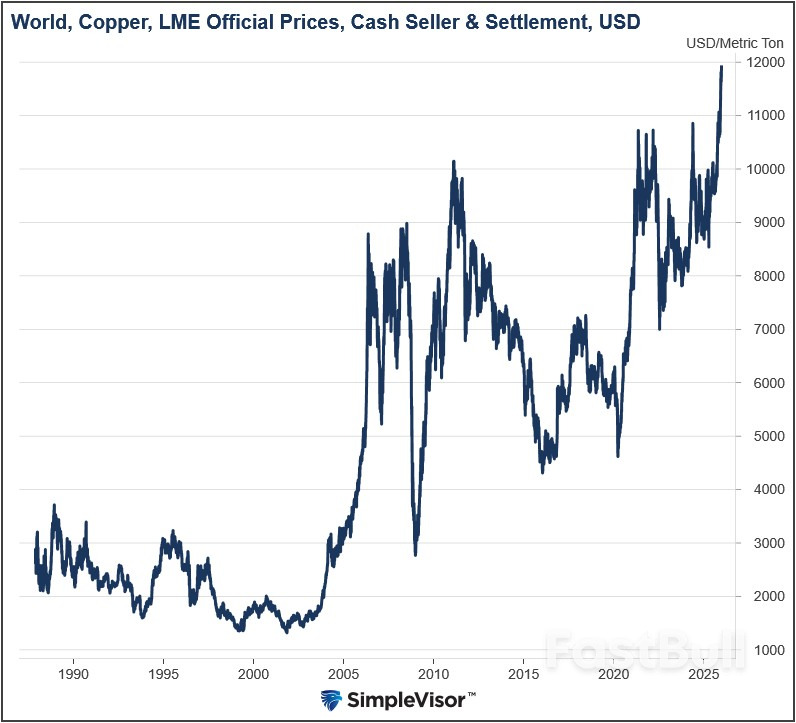
          On Monday night, copper prices, as shown below, reached an all-time high of over $12,000 per metric ton. Copper is often referred to as “Doctor Copper” because it serves as a barometer of global economic activity. However, the current surge in prices is not due to sharply rising demand; tariffs and physical dislocation are heavily impacting the supply side. The bullet points below help appreciate why copper is hitting all-time highs.
          Traders are front-running U.S. tariff policy, bringing the metal into the U.S. ahead of potential tariffs. This has distorted global trade flows, tightening inventories elsewhere, and creating artificial scarcity.
          The scarcity is enhanced by inventory stockpiling, not end-user consumption.
          Adding to supply woes, copper mine disruptions, declining ore grades, and years of underinvestment limit miners’ ability to meet growing demand quickly.
          Copper trades on the futures exchanges. Accordingly, it is leveraged and traded by speculative momentum traders. As we are witnessing with silver, speculative traders make a living chasing trends.
          Because the price increase is primarily supply-related, if tariff threats fade and trade routes normalize, excess inventories could quickly hit the market, causing speculative trades to unwind. In such an instance, copper prices could fall just as fast as they have risen.
          Why Are Copper Prices Surging to All-Time Highs?_1
          Watch The Yen In 2026
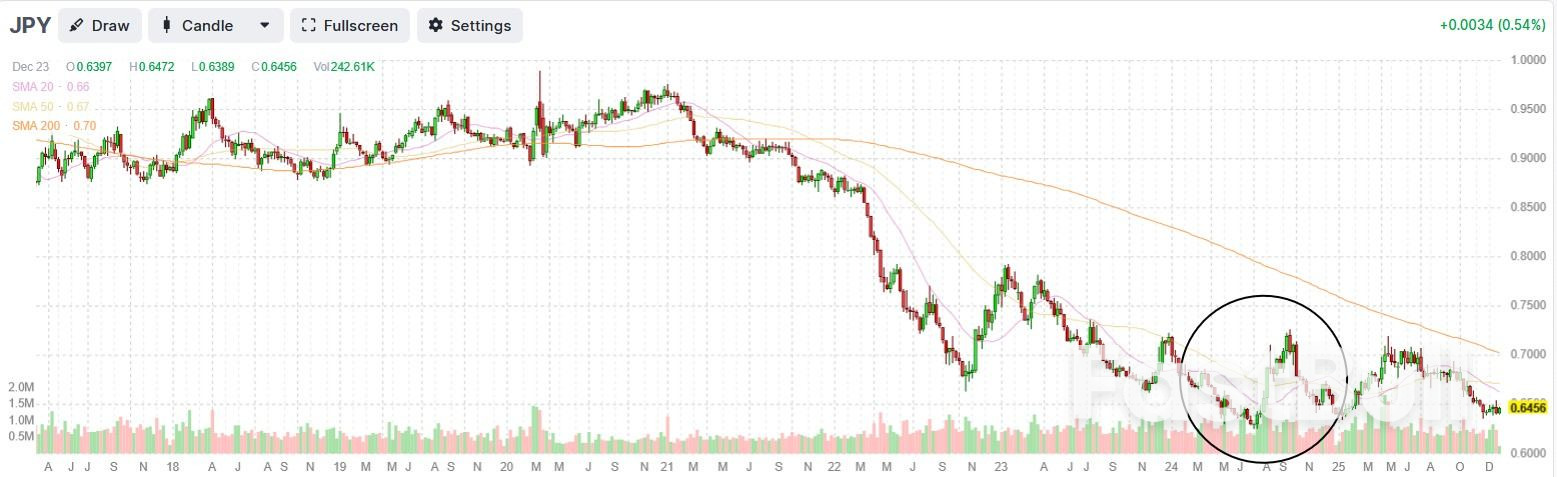
          As we share below, the yen is again approaching its lowest levels against the dollar since at least 1995. We circle the sharp, short-term increase in the yen occurring in August 2024. This was the market swoon related to the supposed liquidation of the yen carry trade. It is rumored that tens of billions of dollars are propping up US assets, supported by loans made in Japan through the yen carry trade. The relatively low Japanese borrowing rates and a declining yen make such a trade highly attractive to hedge funds and other institutional money managers. Moreover, Japanese citizens and corporations, facing low interest rates, are incentivized to invest their money abroad. By doing so, they can profit from high-yielding assets they cannot access at home and from a depreciating yen.
          The depreciating yen fortifies the yen carry trade. However, looking ahead, there are growing rumors that Japan will intervene to support the yen. Japan heavily depends on energy and materials imports. A depreciating yen makes these goods more expensive. As a result, per Bloomberg:
          The resulting cost-of-living crunch helped bring down two prime ministers before the current leader, Sanae Takaichi, took office.
          Given the domestic economic and political situation, along with pressure from the US, we should expect the Japanese government to take steps to strengthen the yen. If an upward adjustment is done gradually, the impact on financial markets should be minimal. However, if it occurs suddenly, such as in August 2024, volatility could spike. Stay aware of this risk in 2026!
          Why Are Copper Prices Surging to All-Time Highs?_2

          Source: investing

          Risk Warnings and Disclaimers
          You understand and acknowledge that there is a high degree of risk involved in trading. Following any strategies or investment methods may lead to potential losses. The content on the site is provided by our contributors and analysts for information purposes only. You are solely responsible for determining whether any trading assets, securities, strategy, or any other product is suitable for investing based on your own investment objectives and financial situation.
          Add to Favorites
          Share

          Markets May Be Underpricing the Risk to Fed Independence

          Adam

          Economic

          President Trump’s recent statement that “anybody that disagrees with me will never be the Fed Chairman” may sound like political theater. For markets, it’s something else entirely: a reminder that central bank independence which is a cornerstone of modern monetary stability, is no longer a guaranteed assumption.
          Markets don’t trade personalities. They trade credibility. And right now, there’s a credibility question hanging over the Federal Reserve that bond yields, equity valuations, and currency markets may not be fully pricing in.

          Why Fed Independence Actually Matters for Your Portfolio

          Central bank independence isn’t an abstract concept debated in economics seminars. It’s the foundation of how markets price inflation expectations, government debt, and the dollar’s reserve currency status.
          When markets believe the Fed sets rates based purely on economic data, unemployment, inflation and growth. They can price risk with confidence. Interest rate futures behave predictably. Treasury yields reflect real economic fundamentals. The dollar maintains credibility as a store of value.
          But when political pressure enters the equation, that entire framework starts to crack. If markets suspect rate decisions might be influenced by electoral cycles or executive preferences rather than inflation targets, the risk premium on everything changes.
          This isn’t hypothetical. We’ve seen it before.

          The Nixon-Burns Precedent Markets Forgot

          The 1970s offer a textbook case. Federal Reserve Chairman Arthur Burns, under pressure from President Nixon to keep rates low ahead of the 1972 election, accommodated an inflationary monetary policy. The result wasn’t just bad economics. It was a market catastrophe.
          Inflation spiraled into double digits. Treasury yields exploded. The dollar collapsed against gold and foreign currencies. Equity markets stagnated for a decade in real terms.
          It took Paul Volcker’s credibility-restoring rate hikes in the early 1980s, pushing the Fed funds rate above 19%—to rebuild trust in the Fed’s inflation-fighting commitment. The cost was a brutal recession, but the alternative was unanchored inflation expectations and currency collapse.
          Markets today seem to have forgotten this lesson. Or perhaps they’re betting it can’t happen again.

          What Changes When Credibility Is Questioned

          The immediate market risk isn’t that Trump fires Jerome Powell or appoints a dovish successor. Though both are technically possible under certain legal interpretations. The risk is subtler and potentially more damaging: a slow erosion of the belief that Fed policy is truly independent.

          Consider what happens when that belief weakens:

          Treasury markets start demanding higher term premiums to compensate for political risk. Long-duration bonds become less attractive. The yield curve reflects not just growth and inflation expectations, but also policy uncertainty.
          The dollar loses some of its safe-haven appeal. If Fed decisions might be politically influenced, why hold dollars over other reserve currencies? Currency markets begin pricing in a Fed that’s less credible as an inflation anchor.
          Inflation expectations become unmoored. If markets suspect the Fed might keep rates lower than fundamentals justify, inflation breakevens rise. Real yields fall. Hard assets and inflation hedges gain appeal.
          Equity valuations face pressure from both higher discount rates and greater uncertainty around future policy paths. The “Fed put” becomes less reliable if markets don’t trust Fed independence.

          Why This Matters Right Now

          The timing of this credibility question couldn’t be more delicate. The Fed is navigating one of the trickiest policy paths in recent history: trying to maintain restrictive rates long enough to ensure inflation stays near the 2% target, while avoiding a hard landing.
          Inflation has cooled from its 2022 peak, but progress has been uneven. Core PCE remains above target. Labor markets are softening but not collapsing. The last thing the Fed needs right now is markets questioning whether rate decisions will be driven by data or by political considerations.
          If traders start pricing in even a small probability that the Fed might cut rates prematurely due to political pressure, you’d expect to see it first in rate-sensitive sectors: a steepening yield curve, weaker dollar positioning, higher gold prices, and increased demand for Bitcoin as a non-sovereign store of value.
          Some of that is already happening. Gold hit record highs this year. Bitcoin is consolidating near elevated levels. Whether that’s due to Fed credibility concerns or other factors is debatable, but the correlation is worth watching.

          The Credibility Trade

          When central bank independence comes into question, markets historically rotate toward assets that don’t depend on government policy credibility. Gold, traditionally, has been the primary beneficiary. But in 2025, the playbook has expanded.
          Bitcoin and other decentralized assets gain appeal precisely because they can’t be influenced by central bank decisions. Institutional investors increasingly view them as hedges against monetary policy uncertainty not inflation itself, but the credibility of the institutions managing inflation.
          This doesn’t mean crypto replaces traditional hedges. It means the toolkit for protecting against central bank credibility risk has broadened.

          What Investors Should Watch

          The key question for markets isn’t whether Trump will actually interfere with Fed policy. It’s whether the possibility of interference changes how risk is priced.
          Watch the Fed’s response. If Powell and other officials feel the need to publicly reaffirm their independence more frequently, that’s a signal markets are beginning to price in credibility risk. Watch term premiums on long-duration Treasuries. Watch how gold and Bitcoin respond to Fed communications.
          Most importantly, watch whether inflation expectations start to drift upward without corresponding economic data to justify the move. That would be the clearest sign that markets are beginning to doubt the Fed’s ability or willingness to maintain price stability independent of political considerations.
          Central bank credibility is built slowly and lost quickly. Right now, markets seem comfortable assuming Fed independence remains intact. But the cost of being wrong on that assumption is substantial. And history suggests it’s a risk worth taking seriously.​​​​​​​​​​​​​​​​

          Source : investing

          To stay updated on all economic events of today, please check out our Economic calendar
          Risk Warnings and Disclaimers
          You understand and acknowledge that there is a high degree of risk involved in trading. Following any strategies or investment methods may lead to potential losses. The content on the site is provided by our contributors and analysts for information purposes only. You are solely responsible for determining whether any trading assets, securities, strategy, or any other product is suitable for investing based on your own investment objectives and financial situation.
          Add to Favorites
          Share

          Gold’s bull run is set to continue in 2026, and crypto’s weakness could boost silver higher – ByteTree’s Charlie Morris

          Adam

          Commodity

          While Bitcoin, AI and the tech sector are likely to take a step back in 2026, gold’s bull run still has legs – and crypto’s weakness could add to silver’s strength, according to Charlie Morris, CIO and founder of ByteTree.
          ByteTree created the BOLD Index, which blends Bitcoin and gold on a risk-weighted basis, and the 21Shares BOLD ETP (BOLD) which tracks the index is listed across Europe. The theory behind the BOLD index is that gold and Bitcoin are uncorrelated alternative assets, so balancing between them is very advantageous.
          Morris is very bullish on both Bitcoin and gold over the long term. Five years ago – well before the current bull market had even begun – he predicted that the yellow metal would hit $7,000 per ounce by 2030. This was an extreme outlier at the time, but with gold prices gaining around $2,500 in the five years since, it looks less outlandish by the day.
          “Generally speaking, I don't make projections, but I did in 2020 make that projection,” Morris told Kitco News. “It's not looking so stupid now.”
          “It's all worked for the wrong reasons, which is hilarious,” he said. “And maybe the [original] reasons come true later, but my simple thesis was that long-term expectations for inflation rose in the Western world, from 2% to about 4%, and the money printing would see lasting inflation.”
          Morris said markets have since seen monetary inflation, but not yet sustained consumer inflation. Still, he believes this will materialize eventually. “It just seems so inevitable with these persistent deficits that at some point it will come through,” he said. “I just don't see how you can come into this world full of money and for it not to feed through eventually, particularly with policymakers so focused these days on the real economy. As money finds its way into the real economy, then that's got to be inflationary sooner or later.”
          Morris said that when this same thesis is applied to silver, it produces a projection that looks even more dramatic – even after silver’s recent run to fresh all-time highs.
          “The silver forecast was just logical,” he said. “Silver is in a nice bull market, and if gold is $7,000 and you have a gold-silver ratio of 40 – which is not particularly aggressive for the top of a bull market – it takes you to $175,” he said. “It was as simple as that, and I just pointed out the obvious.”
          Morris said his philosophy on Bitcoin and gold is very simple: the two assets are not in competition.
          “Gold is the reserve asset of the real world, and Bitcoin is the reserve asset of the internet. That's why the price of gold correlates with things in the real world like bonds, real yields and stuff, and that's why Bitcoin correlates with internet stocks and anything to do with technology and the internet. It's obvious in that sense.”
          And unlike many Bitcoin maximalists, Morris’ bullishness does not rely on BTC becoming a fully mainstream reserve asset. “Why the hell should Bitcoin be the reserve asset of the real world, and why the hell would gold be the reserve asset of the internet?” he mused. “There are people waiting for the central banks to buy Bitcoin. It's just not going to happen. Not in my lifetime, not in anyone's lifetime. Gold has that role.”
          “I think that's really important to understand,” he added. “That's why they're fundamentally different, and they're uncorrelated, and that's why BOLD works.”
          Morris said this logic results in a simple yet powerful strategy for long-term investment – one that relies on the ability of gold and Bitcoin to sniff out the likely trajectory of their respective sectors.
          “When is Bitcoin going to go up? When gold goes down,” he said. “I think that when we get bored of gold and silver, then it's Bitcoin's turn. I don’t know when that is; it could be today, it could be next year, it could be the year after, but they seem to take it in turns.”
          And the two assets are clearly at opposite ends of the investor sentiment spectrum at the moment.
          “Bitcoin is currently very oversold; it's been more oversold in the past,” Morris said. “And gold and silver are very over bought, [but] they've been more overbought in the past. One's hot, one's not, that's pretty obvious.”
          The BOLD thesis would also suggest that AI and tech are indeed overvalued – and overdue for a significant correction. “I do think that the Internet's going down, because it's just been too hot for too long,” he said. “AI obviously is a frenzy in terms of capital expenditure and returns on net capital, and the no-profit stocks have overdone it.”
          “We are in a historic equity momentum bubble; the extension of net positive momentum has never been large for 25 years at least,” Morris added. “And Bitcoin is correlated to the internet, so I think anything internet is probably going to say, ‘Thanks, it's been great, time to take a break.’”
          That said, Morris believes that gold and Bitcoin will both continue to post strong gains for many years to come – even as they take turns as the top performer – in part because neither has yet achieved mainstream industry support.
          “On gold, I would say institutional investors are underweight and retail and family offices are probably okay,” he said. “And where are we on Bitcoin? The world is underweight – given the size of the asset and its likely future importance, no one owns it.”
          “Most average wealth managers in America, I still don't believe are allocated to Bitcoin,” he added. “If you go and buy a balanced portfolio off your bank or wealth advisor, I get the impression you're not getting Bitcoin. We look at the [iShares Bitcoin Trust ETF] holders, and it's all the pirates of Wall Street. It's all the trading firms and the hedge funds and the high-frequency crowd. It's not really the mom-and-pop, Merrill Lynch-type wealth managers.”
          “That's what keeps me more bullish than anything else, is the fact that the allocation, certainly in UK wealth management, European wealth management, U.S., Canadian wealth management, is approximately zero.”
          Morris said that in the near term, silver also stands to benefit from the crypto correction.
          “Kitco people love silver like I love silver, and silver's just been forgotten,” he said. “The gold/silver ratio is at 68 or so at the moment, but it's been hanging around 100 or just below for years. All the fun money went, ‘Ah, I’m bored of silver, let's have a go at this digital stuff,’ so they all went away. Then silver had no friends and it just was dirt.”
          “Then a few weirdos like me and Kitco readers said, ‘Let's buy this thing.’ And guess what? Its time has come.”
          That said, Morris cautioned against getting too attached to silver, characterizing it as more of a short-term play. “Gold and Bitcoin are the daddies in their respective categories, global neutral assets,” he said. “Silver's the tourist. You don't need to own silver; you rent silver. You own Bitcoin and gold.”
          And while others are ready to call the top of the precious metals bull market, Morris sees other indications that gold has further to fly.
          “The VanEck GDX still hasn't had any inflows,” he noted. “It's got the same number of shares that it did at the end of 2013. Oil's on the floor, and with the miners, they've had this perfect setup with a high gold price and a low oil price, margins through the roof… and I just don't think Wall Street's that interested.”
          The general public also appears to still be skeptical, even after the yellow metal’s record-breaking run. “You look at the comments section in a credible newspaper whenever they talk about gold, and you just get these ridiculous comments about ‘barbaric relic’ still, after all these years,” Morris said. “There's just no societal consensus that gold is useful.”
          “I think that's really bullish,” he said. “[The top isn’t in] until everyone agrees that actually this is what you ought to be doing. And I just don't see a frenzy in the Western gold bullion space.”
          Asked about the bear case for gold and Bitcoin, Morris pointed to their fundamental drivers as reasons why they’re both good long-term bets.
          “Both of them could, of course, collapse,” he said, tongue-in-cheek. “If every country was managed like Switzerland, there would indeed be no purpose to have gold or Bitcoin. If we all balanced the budgets and didn't have debt problems, and we didn't have asset confiscation and these sorts of things, they would serve no purpose. They'd just sit in the background for wedding rings, and intellectual curiosity in the case of blockchain or Bitcoin."
          "If [former Prime Minister of Singapore] Lee Kuan Yew was in charge of the Western world, and Japan, and frankly most other emerging markets too, then there'd be no need for Bitcoin and gold,” Morris added. “Unfortunately, Lee Kuan Yew is pretty singular, and dead.”

          Source: kitco

          Risk Warnings and Disclaimers
          You understand and acknowledge that there is a high degree of risk involved in trading. Following any strategies or investment methods may lead to potential losses. The content on the site is provided by our contributors and analysts for information purposes only. You are solely responsible for determining whether any trading assets, securities, strategy, or any other product is suitable for investing based on your own investment objectives and financial situation.
          Add to Favorites
          Share
          FastBull
          Copyright © 2025 FastBull Ltd

          728 RM B 7/F GEE LOK IND BLDG NO 34 HUNG TO RD KWUN TONG KLN HONG KONG

          TelegramInstagramTwitterfacebooklinkedin
          App Store Google Play Google Play
          Products
          Charts

          Chats

          Q&A with Experts
          Screeners
          Economic Calendar
          Data
          Tools
          Membership
          Features
          Function
          Markets
          Copy Trading
          Latest Signals
          Contests
          News
          Analysis
          24/7
          Columns
          Education
          Company
          Careers
          About Us
          Contact Us
          Advertising
          Help Center
          Feedback
          User Agreement
          Privacy Policy
          Personal Information Protection Statement
          Business

          White Label

          Data API

          Web Plug-ins

          Poster Maker

          Affiliate Program

          Risk Disclosure

          The risk of loss in trading financial instruments such as stocks, FX, commodities, futures, bonds, ETFs and crypto can be substantial. You may sustain a total loss of the funds that you deposit with your broker. Therefore, you should carefully consider whether such trading is suitable for you in light of your circumstances and financial resources.

          No decision to invest should be made without thoroughly conducting due diligence by yourself or consulting with your financial advisors. Our web content might not suit you since we don't know your financial conditions and investment needs. Our financial information might have latency or contain inaccuracy, so you should be fully responsible for any of your trading and investment decisions. The company will not be responsible for your capital loss.

          Without getting permission from the website, you are not allowed to copy the website's graphics, texts, or trademarks. Intellectual property rights in the content or data incorporated into this website belong to its providers and exchange merchants.

          Not Logged In

          Log in to access more features

          FastBull Membership

          Not yet

          Purchase

          Become a signal provider
          Help Center
          Customer Service
          Dark Mode
          Price Up/Down Colors

          Log In

          Sign Up

          Position
          Layout
          Fullscreen
          Default to Chart
          The chart page opens by default when you visit fastbull.com