• Trade
  • Markets
  • Copy
  • Contests
  • News
  • 24/7
  • Calendar
  • Q&A
  • Chats
Trending
Screeners
SYMBOL
LAST
BID
ASK
HIGH
LOW
NET CHG.
%CHG.
SPREAD
SPX
S&P 500 Index
6827.42
6827.42
6827.42
6899.86
6801.80
-73.58
-1.07%
--
DJI
Dow Jones Industrial Average
48458.04
48458.04
48458.04
48886.86
48334.10
-245.98
-0.51%
--
IXIC
NASDAQ Composite Index
23195.16
23195.16
23195.16
23554.89
23094.51
-398.69
-1.69%
--
USDX
US Dollar Index
97.950
98.030
97.950
98.500
97.950
-0.370
-0.38%
--
EURUSD
Euro / US Dollar
1.17394
1.17409
1.17394
1.17496
1.17192
+0.00011
+ 0.01%
--
GBPUSD
Pound Sterling / US Dollar
1.33707
1.33732
1.33707
1.33997
1.33419
-0.00148
-0.11%
--
XAUUSD
Gold / US Dollar
4299.39
4299.39
4299.39
4353.41
4257.10
+20.10
+ 0.47%
--
WTI
Light Sweet Crude Oil
57.233
57.485
57.233
58.011
56.969
-0.408
-0.71%
--

Community Accounts

Signal Accounts
--
Profit Accounts
--
Loss Accounts
--
View More

Become a signal provider

Sell trading signals to earn additional income

View More

Guide to Copy Trading

Get started with ease and confidence

View More

Signal Accounts for Members

All Signal Accounts

Best Return
  • Best Return
  • Best P/L
  • Best MDD
Past 1W
  • Past 1W
  • Past 1M
  • Past 1Y

All Contests

  • All
  • Trump Updates
  • Recommend
  • Stocks
  • Cryptocurrencies
  • Central Banks
  • Featured News
Top News Only
Share

Thai Leader Anutin: Landmine Blast That Killed Thai Soldiers 'Not A Roadside Accident'

Share

Thai Leader Anutin: Thailand To Continue Military Action Until 'We Feel No More Harm'

Share

Cambodian Prime Minister Hun Manet Says He Had Phone Calls With Trump And Malaysian Leader Anwar About Ceasefire

Share

Cambodia's Hun Manet Says USA, Malaysia Should Verify 'Which Side Fired First' In Latest Conflict

Share

Cambodia's Hun Manet: Cambodia Maintains Its Stance In Seeking Peaceful Resolution Of Disputes

Share

Nasdaq Companies: Allergan, Ferrovia, Insmed, Monolithic Power Systems, Seagate Technology, And Western Digital Will Be Added To The NASDAQ 100 Index. Biogen, CdW, GlobalFoundries, Lululemon, ON Semiconductor, And Tradedesk Will Be Removed From The NASDAQ 100 Index

Share

Witkoff Headed To Berlin This Weekend To Meet With Zelenskiy, European Leaders -Wsj Reporter On X

Share

Russia Attacks Two Ukrainian Ports, Damaging Three Turkish-Owned Vessels

Share

[Historic Flooding Occurs In At Least Four Rivers In Washington State Due To Days Of Torrential Rains] Multiple Areas In Washington State Have Been Hit By Severe Flooding Due To Days Of Torrential Rains, With At Least Four Rivers Experiencing Historic Flooding. Reporters Learned On The 12th That The Floods Caused By The Torrential Rains In Washington State Have Destroyed Homes And Closed Several Highways. Experts Warn That Even More Severe Flooding May Occur In The Future. A State Of Emergency Has Been Declared In Washington State

Share

Trump Says Proposed Free Economic Zone In Donbas Would Work

Share

Trump: I Think My Voice Should Be Heard

Share

Trump Says Will Be Choosing New Fed Chair In Near Future

Share

Trump Says Proposed Free Economic Zone In Donbas Complex But Would Work

Share

Trump Says Land Strikes In Venezuela Will Start Happening

Share

US President Trump: Thailand And Cambodia Are In A Good Situation

Share

State Media: North Korean Leader Kim Hails Troops Returning From Russia Mission

Share

The 10-year Treasury Yield Rose About 5 Basis Points During The "Fed Rate Cut Week," And The 2/10-year Yield Spread Widened By About 9 Basis Points. On Friday (December 12), In Late New York Trading, The Yield On The Benchmark 10-year US Treasury Note Rose 2.75 Basis Points To 4.1841%, A Cumulative Increase Of 4.90 Basis Points For The Week, Trading Within A Range Of 4.1002%-4.2074%. It Rose Steadily From Monday To Wednesday (before The Fed Announced Its Rate Cut And Treasury Bill Purchase Program), Subsequently Exhibiting A V-shaped Recovery. The 2-year Treasury Yield Fell 1.82 Basis Points To 3.5222%, A Cumulative Decrease Of 3.81 Basis Points For The Week, Trading Within A Range Of 3.6253%-3.4989%

Share

Trump: Lots Of Progress Being Made On Russia-Ukraine

Share

NOPA November US Soybean Crush Estimated At 220.285 Million Bushels

Share

SPDR Gold Trust Reports Holdings Up 0.22%, Or 2.28 Tonnes, To 1053.11 Tonnes By Dec 12

TIME
ACT
FCST
PREV
U.K. Trade Balance Non-EU (SA) (Oct)

A:--

F: --

P: --

U.K. Trade Balance (Oct)

A:--

F: --

P: --

U.K. Services Index MoM

A:--

F: --

P: --

U.K. Construction Output MoM (SA) (Oct)

A:--

F: --

P: --

U.K. Industrial Output YoY (Oct)

A:--

F: --

P: --

U.K. Trade Balance (SA) (Oct)

A:--

F: --

P: --

U.K. Trade Balance EU (SA) (Oct)

A:--

F: --

P: --

U.K. Manufacturing Output YoY (Oct)

A:--

F: --

P: --

U.K. GDP MoM (Oct)

A:--

F: --

P: --

U.K. GDP YoY (SA) (Oct)

A:--

F: --

P: --

U.K. Industrial Output MoM (Oct)

A:--

F: --

P: --

U.K. Construction Output YoY (Oct)

A:--

F: --

P: --

France HICP Final MoM (Nov)

A:--

F: --

P: --

China, Mainland Outstanding Loans Growth YoY (Nov)

A:--

F: --

P: --

China, Mainland M2 Money Supply YoY (Nov)

A:--

F: --

P: --

China, Mainland M0 Money Supply YoY (Nov)

A:--

F: --

P: --

China, Mainland M1 Money Supply YoY (Nov)

A:--

F: --

P: --

India CPI YoY (Nov)

A:--

F: --

P: --

India Deposit Gowth YoY

A:--

F: --

P: --

Brazil Services Growth YoY (Oct)

A:--

F: --

P: --

Mexico Industrial Output YoY (Oct)

A:--

F: --

P: --

Russia Trade Balance (Oct)

A:--

F: --

P: --

Philadelphia Fed President Henry Paulson delivers a speech
Canada Building Permits MoM (SA) (Oct)

A:--

F: --

P: --

Canada Wholesale Sales YoY (Oct)

A:--

F: --

P: --

Canada Wholesale Inventory MoM (Oct)

A:--

F: --

P: --

Canada Wholesale Inventory YoY (Oct)

A:--

F: --

P: --

Canada Wholesale Sales MoM (SA) (Oct)

A:--

F: --

P: --

Germany Current Account (Not SA) (Oct)

A:--

F: --

P: --

U.S. Weekly Total Rig Count

A:--

F: --

P: --

U.S. Weekly Total Oil Rig Count

A:--

F: --

P: --

Japan Tankan Large Non-Manufacturing Diffusion Index (Q4)

--

F: --

P: --

Japan Tankan Small Manufacturing Outlook Index (Q4)

--

F: --

P: --

Japan Tankan Large Non-Manufacturing Outlook Index (Q4)

--

F: --

P: --

Japan Tankan Large Manufacturing Outlook Index (Q4)

--

F: --

P: --

Japan Tankan Small Manufacturing Diffusion Index (Q4)

--

F: --

P: --

Japan Tankan Large Manufacturing Diffusion Index (Q4)

--

F: --

P: --

Japan Tankan Large-Enterprise Capital Expenditure YoY (Q4)

--

F: --

P: --

U.K. Rightmove House Price Index YoY (Dec)

--

F: --

P: --

China, Mainland Industrial Output YoY (YTD) (Nov)

--

F: --

P: --

China, Mainland Urban Area Unemployment Rate (Nov)

--

F: --

P: --

Saudi Arabia CPI YoY (Nov)

--

F: --

P: --

Euro Zone Industrial Output YoY (Oct)

--

F: --

P: --

Euro Zone Industrial Output MoM (Oct)

--

F: --

P: --

Canada Existing Home Sales MoM (Nov)

--

F: --

P: --

Euro Zone Total Reserve Assets (Nov)

--

F: --

P: --

U.K. Inflation Rate Expectations

--

F: --

P: --

Canada National Economic Confidence Index

--

F: --

P: --

Canada New Housing Starts (Nov)

--

F: --

P: --

U.S. NY Fed Manufacturing Employment Index (Dec)

--

F: --

P: --

U.S. NY Fed Manufacturing Index (Dec)

--

F: --

P: --

Canada Core CPI YoY (Nov)

--

F: --

P: --

Canada Manufacturing Unfilled Orders MoM (Oct)

--

F: --

P: --

Canada Manufacturing New Orders MoM (Oct)

--

F: --

P: --

Canada Core CPI MoM (Nov)

--

F: --

P: --

Canada Manufacturing Inventory MoM (Oct)

--

F: --

P: --

Canada CPI YoY (Nov)

--

F: --

P: --

Canada CPI MoM (Nov)

--

F: --

P: --

Canada CPI YoY (SA) (Nov)

--

F: --

P: --

Canada Core CPI MoM (SA) (Nov)

--

F: --

P: --

Q&A with Experts
    • All
    • Chatrooms
    • Groups
    • Friends
    Connecting
    .
    .
    .
    Type here...
    Add Symbol or Code

      No matching data

      All
      Trump Updates
      Recommend
      Stocks
      Cryptocurrencies
      Central Banks
      Featured News
      • All
      • Russia-Ukraine Conflict
      • Middle East Flashpoint
      • All
      • Russia-Ukraine Conflict
      • Middle East Flashpoint
      Search
      Products

      Charts Free Forever

      Chats Q&A with Experts
      Screeners Economic Calendar Data Tools
      Membership Features
      Data Warehouse Market Trends Institutional Data Policy Rates Macro

      Market Trends

      Market Sentiment Order Book Forex Correlations

      Top Indicators

      Charts Free Forever
      Markets

      News

      News Analysis 24/7 Columns Education
      From Institutions From Analysts
      Topics Columnists

      Latest Views

      Latest Views

      Trending Topics

      Top Columnists

      Latest Update

      Signals

      Copy Rankings Latest Signals Become a signal provider AI Rating
      Contests
      Brokers

      Overview Brokers Assessment Rankings Regulators News Claims
      Broker listing Forex Brokers Comparison Tool Live Spread Comparison Scam
      Q&A Complaint Scam Alert Videos Tips to Detect Scam
      More

      Business
      Events
      Careers About Us Advertising Help Center

      White Label

      Data API

      Web Plug-ins

      Affiliate Program

      Awards Institution Evaluation IB Seminar Salon Event Exhibition
      Vietnam Thailand Singapore Dubai
      Fans Party Investment Sharing Session
      FastBull Summit BrokersView Expo
      Recent Searches
        Top Searches
          Markets
          News
          Analysis
          User
          24/7
          Economic Calendar
          Education
          Data
          • Names
          • Latest
          • Prev

          View All

          No data

          Scan to Download

          Faster Charts, Chat Faster!

          Download App
          English
          • English
          • Español
          • العربية
          • Bahasa Indonesia
          • Bahasa Melayu
          • Tiếng Việt
          • ภาษาไทย
          • Français
          • Italiano
          • Türkçe
          • Русский язык
          • 简中
          • 繁中
          Open Account
          Search
          Products
          Charts Free Forever
          Markets
          News
          Signals

          Copy Rankings Latest Signals Become a signal provider AI Rating
          Contests
          Brokers

          Overview Brokers Assessment Rankings Regulators News Claims
          Broker listing Forex Brokers Comparison Tool Live Spread Comparison Scam
          Q&A Complaint Scam Alert Videos Tips to Detect Scam
          More

          Business
          Events
          Careers About Us Advertising Help Center

          White Label

          Data API

          Web Plug-ins

          Affiliate Program

          Awards Institution Evaluation IB Seminar Salon Event Exhibition
          Vietnam Thailand Singapore Dubai
          Fans Party Investment Sharing Session
          FastBull Summit BrokersView Expo

          Trump Tariffs Live Updates: Trump Pushes For Higher EU Tariffs As Aug. 1 Barrage Looms

          Devin

          Economic

          Summary:

          President Trump is reportedly pushing for higher blanket tariffs on imports from the European Union, throwing a wrench in negotiations ahead of an Aug. 1 deadline for sweeping duties to take effect.

          President Trump is reportedly pushing for higher blanket tariffs on imports from the European Union, throwing a wrench in negotiations ahead of an Aug. 1 deadline for sweeping duties to take effect.

          The Financial Times reported that Trump wants a minimum of a 15% to 20% tariff on EU goods as part of any deal. Trump has threatened the bloc with 30% duties beginning Aug. 1. That is the date he is also set to impose tariffs on an array of other trading partners, as well as potential levies on copper, pharmaceuticals, and semiconductors.

          The EU has left the latest discussions disappointed, according to the report, and considering options in negotiations and in potential retaliation.

          "We don’t want a trade war, but we don’t know if the US will leave us a choice," the report quoted a senior EU diplomat as saying.

          Earlier this week, Trump said he would soon send letters to over 150 smaller US trade partners, setting blanket tariff rates for that large group.

          Trump has already sent letters to over 20 trade partners outlining tariffs on goods imported from their countries. The letters set new baseline tariff levels at 20% to 40% — except for a 50% levy on goods from Brazil in a move that waded into the country's domestic politics.

          Last week, Trump announced a 35% tariff on Canadian goods and followed that up with promises of 30% duties on Mexico and the EU. The letters have at times upended months of careful negotiations, with Trump saying he is both open to reaching different deals but also touting his letters as "the deals" themselves.

          As markets focus on US talks, here is where things stand with other key partners:

          • Vietnam: Trump said a deal with Vietnam is "pretty well set." Two weeks ago, Trump said the pact would see the country's imports face a 20% tariff — lower than the 46% Trump threatened in April. In addition, there's a higher 40% tariff "on any transshipping" — when goods shipped from Vietnam originate elsewhere, like China.

          • India: Trump's tariffs on Brazil have raised the stakes for India, another member of the BRICS coalition. Bloomberg reported that the countries are working toward a framework deal that could see US tariffs on goods from India drop below 20%.
          Source: Yahoo Finance

          To stay updated on all economic events of today, please check out our Economic calendar
          Risk Warnings and Disclaimers
          You understand and acknowledge that there is a high degree of risk involved in trading. Following any strategies or investment methods may lead to potential losses. The content on the site is provided by our contributors and analysts for information purposes only. You are solely responsible for determining whether any trading assets, securities, strategy, or any other product is suitable for investing based on your own investment objectives and financial situation.
          Add to Favorites
          Share

          Fed's rate-cut delay intact as inflation fears override Trump pressure

          Adam

          Economic

          The case for a U.S. interest rate cut remains unresolved as Federal Reserve officials head into their policy meeting later this month, with data showing fresh signs of higher inflation and President Donald Trump intensifying his demands for lower borrowing costs.
          Trump appeared near the point of trying to fire Fed Chair Jerome Powell this week, but backed off with a nod to the market disruption that would likely follow, and the U.S. central bank's policy rate outlook remains virtually unchanged despite the drama.
          Fed officials haven't mentioned raising rates, but headlines about an imminent Powell firing caused U.S. Treasury yields to jump, not exactly what Trump wants as he yearns for cheaper financing for massive federal deficits.
          On Friday the president repeated his criticism of Powell and said the Fed's policy rate should be 1%, a low level typically used by the Fed to boost a weak economy not, as the Fed is currently attempting to do, temper inflation with tight monetary policy.
          The Fed is expected to hold its benchmark rate steady in the 4.25%-4.50% range at its July 29-30 meeting, a level policymakers regard as at least moderately restrictive. The Fed last cut rates in December, when policymakers started assessing the possible impact on prices from the import tariffs that Trump quickly began imposing after returning to the White House in January.
          Rate cuts are expected to resume later this year, with investors anticipating a quarter-percentage-point reduction in September.
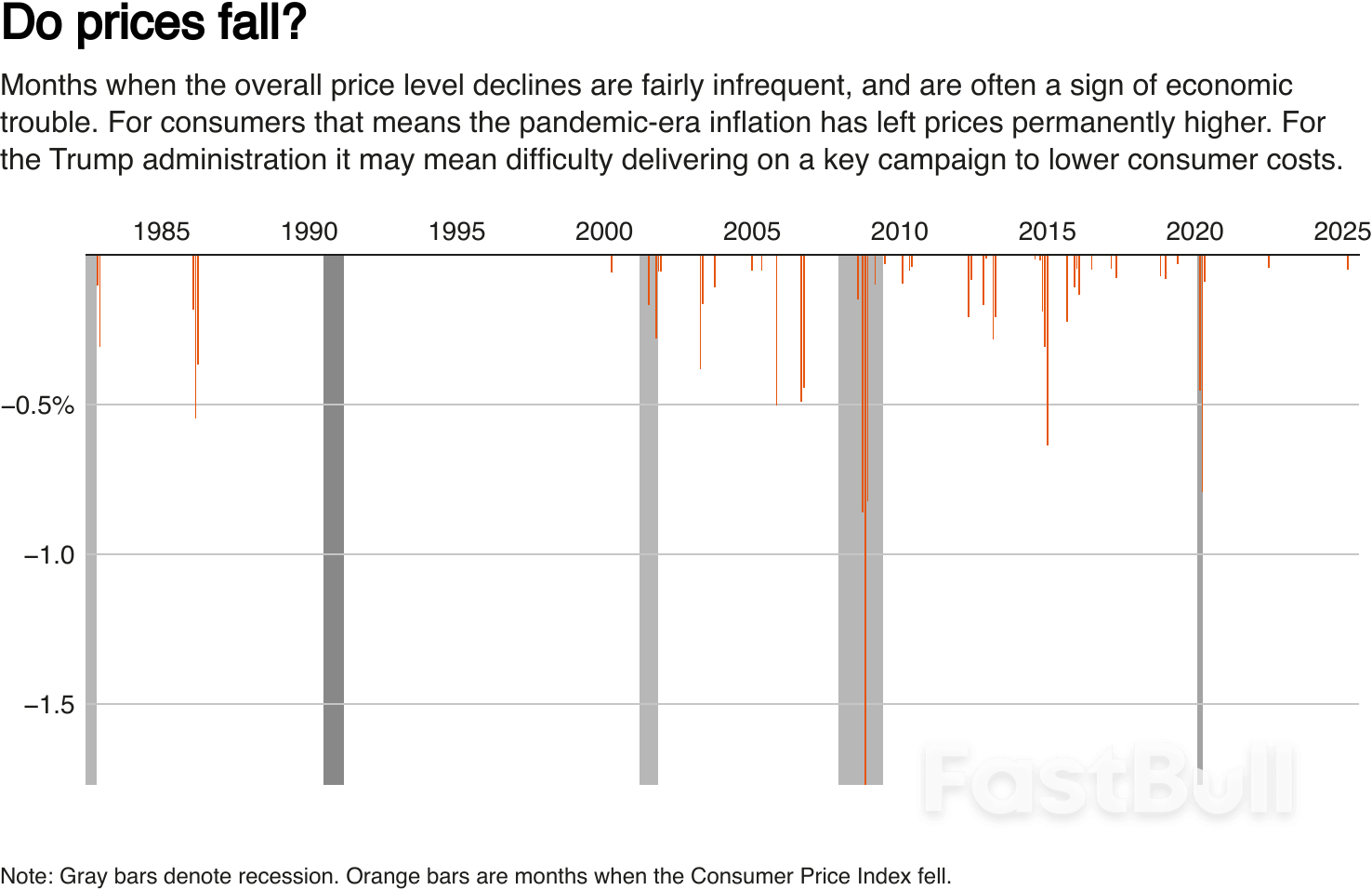
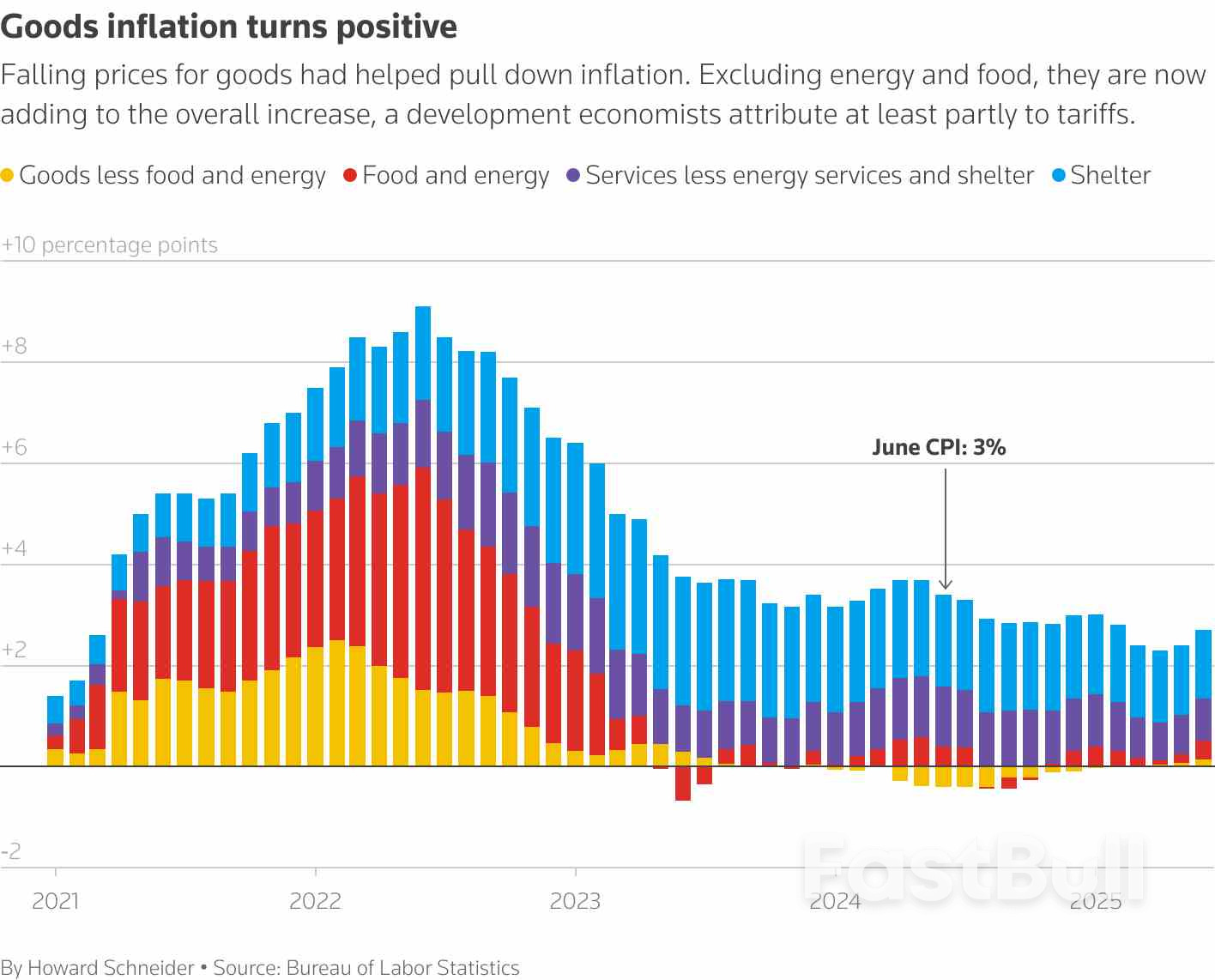
          But those odds slipped to nearly 50-50 this week after the Consumer Price Index showed inflation rose to 2.7% in June from 2.4% in the prior month. A trend that saw declining prices for goods is beginning to shift, adding to overall inflation, in a sign businesses may have begun passing some of the tariffs along to consumers.
          Fed's rate-cut delay intact as inflation fears override Trump pressure_1

          Bar chart showing contributions of different items to overall inflation.

          Powell and other Fed officials said they expected price increases to quicken this summer. They have been reluctant to cut rates until it is clear how much inflation is in train, how long it persists, and whether the economy begins to slow enough to ease the pressure on prices.
          Fed policymakers will receive two more months of jobs and inflation data before their meeting in September, and investors - and Trump administration officials - will be listening closely to Powell's post-meeting press conference on July 30 for language that leans towards a rate cut then or not.
          In the final comments before policymakers begin a "blackout" period on public statements before the next meeting, the focus remained largely on inflation and how June's uptick showed prices rising across an array of largely imported goods.
          Trade and tariff issues are now "the key drivers of the U.S. economic outlook," Fed Governor Adriana Kugler said on Thursday, adding that with price pressures building, the central bank needed to keep rates steady "for some time" to hold inflation and inflationary psychology in check.
          "I see upward pressure on inflation from trade policies, and I expect additional price increases later in the year," she said. Maintaining tight monetary policy for now "is important to keep longer-run inflation expectations anchored."
          Fed Governor Christopher Waller, mentioned as a possible replacement for Powell, disagreed in comments later on Thursday, repeating his call for a rate cut at the meeting in two weeks to account for what he sees as a coming economic slowdown and the likelihood that the impact of tariffs on inflation won't last.
          "With inflation near target and the upside risks to inflation limited, we should not wait until the labor market deteriorates before we cut the policy rate," Waller said in prepared remarks for a speech to the Money Marketeers of New York University.
          'INFLECTION POINT'
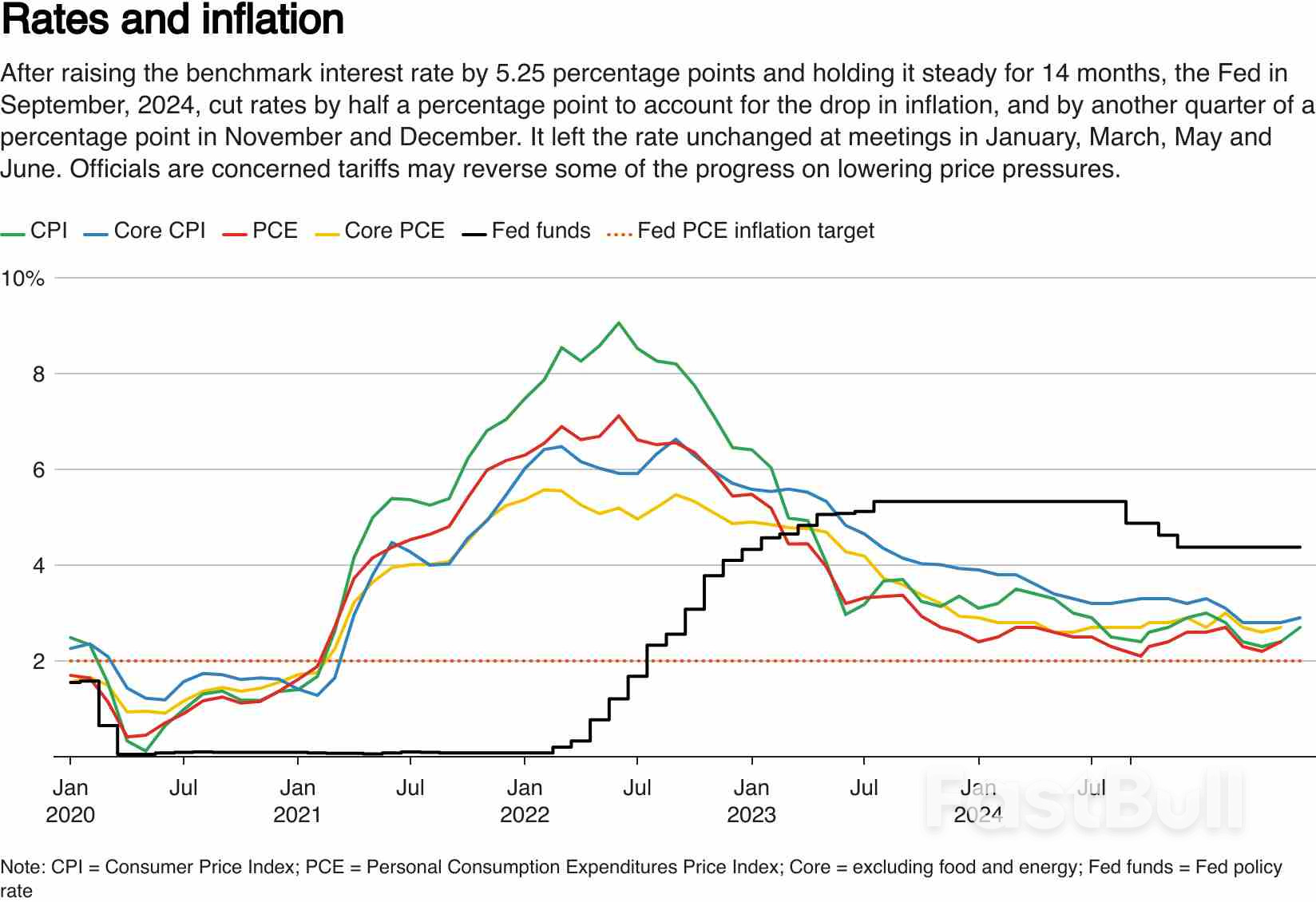
          The Fed used a historically rapid escalation of interest rates in 2022 to help contain a surge of inflation in the aftermath of the COVID-19 pandemic.
          Fed's rate-cut delay intact as inflation fears override Trump pressure_2

          Line graph showing various measures of inflation and the Federal Reserve's policy rate of interest.

          By last fall, Fed officials were confident enough that inflation was receding towards the central bank's 2% target that they began to lower rates, delivering three cuts in the final four months of the year.
          Trump made criticism of high inflation a centerpiece of his 2024 presidential campaign, pledging that prices would actually fall on his watch while also promising to raise tariffs.
          Fed's rate-cut delay intact as inflation fears override Trump pressure_3

          Line chart showing months when the CPI index has declined.

          As Trump's inauguration arrived, the economy was still growing above trend and the labor market remained tight. Fed officials and staff worried that while tariffs, like any tax, should in theory have only a one-time price impact, those conditions coupled with the recent bout of high inflation could lead to a more persistent problem.
          The focus on tariffs as a source of inflation and a reason for delaying rate cuts has been central to Trump's ire at Powell, but U.S. central bankers this week said the CPI data for June showed why they are concerned, with inflation still above target and possibly poised to move higher.
          Kugler estimated that coming data will show the Personal Consumption Expenditures Price Index the Fed uses for its inflation target increased 2.5% in June, while the "core" measure excluding food and energy items rose 2.8%, higher than in May.
          "We may be at an inflection point," as far as inflation is concerned, Atlanta Fed President Raphael Bostic told Fox Business a day after the CPI release. Nearly half of goods saw price increases that annualize to 5% or more, he said, a ratio he uses to monitor inflation's breadth during the pandemic surge. That was double the share in January.
          "The headline number moved away from our target, not towards it ... We've seen the highest increase in prices that we've seen all year," Bostic said. "We are seeing things underlying in the economy that suggest inflation pressures are up ... The price pressures are real."
          In economic projections issued in June, Fed officials expected PCE inflation to hit 3% by the end of this year but still anticipated being able to cut rates by half a percentage point.
          "It's important to note that it's still early days for the effects of tariffs, which take time to come into full force," New York Fed President John Williams said this week. "Though we are only seeing relatively modest effects of tariffs in the hard aggregate data so far, I expect those effects to increase in coming months."

          Source: reuters

          To stay updated on all economic events of today, please check out our Economic calendar
          Risk Warnings and Disclaimers
          You understand and acknowledge that there is a high degree of risk involved in trading. Following any strategies or investment methods may lead to potential losses. The content on the site is provided by our contributors and analysts for information purposes only. You are solely responsible for determining whether any trading assets, securities, strategy, or any other product is suitable for investing based on your own investment objectives and financial situation.
          Add to Favorites
          Share

          How the EU is preparing to reach a tariff deal in Trump’s game of chicken

          Adam

          Economic

          The U.S. has doubled down on its plan to impose 30% tariffs on the European Union next month, seeking to ramp up pressure on the bloc to reach a deal.
          With less than two weeks to go until U.S. President Donald Trump’s Aug. 1 deadline, the EU continues to negotiate with U.S. trade officials, while drawing up a series of possible countermeasures if a deal is not forthcoming.
          For its part, the U.S. said the EU continues to be “very eager” in negotiating a trade agreement, according to White House press secretary Karoline Leavitt.
          Speaking at a news conference on Thursday, Leavitt said the EU is exploring “ways to lower their tariff and their non-tariff barriers that we have long said harm our workers and our companies.”
          The U.S. president, whose trade war tactics have earned him the TACO nickname, will not accept a postponement of the Aug. 1 deadline, Leavitt said.
          TACO stands for “Trump always chickens out” in reference to the president’s tendency to date to announce high import tariffs, only to later delay or lower them.
          A four-part strategy
          Michal Baranowski, Polish undersecretary of state at the ministry of economic development and technology, said that, as work continues in a bid to reach a deal, the first part of the EU’s strategy is to negotiate with U.S. officials in good faith.
          “The second one is, let’s prepare for countermeasures in case we don’t [reach a deal]. And we have countermeasures on both the steel and aluminium tariffs as well as the initial package of 72 billion [euros] for so-called reciprocal tariffs,” Baranowski told CNBC’s “Europe Early Edition” on Friday.
          “Point three, we are comparing notes with other countries that are affected by U.S. tariffs, not to necessarily coordinate but to get a sense of where everyone else is, because the other countries negotiating with the U.S. are a bit on the same wagon,” he continued.
          “Fourth, we are really strengthening European competitiveness.”
          Poland’s Baranowski said the EU represents the “most vital economic relationship” for the U.S., adding that Washington has “as much to gain or to lose from this relationship as Europe.”
          His comments come shortly after the EU’s top trade negotiator Maros Sefcovic traveled to Washington for further trade talks.
          The prospect of fresh U.S. tariffs represents a major blow to the EU. The 27-nation bloc had been scrambling to secure a preliminary agreement to spare it from receiving a Trump letter dictating a new, across-the-board tariff on its exports to the U.S.
          The U.S. and EU have the largest bilateral trade and investment relationship in the world, representing almost 30% of global trade in goods and services, and accounting for 43% of the global gross domestic product (GDP), according to EU figures.
          Last year alone, the value of EU-U.S. trade amounted to 1.68 trillion euros ($1.96 trillion), equivalent to roughly 4.6 billion euros of trade per day.
          Trump has repeatedly hit out at the EU for what he perceives to be an unfair trading relationship, often citing the EU’s trade surplus with the U.S.
          Tit-for-tat auto tariff cuts?
          As part of its push to reach a U.S.-EU framework trade deal, the European bloc is said to be planning to offer the U.S. tit-for-tat tariff reductions on cars.
          The move, as reported by the Financial Times on Thursday, would see the EU drop its 10% duties on U.S. car exports if the Trump administration reduces its own tariffs on the sector to below 20%.
          The European Commission, the EU’s executive arm, declined to comment on the report when contacted by CNBC on Friday.
          The U.S. president imposed 25% tariffs on foreign-made vehicles and parts earlier in the year, hitting companies across Europe particularly hard.
          Sweden’s Volvo Cars, for instance, on Thursday reported a sharp decline in second-quarter operating profit, saying the result reflects an ongoing challenging environment for the industry. The automaker, which is seen as one of the most exposed European automakers to U.S. tariffs, was the first regional carmaker to release results in what is expected to be a bruising earnings season.

          Source: cnbc

          To stay updated on all economic events of today, please check out our Economic calendar
          Risk Warnings and Disclaimers
          You understand and acknowledge that there is a high degree of risk involved in trading. Following any strategies or investment methods may lead to potential losses. The content on the site is provided by our contributors and analysts for information purposes only. You are solely responsible for determining whether any trading assets, securities, strategy, or any other product is suitable for investing based on your own investment objectives and financial situation.
          Add to Favorites
          Share

          Battery Material Stocks Jump after US Announces Graphite Duty

          Adam

          Stocks

          Stocks of battery material makers climbed after the US announced it would impose preliminary anti-dumping duties of 93.5% on graphite imports from China.
          Shares of Australian graphite miner Syrah Resources Ltd. surged as much as 38%, while shares of South Korea’s Posco Future M Co. climbed 24%. Novonix Ltd., an Australian-listed company with a graphite production plant in Chattanooga, Tennessee, surged 21%. Gains in these and other Asian stocks tracked earlier jumps in Canadian peers including Nouveau Monde Graphite Inc.
          The Commerce Department issued the preliminary determination Thursday, and a final plan should be announced by Dec. 5. The US determined that China, which dominates the processing capacity of graphite, had been unfairly subsidizing the industry.
          Graphite is a key raw material in the anodes of electric-vehicle batteries. About two-thirds of the material imported by the US still came from China last year, according to BloombergNEF, even though China strengthened export control on some categories of graphite since 2023. The US has sought to encourage EV makers to be less reliant on Chinese components with subsidy-qualifying measures under its Inflation Reduction Act.
          “I think this is going to change behaviors and sourcing strategies of battery manufacturers in the United States,” said Michael O’Kronley, chief executive officer at Novonix. “The cost of graphite imported from China is going to go up. This ruling essentially is going to accelerate some of those discussion we have with manufacturers.”
          The new duties will add to existing rates making the effective tariff 160%, according to the American Active Anode Material Producers, the trade group that filed the complaint. China currently dominates the processing capacity of graphite, with the International Energy Agency in a report in May calling the material one of the most exposed to potential supply risks.
          “Expectations of IRA benefits coupled with US-China decoupling are boosting investor sentiment and driving up the share prices of related companies,” said Namho Kim, general manager of Timefolio Investment Management in Seoul. “Battery material companies with lower reliance on China will emerge as key beneficiaries.”
          Chinese suppliers including Hunan Zhongke Electric Co. and Jiangsu Baichuan High-Tech New Materials Co. traded slightly higher early Friday.
          “The US is likely to be promoting the development of its own graphite industry by forcing domestic battery makers to switch suppliers,” said Eugene Hsiao, head of China equity strategy at Macquarie Capital. “Thus upstream suppliers of Chinese graphite anodes are more likely to be impacted.”

          Source: Bloomberg

          Risk Warnings and Disclaimers
          You understand and acknowledge that there is a high degree of risk involved in trading. Following any strategies or investment methods may lead to potential losses. The content on the site is provided by our contributors and analysts for information purposes only. You are solely responsible for determining whether any trading assets, securities, strategy, or any other product is suitable for investing based on your own investment objectives and financial situation.
          Add to Favorites
          Share

          EU Imposes New Sanctions On Russia And Its Oil Trade

          Devin

          Economic

          Commodity

          The European Union has approved a new package of sanctions on Russia, including restrictions on banking and fuels made from Russian petroleum, and a revised oil price cap – the 18th raft of measures since the country’s full scale invasion of Ukraine. The new controls will cut around 20 more Russian banks off from the international payments system SWIFT and blacklist a large oil refinery in India, which is partially owned by Russia’s state-run oil company.

          The deal was initially blocked by Slovakia, until the country last night accepted guarantees from the European Commission that would limit the fallout from a planned cut off of Russian gas.

          The UK today separately sanctioned 18 people it accused of spying for Russia’s GRU military intelligence agency, who it said had conducted cyber and hybrid warfare operations against Britain and Ukraine, including online reconnaissance to help target missile strikes.

          The UK could join together with European powers in a Donald Trump plan to purchase US military equipment for Ukraine. British and German defense ministers are set to talk during a virtual meeting of the Ukraine Defense Contact Group on Monday.

          Indian Prime Minister Narendra Modi is likely to visit the UK next week to sign a landmark trade deal between the countries. The agreement would slash tariffs on cosmetics, cars, and alcohol, amongst other goods, helping India and the UK to reduce disruption in the wake of protectionism from the US. The trading relationship is currently worth around £42.6 billion, and the deal – the UK’s biggest new agreement since Brexit – was signed in May and is likely to take around a year to become effective.

          Barcelona will limit port space for cruise ships in a new bid to tighten up tourism to the city. The number of cruise ship passengers increased by 20% from 2018 to 2024, part of a general increase in tourism to the city which has recently led to fierce protests from residents. The move is less restrictive than some other measures the city has taken, including last year promising to ban all short-term rentals by 2029.

          Meta Platforms said it won’t sign the code of practice for Europe’s new set of laws governing artificial intelligence, calling the guidelines to help companies follow the AI Act overreach. “Europe is heading down the wrong path on AI,” Meta’s head of global affairs Joel Kaplan said in a post on LinkedIn. The EU published the voluntary framework earlier this month. It is meant to help companies put processes in place to stay in line with the bloc’s sprawling AI Act, and includes copyright protections for creators and transparency requirements for advanced AI models.

          The EU has agreed to open talks on strategic ties with six Gulf states, aiming to create bilateral Strategic Partnership Agreements that will broaden its international influence amid tariff threats from the US. Negotiations with the Gulf Cooperation Council countries – Bahrain, Kuwait, Oman, Qatar, Saudi Arabia and the United Arab Emirates – are expected to begin as soon as possible, and will touch on issues from security to energy.

          Cryptoassets’ total market value surged past $4 trillion for the first time, as the US legislature ends so-called “Crypto Week,” when the first-ever federal legislation for stablecoins was passed. The path to Bitcoin being worth $150,000 now looks “increasingly inevitable,” according to Fadi Aboualfa, head of research at Copper.

          Burberry’s sales fell less than predicted, as the turnaround plan from CEO Joshua Schulman begins to deliver returns for the British fashion house. Analysts had expected a 3.7% drop in comparable store sales in the second quarter of the year – but a statement published today showed it was in fact 1%. At yesterday’s close, shares were up 27% from the start of the year – yet the company warned that the luxury slowdown in China, as well as trade tensions, mean the macroeconomic picture is still uncertain.

          Zara founder Amancio Ortega’s private investment firm is on a shopping spree buying a string of trophy assets which will shield him from tax. Ortega’s family office Pontegadea has spent $500 million in the last three months buying a five-star Paris hotel, a Florida apartment block and a building on Barcelona’s iconic Diagonal Avenue. Future transactions include a potential deal to buy a $275 million office building in Miami. The shopping blitz coincided with Ortega, who is worth around $103.7 billion, receiving a multi-billion annual dividend from Inditex, the retail giant owner of Zara that he founded over six decades ago.
          Source: Bloomberg Europe

          To stay updated on all economic events of today, please check out our Economic calendar
          Risk Warnings and Disclaimers
          You understand and acknowledge that there is a high degree of risk involved in trading. Following any strategies or investment methods may lead to potential losses. The content on the site is provided by our contributors and analysts for information purposes only. You are solely responsible for determining whether any trading assets, securities, strategy, or any other product is suitable for investing based on your own investment objectives and financial situation.
          Add to Favorites
          Share

          Eroding Fed credibility could be gold’s next catalyst, analysts warn

          Adam

          Commodity

          Economic

          Rising political tensions between President Trump and the Federal Reserve are rattling investor confidence, with analysts warning that any blow to central bank independence could send gold prices soaring.
          President Donald Trump has never been shy about expressing his disapproval of Federal Reserve Chair Jerome Powell, as Powell maintains the central bank’s current neutral monetary policy stance. Trump recently stated that interest rates should be at least 3% lower, which would place them in a range between 1.25% and 1.50%.
          Over the past several months, Trump has launched personal attacks, calling Powell a “dumb guy,” a “moron,” a “knucklehead,” and nicknaming him “Mr. Too Late.” However, the rhetoric has intensified in recent days.
          On Friday, William Pulte, Chairman of the Board of Fannie Mae and Freddie Mac, helped spread false rumors that Powell was considering resigning.
          “I’m encouraged by reports that Jerome Powell is considering resigning. I think this will be the right decision for America, and the economy will boom,” he said in an official statement.
          It was also revealed that Trump spoke with Republican lawmakers on Tuesday about potentially firing Powell, but he later backtracked, saying that it was “highly unlikely.”
          The uncertainty surrounding central bank leadership is injecting new volatility into markets, and analysts say this environment will only worsen as concerns about the Federal Reserve’s independence grow.
          In a note published Thursday, Ipek Ozkardeskaya, Senior Analyst at Swissquote Bank, described the Federal Reserve’s independence as its “superpower.”
          “The consequences of such an attack on the Fed’s independence could be dramatic. Not only would the US dollar and Treasuries tumble, but the Fed would lose a superpower: the one that helps it support turmoiled financial markets by buying billions of dollars in US debt,” she said. “Remember, the US—and a few privileged economic zones—are unique in that government bonds can be supported by their central banks purchasing their debt. This is due to credibility. If that credibility is lost, the Fed loses its most important tool. If QE and the Fed’s expanding balance sheet have worked so well over decades, it’s because the Fed enjoys a level of credibility that few others do. If that credibility disappears, lowering rates would severely hurt both the dollar and Treasuries.”
          In this environment, Ozkardeskaya advised investors to keep an eye on safe-haven assets, noting, “it looks like we might see some serious action at the Fed this fall.”
          She pointed to Turkey’s central bank as an example of an institution that lost credibility after losing its independence. From 2018 to 2023, Turkish President Recep Tayyip Erdogan pursued a policy of continuous interest rate cuts and currency intervention, even as inflation soared out of control.
          Michael Brown, Senior Market Analyst at Pepperstone, also cited Turkey’s economic turmoil as a warning for U.S. investors. He added that such an environment would be favorable for gold.
          “When one has to reach for Turkey as an analogy for how monetary policy could end up being set, it isn’t exactly a promising, or reassuring, sign,” he said in a note. “And, in any case, yesterday’s reaction supports my longer-running bearish view: selling rallies in the greenback as any and all pretense of monetary policy independence continues to be eroded, in rather rapid fashion.”
          “It appears that the administration is seeking to erode every last shred of monetary policy independence—either right now or via the appointment of Powell’s successor next May,” Brown said in a comment to Kitco News. “Either way, this is going to keep international investors spooked and ensure that reserve allocators continue to seek alternatives to the greenback. Obviously, this is where gold can shine.”
          Naeem Aslam, Chief Investment Officer at Zaye Capital Markets, said he is bullish on gold as the turmoil at the Fed adds to growing geopolitical uncertainty across financial markets.
          “If political tensions rise even higher and the Federal Reserve faces more pressure from the White House, the most likely scenario would be increased volatility in the market. Gold, given its past role as a safe haven in times of political and economic volatility, would likely see more use as a store of value,” he said.
          Jim Wyckoff, Senior Market Analyst at Kitco.com, also said he expects gold to rally if Trump follows through with his initial threat to fire Powell.
          “Trump firing Powell would surprise the marketplace and drive safe-haven demand to gold, which in turn would likely pressure the U.S. dollar index—at least initially,” he said.
          Some analysts suspect that Trump’s remarks were an attempt to test the waters on changing the Fed’s leadership. Marc Chandler, Managing Director at Bannockburn Global Forex, said the trial balloon floated “as well as a lead zeppelin.”
          Analysts also note that the central bank drama is just the latest addition to a growing list of fundamental factors supporting gold. Like Trump’s ongoing trade war, they say anything that threatens the U.S. dollar’s role as the world’s reserve currency will ultimately drive gold prices higher.
          While investment demand has increased this year, analysts emphasize that central bank demand remains a critical factor behind gold’s historic rally over the last three years. Some expect global central banks to boost gold reserves by another 1,000 tonnes this year—for the third consecutive year.
          While market analysts at TD Securities say it is unlikely Trump would be able to fire Powell before his term expires in May 2026, they suggest that creating a "shadow chair" on the committee might be an option. However, they caution that this would have a similar disruptive effect on broader financial markets.
          “In this scenario, monetary policy guidance will be diluted, as there will be no central message to rely on, which will complicate one of the avenues the Fed uses to manage expectations,” the analysts wrote. “A shadow Fed Chair could be the next big worry for the USD, especially given the financing risks of the widening fiscal deficit. This would serve to shorten the path to the FX value trade (USD selloff) if the Fed starts to lose credibility. This could usher in the next leg lower for the USD, accompanied by a steeper curve and further reversal of the historical relationship to the US 10-year rate.”

          Source: kitco

          To stay updated on all economic events of today, please check out our Economic calendar
          Risk Warnings and Disclaimers
          You understand and acknowledge that there is a high degree of risk involved in trading. Following any strategies or investment methods may lead to potential losses. The content on the site is provided by our contributors and analysts for information purposes only. You are solely responsible for determining whether any trading assets, securities, strategy, or any other product is suitable for investing based on your own investment objectives and financial situation.
          Add to Favorites
          Share

          Foreign investors are warming to London's unloved stocks

          Adam

          Stocks

          Britain's stock market finally appears to be reversing years of underperformance against the rest of Europe, as a UK/U.S. trade deal, lighter regulation and cheap stocks deliver juicy returns that are starting to attract foreign investors.
          The FTSE 100 has gained nearly 10% this year to hit record highs this week, beating the STOXX 600, which is up 7.5%.
          On a year-to-date basis, London's blue-chip index has performed better than its European counterpart for the last six weeks, its longest such stretch since late 2022, when a weak pound beefed up revenues for the export-focused FTSE.
          This week, the financial regulator said it will roll out new rules to boost Britain's capital markets, while Chancellor Rachel Reeves told the financial industry to paint a less negative picture of UK stocks for would-be retail investors, as she seeks new ways to revive a stagnating economy.
          For foreign investors, the blue-chip index is already looking appealing given sterling's rally this year, while asset managers say the narrative around the UK is shifting.
          "We are seeing signs of big asset allocators coming back to the UK," Justin Onuekwusi, chief investment officer at St. James's Place. "I am talking about non-UK endowments, pension funds, asset owners, wealth managers who were all very underweight the UK post-Brexit," he said.
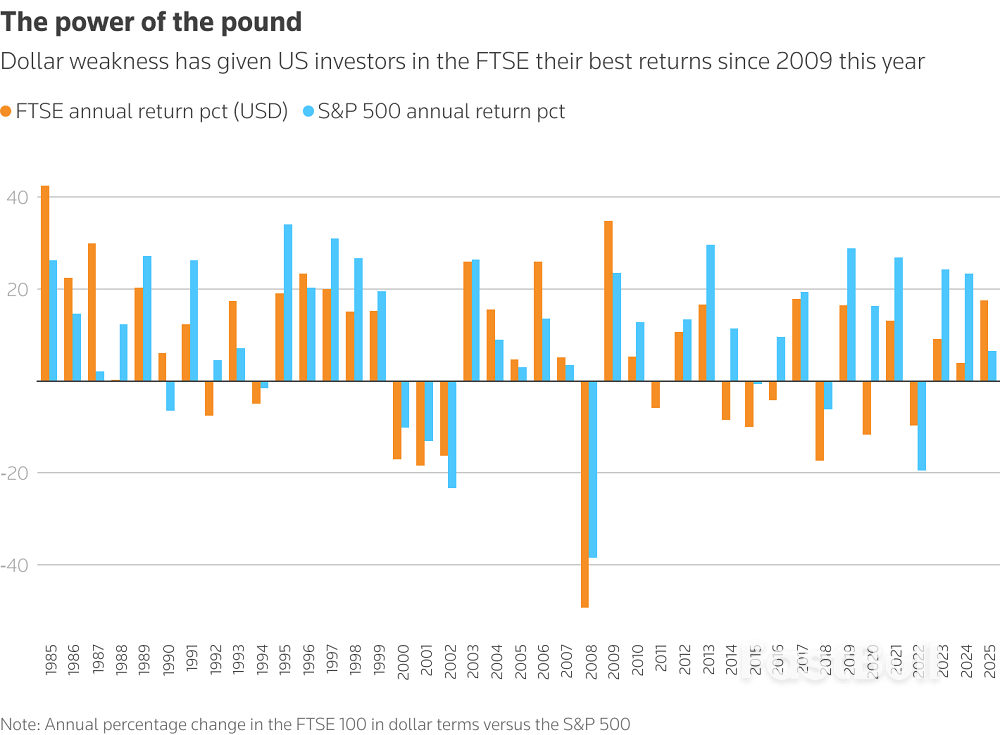
          In dollar terms, the FTSE-100 is up nearly 18% so far this year, set for the biggest dollar-denominated returns since 2009, compared with a 6% year-to-date gain in the S&P 500 which has also hit record highs.
          The pound , up 7% this year against the dollar as investors turn away from U.S. assets in response to heightened U.S. policy uncertainty under U.S. President Donald Trump, acts as a headwind for FTSE constituents, 80% of whom get their revenues from overseas.
          Yet the index's wealth of large defensive companies, including healthcare, utilities and food retailers, help insulate it against swings in the underlying economy, like drugmaker AstraZeneca or supermarket chain Tesco It also has growth-sensitive resource stocks such as Anglo American and BP to tap into strength in oil, copper and gold.
          Britain meanwhile is one of the few economies facing less trade uncertainty with a U.S. trade deal in place. In contrast, the European Union faces the threat of 30% tariffs if there is no agreement by August 1.
          Foreign investors are warming to London's unloved stocks_1

          A bar chart showing the annual percentage change in the FTSE 100 in dollars in orange and the S&P 500 in blue from 1985 to 2025

          'TEA AND BISCUIT'
          "The UK stock market is the calming cup of tea and biscuit in an uncertain world. There’s nothing fancy on offer, just reliable names that do their job day in, day out," AJ Bell investment analyst Dan Coatsworth said.
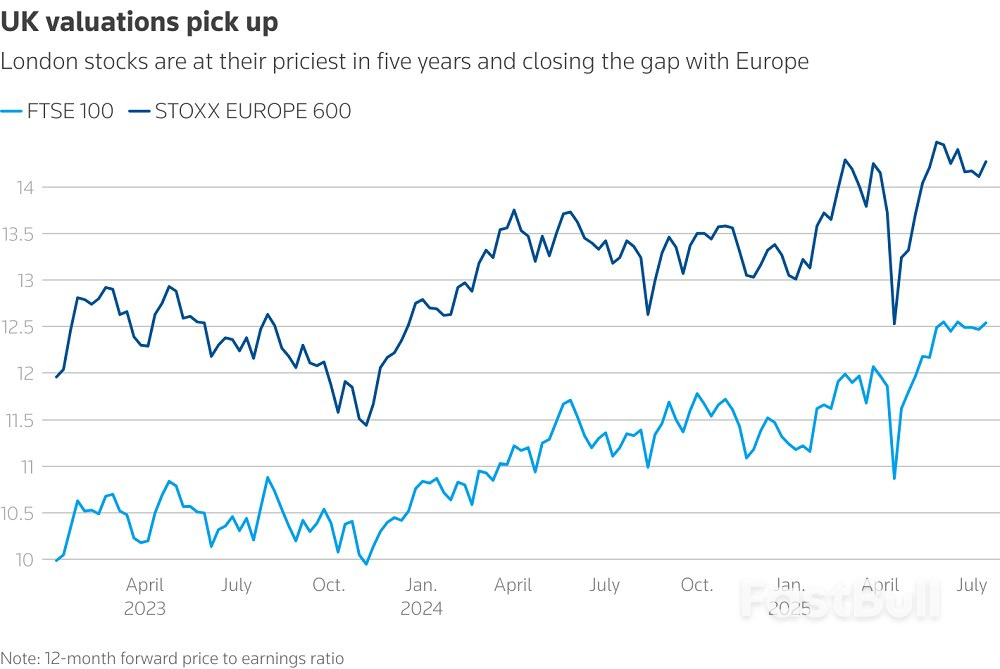
          Valuations for FTSE-100 companies have lagged those elsewhere in Europe for years.
          The 2016 Brexit vote accelerated that trend, with fewer companies using London to list their shares and fewer cropping up as M&A targets, given the political and economic uncertainty that prevailed at the time.
          Now the UK market is catching up. The FTSE-100's 12-month forward price-to-earnings ratio of 12.5 is the highest for around five years, compared with 14.11 for the STOXX, the narrowest gap in around 18 months, LSEG data shows.
          The S&P trades at a ratio of 23, a near-10 point premium to the FTSE, compared with under 2 points 10 years ago.
          "The relatively poor performance we’ve seen in the UK versus particularly the U.S. over the past two years has begun to unwind. We’re in the foothills of that," Michael Stiasny, head of UK Equities, M&G Investments, said, adding that the UK market has traded at a "significant discount".
          The pound is close to a four-year high against the dollar, but has weakened against the euro this year , offering a tailwind to the FTSE's big exporters.
          The EU is Britain's largest trading partner, accounting for 41% of exports in 2024, followed by the United States, with 22%, according to official data.
          It isn't all rosy. The British economy is flagging, inflation is well above the Bank of England's target of 2% and business activity and employment are slowing.
          Barclays data shows UK equities have seen a net outflow of $20 billion in 2025, although outflows have almost dried up in the last month, compared with Europe's year-to-date inflow of $13 billion and rapidly slowing inflows.
          Sebastian Raedler, head of European equity strategy and Bank of America Merrill Lynch, said he felt the FTSE's strong run was a function of the currency and in line with the rest of Europe.
          "Net-net, the FTSE has mildly outperformed, but I would say in an environment where there are a lot of big stories ... a 2% (out)performance of the UK this year would rank further down the radar from my perspective," he said, referring to the percentage gain in the FTSE in 2025 versus that of the STOXX.
          Foreign investors are warming to London's unloved stocks_2

          Two blue lines showing the P/R ratios for the STOXX 600 and FTSE 100 indices

          Source: reuters

          Risk Warnings and Disclaimers
          You understand and acknowledge that there is a high degree of risk involved in trading. Following any strategies or investment methods may lead to potential losses. The content on the site is provided by our contributors and analysts for information purposes only. You are solely responsible for determining whether any trading assets, securities, strategy, or any other product is suitable for investing based on your own investment objectives and financial situation.
          Add to Favorites
          Share
          FastBull
          Copyright © 2025 FastBull Ltd

          728 RM B 7/F GEE LOK IND BLDG NO 34 HUNG TO RD KWUN TONG KLN HONG KONG

          TelegramInstagramTwitterfacebooklinkedin
          App Store Google Play Google Play
          Products
          Charts

          Chats

          Q&A with Experts
          Screeners
          Economic Calendar
          Data
          Tools
          Membership
          Features
          Function
          Markets
          Copy Trading
          Latest Signals
          Contests
          News
          Analysis
          24/7
          Columns
          Education
          Company
          Careers
          About Us
          Contact Us
          Advertising
          Help Center
          Feedback
          User Agreement
          Privacy Policy
          Business

          White Label

          Data API

          Web Plug-ins

          Poster Maker

          Affiliate Program

          Risk Disclosure

          The risk of loss in trading financial instruments such as stocks, FX, commodities, futures, bonds, ETFs and crypto can be substantial. You may sustain a total loss of the funds that you deposit with your broker. Therefore, you should carefully consider whether such trading is suitable for you in light of your circumstances and financial resources.

          No decision to invest should be made without thoroughly conducting due diligence by yourself or consulting with your financial advisors. Our web content might not suit you since we don't know your financial conditions and investment needs. Our financial information might have latency or contain inaccuracy, so you should be fully responsible for any of your trading and investment decisions. The company will not be responsible for your capital loss.

          Without getting permission from the website, you are not allowed to copy the website's graphics, texts, or trademarks. Intellectual property rights in the content or data incorporated into this website belong to its providers and exchange merchants.

          Not Logged In

          Log in to access more features

          FastBull Membership

          Not yet

          Purchase

          Become a signal provider
          Help Center
          Customer Service
          Dark Mode
          Price Up/Down Colors

          Log In

          Sign Up

          Position
          Layout
          Fullscreen
          Default to Chart
          The chart page opens by default when you visit fastbull.com