Markets
News
Analysis
User
24/7
Economic Calendar
Education
Data
- Names
- Latest
- Prev


Signal Accounts for Members
All Signal Accounts
All Contests


U.K. Trade Balance Non-EU (SA) (Oct)A:--
F: --
P: --
U.K. Trade Balance (Oct)A:--
F: --
P: --
U.K. Services Index MoMA:--
F: --
P: --
U.K. Construction Output MoM (SA) (Oct)A:--
F: --
P: --
U.K. Industrial Output YoY (Oct)A:--
F: --
P: --
U.K. Trade Balance (SA) (Oct)A:--
F: --
P: --
U.K. Trade Balance EU (SA) (Oct)A:--
F: --
P: --
U.K. Manufacturing Output YoY (Oct)A:--
F: --
P: --
U.K. GDP MoM (Oct)A:--
F: --
P: --
U.K. GDP YoY (SA) (Oct)A:--
F: --
P: --
U.K. Industrial Output MoM (Oct)A:--
F: --
P: --
U.K. Construction Output YoY (Oct)A:--
F: --
P: --
France HICP Final MoM (Nov)A:--
F: --
P: --
China, Mainland Outstanding Loans Growth YoY (Nov)A:--
F: --
P: --
China, Mainland M2 Money Supply YoY (Nov)A:--
F: --
P: --
China, Mainland M0 Money Supply YoY (Nov)A:--
F: --
P: --
China, Mainland M1 Money Supply YoY (Nov)A:--
F: --
P: --
India CPI YoY (Nov)A:--
F: --
P: --
India Deposit Gowth YoYA:--
F: --
P: --
Brazil Services Growth YoY (Oct)A:--
F: --
P: --
Mexico Industrial Output YoY (Oct)A:--
F: --
P: --
Russia Trade Balance (Oct)A:--
F: --
P: --
Philadelphia Fed President Henry Paulson delivers a speech
Canada Building Permits MoM (SA) (Oct)A:--
F: --
P: --
Canada Wholesale Sales YoY (Oct)A:--
F: --
P: --
Canada Wholesale Inventory MoM (Oct)A:--
F: --
P: --
Canada Wholesale Inventory YoY (Oct)A:--
F: --
P: --
Canada Wholesale Sales MoM (SA) (Oct)A:--
F: --
P: --
Germany Current Account (Not SA) (Oct)A:--
F: --
P: --
U.S. Weekly Total Rig CountA:--
F: --
P: --
U.S. Weekly Total Oil Rig CountA:--
F: --
P: --
Japan Tankan Large Non-Manufacturing Diffusion Index (Q4)--
F: --
P: --
Japan Tankan Small Manufacturing Outlook Index (Q4)--
F: --
P: --
Japan Tankan Large Non-Manufacturing Outlook Index (Q4)--
F: --
P: --
Japan Tankan Large Manufacturing Outlook Index (Q4)--
F: --
P: --
Japan Tankan Small Manufacturing Diffusion Index (Q4)--
F: --
P: --
Japan Tankan Large Manufacturing Diffusion Index (Q4)--
F: --
P: --
Japan Tankan Large-Enterprise Capital Expenditure YoY (Q4)--
F: --
P: --
U.K. Rightmove House Price Index YoY (Dec)--
F: --
P: --
China, Mainland Industrial Output YoY (YTD) (Nov)--
F: --
P: --
China, Mainland Urban Area Unemployment Rate (Nov)--
F: --
P: --
Saudi Arabia CPI YoY (Nov)--
F: --
P: --
Euro Zone Industrial Output YoY (Oct)--
F: --
P: --
Euro Zone Industrial Output MoM (Oct)--
F: --
P: --
Canada Existing Home Sales MoM (Nov)--
F: --
P: --
Euro Zone Total Reserve Assets (Nov)--
F: --
P: --
U.K. Inflation Rate Expectations--
F: --
P: --
Canada National Economic Confidence Index--
F: --
P: --
Canada New Housing Starts (Nov)--
F: --
P: --
U.S. NY Fed Manufacturing Employment Index (Dec)--
F: --
P: --
U.S. NY Fed Manufacturing Index (Dec)--
F: --
P: --
Canada Core CPI YoY (Nov)--
F: --
P: --
Canada Manufacturing Unfilled Orders MoM (Oct)--
F: --
P: --
Canada Manufacturing New Orders MoM (Oct)--
F: --
P: --
Canada Core CPI MoM (Nov)--
F: --
P: --
Canada Manufacturing Inventory MoM (Oct)--
F: --
P: --
Canada CPI YoY (Nov)--
F: --
P: --
Canada CPI MoM (Nov)--
F: --
P: --
Canada CPI YoY (SA) (Nov)--
F: --
P: --
Canada Core CPI MoM (SA) (Nov)--
F: --
P: --


No matching data
Latest Views
Latest Views
Trending Topics
Top Columnists
Latest Update
White Label
Data API
Web Plug-ins
Affiliate Program
View All

No data
Warnings from CEOs and advisers about tariffs and firing Powell prompted Trump to soften his stance, calming markets. Stocks rallied but uncertainty remains over trade with China and economic stability.
Bank of England policymaker, Megan Greene, expressed her concerns about weak growth and the potential impact of U.S. tariffs on the UK’s inflation during a discussion with the Atlantic Council think tank. The discussion took place on the sidelines of the International Monetary Fund’s spring meeting on Friday.
Greene said that the U.S. President Donald Trump’s tariffs are more likely to lead to lower inflation in Britain rather than higher. She expressed uncertainty about the final impact of these tariffs, stating, "We have tariffs, and none of us have any idea what they’ll look like when the dust finally settles."
She further added that the risk space has shifted slightly. She believes that the risk is now leaning towards the disinflationary side. In her view, the tariffs on the UK would, on balance, be more disinflationary than inflationary.
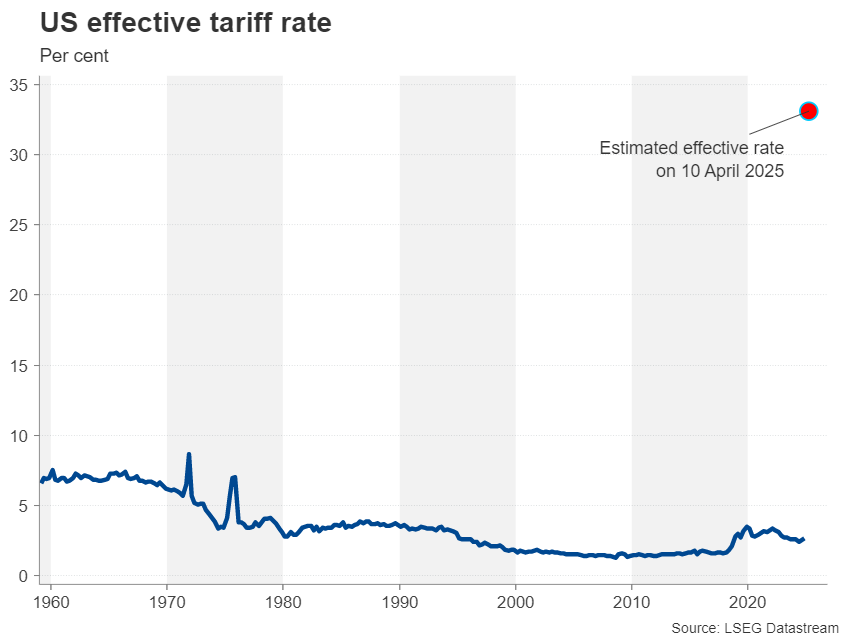
There was finally some relief for financial markets in the past week when US President Trump offered investors a rare glimmer of hope that there is light at the end of the trade war tunnel. However, it didn’t take long for the light to start dimming again as the trade conflict took another complicated turn after it became apparent that the Trump administration’s climbdown in the standoff against China isn’t as big as previously anticipated.
Trump’s carrot-and-stick approach in his bid to get China onto the negotiating table isn’t proving very effective, particularly when the carrot is much smaller than the stick. For Beijing, the trade war has escalated to a level where national pride is at stake, hence, it is not blinking as easily as Trump assumed it would. This is already posing a problem for the White House, which has signalled that the Trump administration is willing to lower the exorbitant 145% tariff rate within two-three weeks if there is a deal.
But according to Chinese officials, the two sides have not even started talks, casting doubt on Trump’s negotiating tactic. Furthermore, other concessions, for example on auto tariffs for US car manufacturers, are far from a done deal, with Trump even threatening to raise them for auto imports from Canada.
All this is only worsening the uncertainty for US businesses rather than offering some clarity. So, although the acknowledgement by the White House that it is keeping an eye on the market turbulence and Trump is keen to reach trade agreements with America’s main trading partners is a positive sign, it does little in terms of easing the immediate fears about the country’s economic prospects.
Those concerns will either be fuelled or reduced in the coming week, as there’s a flurry of top-tier economic releases on the way. Kicking things off on Tuesday are the consumer confidence index for April and JOLTS job openings for March. On Wednesday, the advance estimate for GDP growth will be monitored very closely amid some predictions that the US economy contracted in the first quarter.
The Atlanta Fed’s GDPNow model is estimating an annualized drop of 2.2% in GDP, but analysts according to a Reuters poll are forecasting growth of 0.4%, down sharply from the Q4 pace of 2.4%.
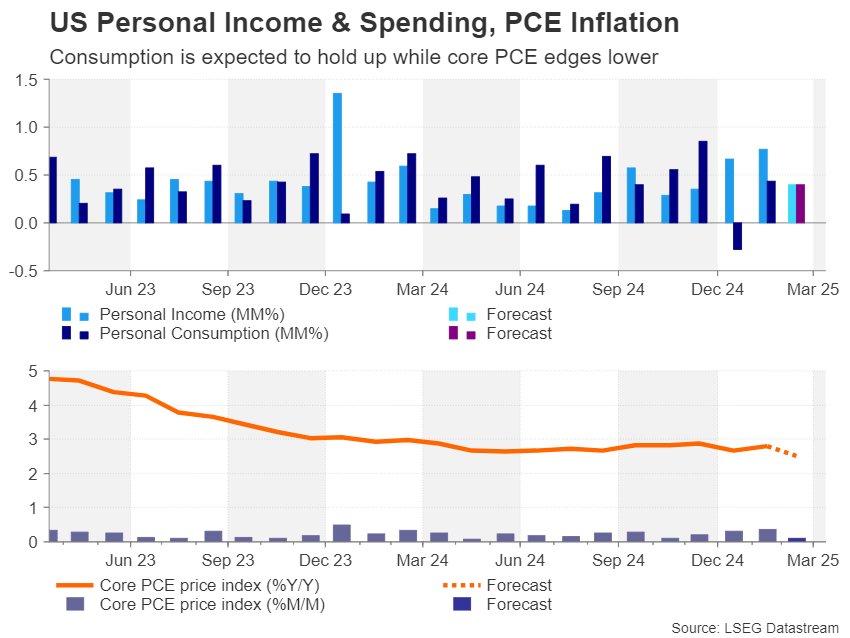
The ADP employment survey is also out on Wednesday, along with the latest PCE inflation and consumption numbers. The all-important core PCE price index is expected to have risen by 0.1% month-on-month in March to give an annual figure of 2.5%, which would be a decrease from the prior 2.8%.
Personal consumption is forecast to have maintained month-on-month growth of 0.4%, suggesting that US households continue to spend at a healthy clip.
Other data on Wednesday will include the Chicago PMI as well as pending home sales. On Thursday, the Challenger Layoffs for April might attract some attention but the bigger focus that day will be the ISM manufacturing PMI. The index is expected to have declined in April from 49.0 to 47.9, with investors also likely to track the direction of the employment and prices sub-indices.
The real highlight, however, will be Friday’s nonfarm payrolls report, amid the intense speculation about how soon the Fed will cut rates. Jobs growth is projected to have slowed from 228k in March to 130k in April, with the unemployment rate staying unchanged at 4.2%. Average earnings probably grew by 0.3% in April.
A disappointing NFP print, combined with a soft core PCE reading could bolster expectations of a 25-basis-point rate cut in June as opposed to July, though bets for the May meeting would likely remain very low. For the US dollar, a worrying set of data would almost certainly be negative, but on Wall Street, stocks could rise if increased rate cut hopes are not overshadowed by recession fears.
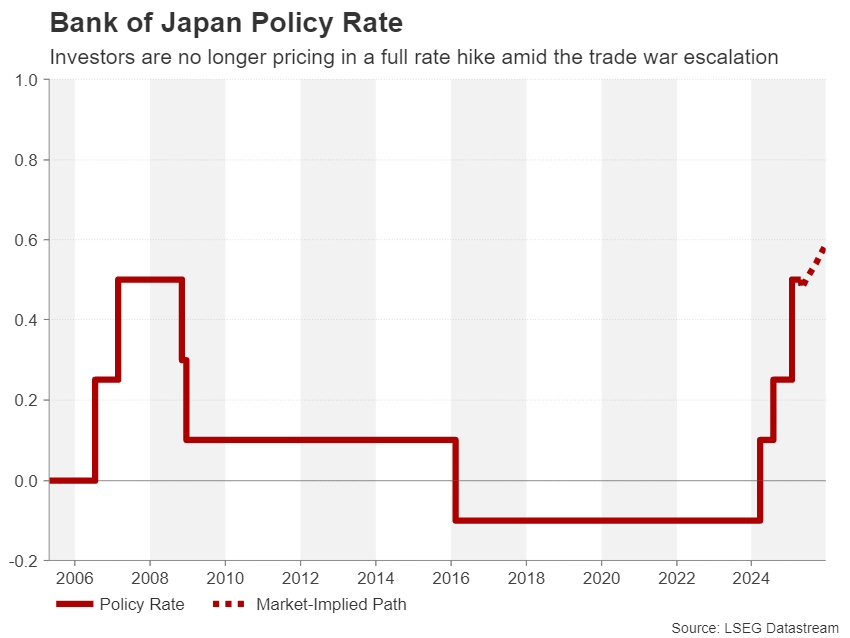
The Bank of Japan is not anticipated to announce any changes to its monetary policy settings when it meets on Thursday, as policymakers take time to assess the impact of Donald Trump’s tariffs on the Japanese economy before deciding whether to hike interest rates again.
Inflation in Japan edged up to 3.2% y/y in March as per the core CPI measure and the BoJ remains confident that the recent wage growth momentum is now becoming more sustainable. However, the downside risks to growth have increased markedly since February when Trump unleashed the first of many waves of tariffs, with Japan not being spared from the universal 10% levies, nor the sectoral tariffs on steel and autos.
The BoJ is therefore expected to lower its growth forecasts in its latest quarterly Outlook Report. The question is whether the Bank will also cut its inflation projections or keep them more or less unchanged. Policymakers don’t think at this stage that tariffs pose a significant danger to their inflation goal so they will probably keep the door to future rate hikes wide open.
If Governor Ueda goes a step further and explicitly signals that further rate hikes are likely in the coming months, this could boost the yen, which is enjoying strong safe-haven demand lately.
In terms of data, the preliminary industrial output for March is due on Wednesday, to be followed by some jobs stats on Friday.
The flash PMI numbers for April painted a grim picture for the Eurozone economy as businesses were hit by a new round of duties. With the impact of the US tariffs on global trade only now being felt, investors will probably ignore the preliminary GDP figures for the first quarter that are out on Wednesday.
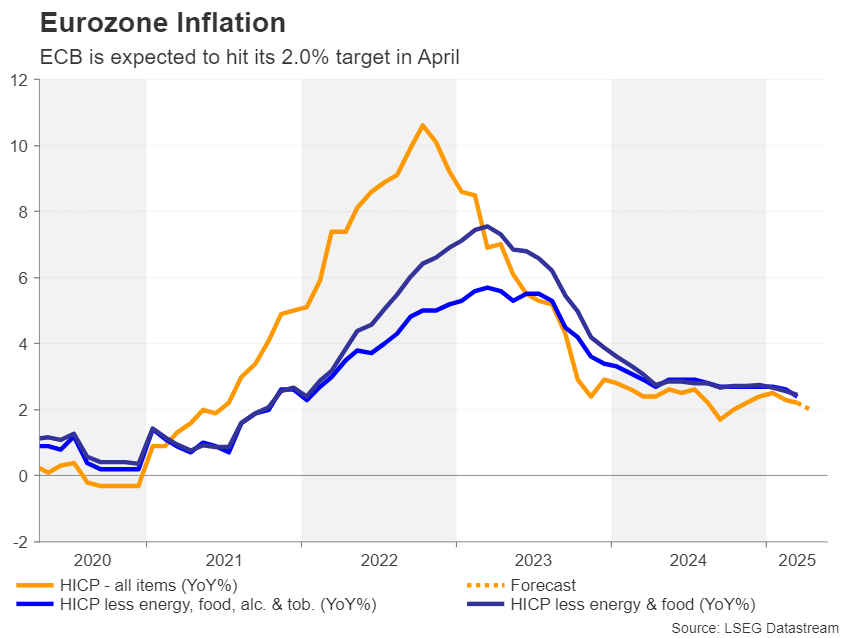
Even if the euro area notched up impressive growth in the first three months of the year, this is unlikely to dampen rate cut expectations for the European Central Bank as inflation is falling and growth forecasts are being downgraded. ECB policymakers have already slashed rates by a total of 175 bps and have strongly hinted that they’re not done yet.
If Friday’s flash CPI data shows that inflationary pressures continue to subside, the ECB will have little reason to pause. The headline rate of CPI moderated to 2.2% y/y in March and is forecast to ease further to 2.0% in April.
The euro could come under some pressure if the CPI prints are on the soft side, but the primary driver in the FX domain will be the US dollar, and specifically, sentiment towards Trump’s trade policies. Fresh efforts by the White House to defuse tensions could spur another bounce in the US dollar, setting back the euro’s uptrend.
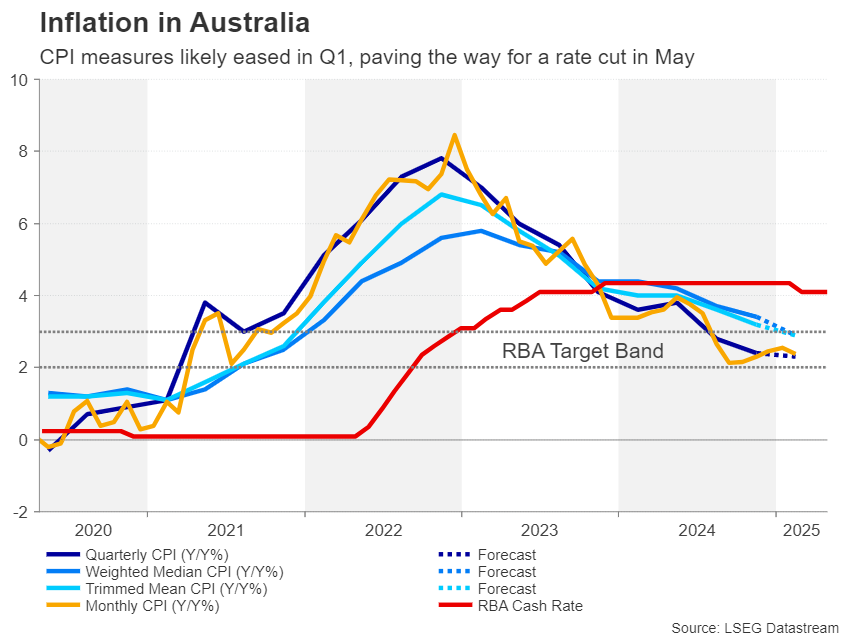
Inflation will also be in the spotlight in Australia where the quarterly CPI readings will be published on Wednesday. The Reserve Bank of Australia has only cut rates once during this cycle amid slow progress in getting inflation under control.
The monthly measure dipped from 2.5% to 2.4% y/y in February in a huge relief after rising for three consecutive months. The quarterly figure covering the first three months of 2025 is expected to inch lower too. But for the RBA, the underlying gauges of CPI might be more important. If they extend their decline in Q1 and the monthly rate also falls, there would be nothing stopping the RBA from cutting rates in May.
However, this may not necessarily trigger much reaction in the Australian dollar, as a 25-bps rate cut is already fully priced in for May and for almost every other meeting in the remainder of the year.
Aussie traders will also be watching the manufacturing PMIs out of China for any signs that the steep US levies are hurting the world’s second largest economy. Both the official and Caixin manufacturing PMIs are due on Wednesday.
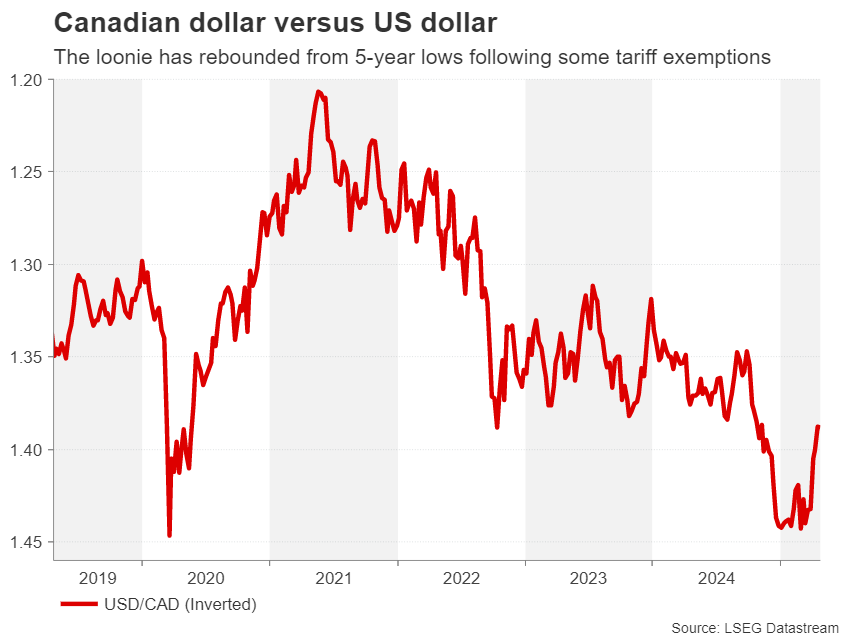
Canadians will be voting in a general election on Monday after former Bank of England and Bank of Canada governor Mark Carney called a snap vote following Justin Trudeau’s resignation. Carney’s Liberal party was all set to lose the election until Trump’s trade tirade reinvigorated the party among voters.
Trudeau’s and Carney’s handling of Trump’s threats to Canada’s economy as well as its sovereignty appear to have earned them plaudits, pushing the Liberals ahead of the Conservatives, who were poised for victory before the trade war escalation.
There’s still room for surprises, however, as the Liberals may fail to win a majority, and with their current coalition partners, the New Democratic Party, expected to lose most of its seats, a hung parliament may not go down well with Canada’s stock market and the local dollar.
But should the Liberals secure a majority, the Canadian dollar could gain slightly, although it’s likely to benefit more from a shock Conservative win, as they’ve pledged bigger tax cuts.


White Label
Data API
Web Plug-ins
Poster Maker
Affiliate Program
The risk of loss in trading financial instruments such as stocks, FX, commodities, futures, bonds, ETFs and crypto can be substantial. You may sustain a total loss of the funds that you deposit with your broker. Therefore, you should carefully consider whether such trading is suitable for you in light of your circumstances and financial resources.
No decision to invest should be made without thoroughly conducting due diligence by yourself or consulting with your financial advisors. Our web content might not suit you since we don't know your financial conditions and investment needs. Our financial information might have latency or contain inaccuracy, so you should be fully responsible for any of your trading and investment decisions. The company will not be responsible for your capital loss.
Without getting permission from the website, you are not allowed to copy the website's graphics, texts, or trademarks. Intellectual property rights in the content or data incorporated into this website belong to its providers and exchange merchants.
Not Logged In
Log in to access more features

FastBull Membership
Not yet
Purchase
Log In
Sign Up