• Trade
  • Markets
  • Copy
  • Contests
  • News
  • 24/7
  • Calendar
  • Q&A
  • Chats
Trending
Screeners
SYMBOL
LAST
BID
ASK
HIGH
LOW
NET CHG.
%CHG.
SPREAD
SPX
S&P 500 Index
6827.42
6827.42
6827.42
6899.86
6801.80
-73.58
-1.07%
--
DJI
Dow Jones Industrial Average
48458.04
48458.04
48458.04
48886.86
48334.10
-245.98
-0.51%
--
IXIC
NASDAQ Composite Index
23195.16
23195.16
23195.16
23554.89
23094.51
-398.69
-1.69%
--
USDX
US Dollar Index
97.950
98.030
97.950
98.500
97.950
-0.370
-0.38%
--
EURUSD
Euro / US Dollar
1.17394
1.17409
1.17394
1.17496
1.17192
+0.00011
+ 0.01%
--
GBPUSD
Pound Sterling / US Dollar
1.33707
1.33732
1.33707
1.33997
1.33419
-0.00148
-0.11%
--
XAUUSD
Gold / US Dollar
4299.39
4299.39
4299.39
4353.41
4257.10
+20.10
+ 0.47%
--
WTI
Light Sweet Crude Oil
57.233
57.485
57.233
58.011
56.969
-0.408
-0.71%
--

Community Accounts

Signal Accounts
--
Profit Accounts
--
Loss Accounts
--
View More

Become a signal provider

Sell trading signals to earn additional income

View More

Guide to Copy Trading

Get started with ease and confidence

View More

Signal Accounts for Members

All Signal Accounts

Best Return
  • Best Return
  • Best P/L
  • Best MDD
Past 1W
  • Past 1W
  • Past 1M
  • Past 1Y

All Contests

  • All
  • Trump Updates
  • Recommend
  • Stocks
  • Cryptocurrencies
  • Central Banks
  • Featured News
Top News Only
Share

Iranian Media Says 18 Crew Members Of Foreign Tanker Seized In Gulf Of Oman Over Carrying 'Smuggled Fuel' Detained

Share

Regional Governor: Two Killed In Ukrainian Drone Strike On Russia's Saratov

Share

Chinese Foreign Ministry - China Foreign Minister Met With United Arab Emirates Counterpart On Dec 12

Share

China's Central Financial And Economic Affairs Commission Deputy Director: Will Expand Export And Increase Import In 2026

Share

Thai Leader Anutin: Landmine Blast That Killed Thai Soldiers 'Not A Roadside Accident'

Share

Thai Leader Anutin: Thailand To Continue Military Action Until 'We Feel No More Harm'

Share

Cambodian Prime Minister Hun Manet Says He Had Phone Calls With Trump And Malaysian Leader Anwar About Ceasefire

Share

Cambodia's Hun Manet Says USA, Malaysia Should Verify 'Which Side Fired First' In Latest Conflict

Share

Cambodia's Hun Manet: Cambodia Maintains Its Stance In Seeking Peaceful Resolution Of Disputes

Share

Nasdaq Companies: Allergan, Ferrovia, Insmed, Monolithic Power Systems, Seagate Technology, And Western Digital Will Be Added To The NASDAQ 100 Index. Biogen, CdW, GlobalFoundries, Lululemon, ON Semiconductor, And Tradedesk Will Be Removed From The NASDAQ 100 Index

Share

Witkoff Headed To Berlin This Weekend To Meet With Zelenskiy, European Leaders -Wsj Reporter On X

Share

Russia Attacks Two Ukrainian Ports, Damaging Three Turkish-Owned Vessels

Share

[Historic Flooding Occurs In At Least Four Rivers In Washington State Due To Days Of Torrential Rains] Multiple Areas In Washington State Have Been Hit By Severe Flooding Due To Days Of Torrential Rains, With At Least Four Rivers Experiencing Historic Flooding. Reporters Learned On The 12th That The Floods Caused By The Torrential Rains In Washington State Have Destroyed Homes And Closed Several Highways. Experts Warn That Even More Severe Flooding May Occur In The Future. A State Of Emergency Has Been Declared In Washington State

Share

Trump Says Proposed Free Economic Zone In Donbas Would Work

Share

Trump: I Think My Voice Should Be Heard

Share

Trump Says Will Be Choosing New Fed Chair In Near Future

Share

Trump Says Proposed Free Economic Zone In Donbas Complex But Would Work

Share

Trump Says Land Strikes In Venezuela Will Start Happening

Share

US President Trump: Thailand And Cambodia Are In A Good Situation

Share

State Media: North Korean Leader Kim Hails Troops Returning From Russia Mission

TIME
ACT
FCST
PREV
U.K. Trade Balance Non-EU (SA) (Oct)

A:--

F: --

P: --

U.K. Trade Balance (Oct)

A:--

F: --

P: --

U.K. Services Index MoM

A:--

F: --

P: --

U.K. Construction Output MoM (SA) (Oct)

A:--

F: --

P: --

U.K. Industrial Output YoY (Oct)

A:--

F: --

P: --

U.K. Trade Balance (SA) (Oct)

A:--

F: --

P: --

U.K. Trade Balance EU (SA) (Oct)

A:--

F: --

P: --

U.K. Manufacturing Output YoY (Oct)

A:--

F: --

P: --

U.K. GDP MoM (Oct)

A:--

F: --

P: --

U.K. GDP YoY (SA) (Oct)

A:--

F: --

P: --

U.K. Industrial Output MoM (Oct)

A:--

F: --

P: --

U.K. Construction Output YoY (Oct)

A:--

F: --

P: --

France HICP Final MoM (Nov)

A:--

F: --

P: --

China, Mainland Outstanding Loans Growth YoY (Nov)

A:--

F: --

P: --

China, Mainland M2 Money Supply YoY (Nov)

A:--

F: --

P: --

China, Mainland M0 Money Supply YoY (Nov)

A:--

F: --

P: --

China, Mainland M1 Money Supply YoY (Nov)

A:--

F: --

P: --

India CPI YoY (Nov)

A:--

F: --

P: --

India Deposit Gowth YoY

A:--

F: --

P: --

Brazil Services Growth YoY (Oct)

A:--

F: --

P: --

Mexico Industrial Output YoY (Oct)

A:--

F: --

P: --

Russia Trade Balance (Oct)

A:--

F: --

P: --

Philadelphia Fed President Henry Paulson delivers a speech
Canada Building Permits MoM (SA) (Oct)

A:--

F: --

P: --

Canada Wholesale Sales YoY (Oct)

A:--

F: --

P: --

Canada Wholesale Inventory MoM (Oct)

A:--

F: --

P: --

Canada Wholesale Inventory YoY (Oct)

A:--

F: --

P: --

Canada Wholesale Sales MoM (SA) (Oct)

A:--

F: --

P: --

Germany Current Account (Not SA) (Oct)

A:--

F: --

P: --

U.S. Weekly Total Rig Count

A:--

F: --

P: --

U.S. Weekly Total Oil Rig Count

A:--

F: --

P: --

Japan Tankan Large Non-Manufacturing Diffusion Index (Q4)

--

F: --

P: --

Japan Tankan Small Manufacturing Outlook Index (Q4)

--

F: --

P: --

Japan Tankan Large Non-Manufacturing Outlook Index (Q4)

--

F: --

P: --

Japan Tankan Large Manufacturing Outlook Index (Q4)

--

F: --

P: --

Japan Tankan Small Manufacturing Diffusion Index (Q4)

--

F: --

P: --

Japan Tankan Large Manufacturing Diffusion Index (Q4)

--

F: --

P: --

Japan Tankan Large-Enterprise Capital Expenditure YoY (Q4)

--

F: --

P: --

U.K. Rightmove House Price Index YoY (Dec)

--

F: --

P: --

China, Mainland Industrial Output YoY (YTD) (Nov)

--

F: --

P: --

China, Mainland Urban Area Unemployment Rate (Nov)

--

F: --

P: --

Saudi Arabia CPI YoY (Nov)

--

F: --

P: --

Euro Zone Industrial Output YoY (Oct)

--

F: --

P: --

Euro Zone Industrial Output MoM (Oct)

--

F: --

P: --

Canada Existing Home Sales MoM (Nov)

--

F: --

P: --

Euro Zone Total Reserve Assets (Nov)

--

F: --

P: --

U.K. Inflation Rate Expectations

--

F: --

P: --

Canada National Economic Confidence Index

--

F: --

P: --

Canada New Housing Starts (Nov)

--

F: --

P: --

U.S. NY Fed Manufacturing Employment Index (Dec)

--

F: --

P: --

U.S. NY Fed Manufacturing Index (Dec)

--

F: --

P: --

Canada Core CPI YoY (Nov)

--

F: --

P: --

Canada Manufacturing Unfilled Orders MoM (Oct)

--

F: --

P: --

Canada Manufacturing New Orders MoM (Oct)

--

F: --

P: --

Canada Core CPI MoM (Nov)

--

F: --

P: --

Canada Manufacturing Inventory MoM (Oct)

--

F: --

P: --

Canada CPI YoY (Nov)

--

F: --

P: --

Canada CPI MoM (Nov)

--

F: --

P: --

Canada CPI YoY (SA) (Nov)

--

F: --

P: --

Canada Core CPI MoM (SA) (Nov)

--

F: --

P: --

Q&A with Experts
    • All
    • Chatrooms
    • Groups
    • Friends
    Connecting
    .
    .
    .
    Type here...
    Add Symbol or Code

      No matching data

      All
      Trump Updates
      Recommend
      Stocks
      Cryptocurrencies
      Central Banks
      Featured News
      • All
      • Russia-Ukraine Conflict
      • Middle East Flashpoint
      • All
      • Russia-Ukraine Conflict
      • Middle East Flashpoint
      Search
      Products

      Charts Free Forever

      Chats Q&A with Experts
      Screeners Economic Calendar Data Tools
      Membership Features
      Data Warehouse Market Trends Institutional Data Policy Rates Macro

      Market Trends

      Market Sentiment Order Book Forex Correlations

      Top Indicators

      Charts Free Forever
      Markets

      News

      News Analysis 24/7 Columns Education
      From Institutions From Analysts
      Topics Columnists

      Latest Views

      Latest Views

      Trending Topics

      Top Columnists

      Latest Update

      Signals

      Copy Rankings Latest Signals Become a signal provider AI Rating
      Contests
      Brokers

      Overview Brokers Assessment Rankings Regulators News Claims
      Broker listing Forex Brokers Comparison Tool Live Spread Comparison Scam
      Q&A Complaint Scam Alert Videos Tips to Detect Scam
      More

      Business
      Events
      Careers About Us Advertising Help Center

      White Label

      Data API

      Web Plug-ins

      Affiliate Program

      Awards Institution Evaluation IB Seminar Salon Event Exhibition
      Vietnam Thailand Singapore Dubai
      Fans Party Investment Sharing Session
      FastBull Summit BrokersView Expo
      Recent Searches
        Top Searches
          Markets
          News
          Analysis
          User
          24/7
          Economic Calendar
          Education
          Data
          • Names
          • Latest
          • Prev

          View All

          No data

          Scan to Download

          Faster Charts, Chat Faster!

          Download App
          English
          • English
          • Español
          • العربية
          • Bahasa Indonesia
          • Bahasa Melayu
          • Tiếng Việt
          • ภาษาไทย
          • Français
          • Italiano
          • Türkçe
          • Русский язык
          • 简中
          • 繁中
          Open Account
          Search
          Products
          Charts Free Forever
          Markets
          News
          Signals

          Copy Rankings Latest Signals Become a signal provider AI Rating
          Contests
          Brokers

          Overview Brokers Assessment Rankings Regulators News Claims
          Broker listing Forex Brokers Comparison Tool Live Spread Comparison Scam
          Q&A Complaint Scam Alert Videos Tips to Detect Scam
          More

          Business
          Events
          Careers About Us Advertising Help Center

          White Label

          Data API

          Web Plug-ins

          Affiliate Program

          Awards Institution Evaluation IB Seminar Salon Event Exhibition
          Vietnam Thailand Singapore Dubai
          Fans Party Investment Sharing Session
          FastBull Summit BrokersView Expo

          Trump Casts Doubt on Mutual Defence as he Flies to Europe for NATO Summit

          Manuel

          Political

          Summary:

          NATO Secretary General Mark Rutte played down the comments. "I have no doubt that the U.S. is totally committed to NATO, totally committed to Article 5.
          President Donald Trump cast doubt on Tuesday over the United States' commitment to defending its NATO partners, suggesting there were "numerous" definitions to the cornerstone of the alliance's mutual defence pact.
          Trump was speaking to reporters en route to a NATO summit in the Netherlands, a two-day gathering which is intended to signal to Russian President Vladimir Putin that NATO is united, despite the U.S. president's past criticism, and determined to expand and upgrade its defences to deter any attack from Moscow.
          However, pressed by reporters on Air Force One over whether he remained committed to mutual defence among allies as set out by NATO's Article 5, Trump responded:
          "I'm committed to saving lives. I'm committed to life and safety. And I'm going to give you an exact definition when I get there."
          NATO Secretary General Mark Rutte played down the comments. "I have no doubt that the U.S. is totally committed to NATO, totally committed to Article 5," he told reporters at the summit venue in The Hague.

          NATO'S RUTTE HAILS TRUMP'S 'DECISIVE ACTION IN IRAN'

          Trump also posted a screenshot of a message from Rutte congratulating him on his "decisive action in Iran" and getting all NATO allies to agree to spend more on defence.
          "Europe is going to pay in a BIG way as they should, and it will be your win," Rutte's message read, indicating the effort he has put into keeping on the right side of Trump and ensuring the summit is a success.
          The summit and its final statement will be focused on heeding Trump's call to spend 5% of GDP on defence - a significant jump from the current 2% goal. It is to be achieved both by spending more on military items and by including broader security-related spending in the new target.
          Trump singled out Spain for criticism after Spanish Prime Minister Pedro Sanchez declared Madrid did not need to meet the new spending target.

          TRUMP SET TO MEET ZELENSKIY

          Trump is expected to meet Ukraine's President Volodymyr Zelenskiy for talks during the summit. Zelenskiy has said he wants to discuss substantial purchases of weaponry including Patriot missile defence systems as well as sanctions and other ways to put pressure on Putin.
          Zelenskiy warned European NATO members on Tuesday that they risked being attacked by Russia if it was not defeated in Ukraine.
          "Russia is even planning new military operations on NATO territory – meaning your countries," Zelenskiy told a defence industry event on the sidelines of the summit, hours after Russian missiles killed at least 17 people in southeast Ukraine.
          Zelenskiy said it was essential that Ukraine lead in drone technology, which has shaped the battlefield and developed at breathtaking pace in the 40 months the war has lasted so far.

          RUSSIA CRITICISES NATO'S SPENDING BOOST

          The Kremlin accused NATO of being on a path of rampant militarisation and portraying Russia as a "fiend of hell" in order to justify its big increase in defence spending.
          Russia has cited its neighbour's desire to join the U.S.-led transatlantic defence pact as one of the reasons why it invaded Ukraine in 2022.
          NATO was founded by 12 Western countries in 1949 to resist the threat from the communist Soviet Union.
          Russia denies any plan to attack the alliance, which now boasts 32 members, but Kremlin spokesman Dmitry Peskov said it was "largely a wasted effort" to assure the grouping of this because it was determined to demonise Russia.
          "It is an alliance created for confrontation ... It is not an instrument of peace and stability," he said.

          Source: Reuters

          Risk Warnings and Disclaimers
          You understand and acknowledge that there is a high degree of risk involved in trading. Following any strategies or investment methods may lead to potential losses. The content on the site is provided by our contributors and analysts for information purposes only. You are solely responsible for determining whether any trading assets, securities, strategy, or any other product is suitable for investing based on your own investment objectives and financial situation.
          Add to Favorites
          Share

          Oil Drops as Trump Cheers Slide with Iran-Israel Truce Back On

          Manuel

          Middle East Situation

          Commodity

          Oil plunged for the second straight day as US President Donald Trump signaled he wants to keep oil flowing out of Iran after brokering a fragile ceasefire between Tehran and Israel.
          West Texas Intermediate crude plunged by nearly 15% over two sessions to settle near $64 a barrel, while Brent was just above $67. Prices have slumped amid the significant deescalation of a conflict that has rocked the energy-rich Middle East. Trump said in a social media post that China can continue buying Iranian oil and that he hopes the country will also be purchasing “plenty” from the US. Crude fell further as both sides made deescalatory remarks.
          The move is a stark departure from an earlier US strategy of squeezing Iranian energy exports to apply pressure at the negotiating table, a move many investors thought might be contingent on upholding the ceasefire or assurances on nuclear intentions, said Rebecca Babin, a senior energy trader at CIBC Private Wealth Group.
          Crude has declined sharply this week — including a 7% rout on Monday — despite the arrival of a long-feared clash that saw America bomb Iran’s nuclear sites and the Islamic Republic retaliate against US bases in Qatar. While prices spiked in the wake of Israel and America’s initial attacks, the conflict hasn’t had any significant impact on oil flows from the Persian Gulf, and exports from Iran have surged.
          Trump cheered crude’s slide earlier on Tuesday, saying “I love it.”
          Furthermore, the shale boom of the early 2000s has helped to greatly reduce US reliance on Middle Eastern oil, blunting the impact of a conflict in the region on energy prices. The initial price surge has instead presented a major opportunity for domestic producers to lock in higher prices, with swap dealer positions in US crude futures climbing to the most on record last week.
          The latest price slump brings the market back to where it was before Israel attacked Iran on June 12. Traders are now refocusing on a looming surplus later in the year, with a supply surge from producers both inside and outside the OPEC+ alliance set to outpace growth in demand. The pullback also offers a fresh reminder that geopolitical disruptions to crude prices can ultimately be short-lived.
          “The geopolitical risk premium built up since the first Israeli strike on Iran almost two weeks ago has entirely vanished,” said Tamas Varga, an analyst at brokerage PVM. “There are growing hopes that investors will be able to focus on economic policies instead of geopolitics.”
          A sustained market retreat may alleviate fears about elevated inflation, fulfilling one of Trump’s key aims. Still, cheaper crude dents the economies of producer nations, particularly in the Middle East, and may refocus discussions around the financial health of major oil companies.
          In another sign of waning supply fears, Brent’s prompt spread — the difference between its two nearest contracts — narrowed to about 97 cents a barrel in backwardation. While that’s still a bullish pattern, with nearer-term prices above those further out, it’s down from last week’s closing peak of $1.77. The key December-December spread fell back into contango — the opposite, bearish pricing structure.
          In wider energy markets, European natural gas fell by as much as 13% as fears of disruptions to traffic through the Strait of Hormuz — a conduit for 20% of seaborne gas shipments — started to fade.
          The Mideast crisis erupted about two weeks ago as Israel attacked Iran in a bid to eradicate its nuclear program, decimate its leadership and degrade its military, with Tehran firing missiles in reply. In a major escalation, Trump ordered a strike against the Islamic Republic’s nuclear sites, prompting Iran to launch a limited missile salvo against a US airbase in Qatar.

          OPEC+ Supply

          The OPEC+ alliance — which includes Iran — has been reactivating idled capacity at a rapid clip in a bid to recapture market share. The group is due to hold a video-conference July 6 to consider a further supply hike in August.
          “In a week and a half, OPEC+ will agree to increase production by another 400,000 barrels a day,” said Robert Rennie, head of commodity and carbon research at Westpac Banking Corp. “As we move into the third quarter — and global production rises and demand wanes, driving inventory sharply higher — we will see prices probing the lower end of the previous $60-to-$65 range.”

          Source: Bloomberg

          Risk Warnings and Disclaimers
          You understand and acknowledge that there is a high degree of risk involved in trading. Following any strategies or investment methods may lead to potential losses. The content on the site is provided by our contributors and analysts for information purposes only. You are solely responsible for determining whether any trading assets, securities, strategy, or any other product is suitable for investing based on your own investment objectives and financial situation.
          Add to Favorites
          Share

          UBS Calls US Dollar ‘Unattractive’—Is It Time to Rebalance With Gold?

          Adam

          Economic

          Central Bank

          The U.S. Dollar Index, when measured against a basket of other major currencies, has declined by approximately 10% this year through mid-June and is currently trading at its lowest level in three years.
          That’s no small dip, and there may be additional downside risk due to concerns over America’s growing deficit and the ongoing fluctuations in tariffs.
          In a note to clients this last, UBS says the dollar is now “unattractive,” with further declines expected as the U.S. economy slows.
          Meanwhile, Bloomberg reports that foreign vendors—from Latin America to Asia—are asking U.S. importers to settle invoices in euros, pesos and renminbi to avoid the currency swings.
          This is a far cry from the post-World War II era, when the greenback was the unquestioned default for global transactions.

          Gold Now the Second-Largest Reserve Currency, Following the Dollar

          One of the surest beneficiaries of the dollar’s weakness has been gold. Priced in dollars, the precious metal has tended to move inversely with the dollar’s value.
          That inverse relationship has been on full display this year, with gold trading above $3,400 per ounce, approximately $100 off its record high.
          Even at these elevated prices, central banks around the world have continued to accumulate. According to the World Gold Council (WGC), official sector gold purchases exceeded 1,000 tonnes in each of the last three years, which is more than double the annual average of the previous decade. Institutions now hold nearly as much gold as they did back in 1965, during the Bretton Woods era.
          A recent European Central Bank (ECB) report noted that, for the first time ever, gold now represents a larger share of total global foreign exchange reserves (20%) than the euro (16%).
          This is remarkable, and it aligns with recent survey data from the WGC showing that 95% of central banks expect to increase their gold reserves over the next 12 months. That’s the highest figure since the WGC’s survey began.

          The Global South Is Leading the Way

          Much of the gold buying is occurring in the Global South. Countries like Turkey, India, China and Brazil have all increased their gold holdings in recent years.
          Many of these nations are also exploring alternatives to the dollar-based financial system, which they increasingly see as a source of vulnerability rather than stability.
          Consider Asia. CNBC reported how member countries in the Association of Southeast Asian Nations (ASEAN) are implementing a regional plan to reduce their dependence on the dollar by settling more trade in local currencies.
          China is doubling down on its own payments network, the Cross-Border Interbank Payment System (CIPS), which offers a yuan-denominated alternative to SWIFT—the Society for Worldwide Interbank Financial Telecommunication, which facilitates international transactions between banks and institutions. Just this month, China announced six new foreign banks as participants in the system, stretching its reach across Africa, the Middle East and Central Asia.
          Sanctions Could Be Accelerating the Trend
          Since Russia’s invasion of Ukraine in 2022, Western sanctions have highlighted the risks of holding too many dollar-based assets. According to the ECB, in five of the 10 largest annual increases in gold’s share of central bank reserves since 1999, the country in question had been sanctioned either that year or the one before.
          For many emerging economies, gold serves as a form of geopolitical insurance. Treasury holdings and access to SWIFT can be frozen at any time. It’s more challenging to do the same with physical gold stored in a domestic vault.

          What It Means for American Investors

          To be clear, the dollar isn’t going anywhere anytime soon. It still dominates global trade and debt markets, accounting for around half of all transactions worldwide.
          But its supremacy is gradually slipping, and the evidence is mounting.
          That means American investors—especially those in or approaching retirement—should think carefully about how exposed their portfolios are to a single currency. Just as central banks are hedging their dollar exposure with gold and foreign assets, individuals and households may want to do the same.
          As most of you know, I’ve long advocated the 10% Golden Rule. Consider allocating 10% of your portfolio to gold and gold-related investments—5% in physical bullion, and 5% in high-quality gold mining stocks.

          Source: investing

          To stay updated on all economic events of today, please check out our Economic calendar
          Risk Warnings and Disclaimers
          You understand and acknowledge that there is a high degree of risk involved in trading. Following any strategies or investment methods may lead to potential losses. The content on the site is provided by our contributors and analysts for information purposes only. You are solely responsible for determining whether any trading assets, securities, strategy, or any other product is suitable for investing based on your own investment objectives and financial situation.
          Add to Favorites
          Share

          Oil prices plunge as Middle East ceasefire eases supply fears​

          Adam

          Commodity

          Middle East Situation

          Ceasefire announcement triggers sharp oil price decline

          ​Oil prices experienced a sharp decline following the announcement of a ceasefire between Israel and Iran, alleviating concerns over potential disruptions in the Middle East's oil supply. Brent crude fell by over 3% to $68.55 per barrel, while West Texas Intermediate (WTI) dropped by a similar percentage to $65.68, marking their lowest levels in more than a week.
          ​The truce, brokered by US President Donald Trump, was declared on Monday evening via social media. Although initial reports suggested mutual compliance, subsequent accusations of violations by both sides have cast doubt on the ceasefire's durability.
          ​Nonetheless oil traders are clearly pricing in a normalisation of relations between the two Middle Eastern countries with the Brent crude oil price falling by around 13% and WTI by close to 15% from their Monday highs.
          ​This rapid price movement demonstrates how sensitive oil markets remain to geopolitical developments in the Middle East, where any shift in tensions can trigger significant volatility across energy markets globally.
          ​The magnitude of the decline reflects the substantial risk premium that had been built into oil prices during the height of the Israel-Iran conflict, with traders now unwinding these positions as immediate supply threats appear to diminish.

          ​Previous escalation had driven risk premiums higher

          ​Prior to the ceasefire, oil prices had surged due to escalating tensions, including a US airstrike on Iranian nuclear facilities and Iran's retaliatory missile attack on a US base in Qatar. These developments had raised serious concerns about potential broader regional conflict.
          ​However, Iran's limited response, which avoided critical infrastructure like the Strait of Hormuz - a vital passage for global oil shipments - signalled a potential de-escalation. This strategic restraint by Iran was viewed by markets as indicating both sides' desire to avoid full-scale confrontation.
          ​The Strait of Hormuz remains crucial to global energy security, with approximately 20% of the world's oil passing through this narrow waterway daily. Any disruption to this chokepoint would have dramatic implications for global energy supplies and prices.
          ​Market participants had been particularly concerned about the potential for the conflict to spread to other Gulf states or to directly impact major oil production and shipping infrastructure throughout the region.

          ​Risk premium unwinding drives price decline

          ​Market analysts suggest that the easing of geopolitical tensions has led to the unwinding of the risk premium previously factored into oil prices. Additionally, the potential for Iran, OPEC's third-largest producer, to resume regular exports has contributed to the downward pressure on prices.
          ​The speed of the price decline indicates how much of the recent oil price strength was driven by geopolitical concerns rather than fundamental supply-demand dynamics, highlighting the premium that markets place on Middle Eastern stability.
          ​Iran's position as a major oil producer means that any resolution of sanctions or return to normal production levels could significantly impact global supply balances, particularly if combined with existing OPEC+ production policies.
          ​The prospect of increased Iranian oil supply comes at a time when global demand growth has been moderating, potentially creating additional downward pressure on prices beyond the immediate geopolitical relief.

          ​Broader market implications of oil price decline

          ​The decline in oil prices has had ripple effects across global markets. Shares of sectors sensitive to fuel costs, such as aviation and manufacturing, saw gains as lower energy costs improve their operational economics.
          ​Airlines have been among the biggest beneficiaries of the oil price decline, with lower jet fuel costs directly improving their profit margins and potentially enabling more competitive pricing strategies for consumers.
          ​Manufacturing sectors that rely heavily on energy inputs have also responded positively, as reduced energy costs can improve competitiveness and margins, particularly for energy-intensive industries like chemicals and steel production.
          ​Conversely, oil and gas company shares have faced pressure as lower crude prices threaten revenue and profit projections, particularly for companies with higher production costs or significant exploration investments.

          ​Fragility concerns maintain market vigilance

          ​While the ceasefire has provided temporary relief, the fragility of the agreement means that oil markets remain susceptible to volatility. Traders and analysts alike are keeping a watchful eye on the Middle East, aware that any resurgence in hostilities could swiftly reverse the current downward trend in oil prices.
          ​The accusations of ceasefire violations by both sides highlight the tenuous nature of the current truce and suggest that sustainable peace remains elusive, keeping risk premiums ready to return quickly if tensions escalate again.
          ​Investors are now closely monitoring the situation for further developments that could impact oil supply and prices, with particular attention to any signs that the ceasefire might be breaking down or that other regional actors might become involved.
          ​The experience of previous Middle Eastern conflicts suggests that market relief can be short-lived if underlying political tensions remain unresolved, making the current price decline potentially vulnerable to rapid reversal.

          ​Technical and fundamental factors converge

          ​From a technical perspective, the sharp decline has brought oil prices back toward key support levels that had held prior to the geopolitical escalation, suggesting that the market may be returning to trading based on fundamental supply-demand factors.
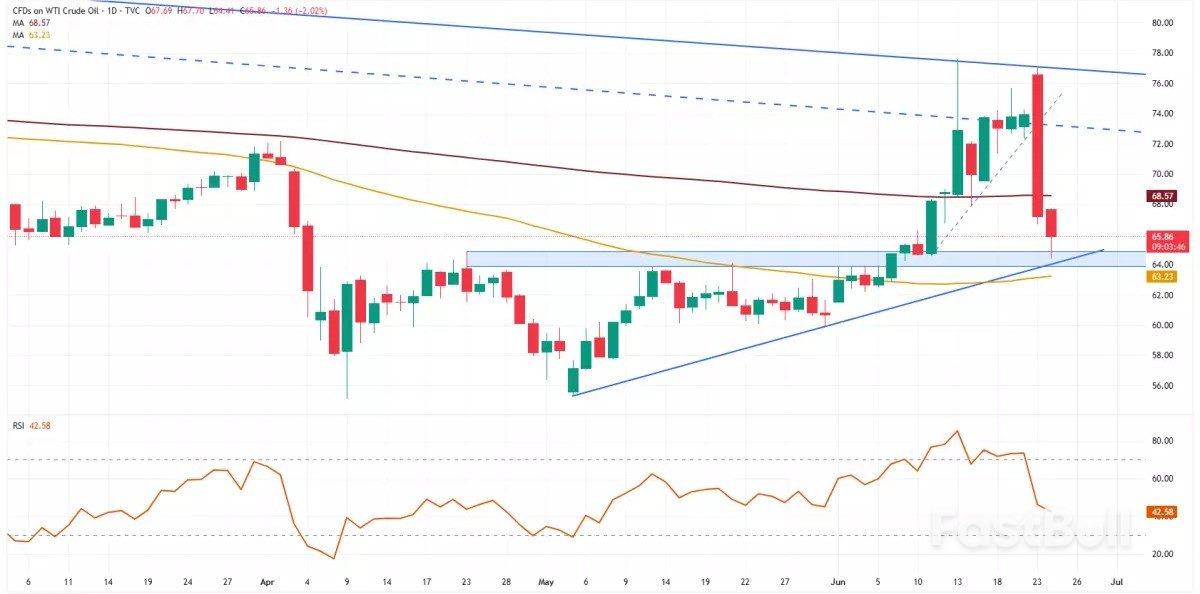
          ​On Tuesday morning the price of WTI found intraday support marginally above its May-to-June uptrend line at $64.00 per barrel, within its $64.83-to-$63.86 support zone. It consists of the late April-to-early June highs on the daily chart and is expected to act as support this week.

          ​WTI daily candlestick chart

          Oil prices plunge as Middle East ceasefire eases supply fears​_1
          Below the $64.83-to-$63.86 support area the 55-day simple moving average (SMA) at $63.23 may also offer support with the late May high at $63.04.
          ​Resistance is now seen between the 16 June low and the 200-day SMA at $67.88-to-$68.57.
          ​The decline also coincides with broader concerns about global economic growth and energy demand, with recent economic data from major consuming regions showing mixed signals about the strength of oil consumption growth.
          ​OPEC+ production policies remain a crucial factor in determining oil price direction, with the cartel's response to current price levels likely to influence whether the decline continues or stabilises around current levels.
          ​Inventory data and seasonal demand patterns will likely become more important drivers of price action if geopolitical tensions remain subdued, returning focus to traditional commodity market fundamentals.

          ​Trading considerations in volatile oil markets

          ​For traders looking to navigate the current oil market volatility, the ceasefire development highlights the importance of monitoring both geopolitical and fundamental factors.
          Research both geopolitical developments and fundamental supply-demand factors to understand the multiple drivers affecting oil prices. Consider how your risk tolerance aligns with the volatility typical of geopolitically-sensitive commodity markets.Open an account with IG by visiting our website and completing the application process.Access oil markets through our trading platform, including both Brent and WTI crude contracts.​Implement robust risk management given the potential for rapid price reversals based on news developments.
          ​Spread betting and CFD trading provide flexible approaches for trading oil, allowing positions on both rising and falling prices while managing risk through guaranteed stops and appropriate position sizing.
          ​The current environment requires careful attention to both breaking news and longer-term market trends, as geopolitical developments can quickly override fundamental analysis in determining short-term price direction.
          ​Today's oil swift price decline demonstrates how quickly markets can shift when geopolitical tensions ease, though the fragility of the current ceasefire means that volatility is likely to remain elevated as traders monitor developments closely.
          ​The unwinding of risk premiums has brought oil prices closer to levels justified by fundamental supply-demand dynamics, though the potential for renewed Middle Eastern tensions means that energy markets will continue to trade with heightened sensitivity to regional political developments.​​

          source :ig

          Risk Warnings and Disclaimers
          You understand and acknowledge that there is a high degree of risk involved in trading. Following any strategies or investment methods may lead to potential losses. The content on the site is provided by our contributors and analysts for information purposes only. You are solely responsible for determining whether any trading assets, securities, strategy, or any other product is suitable for investing based on your own investment objectives and financial situation.
          Add to Favorites
          Share

          Tracking Strong Dividend-Increase Trends Amid Macro Uncertainty

          Adam

          Economic

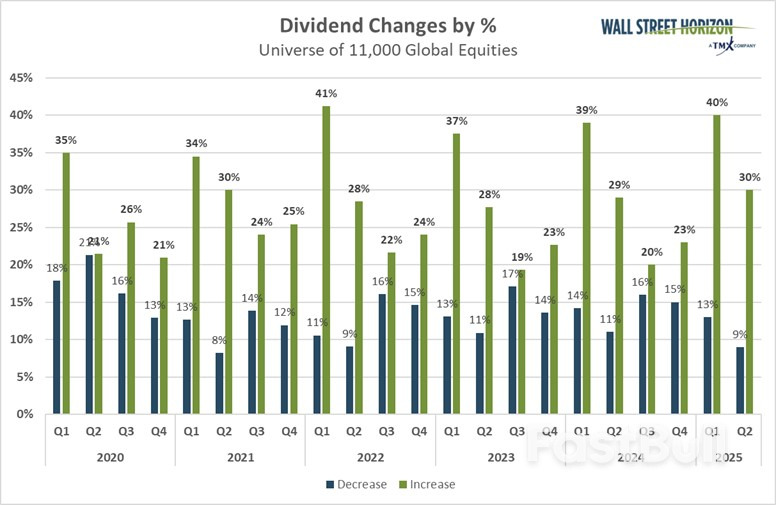
          As we put the finishing touches on a first half that was littered with uncertainty, a small treasure is seen in global dividend trends. Thirty percent of the companies Wall Street Horizon tracks announced shareholder-payout increases in the second quarter—the best Q2 mark going back to 2021. Also, just 9% of companies from around the world slashed their dividend, which was the lowest in three years.

          Healthy Dividend-Hike Rate in Q2

          Tracking Strong Dividend-Increase Trends Amid Macro Uncertainty_1
          These continue strong numbers that we profiled earlier in the year. It also bodes well for the balance of 2025, despite so much macro uncertainty (there’s that word!). Indeed, now more than ever, it’s important to pay attention to and deeply analyze what those in the C-suite are doing versus what they are saying. Investors have heard the constant refrain of “macro headwinds” and “an uncertain economic landscape” ad nauseam, but all the while, corporations continue to churn out profits, buy back shares, and, yes, hike dividends (on net).
          The upshot? Investors must seek signals and dismiss the noise.
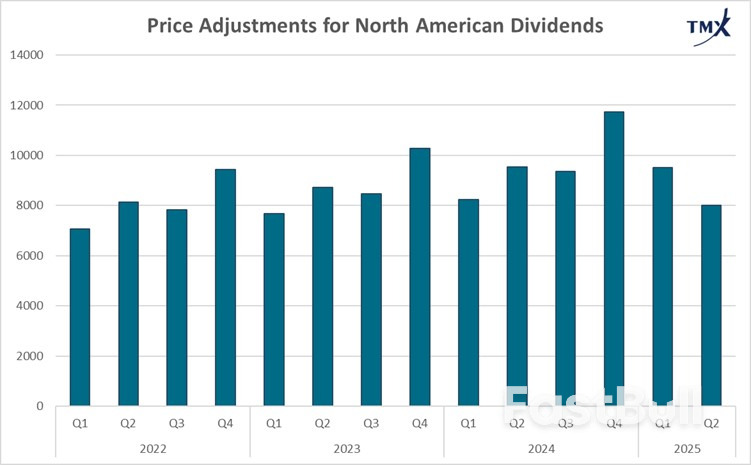
          More dividend payouts mean investment teams need to adjust stock prices to reflect these corporate actions properly in order to conduct time-series analysis. TMX’s Price Adjustment Curve (PAC) provides price adjustments applicable down to tick level prices or even orders, and below you can see the number of recorded adjustments for North American dividends have been steadily increasing. H1 2025 recorded 17,509 such price adjustments (as of June 22, 2025). With one week left in the second quarter that number is on track to match or beat the first half record set in 2024 of 17,771 price adjustments.
          Tracking Strong Dividend-Increase Trends Amid Macro Uncertainty_2
          Accurately tracking and analyzing these crucial corporate actions, such as dividend changes, at scale presents its own set of challenges. For asset management and risk professionals, manual processes and fragmented data systems can obscure insights and increase risk.

          Listen to that Baby Purr! Caterpillar Plowing Ahead in 2025

          Earlier this month, Caterpillar Inc (NYSE:CAT) announced a 7% dividend increase, bringing its quarterly distribution to $1.51. An S&P 500® Dividend Aristocrats Index member (companies that have raised their dividends in each of the past 25 consecutive years), the all-American brand is one of many multinational corporations facing the threat of higher tariffs.
          Shares are merely flat on the year, but gains off the April 8 closing low have been massive, on the order of 30%-plus. The sellside is still gaming out how the future trade landscape will impact CAT. In May, the $168 billion Industrials-sector firm was upgraded to Hold from Sell at UBS amid improving US-China trade talks. Then, on the same day the Texas-based blue chip announced its dividend hike, BMO Capital Markets tagged CAT as a GARP candidate (growth at a reasonable price).
          But the stock is a far cry from its late 2024 all-time high of $419. Resting right now at its flat 200-day moving average, the bears might argue it’s a dead-CAT bounce. Time will tell, but it appears the company’s management team is just fine with where it’s positioned heading into H2 2025.
          Looking ahead, Caterpillar’s Q2 earnings date is Tuesday, August 5, BMO (confirmed).

          UnitedHealth Group: Assessing the Damage

          Turning from Industrials to the Health Care sector, Unitedhealth Group (NYSE:UNH) is battling through what may be the most tumultuous year in its five-decade history. Shares are down 39% year to date, underperforming the S&P 500 by more than 40 percentage points on a total return basis. Before 2025 began, the tragic murder of UnitedHealthcare CEO Brian Thompson last December heightened public and investor scrutiny of the company.
          Then, in its January earnings report, higher-than-expected medical costs, particularly within its Medicare Advantage business, resulted in a soft FY 2025 profit guide.4 Investors didn’t like that—the stock fell 6% in the session that followed the Q4 earnings report. That decline was a paper cut compared to the severe pain shareholders endured three months later.
          UNH plunged by more than 22% after its Q1 earnings release, its worst single-day drop in decades. Near the beginning of the earnings season in April, the company slashed its full-year profit outlook after missing on the top and bottom lines.5 Its medical cost ratio, which is like an inverted profit margin for a health insurance company, was once again above what analysts hoped for. By the time the dust settled, what was once the largest weight in the Dow Jones Industrial Average was among the biggest S&P 500 laggards in 2025.
          The pain wasn’t done, however. Within a month of their Q1 report, a story surfaced that UnitedHealth was the target of a US Department of Justice probe into possible Medicare fraud.6 Another 11% was shed from the stock’s value, dropping it to the No. 10 spot on the DJIA weighting list at the time.
          The good news? On June 6, UNH announced a $2.21 quarterly dividend, a 5.2% increase from the previous $2.10 quarterly payout.7 Shares, so far, have stabilized above $300 after notching an intraday low of $247 on May 15. Once the biggest company by market cap in the Health Care sector, the embattled insurer faces headwinds and public scorn, but the dividend hike news is a welcome relief for its stockholders.
          UNH reports Q2 results on Tuesday, July 29 BMO (confirmed).

          Macro Volatility Catalysts Heading into Q3

          Eyes now turn to the second half. There’s still macro wood to chop to help clear out all this uncertainty being bandied about. We expect developments on the trade front with President Trump’s July 9 reciprocal tariff pause deadline in sight. Moreover, the One Big, Beautiful Bill is still being chiseled in the Senate.
          Higher oil prices due to the Israel-Iran conflict add yet another wildcard into the macro shuffle, too. All the while, it’s clear that Chair Powell and the rest of the Federal Reserve’s Open Market Committee members are standing pat on interest rates.
          Be on the lookout for potential volatility this week on the data front. According to the Economic Calendar, the May Personal Consumption Expenditures Price Index (PCE), the Fed’s preferred inflation gauge, hits the tape this Friday. Market bulls hope for another tame update on consumer prices.

          The Bottom Line

          Economic surprises have turned south, worries grow about the labor market, and there’s increasing conflict in the Middle East. Amid so much angst and a plethora of unknowns, companies signal optimism, at least according to the high percentage of dividend hikers to slashers. Though the summer travel season is in full swing, investors stay on watch as macro and firm-specific volatility catalysts are front and center—and earnings season is just two weeks away!

          Source: investing

          To stay updated on all economic events of today, please check out our Economic calendar
          Risk Warnings and Disclaimers
          You understand and acknowledge that there is a high degree of risk involved in trading. Following any strategies or investment methods may lead to potential losses. The content on the site is provided by our contributors and analysts for information purposes only. You are solely responsible for determining whether any trading assets, securities, strategy, or any other product is suitable for investing based on your own investment objectives and financial situation.
          Add to Favorites
          Share

          Investment Groups Call for Exemption of Passive Income From US tax BilT

          Manuel

          Economic

          Political

          Six investment groups representing sectors including fund managers, venture capital and real estate in a letter to two Senate Republicans over the tax and spending bill now under debate asked that passive investments be exempt from a provision of the bill that targets foreign investors.
          The proposal would allow the imposition of new taxes on residents, businesses and other entities from countries that are found to impose "unfair foreign taxes." It targets, for instance, income from investments, rents and dividends.
          The investment groups said the levy, which includes the possibility of imposing a progressive tax burden of up to 20% on foreign investors' passive income, could spook investments in the U.S.
          The new tax "would significantly disrupt U.S. public and private debt and equity markets," the associations said in the letter, which was sent to Senate Majority Leader John Thune and Senate Finance Committee Chairman Mike Crapo on Monday evening.
          The groups said there would be the risk of investors selling portfolios in advance of the new levy. "This unnecessary sell-off will cause U.S. asset values to fall," they said in the letter.
          Although Senate Republicans proposed changes to the tax and spending bill that the House of Representatives passed last month, the Senate kept the provision of a tax targeting foreign investors. Under the Senate version, however, the tax would take effect in 2027, one year after the House version.
          The letter was jointly submitted by the Managed Funds Association, American Investment Council, Investment Company Institute, Loan Syndications and Trading Association, National Venture Capital Association and the Real Estate Roundtable.
          In notes to clients, many Wall Street analysts have cautioned that the levy could end up weighing on demand for U.S. assets. Multinational companies have said they could shut down operations in the U.S.

          Source: Reuters

          To stay updated on all economic events of today, please check out our Economic calendar
          Risk Warnings and Disclaimers
          You understand and acknowledge that there is a high degree of risk involved in trading. Following any strategies or investment methods may lead to potential losses. The content on the site is provided by our contributors and analysts for information purposes only. You are solely responsible for determining whether any trading assets, securities, strategy, or any other product is suitable for investing based on your own investment objectives and financial situation.
          Add to Favorites
          Share

          Powell Says Higher Inflation Outlook Keeping Fed on Hold for Now

          Adam

          Economic

          Central Bank

          Federal Reserve Chair Jerome Powell told lawmakers the central bank is in no rush to lower interest rates as officials wait for more clarity on the economic impact of President Donald Trump’s tariffs.
          “The effects of tariffs will depend, among other things, on their ultimate level,” Powell said Tuesday in remarks before a congressional panel. “For the time being, we are well positioned to wait to learn more about the likely course of the economy before considering any adjustments to our policy stance.”
          Powell’s remarks before the House Financial Services Committee come on the heels of the Fed’s decision last week to leave interest rates unchanged in a range of 4.25%-4.5%.
          “If it turns out that inflation pressures do remain contained, then we will get to a place where we cut rates, sooner rather than later,” Powell said in response to a question about the possibility of a July rate cut. “But I wouldn’t want to point to a particular meeting. I don’t think we need to be in any rush because the economy is still strong.”
          Fed officials signaled last week they favor two rate cuts by year’s end. Economists surveyed by Bloomberg expect a cut to come by September.
          Powell, however, underscored that uncertainty in the economic outlook meant a wide set of outcomes remained possible. Should inflation come in weaker than expected or the labor market deteriorate, he said, the Fed could cut rates sooner. Equally, he added, higher-than-expected inflation could push the Fed to keep holding.
          “Many paths are possible here,” Powell said.
          He acknowledged that recent data supported a case for lower rates. But, he emphasized, that data was backward-looking, and many economists expect “a meaningful increase in inflation” over the course of this year due to tariffs.
          “At this time, all forecasters are expecting pretty soon that some significant inflation will show up from tariffs,” he said. “We can’t just ignore that.”
          Treasury yields and the dollar declined during Powell’s testimony as traders priced in slightly higher odds of at least two Fed interest-rate cuts by the end of the year. They pointed to his comments on the potential for tariffs to contribute less to inflation than forecasters currently expect. Powell’s appearance coincided with the release of a weaker-than-anticipated consumer confidence gauge for June that also supported those wagers.

          Trump Comments

          The central bank’s on-hold position has angered Trump, who has consistently called for lower rates and argued the Fed is keeping borrowing costs for the US government high by holding rates steady.
          “‘Too Late’ Jerome Powell, of the Fed, will be in Congress today in order to explain, among other things, why he is refusing to lower the Rate,” Trump said on social media early Tuesday. “I hope Congress really works this very dumb, hardheaded person, over. We will be paying for his incompetence for many years to come.”
          Powell and several other policymakers have pointed to increased economic uncertainty stemming from the Trump administration’s stepped up use of tariffs, and other policy changes, to justify leaving rates steady for now. Many forecasters expect the tariffs to put upward pressure on inflation and dent economic growth, although those estimates carry significant uncertainty.
          Trump has frequently shifted on the specifics of his tariff policies, and the administration says it’s working on trade deals that could affect the nature and level of the duties.
          “Expectations of that level, and thus of the related economic effects, reached a peak in April and have since declined,” Powell said in his opening statement, which largely echoed remarks he delivered last week. “Even so, increases in tariffs this year are likely to push up prices and weigh on economic activity.”
          Powell said the tariffs’ impact on inflation could be short-lived or possibly be more persistent.

          Tariff Effect

          Avoiding the latter outcome “will depend on the size of the tariff effects, on how long it takes for them to pass through fully into prices and, ultimately, on keeping longer-term inflation expectations well anchored,” he said.
          Economic data so far has shown limited impact from tariffs. Fed Governors Christopher Waller and Michelle Bowman have pointed to that dynamic, among other factors, in arguing the Fed could cut as soon as its next meeting in July.
          Meanwhile, Powell described the overall economy and labor market as solid. He said inflation had eased significantly from highs reached in mid-2022, but was somewhat elevated above the Fed’s 2% objective. He added that beyond the next year or so, most measures of longer-term expectations remain consistent with the Fed’s inflation goal.

          Source: Bloomberg

          To stay updated on all economic events of today, please check out our Economic calendar
          Risk Warnings and Disclaimers
          You understand and acknowledge that there is a high degree of risk involved in trading. Following any strategies or investment methods may lead to potential losses. The content on the site is provided by our contributors and analysts for information purposes only. You are solely responsible for determining whether any trading assets, securities, strategy, or any other product is suitable for investing based on your own investment objectives and financial situation.
          Add to Favorites
          Share
          FastBull
          Copyright © 2025 FastBull Ltd

          728 RM B 7/F GEE LOK IND BLDG NO 34 HUNG TO RD KWUN TONG KLN HONG KONG

          TelegramInstagramTwitterfacebooklinkedin
          App Store Google Play Google Play
          Products
          Charts

          Chats

          Q&A with Experts
          Screeners
          Economic Calendar
          Data
          Tools
          Membership
          Features
          Function
          Markets
          Copy Trading
          Latest Signals
          Contests
          News
          Analysis
          24/7
          Columns
          Education
          Company
          Careers
          About Us
          Contact Us
          Advertising
          Help Center
          Feedback
          User Agreement
          Privacy Policy
          Business

          White Label

          Data API

          Web Plug-ins

          Poster Maker

          Affiliate Program

          Risk Disclosure

          The risk of loss in trading financial instruments such as stocks, FX, commodities, futures, bonds, ETFs and crypto can be substantial. You may sustain a total loss of the funds that you deposit with your broker. Therefore, you should carefully consider whether such trading is suitable for you in light of your circumstances and financial resources.

          No decision to invest should be made without thoroughly conducting due diligence by yourself or consulting with your financial advisors. Our web content might not suit you since we don't know your financial conditions and investment needs. Our financial information might have latency or contain inaccuracy, so you should be fully responsible for any of your trading and investment decisions. The company will not be responsible for your capital loss.

          Without getting permission from the website, you are not allowed to copy the website's graphics, texts, or trademarks. Intellectual property rights in the content or data incorporated into this website belong to its providers and exchange merchants.

          Not Logged In

          Log in to access more features

          FastBull Membership

          Not yet

          Purchase

          Become a signal provider
          Help Center
          Customer Service
          Dark Mode
          Price Up/Down Colors

          Log In

          Sign Up

          Position
          Layout
          Fullscreen
          Default to Chart
          The chart page opens by default when you visit fastbull.com