• Trade
  • Markets
  • Copy
  • Contests
  • News
  • 24/7
  • Calendar
  • Q&A
  • Chats
Trending
Screeners
SYMBOL
LAST
BID
ASK
HIGH
LOW
NET CHG.
%CHG.
SPREAD
SPX
S&P 500 Index
6827.42
6827.42
6827.42
6899.86
6801.80
-73.58
-1.07%
--
DJI
Dow Jones Industrial Average
48458.04
48458.04
48458.04
48886.86
48334.10
-245.98
-0.51%
--
IXIC
NASDAQ Composite Index
23195.16
23195.16
23195.16
23554.89
23094.51
-398.69
-1.69%
--
USDX
US Dollar Index
97.950
98.030
97.950
98.500
97.950
-0.370
-0.38%
--
EURUSD
Euro / US Dollar
1.17394
1.17409
1.17394
1.17496
1.17192
+0.00011
+ 0.01%
--
GBPUSD
Pound Sterling / US Dollar
1.33707
1.33732
1.33707
1.33997
1.33419
-0.00148
-0.11%
--
XAUUSD
Gold / US Dollar
4299.39
4299.39
4299.39
4353.41
4257.10
+20.10
+ 0.47%
--
WTI
Light Sweet Crude Oil
57.233
57.485
57.233
58.011
56.969
-0.408
-0.71%
--

Community Accounts

Signal Accounts
--
Profit Accounts
--
Loss Accounts
--
View More

Become a signal provider

Sell trading signals to earn additional income

View More

Guide to Copy Trading

Get started with ease and confidence

View More

Signal Accounts for Members

All Signal Accounts

Best Return
  • Best Return
  • Best P/L
  • Best MDD
Past 1W
  • Past 1W
  • Past 1M
  • Past 1Y

All Contests

  • All
  • Trump Updates
  • Recommend
  • Stocks
  • Cryptocurrencies
  • Central Banks
  • Featured News
Top News Only
Share

Ukraine Says It Received 114 Prisoners From Belarus

Share

USA Embassy In Lithuania: Maria Kalesnikava Is Not Going To Vilnius

Share

USA Embassy In Lithuania: Other Prisoners Are Being Sent From Belarus To Ukraine

Share

Ukraine President Zelenskiy: Five Ukrainians Released By Belarus In US-Brokered Deal

Share

USA Vilnius Embassy: USA Stands Ready For "Additional Engagement With Belarus That Advances USA Interests"

Share

USA Vilnius Embassy: Belarus, USA, Other Citizens Among The Prisoners Released Into Lithuania

Share

USA Vilnius Embassy: USA Will Continue Diplomatic Efforts To Free The Remaining Political Prisoners In Belarus

Share

USA Vilnius Embassy: Belarus Releases 123 Prisoners Following Meeting Of President Trump's Envoy Coale And Belarus President Lukashenko

Share

USA Vilnius Embassy: Masatoshi Nakanishi, Aliaksandr Syrytsa Are Among The Prisoners Released By Belarus

Share

USA Vilnius Embassy: Maria Kalesnikava And Viktor Babaryka Are Among The Prisoners Released By Belarus

Share

USA Vilnius Embassy: Nobel Peace Prize Laureate Ales Bialiatski Is Among The Prisoners Released By Belarus

Share

Belarusian Presidential Administration Telegram Channel: Lukashenko Has Pardoned 123 Prisoners As Part Of Deal With US

Share

Two Local Syrian Officials: Joint US-Syrian Military Patrol In Central Syria Came Under Fire From Unknown Assailants

Share

Israeli Military Says It Targeted 'Key Hamas Terrorist' In Gaza City

Share

Rwanda's Actions In Eastern Drc Are A Clear Violation Of Washington Accords Signed By President Trump - Secretary Of State Rubio

Share

Israeli Military Issues Evacuation Warning In Southern Lebanon Village Ahead Of Strike - Spokesperson On X

Share

Belarusian State Media Cites US Envoy Coale As Saying He Discussed Ukraine And Venezuela With Lukashenko

Share

Belarusian State Media Cites US Envoy Coale As Saying That US Removes Sanctions On Belarusian Potassium

Share

Thai Prime Minister: No Ceasefire Agreement With Cambodia

Share

US, Ukraine To Discuss Ceasefire In Berlin Ahead Of European Summit

TIME
ACT
FCST
PREV
U.K. Trade Balance Non-EU (SA) (Oct)

A:--

F: --

P: --

U.K. Trade Balance (Oct)

A:--

F: --

P: --

U.K. Services Index MoM

A:--

F: --

P: --

U.K. Construction Output MoM (SA) (Oct)

A:--

F: --

P: --

U.K. Industrial Output YoY (Oct)

A:--

F: --

P: --

U.K. Trade Balance (SA) (Oct)

A:--

F: --

P: --

U.K. Trade Balance EU (SA) (Oct)

A:--

F: --

P: --

U.K. Manufacturing Output YoY (Oct)

A:--

F: --

P: --

U.K. GDP MoM (Oct)

A:--

F: --

P: --

U.K. GDP YoY (SA) (Oct)

A:--

F: --

P: --

U.K. Industrial Output MoM (Oct)

A:--

F: --

P: --

U.K. Construction Output YoY (Oct)

A:--

F: --

P: --

France HICP Final MoM (Nov)

A:--

F: --

P: --

China, Mainland Outstanding Loans Growth YoY (Nov)

A:--

F: --

P: --

China, Mainland M2 Money Supply YoY (Nov)

A:--

F: --

P: --

China, Mainland M0 Money Supply YoY (Nov)

A:--

F: --

P: --

China, Mainland M1 Money Supply YoY (Nov)

A:--

F: --

P: --

India CPI YoY (Nov)

A:--

F: --

P: --

India Deposit Gowth YoY

A:--

F: --

P: --

Brazil Services Growth YoY (Oct)

A:--

F: --

P: --

Mexico Industrial Output YoY (Oct)

A:--

F: --

P: --

Russia Trade Balance (Oct)

A:--

F: --

P: --

Philadelphia Fed President Henry Paulson delivers a speech
Canada Building Permits MoM (SA) (Oct)

A:--

F: --

P: --

Canada Wholesale Sales YoY (Oct)

A:--

F: --

P: --

Canada Wholesale Inventory MoM (Oct)

A:--

F: --

P: --

Canada Wholesale Inventory YoY (Oct)

A:--

F: --

P: --

Canada Wholesale Sales MoM (SA) (Oct)

A:--

F: --

P: --

Germany Current Account (Not SA) (Oct)

A:--

F: --

P: --

U.S. Weekly Total Rig Count

A:--

F: --

P: --

U.S. Weekly Total Oil Rig Count

A:--

F: --

P: --

Japan Tankan Large Non-Manufacturing Diffusion Index (Q4)

--

F: --

P: --

Japan Tankan Small Manufacturing Outlook Index (Q4)

--

F: --

P: --

Japan Tankan Large Non-Manufacturing Outlook Index (Q4)

--

F: --

P: --

Japan Tankan Large Manufacturing Outlook Index (Q4)

--

F: --

P: --

Japan Tankan Small Manufacturing Diffusion Index (Q4)

--

F: --

P: --

Japan Tankan Large Manufacturing Diffusion Index (Q4)

--

F: --

P: --

Japan Tankan Large-Enterprise Capital Expenditure YoY (Q4)

--

F: --

P: --

U.K. Rightmove House Price Index YoY (Dec)

--

F: --

P: --

China, Mainland Industrial Output YoY (YTD) (Nov)

--

F: --

P: --

China, Mainland Urban Area Unemployment Rate (Nov)

--

F: --

P: --

Saudi Arabia CPI YoY (Nov)

--

F: --

P: --

Euro Zone Industrial Output YoY (Oct)

--

F: --

P: --

Euro Zone Industrial Output MoM (Oct)

--

F: --

P: --

Canada Existing Home Sales MoM (Nov)

--

F: --

P: --

Euro Zone Total Reserve Assets (Nov)

--

F: --

P: --

U.K. Inflation Rate Expectations

--

F: --

P: --

Canada National Economic Confidence Index

--

F: --

P: --

Canada New Housing Starts (Nov)

--

F: --

P: --

U.S. NY Fed Manufacturing Employment Index (Dec)

--

F: --

P: --

U.S. NY Fed Manufacturing Index (Dec)

--

F: --

P: --

Canada Core CPI YoY (Nov)

--

F: --

P: --

Canada Manufacturing Unfilled Orders MoM (Oct)

--

F: --

P: --

Canada Manufacturing New Orders MoM (Oct)

--

F: --

P: --

Canada Core CPI MoM (Nov)

--

F: --

P: --

Canada Manufacturing Inventory MoM (Oct)

--

F: --

P: --

Canada CPI YoY (Nov)

--

F: --

P: --

Canada CPI MoM (Nov)

--

F: --

P: --

Canada CPI YoY (SA) (Nov)

--

F: --

P: --

Canada Core CPI MoM (SA) (Nov)

--

F: --

P: --

Q&A with Experts
    • All
    • Chatrooms
    • Groups
    • Friends
    Connecting
    .
    .
    .
    Type here...
    Add Symbol or Code

      No matching data

      All
      Trump Updates
      Recommend
      Stocks
      Cryptocurrencies
      Central Banks
      Featured News
      • All
      • Russia-Ukraine Conflict
      • Middle East Flashpoint
      • All
      • Russia-Ukraine Conflict
      • Middle East Flashpoint
      Search
      Products

      Charts Free Forever

      Chats Q&A with Experts
      Screeners Economic Calendar Data Tools
      Membership Features
      Data Warehouse Market Trends Institutional Data Policy Rates Macro

      Market Trends

      Market Sentiment Order Book Forex Correlations

      Top Indicators

      Charts Free Forever
      Markets

      News

      News Analysis 24/7 Columns Education
      From Institutions From Analysts
      Topics Columnists

      Latest Views

      Latest Views

      Trending Topics

      Top Columnists

      Latest Update

      Signals

      Copy Rankings Latest Signals Become a signal provider AI Rating
      Contests
      Brokers

      Overview Brokers Assessment Rankings Regulators News Claims
      Broker listing Forex Brokers Comparison Tool Live Spread Comparison Scam
      Q&A Complaint Scam Alert Videos Tips to Detect Scam
      More

      Business
      Events
      Careers About Us Advertising Help Center

      White Label

      Data API

      Web Plug-ins

      Affiliate Program

      Awards Institution Evaluation IB Seminar Salon Event Exhibition
      Vietnam Thailand Singapore Dubai
      Fans Party Investment Sharing Session
      FastBull Summit BrokersView Expo
      Recent Searches
        Top Searches
          Markets
          News
          Analysis
          User
          24/7
          Economic Calendar
          Education
          Data
          • Names
          • Latest
          • Prev

          View All

          No data

          Scan to Download

          Faster Charts, Chat Faster!

          Download App
          English
          • English
          • Español
          • العربية
          • Bahasa Indonesia
          • Bahasa Melayu
          • Tiếng Việt
          • ภาษาไทย
          • Français
          • Italiano
          • Türkçe
          • Русский язык
          • 简中
          • 繁中
          Open Account
          Search
          Products
          Charts Free Forever
          Markets
          News
          Signals

          Copy Rankings Latest Signals Become a signal provider AI Rating
          Contests
          Brokers

          Overview Brokers Assessment Rankings Regulators News Claims
          Broker listing Forex Brokers Comparison Tool Live Spread Comparison Scam
          Q&A Complaint Scam Alert Videos Tips to Detect Scam
          More

          Business
          Events
          Careers About Us Advertising Help Center

          White Label

          Data API

          Web Plug-ins

          Affiliate Program

          Awards Institution Evaluation IB Seminar Salon Event Exhibition
          Vietnam Thailand Singapore Dubai
          Fans Party Investment Sharing Session
          FastBull Summit BrokersView Expo

          Trump Blames Biden as U.S. Economy Shrinks 0.3% in Q1, Sparks Fears of Tariff-Driven Recession

          Gerik

          Economic

          Summary:

          The U.S. economy contracted by 0.3% in Q1 2025—its worst performance since 2022—mainly due to tariff-induced trade imbalances, sparking public anxiety and drawing political deflection from President Trump...

          A Fragile Quarter: Trump Deflects Blame as U.S. Economy Contracts Amid Tariff Anxiety

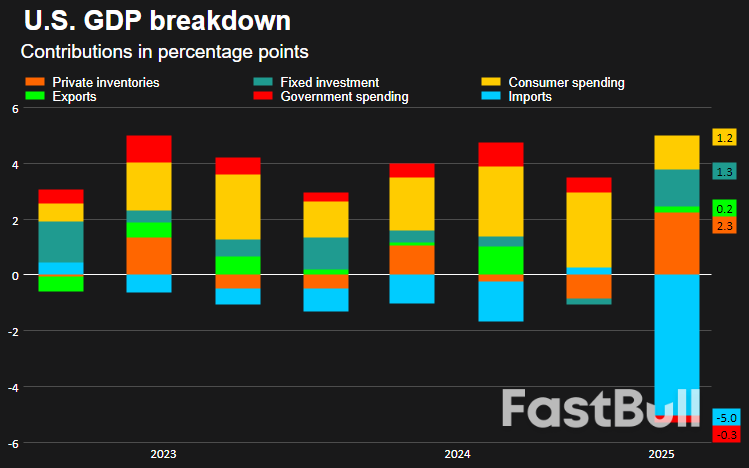
          In a dramatic turn from the final quarter of 2024, the U.S. economy shrank by 0.3% in the first quarter of 2025, according to the Commerce Department’s latest GDP report. The figure marked the country’s sharpest economic pullback in over two years and fell well short of economist forecasts, who had anticipated modest growth at 0.8%. The contraction has raised alarms over the economic toll of President Donald Trump’s aggressive tariff policies and the volatile trade environment they’ve created.
          The primary culprit behind the GDP drop was a record surge in imports, which soared 41.3% in Q1 after contracting 1.9% in Q4 2024. The spike was attributed to businesses and consumers front-loading purchases to avoid incoming tariff hikes—especially those targeting Chinese goods. Meanwhile, exports grew only marginally at 1.8%, deepening the trade imbalance and dragging down net GDP. Government spending also fell, compounding the weakness.
          Yet, amid the gloomy headlines, some underlying components of the economy remained intact. Business investment rebounded strongly, growing at a robust 9.8% after falling 3% the previous quarter. Consumer spending, though slowing, still contributed positively.

          Trump: “Boom is Coming” — But Not Yet

          President Trump responded by downplaying the role of his own policies, instead attributing the downturn to residual effects from the Biden administration. In a post on social media, Trump stated, “The negative impacts have nothing to do with tariffs—it’s Biden’s numbers we inherited. But when the boom starts, it will be unlike anything you’ve seen.”
          He continued to promise a forthcoming period of “explosive growth,” despite mounting skepticism among economists and voters alike. A recent CNN poll found that 59% of respondents believe Trump’s policies are worsening the economy, and many express growing doubt about the effectiveness of his tariff-centric trade strategy.

          Not Recession Yet, But Risks Are Rising

          Technically, the U.S. is not yet in recession, which is defined by two consecutive quarters of negative GDP growth. The labor market remains relatively strong with unemployment holding steady at 4.2%, and some business sectors are still expanding. However, signs of strain are accumulating.
          Private sector hiring slowed sharply in April, with ADP reporting only 62,000 new jobs, down from 147,000 in March. “It’s difficult to make hiring decisions in this uncertain environment,” said Nela Richardson, Chief Economist at ADP.
          Analysts like Gregory Daco of EY note that while the Q1 contraction doesn’t yet confirm a recession, it signals the economy is “on the edge.” Continued escalation in tariffs could tip the balance quickly.

          Economy in Limbo as Trade War Looms Larger

          While Trump insists a historic recovery is on the horizon, the latest GDP figures and hiring data reveal a nation caught between fragile resilience and policy-driven risk. With consumer sentiment deteriorating, imports flooding in, and trade tensions mounting, the promise of a coming boom is met with caution. Unless global trade conditions stabilize and tariffs are reevaluated, the second quarter may bring a clearer answer to whether the U.S. economy is headed toward a full-blown recession.

          Source: CNN

          To stay updated on all economic events of today, please check out our Economic calendar
          Risk Warnings and Disclaimers
          You understand and acknowledge that there is a high degree of risk involved in trading. Following any strategies or investment methods may lead to potential losses. The content on the site is provided by our contributors and analysts for information purposes only. You are solely responsible for determining whether any trading assets, securities, strategy, or any other product is suitable for investing based on your own investment objectives and financial situation.
          Add to Favorites
          Share

          China’s Economy Falters as Record U.S. Tariffs Slam Manufacturing and Exports

          Gerik

          China–U.S. Trade War

          Economic

          Deepening Cracks: How U.S. Tariffs Are Undermining China’s Economic Stability

          China’s economy has begun to show significant signs of strain as the country absorbs the full brunt of sweeping U.S. tariffs, with key indicators of manufacturing health plunging sharply in April. As geopolitical and trade tensions continue to escalate, Beijing faces mounting pressure to intervene with new stimulus measures.

          Manufacturing Struggles Under Tariff Burden

          According to the latest data released by China’s National Bureau of Statistics on April 30, the country's manufacturing Purchasing Managers' Index (PMI) fell to 49 — below the critical 50-point threshold separating expansion from contraction — marking the lowest reading in over a year. More alarmingly, new export orders dropped to 44.7, the weakest level since December 2022 and one of the lowest since 2012 when excluding the pandemic years.
          The data reflects the direct impact of President Trump’s unprecedented 145% tariff wall on Chinese imports, which has caused widespread disruption across China’s export-reliant manufacturing sector. Following an initial surge in orders earlier this year — as buyers front-loaded shipments to beat tariff deadlines — American firms have begun canceling or postponing further orders, triggering a ripple effect across China’s factories.

          Widespread Economic Fallout and Political Firmness

          Exports remain a vital growth pillar for China, contributing around one-third of GDP in 2024. According to Goldman Sachs, an estimated 10 to 20 million manufacturing jobs in China are directly tied to the U.S. market. The collapse in export orders thus places substantial pressure on employment and industrial stability.
          Despite these headwinds, China has doubled down on its firm political stance. In a recent social media post, Beijing vowed to “never bow to Washington” and warned against global acquiescence to U.S. pressure. In retaliation, China imposed over 100% tariffs on select U.S. goods and tightened restrictions on critical resource exports such as rare earth minerals and lithium — essential for high-tech manufacturing and battery production.

          Limited Diplomatic Progress, Fragmented Global Supply Chains

          Trump’s tariff initiative, aimed at reshoring American manufacturing and reducing trade deficits, has yet to yield tangible gains but has instead triggered a broader realignment of global trade. Although the White House has paused tariffs for 90 days with certain allied nations, China has notably been excluded from any exemptions.
          This lack of dialogue — combined with additional U.S. pressure on third countries to reduce trade with China in exchange for U.S. market access — has left room for only limited relief. Some high-tech products such as semiconductors, smartphones, and aerospace components have seen temporary tariff suspensions, but a comprehensive trade deal remains unlikely.

          Broader Asia and Global Economy Also Hit

          The impact of the U.S.–China tariff conflict is not limited to Beijing. According to the IMF, prolonged trade tensions could drag global GDP growth below expectations. April export figures from both South Korea and Japan also show contraction, and shipping data indicates declining container volumes between China and the United States.
          Against this backdrop, economic forecasting firms like Capital Economics have revised down China’s 2025 GDP growth outlook to just 3.5%, significantly below Beijing’s official 5% target. The firm warns that even if survey data exaggerates short-term pessimism, the underlying trend reflects mounting structural and external stress.
          China now finds itself at an inflection point — with manufacturing output sagging, global trade links fraying, and few signs of a diplomatic breakthrough with the United States. If the country fails to launch impactful stimulus or find alternative export markets, the slowdown may deepen. The world’s second-largest economy is resilient, but as April’s data shows, even China isn’t immune to a global trade war it can’t control.

          Source: WSJ

          To stay updated on all economic events of today, please check out our Economic calendar
          Risk Warnings and Disclaimers
          You understand and acknowledge that there is a high degree of risk involved in trading. Following any strategies or investment methods may lead to potential losses. The content on the site is provided by our contributors and analysts for information purposes only. You are solely responsible for determining whether any trading assets, securities, strategy, or any other product is suitable for investing based on your own investment objectives and financial situation.
          Add to Favorites
          Share

          US Futures Extend Wall Street Gain On Tech Results: Markets Wrap

          Catherine Richards

          Economic

          US equity futures rallied Thursday on stronger-than-expected tech earnings and signs the Trump administration may be close to announcing the first round of trade deals to reduce planned tariffs.

          Contracts for the S&P 500 and Nasdaq 100 both gained at least 0.9%, helped by a post-market rally for Microsoft Corp. and Meta Platforms Inc. following their bullish corporate results. Microsoft posted better-than-expected sales, while Meta also exceeded analysts’ sales forecasts, suggesting customer demand hasn’t been rattled by tariffs.

          The advance for US futures came after the S&P 500 erased an intraday drop of more than 2% Wednesday to close 0.2% higher. Shares in Japan edged up Thursday while those in Australia fell. A number of markets are shut for holidays across Asia including Mainland China, Hong Kong, Singapore and India.

          Sentiment toward equities was boosted Wednesday after President Donald Trump’s trade representative said the US was nearing an announcement of a first tranche of trade deals that would see the White House reduce planned tariffs on trading partners.

          Treasuries edged lower across the curve in Asia after short-maturity US government debt gained on Wednesday amid expectations the Federal Reserve will cut interest rates to bolster the flagging economy.

          An index of the dollar was little changed, while the yen traded in a narrow range before a Bank of Japan meeting where the central bank is expected to keep policy settings on hold for a second gathering.

          US stocks slid in early trading Wednesday after data showed the economy contracted at the start of the year for the first time since 2022. Their rebound was partly helped by a report that the US has been proactively reaching out to China through various channels. At the same time, a cohort of investors is betting the Fed will administer its policy medicine to forestall a recession.

          “Weak data could hasten Fed cuts,” said Fawad Razaqzada at City Index and Forex.com. “The Fed is now more likely to step in sooner with its rate cuts to support an ailing economy, while the weakness in data could also encourage Trump to ease off on tariffs and make deals quicker.”

          The stock recovery was also assisted by separate data that showed a jump in consumer spending, while a key inflation gauge decelerated.

          Wednesday’s economic numbers give investors and the Fed a better read on the state of the economy heading into the tariff shock, according to Krishna Guha at Evercore. But the relative magnitude of these effects may not become clear until some time in the third quarter, he said.

          “This presents the Fed with a dilemma as to whether it should wait to July/September or consider cutting in June anyway because the risk of delay is too high, even though it may not have as much clarity on the outlook as it would like,” Guha said.

          Oil edged higher in Asia after settling below $60 a barrel Wednesday for the first time in three weeks as signs emerged that the Saudi-led OPEC+ alliance may be entering a prolonged period of higher production. Gold crept lower as traders assessed the Fed’s rate path after US data showed signs of downside risks under President Donald Trump’s trade agenda.

          The US and Ukraine reached a deal over access to Ukraine’s natural resources Wednesday, according to a person familiar with the accord, a move that Kyiv sought to solidify Trump’s backing in ceasefire talks with Russia.

          To Louis Navellier, chief investment officer at Navellier & Associates., what happens next very much depends on the tariff developments.

          “If we get a series of announcements soon of trade agreements reached, optimism will rise, and the Fed will likely cut soon,” he said. “If things drag out for weeks and months, the damage to supply chains and inevitable near-term inflation could cause shouts of stagflation and be very bearish for stocks.”

          Source: Bloomberg Europe

          To stay updated on all economic events of today, please check out our Economic calendar
          Risk Warnings and Disclaimers
          You understand and acknowledge that there is a high degree of risk involved in trading. Following any strategies or investment methods may lead to potential losses. The content on the site is provided by our contributors and analysts for information purposes only. You are solely responsible for determining whether any trading assets, securities, strategy, or any other product is suitable for investing based on your own investment objectives and financial situation.
          Add to Favorites
          Share

          China’s Oil Sector Capitalizes on Trump’s Tariff Shock with Record Crude ImportsG

          Gerik

          Commodity

          China–U.S. Trade War

          In the face of escalating trade tensions with the U.S., Chinese oil traders have found an unexpected silver lining: plunging oil prices. Far from retreating due to fears of a global economic slowdown, China has ramped up its crude oil imports to the highest level in 18 months, leveraging the price drop to stockpile reserves at discounted rates.

          Strategic Stockpiling Amid Global Trade Disruptions

          Data from Kpler, a firm tracking global tanker movements, indicates that China imported nearly 11 million barrels of oil per day in March — a sharp rise from 8.9 million in January — and this elevated pace has continued through April. Initially driven by concerns over U.S. sanctions on Iranian oil, the surge in imports has since been fueled by opportunistic buying as Brent crude prices dipped to four-year lows.
          The pricing slump was triggered by a mix of Trump’s aggressive tariff announcements and OPEC’s decision to boost production. Though Brent prices have slightly rebounded to above $65 per barrel, Morgan Stanley projects continued downward pressure with an average of $62.50 expected in the second half of 2025.

          Low Reserves and High Incentives

          Johannes Rauball of Kpler noted that China’s strategic reserves remain relatively low, incentivizing continued imports despite domestic demand not surging significantly. Chinese importers are seizing this price window to bolster inventories, a strategy aligned with their longstanding sensitivity to oil market fluctuations — buying heavily when prices drop, scaling back when they rise.
          Contrary to predictions of declining consumption due to the U.S.–China trade war, China’s current domestic fuel demand — especially for road and air transport — remains robust. Emma Li of Vortexa highlighted that some Chinese refiners have even delayed scheduled maintenance to extend production while profit margins remain favorable.

          Iranian Oil Still Flows, Despite Sanctions

          China remains the largest importer of oil globally, and a key buyer of crude from sanctioned sources like Iran, Russia, and Venezuela. However, new U.S. sanctions imposed in early April on a private refinery in Shandong province — a hub for China’s independent refiners — have already curbed Iranian oil imports. From a record 1.8 million barrels/day in March, imports fell to 1.2 million in April.
          Rauball confirmed that many cargoes are now stranded at sea due to logistical and legal challenges stemming from sanctions. About 40 million barrels are currently held aboard 36 tankers across key maritime chokepoints — including 18 million barrels near Singapore and others in the Yellow Sea and South China Sea.

          Private Refineries Walk a Thin Line

          Despite this, private Chinese refiners are expected to continue purchasing Iranian oil. Rauball explains that these firms operate on razor-thin margins and often lack access to global financial systems tied to the U.S., insulating them somewhat from direct repercussions of sanctions. For them, Iranian oil remains the most viable option — both economically and logistically.
          As President Trump’s tariff campaign reshapes global trade dynamics, China’s oil industry has proven remarkably agile. By stockpiling low-cost crude and navigating geopolitical landmines, Chinese traders and refiners are not only weathering the storm — they’re positioning themselves for future energy security and profit. Even with looming economic uncertainties, China’s ability to act quickly in volatile markets may offer it a strategic edge in an increasingly fragmented global energy landscape.

          Source: AFP

          Risk Warnings and Disclaimers
          You understand and acknowledge that there is a high degree of risk involved in trading. Following any strategies or investment methods may lead to potential losses. The content on the site is provided by our contributors and analysts for information purposes only. You are solely responsible for determining whether any trading assets, securities, strategy, or any other product is suitable for investing based on your own investment objectives and financial situation.
          Add to Favorites
          Share

          Ukraine, US Sign Minerals deal Sought by Trump

          Manuel

          Commodity

          Political

          Ukraine and the U.S. on Wednesday signed a deal heavily promoted by U.S. President Donald Trump that will give the United States preferential access to new Ukrainian minerals deals and fund investment in Ukraine's reconstruction.
          The two countries signed the accord in Washington after months of sometimes fraught negotiations, with uncertainty persisting until the last moment with word of an eleventh-hour snag.
          The accord establishes a joint investment fund for Ukraine's reconstruction as Trump tries to secure a peace settlement in Russia's three-year-old war in Ukraine.
          The agreement is central to Kyiv's efforts to mend ties with Trump and the White House, which frayed after he took office in January.
          U.S. Treasury Secretary Scott Bessent and Ukrainian First Deputy Prime Minister Yulia Svyrydenko were shown signing the agreement in a photo posted on X by the Treasury, which said the deal "clearly signals the Trump Administration's commitment to a free, sovereign, prosperous Ukraine."
          Svyrydenko wrote on X that the accord provides for Washington to contribute to the fund.
          "In addition to direct financial contributions, it may also provide NEW assistance -- for example air defense systems for Ukraine," she said.
          Washington has been Ukraine's single largest military donor since Russia's 2022 invasion with aid of more than 64 billion euros ($72 billion), according to the Kiel Institute in Germany.
          Before the signing, Trump repeated on Wednesday that the U.S. should get something for its aid to Kyiv, thus the effort to secure a deal for Ukraine's plentiful deposits of rare earth minerals.
          In announcing the deal, the U.S. Treasury said the partnership recognized "the significant financial and material support that the people of the United States have provided to the defense of Ukraine since Russia's full-scale invasion."
          A draft of the agreement seen by Reuters earlier on Wednesday showed Ukraine secured the removal of any requirement for it to pay back the U.S. for past military assistance, something Kyiv had staunchly opposed.
          Ukrainian officials hope that signing the deal will firm up American support for Kyiv in the war.
          The draft did not specify any concrete U.S. security guarantees for Ukraine, one of Kyiv's initial goals.
          Separately, Ukraine has discussed with European allies the forming of an international force to help ensure Ukraine's security if a peace agreement is reached with Russia.

          Source: Reuters

          Risk Warnings and Disclaimers
          You understand and acknowledge that there is a high degree of risk involved in trading. Following any strategies or investment methods may lead to potential losses. The content on the site is provided by our contributors and analysts for information purposes only. You are solely responsible for determining whether any trading assets, securities, strategy, or any other product is suitable for investing based on your own investment objectives and financial situation.
          Add to Favorites
          Share

          Trump Struggles to Explain Weak Economic Data as he Reaches 100-day Mark

          Manuel

          Economic

          Political

          President Donald Trump on Wednesday counseled patience, cast blame and claimed victory in the face of a first-quarter U.S. economic contraction and tariffs that have taken a bite out of his popularity, saying a resurgence was around the corner.
          The U.S. Commerce Department's advance gross domestic product data on Wednesday pointed to the first quarterly decline in three years as businesses imported a flood of goods to avoid higher costs from Trump's pending tariffs. Some economists pointed to robust consumer spending and private investment as a sign that growth could soon rebound.
          Trump and his aides struggled to coalesce around a message about the GDP number, simultaneously saying it was bad because of Biden administration policies but also good because of Trump's efforts.
          "You probably saw some numbers today, and I have to start off by saying that's Biden," Trump said to reporters, without elaborating as he referred to his Democratic predecessor.
          He then said the figure was due to "distortions" from imports, inventories and government spending, components that figure into the GDP calculation. He also celebrated a surge in business investment that some economists attribute to tariff-related spending.
          "We had numbers that, despite what we were handed, we turned them around and we were getting them really turned around," Trump said during a two-hour-long Cabinet meeting broadcast live.
          Earlier, Trump trade adviser Peter Navarro said, "This was the best negative print, as they say in the trade, the GDP - that I've ever seen in my life. It really should be very positive news for America."
          Navarro also discounted the GDP number, saying it declined because businesses were buying goods from abroad to get ahead of tariffs, an idea that clashed with Trump's claim on social media that tariffs played no role in declining stock markets.
          The varying explanations came as Trump crossed the symbolic milestone of 100 days in office and polls showed rising public discontent over the Republican's handling of the economy.
          A Reuters/Ipsos poll completed on Sunday showed 42% of respondents approve of Trump's performance in office, and 53% disapprove. The approval rate stood at 47% in the hours after his January 20 inauguration.
          The share of respondents who approve of Trump's economic stewardship declined a percentage point to 36% from the prior week, the lowest level in his current term or in his 2017-2021 presidency, while disapproval rose 5 points to 56%.

          RECESSION FEARS

          Fears of a recession have surged in recent weeks as Trump has launched a global trade war, hiking tariffs so high that economists warn trade with some countries - notably China - could grind nearly to a halt. The moves have shaken investors and companies.
          Some private sector economists laid the first-quarter downturn on Trump's plate, not former President Joe Biden's, as gross domestic product expanded at an annualized rate of about 2.9% per quarter on average over the second half of Biden's presidency. And some see the stage now set for a recession.
          "This isn't going to reverse because of the internal properties of the economy," said Joseph Brusuelas, chief economist with consulting firm RSM US LLP. "This is all policy induced, so unless the tariffs are walked back rapidly, it's just simply going to be too late to avoid an economic downturn."
          He added: "We'll be talking about a recession starting around midyear."
          Democrats were quick to seize on the economic uncertainty and lay blame squarely on Trump.
          "This is not Joe Biden's economy, Donald, it is your economy," U.S. House Minority Leader Hakeem Jeffries said on Wednesday, standing alongside fellow Democratic lawmakers. "It is the Trump economy, it is a failed economy and the American people know it."
          On Wednesday, Trump on social media blamed sliding stock markets on Biden but later said he was taking neither credit nor "discredit" for market performance.
          During the lengthy Cabinet meeting, several of Trump's aides took turns praising Trump's economic policies.
          "American families are finding their financial footing again," said U.S. Treasury Secretary Scott Bessent, adding that Trump was going to make the country an artificial intelligence and manufacturing superpower.
          Bessent also said the country was experiencing lower mortgage rates, food costs and energy prices.
          Benchmark 30-year mortgage rates are roughly the same as when Trump won the election in November, while food prices are rising at a 3% annualized rate and energy prices are falling by the same rate, according to the U.S. Bureau of Labor Statistics.
          Reporting by Trevor Hunnicutt; Additional reporting by Bo Erickson, Michael S. Derby, Lucia Mutikani, Doina Chiacu and Susan Heavey; Editing by Colleen Jenkins and Alistair Bell

          Source: Reuters

          To stay updated on all economic events of today, please check out our Economic calendar
          Risk Warnings and Disclaimers
          You understand and acknowledge that there is a high degree of risk involved in trading. Following any strategies or investment methods may lead to potential losses. The content on the site is provided by our contributors and analysts for information purposes only. You are solely responsible for determining whether any trading assets, securities, strategy, or any other product is suitable for investing based on your own investment objectives and financial situation.
          Add to Favorites
          Share

          S&P 500, Dow Reverse to end Higher Despite GDP Decline, Crude Prices Sink

          Manuel

          Stocks

          Economic

          U.S. stocks pulled a late-session rebound on Wednesday and oil prices logged their biggest monthly drop in 3-1/2 years as investors parsed news of the first U.S. economic contraction since 2022.
          All three major U.S. stock indexes recovered from a sharp selloff earlier in the day, with the S&P 500 and the Dow flipping positive just minutes ahead of the closing bell.
          The S&P 500 and the Dow lost ground in April, while the Nasdaq posted a small monthly gain.
          "The market's action ... is reflective of an economy that's probably going to be struggling as the year progresses," said Chuck Carlson, CEO of Horizon Investment Services in Hammond, Indiana.
          U.S. gross domestic product contracted in the first quarter, largely due to a surge in imports to avoid expected tariffs. U.S. President Donald Trump blamed his Democratic predecessor Joe Biden, and said his tariffs would eventually bring a booming economy.S&P 500, Dow Reverse to end Higher Despite GDP Decline, Crude Prices Sink_1
          The reversal "may be a result of people digesting some of these numbers and trying to put them into context," Carlson added.
          "Was it that bad? Are we on the precipice of a recession? Markets are trying to evaluate that and put into some context," Carlson said.
          The ongoing, multi-front trade war continues to cloud U.S. corporate earnings season, with companies increasingly pulling or reducing guidance due to tariff uncertainties.
          Wall Street pared losses after the release of more upbeat economic indicators. The Personal Consumption Expenditures (PCE) price index was unchanged on a monthly basis and consumer spending was stronger than expected.
          Of the "Magnificent Seven" group of artificial intelligence-related megacap companies, Meta Platforms, and Microsoft, are expected to post results after the bell.
          The Dow Jones Industrial Average, rose 141.74 points, or 0.35%, to 40,669.36, the S&P 500,rose 8.23 points, or 0.15%, to 5,569.06 and the Nasdaq Composite, fell 14.98 points, or 0.09%, to 17,446.34.
          European stocks ended a choppy session higher as investors mulled key data and corporate earnings. But the STOXX 600 registered a second consecutive monthly loss due to tariff-related uncertainties.
          MSCI's gauge of stocks across the globe, rose 1.56 points, or 0.19%, to 832.90.
          The pan-European STOXX 600, index rose 0.46%, while Europe's broad FTSEurofirst 300 index, rose 9.45 points, or 0.45%.
          Emerging market stocks,rose 5.67 points, or 0.51%, to 1,111.67. MSCI's broadest index of Asia-Pacific shares outside Japan, closed higher by 0.88%, to 580.65, while Japan's Nikkei,rose 205.39 points, or 0.57%, to 36,045.38.
          The dollar held its gains after a swath of mixed U.S. economic data and as trade tensions eased.
          The dollar index , which measures the greenback against a basket of currencies including the yen and the euro, rose 0.51% to 99.68, with the euro down 0.58% at $1.132.
          Against the Japanese yen , the dollar strengthened 0.52% to 143.08.
          Sterling weakened 0.63% to $1.3322.
          The Mexican peso weakened 0.32% versus the dollar at 19.616.
          The Canadian dollar strengthened 0.33% versus the greenback to C$1.38 per dollar.
          Benchmark U.S. Treasury yields seesawed to a lower close amid choppy trading. They inched 2 basis points lower to 4.156%, from 4.174% late on Tuesday.
          The 30-year bond yield rose 2.5 basis points to 4.6734% from 4.648% late on Tuesday.
          The 2-year note yield, which typically moves in step with interest rate expectations for the Federal Reserve, fell 5.3 basis points to 3.605%, from 3.658% late on Tuesday.
          Oil prices plunged further, logging their largest monthly drop in nearly 3-1/2 years as Trump's trade war eroded the demand outlook.
          U.S. crude fell 3.66% to settle at $58.21 per barrel, while Brent settled at $63.12 per barrel, down 1.76% on the day.
          Gold prices dipped in opposition to the dollar.
          Spot gold fell 0.65% to $3,294.59 an ounce. U.S. gold futures fell 0.72% to $3,295.00 an ounce.

          Source: Reuters

          To stay updated on all economic events of today, please check out our Economic calendar
          Risk Warnings and Disclaimers
          You understand and acknowledge that there is a high degree of risk involved in trading. Following any strategies or investment methods may lead to potential losses. The content on the site is provided by our contributors and analysts for information purposes only. You are solely responsible for determining whether any trading assets, securities, strategy, or any other product is suitable for investing based on your own investment objectives and financial situation.
          Add to Favorites
          Share
          FastBull
          Copyright © 2025 FastBull Ltd

          728 RM B 7/F GEE LOK IND BLDG NO 34 HUNG TO RD KWUN TONG KLN HONG KONG

          TelegramInstagramTwitterfacebooklinkedin
          App Store Google Play Google Play
          Products
          Charts

          Chats

          Q&A with Experts
          Screeners
          Economic Calendar
          Data
          Tools
          Membership
          Features
          Function
          Markets
          Copy Trading
          Latest Signals
          Contests
          News
          Analysis
          24/7
          Columns
          Education
          Company
          Careers
          About Us
          Contact Us
          Advertising
          Help Center
          Feedback
          User Agreement
          Privacy Policy
          Business

          White Label

          Data API

          Web Plug-ins

          Poster Maker

          Affiliate Program

          Risk Disclosure

          The risk of loss in trading financial instruments such as stocks, FX, commodities, futures, bonds, ETFs and crypto can be substantial. You may sustain a total loss of the funds that you deposit with your broker. Therefore, you should carefully consider whether such trading is suitable for you in light of your circumstances and financial resources.

          No decision to invest should be made without thoroughly conducting due diligence by yourself or consulting with your financial advisors. Our web content might not suit you since we don't know your financial conditions and investment needs. Our financial information might have latency or contain inaccuracy, so you should be fully responsible for any of your trading and investment decisions. The company will not be responsible for your capital loss.

          Without getting permission from the website, you are not allowed to copy the website's graphics, texts, or trademarks. Intellectual property rights in the content or data incorporated into this website belong to its providers and exchange merchants.

          Not Logged In

          Log in to access more features

          FastBull Membership

          Not yet

          Purchase

          Become a signal provider
          Help Center
          Customer Service
          Dark Mode
          Price Up/Down Colors

          Log In

          Sign Up

          Position
          Layout
          Fullscreen
          Default to Chart
          The chart page opens by default when you visit fastbull.com