• Trade
  • Markets
  • Copy
  • Contests
  • News
  • 24/7
  • Calendar
  • Q&A
  • Chats
Trending
Screeners
SYMBOL
LAST
BID
ASK
HIGH
LOW
NET CHG.
%CHG.
SPREAD
SPX
S&P 500 Index
6870.39
6870.39
6870.39
6895.79
6858.28
+13.27
+ 0.19%
--
DJI
Dow Jones Industrial Average
47954.98
47954.98
47954.98
48133.54
47871.51
+104.05
+ 0.22%
--
IXIC
NASDAQ Composite Index
23578.12
23578.12
23578.12
23680.03
23506.00
+72.99
+ 0.31%
--
USDX
US Dollar Index
98.820
98.900
98.820
98.960
98.730
-0.130
-0.13%
--
EURUSD
Euro / US Dollar
1.16599
1.16607
1.16599
1.16717
1.16341
+0.00173
+ 0.15%
--
GBPUSD
Pound Sterling / US Dollar
1.33302
1.33309
1.33302
1.33462
1.33151
-0.00010
-0.01%
--
XAUUSD
Gold / US Dollar
4210.90
4211.24
4210.90
4218.85
4190.61
+12.99
+ 0.31%
--
WTI
Light Sweet Crude Oil
59.973
60.003
59.973
60.063
59.752
+0.164
+ 0.27%
--

Community Accounts

Signal Accounts
--
Profit Accounts
--
Loss Accounts
--
View More

Become a signal provider

Sell trading signals to earn additional income

View More

Guide to Copy Trading

Get started with ease and confidence

View More

Signal Accounts for Members

All Signal Accounts

Best Return
  • Best Return
  • Best P/L
  • Best MDD
Past 1W
  • Past 1W
  • Past 1M
  • Past 1Y

All Contests

  • All
  • Trump Updates
  • Recommend
  • Stocks
  • Cryptocurrencies
  • Central Banks
  • Featured News
Top News Only
Share

It Was Gazprom's First Such LNG Delivery Since Sanctions Introduced In January, Lseg Data Shows

Share

United Arab Emirates Energy Minister: We Are Working To Open Opportunities For Ai Firms To Improve Efficiency Of Electricity Andwater Grids, We Already Saved 30% Of Energy Consumption By Using Ai

Share

Switzerland's Consumer Confidence Index Fell To 34 In November, Compared With A Previous Reading Of -36.9

Share

Shares In Italy's Fincantieri Up 3.2% In Early Trade

Share

India's Nifty Smallcap 100 Index Falls 2.75%

Share

Britain's FTSE 100 Up 0.17%, France's CAC 40 Down 0.07%

Share

Europe's STOXX Index Up 0.04%, Euro Zone Blue Chips Index Up 0.02%

Share

United Arab Emirates Energy Minister: Natural Gas Is Important And We Intend To Not Only Satisfy Our Local Demand, But Also Grow Our Export Of LNG

Share

Yomiuri: Mitsubishi Ufj Bank Chief Hanzawa Likely To Become MUFG President

Share

Benin's International Bonds Slip After Attempted Coup, 2052 Maturity Down By 1.5 Euro Cents, Tradeweb Data

Share

China Vice Commerce Minister, On Nexperia: Root Cause Of Chaos In The Global Semiconductor Supply Chain Lies In The Netherlands

Share

United Arab Emirates Energy Minister: We Should Not Be Worrying About When Demand For Fossil Fuels Will Peak

Share

China Vice Commerce Minister: Urges Germany And EU Auto Association To Push EU Commission To Resolve EV Anti-Subsidy Case

Share

China Vice Commerce Minister Held Video Conferences With The President Of The German Association Of The Automotive Industry And The President Of The European Automobile Manufacturers Association, Respectively, To Exchange Views On Cooperation In The Automotive Industry And Supply Chain Between China And Germany And Between China And Europe

Share

China Vice Commerce Minister: Welcomes Eu Automakers To Continue To Invest In China

Share

China Says It Is Ready To Improve US Ties While Safeguarding Sovereignty

Share

The Chinese Foreign Ministry Stated That Japanese Prime Minister Takaichi And The Right-wing Forces Behind Him Continue To Misjudge The Situation, Refuse To Repent, Turn A Deaf Ear To Criticism Both Domestically And Internationally, Downplay Their Interference In Other Countries' Internal Affairs And Threats Of Force, Distort The Truth, Disregard Right And Wrong, And Show No Basic Respect For International Law And The Fundamental Norms Of International Relations. They Attempt To Revive Japanese Militarism By Instigating Conflict And Confrontation, Thus Breaking Through The Post-war International Order. Neighboring Asian Countries And The International Community Should Remain Highly Vigilant

Share

Indonesia Government Proposes Additional 11.5 Trillion Rupiah State Injection In 2025 For Housing, Transportation Sectors

Share

Sweden Prime Minister, In Letter Sent To European Commission And European Council President: Russia's Aggression Against Ukraine Is An Existential Threat To Europe

Share

Sweden Prime Minister, In Letter Sent To European Commission And European Council President: Must Move Ahead Quickly On Proposals To Use The Cash Balances From Russia's Immobilized Assets For A Reparations Loan To Ukraine

TIME
ACT
FCST
PREV
U.S. Personal Income MoM (Sept)

A:--

F: --

P: --

U.S. PCE Price Index YoY (SA) (Sept)

A:--

F: --

P: --

U.S. PCE Price Index MoM (Sept)

A:--

F: --

P: --

U.S. Personal Outlays MoM (SA) (Sept)

A:--

F: --

P: --

U.S. Core PCE Price Index MoM (Sept)

A:--

F: --

P: --

U.S. Core PCE Price Index YoY (Sept)

A:--

F: --

P: --

U.S. UMich 5-Year-Ahead Inflation Expectations Prelim YoY (Dec)

A:--

F: --

P: --

U.S. Real Personal Consumption Expenditures MoM (Sept)

A:--

F: --

P: --

U.S. UMich Current Economic Conditions Index Prelim (Dec)

A:--

F: --

P: --

U.S. UMich 1-Year-Ahead Inflation Expectations Prelim (Dec)

A:--

F: --

P: --

U.S. UMich Consumer Expectations Index Prelim (Dec)

A:--

F: --

P: --

U.S. Weekly Total Rig Count

A:--

F: --

P: --

U.S. Weekly Total Oil Rig Count

A:--

F: --

P: --

U.S. Unit Labor Cost Prelim (SA) (Q3)

--

F: --

P: --

U.S. Consumer Credit (SA) (Oct)

A:--

F: --

P: --

China, Mainland Foreign Exchange Reserves (Nov)

A:--

F: --

P: --

Japan Wages MoM (Oct)

A:--

F: --

P: --

Japan Trade Balance (Oct)

A:--

F: --

P: --

Japan Nominal GDP Revised QoQ (Q3)

A:--

F: --

P: --

Japan Trade Balance (Customs Data) (SA) (Oct)

A:--

F: --

P: --

Japan GDP Annualized QoQ Revised (Q3)

A:--

F: --

P: --
China, Mainland Exports YoY (CNH) (Nov)

A:--

F: --

P: --

China, Mainland Trade Balance (USD) (Nov)

A:--

F: --

P: --

China, Mainland Imports YoY (CNH) (Nov)

A:--

F: --

P: --

China, Mainland Exports (Nov)

A:--

F: --

P: --

China, Mainland Imports (CNH) (Nov)

A:--

F: --

P: --

China, Mainland Trade Balance (CNH) (Nov)

A:--

F: --

P: --

China, Mainland Imports YoY (USD) (Nov)

A:--

F: --

P: --

China, Mainland Exports YoY (USD) (Nov)

A:--

F: --

P: --

Germany Industrial Output MoM (SA) (Oct)

A:--

F: --

P: --

Euro Zone Sentix Investor Confidence Index (Dec)

--

F: --

P: --

Canada Leading Index MoM (Nov)

--

F: --

P: --

Canada National Economic Confidence Index

--

F: --

P: --

China, Mainland Trade Balance (USD) (Nov)

--

F: --

P: --

U.S. 3-Year Note Auction Yield

--

F: --

P: --

U.K. BRC Overall Retail Sales YoY (Nov)

--

F: --

P: --

U.K. BRC Like-For-Like Retail Sales YoY (Nov)

--

F: --

P: --

Australia Overnight (Borrowing) Key Rate

--

F: --

P: --

RBA Rate Statement
RBA Press Conference
Germany Exports MoM (SA) (Oct)

--

F: --

P: --

U.S. NFIB Small Business Optimism Index (SA) (Nov)

--

F: --

P: --

Mexico Core CPI YoY (Nov)

--

F: --

P: --

Mexico 12-Month Inflation (CPI) (Nov)

--

F: --

P: --

Mexico PPI YoY (Nov)

--

F: --

P: --

Mexico CPI YoY (Nov)

--

F: --

P: --

U.S. Weekly Redbook Index YoY

--

F: --

P: --

U.S. JOLTS Job Openings (SA) (Oct)

--

F: --

P: --

China, Mainland M2 Money Supply YoY (Nov)

--

F: --

P: --

China, Mainland M0 Money Supply YoY (Nov)

--

F: --

P: --

China, Mainland M1 Money Supply YoY (Nov)

--

F: --

P: --

U.S. EIA Short-Term Crude Production Forecast For The Next Year (Dec)

--

F: --

P: --

U.S. EIA Short-Term Crude Production Forecast For The Year (Dec)

--

F: --

P: --

U.S. EIA Natural Gas Production Forecast For The Next Year (Dec)

--

F: --

P: --

EIA Monthly Short-Term Energy Outlook
U.S. 10-Year Note Auction Avg. Yield

--

F: --

P: --

U.S. API Weekly Cushing Crude Oil Stocks

--

F: --

P: --

U.S. API Weekly Crude Oil Stocks

--

F: --

P: --

U.S. API Weekly Refined Oil Stocks

--

F: --

P: --

U.S. API Weekly Gasoline Stocks

--

F: --

P: --

Q&A with Experts
    • All
    • Chatrooms
    • Groups
    • Friends
    Connecting
    .
    .
    .
    Type here...
    Add Symbol or Code

      No matching data

      All
      Trump Updates
      Recommend
      Stocks
      Cryptocurrencies
      Central Banks
      Featured News
      • All
      • Russia-Ukraine Conflict
      • Middle East Flashpoint
      • All
      • Russia-Ukraine Conflict
      • Middle East Flashpoint
      Search
      Products

      Charts Free Forever

      Chats Q&A with Experts
      Screeners Economic Calendar Data Tools
      Membership Features
      Data Warehouse Market Trends Institutional Data Policy Rates Macro

      Market Trends

      Market Sentiment Order Book Forex Correlations

      Top Indicators

      Charts Free Forever
      Markets

      News

      News Analysis 24/7 Columns Education
      From Institutions From Analysts
      Topics Columnists

      Latest Views

      Latest Views

      Trending Topics

      Top Columnists

      Latest Update

      Signals

      Copy Rankings Latest Signals Become a signal provider AI Rating
      Contests
      Brokers

      Overview Brokers Assessment Rankings Regulators News Claims
      Broker listing Forex Brokers Comparison Tool Live Spread Comparison Scam
      Q&A Complaint Scam Alert Videos Tips to Detect Scam
      More

      Business
      Events
      Careers About Us Advertising Help Center

      White Label

      Data API

      Web Plug-ins

      Affiliate Program

      Awards Institution Evaluation IB Seminar Salon Event Exhibition
      Vietnam Thailand Singapore Dubai
      Fans Party Investment Sharing Session
      FastBull Summit BrokersView Expo
      Recent Searches
        Top Searches
          Markets
          News
          Analysis
          User
          24/7
          Economic Calendar
          Education
          Data
          • Names
          • Latest
          • Prev

          View All

          No data

          Scan to Download

          Faster Charts, Chat Faster!

          Download App
          English
          • English
          • Español
          • العربية
          • Bahasa Indonesia
          • Bahasa Melayu
          • Tiếng Việt
          • ภาษาไทย
          • Français
          • Italiano
          • Türkçe
          • Русский язык
          • 简中
          • 繁中
          Open Account
          Search
          Products
          Charts Free Forever
          Markets
          News
          Signals

          Copy Rankings Latest Signals Become a signal provider AI Rating
          Contests
          Brokers

          Overview Brokers Assessment Rankings Regulators News Claims
          Broker listing Forex Brokers Comparison Tool Live Spread Comparison Scam
          Q&A Complaint Scam Alert Videos Tips to Detect Scam
          More

          Business
          Events
          Careers About Us Advertising Help Center

          White Label

          Data API

          Web Plug-ins

          Affiliate Program

          Awards Institution Evaluation IB Seminar Salon Event Exhibition
          Vietnam Thailand Singapore Dubai
          Fans Party Investment Sharing Session
          FastBull Summit BrokersView Expo

          The First Step Workers Should Take After A Layoff, As Job Losses Soar

          Justin

          Economic

          Summary:

          This year has been the worst for layoffs since the start of the pandemic, a new report shows — and those newly unemployed workers are entering a tough job market.

          This year has been the worst for layoffs since the start of the pandemic, a new report shows — and those newly unemployed workers are entering a tough job market.

          While a job loss can leave workers scrambling to keep up with bills like their mortgage or children's college tuition, there is one thing it's important to do before you reassess your expenses or talk to lenders, experts say: Apply for unemployment benefits.

          It can take weeks for the benefits to reach you, and minimizing that wait can help you shore up your financial situation.

          "After a layoff, workers should apply for unemployment benefits immediately to help cover essential expenses and preserve their savings for true emergencies," said certified financial planner Douglas Boneparth, president of Bone Fide Wealth in New York. Boneparth is also a member of the CNBC Financial Advisor Council.

          U.S. employers have cut 1.17 million jobs through November of this year, with corporate restructuring, artificial intelligence and tariffs to blame, consulting firm Challenger, Gray & Christmas reported Thursday. That number is the highest level since 2020, during the Covid pandemic.

          Payroll processing firm ADP also found this week that the labor market slowdown intensified in November, with private companies cutting 32,000 workers.

          If you live in one state and work in another, you'll want to apply for the aid in the state where you worked, experts say.

          On a DOL-sponsored website, you can find the contact information for state unemployment agencies.

          State agencies should pay benefits within three weeks of your application, but delays have become more common since the pandemic, Evermore said.

          "It's probably going to get worse as layoffs increase," she added.

          Maximum benefits vary by state

          Maximum unemployment benefit amounts vary by state. For example, California's maximum weekly benefit is $450; in Florida, the cap is $275, Evermore said. Recently, the maximum weekly benefit in New York rose to $869.

          Standard benefit timeline is 26 weeks, but not always

          In most states, claimants can get unemployment benefits for 26 weeks, Evermore said — although it's less in some states. In Florida, for example, the benefits last for just 12 weeks.

          Unemployment benefits are subject to taxes

          Unemployment benefits are subject to federal taxes, and many states tax them, too. When you start to receive the payments, your state will typically give you the option to have taxes withheld, Evermore said.

          It's a good idea to take that option to avoid a potentially hefty tax bill later, she said.

          Source: CNBC

          To stay updated on all economic events of today, please check out our Economic calendar
          Risk Warnings and Disclaimers
          You understand and acknowledge that there is a high degree of risk involved in trading. Following any strategies or investment methods may lead to potential losses. The content on the site is provided by our contributors and analysts for information purposes only. You are solely responsible for determining whether any trading assets, securities, strategy, or any other product is suitable for investing based on your own investment objectives and financial situation.
          Add to Favorites
          Share

          US Yields Advance As Market In Consolidation Mode Ahead Of Fed Next Week

          Justin

          Economic

          U.S. Treasury yields rose on Thursday, snapping a three-day decline, as investors stepped back from bond purchases and consolidated positions ahead of next week's Federal Reserve meeting, where the central bank is widely expected to deliver a third consecutive rate cut.

          In the bond market, yields rise when prices fall.

          In late morning trading, the benchmark 10-year yield rose 3.4 basis points to 4.092%, while the 30-year yield climbed 2.7 bps to 4.752% (US30YT=RR).

          On the front end of the curve, the two-year yield, which reflects interest rate moves by the Fed, advanced 3.3 bps at 3.519% (US2YT=RR).

          "We've had a little bit of a streak of lower yields since Monday and with the focus on monetary policy, it feels like rate cuts just kept getting more and more momentum," said Jim Barnes, director of fixed income at Bryn Mawr Trust in Berwyn, Pennsylvania.

          "Today you just have a little bit of a giveback. The jobless claims data probably helped with that a little bit. But the market was already trading off earlier, even before the claims data even came out."

          ECONOMY LOST 9,000 JOBS IN NOVEMBER: REPORT

          U.S. yields, however, pared their increase after data from Revelio Labs, which develops monthly employment estimates from online employment profiles and other information, showed that the economy lost 9,000 jobs in November, a second month of decline after a drop of 9,100 estimated for October.

          The report overshadowed weekly U.S. jobless claims numbers that fell to their lowest in more than three years, although analysts said the data could have been skewed lower by the Thanksgiving holiday.

          Initial claims for state unemployment benefits fell 27,000 to a seasonally adjusted 191,000 for the week ended November 29, the lowest level since September 2022. Economists polled by Reuters had forecast 220,000 claims for the latest week.

          The initial claims number was also consistent with a report showing fewer job cuts in the first 11 months of 2025.

          Global outplacement firm Challenger, Gray & Christmas said planned job cuts declined 53% to 71,321 last month from October. They were, however, 24% higher compared to the same period last year, and November's tally was the largest for the month since 2022.

          "Initial jobless claims look better than the alternate data sources on layoffs ... (but) the latest week for claims data included the Thanksgiving holiday, and holidays often distort claims data, so this release should be taken with a big grain of salt," wrote Bill Adams, chief economist at Comerica Bank in Dallas.

          "Even so, the recent trend looks good, with initial claims averaging a low 215,000 in the last four weeks."

          On Thursday, U.S. rate futures have priced in an 87% chance of a 25-bps cut next week, down from 90% on Wednesday, CME FedWatch showed.

          Fed funds futures have factored in more than 90 bps of easing next year, with two rate declines in the first half amid expectations the new Fed chair will push steeper rate cuts in line with what President Donald Trump wants.

          Source: TradingView

          To stay updated on all economic events of today, please check out our Economic calendar
          Risk Warnings and Disclaimers
          You understand and acknowledge that there is a high degree of risk involved in trading. Following any strategies or investment methods may lead to potential losses. The content on the site is provided by our contributors and analysts for information purposes only. You are solely responsible for determining whether any trading assets, securities, strategy, or any other product is suitable for investing based on your own investment objectives and financial situation.
          Add to Favorites
          Share

          Stocks Higher, Dollar To Extend Losing Streak, As Markets Weigh Rate Cuts

          Olivia Brooks

          Stocks

          Economic

          Forex

          Global shares edged up on Thursday, powered by expectations that a U.S. rate cut will support the world's largest economy after data showed employment is slowing, while the dollar was lower and poised for its 10th straight day of losses against a basket of major currencies.

          U.S. stocks were losing ground in early trade after two consecutive sessions of gains, with the benchmark S&P 500 (.SPX), flat. Healthcare, consumer discretionary and materials stocks were suffering the most losses, while real estate, financials and utilities were advancing.

          The Dow Jones Industrial Average (.DJI), fell 0.09%, the S&P 500 (.SPX), edged down 0.06% and the Nasdaq Composite (.IXIC), lost 0.14%.

          In Europe, the STOXX 600 (.STOXX), was up 0.42% and still headed for a modest weekly gain. London's FTSE 100 index (.FTSE), was up 0.16% while Germany's DAX (DAX.O), gained 0.45%. MSCI's gauge of stocks across the globe (.MIWD00000PUS), rose 0.18%.

          Japanese stocks rallied sharply after an auction of government bonds drew strong demand from investors, which helped set the tone for the broader equity market. The Nikkei (.N225), rose 2.33%.

          "After a 5% pullback in late November, stocks have rebounded and are now trading at the pre-pullback levels and near all-time highs," Michael Farr, chief executive of investment advisory firm Farr, Miller & Washington in Washington.

          US PRIVATE PAYROLLS DATA POST BIG DROP

          The gains came after U.S. private payrolls data posted their biggest drop in more than two-and-a-half years, and following a survey of the services sector that showed activity held steady in November while hiring slowed.

          "If they cut rates by a quarter of a point and then take a pause - which every Fed speaker has indicated, markets might be disappointed in the messaging. If they don't cut and say we're going to wait until the next meeting, markets will be disappointed there too," Farr said.

          Fed funds futures are pricing a near 90% chance of a quarter-point cut at the end of the Fed's next meeting on December 10, compared with an 83.4% chance a week ago, according to the CME Group's FedWatch tool.

          The dollar index , which tracks the U.S. currency's performance against six others, was last down 0.08% on the day, heading for a 10th straight daily decline, making this its longest stretch of losses since at least 1971, according to LSEG data.

          US 10-YEAR TREASURY BOND YIELD UP 3.4 BASIS POINTS

          The yield on the U.S. 10-year Treasury bond was last up 3.4 basis points at 4.092%. The Financial Times reported on Wednesday that bond investors had expressed concerns to the U.S. Treasury that Kevin Hassett, a candidate to replace Jerome Powell as Fed chair next year, could aggressively cut interest rates to align with President Donald Trump's preferences.

          "I think there's purposeful timing by the Trump administration to announce the president's selection of a new Fed chairman that will be seen - correctly or not - as being more dovish around this meeting to appear as an antidote to the messaging," Farr said.

          In Japan, the government's debt sale drew the strongest demand in more than six years, which helped soothe investor nerves about the country's long-term finances that have stoked similar worries about other economies.

          The dollar was last down 0.28% at 154.8 against the yen , which is heading for its largest weekly gain against the U.S. currency in over two months.

          The yen got another boost from a Reuters report that the Bank of Japan (BOJ) is likely to raise interest rates in December with the government expected to tolerate such a decision, citing three government sources familiar with the deliberations.

          Meanwhile, the yuan softened a touch, leaving the dollar up 0.18% at 7.070 yuan in offshore trading in Hong Kong . The Chinese currency hit its strongest level against the dollar in more than a year on Wednesday.

          Precious metals cooled after a recent hot streak. Gold was last down 0.28% at $4,195 an ounce, while silver fell 2.4% to $57.03 an ounce, after hitting a record high of $58.98 on Tuesday.

          Brent crude was last up 0.06% at $62.71 a barrel.

          Reporting by Chibuike Oguh in New York and Gregor Stuart Hunter; Editing by Lincoln Feast, Sonali Paul, Andrew Heavens, Chizu Nomiyama and Ed Osmond

          Source: Kitco

          To stay updated on all economic events of today, please check out our Economic calendar
          Risk Warnings and Disclaimers
          You understand and acknowledge that there is a high degree of risk involved in trading. Following any strategies or investment methods may lead to potential losses. The content on the site is provided by our contributors and analysts for information purposes only. You are solely responsible for determining whether any trading assets, securities, strategy, or any other product is suitable for investing based on your own investment objectives and financial situation.
          Add to Favorites
          Share

          What Expected Fed Rate Cut Next Week Will Do for Markets, US Dollar and Investors

          Adam

          Economic

          Global markets are increasingly positioning for a US interest-rate cut at the December 9–10 policy meeting of the Federal Reserve, with investors concluding that current monetary settings no longer align with an economy losing momentum.
          The case for easing has strengthened decisively as growth indicators soften and inflation risks continue to retreat. The data points to further rate cuts. Labor demand is weakening, consumer spending pressure is emerging, and the inflation backdrop has become far less threatening. Policy no longer needs to remain this restrictive.
          Labor market dynamics remain central to expectations for next week’s meeting.
          While headline job growth persists, underlying signals indicate cooling demand for workers. Job openings have fallen sharply from their peak, hiring intentions have eased, and wage growth is moderating across sectors. Businesses are adjusting to softer conditions rather than competing aggressively for staff.
          Forward-looking labor data matters more than backward headlines. Monetary policy has long lags. Central banks that wait for visible stress tend to respond too late.
          Consumer behaviour reinforces the argument for action. Household spending has supported US growth for much of the past two years, but signs of strain are increasing.
          Credit reliance is rising, delinquency rates are edging higher, and excess savings accumulated during the pandemic have largely faded. Consumers are becoming more cautious and more selective, particularly around discretionary purchases.
          The consumer engine is still running, but it’s no longer accelerating. This change shifts the risk toward overtightening rather than overheating.
          At the same time, inflation conditions have altered meaningfully. Goods prices remain contained, services inflation is easing alongside slower wage growth and supply-side pressures have normalized.
          While inflation remains above target, the trajectory and risk profile have changed. The probability of renewed upside inflation shocks has diminished substantially. Rates were set for an economy running hot, and that environment has passed. Keeping monetary policy unchanged for too long creates unnecessary downside risk.
          For financial markets, a rate cut next week would validate a transition already underway rather than trigger disruption.
          Equities have responded to easing expectations, with sentiment improving and participation broadening beyond defensive sectors. A policy move would reinforce confidence that the tightening cycle has ended and that growth risks are being addressed.
          Bond markets would also respond to confirmation that peak rates are behind us. Yields are likely to continue drifting lower as investors adjust duration exposure and reprice future policy paths.
          Lower yields would ease financial conditions and improve the outlook for fixed income after years of contraction.
          The US dollar would feel the effects indirectly. A shift toward easier policy would reduce yield support, encouraging modest US dollar weakness over time as global capital flows diversify.
          A lower-rate US environment changes the global equation. It eases pressure on international markets, improves conditions for emerging economies, and supports broader risk appetite.
          Globally, a Fed move would ripple well beyond US borders. Other central banks would gain greater flexibility, financial conditions would loosen worldwide, and cross-border investment could regain momentum following an extended period of tight liquidity.
          Next week’s meeting leaves policymakers with narrowing room for delay. Markets are responding to the current available data. When policy follows that reality, confidence strengthens. Hesitation carries its own risks.
          With expectations firming ahead of the December 9–10 meeting, the economic case for a rate cut is clear, investors are positioning for it, and global markets are preparing for the next phase of the monetary cycle.

          Source: investing

          To stay updated on all economic events of today, please check out our Economic calendar
          Risk Warnings and Disclaimers
          You understand and acknowledge that there is a high degree of risk involved in trading. Following any strategies or investment methods may lead to potential losses. The content on the site is provided by our contributors and analysts for information purposes only. You are solely responsible for determining whether any trading assets, securities, strategy, or any other product is suitable for investing based on your own investment objectives and financial situation.
          Add to Favorites
          Share

          Trump May Demolish Another Trade Deal He Negotiated: USMCA

          Devin

          Economic

          The Trump administration is signaling that it could withdraw entirely and renegotiate large parts of an existing trade accord with the Canada and Mexico next year, underscoring its volatile approach even among trusted trade partners.

          In an interview with Politico, U.S. Trade Ambassador Jamieson Greer floated the possibility of the U.S. exiting the U.S.-Canada-Mexico trade agreement that Trump negotiated in his first term. The three countries are set to enter fresh talks in July to update the agreement, if necessary.

          Trump, though, might take a wrecking ball to the entire trade deal in pursuit of something he perceives as fairer.

          "The president's view is he only wants deals that are a good deal," Greer said. "The reason why we built a review period into USMCA was in case we needed to revise it, review it or exit it."

          Greer added that the Trump administration might simply split the agreement in two and negotiate with Mexico and Canada separately.

          Trump blew up trade talks with Canada in October over a Canadian TV ad that borrowed from President Ronald Reagan to criticize his signature tariffs. Those discussions have been paused ever since, and Canadian Prime Minister Mark Carney has expressed no rush on his end to revive the talks.

          "Our relationship with the Canadian economy is totally different than our relationship with the Mexican economy," Greer told Politico. "I mean, the labor situation is different. The stuff that's being made is different. The export and import profile is different. It actually doesn't make a ton of economic sense why we would marry those three together."

          The USMCA represents the biggest trade achievement for Trump in his first term. In 2020, it replaced the North American Free Trade Agreement that he relentlessly attacked first as a 2016 presidential candidate and later on as president.

          It enabled $1.8 trillion in cross-border, tariff-free trade from the U.S. to Mexico and Canada in 2022, according to government data. Much of U.S. exports to both countries consisted of services exports including professional and financial services.

          The U.S. has kept 50% tariffs on Canadian steel and aluminum in tandem with a 25% tariff on Canadian imports. By comparison, Mexico has largely been spared from Trump's tariffs, with the bulk of its goods still entering the U.S. duty-free since they comply with U.S. origin rules under the USMCA agreement.

          Source: Yahoo Finance

          To stay updated on all economic events of today, please check out our Economic calendar
          Risk Warnings and Disclaimers
          You understand and acknowledge that there is a high degree of risk involved in trading. Following any strategies or investment methods may lead to potential losses. The content on the site is provided by our contributors and analysts for information purposes only. You are solely responsible for determining whether any trading assets, securities, strategy, or any other product is suitable for investing based on your own investment objectives and financial situation.
          Add to Favorites
          Share

          China gives most forceful signal since 2022 to slow yuan gains

          Adam

          Economic

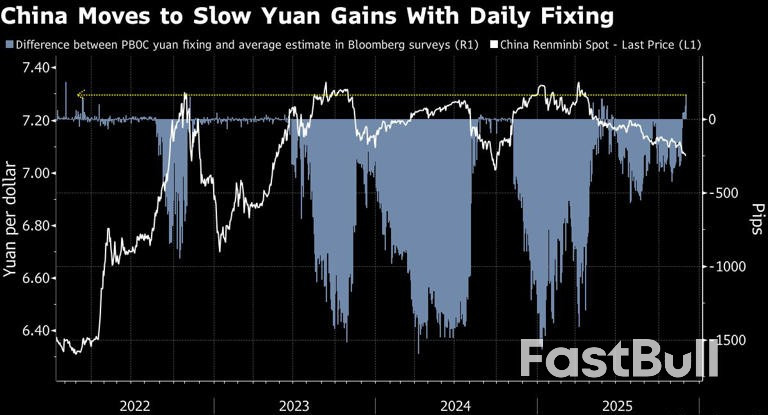
          China set its daily reference rate for the yuan at a level that was significantly weaker than estimated by traders and analysts, suggesting the central bank is aiming to cool gains in the managed currency.
          The People’s Bank of China set the so-called fixing at 7.0733 per dollar, 164 pips from the average estimate in a Bloomberg survey. The gap between the fixing, which limits the onshore yuan’s moves by 2% on either side, and the forecast was the widest to the weak side since February 2022.
          The yuan fell 0.1% in both onshore and overseas trading Thursday morning, after rising to the strongest level versus the dollar in more than a year this week. Versus a basket of currencies, it has been trading near the highest since April.
          China’s central bank is trying to engineer a calibrated ascent in the yuan that reflects stronger sentiment toward local assets and a weaker dollar, but also keeps its export engine humming. While the currency’s rally may be a vote of confidence from returning capital and thawing US relations, it may pose a risk for the nation’s exporters as it reduces the competitive advantage of their products.
          “Obviously, the PBOC is leaning against the appreciating momentum of the yuan,” said Fiona Lim, a senior foreign-exchange analyst at Malayan Banking Berhad in Singapore. “There are reasons for yuan to appreciate but the PBOC has started to ensure that the appreciation pace continues to remain gradual.”
          China gives most forceful signal since 2022 to slow yuan gains_1

          China Moves to Slow Yuan Gains With Daily Fixing

          Thursday’s fixing came in weaker than all 10 estimates submitted by those surveyed by Bloomberg. Still, it was slightly stronger than the previous session’s level, reflecting the greenback’s drop overnight.
          There’s also evidence that China is using more direct tools to limit gains than the fixing. In recent weeks, state-owned banks have been buying dollars from time to time to slow the yuan’s rally, according to traders who asked not to be named as they are not authorized to speak publicly.
          Before Thursday, the yuan had been inching toward the key psychological level of 7 amid a rally in local stocks and a slump in the dollar due to concerns over US’s fiscal conditions. Momentum has grown following an unexpected call between US President Donald Trump and his Chinese counterpart Xi Jinping, and a potential Trump visit to the Asian nation next year.
          “We do not expect the 7 level to be tested for the rest of this year, but it likely will be breached at some point next year,” said Lynn Song, chief economist for ING. “Currency stability has been useful to provide a stable environment for foreign trade and investment, and it has also been key to help avoid another area of market uncertainty when we are already in a period where uncertainty runs rampant.”
          Hedge funds on Wednesday sold dollars against the offshore yuan in the cash market and made trades in the option market that benefit from declines in the dollar-yuan currency pair, according to traders.
          The yuan’s strengthening shows how much things have changed since Trump’s earlier trade war in 2018-19. Back then, the Chinese economy was heavily reliant on US consumers — but the country has since diversified its exports toward the so-called Global South and extended its dominance in critical supply chains, such as rare earths.
          Still, on a trade-weighted basis, the yuan doesn’t look that strong yet. Despite recent gains, China’s real effective exchange rate, which strips out the impacts of inflation, is close to the lowest since 2011, according to data from the Bank for International Settlements.
          The fixing “suggests the authorities are seeking to manage the pace of yuan appreciation, but importantly they are not trying to halt it,” said Khoon Goh, head of Asia research at Australia & New Zealand Banking Group in Singapore. “Most likely the authorities want a smoother path of appreciation for the currency, especially with expected foreign-exchange volatility ahead.”

          Source: Bloomberg

          To stay updated on all economic events of today, please check out our Economic calendar
          Risk Warnings and Disclaimers
          You understand and acknowledge that there is a high degree of risk involved in trading. Following any strategies or investment methods may lead to potential losses. The content on the site is provided by our contributors and analysts for information purposes only. You are solely responsible for determining whether any trading assets, securities, strategy, or any other product is suitable for investing based on your own investment objectives and financial situation.
          Add to Favorites
          Share

          US Data Center Power Demand Could Reach 106 GW By 2035

          Justin

          Stocks

          Economic

          Summary:

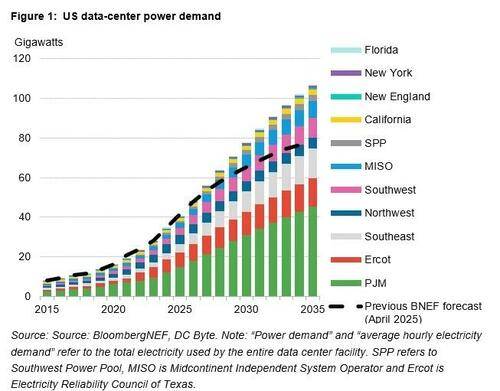
          · U.S. data center power demand could reach 106 GW in 2035, BloombergNEF said Monday in one of the more aggressive load growth estimates to date. The U.S. had about 25 GW of operating data centers in 2024, Bloom Energy said earlier this year.
          · BloombergNEF's latest forecast is 36% higher than its previous prediction, released in April. The jump is due in part to the higher average size of the 150 significant U.S. data center projects announced in the past year, over a quarter of which are larger than 500 MW, BNEF said.
          · The Energy Information Administration, which tracks demand for the federal government, generally only publishes detailed projections out two or three years, and few other analyses have attempted firm forecasts as far out as 2035.

          BNEF's report comes as some energy industry analysts and executives warn that an artificial intelligence bubble or speculative data center proposals could be fueling excessive load growth projections.

          A report from Grid Strategies released last month said utility forecasts of 90 GW additional data center load by 2030 were likely overstated; market analysis indicates load growth in that time frame is likely closer to 65 GW, it said.

          A July report from the Department of Energy estimated an additional 100 GW of new peak capacity is needed by 2030, of which 50 GW is attributable to data centers. Those facilities could account for as much as 12% of peak demand by 2028, according to Lawrence Berkeley National Laboratory.

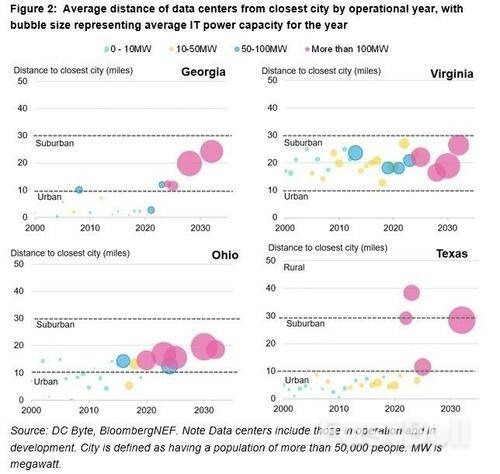
          BNEF's data center project tracker shows the industry diversifying beyond traditional data center hubs like Northern Virginia, metro Atlanta and central Ohio into exurban and rural regions served by existing fiber-optic trunk lines for data traffic.

          A map of under-construction, committed and early-stage projects shows gigawatts of planned data center capacity spreading south through Virginia and the Carolinas, up through eastern Pennsylvania and outward from Chicago along the Lake Michigan shore. More data centers are also planned for Texas and the Gulf Coast states.

          Much of the capacity is poised to materialize on grids overseen by the PJM Interconnection, the Midcontinent Independent System Operator and the Electric Reliability Council of Texas. BNEF predicts PJM alone could add 31 GW of data center load over the next five years, about 3 GW more than expected capacity additions from new generation.

          With the expected surge, the North American Electric Reliability Corp. warned late last year of "elevated risk" of summer electricity shortfalls this year, in 2026 and onward in all three regions.

          Some experts disputed NERC's methodology, however. MISO's independent market monitor said in June that the group's analysis was flawed and that MISO was in a better position than grid regions not expected to see exponential data center growth, like ISO New England and the New York Independent System Operator.

          Other technology and energy system analysts expect a significant amount of proposed data center capacity to dissipate in the coming years due to chip shortages, duplicative permit requests and other factors.

          In July, London Economics International said in a report prepared for the Southern Environmental Law Center that meeting projections for U.S. data center load in 2030 would require 90% of global chip supply — a scenario it called "unrealistic."

          Patricia Taylor, director of policy and research at the American Public Power Association, told Utility Dive earlier this year that it's common for data center developers to "shop around" the same project across neighboring jurisdictions.

          Still, U.S. grid operators face an "inflection moment" as they balance the desire to accommodate large-scale data centers with the obligation to ensure reliable service for all customers, BNEF said.

          Source: Zero Hedge

          To stay updated on all economic events of today, please check out our Economic calendar
          Risk Warnings and Disclaimers
          You understand and acknowledge that there is a high degree of risk involved in trading. Following any strategies or investment methods may lead to potential losses. The content on the site is provided by our contributors and analysts for information purposes only. You are solely responsible for determining whether any trading assets, securities, strategy, or any other product is suitable for investing based on your own investment objectives and financial situation.
          Add to Favorites
          Share
          FastBull
          Copyright © 2025 FastBull Ltd

          728 RM B 7/F GEE LOK IND BLDG NO 34 HUNG TO RD KWUN TONG KLN HONG KONG

          TelegramInstagramTwitterfacebooklinkedin
          App Store Google Play Google Play
          Products
          Charts

          Chats

          Q&A with Experts
          Screeners
          Economic Calendar
          Data
          Tools
          Membership
          Features
          Function
          Markets
          Copy Trading
          Latest Signals
          Contests
          News
          Analysis
          24/7
          Columns
          Education
          Company
          Careers
          About Us
          Contact Us
          Advertising
          Help Center
          Feedback
          User Agreement
          Privacy Policy
          Business

          White Label

          Data API

          Web Plug-ins

          Poster Maker

          Affiliate Program

          Risk Disclosure

          The risk of loss in trading financial instruments such as stocks, FX, commodities, futures, bonds, ETFs and crypto can be substantial. You may sustain a total loss of the funds that you deposit with your broker. Therefore, you should carefully consider whether such trading is suitable for you in light of your circumstances and financial resources.

          No decision to invest should be made without thoroughly conducting due diligence by yourself or consulting with your financial advisors. Our web content might not suit you since we don't know your financial conditions and investment needs. Our financial information might have latency or contain inaccuracy, so you should be fully responsible for any of your trading and investment decisions. The company will not be responsible for your capital loss.

          Without getting permission from the website, you are not allowed to copy the website's graphics, texts, or trademarks. Intellectual property rights in the content or data incorporated into this website belong to its providers and exchange merchants.

          Not Logged In

          Log in to access more features

          FastBull Membership

          Not yet

          Purchase

          Become a signal provider
          Help Center
          Customer Service
          Dark Mode
          Price Up/Down Colors

          Log In

          Sign Up

          Position
          Layout
          Fullscreen
          Default to Chart
          The chart page opens by default when you visit fastbull.com