• Trade
  • Markets
  • Copy
  • Contests
  • News
  • 24/7
  • Calendar
  • Q&A
  • Chats
Trending
Screeners
SYMBOL
LAST
BID
ASK
HIGH
LOW
NET CHG.
%CHG.
SPREAD
SPX
S&P 500 Index
6827.42
6827.42
6827.42
6899.86
6801.80
-73.58
-1.07%
--
DJI
Dow Jones Industrial Average
48458.04
48458.04
48458.04
48886.86
48334.10
-245.98
-0.51%
--
IXIC
NASDAQ Composite Index
23195.16
23195.16
23195.16
23554.89
23094.51
-398.69
-1.69%
--
USDX
US Dollar Index
97.920
98.000
97.920
98.070
97.810
-0.030
-0.03%
--
EURUSD
Euro / US Dollar
1.17452
1.17459
1.17452
1.17596
1.17262
+0.00058
+ 0.05%
--
GBPUSD
Pound Sterling / US Dollar
1.33854
1.33863
1.33854
1.33961
1.33546
+0.00147
+ 0.11%
--
XAUUSD
Gold / US Dollar
4332.03
4332.44
4332.03
4350.16
4294.68
+32.64
+ 0.76%
--
WTI
Light Sweet Crude Oil
56.830
56.860
56.830
57.601
56.789
-0.403
-0.70%
--

Community Accounts

Signal Accounts
--
Profit Accounts
--
Loss Accounts
--
View More

Become a signal provider

Sell trading signals to earn additional income

View More

Guide to Copy Trading

Get started with ease and confidence

View More

Signal Accounts for Members

All Signal Accounts

Best Return
  • Best Return
  • Best P/L
  • Best MDD
Past 1W
  • Past 1W
  • Past 1M
  • Past 1Y

All Contests

  • All
  • Trump Updates
  • Recommend
  • Stocks
  • Cryptocurrencies
  • Central Banks
  • Featured News
Top News Only
Share

Portugal Treasury Expects 2026 Net Financing Needs At 29.4 Billion Euros, Up From 25.8 Billion In 2025

Share

Bank Of America Says With Indonesia's Smelter Now Ramping Up, It Expects Aluminium Supply Growth To Accelerate To 2.6% Year On Year In 2026

Share

Bank Of America Expects A Deficit In Aluminium Next Year And Sees Prices Pushing Above $3000/T

Share

Fed Data - USA Effective Federal Funds Rate At 3.64 Percent On 12 December On $102 Billion In Trades Versus 3.64 Percent On $99 Billion On 11 December

Share

Brazil's Petrobras Says No Impact Seen On Oil, Petroleum Products Output As Workers Start Planned Strike

Share

Statement: US Travel Group Warns New Proposed Trump Administration Requirements For Foreign Tourists To Provide Social Media Histories Could Mean Millions Of People Opting Not To Visit

Share

Blackrock: Kerry White Will Become Head Of Citi Investment Management At Citi Wealth

Share

Blackrock: Rob Jasminski, Head Of Citi Investment Management, Has Joined With Team

Share

Blackrock: Effective Dec 15, Citi Investment Management Employees Will Join Blackrock

Share

Blackrock: Formally Launch Citi Portfolio Solutions Powered By Blackrock

Share

According To Data From The Federal Reserve Bank Of New York, The Secured Overnight Funding Rate (Sofr) Was 3.67% On The Previous Trading Day (December 15), Compared To 3.66% The Day Before

Share

Peru Energy And Mines Ministry: Copper Production Up 4.8% Year-On-Year In October To 248192 Metric Tons

Share

Security Source: Ukrainian Drones Hits Russian Oil Infrastructure In Caspian Sea For Third Time

Share

Spot Palladium Extends Gains, Last Up 5% To $1562.7/Oz

Share

Mexico's Economy Ministry Announces Start Of Anti-Dumping Investigation And Anti-Subsidy Investigations Into USA Pork Imports

Share

Canada Nov CPI Common +2.8%, CPI Median +2.8%, CPI Trim +2.8% On Year

Share

NY Fed's Empire State Prices Paid Index +37.6 In December Versus+49.0 In November

Share

Canada Nov Consumer Prices +0.1% On Month, +2.2% On Year

Share

Canada Nov CPI Core -0.1% On Month, +2.9% On Year

Share

Canada Nov Core CPI, Seasonally Adjusted +0.2% On Month, Oct +0.3% (Unrevised)

TIME
ACT
FCST
PREV
Japan Tankan Small Manufacturing Outlook Index (Q4)

A:--

F: --

P: --

Japan Tankan Large Non-Manufacturing Outlook Index (Q4)

A:--

F: --

P: --

Japan Tankan Large Manufacturing Outlook Index (Q4)

A:--

F: --

P: --

Japan Tankan Small Manufacturing Diffusion Index (Q4)

A:--

F: --

P: --

Japan Tankan Large Manufacturing Diffusion Index (Q4)

A:--

F: --

P: --

Japan Tankan Large-Enterprise Capital Expenditure YoY (Q4)

A:--

F: --

P: --

U.K. Rightmove House Price Index YoY (Dec)

A:--

F: --

P: --

China, Mainland Industrial Output YoY (YTD) (Nov)

A:--

F: --

P: --

China, Mainland Urban Area Unemployment Rate (Nov)

A:--

F: --

P: --

Saudi Arabia CPI YoY (Nov)

A:--

F: --

P: --

Euro Zone Industrial Output YoY (Oct)

A:--

F: --

P: --

Euro Zone Industrial Output MoM (Oct)

A:--

F: --

P: --

Canada Existing Home Sales MoM (Nov)

A:--

F: --

P: --

Canada National Economic Confidence Index

A:--

F: --

P: --

Canada New Housing Starts (Nov)

A:--

F: --

P: --
U.S. NY Fed Manufacturing Employment Index (Dec)

A:--

F: --

P: --

U.S. NY Fed Manufacturing Index (Dec)

A:--

F: --

P: --

Canada Core CPI YoY (Nov)

A:--

F: --

P: --

Canada Manufacturing Unfilled Orders MoM (Oct)

A:--

F: --

P: --

U.S. NY Fed Manufacturing Prices Received Index (Dec)

A:--

F: --

P: --

U.S. NY Fed Manufacturing New Orders Index (Dec)

A:--

F: --

P: --

Canada Manufacturing New Orders MoM (Oct)

A:--

F: --

P: --

Canada Core CPI MoM (Nov)

A:--

F: --

P: --

Canada Trimmed CPI YoY (SA) (Nov)

A:--

F: --

P: --

Canada Manufacturing Inventory MoM (Oct)

A:--

F: --

P: --

Canada CPI YoY (Nov)

A:--

F: --

P: --

Canada CPI MoM (Nov)

A:--

F: --

P: --

Canada CPI YoY (SA) (Nov)

A:--

F: --

P: --

Canada Core CPI MoM (SA) (Nov)

A:--

F: --

P: --

Canada CPI MoM (SA) (Nov)

A:--

F: --

P: --

Federal Reserve Board Governor Milan delivered a speech
U.S. NAHB Housing Market Index (Dec)

--

F: --

P: --

Australia Composite PMI Prelim (Dec)

--

F: --

P: --

Australia Services PMI Prelim (Dec)

--

F: --

P: --

Australia Manufacturing PMI Prelim (Dec)

--

F: --

P: --

Japan Manufacturing PMI Prelim (SA) (Dec)

--

F: --

P: --

U.K. 3-Month ILO Employment Change (Oct)

--

F: --

P: --

U.K. Unemployment Claimant Count (Nov)

--

F: --

P: --

U.K. Unemployment Rate (Nov)

--

F: --

P: --

U.K. 3-Month ILO Unemployment Rate (Oct)

--

F: --

P: --

U.K. Average Weekly Earnings (3-Month Average, Including Bonuses) YoY (Oct)

--

F: --

P: --

U.K. Average Weekly Earnings (3-Month Average, Excluding Bonuses) YoY (Oct)

--

F: --

P: --

France Services PMI Prelim (Dec)

--

F: --

P: --

France Composite PMI Prelim (SA) (Dec)

--

F: --

P: --

France Manufacturing PMI Prelim (Dec)

--

F: --

P: --

Germany Services PMI Prelim (SA) (Dec)

--

F: --

P: --

Germany Manufacturing PMI Prelim (SA) (Dec)

--

F: --

P: --

Germany Composite PMI Prelim (SA) (Dec)

--

F: --

P: --

Euro Zone Composite PMI Prelim (SA) (Dec)

--

F: --

P: --

Euro Zone Services PMI Prelim (SA) (Dec)

--

F: --

P: --

Euro Zone Manufacturing PMI Prelim (SA) (Dec)

--

F: --

P: --

U.K. Services PMI Prelim (Dec)

--

F: --

P: --

U.K. Manufacturing PMI Prelim (Dec)

--

F: --

P: --

U.K. Composite PMI Prelim (Dec)

--

F: --

P: --

Euro Zone ZEW Economic Sentiment Index (Dec)

--

F: --

P: --

Germany ZEW Current Conditions Index (Dec)

--

F: --

P: --

Germany ZEW Economic Sentiment Index (Dec)

--

F: --

P: --

Euro Zone Trade Balance (Not SA) (Oct)

--

F: --

P: --

Euro Zone ZEW Current Conditions Index (Dec)

--

F: --

P: --

Euro Zone Trade Balance (SA) (Oct)

--

F: --

P: --

U.S. Retail Sales MoM (Excl. Automobile) (SA) (Oct)

--

F: --

P: --

Q&A with Experts
    • All
    • Chatrooms
    • Groups
    • Friends
    Connecting
    .
    .
    .
    Type here...
    Add Symbol or Code

      No matching data

      All
      Trump Updates
      Recommend
      Stocks
      Cryptocurrencies
      Central Banks
      Featured News
      • All
      • Russia-Ukraine Conflict
      • Middle East Flashpoint
      • All
      • Russia-Ukraine Conflict
      • Middle East Flashpoint
      Search
      Products

      Charts Free Forever

      Chats Q&A with Experts
      Screeners Economic Calendar Data Tools
      Membership Features
      Data Warehouse Market Trends Institutional Data Policy Rates Macro

      Market Trends

      Market Sentiment Order Book Forex Correlations

      Top Indicators

      Charts Free Forever
      Markets

      News

      News Analysis 24/7 Columns Education
      From Institutions From Analysts
      Topics Columnists

      Latest Views

      Latest Views

      Trending Topics

      Top Columnists

      Latest Update

      Signals

      Copy Rankings Latest Signals Become a signal provider AI Rating
      Contests
      Brokers

      Overview Brokers Assessment Rankings Regulators News Claims
      Broker listing Forex Brokers Comparison Tool Live Spread Comparison Scam
      Q&A Complaint Scam Alert Videos Tips to Detect Scam
      More

      Business
      Events
      Careers About Us Advertising Help Center

      White Label

      Data API

      Web Plug-ins

      Affiliate Program

      Awards Institution Evaluation IB Seminar Salon Event Exhibition
      Vietnam Thailand Singapore Dubai
      Fans Party Investment Sharing Session
      FastBull Summit BrokersView Expo
      Recent Searches
        Top Searches
          Markets
          News
          Analysis
          User
          24/7
          Economic Calendar
          Education
          Data
          • Names
          • Latest
          • Prev

          View All

          No data

          Scan to Download

          Faster Charts, Chat Faster!

          Download App
          English
          • English
          • Español
          • العربية
          • Bahasa Indonesia
          • Bahasa Melayu
          • Tiếng Việt
          • ภาษาไทย
          • Français
          • Italiano
          • Türkçe
          • Русский язык
          • 简中
          • 繁中
          Open Account
          Search
          Products
          Charts Free Forever
          Markets
          News
          Signals

          Copy Rankings Latest Signals Become a signal provider AI Rating
          Contests
          Brokers

          Overview Brokers Assessment Rankings Regulators News Claims
          Broker listing Forex Brokers Comparison Tool Live Spread Comparison Scam
          Q&A Complaint Scam Alert Videos Tips to Detect Scam
          More

          Business
          Events
          Careers About Us Advertising Help Center

          White Label

          Data API

          Web Plug-ins

          Affiliate Program

          Awards Institution Evaluation IB Seminar Salon Event Exhibition
          Vietnam Thailand Singapore Dubai
          Fans Party Investment Sharing Session
          FastBull Summit BrokersView Expo

          The Fed Faces Economic Uncertainty And Political Pressure As It Decides Whether to Cut Rates

          Michelle

          Economic

          Forex

          Summary:

          In a sign of how unusual this week's Federal Reserve meeting is, the decision it will make on interest rates — usually the main event — is just one of the key unknowns to be resolved when officials gather Tuesday and Wednesday.

          In a sign of how unusual this week's Federal Reserve meeting is, the decision it will make on interest rates — usually the main event — is just one of the key unknowns to be resolved when officials gather Tuesday and Wednesday.

          For now, it's not even clear who will be there. The meeting will likely include Lisa Cook, an embattled governor, unless an appeals court or the Supreme Court rules in favor of an effort by President Donald Trump to remove her from office. And it will probably include Stephen Miran, a top White House economic aide whom Trump has nominated to fill an empty seat on the Fed's board. But those questions may not be resolved until late Monday.

          Meanwhile, the U.S. economy is mired in uncertainty. Hiring has slowed sharply, while inflation remains stubbornly high.

          So a key question for the Fed is: Do they worry more about people who are out of work and struggling to find jobs, or do they focus more on the struggles many Americans face in keeping up with rising costs for groceries and other items? The Fed's mandate from Congress requires it to seek both stable prices and full employment.

          For now, Fed Chair Jerome Powell and other Fed policymakers have signaled the Fed is more concerned about weaker hiring, a key reason investors expect the central bank will reduce its benchmark interest rate by a quarter point on Wednesday to about 4.1%.

          Still, stubbornly high inflation may force them to proceed slowly and limit how many reductions they make. The central bank will also release its quarterly economic projections Wednesday, and economists project they will show that policymakers expect one or two additional cuts this year, plus several more next year.

          Ellen Meade, an economics professor at Duke University and former senior economist at the Fed, said it's a stark contrast to the early pandemic, when it was clear the Fed had to rapidly reduce rates to boost the economy. And when inflation surged in 2021 and 2022, it was also a straightforward call for the Fed, which moved quickly to raise borrowing costs to combat higher prices.

          But now, “it’s a tough time,” Meade said. “It would be a tough time, even if the politics and the whole thing weren’t going on the way they are, it would be a tough time. Some people would want to cut, some people would not want to cut.”

          Amid all the economic uncertainty, Trump is applying unprecedented political pressure on the Fed, demanding sharply lower rates, seeking to fire Cook, and insulting Powell, whom he has called a “numbskull,” “fool,” and “moron.”

          Source: Yahoo Finance

          To stay updated on all economic events of today, please check out our Economic calendar
          Risk Warnings and Disclaimers
          You understand and acknowledge that there is a high degree of risk involved in trading. Following any strategies or investment methods may lead to potential losses. The content on the site is provided by our contributors and analysts for information purposes only. You are solely responsible for determining whether any trading assets, securities, strategy, or any other product is suitable for investing based on your own investment objectives and financial situation.
          Add to Favorites
          Share

          The Crypto Market Is Hesitant to Rewrite Its Highs Until The FOMC

          Glendon

          Economic

          Cryptocurrency

          Market Overview

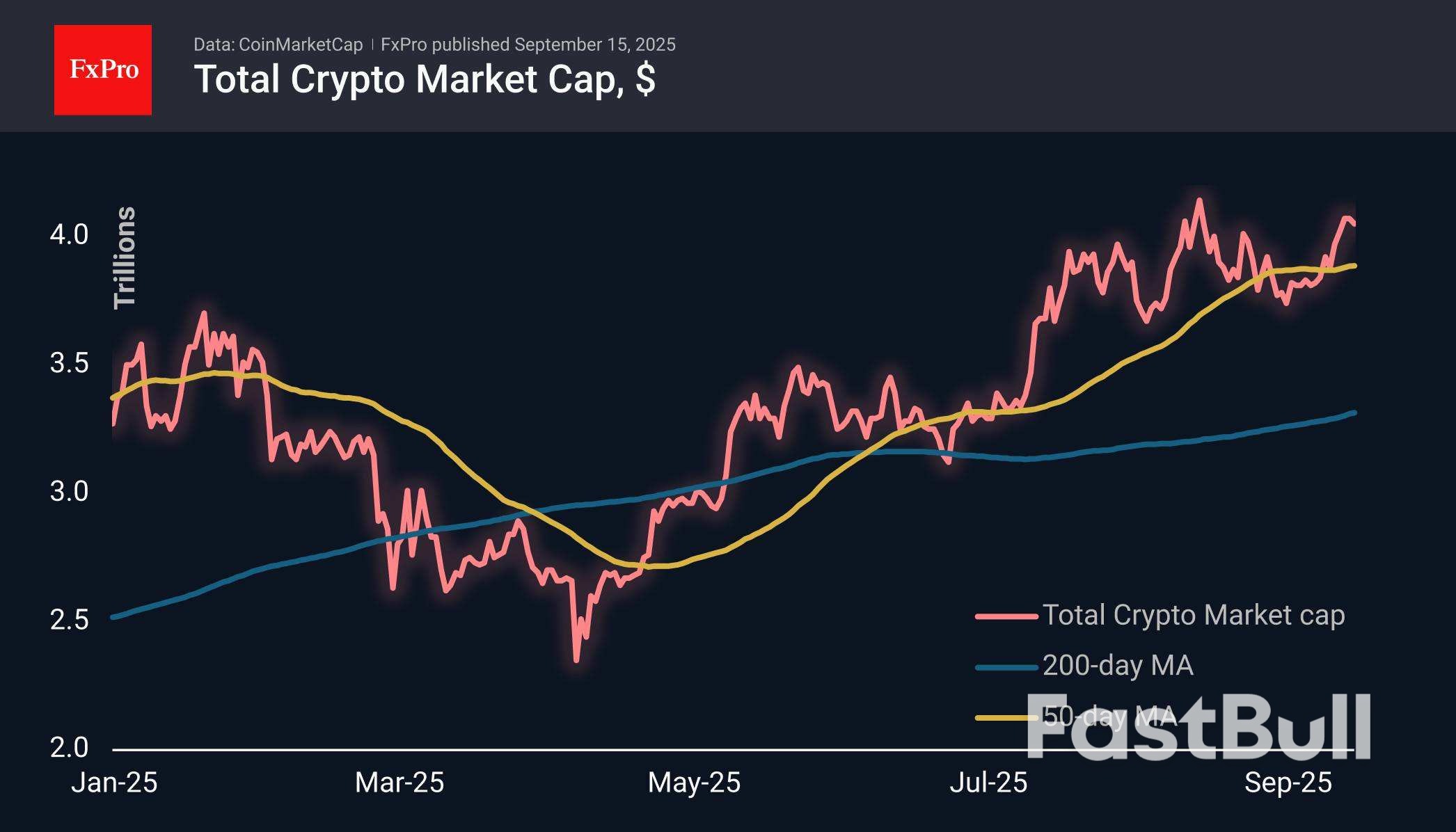
          The crypto market cap reached $4.09 trillion over the weekend, approaching the peak levels set a month earlier. The initial impetus came from positive dynamics in the US stock market on Friday, thanks to technology sector stocks. However, retail traders used the moment to take profits in BTC and major altcoins, except for Solana, which went down on Monday. As a result, the market level fell back to $4.05 trillion.

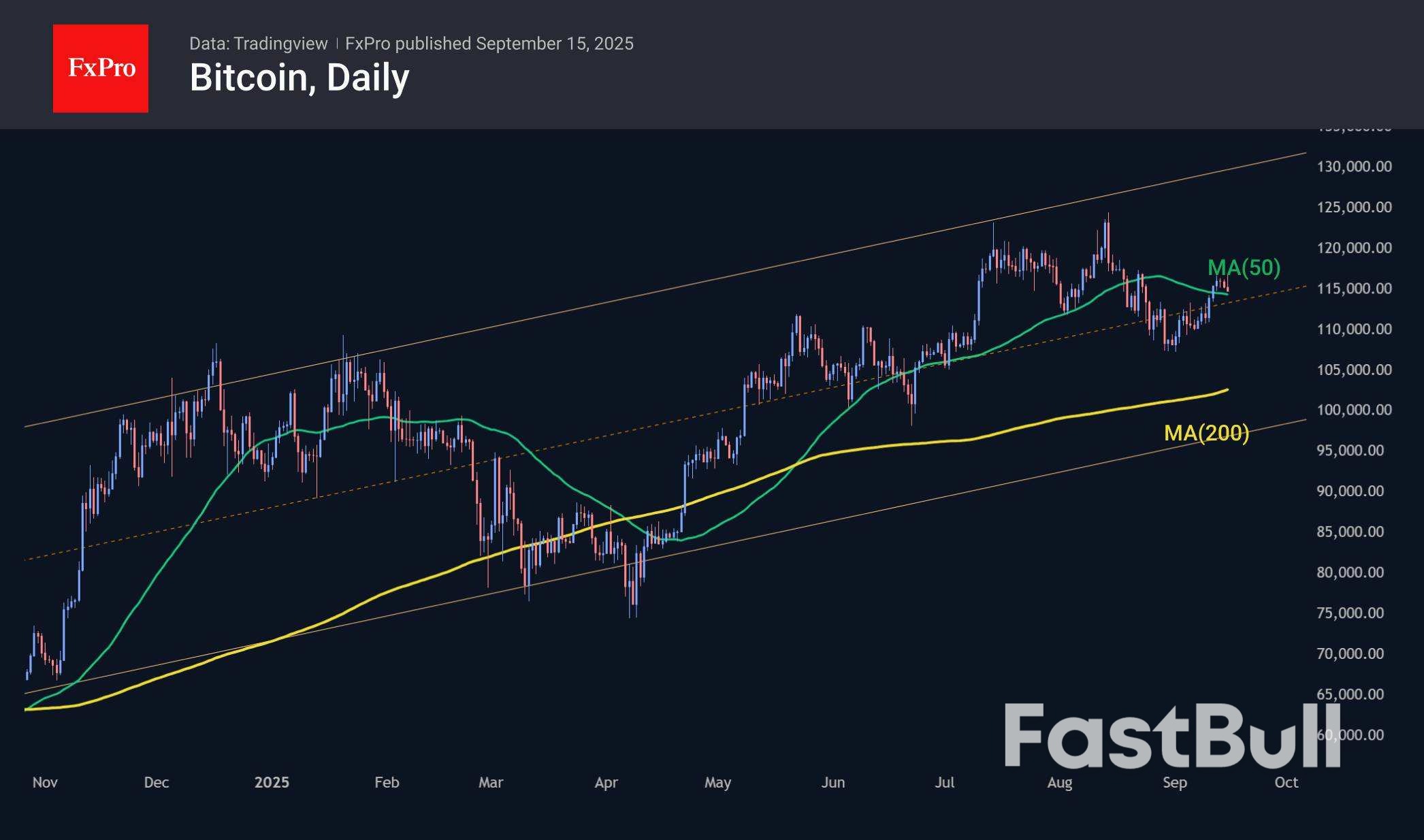
          Bitcoin ran into resistance at $116K, but the sell-off is drying up as it approaches $114K, turning the 50-day moving average back into a support line. It seems that Bitcoin has found a temporary balance until the FOMC meeting results are announced. A quarter-point cut is already clearly priced in, but the driver will be the tone of comments regarding the Fed’s future actions. A willingness to further cut rates in the foreseeable future could inspire BTC to march toward new all-time highs.

          News Background

          According to SoSoValue, net weekly inflows into spot BTC ETFs jumped nearly 10-fold to $2.34 billion, the highest since mid-July. Total inflows since the approval of Bitcoin ETFs in January 2024 have increased to $56.83 billion. On Wednesday, the indicator recouped all of the previous week’s losses.

          Inflows into spot Ethereum ETFs in the US resumed last week, amounting to $637.7 million, offsetting 80% of the previous week’s outflows. The cumulative net inflow since the ETF’s launch in July 2024 has grown to $13.36 billion.

          Investors should give up hope of quick profits from their investments in the first cryptocurrency, said BitMEX founder Arthur Hayes. In his opinion, Bitcoin was created to protect against inflation, not to make a profit here and now.

          The US SEC has postponed its decision on applications from BlackRock, Fidelity, and Franklin Templeton, which wanted to add a staking feature to their spot Ethereum ETFs until the end of October or November.

          According to Galaxy Digital CEO Mike Novogratz, the crypto industry has entered the “Solana season.” A key factor was Forward Industries’ launch of the largest SOL treasury, worth $1.6 billion. Against this background, Galaxy Digital purchased 2.31 million SOL worth $536 million for its reserves.

          The Winklevoss brothers’ Gemini crypto exchange raised $425 million during its IPO. The event caused a stir among investors, creating more than 20 times oversubscription for the shares.

          Tether introduced the USAT stablecoin for the US market. It is backed by dollars and fully compliant with US regulations. The stablecoin will use Tether’s Hadron RWA platform technology.

          Source: FxPro

          To stay updated on all economic events of today, please check out our Economic calendar
          Risk Warnings and Disclaimers
          You understand and acknowledge that there is a high degree of risk involved in trading. Following any strategies or investment methods may lead to potential losses. The content on the site is provided by our contributors and analysts for information purposes only. You are solely responsible for determining whether any trading assets, securities, strategy, or any other product is suitable for investing based on your own investment objectives and financial situation.
          Add to Favorites
          Share

          Exclusive-France Threatens To Block Crypto Licence 'passporting' In EU Regulatory Fight

          Samantha Luan

          Cryptocurrency

          Forex

          Political

          Economic

          France has warned it may try to block some crypto firms licenced in other EU countries from operating domestically as part of a push to get oversight transferred to the bloc’s central securities regulator, the head of its financial watchdog told Reuters.France's securities watchdog, the AMF, is concerned that under the EU's new regulatory regime, crypto companies are seeking out jurisdictions with more lenient licensing standards, its president, Marie-Anne Barbat-Layani, said.

          MiCA, a landmark set of digital asset rules which came into force this year, allows crypto companies to apply for licences from individual EU members, which they can use as a "passport" to operate throughout the 27-nation bloc.The legislation has already exposed inconsistencies in how national regulators apply the rules, raising questions about whether some licences are being granted too quickly and whether cross-border firms are being adequately supervised.

          OVERSIGHT GAPS RAISE ALARM

          At stake is oversight of the multi-trillion-dollar crypto industry, which regulators globally have long warned could destabilise markets and harm investors if not properly supervised.On Monday, France joined Italy and Austria in calling for the European Securities and Markets Authority (ESMA), based in Paris, to take over supervision of major crypto firms, according to a position paper seen by Reuters.

          In its strongest warning yet, the AMF told Reuters that France would not rule out the possibility of using the "atomic weapon" of challenging the "passporting" of a license granted by a different member state.A hallmark of the EU's single market for financial services, "passporting" allows companies authorised by one member state to operate across the bloc. The AMF did not give details about which companies' licences it could consider challenging, or on what basis.

          "We do not exclude the possibility of refusing the EU passport," Barbat-Layani said. "It's very complex legally and not a very good signal for the single market - it's a bit like the 'atomic weapon' ... but it's still a possibility we hold in reserve."Crypto platforms "are doing their regulatory shopping all over Europe, trying to find a weak link that will give them a licence with fewer requirements than the others," she added, without providing specific examples.

          MAJOR DIFFERENCES BETWEEN REGULATORS

          In Monday's paper, France's AMF, Italy's Consob and Austria's FMA called on European lawmakers to introduce a mechanism to transfer powers to ESMA."The first few months of the application of the Regulation have revealed major differences in how crypto-markets are being supervised by national authorities," the three regulators said.

          Direct European supervision would better protect investors, they said.
          Malta's financial regulator faced scrutiny over its licence-granting process earlier this year. An ESMA review found that Malta did not do enough to assess the risk when granting a licence to one particular unnamed crypto company. Malta said it was proud of its role as an "early adopter" of digital asset regulation.The French, Italian and Austrian regulators did not give examples of where regulators had interpreted the rules differently.
          Crypto companies are in the process of applying for MiCA licences during a transition period. Luxembourg granted a licence to U.S.-listed exchange Coinbase and Malta gave a licence to the Winklevoss-founded exchange Gemini.France, Italy and Austria also called for MiCA revisions, including stricter rules for crypto companies’ activities outside of the EU, better cybersecurity supervision, and a review of how authorities manage new crypto token offerings.France has long been pushing for ESMA to be given greater power. ESMA head Verena Ross has said she would welcome the move, but it faces resistance from some EU members.

          Source: Yahoo Finance

          To stay updated on all economic events of today, please check out our Economic calendar
          Risk Warnings and Disclaimers
          You understand and acknowledge that there is a high degree of risk involved in trading. Following any strategies or investment methods may lead to potential losses. The content on the site is provided by our contributors and analysts for information purposes only. You are solely responsible for determining whether any trading assets, securities, strategy, or any other product is suitable for investing based on your own investment objectives and financial situation.
          Add to Favorites
          Share

          Vietnam Enforces New Capital Adequacy Standards: Banks Must Maintain 8% CAR Starting September 15

          Gerik

          Economic

          New Regulatory Framework Raises Minimum Capital Standards

          The State Bank of Vietnam (SBV) has officially implemented Circular 14/2025/TT-NHNN from September 15, mandating that all commercial banks and foreign bank branches maintain a minimum capital adequacy ratio (CAR) of 8%. This baseline requirement applies to both standalone institutions and consolidated banking groups, including subsidiaries.
          Within this 8%, core Tier 1 capital must be no less than 4.5%, while total Tier 1 capital is required to meet a minimum threshold of 6%. The regulation aligns Vietnam’s banking system more closely with international Basel III standards, reinforcing systemic stability and risk absorption capacity in an increasingly complex financial environment.

          Introduction of Capital Buffers Signals Proactive Prudential Oversight

          Circular 14 introduces two additional capital buffers: the Capital Conservation Buffer (CCB) and the Counter-Cyclical Capital Buffer (CCyB). The CCB will be phased in gradually over four years, starting at 0.625% in the first year and reaching 2.5% by the fourth year.
          This means that the consolidated CAR requirement will climb from 8.625% in the first year to 10.5% by 2029. Likewise, Tier 1 capital with buffer adjustments will increase from 6.625% to 8.5%, while core Tier 1 capital (CET1) with buffer will rise from 5.125% to 7%.
          This structure serves a dual purpose: to improve shock resilience in periods of economic volatility, and to encourage conservative risk-taking behavior even during credit expansion cycles. The inclusion of a counter-cyclical buffer gives regulators the flexibility to increase capital requirements during credit booms to prevent systemic overheating.

          Dividend Payout Restrictions Encourage Internal Capital Reinforcement

          A notable clause in the regulation is the restriction on cash profit distribution. Banks may only pay out profits in cash once they fully comply with the new capital standards. This measure forces institutions to prioritize capital accumulation over shareholder returns, incentivizing stronger financial foundations.
          The emphasis on capital reinforcement has led many banks to increase their charter capital through various channels. These include retained earnings, issuing new shares, and raising subordinated debt instruments that qualify as Tier 2 capital under regulatory definitions.

          Capital Growth Momentum Accelerates in Anticipation of the Circular

          As banks anticipated the enforcement of Circular 14, the sector began ramping up capital throughout 2025. By the end of June 2025, total charter capital across 29 surveyed banks reached 879.352 trillion VND, up 6.6% from the end of 2024. Five major banks Vietcombank, VPBank, Techcombank, BIDV, and MB collectively held 41% of the system’s total capital, reinforcing their dominant role in Vietnam’s financial ecosystem.
          This increase in capital is not just a compliance exercise but also a strategic move to maintain competitiveness and creditworthiness as the regulatory landscape tightens. Banks with stronger capital buffers will have more room to expand credit, absorb shocks, and engage in international transactions under global risk-based capital standards.
          Circular 14/2025/TT-NHNN marks a significant regulatory step in strengthening Vietnam’s banking sector. By enforcing higher and phased capital requirements, the central bank aims to fortify financial system resilience, mitigate macro-financial vulnerabilities, and align domestic practices with international regulatory frameworks. As the transition unfolds, banks must carefully balance capital enhancement strategies with profitability goals, ensuring that long-term solvency remains at the forefront of corporate strategy.
          To stay updated on all economic events of today, please check out our Economic calendar
          Risk Warnings and Disclaimers
          You understand and acknowledge that there is a high degree of risk involved in trading. Following any strategies or investment methods may lead to potential losses. The content on the site is provided by our contributors and analysts for information purposes only. You are solely responsible for determining whether any trading assets, securities, strategy, or any other product is suitable for investing based on your own investment objectives and financial situation.
          Add to Favorites
          Share

          Markets Tense Ahead of Fed Meeting as Powell Faces Delicate Balancing Act on Rate Cuts

          Gerik

          Economic

          Stock Market Rallies on Hopes of Fed Pivot

          U.S. financial markets ended last week on an optimistic note, buoyed by growing expectations that the Federal Reserve will deliver its first interest rate cut since the tightening cycle began. Despite a mixed closing on Friday, the Dow Jones Industrial Average rose nearly 1% for the week, snapping a three-week losing streak. Meanwhile, the S&P 500 and Nasdaq notched their strongest weekly performances since early August.
          This market enthusiasm is reinforced by subdued Treasury yields and surging gold prices both signals that investors are preparing for a potential policy shift by the Fed.
          According to the CME FedWatch tool, the probability of a 25 basis point rate cut at this week’s meeting exceeds 90%. Such expectations are grounded in rising concerns over a softening labor market, even as inflation remains stubbornly high.

          Jerome Powell Caught Between Conflicting Macro Signals

          At the center of this week’s policy meeting is Chair Jerome Powell, whose challenge is growing more acute. If the Fed moves too slowly on rate cuts, it risks exacerbating labor market fragility. But if it loosens monetary conditions too rapidly, inflation could reaccelerate, undermining months of tightening efforts.
          Recent macroeconomic data illustrates this tightrope. The August consumer price index (CPI) showed persistent inflationary pressures across sectors, including food, coffee, airfares, and auto parts. Particularly notable was a 6% increase in airline ticket prices, signaling that service-sector inflation remains elevated. Some of this inflationary momentum has been attributed to new retaliatory tariffs implemented by the Trump administration, which helped generate a record $29.5 billion in tariff revenue last month.
          In parallel, the labor market is showing cracks. Weekly jobless claims have risen to their highest levels in nearly four years. Additionally, August saw a net job creation of only 22,000, and revised data revealed that employment growth in the 12 months through March 2025 was overstated by nearly one million jobs. These figures suggest a material slowdown in hiring momentum, raising red flags about economic resilience.

          Dot Plot Projections and Powell’s Communication Challenge

          Investors are also keenly watching the Fed’s updated "dot plot," which maps the individual interest rate projections of Federal Open Market Committee (FOMC) members. In June, policymakers anticipated two rate cuts in 2025, but internal divergence has since widened. As of the last update, seven FOMC members projected no cuts at all in 2025, up from four in March.
          Powell has previously downplayed the dot plot’s predictive power, calling it merely a forecast during a period of uncertainty. However, markets are now demanding greater clarity. Investors will closely analyze Powell’s post-meeting press conference for any forward guidance on the rate path, inflation expectations, and the Fed’s interpretation of recent labor data.
          The credibility of the Fed’s dual mandate controlling inflation while ensuring full employment hinges on Powell’s ability to balance the tone of caution with the urgency of policy adaptation.

          Economic Data and Corporate Earnings Add to the Narrative

          Beyond the Fed’s decision, markets this week will digest a wave of new economic data, including August retail sales, weekly unemployment claims, and manufacturing indices. These indicators will offer additional context for assessing consumer demand and industrial health.
          On the corporate front, the tail end of earnings season features reports from FedEx, a bellwether of global trade and U.S. economic activity. The company’s performance is often seen as a proxy for broader economic momentum. Other notable earnings come from homebuilder Lennar, food producer General Mills, and restaurant chains Darden and Cracker Barrel the latter drawing attention for its ongoing rebranding efforts.
          As markets hold their breath ahead of the Fed’s policy announcement, Jerome Powell finds himself navigating a difficult environment marked by contradictory pressures: persistent inflation and emerging signs of economic cooling. Whether the central bank chooses to initiate a rate cut this week or signal one in the near future, the broader message from the Fed will shape not only market direction but also perceptions of its credibility in managing an increasingly complex economic landscape.
          To stay updated on all economic events of today, please check out our Economic calendar
          Risk Warnings and Disclaimers
          You understand and acknowledge that there is a high degree of risk involved in trading. Following any strategies or investment methods may lead to potential losses. The content on the site is provided by our contributors and analysts for information purposes only. You are solely responsible for determining whether any trading assets, securities, strategy, or any other product is suitable for investing based on your own investment objectives and financial situation.
          Add to Favorites
          Share

          Japan Faces Unprecedented Aging Crisis as Senior Population Reaches Record High

          Gerik

          Economic

          Japan’s Elderly Population Surges to 29.4%—A Global High

          Japan is entering an increasingly critical stage of demographic aging. According to data released on September 15 by the Ministry of Internal Affairs and Communications, seniors aged 65 and over now make up 29.4% of the national population. This marks the highest percentage Japan has ever recorded and places it at the top globally among countries with populations exceeding 40 million. For comparison, Italy follows at 25.1%, with Germany at 23.7% and France at 22.5%, according to UN estimates.
          The demographic structure also shows a stark gender imbalance: Japan currently has 15.68 million elderly men and 20.51 million elderly women, a difference of nearly 5 million. Meanwhile, those aged 70 and above now account for 23.5% of the population, and people over 80 make up 10.5%.

          Elderly Workforce Participation Hits New Records

          While aging presents growing socio-economic challenges, it is also reshaping Japan’s labor market. The number of elderly individuals still participating in the workforce has risen for the 21st consecutive year, now reaching a record 9.3 million. This group now makes up 25.7% of the elderly population, reflecting a year-on-year increase of 160,000 people.
          Age-based breakdowns show that among the working elderly, 53.6% fall within the 65–69 age group, 35.1% are aged 70–74, and a remarkable 12% are aged 75 or older. This highlights not only extended longevity but also a social necessity: many retirees return to work due to financial pressures, rising living costs, or personal fulfillment.
          As a share of the total working-age population (15 years and older), elderly workers now account for 13.7%, meaning that roughly one in every seven workers in Japan is a senior.

          Retail and Healthcare Sectors Most Dependent on Elderly Workers

          Labor force participation among seniors is particularly concentrated in specific industries. Wholesale and retail sectors employ the most, with 1.33 million elderly workers. Healthcare and welfare services follow with 1.15 million, reflecting the paradox of a graying society increasingly reliant on the elderly themselves to sustain key support sectors.
          This trend points to both a labor shortage in these industries and the increasing economic role that aging individuals continue to play despite retirement eligibility.

          Long-Term Projections Paint a More Complex Picture

          The National Institute of Population and Social Security Research projects that the proportion of elderly in Japan’s population will continue to climb. By 2040, seniors are expected to make up 34.8% of the population, and by 2050, this figure may reach 37.1%. These increases are primarily attributed to the aging of the second baby boom generation (born between 1971 and 1974), whose transition into retirement age will intensify demographic pressure over the next two decades.
          While these trends are structurally inevitable, they present profound implications for healthcare, pensions, urban planning, labor market design, and intergenerational equity.
          Japan stands at the forefront of a demographic shift that many advanced economies will eventually face. Its record-high aging rate is not only reshaping social policy but also redefining labor dynamics and economic sustainability. As older workers remain active longer and the population structure skews further toward seniors, Japan must innovate across public policy, social services, and workplace culture to maintain resilience in the face of demographic headwinds.
          To stay updated on all economic events of today, please check out our Economic calendar
          Risk Warnings and Disclaimers
          You understand and acknowledge that there is a high degree of risk involved in trading. Following any strategies or investment methods may lead to potential losses. The content on the site is provided by our contributors and analysts for information purposes only. You are solely responsible for determining whether any trading assets, securities, strategy, or any other product is suitable for investing based on your own investment objectives and financial situation.
          Add to Favorites
          Share

          Trump Criticizes Europe’s Sanctions on Russia as Insufficient, Ties U.S. Actions to NATO Unity

          Gerik

          Economic

          Political

          Trump Links Further U.S. Sanctions to European Action

          Returning to the White House on September 14, Donald Trump stated that the European Union’s current sanctions on Russia are “not strict enough” and reiterated that the U.S. will not unilaterally intensify punitive measures unless its NATO allies take equivalent steps. Trump emphasized that European countries must stop purchasing Russian oil to present a united front and restore leverage in negotiations with Moscow.
          Trump’s comments highlight a conditional stance: although he expressed readiness to proceed with more severe sanctions, he expects reciprocal commitment from NATO allies. “I’m ready to move forward, but they need to do the same,” he told the press. He further criticized Europe for "still talking, not acting."

          Truth Social Post Calls for Unified NATO Embargo on Russian Oil

          One day earlier, on September 13, Trump used his social media platform, Truth Social, to issue a statement titled “Letter to NATO and the World.” In it, he made clear that comprehensive sanctions from the U.S. would only be justified if all NATO members jointly agreed to ban Russian oil imports.
          Trump argued that continued energy trade with Moscow by some NATO countries undermines the bloc’s bargaining power and creates a fragmented strategy. “Let me know when you’re ready,” he added, urging NATO to coordinate a timeline for cutting oil ties with Russia.
          This reflects Trump's broader foreign policy approach, placing emphasis on cost-sharing, alliance parity, and synchronized action especially in matters of geopolitical conflict.

          Proposes High Tariffs on Chinese Imports as Leverage Tool

          In a notable addition to his Ukraine-Russia comments, Trump proposed that NATO impose a temporary 50%–100% tariff on goods imported from China. He claimed such a move would pressure Beijing to support an end to the conflict and act as a geopolitical lever. Trump promised that these tariffs would be lifted entirely once the Russia-Ukraine war concludes.
          This approach introduces an interlinked strategy that goes beyond Russia, suggesting Trump views the Ukraine conflict not only as a European security issue but as a global economic power play where both Russia and China are interconnected actors in challenging Western dominance.

          Moscow Responds with Familiar Defiance

          Russia, for its part, continues to portray Western sanctions as illegitimate and ineffective. According to Kremlin spokesperson Dmitry Peskov, Moscow has developed a degree of "immunity" to sanctions and has adapted its economic infrastructure accordingly. Peskov labeled the sanctions a “double-edged sword” that negatively impacts not only Russia but also the economies of those who impose them.
          The Kremlin reiterated its stated preference for a peaceful resolution, accusing Ukraine and its Western allies of sabotaging negotiation efforts. While these statements offer little new direction, they reinforce Russia’s strategy of projecting resilience and shifting blame for diplomatic stagnation.
          Trump’s remarks signal a return to a transactional, alliance-dependent strategy in foreign policy one where U.S. actions are contingent on shared burden and unified execution. By demanding more aggressive sanctions from NATO and proposing broad tariffs on China, Trump is positioning himself as both a pressure agent and a coordinator of global strategy. Whether this approach gains traction among NATO members remains to be seen, particularly as internal economic pressures and divergent energy needs continue to challenge the bloc’s cohesion in its stance toward Moscow.
          To stay updated on all economic events of today, please check out our Economic calendar
          Risk Warnings and Disclaimers
          You understand and acknowledge that there is a high degree of risk involved in trading. Following any strategies or investment methods may lead to potential losses. The content on the site is provided by our contributors and analysts for information purposes only. You are solely responsible for determining whether any trading assets, securities, strategy, or any other product is suitable for investing based on your own investment objectives and financial situation.
          Add to Favorites
          Share
          FastBull
          Copyright © 2025 FastBull Ltd

          728 RM B 7/F GEE LOK IND BLDG NO 34 HUNG TO RD KWUN TONG KLN HONG KONG

          TelegramInstagramTwitterfacebooklinkedin
          App Store Google Play Google Play
          Products
          Charts

          Chats

          Q&A with Experts
          Screeners
          Economic Calendar
          Data
          Tools
          Membership
          Features
          Function
          Markets
          Copy Trading
          Latest Signals
          Contests
          News
          Analysis
          24/7
          Columns
          Education
          Company
          Careers
          About Us
          Contact Us
          Advertising
          Help Center
          Feedback
          User Agreement
          Privacy Policy
          Business

          White Label

          Data API

          Web Plug-ins

          Poster Maker

          Affiliate Program

          Risk Disclosure

          The risk of loss in trading financial instruments such as stocks, FX, commodities, futures, bonds, ETFs and crypto can be substantial. You may sustain a total loss of the funds that you deposit with your broker. Therefore, you should carefully consider whether such trading is suitable for you in light of your circumstances and financial resources.

          No decision to invest should be made without thoroughly conducting due diligence by yourself or consulting with your financial advisors. Our web content might not suit you since we don't know your financial conditions and investment needs. Our financial information might have latency or contain inaccuracy, so you should be fully responsible for any of your trading and investment decisions. The company will not be responsible for your capital loss.

          Without getting permission from the website, you are not allowed to copy the website's graphics, texts, or trademarks. Intellectual property rights in the content or data incorporated into this website belong to its providers and exchange merchants.

          Not Logged In

          Log in to access more features

          FastBull Membership

          Not yet

          Purchase

          Become a signal provider
          Help Center
          Customer Service
          Dark Mode
          Price Up/Down Colors

          Log In

          Sign Up

          Position
          Layout
          Fullscreen
          Default to Chart
          The chart page opens by default when you visit fastbull.com