• Trade
  • Markets
  • Copy
  • Contests
  • News
  • 24/7
  • Calendar
  • Q&A
  • Chats
Trending
Screeners
SYMBOL
LAST
BID
ASK
HIGH
LOW
NET CHG.
%CHG.
SPREAD
SPX
S&P 500 Index
6846.50
6846.50
6846.50
6878.28
6827.18
-23.90
-0.35%
--
DJI
Dow Jones Industrial Average
47739.31
47739.31
47739.31
47971.51
47611.93
-215.67
-0.45%
--
IXIC
NASDAQ Composite Index
23545.89
23545.89
23545.89
23698.93
23455.05
-32.22
-0.14%
--
USDX
US Dollar Index
99.000
99.080
99.000
99.000
99.000
+0.050
+ 0.05%
--
EURUSD
Euro / US Dollar
1.16370
1.16380
1.16370
1.16388
1.16322
+0.00006
+ 0.01%
--
GBPUSD
Pound Sterling / US Dollar
1.33214
1.33226
1.33214
1.33220
1.33140
+0.00009
+ 0.01%
--
XAUUSD
Gold / US Dollar
4191.65
4192.09
4191.65
4193.27
4189.64
+1.95
+ 0.05%
--
WTI
Light Sweet Crude Oil
58.660
58.702
58.660
58.676
58.543
+0.105
+ 0.18%
--

Community Accounts

Signal Accounts
--
Profit Accounts
--
Loss Accounts
--
View More

Become a signal provider

Sell trading signals to earn additional income

View More

Guide to Copy Trading

Get started with ease and confidence

View More

Signal Accounts for Members

All Signal Accounts

Best Return
  • Best Return
  • Best P/L
  • Best MDD
Past 1W
  • Past 1W
  • Past 1M
  • Past 1Y

All Contests

  • All
  • Trump Updates
  • Recommend
  • Stocks
  • Cryptocurrencies
  • Central Banks
  • Featured News
Top News Only
Share

Japan Prime Minister Takaichi: 30 Injuries Reported So Far From Monday Earthquake

Share

USA Senate Committee Votes To Advance Nomination Of Jared Isaacman To Head Nasa

Share

Singapore Post - New Rate For Standard Regular Mail & Standard Large Mail Will Be S$0.62 And S$0.90 Respectively

Share

Australia's S&P/ASX 200 Index Down 0.27% At 8601.10 Points In Early Trade

Share

Trump: The USA Needs Mexico To Release 200000 Acre-Feet Of Water Before December 31St, And The Rest Must Come Soon After

Share

Trump: I Have Authorized Documentation To Impose A 5% Tariff On Mexico If This Water Isn't Released

Share

Brazil's Sao Paulo State Governor Tarcisio De Freitas Says Flavio Bolsonaro Will Have His Support - Cnn Brasil

Share

Ukraine's Security Must Be Guaranteed, In The Long Term, As A First Line Of Defence For Our Union, Says European Commission President

Share

Ukraine's Sovereignty Must Be Respected, Says European Commission President

Share

The Goal Is A Strong Ukraine, On The Battlefield And At The Negotiating Table, Says European Commission President

Share

As Peace Talks Are Ongoing, The EU Remains Ironclad In Its Support For Ukraine, Says European Commission President

Share

Pepsico: Asking USA-Based Pepna Employees As Well As Pbus Division Offices And Pfus Region Offices To Work Remotely This Week

Share

A U.S. Judge Ruled That President Trump’s Ban On Several Wind Power Projects Was Illegal

Share

Senior USA Administration Official: We Continue To Monitor Drc-Rwanda Situation Closely, Continue To Work With All Sides To Ensure Commitments Are Honored

Share

Israeli Military Says It Has Struck Infrastructure Belonging To Hezbollah In Several Areas In Southern Lebanon

Share

SPDR Gold Holdings Down 0.11%, Or 1.14 Tonnes

Share

On Monday (December 8), In Late New York Trading, S&P 500 Futures Fell 0.21%, Dow Jones Futures Fell 0.43%, NASDAQ 100 Futures Fell 0.08%, And Russell 2000 Futures Fell 0.04%

Share

Morgan Stanley: Data Center ABS Spreads Are Expected To Widen In 2026

Share

(US Stocks) The Philadelphia Gold And Silver Index Closed Down 2.34% At 311.01 Points. (Global Session) The NYSE Arca Gold Miners Index Closed Down 2.17%, Hitting A Daily Low Of 2235.45 Points; US Stocks Remained Slightly Down Before The Opening Bell—holding Steady Around 2280 Points—before Briefly Rising Slightly

Share

IMF: IMF Executive Board Approves Extension Of The Extended Credit Facility Arrangement With Nepal

TIME
ACT
FCST
PREV
France Trade Balance (SA) (Oct)

A:--

F: --

P: --
Euro Zone Employment YoY (SA) (Q3)

A:--

F: --

P: --
Canada Part-Time Employment (SA) (Nov)

A:--

F: --

P: --

Canada Unemployment Rate (SA) (Nov)

A:--

F: --

P: --

Canada Full-time Employment (SA) (Nov)

A:--

F: --

P: --

Canada Labor Force Participation Rate (SA) (Nov)

A:--

F: --

P: --

Canada Employment (SA) (Nov)

A:--

F: --

P: --

U.S. PCE Price Index MoM (Sept)

A:--

F: --

P: --

U.S. Personal Income MoM (Sept)

A:--

F: --

P: --

U.S. Core PCE Price Index MoM (Sept)

A:--

F: --

P: --

U.S. PCE Price Index YoY (SA) (Sept)

A:--

F: --

P: --

U.S. Core PCE Price Index YoY (Sept)

A:--

F: --

P: --

U.S. Personal Outlays MoM (SA) (Sept)

A:--

F: --

P: --
U.S. 5-10 Year-Ahead Inflation Expectations (Dec)

A:--

F: --

P: --

U.S. Real Personal Consumption Expenditures MoM (Sept)

A:--

F: --

P: --
U.S. Weekly Total Rig Count

A:--

F: --

P: --

U.S. Weekly Total Oil Rig Count

A:--

F: --

P: --

U.S. Consumer Credit (SA) (Oct)

A:--

F: --

P: --
China, Mainland Foreign Exchange Reserves (Nov)

A:--

F: --

P: --

Japan Trade Balance (Oct)

A:--

F: --

P: --

Japan Nominal GDP Revised QoQ (Q3)

A:--

F: --

P: --

China, Mainland Imports YoY (CNH) (Nov)

A:--

F: --

P: --

China, Mainland Exports (Nov)

A:--

F: --

P: --

China, Mainland Imports (CNH) (Nov)

A:--

F: --

P: --

China, Mainland Trade Balance (CNH) (Nov)

A:--

F: --

P: --

China, Mainland Exports YoY (USD) (Nov)

A:--

F: --

P: --

China, Mainland Imports YoY (USD) (Nov)

A:--

F: --

P: --

Germany Industrial Output MoM (SA) (Oct)

A:--

F: --

P: --
Euro Zone Sentix Investor Confidence Index (Dec)

A:--

F: --

P: --

Canada National Economic Confidence Index

A:--

F: --

P: --

U.K. BRC Like-For-Like Retail Sales YoY (Nov)

--

F: --

P: --

U.K. BRC Overall Retail Sales YoY (Nov)

--

F: --

P: --

Australia Overnight (Borrowing) Key Rate

--

F: --

P: --

RBA Rate Statement
RBA Press Conference
Germany Exports MoM (SA) (Oct)

--

F: --

P: --

U.S. NFIB Small Business Optimism Index (SA) (Nov)

--

F: --

P: --

Mexico 12-Month Inflation (CPI) (Nov)

--

F: --

P: --

Mexico Core CPI YoY (Nov)

--

F: --

P: --

Mexico PPI YoY (Nov)

--

F: --

P: --

U.S. Weekly Redbook Index YoY

--

F: --

P: --

U.S. JOLTS Job Openings (SA) (Oct)

--

F: --

P: --

China, Mainland M1 Money Supply YoY (Nov)

--

F: --

P: --

China, Mainland M0 Money Supply YoY (Nov)

--

F: --

P: --

China, Mainland M2 Money Supply YoY (Nov)

--

F: --

P: --

U.S. EIA Short-Term Crude Production Forecast For The Year (Dec)

--

F: --

P: --

U.S. EIA Natural Gas Production Forecast For The Next Year (Dec)

--

F: --

P: --

U.S. EIA Short-Term Crude Production Forecast For The Next Year (Dec)

--

F: --

P: --

EIA Monthly Short-Term Energy Outlook
U.S. API Weekly Gasoline Stocks

--

F: --

P: --

U.S. API Weekly Cushing Crude Oil Stocks

--

F: --

P: --

U.S. API Weekly Crude Oil Stocks

--

F: --

P: --

U.S. API Weekly Refined Oil Stocks

--

F: --

P: --

South Korea Unemployment Rate (SA) (Nov)

--

F: --

P: --

Japan Reuters Tankan Non-Manufacturers Index (Dec)

--

F: --

P: --

Japan Reuters Tankan Manufacturers Index (Dec)

--

F: --

P: --

Japan Domestic Enterprise Commodity Price Index MoM (Nov)

--

F: --

P: --

Japan Domestic Enterprise Commodity Price Index YoY (Nov)

--

F: --

P: --

China, Mainland PPI YoY (Nov)

--

F: --

P: --

China, Mainland CPI MoM (Nov)

--

F: --

P: --

Italy Industrial Output YoY (SA) (Oct)

--

F: --

P: --

Q&A with Experts
    • All
    • Chatrooms
    • Groups
    • Friends
    Connecting
    .
    .
    .
    Type here...
    Add Symbol or Code

      No matching data

      All
      Trump Updates
      Recommend
      Stocks
      Cryptocurrencies
      Central Banks
      Featured News
      • All
      • Russia-Ukraine Conflict
      • Middle East Flashpoint
      • All
      • Russia-Ukraine Conflict
      • Middle East Flashpoint
      Search
      Products

      Charts Free Forever

      Chats Q&A with Experts
      Screeners Economic Calendar Data Tools
      Membership Features
      Data Warehouse Market Trends Institutional Data Policy Rates Macro

      Market Trends

      Market Sentiment Order Book Forex Correlations

      Top Indicators

      Charts Free Forever
      Markets

      News

      News Analysis 24/7 Columns Education
      From Institutions From Analysts
      Topics Columnists

      Latest Views

      Latest Views

      Trending Topics

      Top Columnists

      Latest Update

      Signals

      Copy Rankings Latest Signals Become a signal provider AI Rating
      Contests
      Brokers

      Overview Brokers Assessment Rankings Regulators News Claims
      Broker listing Forex Brokers Comparison Tool Live Spread Comparison Scam
      Q&A Complaint Scam Alert Videos Tips to Detect Scam
      More

      Business
      Events
      Careers About Us Advertising Help Center

      White Label

      Data API

      Web Plug-ins

      Affiliate Program

      Awards Institution Evaluation IB Seminar Salon Event Exhibition
      Vietnam Thailand Singapore Dubai
      Fans Party Investment Sharing Session
      FastBull Summit BrokersView Expo
      Recent Searches
        Top Searches
          Markets
          News
          Analysis
          User
          24/7
          Economic Calendar
          Education
          Data
          • Names
          • Latest
          • Prev

          View All

          No data

          Scan to Download

          Faster Charts, Chat Faster!

          Download App
          English
          • English
          • Español
          • العربية
          • Bahasa Indonesia
          • Bahasa Melayu
          • Tiếng Việt
          • ภาษาไทย
          • Français
          • Italiano
          • Türkçe
          • Русский язык
          • 简中
          • 繁中
          Open Account
          Search
          Products
          Charts Free Forever
          Markets
          News
          Signals

          Copy Rankings Latest Signals Become a signal provider AI Rating
          Contests
          Brokers

          Overview Brokers Assessment Rankings Regulators News Claims
          Broker listing Forex Brokers Comparison Tool Live Spread Comparison Scam
          Q&A Complaint Scam Alert Videos Tips to Detect Scam
          More

          Business
          Events
          Careers About Us Advertising Help Center

          White Label

          Data API

          Web Plug-ins

          Affiliate Program

          Awards Institution Evaluation IB Seminar Salon Event Exhibition
          Vietnam Thailand Singapore Dubai
          Fans Party Investment Sharing Session
          FastBull Summit BrokersView Expo

          The dollar could lose its crown as an 'unfortunate truth' forces investors to rethink US assets

          Adam

          Forex

          Summary:

          The US dollar faces mounting pressure amid rising debt, policy uncertainty, and tariff impacts. Investors are shifting toward foreign assets, viewing the dollar less as a safe haven and more like an emerging-market currency.

          The US dollar is under pressure as global investors grow increasingly wary of America's fiscal trajectory.
          Once seen as a reliable safe haven, the greenback is now facing renewed skepticism, with strategists telling Yahoo Finance that capital is shifting toward undervalued currencies in Europe and Asia amid expectations of foreign stimulus and more attractive valuations abroad.
          The US Dollar Index (DX-Y.NYB) — which tracks the dollar's value against a basket of major currencies including the euro, Japanese yen, British pound, Canadian dollar, Swedish krona, and Swiss franc — has dropped more than 8% since the start of the year, underperforming every other G10 currency, according to Bloomberg data. It ranks as one of the worst-performing asset classes of the year, alongside Brent Crude (BZ=F).
          Since April, the index has dipped below the crucial technical and psychological level of 100, hitting lows not seen since 2022.
          "Investors now have a very strong reason to hedge their long US asset exposure, and the dollar is no longer behaving like a safe haven," Jayati Bharadwaj, FX and macro strategist at TD Securities, told Yahoo Finance on Wednesday. "I would say it's actually following much more of an emerging market playbook, which is the unfortunate truth that we need to come to terms with."
          Bharadwaj cited mounting US debt and policy uncertainty as key catalysts behind the dollar's decline. Last week's credit rating downgrade by Moody's only deepened market concerns. Adding to the fiscal anxiety, the House of Representatives on Thursday approved President Trump's sweeping tax reform package, otherwise known as the president's "big, beautiful bill."
          The proposal includes significant cuts to both individual and corporate tax rates and is projected to increase the national debt by $4 trillion over the next decade. The legislation now moves to the Senate for consideration.
          "The volatility associated with the current administration's policies is a big confidence shock, which is actually forcing other countries to step up their local fiscal policies and work on fostering stronger trade relationships amongst themselves," Bharadwaj said, noting that it ultimately reduces foreign nations' dependence on the US.
          As a result, Bharadwaj expects the dollar to keep weakening gradually, with another 5% drop likely by year-end.

          The inflationary spiral

          A weaker dollar adds to inflation by driving up import costs, an issue compounded by tariffs that remain near their highest levels since World War II.
          "The dollar going down is going to add to inflation pressure and reduce purchasing power," Kevin Gordon, senior investment strategist at Charles Schwab, told Yahoo Finance.
          Gordon highlighted that during the 2021 to 2023 inflation surge, the dollar's strength acted as a partial hedge against rising prices. But with the greenback now weakening and inflation still elevated, that protective buffer is fading. On top of that, tariffs have added further pressure by reducing capital inflows, or the money coming into the US from foreign investors seeking American assets.
          The shift comes at a challenging time for US policymakers, with President Trump's "Liberation Day" tariff announcement fueling concerns of a broader "sell America" trade, in which US stocks fall, the dollar weakens, and Treasury yields rise.
          While some of those worries eased after a partial tariff rollback, Deutsche Bank said foreign investors remain wary of America’s fiscal trajectory.
          To be sure, despite recent weakness, strategists say the US dollar remains dominant in global finance, accounting for about 80% of trade finance and nearly half of global bond issuance.
          Charles Schwab's Gordon described current softness as a "positioning adjustment" driven by sentiment and portfolio shifts rather than fundamental changes, especially after the dollar's strong bull run since 2011. "The scale is still very much in favor of the dollar, disproportionately so," he said.
          TD's Bharadwaj echoed this view, calling the recent moves a "healthy recalibration."
          "For the longest time, most markets became a pure US move and a pure dollar bet," she said. "Now you can actually start to focus on local, idiosyncratic stories."
          While she doesn’t expect the US to lose its "crown" currency status, she noted that "other princes and princesses" may start to take the stage.

          Source: finance.yahoo

          Risk Warnings and Disclaimers
          You understand and acknowledge that there is a high degree of risk involved in trading. Following any strategies or investment methods may lead to potential losses. The content on the site is provided by our contributors and analysts for information purposes only. You are solely responsible for determining whether any trading assets, securities, strategy, or any other product is suitable for investing based on your own investment objectives and financial situation.
          Add to Favorites
          Share

          Donald Trump and the loss of the triple-A rating

          Adam

          Economic

          At the end of last week, Moody's announced that it is downgrading the US credit rating from Aaa (the highest rating) to Aa1. As we explained earlier this week, only a few countries still have a AAA rating.
          This is obviously not good news for Donald Trump as he tries to get his tax cut plan through Congress.
          As always, the blame is being shifted to the previous administration. Treasury Secretary Scott Bessent said that Moody's is a "lagging indicator" and that the downgrade is the result of Joe Biden's policies.
          What is true is that the Democratic president passed several laws that significantly increased the US deficit, such as the Inflation Reduction Act in 2022, which offers companies tax credits for the development of renewable energies. In the last two years of his presidency, the public deficit rose to over 6%, even though the US did not experience a crisis over this period.
          However, this deterioration in the US budgetary situation cannot be attributed solely to Joe Biden's policies. In its statement announcing the downgrade of the US credit rating, Moody's summed it up as follows: "Successive US administrations and Congress have failed to agree on measures to reverse the trend of large annual budget deficits and rising interest costs."
          This observation still holds true today, as Congress is currently examining Donald Trump's tax cut plan, the famous "big, beautiful bill." According to estimates by the Committee for a Responsible Federal Budget, this plan is expected to add between $3.3 trillion and $5.2 trillion to the deficit over 10 years.
          The equity markets did not react much to Moody's announcement, with US indices even closing up on Monday. However, there is tension on Treasuries, particularly on the long end of the curve, which is most sensitive to deficit issues. The 30-year yield has thus once again exceeded 5%.
          Moody's decision comes as no surprise. Investors have long been aware of the US budget situation. The "definitive loss" of the triple A rating – the downgrade by the three major agencies – merely confirms this, and it is a reality that Donald Trump, who often takes liberties with the facts, will not be able to ignore. From now on, his economic policy will be closely monitored by the bond markets.

          Source: marketscreener

          To stay updated on all economic events of today, please check out our Economic calendar
          Risk Warnings and Disclaimers
          You understand and acknowledge that there is a high degree of risk involved in trading. Following any strategies or investment methods may lead to potential losses. The content on the site is provided by our contributors and analysts for information purposes only. You are solely responsible for determining whether any trading assets, securities, strategy, or any other product is suitable for investing based on your own investment objectives and financial situation.
          Add to Favorites
          Share

          Why the bond market is so worried about the ‘Big, Beautiful Bill’

          Adam

          Bond

          The decidedly unsexy bond market is usually pretty quiet. But when they want to, bond investors can send a loud, clear message to Washington. They did just that Wednesday and Thursday.
          The 20-year bond auction conducted by the US Treasury on Wednesday afternoon was unusually weak: Demand for the bonds was the lowest since February, according to the Treasury Department. Investors who bought the bonds sought a higher-than-expected yield — effectively saying they wanted to be paid more for taking on the risk of lending to Uncle Sam.
          That sent a big warning to President Donald Trump and congressional Republicans. The poor demand means that investors who lend money to the United States think the Trump agenda — in particular, the “Big, Beautiful” tax cut bill — has made America an unacceptably risky investment. They are not going to keep funding the government’s coffers unless they get paid more for it.
          Long-term Treasuries fell further Thursday; and yields, which trade in opposite direction to prices, continued to surge. The rate on the 10-year Treasury rose above 4.61%, and the 30-year eclipsed 5.14% — its highest level since October 2023.
          The stock market has started to worry a bit about the news. The Dow was flat Thursday after tumbling more than 800 points Wednesday. The broader S&P 500 fell 0.1%, and the Nasdaq gained 0.1%. Wall Street’s problems could soon be felt on Main Street.
          The bond market is already on edge. Bond prices have been falling in recent weeks, and yields have been rising for several reasons. Recession fears have been somewhat allayed after the Trump administration lowered tariffs on China significantly last week. Yet inflation remains a big concern as companies reporting earnings in recent days, including behemoths like Walmart, said they’ll be forced to raise prices because of tariffs.
          Yields have also been rising all over the world, creating competition for US bonds. And the “Sell America” trade — in which US stocks, dollar and bonds have become less attractive — has reignited over growing debt concerns because of the tax cut bill and Friday’s US credit rating downgrade from Moody’s. That raised fears that foreign investors may not want to invest in US Treasuries in the future.
          “The most troubling part of the market reaction is that the dollar is weakening at the same time,” said George Saravelos, head of FX research at Deutsche Bank, in a note to investors. “To us this is a clear signal of a foreign buyer’s strike on US assets and the associated US fiscal risks we have been warning for some time. At the core of the problem is that foreign investors are simply no longer willing to finance US twin deficits at current level of prices.”
          The “yippy” bond market, as Trump previously called it, is what concerned Treasury Secretary Scott Bessent and Commerce Secretary Howard Lutnick enough to convince Trump to reverse course shortly after the “Liberation Day” trade announcement on April 2, CNN reported. That’s why he temporarily rescinded his “reciprocal” tariffs on dozens of countries, some as high as 50%.
          The question now: Will the bond market freak out Republicans again — enough to change the “Big, Beautiful Bill” as it moves through the Senate?
          Debt hawks in the Republican party have been complaining about the Congressional Budget Office’s report that said the bill would add nearly $4 trillion to America’s $36 trillion in debt. That’s not just a number: America needs to pay interest on all that borrowing. This fiscal year alone, America has already spent $684 billion to maintain its debt, amounting to 16% of all federal spending — just on interest.
          But Bessent, the steward of America’s debt and a debt hawk himself, has pooh-poohed higher rates and the Moody’s downgrade. He said Sunday on CNN that the economic benefits of the tax cuts will outweigh the debt problems it creates. And on NBC’s “Meet the Press” on Sunday he dismissed the credit rating downgrade, saying, “Who cares? Qatar doesn’t, Saudi doesn’t, UAE doesn’t,” referring to investment agreements Trump secured during his Middle East trip last week.
          But the Treasury is about to fill its coffers again once Congress raises the debt ceiling, allowing the government to start borrowing again. If bond investors demand higher yields, that will make financing America’s debt significantly more expensive, putting at risk future safety net programs — one reason why Republicans are talking about big cuts to Medicaid.
          Higher bond rates are also going to make life more expensive for everyday Americans. Many loans pegged to Treasury yields, such as mortgages, credit card rates and auto loans, are rising as bond yields grow. That could slow down the economy, taking some of the power out of the tax cut bill, which is expected to help juice the economy.
          “Ultimately, there are only two ‘solutions’ to this problem,” said Saravelos. “Either the US has to sharply revise the current reconciliation bill currently sitting in Congress to result in credibly tighter fiscal policy; or, the non-dollar value of US debt has to decline materially until it becomes cheap enough for foreign investors to return. Brace for more volatility.”

          Source: cnn

          Risk Warnings and Disclaimers
          You understand and acknowledge that there is a high degree of risk involved in trading. Following any strategies or investment methods may lead to potential losses. The content on the site is provided by our contributors and analysts for information purposes only. You are solely responsible for determining whether any trading assets, securities, strategy, or any other product is suitable for investing based on your own investment objectives and financial situation.
          Add to Favorites
          Share

          S&P 500 Directionless After Trump's Tax-cut Bill Narrowly Wins House Vote

          Owen Li

          Economic

          Stocks

          The S&P 500 struggled for direction on Thursday after the U.S. House of Representatives passed President Donald Trump's tax and spending bill, expected to burden the federal government with trillions of dollars in extra debt, by a razor-thin margin.

          If what Trump has described as a "big, beautiful bill" becomes law, it is expected to add about $3.8 trillion to the country's $36.2 trillion debt in the next decade, according to the nonpartisan Congressional Budget Office.

          The bill now faces a test in the Republican-controlled Senate and will fulfill much of Trump's populist agenda if passed, delivering new tax breaks on tips and car loans and boosting U.S. military expenditure.

          "It seems pretty clear that, in its present form, the legislation is certainly not going to improve the budget deficit and could make it substantially worse," said Steve Sosnick, chief market analyst at Interactive Brokers.

          Longer-dated Treasury yields hovered near multi-month highs, with those on the 10-year benchmark at 4.58% and the 30-year Treasury yield at a new 19-month high.

          At 11:46 a.m. ET, the Dow Jones Industrial Average (.DJI), opens new tab rose 52.01 points, or 0.12%, to 41,912.45, the S&P 500 (.SPX), opens new tab gained 8.17 points, or 0.14%, to 5,852.78, and the Nasdaq Composite (.IXIC), opens new tab added 120.56 points, or 0.64%, to 18,993.21.

          Eight of the 11 S&P sub-sectors traded lower, with utilities (.SPLRCU), opens new tab and energy (.SPNY), opens new tab among top decliners, down more than 2% and 1% respectively.

          Most megacap and growth stocks inched up. Alphabet(GOOGL.O), opens new tab led gains with a 3.3% rise, touching a nearly three-month high.

          Shares of solar energy companies including First Solar (FSLR.O), opens new tab fell more than 6% as Trump's tax bill is expected to end a number of green-energy subsidies.

          Snowflake (SNOW.N), opens new tab jumped more than 12% after the cloud computing firm raised its fiscal-year 2026 product revenue forecast.

          All three main stock indexes had witnessed their biggest single-day percentage drops in a month on Wednesday as Treasury yields spiked on worries about mounting U.S. debt.

          U.S. stocks have had a solid month so far, with the S&P 500 climbing more than 15% from its April lows, when Trump's reciprocal tariffs roiled global markets.

          A pause in tariffs, a temporary U.S.-China trade truce and tame inflation data have pushed equities higher, although the S&P 500 is still about 3% off record highs.

          Fed Governor Christopher Waller said in an interview to Fox Business that central bank rate cuts would be on the menu if the Trump administration's tariff agenda settles on the lower side of the ledger.

          On the data front, U.S. business activity picked up in May, while separate data showed jobless claims dropped last week, suggesting that the economy maintained a steady pace of employment growth.

          Traders currently see at least two 25-basis-point rate cuts by the end of the year, according to data compiled by LSEG.

          Declining issues outnumbered advancers by a 1.95-to-1 ratio on the NYSE and by a 1.05-to-1 ratio on the Nasdaq.

          The S&P 500 posted one new 52-week high and nine new lows, while the Nasdaq Composite recorded 34 new highs and 83 new lows.

          Source: Reuters

          To stay updated on all economic events of today, please check out our Economic calendar
          Risk Warnings and Disclaimers
          You understand and acknowledge that there is a high degree of risk involved in trading. Following any strategies or investment methods may lead to potential losses. The content on the site is provided by our contributors and analysts for information purposes only. You are solely responsible for determining whether any trading assets, securities, strategy, or any other product is suitable for investing based on your own investment objectives and financial situation.
          Add to Favorites
          Share

          House budget bill effectively kills US clean energy boom

          Adam

          Economic

          The House budget bill that narrowly passed in an early morning vote on Thursday would effectively put the brakes on a clean energy production boom in the United States spurred by tax credits enacted in 2022.
          The bill to carry out President Donald Trump's "one big beautiful bill" plan that would further his tax cuts and boost spending on the military and border enforcement would kill Inflation Reduction Act tax credits for clean energy years earlier than initially planned in an earlier draft, rendering them unusable for most projects.
          The changes made from the House tax-writing committee's proposal last week would advance by three years an end-date for the use of technology-neutral clean electricity tax credits for wind, solar and battery storage projects to 2028 and require projects to begin construction within 60 days of the final bill's passage, according to a bill summary.
          The House bill also eliminates the "transferability" of tax credits that enabled developers to sell their tax credits and use the funds to finance their projects' construction, a feature that made it easier to get projects up and running except for some nuclear energy projects.
          It also strengthened restrictions using tax credits for any project associated with "foreign entities of concern," which includes companies, subsidiaries and materials linked to China. China dominates all aspects of the clean energy supply chain and the restrictions effectively kill most projects, which rely on many components sourced from there.
          The budget proposal passed with the support of over two dozen Republican representatives who had urged House leaders to preserve key IRA tax credit provisions because their districts have benefited from clean energy and manufacturing investments.
          Advocates for the clean energy industry blasted the bill on Thursday, saying it will destroy billions in investments around the country and complaining that House leadership had initially promised to carefully reform the credits, not kill them.
          "If enacted as written, this bill will weaken our power system and send shockwaves throughout the U.S. economy by raising electricity prices, killing tens of thousands of jobs, and ceding energy dominance to China," said Heather O'Neill, president of clean energy lobby group Advanced Energy United.
          "This isn't a scalpel, it's a meat cleaver, and it will hurt us all."
          The American Petroleum Institute praised the bill for "preserving competitive tax policies" as well as opening up more oil lease sales and eliminating Biden administration policies such as its fee on methane emissions for the oil and gas industry.
          Analysts at JP Morgan described the IRA tax credit changes as "unfavorable" in an analysis, and said the bill contained "significant negative changes" from last week's proposal that it hopes the Senate can reverse.
          Energy analysts at the Rhodium Group said its preliminary review of the bill found the changes amount "to the impact of a full repeal of the energy tax credits" and could raise household energy costs by 7%.
          Clean energy stocks took a hit on Thursday.
          Sunrun shares fell as much as 33%, Complete Solaria fell nearly 22% while Enphase Energy, Maxeon Solar and SolarEdge Technologies dipped between 10% and 15.6%.
          Shares of JinkoSolar fell 2.3%, while First Solar and Canadian Solar dropped 6.5% and 10%, respectively.

          source : Reuters

          To stay updated on all economic events of today, please check out our Economic calendar
          Risk Warnings and Disclaimers
          You understand and acknowledge that there is a high degree of risk involved in trading. Following any strategies or investment methods may lead to potential losses. The content on the site is provided by our contributors and analysts for information purposes only. You are solely responsible for determining whether any trading assets, securities, strategy, or any other product is suitable for investing based on your own investment objectives and financial situation.
          Add to Favorites
          Share

          U.S. Treasury Sell-Off Still Orderly Despite Soaring Yields and Debt Fears

          Gerik

          Economic

          Treasury Market Remains Resilient

          In response to surging long-term bond yields and recent credit rating downgrades, the IMF clarified on Thursday that it does not currently see signs of financial instability in the U.S. bond market. According to Julie Kozack, Director of Communications at the IMF, “market functioning, including in the U.S. Treasury market, has so far been orderly,” despite recent volatility.
          Yields on long-term Treasuries surged this week after Moody’s cut the U.S. credit rating and as lawmakers advanced President Donald Trump’s expansive tax-and-spend legislation. The proposed bill, recently passed by a narrow vote in the House of Representatives, is expected to add $3.8 trillion to the current $36.2 trillion U.S. debt over the next decade, according to estimates from the Congressional Budget Office (CBO).

          IMF Urges Caution and Awaits Full Fiscal Picture

          While the IMF has not yet assessed the full impact of the legislation, Kozack indicated that the Fund will evaluate its economic consequences once the bill clears the Senate and is enacted. The Fund’s concern reflects growing international scrutiny over the sustainability of U.S. debt, especially as higher borrowing costs increasingly burden federal finances.
          On a more positive note, Kozack acknowledged that the recent temporary trade breakthrough between the United States and China—marked by a 90-day tariff pause—offers a potential boost to global economic growth. However, she emphasized that the world economy remains mired in uncertainty.
          “The reduction in tariffs and the easing of tensions does provide some upside risk to our global growth forecast,” she said. “All of this said, of course, the global outlook in general does remain one of high uncertainty.”

          Markets Caught Between Two Fiscal Signals

          The IMF’s remarks reflect a delicate balance: affirming U.S. Treasury liquidity while warning that sustained fiscal expansion—if not paired with structural reforms or revenue offsets—could destabilize long-term investor confidence. While bond markets have not yet shown signs of dislocation, the yield curve’s reaction to ongoing debt accumulation signals investor caution.
          Should the proposed U.S. tax legislation pass into law unchanged, markets will likely recalibrate their expectations on inflation, interest rates, and fiscal credibility—key variables the IMF will continue to monitor closely.

          Source: Reuters

          To stay updated on all economic events of today, please check out our Economic calendar
          Risk Warnings and Disclaimers
          You understand and acknowledge that there is a high degree of risk involved in trading. Following any strategies or investment methods may lead to potential losses. The content on the site is provided by our contributors and analysts for information purposes only. You are solely responsible for determining whether any trading assets, securities, strategy, or any other product is suitable for investing based on your own investment objectives and financial situation.
          Add to Favorites
          Share

          Bond selloff rolls on as US House passes Trump's 'big beautiful' tax bill

          Adam

          Economic

          Bond vigilantes continued to stalk global debt markets on Thursday, also keeping the dollar and stocks subdued, as the U.S. House of Representatives passed President Donald Trump's "big beautiful" tax bill by a single vote.
          Wall Street looked set to open fractionally higher having tumbled on Wednesday after the previous day's limp U.S. and Japanese long-term debt sales had highlighted the unease about rising government debt burdens.
          This reinforced a "Sell America" narrative at the front of investors minds after Moody's last week became the last of the major credit rating agencies to strip the U.S. of its coveted triple-A status.
          Long-term 20- and 30-year U.S. Treasury yields were shuffling higher again as were those in Europe, where benchmark German 20-year yields reached their highest in two months as global yield curves steepened.
          Britain's government borrowed more than expected in April, figures showed, while euro zone business activity unexpectedly slipped back into contraction territory.
          Stock markets in London, Paris, Milan and Frankfurt were all down between 0.75% and 1% EU.. The dollar was at its weakest against the Japanese yen in two weeks, while bitcoin set an all-time high, partly as investors sought out alternatives to U.S. assets. EU.
          The non-partisan Committee for a Responsible Federal Budget estimates that the U.S. bill, which will extend Trump's signature 2017 tax cuts as well as boost military and other spending, will increase the U.S.'s $36 trillion debt pile by $3.8 trillion over the next decade.
          "It should be good news that fiscal stimulus is coming given that markets have been worried about recession risk, but there is also the concern about fiscal sustainability," State Street Global Markets' Michael Metcalfe said.
          "I think the dollar is the bellwether to watch here. If it isn't reacting to higher yields, it shows that confidence in U.S. policymaking has perhaps been dented."
          The yields on 30-year Treasury bonds - a proxy for super long-term U.S. government borrowing costs - reached 5.13%, their highest since October 2023 and the 20-year yield hit 5.14%, its highest since November that year.
          The bond market in Japan has also been in focus given that it has the highest debt-to-GDP ratio of any major economy. The 30-year JGB yield hovered at 3.169%, not far from the record high of 3.185% hit in the previous session.
          Stocks in Asia also fell after Wall Street's Wednesday tumble. MSCI's broadest index of Asia-Pacific shares outside Japan (.MIAPJ0000PUS) , opens new tab ended 0.6% lower, while Japan's Nikkei (.N225) , opens new tab fell 0.8% on the stronger yen.
          "The view is that, with this bill, Trump is playing with fire with the deficit," said Francesco Pesole, FX strategist at ING.
          "It's causing a coordinated sell-off in equities and Treasuries, and the 'Sell America' theme is obviously quite negative for the dollar," Pesole added.
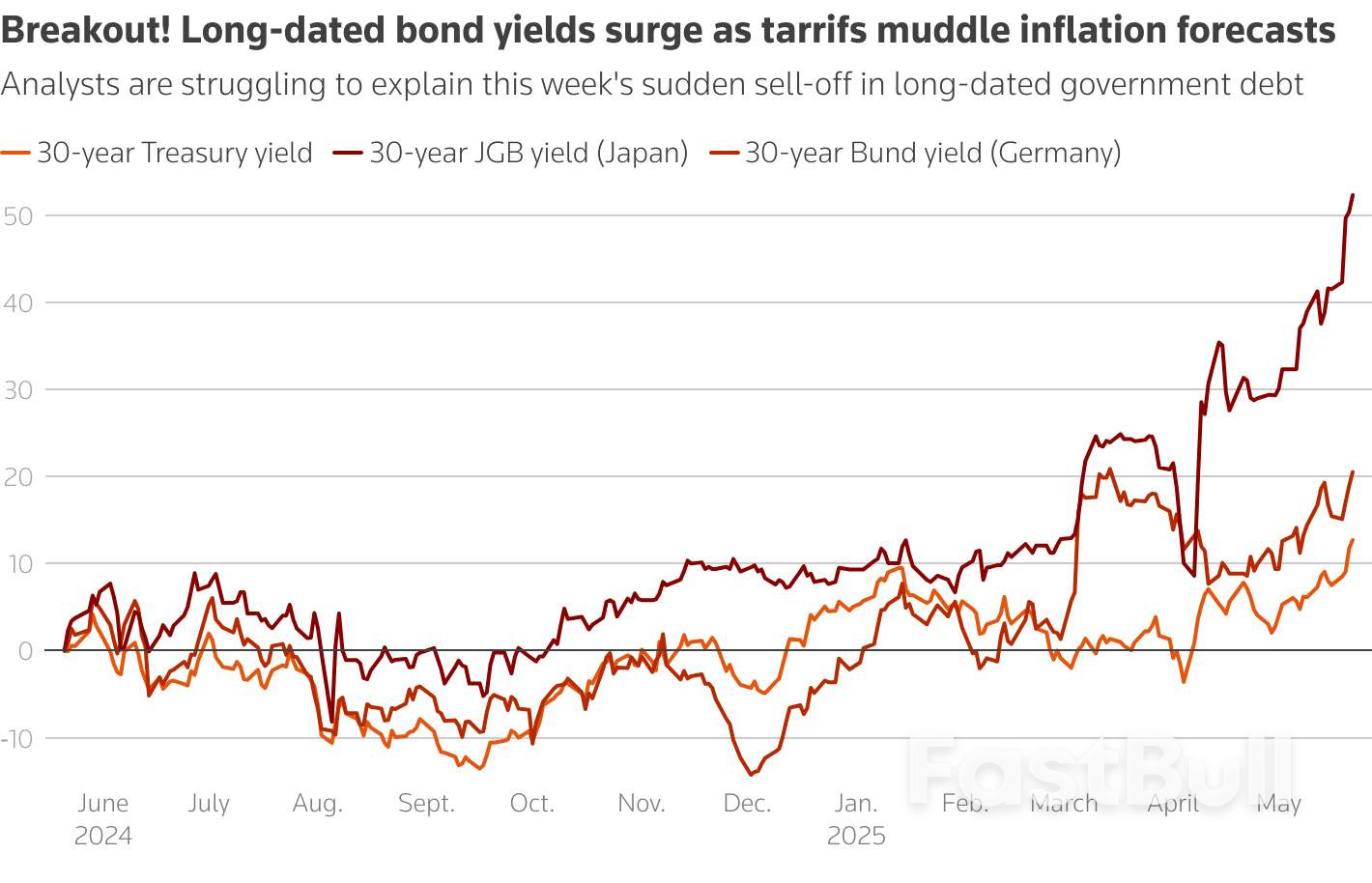
          Bond selloff rolls on as US House passes Trump's 'big beautiful' tax bill_1

          Analysts are struggling to explain this week's sudden sell-off in long-dated government debt as tariff uncertainty muddles inflation forecasts.

          TRADE DEAL PROGRESS

          Oil prices were down more than 1.5% following a report that countries in the OPEC+ group are discussing another sharp production increase for July.
          Brent futures fell $1, or 1.5%, to $63.98 a barrel in Europe, while U.S. West Texas Intermediate crude dropped 97 cents, or 1.58%, to $60.60.
          Modest progress to date on trade deals has also made investors nervous.
          Attention was also on a Group of Seven meeting in Canada, where finance ministers had put a positive spin on discussions to try to reach an agreement on a joint communique largely covering non-tariff issues.
          Investors have been looking for any hints that currency markets could be part of trade negotiations. But Thai and Japanese officials said currency markets were not part of their discussions.
          Bitcoin had no such worries. It climbed as high as $111,862.98, a new record peak and a 3.3% increase from Wednesday's close.
          It comes amid hopes that soon-to-be-finalised U.S. stablecoin regulation will continue to bring cryptoassets into the mainstream.
          "My official forecasts for Bitcoin are 120k end Q2, 200k end 2025 and 500k end 2028," Standard Chartered's Geoff Kendrick said.

          source : reuters

          To stay updated on all economic events of today, please check out our Economic calendar
          Risk Warnings and Disclaimers
          You understand and acknowledge that there is a high degree of risk involved in trading. Following any strategies or investment methods may lead to potential losses. The content on the site is provided by our contributors and analysts for information purposes only. You are solely responsible for determining whether any trading assets, securities, strategy, or any other product is suitable for investing based on your own investment objectives and financial situation.
          Add to Favorites
          Share
          FastBull
          Copyright © 2025 FastBull Ltd

          728 RM B 7/F GEE LOK IND BLDG NO 34 HUNG TO RD KWUN TONG KLN HONG KONG

          TelegramInstagramTwitterfacebooklinkedin
          App Store Google Play Google Play
          Products
          Charts

          Chats

          Q&A with Experts
          Screeners
          Economic Calendar
          Data
          Tools
          Membership
          Features
          Function
          Markets
          Copy Trading
          Latest Signals
          Contests
          News
          Analysis
          24/7
          Columns
          Education
          Company
          Careers
          About Us
          Contact Us
          Advertising
          Help Center
          Feedback
          User Agreement
          Privacy Policy
          Business

          White Label

          Data API

          Web Plug-ins

          Poster Maker

          Affiliate Program

          Risk Disclosure

          The risk of loss in trading financial instruments such as stocks, FX, commodities, futures, bonds, ETFs and crypto can be substantial. You may sustain a total loss of the funds that you deposit with your broker. Therefore, you should carefully consider whether such trading is suitable for you in light of your circumstances and financial resources.

          No decision to invest should be made without thoroughly conducting due diligence by yourself or consulting with your financial advisors. Our web content might not suit you since we don't know your financial conditions and investment needs. Our financial information might have latency or contain inaccuracy, so you should be fully responsible for any of your trading and investment decisions. The company will not be responsible for your capital loss.

          Without getting permission from the website, you are not allowed to copy the website's graphics, texts, or trademarks. Intellectual property rights in the content or data incorporated into this website belong to its providers and exchange merchants.

          Not Logged In

          Log in to access more features

          FastBull Membership

          Not yet

          Purchase

          Become a signal provider
          Help Center
          Customer Service
          Dark Mode
          Price Up/Down Colors

          Log In

          Sign Up

          Position
          Layout
          Fullscreen
          Default to Chart
          The chart page opens by default when you visit fastbull.com