• Trade
  • Markets
  • Copy
  • Contests
  • News
  • 24/7
  • Calendar
  • Q&A
  • Chats
Trending
Screeners
SYMBOL
LAST
BID
ASK
HIGH
LOW
NET CHG.
%CHG.
SPREAD
SPX
S&P 500 Index
6811.92
6811.92
6811.92
6861.30
6801.50
-15.49
-0.23%
--
DJI
Dow Jones Industrial Average
48336.77
48336.77
48336.77
48679.14
48285.67
-121.27
-0.25%
--
IXIC
NASDAQ Composite Index
23081.06
23081.06
23081.06
23345.56
23012.00
-114.10
-0.49%
--
USDX
US Dollar Index
97.980
98.060
97.980
98.070
97.740
+0.030
+ 0.03%
--
EURUSD
Euro / US Dollar
1.17422
1.17430
1.17422
1.17686
1.17262
+0.00028
+ 0.02%
--
GBPUSD
Pound Sterling / US Dollar
1.33644
1.33653
1.33644
1.34014
1.33546
-0.00063
-0.05%
--
XAUUSD
Gold / US Dollar
4303.31
4303.65
4303.31
4350.16
4285.08
+3.92
+ 0.09%
--
WTI
Light Sweet Crude Oil
56.347
56.377
56.347
57.601
56.233
-0.886
-1.55%
--

Community Accounts

Signal Accounts
--
Profit Accounts
--
Loss Accounts
--
View More

Become a signal provider

Sell trading signals to earn additional income

View More

Guide to Copy Trading

Get started with ease and confidence

View More

Signal Accounts for Members

All Signal Accounts

Best Return
  • Best Return
  • Best P/L
  • Best MDD
Past 1W
  • Past 1W
  • Past 1M
  • Past 1Y

All Contests

  • All
  • Trump Updates
  • Recommend
  • Stocks
  • Cryptocurrencies
  • Central Banks
  • Featured News
Top News Only
Share

USA State Department: Rubio Signs Status Of Forces Agreement With Paraguayan Foreign Minister

Share

New York Fed Accepts $2.601 Billion Of $2.601 Billion Submitted To Reverse Repo Facility On Dec 15

Share

Turkey: Shoots Down A Drone In The Black Sea Using F-16 Fighter Jets

Share

Goldman Sachs Says They Believe That The Copper Price Is Vulnerable To An Ai-Linked Price Correction

Share

Goldman Sachs Upgrades 2026 Copper Price Forecast To $11400 From $10,650

Share

Attempts By Ukrainian Troops To Advance From The South-West To Outskirts Of Kupiansk Are Being Thwarted

Share

Russian Troops Control All Of Kupiansk - IFX Cites Russian Military

Share

On Monday (December 15), The South Korean Won Ultimately Rose 0.60% Against The US Dollar, Closing At 1468.91 Won. The Won Was On An Upward Trend Throughout The Day, Rising Significantly At 17:00 Beijing Time And Reaching A Daily High Of 1463.04 Won At 17:36

Share

Health Ministry: Israeli Forces Kill Palestinian Teen In West Bank

Share

New York Federal Reserve President Williams: Over Time, The Size Of Reserves Could Grow From $2.9 Trillion

Share

New York Fed President Williams: AI Valuations Are High, But There Is A Real Driving Factor

Share

New York Federal Reserve President Williams: The Job Market Is In Very Good Shape

Share

New York Fed President Williams: 'Very Supportive' Of USA Central Bank's Decision To Cut Interest Rates Last Week

Share

New York Fed President Williams: 'Too Early To Say' What Central Bank Should Do At January Meeting

Share

New York Fed President Williams: Strong Markets Part Of Reason Why Economy Will Grow Robustly In 2026

Share

New York Fed President Williams: What Constitutes Ample Reserves Will Change Over Time

Share

New York Fed President Williams: Market Valuations 'Elevated,' But There Are Reasons For Pricing

Share

New York Fed President Williams: Ample Reserves System Working Very Well

Share

New York Fed President Williams: Some Signs That Parts Of Underlying Economy Not As Strong As GDP Data Suggests

Share

New York Fed President Williams: Expects Coming Job Data Will Show Gradual Cooling

TIME
ACT
FCST
PREV
Japan Tankan Small Manufacturing Outlook Index (Q4)

A:--

F: --

P: --

Japan Tankan Large Non-Manufacturing Outlook Index (Q4)

A:--

F: --

P: --

Japan Tankan Large Manufacturing Outlook Index (Q4)

A:--

F: --

P: --

Japan Tankan Small Manufacturing Diffusion Index (Q4)

A:--

F: --

P: --

Japan Tankan Large-Enterprise Capital Expenditure YoY (Q4)

A:--

F: --

P: --

U.K. Rightmove House Price Index YoY (Dec)

A:--

F: --

P: --

China, Mainland Industrial Output YoY (YTD) (Nov)

A:--

F: --

P: --

China, Mainland Urban Area Unemployment Rate (Nov)

A:--

F: --

P: --

Saudi Arabia CPI YoY (Nov)

A:--

F: --

P: --

Euro Zone Industrial Output YoY (Oct)

A:--

F: --

P: --

Euro Zone Industrial Output MoM (Oct)

A:--

F: --

P: --

Canada Existing Home Sales MoM (Nov)

A:--

F: --

P: --

Canada National Economic Confidence Index

A:--

F: --

P: --

Canada New Housing Starts (Nov)

A:--

F: --

P: --
U.S. NY Fed Manufacturing Employment Index (Dec)

A:--

F: --

P: --

U.S. NY Fed Manufacturing Index (Dec)

A:--

F: --

P: --

Canada Core CPI YoY (Nov)

A:--

F: --

P: --

Canada Manufacturing Unfilled Orders MoM (Oct)

A:--

F: --

P: --

U.S. NY Fed Manufacturing Prices Received Index (Dec)

A:--

F: --

P: --

U.S. NY Fed Manufacturing New Orders Index (Dec)

A:--

F: --

P: --

Canada Manufacturing New Orders MoM (Oct)

A:--

F: --

P: --

Canada Core CPI MoM (Nov)

A:--

F: --

P: --

Canada Trimmed CPI YoY (SA) (Nov)

A:--

F: --

P: --

Canada Manufacturing Inventory MoM (Oct)

A:--

F: --

P: --

Canada CPI YoY (Nov)

A:--

F: --

P: --

Canada CPI MoM (Nov)

A:--

F: --

P: --

Canada CPI YoY (SA) (Nov)

A:--

F: --

P: --

Canada Core CPI MoM (SA) (Nov)

A:--

F: --

P: --

Canada CPI MoM (SA) (Nov)

A:--

F: --

P: --

Federal Reserve Board Governor Milan delivered a speech
U.S. NAHB Housing Market Index (Dec)

A:--

F: --

P: --

Australia Composite PMI Prelim (Dec)

--

F: --

P: --

Australia Services PMI Prelim (Dec)

--

F: --

P: --

Australia Manufacturing PMI Prelim (Dec)

--

F: --

P: --

Japan Manufacturing PMI Prelim (SA) (Dec)

--

F: --

P: --

U.K. 3-Month ILO Employment Change (Oct)

--

F: --

P: --

U.K. Unemployment Claimant Count (Nov)

--

F: --

P: --

U.K. Unemployment Rate (Nov)

--

F: --

P: --

U.K. 3-Month ILO Unemployment Rate (Oct)

--

F: --

P: --

U.K. Average Weekly Earnings (3-Month Average, Including Bonuses) YoY (Oct)

--

F: --

P: --

U.K. Average Weekly Earnings (3-Month Average, Excluding Bonuses) YoY (Oct)

--

F: --

P: --

France Services PMI Prelim (Dec)

--

F: --

P: --

France Composite PMI Prelim (SA) (Dec)

--

F: --

P: --

France Manufacturing PMI Prelim (Dec)

--

F: --

P: --

Germany Services PMI Prelim (SA) (Dec)

--

F: --

P: --

Germany Manufacturing PMI Prelim (SA) (Dec)

--

F: --

P: --

Germany Composite PMI Prelim (SA) (Dec)

--

F: --

P: --

Euro Zone Composite PMI Prelim (SA) (Dec)

--

F: --

P: --

Euro Zone Services PMI Prelim (SA) (Dec)

--

F: --

P: --

Euro Zone Manufacturing PMI Prelim (SA) (Dec)

--

F: --

P: --

U.K. Services PMI Prelim (Dec)

--

F: --

P: --

U.K. Manufacturing PMI Prelim (Dec)

--

F: --

P: --

U.K. Composite PMI Prelim (Dec)

--

F: --

P: --

Euro Zone ZEW Economic Sentiment Index (Dec)

--

F: --

P: --

Germany ZEW Current Conditions Index (Dec)

--

F: --

P: --

Germany ZEW Economic Sentiment Index (Dec)

--

F: --

P: --

Euro Zone Trade Balance (Not SA) (Oct)

--

F: --

P: --

Euro Zone ZEW Current Conditions Index (Dec)

--

F: --

P: --

Euro Zone Trade Balance (SA) (Oct)

--

F: --

P: --

Euro Zone Total Reserve Assets (Nov)

--

F: --

P: --

U.K. Inflation Rate Expectations

--

F: --

P: --

Q&A with Experts
    • All
    • Chatrooms
    • Groups
    • Friends
    Connecting
    .
    .
    .
    Type here...
    Add Symbol or Code

      No matching data

      All
      Trump Updates
      Recommend
      Stocks
      Cryptocurrencies
      Central Banks
      Featured News
      • All
      • Russia-Ukraine Conflict
      • Middle East Flashpoint
      • All
      • Russia-Ukraine Conflict
      • Middle East Flashpoint
      Search
      Products

      Charts Free Forever

      Chats Q&A with Experts
      Screeners Economic Calendar Data Tools
      Membership Features
      Data Warehouse Market Trends Institutional Data Policy Rates Macro

      Market Trends

      Market Sentiment Order Book Forex Correlations

      Top Indicators

      Charts Free Forever
      Markets

      News

      News Analysis 24/7 Columns Education
      From Institutions From Analysts
      Topics Columnists

      Latest Views

      Latest Views

      Trending Topics

      Top Columnists

      Latest Update

      Signals

      Copy Rankings Latest Signals Become a signal provider AI Rating
      Contests
      Brokers

      Overview Brokers Assessment Rankings Regulators News Claims
      Broker listing Forex Brokers Comparison Tool Live Spread Comparison Scam
      Q&A Complaint Scam Alert Videos Tips to Detect Scam
      More

      Business
      Events
      Careers About Us Advertising Help Center

      White Label

      Data API

      Web Plug-ins

      Affiliate Program

      Awards Institution Evaluation IB Seminar Salon Event Exhibition
      Vietnam Thailand Singapore Dubai
      Fans Party Investment Sharing Session
      FastBull Summit BrokersView Expo
      Recent Searches
        Top Searches
          Markets
          News
          Analysis
          User
          24/7
          Economic Calendar
          Education
          Data
          • Names
          • Latest
          • Prev

          View All

          No data

          Scan to Download

          Faster Charts, Chat Faster!

          Download App
          English
          • English
          • Español
          • العربية
          • Bahasa Indonesia
          • Bahasa Melayu
          • Tiếng Việt
          • ภาษาไทย
          • Français
          • Italiano
          • Türkçe
          • Русский язык
          • 简中
          • 繁中
          Open Account
          Search
          Products
          Charts Free Forever
          Markets
          News
          Signals

          Copy Rankings Latest Signals Become a signal provider AI Rating
          Contests
          Brokers

          Overview Brokers Assessment Rankings Regulators News Claims
          Broker listing Forex Brokers Comparison Tool Live Spread Comparison Scam
          Q&A Complaint Scam Alert Videos Tips to Detect Scam
          More

          Business
          Events
          Careers About Us Advertising Help Center

          White Label

          Data API

          Web Plug-ins

          Affiliate Program

          Awards Institution Evaluation IB Seminar Salon Event Exhibition
          Vietnam Thailand Singapore Dubai
          Fans Party Investment Sharing Session
          FastBull Summit BrokersView Expo

          The Crypto Market's House of Cards

          Kevin Du
          Summary:

          Now we see a full-fledged exodus from the sector, and the entire crypto market is crumbling like a house of cards.

          Bitcoin collapsed 8.4% on Wednesday, ending the day at around $28.4K. Thursday's fall continued, sending the first cryptocurrency down 5% to $27K. Ethereum is down 24% in the last 24 hours, having rolled back to $1815. Other leading altcoins in the top 10 have fallen in price from 6% (Tron) to 37% (Solana).
          Total crypto market capitalisation, according to CoinMarketCap, fell 19.4% overnight to $1.14 trillion. Bitcoin's dominance index jumped 2.5 percentage points to 44.7% due to the altcoin sell-off.
          Bitcoin resumed its decline on Wednesday, but it outperformed the stock market with considerable amplitude this time. Perhaps even pulling it down. BTC broke through last July's lows and tested lows of late December 2020, just above $26.5K.
          Altcoins fell sharply on the back of Terra (LUNA), losing 96% in just one day on UST's (project's stable coin) drawdown. Despite its declared peg to the US dollar, the Terra ecosystem's algorithmic stablecoin, UST itself, continued to lose value on Wednesday. Worth $1 as recently as the beginning of the week, UST fell to $0.30. According to The Block, Luna Foundation Guard's (LFG) attempts to stabilise the UST stablecoin have failed.
          Now the attention of crypto market participants turns to confidence in stable coins. Tether is the most traded stablecoin with a daily turnover double that of Bitcoin and - 2% below the dollar as capital outflows continue to push it in one direction.
          Stablecoin's volatility is a new reality for the crypto market. Previously, investors preferred to park capital in stable currencies, exiting altcoins and withdrawing it from cryptocurrencies. Now we see a full-fledged exodus from the sector, and the entire crypto market is crumbling like a house of cards.
          Adding fuel to the fire, the US Federal Reserve has published its semi-annual Financial Stability Report, highlighting the risks of using stable coins. Democrats on the US Senate Banking Committee have proposed increased oversight of cryptocurrencies, including stable coins.
          According to CryptoQuant, hodlers have sold some of their bitcoins. Investors holding BTC for more than a year have been taking it to exchanges to sell over the past month.
          The CEO of cryptocurrency exchange Kraken, Jesse Powell, said he would like to see bitcoin fall to $20,000. He would allocate the lion's share of his capital to buying BTC in this case.

          Source: FxPro Financial Services Limited

          Risk Warnings and Disclaimers
          You understand and acknowledge that there is a high degree of risk involved in trading. Following any strategies or investment methods may lead to potential losses. The content on the site is provided by our contributors and analysts for information purposes only. You are solely responsible for determining whether any trading assets, securities, strategy, or any other product is suitable for investing based on your own investment objectives and financial situation.
          Comments
          Add to Favorites
          Share

          UAE Auctions $2.5 Billion in Federal Treasury Bonds as Investor Confidence Grows

          Devin
          The UAE's first auction of the dirham denominated federal treasury bonds under the government's T-Bond programme witnessed a strong demand through its six primary bank dealers, with bids received reaching a value of $2.55 billion (AED 9.4 billion).
          The T-Bond programme, which was oversubscribed by 6.3 times, saw strong demand spread across both tranches with a final allocation of $204 million (AED 750 million) for the two years tranche, and AED 750 million for the three years tranche, with a total issuance of $400 million (AED 1.5 billion).
          The UAE was represented by the Ministry of Finance (MoF) as the issuer, in collaboration with the Central Bank of the UAE (CBUAE) as the issuing and payment agent, the state-run news agency, Wam, reported.
          The Deputy Prime Minister, Minister of Presidential Affairs, and Chairman of the Board of Directors of the Central Bank of the UAE, Sheikh Mansour bin Zayed Al Nahyan, said: "The success of the first auction of the Federal T-bonds and the strong demand for them, which witnessed an oversubscription by 6.3 times, is an important milestone.
          "This reflects confidence in the UAE's economic and financial policies and its future development plans. It also reflects the UAE's position as an attractive hub for investment, its strong creditworthiness and economic and competitive capabilities at the global level."
          Sheikh Mansour bin Zayed added: "The Federal T- bond issuance constitutes a new phase in promoting the robust performance of the UAE's financial sector, providing safe and advanced dirham-denominated investment. It will achieve the objectives of the new Dirham Monetary Framework."
          UAE Auctions $2.5 Billion in Federal Treasury Bonds as Investor Confidence Grows_1The first auction will be followed by a series of subsequent periodic auctions, in line with the proposed 2022 issuance plan.

          The securities will be issued initially in two, three, and five-year tenures, followed by a 10-year bond at a later date.
          Sheikh Maktoum bin Mohammed bin Rashid Al Maktoum, the Deputy Ruler of Dubai, Deputy Prime Minister and Minister of Finance, said that the first auction's success is part of strengthening the UAE's economic competitiveness and supporting the sustainability of economic growth, as the UAE continues to solidify its position as one of the most competitive and advanced economies in the world.
          Sheikh Maktoum stressed that this success is reflected in the attractive market-driven prices which achieved a spread of 28 Basis Points (bps) over US Treasuries for two years, and a spread of 29 bps over the US Treasuries for 3 years, pointing that this successful first issuance is a milestone towards building a dirham denominated yield curve.
          UAE Auctions $2.5 Billion in Federal Treasury Bonds as Investor Confidence Grows_2He added that this will providing safe investment alternatives for investors, contribute to strengthening the local financial market, and develop the investment environment.
          Sheikh Maktoum also invited international investors to participate in the T-bonds issuance programme which is widely open for all eligible investors, and will soon be followed by a listing on Nasdaq Dubai to promote secondary market trading along with primary dealers.

          Source: Arabian Business

          Risk Warnings and Disclaimers
          You understand and acknowledge that there is a high degree of risk involved in trading. Following any strategies or investment methods may lead to potential losses. The content on the site is provided by our contributors and analysts for information purposes only. You are solely responsible for determining whether any trading assets, securities, strategy, or any other product is suitable for investing based on your own investment objectives and financial situation.
          Comments
          Add to Favorites
          Share

          Japan, China, South Korea 'On Guard Against Heightening Risks' to Regional Economic Outlook

          Owen Li
          Financial leaders from Japan, China and South Korea on Thursday warned of risks to Asia's economic recovery from the coronavirus pandemic and committed themselves to backing market stability and sound fiscal policy.
          Heightened risks included unexpectedly early rises in interest rates "in some advanced nations", accelerating inflation, and disruption from the war in Ukraine, finance ministers and central bank governors of the three countries said in a joint statement.
          The statement followed an annual meeting, held online, before the leaders were due to meet virtually with their counterparts from the Association of South East Asian Nations (Asean), also on Thursday.
          The Japanese, Chinese and South Korean officials affirmed their commitment to using support measures, which they did not specify, for maintaining financial market stability and long-term fiscal sustainability.
          "We must remain on guard against heightening risks to which the regional economic recovery is being exposed … on top of the ongoing Russia-Ukraine conflict and earlier-than-expected monetary policy normalisation in some advanced nations," it said.
          "These factors could become downside risks to the regional economic outlook, causing volatility to financial markets and capital flows."
          The statement made no mention of specific countries, but US interest rate rises and related reduction in central bank assets have driven up the US dollar.
          This has raised the prospect of capital flight from some emerging markets and a rising burden of dollar-denominated debt in the developing world.
          The officials also steered clear of references to currency market moves, notably rises in the US dollar and falls in the yen, or sanctions against Russia's invasion of Ukraine, which Moscow calls a "special operation."
          Instead, the officials underscored progress in regional initiatives, including a mechanism aimed at helping countries in times of financial distress, the Chiang Mai Initiative Multilateralisation currency swaps deal.
          A deep divide has emerged within the Group of 20 (G20) major economies, which includes Western nations that have accused Moscow of war crimes in Ukraine.
          Other members – China, Indonesia, India and South Africa – have not joined Western-led sanctions against Russia over the conflict.
          The 10-member Asean is chaired by Cambodia this year and includes Indonesia, which currently chairs the G20.
          Also on Thursday, China's central bank made stabilising economic growth a top priority and said that it will step up support for weak sectors, according to deputy governor Chen Yulu.
          The People's Bank of China (PBOC) has guided loan interest rates lower from an already low level, Chen said Thursday at a press briefing in Beijing. He reiterated the PBOC's pledge to use new policy tools to cushion the economy.
          "The PBOC will make stabilising growth a more prominent priority, strengthen cross-cyclical policy adjustment, and accelerate to implement policy measures already announced, especially to actively plan new policy tools," said Chen.
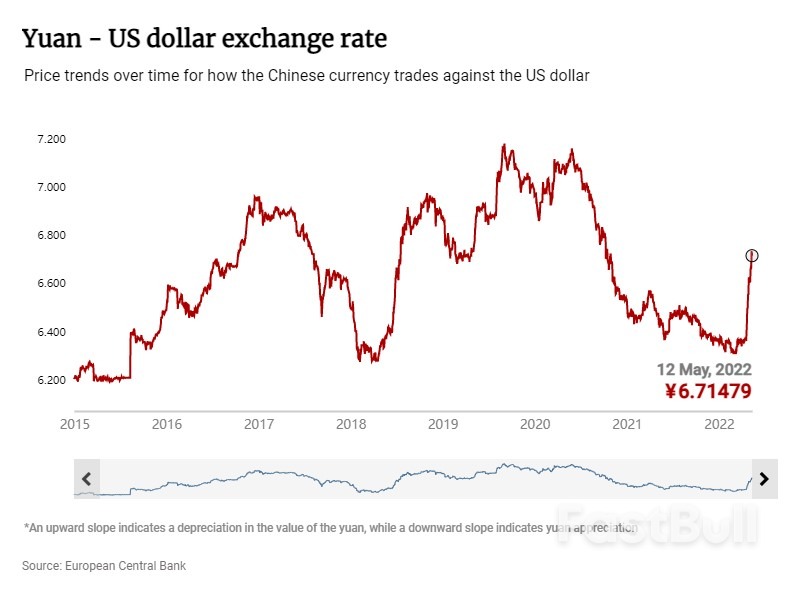
          Japan, China, South Korea 'On Guard Against Heightening Risks' to Regional Economic Outlook_1The yuan extended losses, falling as much as 0.6 per cent to a fresh low of 6.7630, after Chen's comments.
          The decline came even after the central bank set a stronger-than-expected fixing for a eighth straight session on Thursday. The yield on 10-year government bonds was little changed at 2.82 per cent.
          "We think the market is taking the PBOC's remark on guiding interest rates lower, to mean monetary easing will continue," said Irene Cheung, senior foreign exchange strategist at Australia & New Zealand Banking Group in Singapore.
          "By allowing the yuan to weaken since late April, we think the central bank may have included the currency as an easing tool."
          The central bank has taken relatively modest easing action in recent months despite the sharp slump in activity as the government locked down cities like Shanghai to contain virus outbreaks.
          The PBOC made a smaller-than-expected cut in the reserve requirement ratio (RRR) for banks last month and refrained from cutting policy interest rates.
          Even so, lending rates in the economy have come down. The weighted average interest rate for corporate loans was 4.4 per cent in the first quarter, down 0.21 percentage point from the end of 2021, the PBOC said in the monetary policy report published Monday.
          "The PBOC has stepped up the implementation of prudent monetary policy to help the macro economy stay stable," Chen said.
          "First, the pre-emptive RRR cut has kept liquidity reasonably ample. Second, we have guided interest rates in the loan markets to decline from an already low level, to reduce market entities' borrowing costs and stimulate financing demand."
          Chen said China will continue to work to resolve financial risks and avoid systemic financial risks.

          Source: China Macro Economy

          Risk Warnings and Disclaimers
          You understand and acknowledge that there is a high degree of risk involved in trading. Following any strategies or investment methods may lead to potential losses. The content on the site is provided by our contributors and analysts for information purposes only. You are solely responsible for determining whether any trading assets, securities, strategy, or any other product is suitable for investing based on your own investment objectives and financial situation.
          Comments
          Add to Favorites
          Share

          Asia Wobbles Post-US Inflation

          Devin
          US Inflation printed at 8.30% YoY overnight, less than the previous month's 8.50%, but slightly more than the 8.10% median forecast by markets. Equities vacillated after the data as the street tried to make up its mind whether to price in "peak-US-inflation," or not. In the end, the no's won the day as the realisation sunk in that the data reinforced the Federal Reserve's hawkish bias, and that even if US inflation is coming down now, it's going to do so at a snail's pace. That reality was reflected in the US yield curve, with 2-year yields firming, while 10 and 30-year yields fell once again. The pivot in the yield curve likely explains why currency markets were left in neutral, while equities indulged in their usual schizophrenic tail-chasing.
          Energy prices also ramped higher overnight, with oil climbing by around 6.0%. Trans-Ukraine gas pipeline disruptions are playing their part, as did an improvement in the covid situation in Shanghai, which is rapidly reopening. US crude inventories showed a surprise leap in crude stock by around 8.5 million barrels, but gasoline stocks slumped by over 3.60 million barrels, and distillates were flat. ​ The market remains incredibly tight for refined oil products in the US and if one adds in the 6 million barrels fall in US SPR stocks, crude inventories only rose by around 1.50 million barrels.
          The energy picture is further muddied today by the news that President Putin has announced sanctions on European energy companies that were previous JV partners with Gazprom and its ilk. Trans-Ukraine gas flows have slowed as well as Ukraine declares a force-majeure on in if its pipelines from Russia to Western Europe. I'm not sure what impact the Putin sanctions will have on European gas supplies, if any. But if Russia is messing with European gas supplies, and with an EU import ban on Russian oil in the works, you can be fairly certain that oil prices have limited downside. That is another inflationary headwind to the world and with grain disruptions from Ukraine and Russia, markets continue to under-price the Ukraine war's risks to the global economy this year. Hold off on buying Euros on the dip as well.
          That reality is grudgingly starting to permeate Asian markets. In a stagflationary environment, there are no good choices for central bankers and monetary policy. Keep rates low and watch inflation explode and your currency evaporates, hike rates and watch a sharp slowdown develop in economic activity. Singapore and South Korea have already started tightening although I believe the chances of an unscheduled move to tighten by Singapore's MAS are rising. India has also moved to hike rates and yesterday Bank Negara Malaysia also hiked by 0.25%. Philippine's GDP today leapt by 8.30% in Q1 YoY and will likely force the BSP to hike next week. Indonesia will not be far behind them in June. Philippine RPI and Indonesian Retail Sales later today could reinforce that premise.
          That will leave China and Japan as the last doves standing. Thankfully, both have benign inflation environments. Google Japan, deflation, 30-years for an explanation there. Markets tried to price in more China stimulus yesterday, lifting equities as Shanghai's reopening accelerates. But it has run out of steam today despite the noise around supporting the economy by the PBOC this morning. China's covid-zero policy will continue crimping growth, but it won't be immune from the Ukraine/Russia stagflationary wave either. Nor has China's property developer debt woes gone away, with news that major developer Sunac has missed a foreign currency bond payment, and statements suggesting it will struggle to meet future ones.
          Little surprise then that both the Japanese Yen and the Chinese Renminbi remain under pressure, with growth concerns and a widening US/Asia interest rate differential the key drivers. Interestingly, Asian currencies ex-Japan and China are also under the hammer today as well. It could be that financial markets are testing the resolve of Asia's central banks now, or it is part of a general de-risking across the globe by investors. Either way, with the US, expected to hike much faster than Asia, I expect the next six months to be torrid for local currencies, exacerbating imported inflation pressures.
          The United Kingdom releases the mother of all data dumps early this afternoon Asian time. It features GDP, Business Investment, Industrial Production, Construction, Trade Balance, and Manufacturing. You would have to say that all of that data has downside risks. Along with cost-of-living pressures prompting speculation of an emergency budget, the UK is also making its life even harder by once again making noises about suspending the Brexit Northern Ireland protocol. The EU has quite rightly said that it will suspend the entire agreement if that happens.
          You would think that with a war in Eastern Europe the UK government would leave Northern Ireland for another day, but this BoJo is not for turning. Little wonder with that smorgasbord of risk outlined above that Sterling slumped overnight, even as Euro remained relatively calm. Sterling may be oversold on short-term indicators, but data and politics could subsume that. GBP/USD is wobbling at 1.2215 this morning and I would not be surprised to see a 1.1900 handle on it by the end of the week.
          This evening, the US releases its PPI data for April and weekly Initial Jobless Claims. The impact should be limited now that inflation data has been released. We will have the usual plethora of Fed speakers to shake up volatility intraday, but I expect to see attempts to reprice inflation/recession/tightening/geopolitics continue to dominate proceedings. Sitting on the sidelines with a bag of cash and some earplugs in is my preferred strategy.
          Finally, I am continuing to monitor the crypto-space. Bitcoin closed below $30,000.00 overnight, sinking 6.50% overnight, and falling another 6.30% to $27,150.00 this morning. My chart picture is calling for a fall to the $17,000.00 region and Bitcoin would need to close above $33,000.00 to give pause for thought. Only a close above $38,000.00 would signal the downside danger has passed. The rot has spread from the turmoil in the (un)stable coin space. If the one-to-one pegs on the US Dollar backed instead of algorithmic (un)stable coins crack, things are going to get ugly fast and may lead to cross-margining selling in other asset classes. Off course, the main (un)stable coin issuers could release to the public view, incontrovertible proof that they hold a US Dollar for every coin they've issued, in real-time. Just asking for a friend. Otherwise, crypto markets may find themselves at the end of their tether.

          Asian equities follow Wall Street lower

          Asian equities markets are mostly lower today after Wall Street tumbled once again after US inflation data reinforced the Fed tightening path. Admittedly, it took Wall Street some time to come to that conclusion, but the day finished with the S7P 500 down 1.65%, the Nasdaq tumbling by 3.18%, and the Dow Jones losing 1.01%. In Asia, some bottom-fishing had pushed futures on all three a little higher initially, but they have since fallen by -0.20% for the session.
          In Asia, markets are almost all in the red. The exception, once again, is Mainland China where the Shanghai Composite has edged 0.25% high, while the CSI 300 is just 0.10% higher. Although there has been more noise around the room for more stimulus in China, I suspect that China's "national team" is "smoothing" again. I suspect they were busy yesterday as well. Take the rally with a huge grain of salt. With Sunac missing a foreign currency bond payment, Hong Kong is probably a more realistic reflection of China's actual performance today. The Hang Seng is down by 1.90%.
          Elsewhere, Japan's Nikkei 225 has dropped by 1.70%, with South Korea's Kospi 1.05% lower, and Taipei slumping by 1.80%. Singapore is down 0.75%, with Kuala Lumpur up 0.05% with a BNM rate hike out of the way. Jakarta has tumbled by 2.10%, with Bangkok losing 1.0%, and Manila down 0.45%. Australian markets are also deeply in the red, the All ordinaries retreating by 1.80%, and the ASX 200 falling by 1.80%.
          With Ukraine gas pipeline disruptions, Putin sanctions on European energy companies, and the poor performance by the US and Asian markets today, we can reasonably assume that European equity markets will open lower. Once again, I must reiterate, that any threats to European gas flows from Russia are very negative for European equities.
          US markets are a complete turkey shoot and at the mercy of swinging intra-day sentiment and Fed-speak hitting the wires. It wouldn't surprise me if the rear guard buy-the-dippers managed to generate a dead-cat bounce. You can pick and choose your pricing inputs this week in deciding how equities have done what they have done, but I believe that the underlying reason is that the reality of global stagflation and wars is where all roads are leading to.

          Asian currencies falter

          The dollar index had another choppy range overnight but ultimately closed nearly unchanged once again as the G-10 currency space was content to watch from the sidelines. Recessions fears being offset by lower US yields. The dollar index closed slightly higher at 104.00. Although the index has support at 103.50, it is struggling to make a material close above 104.00, although it has moved higher to 104.07 in Asia. A daily close above 104.00 will signal rapid gains to 105.00 and in the bigger picture, the technical picture still says a multi-month rally to above 120.00 is possible. Support lies at 103.50 and 102.50.
          Most of the activity today in Asia has been in the regional currency space and USD/Asia is sharply higher. With cryptos and equities falling heavily Asian currencies seems to be suffering as part of a generalised risk-aversion wave. USD/KRW has jumped 0.80% to 1289.50, with USD/TWD and USD/PHP rising by 0.55%, and USD/INR, USD/MYR, USD/SGD, and USD/IDR between 0.25% and 0.35% higher.
          Asian FX weakness is being exacerbated by the fall of both the onshore and offshore Chinese Yuan today. USD/CNH has risen 0.555 to 6.8000, and USD/CNY by 0.65% to 6.7650. Their next target is the 6.8500 region. Until the PBOC signals that Yuan depreciation has gone far enough, Asian currencies will remain under pressure, and I fully expect to see a few regional central banks in the market selling US Dollars today.
          EUR/USD is treading water at 1.0510 this morning having failed ahead of 1.0600 overnight. Any negative developments around Russian natural gas exports today are likely to spur another wave of selling, testing support at 1.0450. Notably, despite ECB officials overnight signalling rate hikes soon, EUR/USD finished lower than its open overnight. GBP/USD has fallen 0.30% to 1.2210 this morning and faces plenty of downside risk on Northern Ireland developments, emergency budgets, or poor data this afternoon. Rallies should be limited to 1.2400 with 1.2000 a real possibility in the next 36 hours.
          USD/JPY has finally eased slightly to 129.70 as long-dated US yields fell again overnight. Short-dated US yields are rock solid though, limiting USD/JPY downside. ​ Overall, the US/Japan rate differential and technical picture suggest further USD/JPY appreciation is a matter of when, and not if.
          AUD/USD and NZD/USD both gave up intraday gains overnight a sentiment turned sour in New York. The general risk aversion selloff sweeping Asia today has punished both currencies. AUD/USD has fallen through support at 0.7000 on its way to 0.6880, and NZD/USD dropped through 0.6400 on its way to 0.6240 in Asia. The 1.0% losses have left both oversold on short-term technical measures, but unless risk sentiment swings abruptly higher for some reason, both still look like sells on rallies, caught in a US rate hike, China slowdown, pincer move.

          Oil markets remain volatile

          Oil prices spiked overnight, led by a combination of Shanghai reopening, potential gas supply disruption through Ukraine, Russian sanctions on EU energy entities and a plunge in gasoline inventories in the US. Brent crude rose 5.90% to $107.50, and WTI leapt 6.60% higher to $105.50 a barrel. In Asia, the risk aversion selling sweeping other asset classes in Asia today has pushed oil prices slightly lower. Brent crude fell 1.20% to $106.25, and WTI fell 1.10% to $104.40 a barrel.
          With tensions seemingly ratcheting higher after Russia sanctioned ex-Gazprom JVs in Europe, along with reduced trans-Ukraine pipeline flows, there is limited downside for oil prices in the near term. The continuing squeeze on US gasoline, diesel and other distillates is another supportive factor.
          Brent crude has formed a nice trendline support going back to January 2022 at $101.50, while WTI has formed the same pattern at 98.50 a barrel. Resistance remains at $114.75 and $111.50 a barrel respectively. Failure of the respective $101.50 and $98.50 trendline supports is likely to provoke a much stronger test of $100.00 for Brent, and $95.00 for WTI this time around. Eastern European tensions mean this is not my base case, however. I am sticking to my broader calls for the past two months. Brent crude remaining between $100.00 to $120.00, and WTI between $95.00 and $115.00 a barrel.

          Gold survives another day

          Gold probed the downside overnight, testing support in the $1835.00 an ounce region, before rallying to a 0.75% gain, closing at $1852.00 an ounce as US yields fell and risk-hedging flows appeared. In Asia gold is relatively quiet compared to the volatility seen in other asset classes today. It has edged 0.17% lower to $1848.20 an ounce.
          Gold's support critical near-term support remains the triangle apex at $1835.00, the breakout of which in early February, signalled the gold rally to $2060.00 an ounce. Its importance is confirmed by the nearby 200-day moving average (DMA), today at $1836.00 an ounce. A daily close under $1835.00 would be an ominous technical development.
          Failure of $1835.00 sets up a test of support at $1820.00 and then potentially $1780.00 an ounce. Failure of the latter suggests a deeper correction to $1700.00. Gold has resistance at $1860.00 and $1884.00 an ounce, its 100-day moving average.
          If the risk-aversion selloff sweeping other asset classes, notably cryptos, accelerates, gold does stand to benefit. Especially is haven buyers also pile into US bond markets, pushing the US yield curve lower.

          Source: MarketPulse

          Risk Warnings and Disclaimers
          You understand and acknowledge that there is a high degree of risk involved in trading. Following any strategies or investment methods may lead to potential losses. The content on the site is provided by our contributors and analysts for information purposes only. You are solely responsible for determining whether any trading assets, securities, strategy, or any other product is suitable for investing based on your own investment objectives and financial situation.
          Comments
          Add to Favorites
          Share

          Yen Rebounding Further on Risk Aversion and Falling Yields

          Owen Li
          US 10-year yield is back below 2.9% handle in Asian session while Germany 10-year bund yield also broke 1% yesterday. Euro and Dollar are still relatively firm on risk-off sentiment. On the other hand, selloff continues to concentrate on Aussie and Kiwi, with Sterling picking up too.
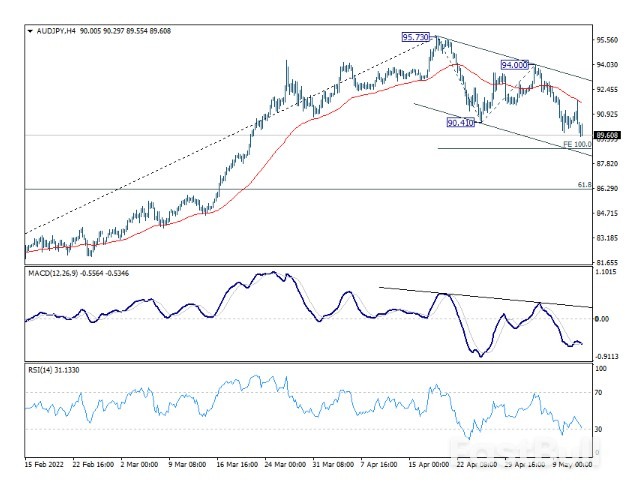
          Technically, AUD/JPY resumed the decline from 95.73 after rejection by 4 hour 55 EMA. Further fall is expected to 100% projection of 95.73 to 90.41 from 94.00 at 88.68. Strong support is expected there to contain downside to complete this "corrective" move, and bring rebound. However, firm break of 88.68, with downside acceleration, would raise the chance that AUD/JPY is already in trend reversal. Such development, if happens, could be a signal to broader risk market developments.
          Yen Rebounding Further on Risk Aversion and Falling Yields_1

          Fed Bullard: We can proceed on a plan of 50bps per meeting

          In a Yahoo Finance interview, St. Louis Fed President James Bullard said that a 75bps rate hike is "not my base case", and he gave a nod to the 50bps per meeting plan.
          "We've got a good plan in place and the committee is, based on public comments anyway from my colleagues, has coalesced around a plan of 50 basis points per meeting. So I think we can proceed on that," he said.
          Bullard added that whether there would be 50bps hike at each of the upcoming meeting, to bring interest rate to 3.5% by year end, would be data-dependent. "It's possible inflation could moderate a lot. It's possible the real economy could take twists and turns. And so I don't think we want to be promising today what we're going to do in December," he said.

          Fed Bostic: We are going to get our policy rate certainly to a neutral space

          Atlanta Fed President Raphael Bostic said yesterday, "we are going to get our policy rate certainly to a neutral space where we are no longer providing accommodation. If inflation stays at high levels or levels that are too high — by too high, it's really not moving back towards our 2% target — then I am going to be supporting moving more."
          "We moved our policy rate 25 basis points and the 30 year (mortgage) moved 2 percentage points. That is tremendous responsiveness," Bostic also noted. "The moves that we have seen in rates and in yields are a sign that the markets still believe the Fed has credibility. They have said what we are going to do and they have priced in us doing them … That is an important dimension in the marketplace."

          BoJ: Necessary to continue with current powerful monetary easing

          In the Summary of Opinions of the April 27-28 meeting, BoJ noted that "as Japan is a commodity importer, the rise in commodity prices leads to an outflow of income from Japan and thus exerts downward pressure on the economy." And, "it is necessary for the Bank to continue with the current powerful monetary easing and thereby firmly support the economy"
          One opinion noted that "one reason for the yen's recent depreciation is that economic conditions in Japan have been different from those in the United States and Europe, and it is not appropriate that the Bank change its policy with the aim of controlling foreign exchange rates."
          "With a view to clarifying the Bank's stance to date of not accepting the long-term interest rate exceeding 0.25 percent and to avoiding a situation where daily operations are unnecessarily factored in by the market, it is appropriate for the Bank to announce in advance that it will conduct fixed-rate purchase operations at 0.25 percent every business day, unless it is highly likely that no bids will be submitted."

          Looking ahead

          UK will release GDP, productions and trade balance in European session. Swiss will release PPI. Later in the day, US will publish PPI and jobless claims.

          GBP/JPY Daily Outlook

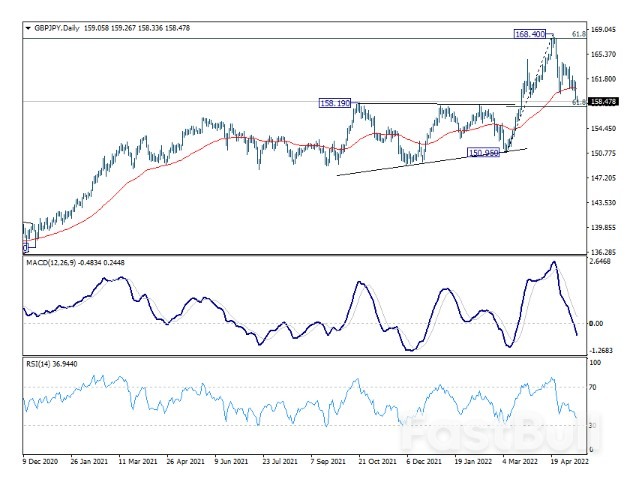
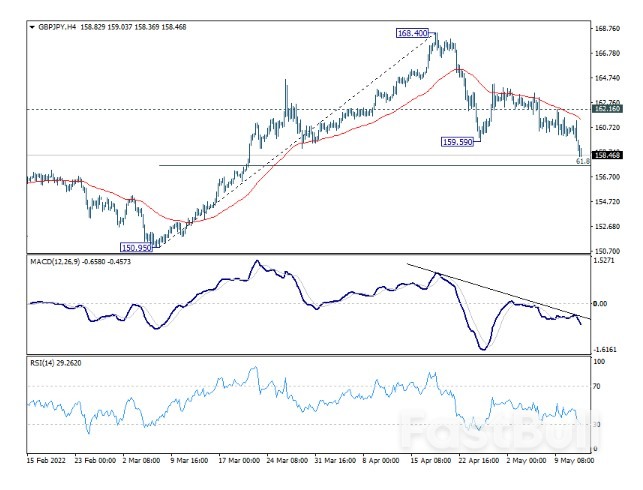
          GBP/JPY's fall from 168.50 resumed by breaking through 159.59 and intraday bias is back on the downside. Current fall should be seen to 61.8% retracement of 150.95 to 168.40 at 157.61. Strong support is expected there to complete the correction to bring rebound. On the upside, above 162.16 minor resistance will turn bias back to the upside for retesting 168.40 high. However, sustained break of 157.61 will bring deeper fall back to 150.95 key structural support.Yen Rebounding Further on Risk Aversion and Falling Yields_2
          In the bigger picture, up trend from 123.94 (2020 low) is still in progress. Sustained break of 61.8% retracement of 195.86 (2015 high) to 122.75 (2016 low) at 167.93 will be a long term bullish signal, and could pave the way back to 195.86 high. This will now remain the favored case as long as 150.95 support holds, even in case of deep pull back.Yen Rebounding Further on Risk Aversion and Falling Yields_3

          Source: ActionForex

          Risk Warnings and Disclaimers
          You understand and acknowledge that there is a high degree of risk involved in trading. Following any strategies or investment methods may lead to potential losses. The content on the site is provided by our contributors and analysts for information purposes only. You are solely responsible for determining whether any trading assets, securities, strategy, or any other product is suitable for investing based on your own investment objectives and financial situation.
          Comments
          Add to Favorites
          Share

          Underlying Price Pressure in The U.S. Remains Too High

          Owen Li
          Commodity prices seems to have stabilised at a high level (although intraday volatility remains high) but labour market imbalances and high inflations expectations mean there are still upside risks to underlying inflation pressure. Despite oil prices have stabilised, gasoline prices remain high (higher crack spread). Freight rates are declining but still high but may be seasonal.
          Fed tightening together with risk of recession are downside risks down the road. However, future developments in Ukraine as well as EU policies towards Russia are important driver for commodity prices.

          Inflation expectations

          Market-based long-term inflation expectations have moved slightly lower recently but remain high. US household inflation expectations are still high, especially near-term. Euro area inflation expectations are also higher than previously.

          U.S.

          CPI inflation in April was 8.3% y/y, which was above consensus. CPI inflation has peaked, as base effects from last year is now dropping out. Still, underlying price increases remain too high, as one should focus on monthly price increases.
          CPI core rose 0.6% m/m, which is equivalent to 7% annualised. This means that inflation is likely to remain high despite the peak, which means that the Fed still needs to front-load rate hikes. Inflation expectations remain high but have not increased significantly over the past month.

          Euro

          Despite energy price inflation slowing down after commodity prices have stabilized, headline inflation reached another new record high of 7.5% in April, with core inflation surprising significantly on the upside at 3.5%.
          The continued building of underlying inflation pressures leaves little room for complacency from ECB, especially as inflation expectations (both survey and market-based) are showing signs of moving above the 2% goal recently.
          Further upside risks loom for food prices in the coming months and tentative signs of wage growth picking up also strengthen the case for a July ECB hike. With the possibility of further disruptions to Russian gas and oil supply looming as the EU readies another sanctions package, the risks to euro inflation remain firmly on the upside in our view.

          China

          PPI inflation has declined to 8.0% in April after peaking at 13.5% in October last year. There is still a limited spill-over from PPI to CPI, which was 2.1% in April.

          Source: Danske Bank A/S

          Risk Warnings and Disclaimers
          You understand and acknowledge that there is a high degree of risk involved in trading. Following any strategies or investment methods may lead to potential losses. The content on the site is provided by our contributors and analysts for information purposes only. You are solely responsible for determining whether any trading assets, securities, strategy, or any other product is suitable for investing based on your own investment objectives and financial situation.
          Comments
          Add to Favorites
          Share

          Oil Slips More Than 1%, Dogged by Recession Fears

          Damon
          Oil prices dropped more than 1% on Thursday (May 12) in a volatile week as economic concerns and recession fears dogged global financial markets, outweighing supply concerns and geopolitical tensions in Europe.
          Brent crude futures had slipped US$1.25, or 1.2%, to US$106.26 (about RM466.11) a barrel by 0303 GMT. West Texas Intermediate (WTI) crude futures fell US$1.24, or 1.2%, to US$104.47 a barrel.
          Oil prices are under pressure this week, along with global financial markets, on jitters over rising interest rates, the strongest US dollar in two decades, concerns over inflation and possible recession. Prolonged Covid-19 lockdowns in the world's top crude importer China have also impacted the market.
          "Those recession concerns are drumming louder and taking oil lower this morning (Thursday)," said Howie Lee, an economist at Singapore's Oversea Chinese Banking Corp (OCBC), pointing to strong US Consumer Price Index (CPI) data on Wednesday.
          The US headline CPI for the 12 months to April jumped 8.3%, reaffirming concerns that interest rates will need to rise quickly to tame it.
          However, supply concerns stemming from Russia's invasion of Ukraine have bolstered the market, with prices rising over 35% so far this year. A pending European Union (EU) ban on oil from Russia, a key EU supplier of crude and fuels, that could further tighten global supplies is underpinning prices.
          The EU is still haggling over the details of the Russian embargo. The vote needs unanimous support, but it has been delayed as Hungary opposes the ban because it would be too disruptive to its economy.
          On Wednesday, oil prices jumped 5% after Russia sanctioned 31 companies based in countries that imposed sanctions on Moscow after the Ukraine invasion.
          That created unease in the market at the same time that Russian natural gas flows to Europe via Ukraine fell by a quarter. It was the first time exports via Ukraine had been disrupted since the invasion.
          Price gains have been limited by worries about demand destruction in China as it attempts to curb the spread of the coronavirus.
          "Until we see some significant policy support coming through in China or policymakers adopt an alternative strategy to Covid-19 (which seems very unlikely), oil prices could remain capped near term," said Stephen Innes, a managing partner at SPI Asset Management.
          In the US, commercial crude inventories rose last week because of a record release of oil from the US strategic reserves, but gasoline stockpiles declined ahead of the peak summer driving demand season, the Energy Information Administration said on Wednesday.

          Source: Reuters

          Risk Warnings and Disclaimers
          You understand and acknowledge that there is a high degree of risk involved in trading. Following any strategies or investment methods may lead to potential losses. The content on the site is provided by our contributors and analysts for information purposes only. You are solely responsible for determining whether any trading assets, securities, strategy, or any other product is suitable for investing based on your own investment objectives and financial situation.
          Comments
          Add to Favorites
          Share
          FastBull
          Copyright © 2025 FastBull Ltd

          728 RM B 7/F GEE LOK IND BLDG NO 34 HUNG TO RD KWUN TONG KLN HONG KONG

          TelegramInstagramTwitterfacebooklinkedin
          App Store Google Play Google Play
          Products
          Charts

          Chats

          Q&A with Experts
          Screeners
          Economic Calendar
          Data
          Tools
          Membership
          Features
          Function
          Markets
          Copy Trading
          Latest Signals
          Contests
          News
          Analysis
          24/7
          Columns
          Education
          Company
          Careers
          About Us
          Contact Us
          Advertising
          Help Center
          Feedback
          User Agreement
          Privacy Policy
          Business

          White Label

          Data API

          Web Plug-ins

          Poster Maker

          Affiliate Program

          Risk Disclosure

          The risk of loss in trading financial instruments such as stocks, FX, commodities, futures, bonds, ETFs and crypto can be substantial. You may sustain a total loss of the funds that you deposit with your broker. Therefore, you should carefully consider whether such trading is suitable for you in light of your circumstances and financial resources.

          No decision to invest should be made without thoroughly conducting due diligence by yourself or consulting with your financial advisors. Our web content might not suit you since we don't know your financial conditions and investment needs. Our financial information might have latency or contain inaccuracy, so you should be fully responsible for any of your trading and investment decisions. The company will not be responsible for your capital loss.

          Without getting permission from the website, you are not allowed to copy the website's graphics, texts, or trademarks. Intellectual property rights in the content or data incorporated into this website belong to its providers and exchange merchants.

          Not Logged In

          Log in to access more features

          FastBull Membership

          Not yet

          Purchase

          Become a signal provider
          Help Center
          Customer Service
          Dark Mode
          Price Up/Down Colors

          Log In

          Sign Up

          Position
          Layout
          Fullscreen
          Default to Chart
          The chart page opens by default when you visit fastbull.com