• Trade
  • Markets
  • Copy
  • Contests
  • News
  • 24/7
  • Calendar
  • Q&A
  • Chats
Trending
Screeners
SYMBOL
LAST
BID
ASK
HIGH
LOW
NET CHG.
%CHG.
SPREAD
SPX
S&P 500 Index
6857.13
6857.13
6857.13
6865.94
6827.13
+7.41
+ 0.11%
--
DJI
Dow Jones Industrial Average
47850.93
47850.93
47850.93
48049.72
47692.96
-31.96
-0.07%
--
IXIC
NASDAQ Composite Index
23505.13
23505.13
23505.13
23528.53
23372.33
+51.04
+ 0.22%
--
USDX
US Dollar Index
98.850
98.930
98.850
98.980
98.850
-0.130
-0.13%
--
EURUSD
Euro / US Dollar
1.16571
1.16579
1.16571
1.16577
1.16408
+0.00126
+ 0.11%
--
GBPUSD
Pound Sterling / US Dollar
1.33437
1.33447
1.33437
1.33448
1.33165
+0.00166
+ 0.12%
--
XAUUSD
Gold / US Dollar
4219.60
4220.01
4219.60
4221.12
4194.54
+12.43
+ 0.30%
--
WTI
Light Sweet Crude Oil
59.281
59.318
59.281
59.469
59.187
-0.102
-0.17%
--

Community Accounts

Signal Accounts
--
Profit Accounts
--
Loss Accounts
--
View More

Become a signal provider

Sell trading signals to earn additional income

View More

Guide to Copy Trading

Get started with ease and confidence

View More

Signal Accounts for Members

All Signal Accounts

Best Return
  • Best Return
  • Best P/L
  • Best MDD
Past 1W
  • Past 1W
  • Past 1M
  • Past 1Y

All Contests

  • All
  • Trump Updates
  • Recommend
  • Stocks
  • Cryptocurrencies
  • Central Banks
  • Featured News
Top News Only
Share

[Market Update] Spot Silver Broke Through $58/ounce, Up 1.56% On The Day

Share

Dollar/Yen Down 0.33% To 154.61

Share

Kremlin Says No Plans For Putin-Trump Call For Now

Share

Kremlin Says Moscow Is Waiting For USA Reaction After Putin-Witkoff Meeting

Share

Cctv - China, France: Say Both Sides Support All Efforts For A Ceasefire, Restore Peace According To Intl Law

Share

[Chinese Ambassador To The US Xie Feng Hopes Chinese And American Business Communities Will Focus On Three Lists] On December 4, Chinese Ambassador To The US Xie Feng Delivered A Speech At The China-US Economic And Trade Cooperation Forum Jointly Hosted By The China Council For The Promotion Of International Trade And The Meridian International Center. Xie Feng Said That In November 2026, China Will Host The APEC Leaders' Informal Meeting For The Third Time In Shenzhen, Guangdong Province. In December 2026, The United States Will Also Host The G20 Meeting. Regarding How Chinese And American Business Communities Can Seize These Opportunities, He Suggested Focusing On Three Lists: First, Continue To Expand The Dialogue List; Second, Continuously Lengthen The Cooperation List; And Third, Constantly Reduce The Problem List

Share

India's Nifty Financial Services Index Extends Gains, Last Up 0.75%

Share

Eni : Jp Morgan Cuts To Underweight From Overweight

Share

Cctv - China, France: Signed Protocol On Sanitary, Phytosanitary Requirements For Export Of French Alfalfa Grass

Share

India's NIFTY IT Index Last Up 1.3%

Share

India's Nifty 50 Index Rises 0.35%

Share

Israel Sets 2026 Defence Budget At $34 Billion

Share

Russia Says Azov Sea's Port Of Temryuk Damaged In Ukrainian Attack

Share

Israel's Defense Budget For 2026 Will Be 112 Billion Israeli Shekels - Defense Minister Office

Share

One India Rate Panel Member Ram Singh Was Of View That Stance Should Be Changed To 'Accommodative' From 'Neutral' - Monetary Policy Committee Statement

Share

Reserve Bank Of India Chief: Will Continue To Meet Productive Needs Of Economy In Proactive Manner

Share

Reserve Bank Of India Chief: System Level Financial Parameters Of Nbfcs Sound

Share

Reserve Bank Of India Chief: Dollar Rupee Swap To Be For 3 Years, To Be Conducted This Month

Share

India's Nifty Realty Index Extend Gains, Last Up 1.4%

Share

India's Nifty Psu Bank Index Rises 1%

TIME
ACT
FCST
PREV
Turkey Trade Balance

A:--

F: --

P: --

Germany Construction PMI (SA) (Nov)

A:--

F: --

P: --

Euro Zone IHS Markit Construction PMI (Nov)

A:--

F: --

P: --

Italy IHS Markit Construction PMI (Nov)

A:--

F: --

P: --

U.K. Markit/CIPS Construction PMI (Nov)

A:--

F: --

P: --

France 10-Year OAT Auction Avg. Yield

A:--

F: --

P: --

Euro Zone Retail Sales MoM (Oct)

A:--

F: --

P: --

Euro Zone Retail Sales YoY (Oct)

A:--

F: --

P: --

Brazil GDP YoY (Q3)

A:--

F: --

P: --

U.S. Challenger Job Cuts (Nov)

A:--

F: --

P: --

U.S. Challenger Job Cuts MoM (Nov)

A:--

F: --

P: --

U.S. Challenger Job Cuts YoY (Nov)

A:--

F: --

P: --

U.S. Initial Jobless Claims 4-Week Avg. (SA)

A:--

F: --

P: --

U.S. Weekly Initial Jobless Claims (SA)

A:--

F: --

P: --

U.S. Weekly Continued Jobless Claims (SA)

A:--

F: --

P: --

Canada Ivey PMI (SA) (Nov)

A:--

F: --

P: --

Canada Ivey PMI (Not SA) (Nov)

A:--

F: --

P: --

U.S. Non-Defense Capital Durable Goods Orders Revised MoM (Excl. Aircraft) (SA) (Sept)

A:--

F: --

P: --
U.S. Factory Orders MoM (Excl. Transport) (Sept)

A:--

F: --

P: --

U.S. Factory Orders MoM (Sept)

A:--

F: --

P: --

U.S. Factory Orders MoM (Excl. Defense) (Sept)

A:--

F: --

P: --

U.S. EIA Weekly Natural Gas Stocks Change

A:--

F: --

P: --

Saudi Arabia Crude Oil Production

A:--

F: --

P: --

U.S. Weekly Treasuries Held by Foreign Central Banks

A:--

F: --

P: --

Japan Foreign Exchange Reserves (Nov)

A:--

F: --

P: --

India Repo Rate

A:--

F: --

P: --

India Benchmark Interest Rate

A:--

F: --

P: --

India Reverse Repo Rate

A:--

F: --

P: --

India Cash Reserve Ratio

A:--

F: --

P: --

Japan Leading Indicators Prelim (Oct)

A:--

F: --

P: --

U.K. Halifax House Price Index YoY (SA) (Nov)

--

F: --

P: --

U.K. Halifax House Price Index MoM (SA) (Nov)

--

F: --

P: --

France Current Account (Not SA) (Oct)

--

F: --

P: --

France Trade Balance (SA) (Oct)

--

F: --

P: --

France Industrial Output MoM (SA) (Oct)

--

F: --

P: --

Italy Retail Sales MoM (SA) (Oct)

--

F: --

P: --

Euro Zone Employment YoY (SA) (Q3)

--

F: --

P: --

Euro Zone GDP Final YoY (Q3)

--

F: --

P: --

Euro Zone GDP Final QoQ (Q3)

--

F: --

P: --

Euro Zone Employment Final QoQ (SA) (Q3)

--

F: --

P: --

Euro Zone Employment Final (SA) (Q3)

--

F: --

P: --
Brazil PPI MoM (Oct)

--

F: --

P: --

Mexico Consumer Confidence Index (Nov)

--

F: --

P: --

Canada Unemployment Rate (SA) (Nov)

--

F: --

P: --

Canada Labor Force Participation Rate (SA) (Nov)

--

F: --

P: --

Canada Employment (SA) (Nov)

--

F: --

P: --

Canada Part-Time Employment (SA) (Nov)

--

F: --

P: --

Canada Full-time Employment (SA) (Nov)

--

F: --

P: --

U.S. Dallas Fed PCE Price Index YoY (Sept)

--

F: --

P: --

U.S. PCE Price Index YoY (SA) (Sept)

--

F: --

P: --

U.S. PCE Price Index MoM (Sept)

--

F: --

P: --

U.S. Personal Outlays MoM (SA) (Sept)

--

F: --

P: --

U.S. Core PCE Price Index MoM (Sept)

--

F: --

P: --

U.S. UMich 5-Year-Ahead Inflation Expectations Prelim YoY (Dec)

--

F: --

P: --

U.S. Core PCE Price Index YoY (Sept)

--

F: --

P: --

U.S. 5-10 Year-Ahead Inflation Expectations (Dec)

--

F: --

P: --

U.S. UMich Current Economic Conditions Index Prelim (Dec)

--

F: --

P: --

U.S. UMich Consumer Sentiment Index Prelim (Dec)

--

F: --

P: --

U.S. UMich 1-Year-Ahead Inflation Expectations Prelim (Dec)

--

F: --

P: --

U.S. UMich Consumer Expectations Index Prelim (Dec)

--

F: --

P: --

Q&A with Experts
    • All
    • Chatrooms
    • Groups
    • Friends
    Connecting
    .
    .
    .
    Type here...
    Add Symbol or Code

      No matching data

      All
      Trump Updates
      Recommend
      Stocks
      Cryptocurrencies
      Central Banks
      Featured News
      • All
      • Russia-Ukraine Conflict
      • Middle East Flashpoint
      • All
      • Russia-Ukraine Conflict
      • Middle East Flashpoint
      Search
      Products

      Charts Free Forever

      Chats Q&A with Experts
      Screeners Economic Calendar Data Tools
      Membership Features
      Data Warehouse Market Trends Institutional Data Policy Rates Macro

      Market Trends

      Market Sentiment Order Book Forex Correlations

      Top Indicators

      Charts Free Forever
      Markets

      News

      News Analysis 24/7 Columns Education
      From Institutions From Analysts
      Topics Columnists

      Latest Views

      Latest Views

      Trending Topics

      Top Columnists

      Latest Update

      Signals

      Copy Rankings Latest Signals Become a signal provider AI Rating
      Contests
      Brokers

      Overview Brokers Assessment Rankings Regulators News Claims
      Broker listing Forex Brokers Comparison Tool Live Spread Comparison Scam
      Q&A Complaint Scam Alert Videos Tips to Detect Scam
      More

      Business
      Events
      Careers About Us Advertising Help Center

      White Label

      Data API

      Web Plug-ins

      Affiliate Program

      Awards Institution Evaluation IB Seminar Salon Event Exhibition
      Vietnam Thailand Singapore Dubai
      Fans Party Investment Sharing Session
      FastBull Summit BrokersView Expo
      Recent Searches
        Top Searches
          Markets
          News
          Analysis
          User
          24/7
          Economic Calendar
          Education
          Data
          • Names
          • Latest
          • Prev

          View All

          No data

          Scan to Download

          Faster Charts, Chat Faster!

          Download App
          English
          • English
          • Español
          • العربية
          • Bahasa Indonesia
          • Bahasa Melayu
          • Tiếng Việt
          • ภาษาไทย
          • Français
          • Italiano
          • Türkçe
          • Русский язык
          • 简中
          • 繁中
          Open Account
          Search
          Products
          Charts Free Forever
          Markets
          News
          Signals

          Copy Rankings Latest Signals Become a signal provider AI Rating
          Contests
          Brokers

          Overview Brokers Assessment Rankings Regulators News Claims
          Broker listing Forex Brokers Comparison Tool Live Spread Comparison Scam
          Q&A Complaint Scam Alert Videos Tips to Detect Scam
          More

          Business
          Events
          Careers About Us Advertising Help Center

          White Label

          Data API

          Web Plug-ins

          Affiliate Program

          Awards Institution Evaluation IB Seminar Salon Event Exhibition
          Vietnam Thailand Singapore Dubai
          Fans Party Investment Sharing Session
          FastBull Summit BrokersView Expo

          Thailand Raises Airport Tax for International Flights to Fund Major Infrastructure Expansion

          Gerik

          Economic

          Summary:

          Thailand will increase its Passenger Service Charge (PSC) for international departures from six major airports in 2026, raising the fee from 730 baht to 1,120 baht per passenger to support airport infrastructure upgrades...

          Thailand Approves Significant Increase in Airport Departure Tax

          On December 4, Thai Deputy Prime Minister and Transport Minister Phiphat Ratchakitprakarn announced that the Civil Aviation Authority of Thailand (CAAT) had approved a notable hike in the Passenger Service Charge (PSC), commonly referred to as the airport tax, for international travelers departing from six airports managed by Airports of Thailand (AOT).
          Starting in early 2026, the PSC for international flights will rise from 730 baht (approximately 23 USD) to 1,120 baht (roughly 35 USD) per person. The new fee will apply to passengers flying out of Suvarnabhumi (BKK), Don Mueang (DMK), Chiang Mai (CNX), Mae Fah Luang–Chiang Rai (CEI), Phuket (HKT), and Hat Yai (HDY) airports.

          Revenue Growth Linked to Infrastructure Investment

          AOT projects that this fee increase, applied to the average 35 million international passengers who pass through these six airports annually, will generate an additional 10 billion baht (approximately 285 million USD) in revenue per year.
          This move is not just a fiscal adjustment but reflects a direct causal relationship between funding needs and long-term infrastructure development goals. The additional funds will be earmarked primarily for service improvement and capacity expansion efforts, particularly the construction of the new South Terminal at Suvarnabhumi Airport.
          As Thailand positions itself to accommodate growing travel demand in the post-pandemic era, the fee adjustment serves a dual function: it responds to increased operational and infrastructure demands while ensuring service quality keeps pace with international standards.

          Implications for Travelers and the Tourism Economy

          While the increased charge may raise concerns among travelers and airlines, the government justifies the hike as necessary for maintaining the competitiveness and efficiency of Thailand’s aviation infrastructure. The additional costs for passengers represent a strategic trade-off—slightly higher travel expenses in exchange for enhanced airport services, reduced congestion, and improved overall passenger experience.
          Given that Thailand's tourism sector remains a cornerstone of the national economy, and international air travel plays a central role in its recovery trajectory, the balance between fee hikes and infrastructure quality will be critical. The new PSC structure reflects a broader shift in the funding model for public infrastructure, where user contributions are expected to finance major development projects.

          User-Funded Modernization in Thai Aviation

          Thailand’s decision to raise the airport tax for international flights is a calculated move to channel consistent revenue into critical infrastructure upgrades. With airport traffic expected to continue its upward trend, particularly in gateway cities like Bangkok and Phuket, the additional income will support long-term improvements in capacity and service quality.
          This marks a shift toward a user-pays model in Thai aviation policy—where international travelers, rather than taxpayers or government subsidies, will directly fund the next generation of airport infrastructure. Whether this strategy succeeds in boosting capacity without dampening tourism demand will be revealed as implementation begins in 2026.
          To stay updated on all economic events of today, please check out our Economic calendar
          Risk Warnings and Disclaimers
          You understand and acknowledge that there is a high degree of risk involved in trading. Following any strategies or investment methods may lead to potential losses. The content on the site is provided by our contributors and analysts for information purposes only. You are solely responsible for determining whether any trading assets, securities, strategy, or any other product is suitable for investing based on your own investment objectives and financial situation.
          Add to Favorites
          Share

          Putin Visits Delhi As Russia And India Seek to Increase And Diversify Trade

          Michelle

          Political

          Economic

          Russian President Vladimir Putin arrived in New Delhi on Thursday to start a two-day state visit, and India and Russia both said they want to boost mutual trade and expand the variety of items in transactions.

          Indian Prime Minister Narendra Modi received Putin at the airport in Delhi, a rare gesture underlining the warm ties between the two countries and the leaders.

          They embraced on the red carpet after Putin walked down from the aircraft and then drove away in the same vehicle.

          Modi is hosting Putin for a private dinner on Thursday and the two will hold summit talks on Friday. Senior Russian ministers and a large Russian business delegation are in New Delhi for Putin's visit.

          INDIA SEEKS NEW MARKETS AFTER TRUMP TARIFFS

          India and Russia aim to raise two-way trade to $100 billion by 2030. Their commerce rose more than five-fold from about $13 billion in 2021 to near $69 billion in 2024–25, almost entirely driven by Indian energy imports.

          Bilateral trade eased to $28.25 billion in April–August 2025, reflecting a decline in crude oil imports following punitive tariffs on Indian goods and sanctions imposed by U.S. President Donald Trump's administration.

          At the same time, India is looking for new destinations to increase exports of its goods hit by a punishing 50% tariff imposed by Trump, half of that over India buying Russian oil, which Washington says helps finance Moscow's war in Ukraine.

          Russia wants to import more Indian goods to balance bilateral trade, which is currently heavily skewed towards energy, Deputy Kremlin Chief of Staff Maxim Oreshkin told a business conference in New Delhi.

          "The Russian delegation and business representatives have arrived with a very specific goal ... We have come for Indian goods and services. We want to significantly increase their purchases," Oreshkin said.

          "This is not a momentary story, but a strategic choice in developing relations" between the two countries, he said, adding that India's share in Russian imports does not exceed 2%.

          DEMAND FOR INDIAN SHRIMP

          Indian Trade Minister Piyush Goyal said New Delhi wants to diversify exports to Russia and increase sales of automobiles, electronics goods, data-processing equipment, heavy machinery, industrial components, textiles, and foodstuffs.

          "Russia has a huge demand for a wide range of industrial goods, consumer products, presenting multiple untapped opportunities for Indian businesses," Goyal told the conference.

          "We need to bring more diversity in our trade basket. We need to make it more balanced between Russia and India. We need to add more variety," he said.

          Russian Agriculture Minister Oksana Lut said Russia was prepared to increase imports of shrimp, rice, and tropical fruits from India. She mentioned that Russian firms were also interested in Indian food-processing equipment.

          India is the world's largest exporter of shrimp, and Lut noted that it was possible to increase India's share in Russian imports of shrimp, currently at 20%.

          India was the biggest supplier of shrimp to the U.S. but Trump's tariffs have badly hit exports, causing a decline in shipments and forcing companies to seek alternative markets.

          Source: Reuters

          To stay updated on all economic events of today, please check out our Economic calendar
          Risk Warnings and Disclaimers
          You understand and acknowledge that there is a high degree of risk involved in trading. Following any strategies or investment methods may lead to potential losses. The content on the site is provided by our contributors and analysts for information purposes only. You are solely responsible for determining whether any trading assets, securities, strategy, or any other product is suitable for investing based on your own investment objectives and financial situation.
          Add to Favorites
          Share

          Oil News: WTI Straddles $59.23 Pivot as Ukraine Strikes Lift Crude Oil Futures

          Adam

          Commodity

          Light Crude Holds the Line at $59.23 as Traders Test Key Levels

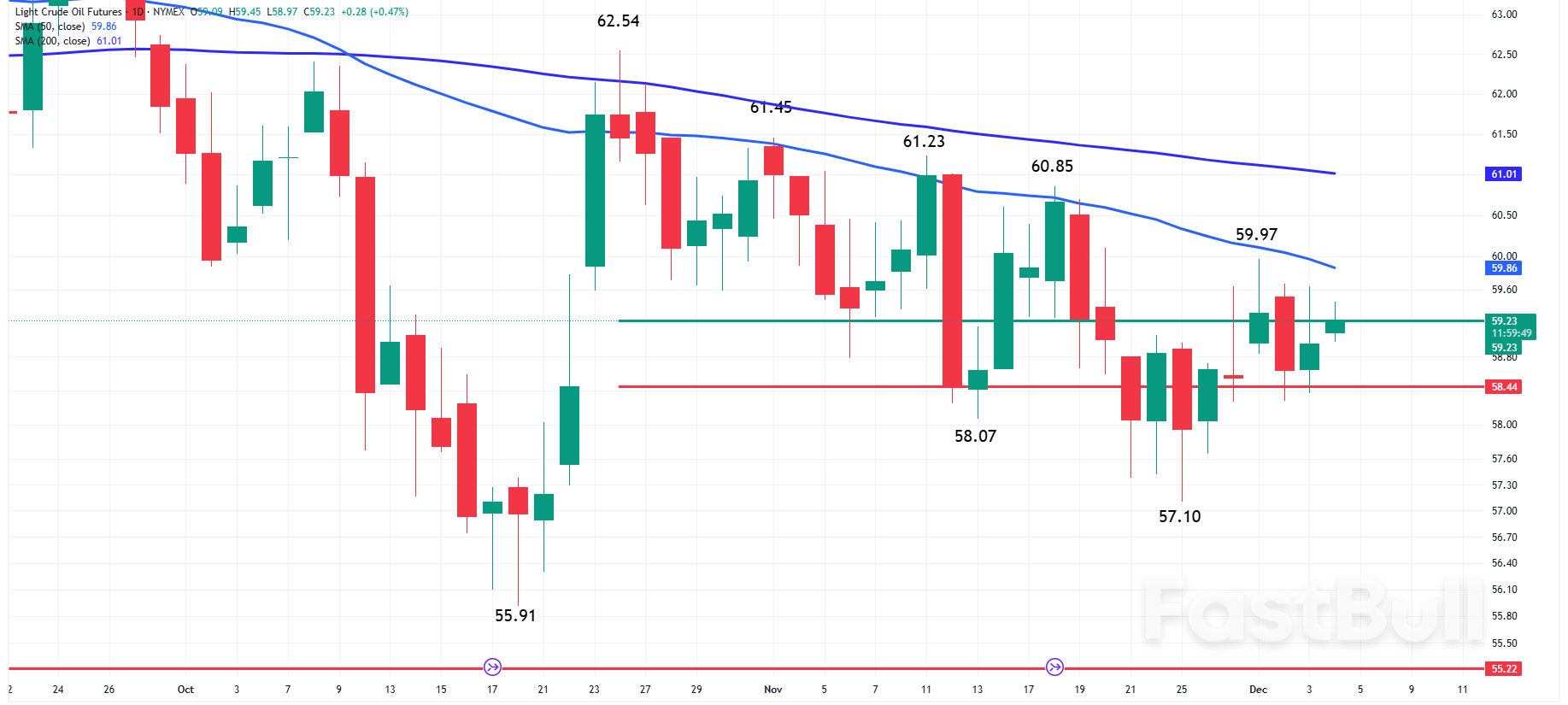
          Oil News: WTI Straddles $59.23 Pivot as Ukraine Strikes Lift Crude Oil Futures_1Daily Light Crude Oil Futures

          Light crude futures ticked higher Thursday with traders leaning on the 50% retracement at $59.23, the top of the short-term zone that extends down to $58.44. Bids around $59.23 are holding for now, and the market is trying to firm up after several sessions of back-and-forth trade.
          At 10:30 GMT, Light Crude Futures are trading $59.19, up $0.24 or +0.41%.
          A steady hold above $59.23 keeps a slight upside bias alive and puts the 50-day moving average at $59.86 back in focus. That indicator has stopped every rally since late October, making it the first real test for anyone looking to press the long side. A clean break would shift attention to the 200-day moving average at $61.01, which remains the next major marker on traders’ charts.
          On the downside, slipping back under $59.23 would expose the 61.8% retracement at $58.44. Buyers will need to show up there to keep the current upside setup intact. If they don’t, the path opens toward the recent swing low at $57.10—the last area where value buyers stepped in.

          Ukraine Strike Adds Fresh Supply Risk in Crude Oil News Today

          Geopolitical risk returned to the front end of the curve after Ukraine hit Russia’s Druzhba pipeline in the Tambov region—the fifth strike on that system supplying Hungary and Slovakia. Operators reported flows were still running, but the repeated hits were enough to nudge crude higher in early trade.
          Kpler noted that Ukraine’s drone operations on Russian refining assets have shifted into repeated cycles aimed at keeping key facilities offline. Russian refining throughput dropped to about 5 million barrels per day from September through November, down 335,000 bpd year-on-year. Gasoline output has taken the biggest hit, with gasoil also materially softer.

          Do Stalled Peace Talks Change the Oil Prices Forecast?

          Talks between U.S. representatives and the Kremlin produced no progress, with President Donald Trump saying there’s no clear path forward. Traders previously priced in the possibility that a deal could ease sanctions and push more Russian barrels onto an already heavy market. With no breakthrough, that pressure has faded, helping crude stabilize.

          Oil Prices Projections Face a Weigh from Fitch

          Fitch Ratings cut its 2025–2027 oil price assumptions, citing continued oversupply and production growth expected to run ahead of demand. The downgrade underscores the broader fundamental drag still hanging over the market.

          Market Forecast: Mild Bullish Bias While $59.23 Holds

          The short-term view leans bullish as long as futures stay above $59.23. A move through the 50-day moving average would confirm momentum. A break under $58.44 would undo the setup and shift control back to sellers.

          Source: fxempire

          Risk Warnings and Disclaimers
          You understand and acknowledge that there is a high degree of risk involved in trading. Following any strategies or investment methods may lead to potential losses. The content on the site is provided by our contributors and analysts for information purposes only. You are solely responsible for determining whether any trading assets, securities, strategy, or any other product is suitable for investing based on your own investment objectives and financial situation.
          Add to Favorites
          Share

          Natural Gas Export Growth Raises Demand Expectations for 2026

          Adam

          Commodity

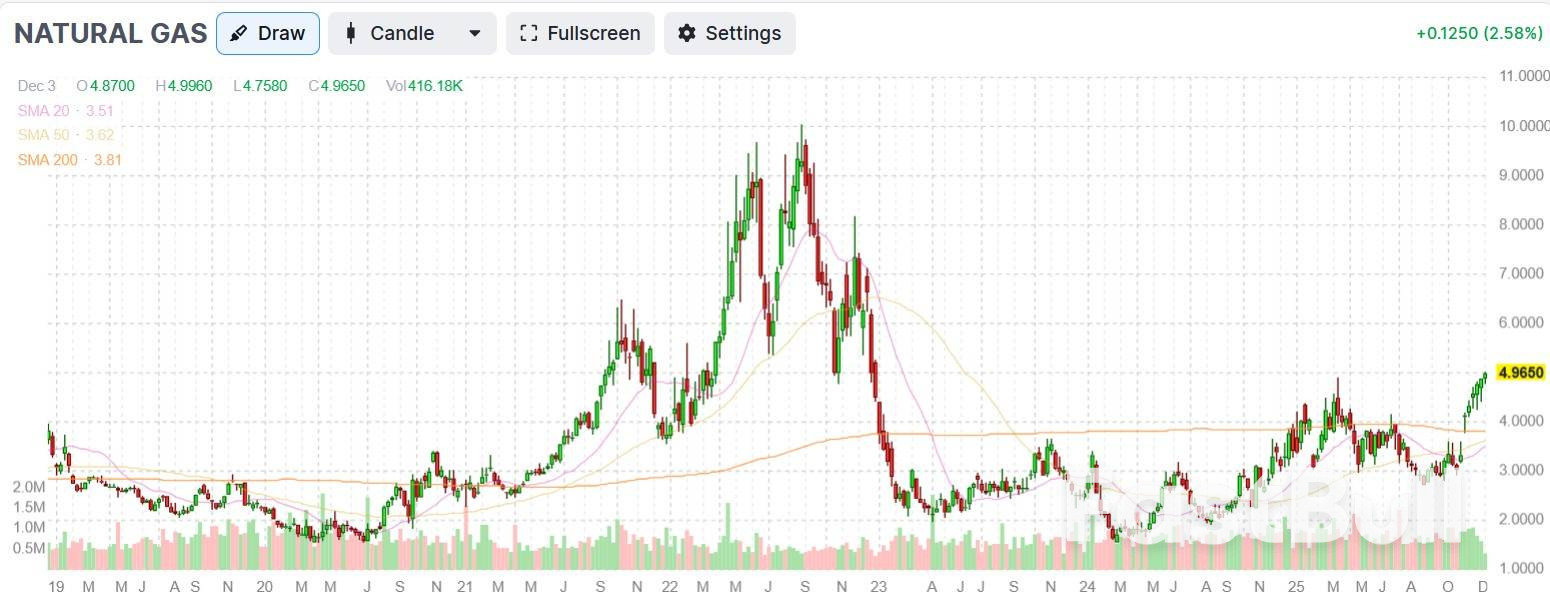
          As we share below, courtesy of FinViz, natural gas prices have risen by over 50% since late October. Moreover, natural gas prices, approaching $5, are at three-year highs. The primary cause of the recent price surge is increased heating demand driven by colder-than-expected winter weather, which is resulting in greater-than-average inventory draws.
          Per the EIA, natural gas stocks are projected to tighten significantly heading into 2026, despite starting the season above five-year averages. Weather is the primary driver of fluctuations in natural gas demand and prices, but increasingly, the buildout of energy-intensive data centers and liquefied natural gas (LNG) facilities is setting a rising floor under natural gas prices.
          While demand is amplified by the massive growth of power-intensive data centers, which investors well know, it’s also worth noting the sharp increase in demand from liquefied natural gas exports. According to the Energy Information Administration’s (EIA) November 2025 Short-Term Energy Outlook (STEO), LNG exports are projected to average 14.9 billion cubic feet per day (Bcf/d) in 2025, a 25% increase from 2024 levels.
          Furthermore, they expect it to increase further to 16.3 Bcf/d in 2026 (up 10% from 2025). While weather trends remain the predominant short-term driver of natural gas prices, LNG exports and increased data center usage will boost demand, likely keeping a slowly increasing floor under natural gas prices.
          Natural Gas Export Growth Raises Demand Expectations for 2026_1

          What To Watch Today

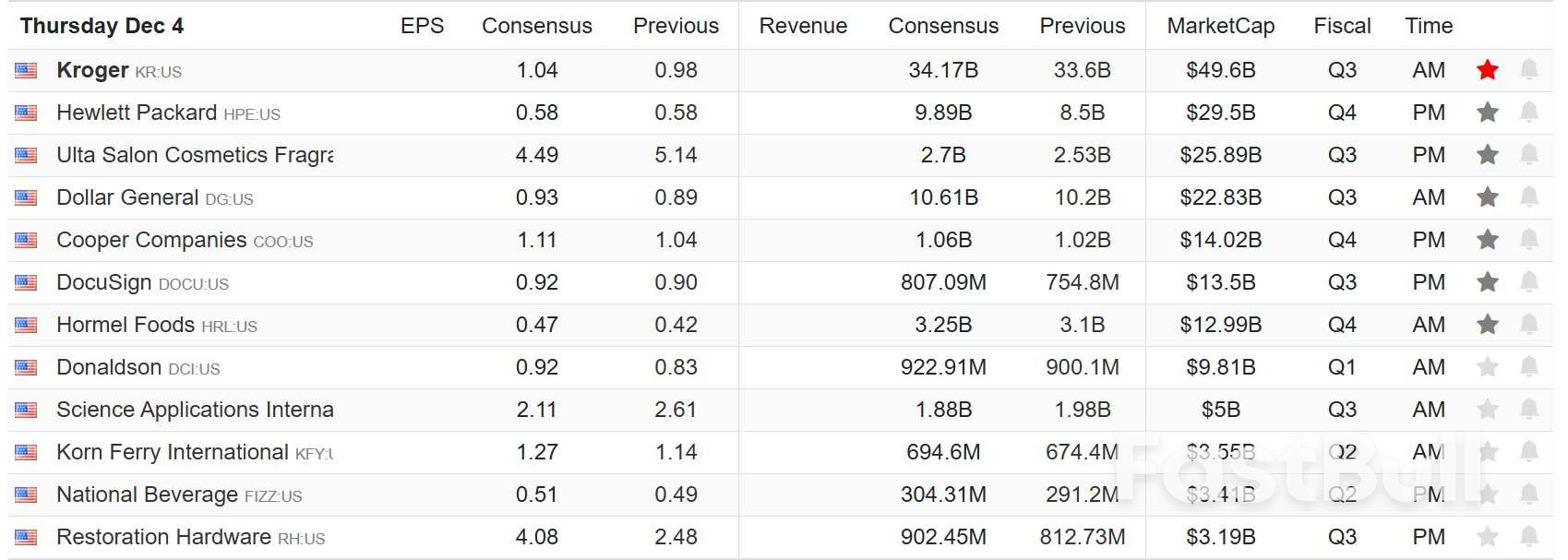
          Earnings
          Natural Gas Export Growth Raises Demand Expectations for 2026_2
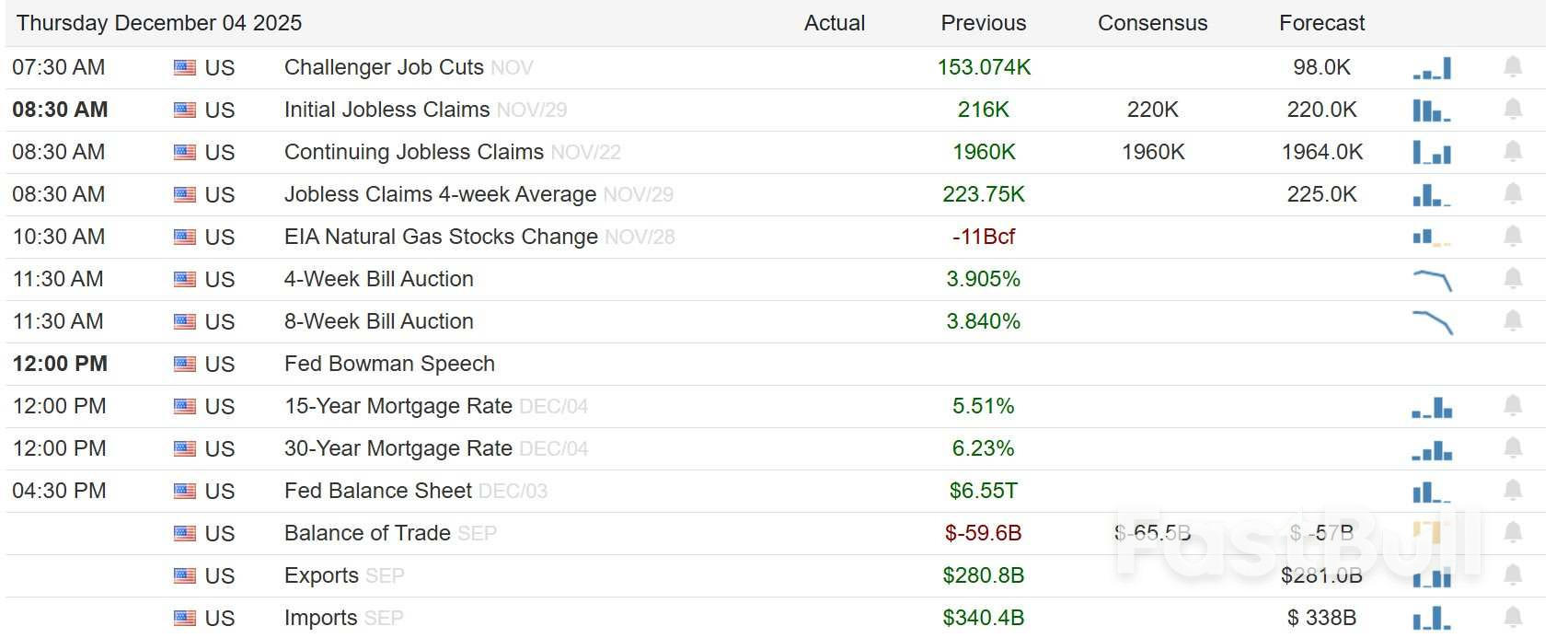
          Economy
          Natural Gas Export Growth Raises Demand Expectations for 2026_3

          The ADP Report Warrants A Fed Cut

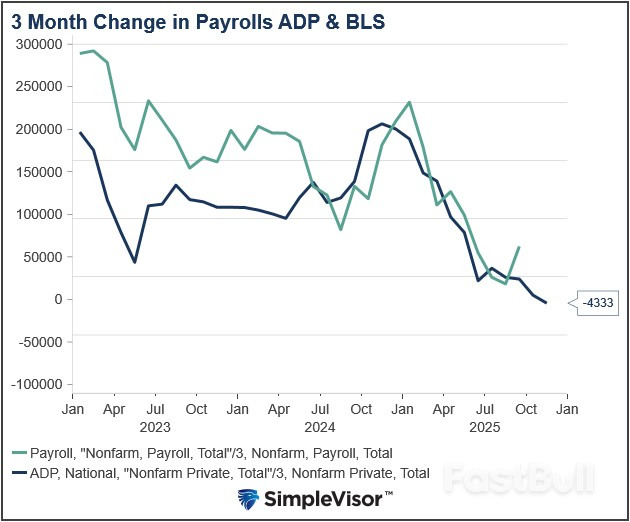
          The monthly ADP jobs report released yesterday showed continued deterioration in the labor market. ADP reported the economy lost 37k jobs. The Wall Street consensus was for a 10k pickup. The graph below shows that the three-month average for ADP is now negative for the first time since the early days of the Pandemic. BLS jobs data is delayed due to the government shutdown.
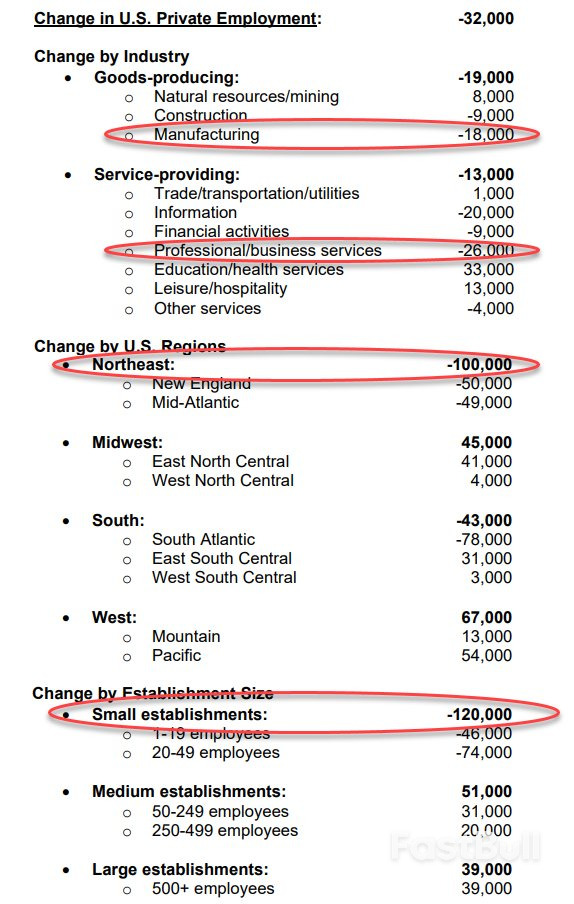
          Notably, the ADP monthly report shows that the Northeast region lost 100k jobs, and the small-business sector reduced its workforce by 120k. The second graphic below, courtesy of ZeroHedge, highlights other factors impacting the aggregate number of job losses.
          The Fed Funds market is now pricing in a 90% chance the Fed cuts at next week’s meeting. Without BLS data and updated inflation data, the weakness seen in the ADP report and other private-sector reports will likely be enough to secure a majority in favor of cutting rates. The jobs data may also warrant a couple of FOMC members to vote for a 50bps rate cut. Currently, the Fed Funds futures market assigns a zero probability of a 50bps cut.

          Market Trading Update

          Natural Gas Export Growth Raises Demand Expectations for 2026_4Natural Gas Export Growth Raises Demand Expectations for 2026_5

          Tweet of the Day

          Natural Gas Export Growth Raises Demand Expectations for 2026_6

          Source: investing

          Risk Warnings and Disclaimers
          You understand and acknowledge that there is a high degree of risk involved in trading. Following any strategies or investment methods may lead to potential losses. The content on the site is provided by our contributors and analysts for information purposes only. You are solely responsible for determining whether any trading assets, securities, strategy, or any other product is suitable for investing based on your own investment objectives and financial situation.
          Add to Favorites
          Share

          Israel and the US Sign Landmark Agricultural Trade Agreement to Bolster Food Security and Strategic Ties

          Gerik

          Economic

          A Strategic Milestone in US-Israel Agricultural Relations

          In a significant move reflecting both economic pragmatism and strategic alignment, Israel and the United States have finalized a long-term Agricultural Trade Agreement (ATAP) to replace a temporary mechanism in place since 2004. The agreement establishes a comprehensive framework to facilitate deeper trade integration in the food and agricultural sectors, promoting mutual benefits across pricing, competitiveness, and bilateral ties.
          Israel’s Minister of Economy and Industry, Nir Barkat, who signed the agreement alongside US Trade Commissioner Jameson Greer, emphasized that the deal responds to Israel’s twin priorities: alleviating domestic living costs and strengthening ties with its most important political and economic partner. Barkat described the new trade framework as a “balanced system” that not only stimulates price competition and reduces food costs but also enhances the positioning of Israeli exports in the US market.
          This development demonstrates a causal link between Israel’s economic pressures particularly the rising cost of living and the government’s push for liberalizing agricultural trade policy, in tandem with securing strategic alliances.

          Trade Concessions to Boost Imports and Protect Local Producers

          One of the core components of the agreement is Israel’s commitment to reduce or eliminate tariffs on around 300 categories of US food and agricultural products. Some of these tariff eliminations will take effect immediately, while others will be phased in gradually over the next decade. These product categories span a wide range, including beef, poultry, lamb, dairy products, eggs, edible oils, juices, and various fresh or frozen produce.
          The phased implementation underscores a deliberate causal policy strategy: stimulating imports and lowering consumer prices, while minimizing shocks to sensitive domestic sectors such as dairy. Government officials acknowledged that abrupt tariff reductions could destabilize entire industries, and the agreement was structured to avoid such outcomes.
          At the same time, the Israeli government is investing in domestic agricultural innovation. The use of artificial intelligence and advanced agri-tech tools will be part of a broader national strategy to support local producers. This dual-track approach opening markets while reinforcing internal capacity shows that increased trade openness is being managed in tandem with risk mitigation.

          Expanding Agricultural Capacity and Enhancing Food Security

          According to Agriculture and Food Security Minister Avi Dichter, the agreement also serves broader national objectives. He noted that expanding high-quality agricultural exports would lead to improvements in domestic agricultural standards and supply consistency. Dichter projected that this agreement could help Israel increase agricultural output by one-third over the next decade.
          The broader implications are strategic. By ensuring product availability, maintaining high standards, and protecting border settlements through rural development, the Israeli government views food security not just as an economic issue, but as a national security concern. The structure of the agreement supports this priority by avoiding abrupt market liberalization while incentivizing long-term productivity growth.

          Negotiating Reciprocal Benefits in the US Market

          While the agreement grants extensive access for US agricultural products, Israel is simultaneously pursuing improved terms for its own exports. Currently, about 70% of Israeli exports to the US are subject to new tariffs. Israeli negotiators are seeking to reverse this situation in the next phase of trade discussions, emphasizing that greater access to the US market is crucial for restoring Israel’s competitive edge.
          The trade imbalance and the need for reciprocal market access reflect a causal dynamic: increased import openness must be matched with export opportunities to ensure balanced economic gains and political support for trade liberalization at home.

          A Balanced Framework with Geopolitical and Economic Significance

          The newly signed US-Israel Agricultural Trade Agreement marks a pivotal shift in both countries’ economic cooperation. It provides a structured and gradual path toward deeper integration, while addressing domestic vulnerabilities and geopolitical imperatives.
          For Israel, the deal offers a pathway to address rising food costs, strengthen rural economies, and modernize its agricultural base. For the United States, it solidifies a crucial alliance in a volatile region while opening new market opportunities. The next phase of negotiations focused on Israeli export access will determine the long-term equilibrium of this strategic partnership.
          To stay updated on all economic events of today, please check out our Economic calendar
          Risk Warnings and Disclaimers
          You understand and acknowledge that there is a high degree of risk involved in trading. Following any strategies or investment methods may lead to potential losses. The content on the site is provided by our contributors and analysts for information purposes only. You are solely responsible for determining whether any trading assets, securities, strategy, or any other product is suitable for investing based on your own investment objectives and financial situation.
          Add to Favorites
          Share

          Bitcoin heads into 2026 with renewed acceptance — and volatility

          Adam

          Cryptocurrency

          It's hard to tell just looking at the price charts if bitcoin (BTC-USD) investors have been naughty or nice.
          A bruising November has given way to some relief — and the prospects of a Santa rally. And while the Thanksgiving table chatter might have moved on to prediction markets, more players in the market are taking seriously the idea that crypto is here to stay.
          The dramatic swing in sentiment — bitcoin has dropped roughly 30% from its recent highs — has been a painful reminder of crypto's volatility. But even if banks and a pro-crypto government have made it easier for people to accept digital currencies, investors ultimately are the ones who have to risk their money to push prices higher.
          And there are now fewer people willing to do that.
          For perspective, gold (GC=F) has risen more than 60% so far this year. Investors have reached for a safe haven from political instability, the "debasement" of fiat currencies, and rising debt loads. (Instead, they found those massive gains, figuratively striking gold as they literally struck it.)
          The bullish notion that crypto is the new gold, even as a loose metaphor, strained under the relative performance of the two assets. When markets convulsed during key moments this year, investors treated gold like a refuge and crypto like a bad habit. Which looked even less flattering with the S&P 500 (^GSPC) up about 16% year to date, leaving crypto off the risk-on train.
          Criticizing bitcoin's propensity to crumble under pressure is hardly new. But the fallback position of acknowledging that crypto is still in its early stages in the financial system is also, at this point, a tired comeback.
          There's a middle ground, of course, and the mainstream financial industry is planting its flag. Allocating just a little bit toward crypto gives investors some exposure to the upside while minimizing the downside.
          Bank of America said earlier this week that it's endorsing a 1%-4% allocation to digital assets for clients of its Merrill, Bank of America Private Bank, and Merrill Edge platforms. The move follows other big banks and asset managers warming up to crypto, including Morgan Stanley's global investment committee, BlackRock (in a big about-face), and Vanguard.
          The industry's push into crypto in moderation does put limits on the to-the-moon winnings that have made crypto millionaires. You don't need to have seen "Ocean's Eleven" to know that sometimes to win big, you have to bet big.
          But in a year when a speculative asset started out higher than it is right now, prudence can win too. Or at least help you lose just a little bit less.

          Source: finance.yahoo

          Risk Warnings and Disclaimers
          You understand and acknowledge that there is a high degree of risk involved in trading. Following any strategies or investment methods may lead to potential losses. The content on the site is provided by our contributors and analysts for information purposes only. You are solely responsible for determining whether any trading assets, securities, strategy, or any other product is suitable for investing based on your own investment objectives and financial situation.
          Add to Favorites
          Share

          Turkey Slashes Russian Oil Imports: Shifts to Kazakhstan and Iraq Amid Sanctions and Supply Concerns

          Gerik

          Economic

          Commodity

          Turkey’s Strategic Withdrawal from Russian Oil

          Once one of Russia's most crucial customers after the European Union ceased buying crude from Moscow in 2022, Turkey is now stepping back. According to energy consultancy Kpler and data provider LSEG, Turkey’s imports of Russian Ural crude fell from 300,000 to 200,000 barrels per day in November 2025, a sharp 33% month-on-month decline.
          This decline is not coincidental but correlates directly with intensifying Western sanctions, particularly from Washington. New restrictions targeting major Russian oil firms such as Lukoil and Rosneft have narrowed the pool of acceptable trading partners for Turkish refiners. In parallel, anticipation of the European Union's January 2026 embargo on refined fuels derived from Russian oil is pressuring Turkish firms to diversify their sourcing strategies preemptively.
          The decision reflects a causal relationship: policy and geopolitical shifts are directly driving changes in Turkey’s oil procurement patterns, rather than coincidental market movements.

          Kazakhstan and Iraq Step In to Fill the Gap

          In response to the shortfall in Russian Ural crude, Turkey is increasingly sourcing oil from Kazakhstan and Iraq. In November, imports of CPC Blend from Kazakhstan reached 105,000 barrels per day the highest level since February 2024. CPC Blend, although exported via Russia’s Yuzhnaya Ozereyevka port, is produced primarily by Kazakh firms and thus exempt from sanctions targeting Russian energy.
          Additionally, Turkey is ramping up purchases of KEBCO (another Kazakh blend) and Iraq’s Basrah crude. These choices reveal a calculated pivot toward alternative suppliers who offer similar quality grades without legal complications. The link between Western sanctions and Turkey’s diversification efforts is not merely correlated but reflects a clear cause-and-effect mechanism whereby external policy constraints are compelling internal strategic adjustments.

          Substitution Limits and Supply Chain Risks

          Despite this shift, replicating the volume and quality of Ural crude presents a structural challenge. As of June 2025, Turkey’s Ural crude imports had climbed to nearly 400,000 barrels per day, highlighting the extent of its dependence. The Mediterranean oil market has limited availability of medium-sour grades with similar refining characteristics, restricting how seamlessly Turkish refiners can pivot.
          Moreover, the replacement strategy carries its own vulnerabilities. The recent conflict affecting the Caspian Pipeline Consortium (CPC) infrastructure raises the risk of future supply disruptions. Any escalation targeting export terminals or pipeline infrastructure in Kazakhstan could significantly impact Turkey’s newly favored CPC Blend imports.
          This reveals a complex web of dependencies: while diversification offers near-term compliance and risk mitigation, it also introduces exposure to new geopolitical and logistical risks. The nature of this relationship is not purely correlative but highlights interconnected causal chains within the global energy supply network.

          Navigating a Constrained Energy Landscape

          Turkey’s energy strategy is undergoing a rapid transformation, shaped primarily by sanctions and shifting alliances in the global oil trade. The significant drop in Russian oil imports reflects more than a temporary market fluctuation it signals a long-term adjustment in sourcing behavior.
          However, the transition from Ural to CPC Blend and Basrah crude is not without friction. Substitution constraints and geopolitical risks remain significant. As Turkey repositions itself within an increasingly fragmented energy landscape, its ability to maintain refinery output and price stability will depend on the resilience of alternative supply routes and the absence of further shocks in key partner nations.
          The coming months will test whether Turkey’s shift is a sustainable long-term strategy or a fragile balancing act between compliance, cost, and supply security.
          To stay updated on all economic events of today, please check out our Economic calendar
          Risk Warnings and Disclaimers
          You understand and acknowledge that there is a high degree of risk involved in trading. Following any strategies or investment methods may lead to potential losses. The content on the site is provided by our contributors and analysts for information purposes only. You are solely responsible for determining whether any trading assets, securities, strategy, or any other product is suitable for investing based on your own investment objectives and financial situation.
          Add to Favorites
          Share
          FastBull
          Copyright © 2025 FastBull Ltd

          728 RM B 7/F GEE LOK IND BLDG NO 34 HUNG TO RD KWUN TONG KLN HONG KONG

          TelegramInstagramTwitterfacebooklinkedin
          App Store Google Play Google Play
          Products
          Charts

          Chats

          Q&A with Experts
          Screeners
          Economic Calendar
          Data
          Tools
          Membership
          Features
          Function
          Markets
          Copy Trading
          Latest Signals
          Contests
          News
          Analysis
          24/7
          Columns
          Education
          Company
          Careers
          About Us
          Contact Us
          Advertising
          Help Center
          Feedback
          User Agreement
          Privacy Policy
          Business

          White Label

          Data API

          Web Plug-ins

          Poster Maker

          Affiliate Program

          Risk Disclosure

          The risk of loss in trading financial instruments such as stocks, FX, commodities, futures, bonds, ETFs and crypto can be substantial. You may sustain a total loss of the funds that you deposit with your broker. Therefore, you should carefully consider whether such trading is suitable for you in light of your circumstances and financial resources.

          No decision to invest should be made without thoroughly conducting due diligence by yourself or consulting with your financial advisors. Our web content might not suit you since we don't know your financial conditions and investment needs. Our financial information might have latency or contain inaccuracy, so you should be fully responsible for any of your trading and investment decisions. The company will not be responsible for your capital loss.

          Without getting permission from the website, you are not allowed to copy the website's graphics, texts, or trademarks. Intellectual property rights in the content or data incorporated into this website belong to its providers and exchange merchants.

          Not Logged In

          Log in to access more features

          FastBull Membership

          Not yet

          Purchase

          Become a signal provider
          Help Center
          Customer Service
          Dark Mode
          Price Up/Down Colors

          Log In

          Sign Up

          Position
          Layout
          Fullscreen
          Default to Chart
          The chart page opens by default when you visit fastbull.com