• Trade
  • Markets
  • Copy
  • Contests
  • News
  • 24/7
  • Calendar
  • Q&A
  • Chats
Trending
Screeners
SYMBOL
LAST
BID
ASK
HIGH
LOW
NET CHG.
%CHG.
SPREAD
SPX
S&P 500 Index
6870.39
6870.39
6870.39
6895.79
6858.28
+13.27
+ 0.19%
--
DJI
Dow Jones Industrial Average
47954.98
47954.98
47954.98
48133.54
47871.51
+104.05
+ 0.22%
--
IXIC
NASDAQ Composite Index
23578.12
23578.12
23578.12
23680.03
23506.00
+72.99
+ 0.31%
--
USDX
US Dollar Index
98.900
98.980
98.900
98.960
98.730
-0.050
-0.05%
--
EURUSD
Euro / US Dollar
1.16503
1.16510
1.16503
1.16717
1.16341
+0.00077
+ 0.07%
--
GBPUSD
Pound Sterling / US Dollar
1.33257
1.33266
1.33257
1.33462
1.33136
-0.00055
-0.04%
--
XAUUSD
Gold / US Dollar
4204.23
4204.57
4204.23
4218.85
4190.61
+6.32
+ 0.15%
--
WTI
Light Sweet Crude Oil
59.374
59.404
59.374
60.084
59.291
-0.435
-0.73%
--

Community Accounts

Signal Accounts
--
Profit Accounts
--
Loss Accounts
--
View More

Become a signal provider

Sell trading signals to earn additional income

View More

Guide to Copy Trading

Get started with ease and confidence

View More

Signal Accounts for Members

All Signal Accounts

Best Return
  • Best Return
  • Best P/L
  • Best MDD
Past 1W
  • Past 1W
  • Past 1M
  • Past 1Y

All Contests

  • All
  • Trump Updates
  • Recommend
  • Stocks
  • Cryptocurrencies
  • Central Banks
  • Featured News
Top News Only
Share

GFZ Revises Magnitude Of Earthquake In Turkey To 4.9 From 5.45

Share

EU To Delay Proposals For Automotive Sector, Including Co2 Emissions, To Dec 16, Draft EU Commission Document Shows

Share

Kremlin: India Buys Energy Where It Is Profitable To And As Far As We Understand They Will Continue To Do That

Share

Turkey's Main Banking Index Up 2.5%

Share

Turkey's Main BIST-100 Index Up 1.9%

Share

Hungary's Preliminary November Budget Balance Huf -403 Billion

Share

Indian Rupee Down 0.1% At 90.07 Per USA Dollar As Of 3:30 P.M. Ist, Previous Close 89.98

Share

India's Nifty 50 Index Provisionally Ends 0.96% Lower

Share

[JPMorgan: US Stock Rally May Stagnate Following Fed Rate Cut] JPMorgan Strategists Say The Recent Rally In US Stocks May Stall As Investors Take Profits Following The Anticipated Fed Rate Cut. The Market Currently Predicts A 92% Probability Of The Fed Lowering Borrowing Costs On Wednesday. Expectations Of A Rate Cut Have Continued To Rise, Fueled By Positive Signals From Policymakers In Recent Weeks. "Investors May Be More Inclined To Lock In Gains At The End Of The Year Rather Than Increase Directional Exposure," Mislav Matejka's Team Wrote In A Report

Share

Russian Defence Ministry: Russian Forces Take Control Of Novodanylivka In Ukraine's Zaporizhzhia Region

Share

Russian Defence Ministry: Russian Forces Take Control Of Chervone In Ukraine's Donetsk Region

Share

French Finance Ministry: Government Started Process To Block Temporarily Shein Platform

Share

Finance Minister: Indonesia To Impose Coal Export Tax Of Up To 5% Next Year

Share

[Trump Considering Fired Homeland Security Secretary Noem? White House Denies] According To Reports From US Media Outlets Such As The Daily Beast And The UK's Independent, The White House Has Denied Reports That US President Trump Is Considering Firing Homeland Security Secretary Noem. White House Spokesperson Abigail Jackson Posted On Social Media On The 7th Local Time, Calling The Claims "fake News" And Stating That "Secretary Noem Has Done An Excellent Job Implementing The President's Agenda And 'making America Safe Again'."

Share

HKEX: Standard Chartered Bought Back 571604 Total Shares On Other Exchanges For Gbp9.5 Million On Dec 5

Share

Morgan Stanley Reiterates Bullish Outlook On US Stocks Due To Fed Rate Cut Expectations. Morgan Stanley Strategists Believe That The US Stock Market Faces A "bullish Outlook" Given Improved Earnings Expectations And Anticipated Fed Rate Cuts. They Expect Strong Corporate Earnings By 2026, And Anticipate The Fed Will Cut Rates Based On Lagging Or Mildly Weak Labor Markets. They Expect The US Consumer Discretionary Sector And Small-cap Stocks To Continue To Outperform

Share

China's National Development And Reform Commission Announced That Starting From 24:00 On December 8, The Retail Price Limit For Gasoline And Diesel In China Will Be Reduced By 55 Yuan Per Ton, Which Translates To A Reduction Of 0.04 Yuan Per Liter For 92-octane Gasoline, 0.05 Yuan Per Liter For 95-octane Gasoline, And 0.05 Yuan Per Liter For 0# Diesel

Share

Tkms CEO: US Security Strategy Highlights Need For Europe To Take Care Of Its Own Defences

Share

USA S&P 500 E-Mini Futures Up 0.1%, NASDAQ 100 Futures Up 0.18%, Dow Futures Down 0.02%

Share

London Metal Exchange (LME): Copper Inventories Increased By 2,000 Tons, Aluminum Inventories Decreased By 2,500 Tons, Nickel Inventories Increased By 228 Tons, Zinc Inventories Increased By 2,375 Tons, Lead Inventories Decreased By 3,725 Tons, And Tin Inventories Decreased By 10 Tons

TIME
ACT
FCST
PREV
France Industrial Output MoM (SA) (Oct)

A:--

F: --

P: --
France Trade Balance (SA) (Oct)

A:--

F: --

P: --
Euro Zone Employment YoY (SA) (Q3)

A:--

F: --

P: --
Canada Part-Time Employment (SA) (Nov)

A:--

F: --

P: --

Canada Unemployment Rate (SA) (Nov)

A:--

F: --

P: --

Canada Full-time Employment (SA) (Nov)

A:--

F: --

P: --

Canada Labor Force Participation Rate (SA) (Nov)

A:--

F: --

P: --

Canada Employment (SA) (Nov)

A:--

F: --

P: --

U.S. PCE Price Index MoM (Sept)

A:--

F: --

P: --

U.S. Personal Income MoM (Sept)

A:--

F: --

P: --

U.S. Core PCE Price Index MoM (Sept)

A:--

F: --

P: --

U.S. PCE Price Index YoY (SA) (Sept)

A:--

F: --

P: --

U.S. Core PCE Price Index YoY (Sept)

A:--

F: --

P: --

U.S. Personal Outlays MoM (SA) (Sept)

A:--

F: --

P: --
U.S. 5-10 Year-Ahead Inflation Expectations (Dec)

A:--

F: --

P: --

U.S. Real Personal Consumption Expenditures MoM (Sept)

A:--

F: --

P: --
U.S. Weekly Total Rig Count

A:--

F: --

P: --

U.S. Weekly Total Oil Rig Count

A:--

F: --

P: --

U.S. Consumer Credit (SA) (Oct)

A:--

F: --

P: --
China, Mainland Foreign Exchange Reserves (Nov)

A:--

F: --

P: --

Japan Trade Balance (Oct)

A:--

F: --

P: --

Japan Nominal GDP Revised QoQ (Q3)

A:--

F: --

P: --

China, Mainland Imports YoY (CNH) (Nov)

A:--

F: --

P: --

China, Mainland Exports (Nov)

A:--

F: --

P: --

China, Mainland Imports (CNH) (Nov)

A:--

F: --

P: --

China, Mainland Trade Balance (CNH) (Nov)

A:--

F: --

P: --

China, Mainland Exports YoY (USD) (Nov)

A:--

F: --

P: --

China, Mainland Imports YoY (USD) (Nov)

A:--

F: --

P: --

Germany Industrial Output MoM (SA) (Oct)

A:--

F: --

P: --
Euro Zone Sentix Investor Confidence Index (Dec)

A:--

F: --

P: --

Canada National Economic Confidence Index

--

F: --

P: --

U.K. BRC Like-For-Like Retail Sales YoY (Nov)

--

F: --

P: --

U.K. BRC Overall Retail Sales YoY (Nov)

--

F: --

P: --

Australia Overnight (Borrowing) Key Rate

--

F: --

P: --

RBA Rate Statement
RBA Press Conference
Germany Exports MoM (SA) (Oct)

--

F: --

P: --

U.S. NFIB Small Business Optimism Index (SA) (Nov)

--

F: --

P: --

Mexico 12-Month Inflation (CPI) (Nov)

--

F: --

P: --

Mexico Core CPI YoY (Nov)

--

F: --

P: --

Mexico PPI YoY (Nov)

--

F: --

P: --

U.S. Weekly Redbook Index YoY

--

F: --

P: --

U.S. JOLTS Job Openings (SA) (Oct)

--

F: --

P: --

China, Mainland M1 Money Supply YoY (Nov)

--

F: --

P: --

China, Mainland M0 Money Supply YoY (Nov)

--

F: --

P: --

China, Mainland M2 Money Supply YoY (Nov)

--

F: --

P: --

U.S. EIA Short-Term Crude Production Forecast For The Year (Dec)

--

F: --

P: --

U.S. EIA Natural Gas Production Forecast For The Next Year (Dec)

--

F: --

P: --

U.S. EIA Short-Term Crude Production Forecast For The Next Year (Dec)

--

F: --

P: --

EIA Monthly Short-Term Energy Outlook
U.S. API Weekly Gasoline Stocks

--

F: --

P: --

U.S. API Weekly Cushing Crude Oil Stocks

--

F: --

P: --

U.S. API Weekly Crude Oil Stocks

--

F: --

P: --

U.S. API Weekly Refined Oil Stocks

--

F: --

P: --

South Korea Unemployment Rate (SA) (Nov)

--

F: --

P: --

Japan Reuters Tankan Non-Manufacturers Index (Dec)

--

F: --

P: --

Japan Reuters Tankan Manufacturers Index (Dec)

--

F: --

P: --

Japan Domestic Enterprise Commodity Price Index MoM (Nov)

--

F: --

P: --

Japan Domestic Enterprise Commodity Price Index YoY (Nov)

--

F: --

P: --

China, Mainland PPI YoY (Nov)

--

F: --

P: --

Q&A with Experts
    • All
    • Chatrooms
    • Groups
    • Friends
    Connecting
    .
    .
    .
    Type here...
    Add Symbol or Code

      No matching data

      All
      Trump Updates
      Recommend
      Stocks
      Cryptocurrencies
      Central Banks
      Featured News
      • All
      • Russia-Ukraine Conflict
      • Middle East Flashpoint
      • All
      • Russia-Ukraine Conflict
      • Middle East Flashpoint
      Search
      Products

      Charts Free Forever

      Chats Q&A with Experts
      Screeners Economic Calendar Data Tools
      Membership Features
      Data Warehouse Market Trends Institutional Data Policy Rates Macro

      Market Trends

      Market Sentiment Order Book Forex Correlations

      Top Indicators

      Charts Free Forever
      Markets

      News

      News Analysis 24/7 Columns Education
      From Institutions From Analysts
      Topics Columnists

      Latest Views

      Latest Views

      Trending Topics

      Top Columnists

      Latest Update

      Signals

      Copy Rankings Latest Signals Become a signal provider AI Rating
      Contests
      Brokers

      Overview Brokers Assessment Rankings Regulators News Claims
      Broker listing Forex Brokers Comparison Tool Live Spread Comparison Scam
      Q&A Complaint Scam Alert Videos Tips to Detect Scam
      More

      Business
      Events
      Careers About Us Advertising Help Center

      White Label

      Data API

      Web Plug-ins

      Affiliate Program

      Awards Institution Evaluation IB Seminar Salon Event Exhibition
      Vietnam Thailand Singapore Dubai
      Fans Party Investment Sharing Session
      FastBull Summit BrokersView Expo
      Recent Searches
        Top Searches
          Markets
          News
          Analysis
          User
          24/7
          Economic Calendar
          Education
          Data
          • Names
          • Latest
          • Prev

          View All

          No data

          Scan to Download

          Faster Charts, Chat Faster!

          Download App
          English
          • English
          • Español
          • العربية
          • Bahasa Indonesia
          • Bahasa Melayu
          • Tiếng Việt
          • ภาษาไทย
          • Français
          • Italiano
          • Türkçe
          • Русский язык
          • 简中
          • 繁中
          Open Account
          Search
          Products
          Charts Free Forever
          Markets
          News
          Signals

          Copy Rankings Latest Signals Become a signal provider AI Rating
          Contests
          Brokers

          Overview Brokers Assessment Rankings Regulators News Claims
          Broker listing Forex Brokers Comparison Tool Live Spread Comparison Scam
          Q&A Complaint Scam Alert Videos Tips to Detect Scam
          More

          Business
          Events
          Careers About Us Advertising Help Center

          White Label

          Data API

          Web Plug-ins

          Affiliate Program

          Awards Institution Evaluation IB Seminar Salon Event Exhibition
          Vietnam Thailand Singapore Dubai
          Fans Party Investment Sharing Session
          FastBull Summit BrokersView Expo

          Tech’s AI-Fueled Debt Wave Meets Calm Credit Markets as Panelists Forecast Stability and Opportunity

          Gerik

          Economic

          Stocks

          Summary:

          Despite concerns over rising bond issuance by Big Tech to fund AI expansion, experts at the Bloomberg Intelligence Credit Outlook Conference believe the market remains healthy, with strong issuer quality, digestible supply...

          Tech Giants Tap Debt Markets, but Credit Pressure Remains Contained

          As Meta Platforms, Alphabet, and other technology leaders ramp up borrowing to finance their artificial intelligence infrastructure and global data center ambitions, market watchers have raised alarms about oversupply and potential spread widening. However, panelists at Bloomberg Intelligence’s credit conference in London argue that these fears are overstated.
          Investment-grade spreads have widened by roughly 10 basis points due to what JPMorgan Asset Management’s Iain Stealey termed “temporary indigestion” from the sheer volume of issuance. Yet he emphasized that these companies generate substantial annual earnings and maintain robust balance sheets, reducing credit risk. Issuers like Meta are unlikely to return to markets until late 2026, suggesting that future supply will be more staggered and manageable.

          Quality Still Reigns in Credit Markets

          Meta and Alphabet’s limited debt profiles are seen as a strength, not a burden. Alphabet, in particular, boasts a credit rating superior to France’s, while Apple and Microsoft should they issue in Europe would be considered among the highest-quality corporate borrowers. Mahesh Bhimalingam of Bloomberg Intelligence noted that whenever such companies do enter the market, they typically trigger strong demand due to their profile and rarity.
          This reinforces a cause-and-effect relationship: the AI buildout necessitates more capital, which is increasingly sourced through bond markets but the resulting pressure is eased by the strength of the issuers and market appetite for quality paper.

          Credit Outlook for 2026: Carry and Structure Over Speculation

          The broader consensus from the conference was that 2026 should remain supportive for credit markets. Ashwin Palta of BNY Investments highlighted that current yields provide attractive compensation for risk, especially when investors move “up in quality.” Lower-rated names are not offering sufficient spread advantage to justify increased risk, prompting a rotation into higher-tier credits and well-structured instruments.
          Among the most appealing asset classes discussed were Additional Tier 1 (AT1), Restricted Tier 1, and hybrid securities. AT1 bonds, in particular, have delivered over 10% returns year-to-date, and expectations for continued strong performance are grounded in sound starting fundamentals.

          Metro Bank and the Case for Small-Cap Financials

          Jackie Ineke of Spring Investments pointed out an unconventional opportunity: the subordinated debt of smaller financial institutions, particularly Metro Bank Holdings Plc. Recently upgraded by Fitch and boosted by deregulatory support from UK Chancellor Rachel Reeves, Metro’s AT1 bonds now carry relatively less perceived risk than some of those issued by larger investment banks. Ineke highlighted its turnaround narrative, asserting that the issuer’s improved profitability outlook and political tailwinds position it as an appealing outlier in the financial credit space.
          This contrast underscores a key analytical insight: risk perception in credit is not always aligned with institutional size. The correlation between bond performance and issuer profile is shaped as much by trajectory and context as it is by legacy reputation.
          The message from the Bloomberg Intelligence panel is clear: the surge in tech-related debt issuance to fund AI initiatives is not destabilizing the credit market. Instead, it is creating high-grade opportunities for investors and reflecting the strategic capital needs of cash-rich, structurally important firms. With yield curves favoring quality and investor demand remaining strong, 2026 is set to offer continued resilience even as AI reshapes corporate capital flows. The credit market is absorbing the tech sector’s evolution with measured confidence.

          Source: Reuters

          To stay updated on all economic events of today, please check out our Economic calendar
          Risk Warnings and Disclaimers
          You understand and acknowledge that there is a high degree of risk involved in trading. Following any strategies or investment methods may lead to potential losses. The content on the site is provided by our contributors and analysts for information purposes only. You are solely responsible for determining whether any trading assets, securities, strategy, or any other product is suitable for investing based on your own investment objectives and financial situation.
          Add to Favorites
          Share

          US equity funds see first weekly outflow in six weeks

          Adam

          Stocks

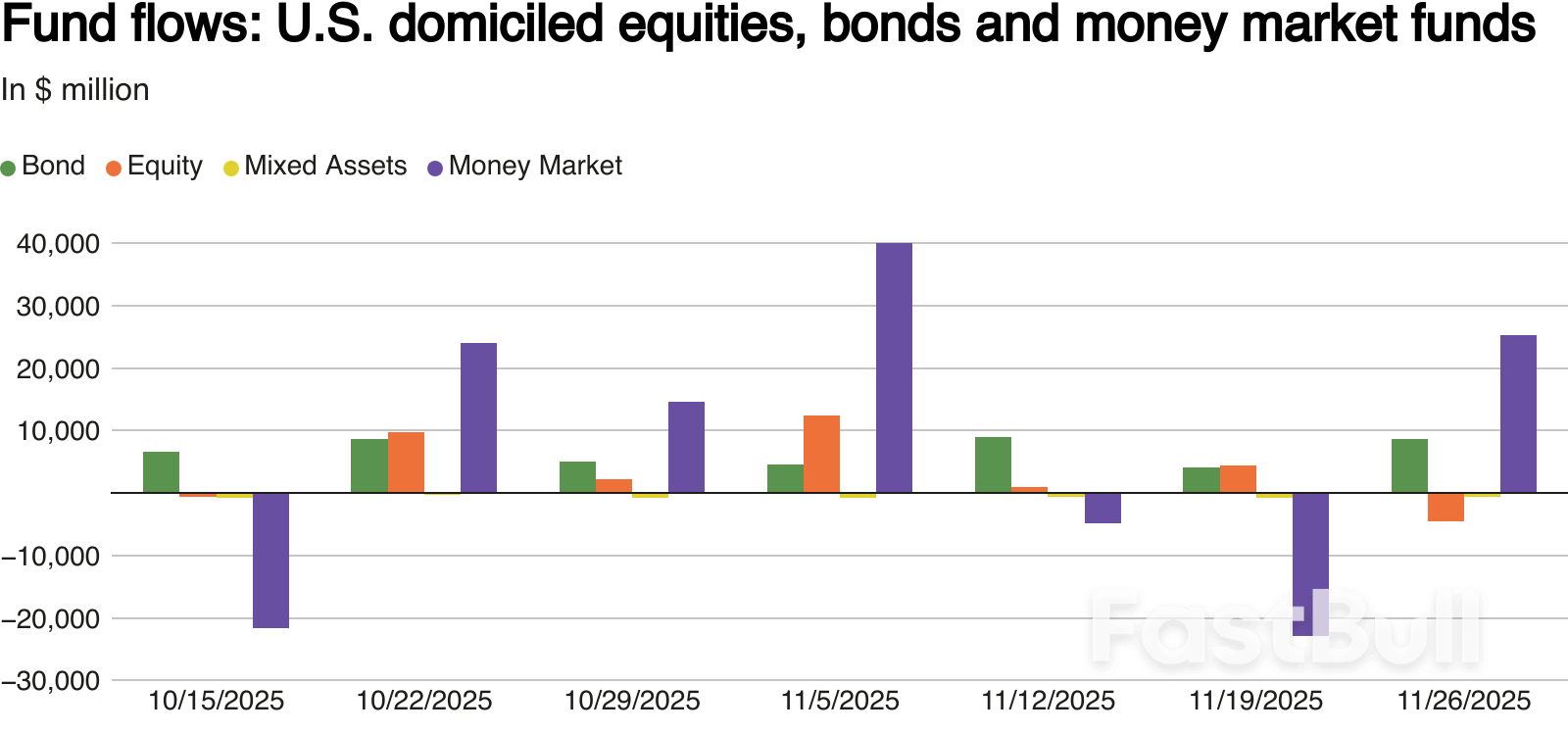
          U.S. equity funds witnessed their first weekly outflow in six weeks in the week through November 26, as concerns over lofty tech valuations prompted investors to take profits and overshadowed optimism about a possible Federal Reserve rate cut next month.
          They divested a net $4.56 billion worth of U.S. equity funds in their first weekly net sales since October 15, LSEG Lipper data showed.
          US equity funds see first weekly outflow in six weeks_1

          Weekly flows into US equity, bond and money market funds in $ million

          The S&P 500 (.SPX), opens new tab has risen more than 3% so far this week on expectations of a Federal Reserve rate cut next month. But investors remain cautious as November has been marked by heightened volatility, driven by concerns over stretched tech valuations and the economic impact of a record 43-day U.S. government shutdown.
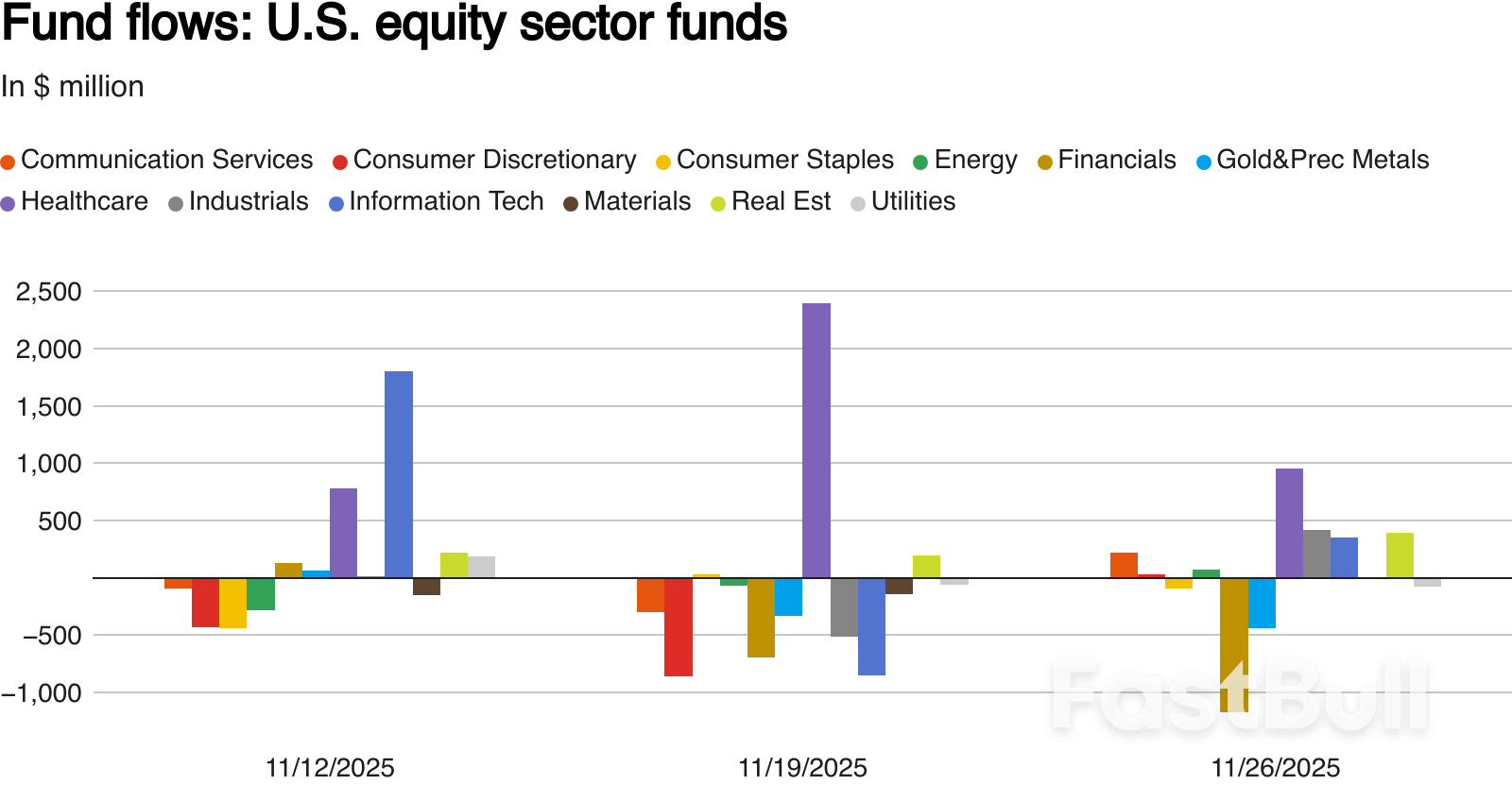
          U.S. large-cap funds saw a net $144 million weekly outflow following five successive weeks of inflows. Investors also ditched mid-cap and small-cap funds worth a total of $1.69 billion and $885 million, respectively.

          US equity funds see first weekly outflow in six weeks_2

          Weekly flows into US equity sector funds in $ million

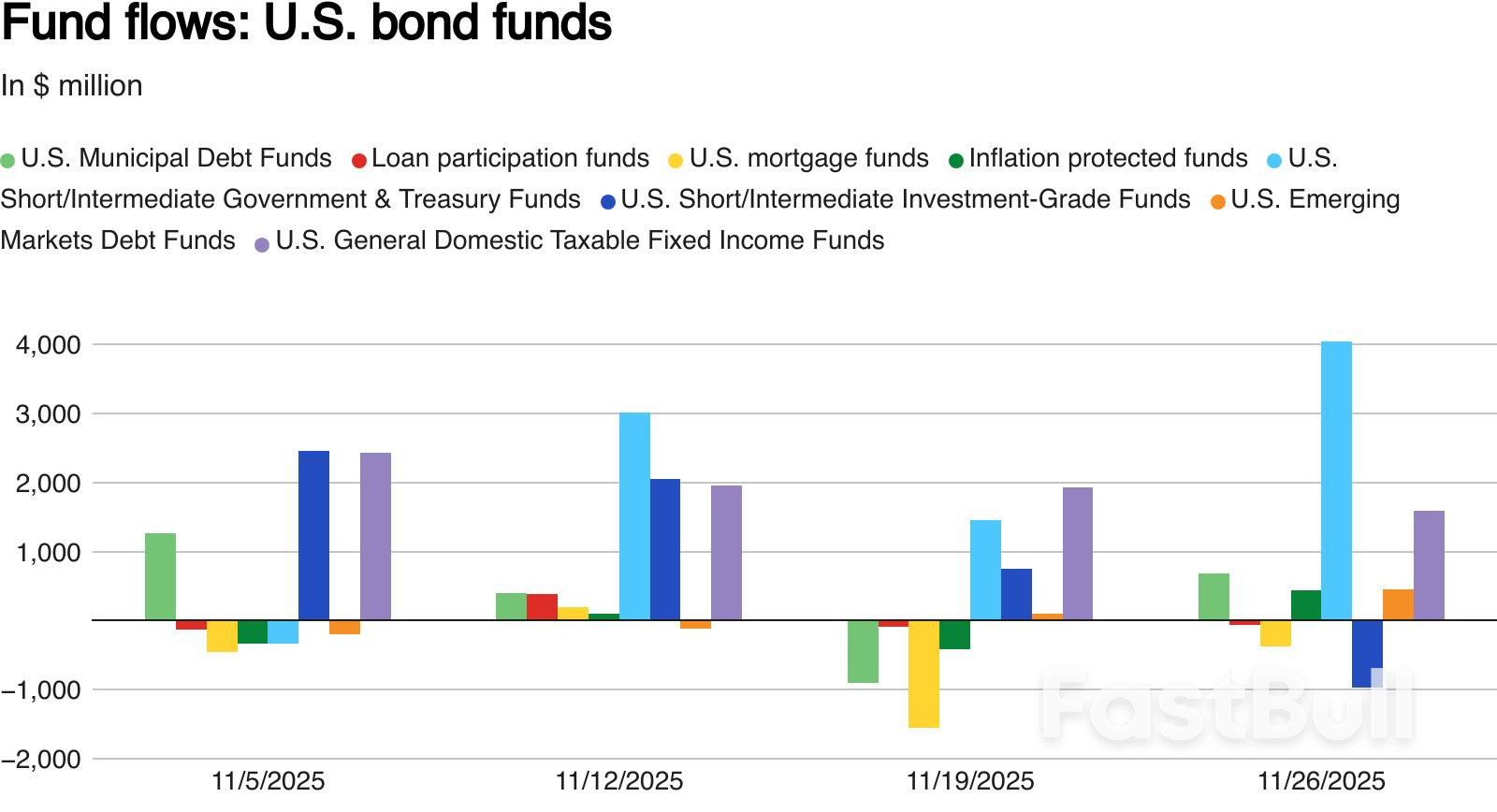
          U.S. bond funds remained popular for an eighth straight week as these funds drew approximately $8.6 billion in weekly inflows.
          Short-to-intermediate government and treasury funds secured $4.05 billion, the largest amount for a week since September 24. General domestic taxable fixed income funds also had a net $1.59 billion weekly inflow.
          US equity funds see first weekly outflow in six weeks_3

          Weekly flows into US bond funds in $ million

          U.S. money market funds, meanwhile, received $25.28 billion worth of inflows after two successive weeks of net sales.

          Source: reuters

          Risk Warnings and Disclaimers
          You understand and acknowledge that there is a high degree of risk involved in trading. Following any strategies or investment methods may lead to potential losses. The content on the site is provided by our contributors and analysts for information purposes only. You are solely responsible for determining whether any trading assets, securities, strategy, or any other product is suitable for investing based on your own investment objectives and financial situation.
          Add to Favorites
          Share

          Why US Utility Stocks Are Falling After the AI Power Surge

          Adam

          Stocks

          The artificial-intelligence boom’s promise of runaway electricity demand has jolted shares of US power companies to all-time highs. But those generators and utilities are now learning that the hype comes with an edge: Investors won’t wait forever for results.
          Companies that recently hit record valuations are returning to earth as investors realize the massive data-center deals they’d banked on are actually smaller, or slower, than expected.
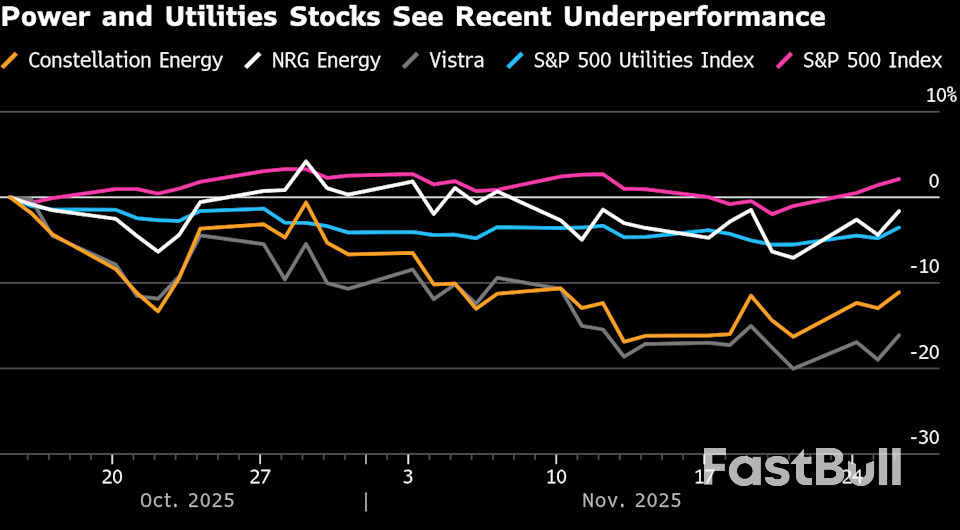
          Constellation Energy Corp. saw shares tumble 11% from an October high after a third-quarter earnings call that yielded no details on new power generation. The headline of one Jefferies analyst note read: “No Data Center Deals.” Similarly, Vistra Corp. has fallen 16% since mid-October as analysts noted a slower pace of data center announcements than they expected.
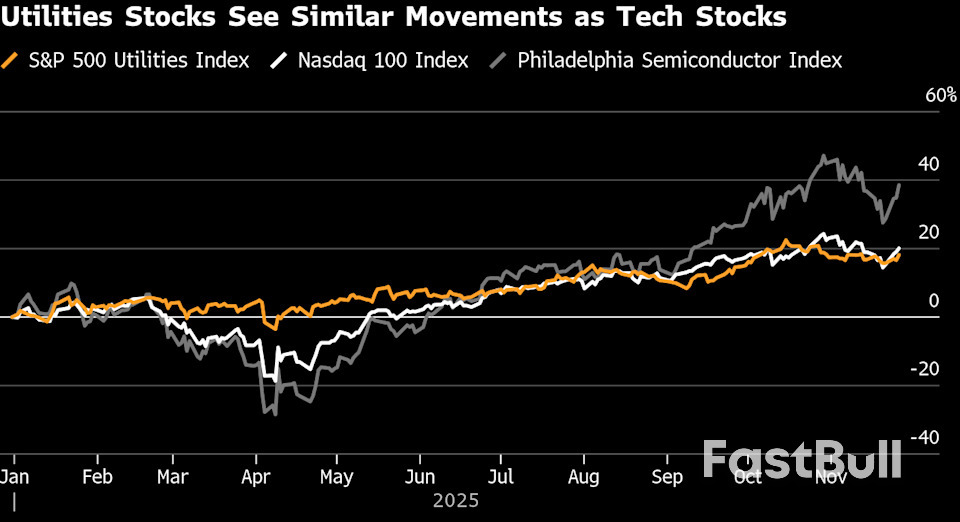
          The S&P 500 Utilities Index is now set to post the worst monthly performance since August, after reaching an all-time high in October.
          “These are not your father’s and mother’s utility stocks,” said Mark Malek, chief investment officer at Muriel Siebert & Co. “People are starting to question, ‘Can these companies scale as fast as they want to, are they throwing capital at these projects that’ll never get done?’”
          Why US Utility Stocks Are Falling After the AI Power Surge_1
          Vistra declined to comment. Constellation didn’t immediately respond to a request for comment.
          While utilities have long been regarded as safe places to park money, the massive data-center build-out being spurred by AI has triggered an avalanche of investment into the sector. Now, as reality sets in, investors are trying to figure out which companies can deliver on their big promises — and which would be able to weather the potential pop of a trillion-dollar AI bubble.
          “The AI bubble fears are playing into some of the weakness recently in utilities,” said Travis Miller, a utility analyst for Morningstar. “If the electricity demand growth doesn’t show up, then utilities look overvalued where they’re trading today.”
          The companies have already started to temper expectations. Constellation narrowed the top end of its full-year earnings per share forecast in November, while Vistra did the same with its adjusted Ebitda forecast. NRG Energy maintained its full-year Ebitda forecast in November, but investors had been expecting a guidance increase.
          Why US Utility Stocks Are Falling After the AI Power Surge_2
          Still, some analysts say the pullback is nothing to worry about, with investors simply taking profits after the huge gains of October.
          “We don’t have a bubble in utilities,” said Sophie Karp, a utility analyst at KeyBanc Capital Markets. “The market is taking a pause until we see the next leg of growth.”
          Even after recent declines, Constellation remains 60% higher this year, with NRG rising 87% and GE Vernova up 79%, outpacing even the 34% gain that Nvidia Corp. has seen this year.
          Such a development would particularly hit unregulated power sellers such as Constellation, NRG and Vistra.

          Source: Bloomberg

          Risk Warnings and Disclaimers
          You understand and acknowledge that there is a high degree of risk involved in trading. Following any strategies or investment methods may lead to potential losses. The content on the site is provided by our contributors and analysts for information purposes only. You are solely responsible for determining whether any trading assets, securities, strategy, or any other product is suitable for investing based on your own investment objectives and financial situation.
          Add to Favorites
          Share

          UN Warns On Voter Surveillance Ahead Of Myanmar Election

          Daniel Carter

          Political

          The U.N. human rights office voiced concern on Friday that the Myanmar junta was pressuring people into voting in an election next month and that electronic voting machines and AI surveillance could help authorities to identify opponents.
          International officials have already raised concerns about Myanmar's phased election from December 28 into January, calling it a sham exercise aimed at legitimising the military's rule after it overthrew a civilian democratic government in 2021.
          The electronic voting machines did not allow people to leave their ballot blank or spoil it, meaning they have to pick a candidate, said James Rodehaver, head of the Myanmar team for Office of the High Commissioner for Human Rights (OHCHR).
          "There's a real worry that this electronic surveillance technology is going to be used to monitor how people are voting," he told a Geneva press conference, saying that authorities could track if people are voting, and who for.
          The military authorities in Myanmar intend "to enable all eligible voters to exercise their franchise freely and fairly in the upcoming general election", state media reported on Friday. Reuters was unable to reach a junta spokesperson for further comment.
          Rodehaver said his team is verifying reports that locals are being forced to attend military training sessions on how to use the electronic voting machines in contested areas.
          "After such training, some participants were warned by armed groups not to vote," he said, saying civilians were caught between the two sides.
          OHCHR has also received reports of displaced people being ordered by the military to return to their villages to vote, Rodehaver said.
          Authorities have arrested three young people who hung up posters depicting a ballot box with a bullet, he added. Myanmar previously said it has pardoned thousands in order to allow them to vote.
          The country has been in turmoil since the coup overthrew the civilian government led by Nobel laureate Aung San Suu Kyi, who has been in detention ever since. Nationwide protests afterwards grew into an armed resistance.
          The Trump administration that it will end temporary legal status for Myanmar citizens in the United States, claiming they can now safely return, citing the junta's planned elections as a sign of improvement. OHCHR is urging the United States to reconsider, it said.
          Junta spokesperson Zaw Min Tun previously said that the U.S. announcement was a positive sign and citizens abroad were welcome to return to take part in the vote.

          Source: Reuters

          Risk Warnings and Disclaimers
          You understand and acknowledge that there is a high degree of risk involved in trading. Following any strategies or investment methods may lead to potential losses. The content on the site is provided by our contributors and analysts for information purposes only. You are solely responsible for determining whether any trading assets, securities, strategy, or any other product is suitable for investing based on your own investment objectives and financial situation.
          Add to Favorites
          Share

          EU Should Reject Automakers’ Biofuel Plea, Says Campaign Group

          Justin

          Political

          Economic

          The European Commission should resist automakers' calls to allow cars to run on biofuels beyond 2035 because they are in short supply and not truly carbon-neutral, campaign group T&E said on Thursday.

          New vehicles in the European Union must have no carbon dioxide emissions from 2035 under rules designed to boost sales of electric cars and phase out fossil fuels and the internal combustion engine.

          However, automakers are pushing the EU executive to grant an exemption to allow carbon-neutral fuels to continue to power internal combustion engines, plug-in hybrids and range extenders. The Commission will unveil measures designed to support the auto sector on December 10.

          In a report published on Thursday, T&E pointed to EU law changes in 2018 that limited the use of crop-based fuels, such as from palm oil or soy, favouring used cooking oil, animals and other waste-based sources, which now account for about half of bio-based diesel in the EU.

          However, some 60% of biofuels and 80% of used cooking oil are imported, principally from Asia, T&E said, with rising cases of fraud, such as palm oil passed off as waste.

          T&E said biofuels made from food crops typically only save 60% of CO2 emissions compared with fossil fuels because of CO2 emitted in their cultivation and transportation. They also risk leading to deforestation.

          More advanced fuels made from municipal waste or sewage sludge are more sustainable, the report said, but are not available in sufficient quantities and are already earmarked for aviation and shipping. If road transport were included, EU demand could be from double to nine times the 2050 sustainable supply.

          The T&E report said that allowing biofuel in EU cars could increase CO2 emissions by up to 23% in 2050.

          The group advises that biofuels should not be part of the post-2035 solution and, if they are, limited to just 5% of sales of cars powered by truly carbon-neutral e-fuels.

          Source: Investing

          To stay updated on all economic events of today, please check out our Economic calendar
          Risk Warnings and Disclaimers
          You understand and acknowledge that there is a high degree of risk involved in trading. Following any strategies or investment methods may lead to potential losses. The content on the site is provided by our contributors and analysts for information purposes only. You are solely responsible for determining whether any trading assets, securities, strategy, or any other product is suitable for investing based on your own investment objectives and financial situation.
          Add to Favorites
          Share

          Frustration, Confusion Ripple Across Markets on CME Outage

          Adam

          Economic

          The Chicago Mercantile Exchange Group proudly describes itself as the place “where the world comes to manage risk.” Except on Friday, the world was shut out.
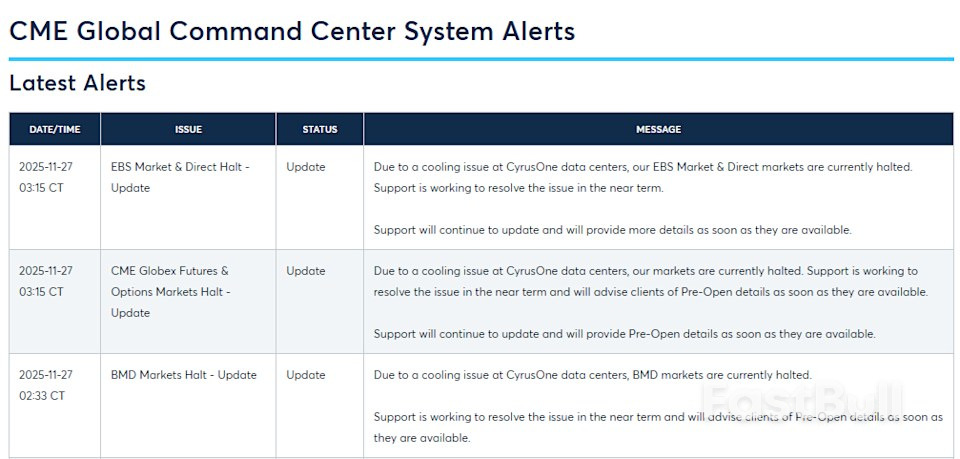
          Trading of futures and options was halted due to a fault at a data center, spilling over into multiple markets and affecting contracts covering trillions of dollars. It hit S&P 500 futures as well as everything from Treasuries and US crude oil to gasoline and palm oil. EBS, a platform used in foreign exchanges, was restored at 12 p.m. London time after being down for several hours.
          In Singapore, one oil trader said when the initial alert was issued around 10:30 a.m. local time on Friday, they thought it was a hoax because the trades and quotes were still streaming in. But a few minutes later, the screen suddenly froze and they were booted out of the Nymex platform.
          With the go-to service out, screens that would usually be a flickering wall of numbers ground to a halt, and traders had to seek out other options to keep trading and operating.
          “It’s pretty annoying. We wanted to price some equity index options,” said Gerald Gan, deputy chief investment officer at Singapore-based Reed Capital Partners. “My provider is scouring for alternatives, but I doubt the liquidity would be as ample as CME.”
          Such reactions reflect how CME — which started in the late 1800s as the Chicago Butter and Egg Board — has grown to become an integral part of the global market machinery and a crucial part of traders’ daily work. On average in October, derivatives trading volumes amounted to more than 26 million contracts every day, according to data from the group.
          On Nov. 20, open interest in CME’s US Treasury futures and options set an all-time high of 35.1 million contracts. About $1 trillion of notional value is traded daily in the E-mini S&P 500 and Nasdaq 100 futures alone.
          Exchange outages have occurred frequently in recent years, with technology issues affecting pricing across platforms globally.
          In June 2024, a glitch during a software update in June 2024 led the New York Stock Exchange to erroneously halt trading on about 40 stocks and display odd trades showing a 99% drop in prices. Earlier in the year, tech issues disrupted premarket Nasdaq trading for almost three hours.
          In Europe, London Stock Exchange Group Plc suffered three outages in a few months at the end of 2023, including one that halted trading for thousands of shares.
          The latest CME malfunction is already longer than a similar, hours-long outage due to a technical error in 2019, which will mean questions for the company, the data center operator and the extent of contingency plans.
          ‘Real Black Friday’
          Commodity traders scrambled to work out what would happen when the US benchmarks for gasoline and diesel futures expired later in the day — that can involve delivering actual barrels when the market closes at the end of month. Some oil brokers questioned why they came to work, with volumes already expected to be low the day after Thanksgiving and unable to trade CME volumes.
          On LinkedIn, one employee at Glencore commented “Real Black Friday” in response to a post on the issues.
          The outage meant limited trading in Treasury futures. Elsewhere, cash bonds traded sporadically and volumes may be hit by the reduced ability of traders to hedge. There are alternative methods to hedge trades, such as through swap markets which became more active following the start of trading in London, according to traders.
          Futures for European and UK bond markets trade on a different exchange and were unaffected.
          In the foreign exchange market, one trader said prices on platforms were returning to normal, but when trading opened at 8 a.m. in London, some platforms initially showed elevated bid-offer spreads.
          “We typically use derivatives for tactical trades but it’s obviously impossible this morning,” said Amelie Derambure, a portfolio manager at Amundi SA. “Thankfully, it’s a quiet day. It would have been quite a handicap had it been a busy day.”
          Global Impact
          Friday was set to be a subdued day for stock markets, with only a half day of trading in the US after the Thanksgiving holiday. There’s no US economic data scheduled and no Federal Reserve speakers ahead of a blackout period leading up to their December decision.
          “Lucky it’s quiet post Thanksgiving,” said Emmanuel Valavanis, a London-based equity sales specialist at Forte Securities. “For this to happen on the last trading day of the month is bad enough, but coinciding with last day of year-end for many mutual funds compounds the potential issue. Freezing a trillion dollars is not a good look for those involved.”
          Frustration, Confusion Ripple Across Markets on CME Outage_1
          Some said they were staying away given the risks posed by the outage on a day when trading was already expected to be thinner.
          “I am wary about trading on such an illiquid day, so I would not have wanted to trigger trades anyway,” said Rajeev De Mello, chief investment officer at Gama Asset Management. “And with this outage, all the more so.”

          Source: Bloomberg

          To stay updated on all economic events of today, please check out our Economic calendar
          Risk Warnings and Disclaimers
          You understand and acknowledge that there is a high degree of risk involved in trading. Following any strategies or investment methods may lead to potential losses. The content on the site is provided by our contributors and analysts for information purposes only. You are solely responsible for determining whether any trading assets, securities, strategy, or any other product is suitable for investing based on your own investment objectives and financial situation.
          Add to Favorites
          Share

          Biggest Eurozone Members See Easing Inflation Except for Germany

          Michelle

          Forex

          Economic

          Inflation figures from the eurozone's major economies paint a mixed picture of the bloc's price prospects. In Germany, the region's biggest economy, the inflation rate unexpectedly rose to the highest level in nine months.

          Mainly driven by food prices, as energy prices fell modestly, EU-harmonised inflation in Germany was 2.6% higher in November compared with the previous year, after inflation hit 2.3% in October of 2025. This is according to preliminary results from the Federal Statistical Office (Destatis).

          Month-on-month, the harmonised inflation rate showed that German prices fell by 0.5% in November, from a 0.3% rise in October.

          French prices are slow to rise

          Elsewhere, it appears that Europe's price pressure is cooling following the region's post-pandemic cost-of-living crisis. Preliminary data released on Friday suggests French inflation remains subdued. According to flash estimates from INSEE, the country's EU-harmonised price index is projected to rise by 0.8% year-on-year in November, unchanged from the previous month and down from 1.7% a year earlier.

          Economists had expected a stronger increase of 1%.

          The stable reading reflects contrasting movements across spending categories: a slowdown in service prices, driven down by communication services, and a more pronounced decrease in manufactured goods prices, offset by a smaller decline in energy prices and a slight acceleration in food prices.

          Month-over-month, French prices fell by 0.2% in November, after a 0.1% increase in October. The consensus forecast had pointed to no change.

          The decline was driven by lower service prices, particularly in transport and communications, and to a lesser extent by cheaper manufactured goods. Energy prices are expected to rebound, led by petrol products, while tobacco prices are projected to edge higher. Food prices are expected to remain broadly stable.

          Inflation in Italy

          The EU's third-largest economy showed a similar pattern. Italy's harmonised index of consumer prices fell by 0.2% in November, matching October's decline, according to preliminary figures from the national statistics agency ISTAT.

          Annual inflation eased to 1.1% from 1.3% in the previous month, which is its lowest level since October 2024.

          Italian inflation remained low as falling energy prices and softer services inflation offset modest rises elsewhere. The largest downward pressures came from steep declines in regulated energy and communication services, alongside slower increases in transport and recreational services.

          Only a few categories — mainly processed food and some unregulated energy products — added mild upward pressure.

          Spanish prices are on the rise

          Spain, the eurozone's fourth-largest economy, recorded somewhat stronger price pressures. The EU-harmonised index of consumer prices was flat in November following a 0.5% rise in October, defying expectations of a 0.2% monthly fall, according to preliminary data from the National Statistics Institute.

          However, annual inflation came in higher than expected. The harmonised rate eased to 3.1% from 3.2% in October, compared with a forecast of 2.9%. Price rises for food, transport and other non-energy goods continued to drive inflation.

          Friday's figures from the eurozone's major economies will inform the European Central Bank ahead of its meeting in December. The ECB is not expected to cut its key interest rate from the current 2%, with policymakers judging that medium-term inflation targets are broadly being met.

          Eurozone inflation stood at 2.1% in October, slightly above the ECB's 2% target, reinforcing the bank's view that price pressures are largely under control after the surge to double-digit highs caused by post-pandemic supply shocks and the energy crisis triggered by Russia's invasion of Ukraine.

          Meanwhile, inflation expectations have edged higher. According to a new ECB survey published on Friday, median consumer inflation expectations for the next year rose to 2.8% in October from 2.7% in September. Expectations for three years ahead were unchanged at 2.5%, while five-year-ahead expectations remained steady at 2.2%.

          Source: Yahoo Finance

          To stay updated on all economic events of today, please check out our Economic calendar
          Risk Warnings and Disclaimers
          You understand and acknowledge that there is a high degree of risk involved in trading. Following any strategies or investment methods may lead to potential losses. The content on the site is provided by our contributors and analysts for information purposes only. You are solely responsible for determining whether any trading assets, securities, strategy, or any other product is suitable for investing based on your own investment objectives and financial situation.
          Add to Favorites
          Share
          FastBull
          Copyright © 2025 FastBull Ltd

          728 RM B 7/F GEE LOK IND BLDG NO 34 HUNG TO RD KWUN TONG KLN HONG KONG

          TelegramInstagramTwitterfacebooklinkedin
          App Store Google Play Google Play
          Products
          Charts

          Chats

          Q&A with Experts
          Screeners
          Economic Calendar
          Data
          Tools
          Membership
          Features
          Function
          Markets
          Copy Trading
          Latest Signals
          Contests
          News
          Analysis
          24/7
          Columns
          Education
          Company
          Careers
          About Us
          Contact Us
          Advertising
          Help Center
          Feedback
          User Agreement
          Privacy Policy
          Business

          White Label

          Data API

          Web Plug-ins

          Poster Maker

          Affiliate Program

          Risk Disclosure

          The risk of loss in trading financial instruments such as stocks, FX, commodities, futures, bonds, ETFs and crypto can be substantial. You may sustain a total loss of the funds that you deposit with your broker. Therefore, you should carefully consider whether such trading is suitable for you in light of your circumstances and financial resources.

          No decision to invest should be made without thoroughly conducting due diligence by yourself or consulting with your financial advisors. Our web content might not suit you since we don't know your financial conditions and investment needs. Our financial information might have latency or contain inaccuracy, so you should be fully responsible for any of your trading and investment decisions. The company will not be responsible for your capital loss.

          Without getting permission from the website, you are not allowed to copy the website's graphics, texts, or trademarks. Intellectual property rights in the content or data incorporated into this website belong to its providers and exchange merchants.

          Not Logged In

          Log in to access more features

          FastBull Membership

          Not yet

          Purchase

          Become a signal provider
          Help Center
          Customer Service
          Dark Mode
          Price Up/Down Colors

          Log In

          Sign Up

          Position
          Layout
          Fullscreen
          Default to Chart
          The chart page opens by default when you visit fastbull.com