Markets
News
Analysis
User
24/7
Economic Calendar
Education
Data
- Names
- Latest
- Prev


Signal Accounts for Members
All Signal Accounts
All Contests


Japan Tankan Small Manufacturing Outlook Index (Q4)A:--
F: --
P: --
Japan Tankan Large Non-Manufacturing Outlook Index (Q4)A:--
F: --
P: --
Japan Tankan Large Manufacturing Outlook Index (Q4)A:--
F: --
P: --
Japan Tankan Small Manufacturing Diffusion Index (Q4)A:--
F: --
P: --
Japan Tankan Large Manufacturing Diffusion Index (Q4)A:--
F: --
P: --
Japan Tankan Large-Enterprise Capital Expenditure YoY (Q4)A:--
F: --
P: --
U.K. Rightmove House Price Index YoY (Dec)A:--
F: --
P: --
China, Mainland Industrial Output YoY (YTD) (Nov)A:--
F: --
P: --
China, Mainland Urban Area Unemployment Rate (Nov)A:--
F: --
P: --
Saudi Arabia CPI YoY (Nov)A:--
F: --
P: --
Euro Zone Industrial Output YoY (Oct)A:--
F: --
P: --
Euro Zone Industrial Output MoM (Oct)A:--
F: --
P: --
Canada Existing Home Sales MoM (Nov)A:--
F: --
P: --
Canada National Economic Confidence IndexA:--
F: --
P: --
Canada New Housing Starts (Nov)A:--
F: --
U.S. NY Fed Manufacturing Employment Index (Dec)A:--
F: --
P: --
U.S. NY Fed Manufacturing Index (Dec)A:--
F: --
P: --
Canada Core CPI YoY (Nov)A:--
F: --
P: --
Canada Manufacturing Unfilled Orders MoM (Oct)A:--
F: --
P: --
U.S. NY Fed Manufacturing Prices Received Index (Dec)A:--
F: --
P: --
U.S. NY Fed Manufacturing New Orders Index (Dec)A:--
F: --
P: --
Canada Manufacturing New Orders MoM (Oct)A:--
F: --
P: --
Canada Core CPI MoM (Nov)A:--
F: --
P: --
Canada Trimmed CPI YoY (SA) (Nov)A:--
F: --
P: --
Canada Manufacturing Inventory MoM (Oct)A:--
F: --
P: --
Canada CPI YoY (Nov)A:--
F: --
P: --
Canada CPI MoM (Nov)A:--
F: --
P: --
Canada CPI YoY (SA) (Nov)--
F: --
P: --
Canada Core CPI MoM (SA) (Nov)A:--
F: --
P: --
Canada CPI MoM (SA) (Nov)A:--
F: --
P: --
Federal Reserve Board Governor Milan delivered a speech
U.S. NAHB Housing Market Index (Dec)--
F: --
P: --
Australia Composite PMI Prelim (Dec)--
F: --
P: --
Australia Services PMI Prelim (Dec)--
F: --
P: --
Australia Manufacturing PMI Prelim (Dec)--
F: --
P: --
Japan Manufacturing PMI Prelim (SA) (Dec)--
F: --
P: --
U.K. 3-Month ILO Employment Change (Oct)--
F: --
P: --
U.K. Unemployment Claimant Count (Nov)--
F: --
P: --
U.K. Unemployment Rate (Nov)--
F: --
P: --
U.K. 3-Month ILO Unemployment Rate (Oct)--
F: --
P: --
U.K. Average Weekly Earnings (3-Month Average, Including Bonuses) YoY (Oct)--
F: --
P: --
U.K. Average Weekly Earnings (3-Month Average, Excluding Bonuses) YoY (Oct)--
F: --
P: --
France Services PMI Prelim (Dec)--
F: --
P: --
France Composite PMI Prelim (SA) (Dec)--
F: --
P: --
France Manufacturing PMI Prelim (Dec)--
F: --
P: --
Germany Services PMI Prelim (SA) (Dec)--
F: --
P: --


No matching data
Latest Views
Latest Views
Trending Topics
Top Columnists
Latest Update
White Label
Data API
Web Plug-ins
Affiliate Program
View All

No data
Sterling traded steadily mixed today, showing little reaction to the BoE’s decision to hold rates at 4.00%. The 7–2 vote leaned slightly dovish, with Swati Dhingra and Alan Taylor backing a 25bps cut, but the outcome was broadly expected given their well-established dovish leanings. Importantly, the MPC’s statement flagged...
Sterling traded steadily mixed today, showing little reaction to the BoE’s decision to hold rates at 4.00%. The 7–2 vote leaned slightly dovish, with Swati Dhingra and Alan Taylor backing a 25bps cut, but the outcome was broadly expected given their well-established dovish leanings. Importantly, the MPC’s statement flagged that medium-term inflation risks remain “prominent,” sending a clear signal that policymakers are not yet comfortable opening the door to more near-term easing.
For markets, the key question is whether November will deliver a cut. On that, the announcement offered little clarity. Progress in services and core disinflation remains uneven, and policymakers may conclude there is insufficient evidence by November to justify a move.
Another complication is fiscal policy. The UK government is scheduled to present its budget in late November, and some MPC members may prefer to wait until the impact of tax and spending plans is clearer before adjusting interest rates. That raises the risk that a December or early-2026 move may be more likely.
On the broader FX board, Kiwi remains the weakest performer of the week after a sharp GDP miss fueled calls for a 50bps RBNZ cut in October. Dollar is the second weakest, as its post-FOMC bounce shows signs of fading, while Aussie sits third from the bottom after soft jobs data.
By contrast, Swiss Franc leads as the strongest performer, followed by Euro and Loonie. Yen and Sterling sit mid-table, though Yen could slide lower if U.S. and European yields extend their rebound into week’s end.
In Europe, at the time of writng, FTSE is up 0.17%. DAX is up 1.05%. CAC is up 1.04%. UK 10-year yield is up 0.039 at 4.668. Germany 10-year yield is up 0.035 at 2.709. Earlier in Asia, Nikkei rose 1.15%. Hong Kong HSI fell -1.35%. China Shanghai SSE fell -1.15%. Singapore Strait Times fell -0.26%. Japan 10-year JGB yield rose 0.008 to 1.601.
US initial jobless claims fell -33k to 231k in the week ending September 13, below expectation of 240k. Four-week moving average of initial claims fell -750 to 240k. Continuing claims fell -7k to 1920k in the week ending September 6. Four-week moving average of continuing claims fell -10k to 1933k.
BoE holds at 4.00%, two doves dissent,
BoE left its Bank Rate unchanged at 4.00% today, in line with expectations. The decision came with a slight dovish tilt, as two members of the Monetary Policy Committee—Swati Dhingra and Alan Taylor—voted for an immediate 25bps cut. The MPC also voted by 7–2 to continue reducing the stock of UK government bonds held for monetary policy purposes by GBP70 billion over the next 12 months, taking the total down to GBP488 billion.
Policymakers reiterated that a “gradual and careful” approach remains appropriate, with the timing of further easing dependent on the extent of disinflation. The statement stressed that policy is not on a pre-set course and will respond flexibly to new data.
On inflation, the Bank acknowledged progress but kept risks in focus. CPI was steady at 3.8% in August and is expected to edge slightly higher in September before trending back toward the 2% target. Wage growth has slowed from its peak and is expected to decelerate further, while services inflation has held broadly flat. Still, the BoE cautioned that medium-term upside risks remain “prominent.”, particularly if the temporary uptick in CPI feeds into wages and price-setting.
New Zealand’s economy contracted far more than expected in Q2, with GDP falling -0.9% qoq against consensus forecasts of -0.3% qoq. The release confirmed a deeper downturn, with economic activity now having declined in three of the last five quarters. The breadth of weakness points to rising headwinds that could force the RBNZ into a more aggressive easing cycle.
Goods-producing industries led the contraction with a -2.3% drop, while primary industries fell -0.7% and services output was flat. “The 0.9 percent fall in economic activity in the June 2025 quarter was broad-based with falls in 10 out of 16 industries,” said economic growth spokesperson Jason Attewell. Manufacturing was the single largest drag, contracting -3.5% in the quarter, while construction fell -1.8% following a modest rebound in Q1.
The scale of contraction triggered a wave of forecasts for deeper RBNZ easing. Westpac now expects a 50bp cut in October followed by a further 25bp reduction in November, compared with earlier projections of 25bp moves at both meetings. That would lower the OCR from the current 3.00% to 2.25% by year-end.
Australia’s labor market weakened in August as total employment fell by -5.4k, against expectations for a 21.2k gain. The headline masked stark contrasts, with full-time jobs dropping by -40.9k while part-time roles increased by 35.5k. Hours worked fell -0.4% mom, underscoring signs of cooling demand for labor.
The unemployment rate held steady at 4.2% in line with forecasts, though the participation rate edged down to 66.8% from 67.0%. The data suggest that while unemployment remains low, underlying labor market conditions are softening.
Daily Pivots: (S1) 1.3588; (P) 1.3657; (R1) 1.3694; More…
Intraday bias in GBP/USD remains neutral and more consolidations could be seen below 1.3725. Further rise is expected as long as 55 D EMA (now at 1.3488) holds. Above 1.3725 will bring retest of 1.3787 high first. Decisive break there will resume larger up trend to 1.4004 projection level. However, sustained break of 55 D EMA will indicate that corrective pattern from 1.3787 is extending with another falling leg, and bring deeper fall to 1.3332 support and below.
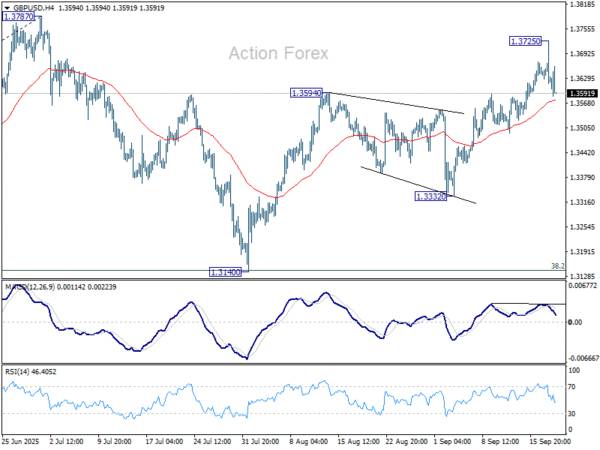
In the bigger picture, up trend from 1.3051 (2022 low) is in progress. Next medium term target is 61.8% projection of 1.0351 to 1.3433 from 1.2099 at 1.4004. Outlook will now stay bullish as long as 55 W EMA (now at 1.3151) holds, even in case of deep pullback.

Former Treasury secretary Lawrence Summers said Federal Reserve policy is leaning towards being too slack, emphasising that the US economy’s biggest risks lie in inflation rather than the job market.
“My own guess is that policy is currently a little looser — looking at all financial conditions — than people view it as being,” Summers said on Bloomberg Television’s Wall Street Week with David Westin. “The balance of risks is a bit more tilted towards inflation rather than unemployment.”
Summers spoke after Fed policymakers cut their benchmark interest rate for the first time in a year. Jerome Powell, the central bank’s chair, said the decision reflected a shift in the balance of risks, with “the much lower level of job creation and other evidence of softening in the labor market” apparent in data in recent weeks.
“The biggest risk in this situation is being that we lose contact with our 2% inflation target and become a country with an inflation psychology,” said Summers, a Harvard University professor and paid contributor to Bloomberg TV.
“I think we’re a bit on the loose side with respect to monetary policy and monetary policy signalling,” Summers said. “But that’s very much a difference of degree.”
Fed governors and reserve bank presidents, in updated projections released on Wednesday, boosted their inflation forecast for next year. The median estimate shows a 3% increase in the Fed’s preferred gauge, the personal consumption expenditures price measure, for 2025, and a 2.6% rise next year — higher than the 2.4% predicted in June.
“If I were sitting in chair Powell’s shoes, my greatest concern would be very much” on the inflation side, Summers said.
The pressure from President Donald Trump and his allies on the Fed to slash interest rates underscores the need to retain credibility on fighting inflation, the former Treasury chief added.
“I don’t think they’re doing it based on political pressure,” Summers said of the Wednesday rate reduction. “But I think you have to bend over backwards at a moment like this. And I’m not sure they’ve bent over quite as far backwards as I would have liked to see.”
The UAE Central Bank on Wednesday lowered its benchmark interest rate, mimicking the US Federal Reserve’s move to cut its policy rate, the first since President Donald Trump resumed office in January.After hitting the pause button for several quarters, the rate cut comes amid mounting pressure from the White House and open criticism of the Fed from Mr Trump amid weakening US economy.The Fed lowered its benchmark rate a quarter of a percentage point, from 4 per cent to 4.25 per cent, at the end of the two-day meeting of the rate setting Federal Open Market Committee.
With the much anticipated cut in the benchmark interest rates, the US has entered the latest monetary policy easing cycle as the Fed tries to stave off a recession, quell divisions within the bank and fend off pressure from Mr Trump, who has been demanding a major rate cut to reboot growth in the world’s biggest economy.Most central banks in the six-member economic bloc of GCC move in lock-step with the Fed's policy rate moves because their currencies are pegged to the US dollar, with Kuwait the only exception in the Gulf region as the dinar is tied to a basket of currencies.The UAE Central Bank said it would cut the base rate applied to its overnight deposit facility by 25 basis points to 4.15 per cent, from 4.40, effective Thursday.
The base rate, which is anchored to the Fed's interest on reserve balances (IORB), signals the general stance of the Central Bank's monetary policy and provides an effective interest rate floor for overnight money market rates.
The UAE economy, which has maintained a robust growth momentum since the coronavirus pandemic driven slowdown, grew by 3.9 per cent on an annual basis in the first quarter of 2025,Gross domestic product at the end of the three-month period rose to Dh455 billion, according to preliminary estimates released by the Federal Competitiveness and Statistics Centre earlier this month.Non-oil GDP posted 5.3 per cent rise on yearly basis, rising to Dh352 billion, contributing more than 77 per cent of total real GDP as the country continues to diversify its economy away from oil.
Non-oil contributions to GDP have risen consistently in the past five years, from 71.3 per cent level in 2020. Oil-related activities accounted for 22.7 per cent of GDP in the first three months of 2025.Non-oil private sector activity in the UAE also rose in August, with output growth and business confidence increasing in the Arab world's second-largest economy, driven by the fastest pace of activity in six months.The seasonally adjusted S&P Global UAE Purchasing Managers' Index climbed to 53.3, from 52.9 in July, partly boosted by an expansion in output levels in the third quarter.
The CBUAE expects the UAE’s GDP to expand at 4.7 per cent in 2025 and by 5.7 per cent in 2026. The country’s non-oil economy is set to grow by 5.1 per cent this year.The banking regulator estimates the country’s hydrocarbons economy to jump by 3.6 per cent in 2025 and by 8.5 per cent the following year.Inflation in the UAE stood at 1.4 per cent in the first quarter of 2025 and the central bank has slightly revised down its inflation forecast for 2025 to 1.9 per cent from 2 per cent.The UAE Central Bank has also lowered its inflation estimate for 2026 to 1.9 per cent from 2.1 per cent.
The number of Americans filing new applications for unemployment benefits fell last week, but the labor market has softened as both demand for and supply of workers have diminished.
Initial claims for state unemployment benefits decreased 33,000 to a seasonally adjusted 231,000 for the week ended September 13, the Labor Department said on Thursday. The decline partially reversed a surge in the prior week, which had pushed claims to levels last seen in October 2021.
That increase in applications was concentrated in Texas, with the state's Workforce Commission later saying it had since the September 1 Labor Day holiday "observed an uptick in identity fraud claim attempts aimed at exploiting the unemployment insurance system."
Economists polled by Reuters had forecast 240,000 claims for the latest week. Layoffs remain relatively low, but the hiring side of the labor market has almost stalled. Demand for workers has slowed, with economists blaming uncertainty stemming fromtariffson imports. At the same time, an immigration crackdown has reduced labor supply, creating what Federal Reserve Chair Jerome Powell on Wednesday described as a "curious balance."
"Typically when we say things are in balance, that sounds good," Powell told reporters. "But in this case, the balance is because both supply and demand have come down quite sharply. We now see the unemployment rate edging up."
The U.S. central bank on Wednesday cut its benchmark overnight interest rate by a quarter-percentage-point to a 4.00%-4.25% range and projected a steady pace of reductions for the rest of 2025 to help the labor market. The Fed paused its policy easing cycle in January because of uncertainty over the inflationary impact of President DonaldTrump'simport tariffs.
The claims data covered the period during which the government surveyed business establishments for the nonfarm payrolls component of September's employment report. Payrolls increased by only 22,000 jobs in August, with employment gains averaging 29,000 positions per month over the last three months.
The unemployment rate is near a four-year high of 4.3%. The government said last week payrolls could have been overstated by 911,000 jobs in the 12 months through March.
Though layoffs remain low, those who lose their jobs are experiencing long bouts of unemployment because of the stall-speed pace of hiring. The number of people receiving benefits after an initial week of aid fell 7,000 to 1.920 million during the week ending September 6, the claims report showed.
The average duration of joblessness jumped to 24.5 weeks in August, the longest since April 2022, from 24.1 in July.
After months of pressure from President Donald Trump, Federal Reserve Chair Jerome Powell made clear Wednesday he and most of his colleagues aren’t about to buy the administration’s argument on inflation or the case for slashing rates.
While policymakers did trim their benchmark rate by 25 basis points, it was really just a “risk-management cut,” Powell said in his press conference after the decision to bring the target to a 4% to 4.25% range. He said the move reflected “the much lower level of job creation and other evidence of softening in the labor market apparent in data in recent weeks.
As for where the economy is headed from here, however, he flagged risks to both of the Fed’s main mandates – price stability and full employment. But “our tools can’t do two things at once,” so policy isn’t on any pre-set path.
The Fed’s new board member, Stephen Miran, who was Trump’s White House chief economist until shifting roles Tuesday, dissented for a 50 basis-point cut. But the other two Trump appointees on the board, Christopher Waller and Michelle Bowman, failed to join him, even after having dissented themselves in July in favor of a quarter-point cut.
“Really the only way for any voter to really move things around is to be incredibly persuasive,” Powell said. And, apparently, Miran wasn’t. “There wasn’t widespread support at all for for a 50 basis point cut today,” Powell said.
Peppered with questions about Fed independence and political pressure, he dismissed the idea of the US central bank becoming a politicized cabal. “Really strong arguments based on the data and one’s understanding of the economy” is all that matters, he said. “And that’s how it’s going to work,” said Powell, who’s been on the board since 2012.
“That’s in the DNA of the institution, that’s not going to change,” he emphasized. For good measure, he also declined specific comment on Treasury Secretary Scott Bessent’s call for an independent review of the Fed, saying he wouldn’t reply to anything an “officer” says.
Perhaps most provocative to Trump and his team, Powell continued to hold out the possibility that he stays on the Fed board even after his term as chair ends in May. (His governorship runs to January 2028.) That would limit Trump’s ability to revamp its leadership.
Waller and Bowman might have taken themselves out of the running to succeed Powell as the next Fed chair, but “it does signal that the independence of the institution may be more durable than some have feared,” Michael Feroli, chief US economist at JPMorgan Chase, wrote in a note.
Is Trump bringing an end to US free market capitalism? On this week’s Trumponomics podcast, host Stephanie Flanders is joined by Bloomberg managing editor Shelly Banjo and senior reporter Ian King to discuss how the US president’s dealmaking is reshaping corporate America and whether it will outlast his presidency. Listen on Apple, Spotify or wherever you get your podcasts.
Before the latest economic projections from Fed policymakers, a group of former central bankers trimmed their own forecasts for rate cuts, taking the benchmark rate down to 3.5% by the end of 2026. The survey, conducted by ex-reporter Jon Hilsenrath, now a visiting scholar at Duke University, also warned about the consequences of political pressure.
“Twenty-four of 25 people described the risk of a policy error due to political interference as ‘extreme,’ ‘serious,’ or ‘elevated,’” the survey, which included nine former policymakers and 16 staff members, showed. “More specifically, people said the Fed risked cutting interest rates too much and spurring more inflation than is already projected.”
The former officials “strongly support” Waller, who served as research director at the St. Louis Fed before joining the Fed board in 2020, to succeed Powell as chair next year, “in part because he was deemed most independent among leading contenders for the job.” However, “several people expressed skepticism that Waller will get the job,” because of that same perception of independence.
White Label
Data API
Web Plug-ins
Poster Maker
Affiliate Program
The risk of loss in trading financial instruments such as stocks, FX, commodities, futures, bonds, ETFs and crypto can be substantial. You may sustain a total loss of the funds that you deposit with your broker. Therefore, you should carefully consider whether such trading is suitable for you in light of your circumstances and financial resources.
No decision to invest should be made without thoroughly conducting due diligence by yourself or consulting with your financial advisors. Our web content might not suit you since we don't know your financial conditions and investment needs. Our financial information might have latency or contain inaccuracy, so you should be fully responsible for any of your trading and investment decisions. The company will not be responsible for your capital loss.
Without getting permission from the website, you are not allowed to copy the website's graphics, texts, or trademarks. Intellectual property rights in the content or data incorporated into this website belong to its providers and exchange merchants.
Not Logged In
Log in to access more features

FastBull Membership
Not yet
Purchase
Log In
Sign Up