• Trade
  • Markets
  • Copy
  • Contests
  • News
  • 24/7
  • Calendar
  • Q&A
  • Chats
Trending
Screeners
SYMBOL
LAST
BID
ASK
HIGH
LOW
NET CHG.
%CHG.
SPREAD
SPX
S&P 500 Index
6827.42
6827.42
6827.42
6899.86
6801.80
-73.58
-1.07%
--
DJI
Dow Jones Industrial Average
48458.04
48458.04
48458.04
48886.86
48334.10
-245.98
-0.51%
--
IXIC
NASDAQ Composite Index
23195.16
23195.16
23195.16
23554.89
23094.51
-398.69
-1.69%
--
USDX
US Dollar Index
97.830
97.910
97.830
98.070
97.810
-0.120
-0.12%
--
EURUSD
Euro / US Dollar
1.17578
1.17585
1.17578
1.17590
1.17262
+0.00184
+ 0.16%
--
GBPUSD
Pound Sterling / US Dollar
1.33905
1.33914
1.33905
1.33940
1.33546
+0.00198
+ 0.15%
--
XAUUSD
Gold / US Dollar
4340.24
4340.67
4340.24
4350.16
4294.68
+40.85
+ 0.95%
--
WTI
Light Sweet Crude Oil
57.109
57.139
57.109
57.601
56.878
-0.124
-0.22%
--

Community Accounts

Signal Accounts
--
Profit Accounts
--
Loss Accounts
--
View More

Become a signal provider

Sell trading signals to earn additional income

View More

Guide to Copy Trading

Get started with ease and confidence

View More

Signal Accounts for Members

All Signal Accounts

Best Return
  • Best Return
  • Best P/L
  • Best MDD
Past 1W
  • Past 1W
  • Past 1M
  • Past 1Y

All Contests

  • All
  • Trump Updates
  • Recommend
  • Stocks
  • Cryptocurrencies
  • Central Banks
  • Featured News
Top News Only
Share

Canada Nov Consumer Prices +0.1% On Month, +2.2% On Year

Share

Canada Nov CPI Core -0.1% On Month, +2.9% On Year

Share

Canada Nov Core CPI, Seasonally Adjusted +0.2% On Month, Oct +0.3% (Unrevised)

Share

UK Health Minister Streeting On Doctors' Strike: Vote To Go Ahead Reveals The Bma's Shocking Disregard For Patient Safety

Share

Venezuelan State Oil Company Pdvsa Says Was Subject To Cyber Attack But Operations Unaffected

Share

Russia Central Bank Says January-October Current Account Surplus At $37.1 Billion

Share

Polish Current Account Balance At +1924 Million Euros In October Versus+130 Million Euros Seen In Reuters Poll

Share

Statement: Germany, Ukraine Propose 10-Point Plan To Strengthen Armament Cooperation

Share

London Metal Exchange Three Month Copper Falls More Than 3% To $11541.50 A Metric Ton

Share

[Market Update] Spot Silver Surged $2.00 During The Day, Returning To $64/ounce, A Gain Of 3.23%

Share

European Central Bank: Italy's Recurrent Ad Hoc Tax Provisions Cause Uncertainty, Damage Investor Confidence, And May Affect Banks' Funding Costs

Share

Stats Office: Nigeria Consumer Inflation At 14.45% Year-On-Year In November

Share

European Central Bank: Italy's Budget Measures Weighing On Domestic Banks Could Have "Negative Implications" On Their Credit Liquidity

Share

Azerbaijan's January-November Oil Exports Via Btc Pipeline Down 7.1% Year-On-Year Data Shows

Share

Azerbaijan's Aliyev Plans A Large-Scale Prisoner Amnesty, Azertac Reports

Share

EU Commission Chief Von Der Leyen, NATO's Rutte Join Ukraine Talks In Berlin

Share

EU Announces Sanctions On Companies, Individuals For Moving Russian Oil

Share

ICE New York Cocoa Futures Fall More Than 5% To $5945 Per Metric Ton

Share

ICE London Cocoa Futures Fall More Than 5% To 4288 Pounds Per Metric Ton

Share

Pakistan Central Bank: Inflation Seen Returning To Target Range In Fy27

TIME
ACT
FCST
PREV
Japan Tankan Small Manufacturing Outlook Index (Q4)

A:--

F: --

P: --

Japan Tankan Large Non-Manufacturing Outlook Index (Q4)

A:--

F: --

P: --

Japan Tankan Large Manufacturing Outlook Index (Q4)

A:--

F: --

P: --

Japan Tankan Small Manufacturing Diffusion Index (Q4)

A:--

F: --

P: --

Japan Tankan Large Manufacturing Diffusion Index (Q4)

A:--

F: --

P: --

Japan Tankan Large-Enterprise Capital Expenditure YoY (Q4)

A:--

F: --

P: --

U.K. Rightmove House Price Index YoY (Dec)

A:--

F: --

P: --

China, Mainland Industrial Output YoY (YTD) (Nov)

A:--

F: --

P: --

China, Mainland Urban Area Unemployment Rate (Nov)

A:--

F: --

P: --

Saudi Arabia CPI YoY (Nov)

A:--

F: --

P: --

Euro Zone Industrial Output YoY (Oct)

A:--

F: --

P: --

Euro Zone Industrial Output MoM (Oct)

A:--

F: --

P: --

Canada Existing Home Sales MoM (Nov)

A:--

F: --

P: --

Canada National Economic Confidence Index

A:--

F: --

P: --

Canada New Housing Starts (Nov)

A:--

F: --

P: --
U.S. NY Fed Manufacturing Employment Index (Dec)

A:--

F: --

P: --

U.S. NY Fed Manufacturing Index (Dec)

A:--

F: --

P: --

Canada Core CPI YoY (Nov)

A:--

F: --

P: --

Canada Manufacturing Unfilled Orders MoM (Oct)

A:--

F: --

P: --

U.S. NY Fed Manufacturing Prices Received Index (Dec)

A:--

F: --

P: --

U.S. NY Fed Manufacturing New Orders Index (Dec)

A:--

F: --

P: --

Canada Manufacturing New Orders MoM (Oct)

A:--

F: --

P: --

Canada Core CPI MoM (Nov)

A:--

F: --

P: --

Canada Trimmed CPI YoY (SA) (Nov)

A:--

F: --

P: --

Canada Manufacturing Inventory MoM (Oct)

A:--

F: --

P: --

Canada CPI YoY (Nov)

A:--

F: --

P: --

Canada CPI MoM (Nov)

A:--

F: --

P: --

Canada CPI YoY (SA) (Nov)

--

F: --

P: --

Canada Core CPI MoM (SA) (Nov)

A:--

F: --

P: --

Canada CPI MoM (SA) (Nov)

A:--

F: --

P: --

Federal Reserve Board Governor Milan delivered a speech
U.S. NAHB Housing Market Index (Dec)

--

F: --

P: --

Australia Composite PMI Prelim (Dec)

--

F: --

P: --

Australia Services PMI Prelim (Dec)

--

F: --

P: --

Australia Manufacturing PMI Prelim (Dec)

--

F: --

P: --

Japan Manufacturing PMI Prelim (SA) (Dec)

--

F: --

P: --

U.K. 3-Month ILO Employment Change (Oct)

--

F: --

P: --

U.K. Unemployment Claimant Count (Nov)

--

F: --

P: --

U.K. Unemployment Rate (Nov)

--

F: --

P: --

U.K. 3-Month ILO Unemployment Rate (Oct)

--

F: --

P: --

U.K. Average Weekly Earnings (3-Month Average, Including Bonuses) YoY (Oct)

--

F: --

P: --

U.K. Average Weekly Earnings (3-Month Average, Excluding Bonuses) YoY (Oct)

--

F: --

P: --

France Services PMI Prelim (Dec)

--

F: --

P: --

France Composite PMI Prelim (SA) (Dec)

--

F: --

P: --

France Manufacturing PMI Prelim (Dec)

--

F: --

P: --

Germany Services PMI Prelim (SA) (Dec)

--

F: --

P: --

Q&A with Experts
    • All
    • Chatrooms
    • Groups
    • Friends
    Connecting
    .
    .
    .
    Type here...
    Add Symbol or Code

      No matching data

      All
      Trump Updates
      Recommend
      Stocks
      Cryptocurrencies
      Central Banks
      Featured News
      • All
      • Russia-Ukraine Conflict
      • Middle East Flashpoint
      • All
      • Russia-Ukraine Conflict
      • Middle East Flashpoint
      Search
      Products

      Charts Free Forever

      Chats Q&A with Experts
      Screeners Economic Calendar Data Tools
      Membership Features
      Data Warehouse Market Trends Institutional Data Policy Rates Macro

      Market Trends

      Market Sentiment Order Book Forex Correlations

      Top Indicators

      Charts Free Forever
      Markets

      News

      News Analysis 24/7 Columns Education
      From Institutions From Analysts
      Topics Columnists

      Latest Views

      Latest Views

      Trending Topics

      Top Columnists

      Latest Update

      Signals

      Copy Rankings Latest Signals Become a signal provider AI Rating
      Contests
      Brokers

      Overview Brokers Assessment Rankings Regulators News Claims
      Broker listing Forex Brokers Comparison Tool Live Spread Comparison Scam
      Q&A Complaint Scam Alert Videos Tips to Detect Scam
      More

      Business
      Events
      Careers About Us Advertising Help Center

      White Label

      Data API

      Web Plug-ins

      Affiliate Program

      Awards Institution Evaluation IB Seminar Salon Event Exhibition
      Vietnam Thailand Singapore Dubai
      Fans Party Investment Sharing Session
      FastBull Summit BrokersView Expo
      Recent Searches
        Top Searches
          Markets
          News
          Analysis
          User
          24/7
          Economic Calendar
          Education
          Data
          • Names
          • Latest
          • Prev

          View All

          No data

          Scan to Download

          Faster Charts, Chat Faster!

          Download App
          English
          • English
          • Español
          • العربية
          • Bahasa Indonesia
          • Bahasa Melayu
          • Tiếng Việt
          • ภาษาไทย
          • Français
          • Italiano
          • Türkçe
          • Русский язык
          • 简中
          • 繁中
          Open Account
          Search
          Products
          Charts Free Forever
          Markets
          News
          Signals

          Copy Rankings Latest Signals Become a signal provider AI Rating
          Contests
          Brokers

          Overview Brokers Assessment Rankings Regulators News Claims
          Broker listing Forex Brokers Comparison Tool Live Spread Comparison Scam
          Q&A Complaint Scam Alert Videos Tips to Detect Scam
          More

          Business
          Events
          Careers About Us Advertising Help Center

          White Label

          Data API

          Web Plug-ins

          Affiliate Program

          Awards Institution Evaluation IB Seminar Salon Event Exhibition
          Vietnam Thailand Singapore Dubai
          Fans Party Investment Sharing Session
          FastBull Summit BrokersView Expo

          Stablecoins are set to reshape the multitrillion-dollar US Treasury market

          Adam

          Forex

          Economic

          Summary:

          Stablecoins like Tether and Circle, boosted by the GENIUS Act, are emerging as major US Treasury buyers. With market growth forecast into trillions, they could rival foreign holders and reshape debt markets.

          With US debt above $37 trillion and climbing, the US Treasury market is eyeing stablecoin issuers like Tether and Circle (CRCL) as key buyers.
          Wall Street's explosive adoption of digital tokens pegged to the US dollar has been fueled by the recently signed GENIUS Act, which established guidelines and a landmark framework for the industry.
          “In terms of US President Trump’s aim to make the US the crypto capital of the planet, a well-regulated stablecoin market could cement the US dollar dominance in the world of digital finance," HSBC analysts wrote earlier this week.
          Under the new law, stablecoin issuers have to back tokens with dollars or other high-quality liquid assets, effectively positioning short-term T-bills as the collateral of choice.
          “Stablecoins will expand dollar access for billions across the globe and lead to a surge in demand for US Treasuries, which back stablecoins,” Scott Bessent wrote earlier this week on X as he touted the benefits of the GENIUS Act. The Treasury Secretary added, “It’s a win-win-win for everyone involved: stablecoin users, stablecoin issuers, and the US Treasury Department."
          Tether and Circle, which went public during a blockbuster IPO, dominate the $250 billion stablecoin market, which is up 22% in 2025. Morgan Stanley analysis shows Tether (USDT-USD) holds about 65% of the total stablecoin capitalization, and Circle’s USD Coin (USDC-USD) holds another 25%, giving the pair a combined 90% share.
          On Tuesday, Tether, heavily used abroad, announced the hiring of former White House crypto policy executive Bo Hines as a strategic adviser to help steer its expansion in the United States.
          While much of issuers' reserves are in the form of short-term US debt, the industry is not yet considered a major part of the Treasury bill market.
          The Federal Reserve Bank of Kansas City issuers hold around $125 billion in Treasury bills — less than 2% of the $6 trillion in outstanding Treasury bills.
          By comparison, insurance companies hold about five times more, and mutual funds, the largest private buyers, hold $4.5 trillion, or 36 times as much.
          "Although the stablecoin market is currently too small to have a large effect on Treasury demand, the market is expected to grow substantially over the next several years," wrote Stefan Jacewitz, economist at the Federal Reserve Bank of Kansas City.
          That's exactly what Wall Street is betting on.
          Last Thursday, Coinbase forecast stablecoins could reach a market cap of around $1.2 trillion by the end of 2028, while Standard Chartered expects it to reach $2 trillion during the same time period. Bernstein projects as much as $4 trillion by 2035.
          Stablecoin demand is rising just as the US Treasury leans more heavily on short-term T-bill issuance, while traditional buyers like China, Japan, and Canada have been scaling back.
          Ark Invest analysis shows the share of Treasurys held by the largest foreign creditors has fallen from 23% to just over 6% in the past 13 years. That trend is expected to continue under President Trump’s tariff policies and a broader shift by foreign central banks to reduce bond holdings.
          Meanwhile, the Federal Reserve has been tapering its own purchases as it winds down quantitative easing.
          In 2024, Tether was the seventh largest buyer of US Treasurys behind the UK and Singapore, while the largest sellers were China and Japan.
          “Clearly, Tether, Circle, and the broader stablecoin industry could create one of the largest sources of demand for US Treasuries in the coming years, potentially replacing China and Japan as the top holders by 2030," wrote Ark Invest's Lorenzo Valente in June. "If so, then the stablecoin industry could contribute importantly to the goal of lowering long term interest rates in the US."
          Digital tokens backed by the dollar may be moving the needle on short-term yields, according to the Bank for International Settlements, whose data shows that five-day stablecoin inflows of $3.5 billion lower three-month T-bill yields by about 2-2.5 basis points within 10 days.
          "If industry projections are remotely accurate, and stablecoin demand balloons north of $1 trillion in the next few years, then not only will stablecoins continue to move short-term yields, they will necessarily become a material factor considered when the Treasury determines its debt issuance schedule," Christopher Vecchio, global co-head of macro at futures and options trading network tastylive, told Yahoo Finance.
          Industry observers warn that as money shifts into stablecoins, it will likely come out of bank deposits, therefore reducing balances and lowering banks’ reserve requirements.
          “This potential flow of funds from bank deposits into stablecoins could increase Treasury demand but also reduce the supply of loans in the economy,” wrote Jacewitz of the Kansas City Fed.
          Still, industry participants see the net effect as positive.
          “Stablecoins will be a meaningful accelerant to economic growth, both in the US and abroad,” Will Beeson, founder of Uniform Labs, a fintech infrastructure company, told Yahoo Finance.

          Source: finance.yahoo

          To stay updated on all economic events of today, please check out our Economic calendar
          Risk Warnings and Disclaimers
          You understand and acknowledge that there is a high degree of risk involved in trading. Following any strategies or investment methods may lead to potential losses. The content on the site is provided by our contributors and analysts for information purposes only. You are solely responsible for determining whether any trading assets, securities, strategy, or any other product is suitable for investing based on your own investment objectives and financial situation.
          Add to Favorites
          Share

          Wall Street hires more senior bankers as growing confidence spurs deal rebound

          Adam

          Economic

          Wall Street banks have hired dozens of senior executives in recent months, as improved economic sentiment has spurred mergers and IPOs after a lull earlier in the year due to concerns over the effect of U.S. tariffs.
          The surge in job-hopping, which typically occurs in the spring, illustrates how rising confidence has prompted banks to staff up to handle a wave of dealmaking.
          “It’s been an active summer in investment banking," said Troy Rohrbaugh, co-CEO of JPMorgan’s commercial and investment bank. "But we’ve also been strategically hiring for the long-term in sectors and geographies where we think we can continue to grow share.”
          On Friday, JPMorgan named industry veteran Jerry Lee as global chair of investment banking who will be joining from rival Goldman Sachs. The bank has recently added several senior bankers in technology, energy and activism defense and hired more than 300 bankers between January and April across its global banking unit.
          "Just at the moment when hiring was really supposed to kick off, strong tariff uncertainty really shook the markets and shook a lot of these banks, and therefore they said 'Hey, let's hold off'," said Meridith Dennes, managing partner at financial search firm Prospect Rock Partners. "As the markets stabilized, hiring started to pick up in July."
          Wall Street executives usually receive and consider job offers between January and April, weeks after receiving their yearly bonuses. But the 2025 hiring season was interrupted by the announcement of U.S. tariffs that President Donald Trump called "Liberation Day."
          Talks for M&A and capital markets transactions froze. "The tariffs put a hard stop on hiring and banks started to downsize," said Alan Johnson, founder of compensation consultancy Johnson Associates.
          In June, as investment banking activity resumed, job openings that were on hold materialized, according to bankers and recruiters.
          "There's been no let up," Julian Bell, head of Americas at executive search firm Sheffield Haworth. "We've been offering and closing on people all year without a pause and we’re still hard at it... it’s active across the market.”
          Among the recent senior hires were Citigroup's (C.N), opens new tab new co-heads of M&A, Guillermo Baygual and Drago Rajkovic, as well as Pankaj Goel, co-head for technology investment banking who all came from JPMorgan, hired by Citi's head of banking Viswas Raghavan. Elsewhere, UBS added Taylor Henricks as its head of M&A in the Americas alongside a raft of other additions.
          Although recruitment improved after tariff-fueled freezing, it is still below more active years in the last decade, said Alan Johnson, founder of compensation consultancy Johnson Associates.
          While hiring for senior managing director positions has been steady, banks started hiring more junior staff in August, according to Tom Ragland, founder and CEO of financial services search firm the Harrison-Rush Group.
          He reported a 200% increase in inbound and unsolicited messages from investment banks wanting associates and vice presidents -- typically early-career positions in banks -- in the week to August 13. This was a rebound from the first half of the year, when Ragland received 30% fewer hiring mandates for junior roles than in the same period of 2024.
          Boutique investment banks appear especially optimistic. Evercore announced late in July a deal to buy British boutique investment bank Robey Warshaw for $196 million. Evercore will now have more than 400 bankers in nine countries in Europe, the Middle East and Africa.
          Lazard has hired 14 managing directors in 2025 as a way to reach the goal of doubling revenue by 2030, it said in July. Other areas that have been actively hiring are wealth management and private credit, according to Johnson Associates. Investment banking revenue was tipped to rise 20% this year before April, but that target is no longer achievable and banks are building up their teams for next year, Alan Johnson added.
          The latest hiring decisions are backed by some deals getting closed, Dennes said.
          “A lot of folks had talked about building up a huge pipeline in the fourth quarter of 2024, and then subsequently, it was really tough to execute deals due to market uncertainty in the first half of 2025," she said. "If you don't have any deals closed, you don't have any money to hire people,” she said.

          Source: reuters

          To stay updated on all economic events of today, please check out our Economic calendar
          Risk Warnings and Disclaimers
          You understand and acknowledge that there is a high degree of risk involved in trading. Following any strategies or investment methods may lead to potential losses. The content on the site is provided by our contributors and analysts for information purposes only. You are solely responsible for determining whether any trading assets, securities, strategy, or any other product is suitable for investing based on your own investment objectives and financial situation.
          Add to Favorites
          Share

          Auto giants forced to confront some hard truths in the age of ‘polycrisis’

          Adam

          Economic

          Western car giants are battling crises on multiple fronts, with declining profits, layoffs and widespread cost-cutting measures showing their strain.
          From rising production costs to U.S. tariffs, intense competition, supply chain disruptions and regulatory pressures, as well as a bumpy electric vehicle transition — top original equipment manufacturers (OEMs) are caught in a perfect storm.
          As Mercedes-Benz Group CEO Ola Källenius recently put it: “Our industry is experiencing heavy rain, hail, storms and snow at the same time.”
          “It does feel like a polycrisis,” said Sigrid de Vries, director general of the European Automobile Manufacturers’ Association (ACEA), a car lobby group.
          The term polycrisis refers to simultaneous headwinds that become entangled and amplify each other, creating a situation that is more severe than the sum of its individual parts.
          “It was already going to be very challenging, the biggest transformation for the industry in its history, to move towards zero emission vehicles. And the dominant path there is electric vehicles — and that will remain the case,” de Vries told CNBC by video call.
          ACEA represents 16 major Europe-based automakers, including the likes of Volkswagen, BMW, Ferrari, Renault and Volvo.
          Several CEOs of car manufacturers are expected to meet with European Commission President Ursula von der Leyen on Sept. 12 for further talks on how to address the sector’s key challenges.
          “For us, politically, this is a very important moment,” ACEA’s de Vries said, noting that the EU currently has the world’s “most ambitious” and “strictest” carbon emission rules in place.
          “We want to make this work, that’s very important, but we feel we have our hands tied behind our backs. We cannot deliver on this objective alone. We need the other parts of the equation to be there as well,” de Vries said.
          The European Commission, the EU’s executive arm, did not respond to a CNBC request for comment.
          As part of the EU’s plans to reach climate neutrality by 2050, the 27-nation bloc has mandated a 55% reduction in carbon emissions from new cars by 2030, compared to 2021 levels.
          The EU has also set a target for all new cars sold from 2035 to have zero carbon emissions, effectively phasing out the sale of new petrol or diesel cars. It has since reaffirmed this target, despite intense political and lobbying pressure to water down its approach.
          ‘Globalization is in retreat’
          Rella Suskin, equity analyst at Morningstar, said the Mercedes CEO was not alone in coming out with some “big statements” about the scale of the challenges facing the industry.
          “They are not directly speaking to government or the EU Commission but in my view, it is kind of hinting at greater support,” Suskin told CNBC by video call.
          “The one big thing is regulatory certainty. The EU regulations around reducing emissions has just been awful. In the way China has been so supportive of their auto industry, the EU regulations have done the exact opposite,” Suskin said.
          China, for its part, has supported its domestic automotive industry through robust industrial measures, such as subsidies, tax incentives and research and development funding, particularly for electric vehicles. The increasing dominance of the country’s EVs is sending shockwaves through many parts of the global car market.
          “Regulations have forced all the Europeans to go an invest billions and billions in new manufacturing processes, build capacity in electric vehicles, but then they take away incentives so that you have less demand. So, you’re sitting with this huge capex bill, and you don’t have the revenue coming through to support that,” Suskin said.
          Henner Lehne, vice president of competitive intelligence, market analysis, forecasting at S&P Global Mobility, said the Western automotive industry “is clearly undergoing a profound structural disruption,” with multiple systemic pressures converging at the same time.
          “This environment demands strategic recalibration across investment, product planning, and global operations,” Lehne told CNBC by email.
          OEMs have committed substantial capital to electrification and digital platforms, Lehne said, but market adoption has lagged, and volumes are falling short. It has led to a scenario in which expectations for return on investment are being strained, while internal combustion engine (ICE) platforms, which were previously slated for a phase-out, are being reconsidered.
          What’s more, robust competition from Chinese car manufacturers remains an ongoing concern for Western players, while the Trump administration’s tariff regime and broader protectionist trends are reshaping global trade dynamics.
          “Globalization is in retreat,” Lehne said. “What was once a unified global market is now fragmented, requiring localized production strategies, market-specific product portfolios, and revised margin models.”
          Innovation
          In response to the industry challenges, carmakers have typically pursued a value-over-volume strategy, prioritizing higher margin models over mass-market vehicles, according to Transport & Environment.
          The campaign group has previously said that the sales challenges facing Europe’s car market do not represent an industry-wide crisis, but rather a transitional phase as manufacturers adapt to a new market landscape.
          Western car giants have also sought to diversify their offerings by focusing on hybrid vehicles, as well as relocating production to lower-cost countries and pursuing strategic partnerships with Chinese firms.
          A spokesperson for the German Association of the Automotive Industry (VDA), which represents Volkswagen, Mercedes-Benz Group and BMW among hundreds of others, said that “without a doubt, these are challenging times for the automotive industry.”
          “Increasing geopolitical tensions, multiple crises, and the spread of protectionism are placing growing pressure on our globally positioned industry,” the VDA said.
          The VDA said Germany’s car industry would double down on innovation over the coming years, and will look to showcase its vision at the upcoming flagship IAA Mobility auto show.
          This means investing around 320 billion euros ($372.5 billion) in research and development between 2025 and 2029, with 220 billion euros allocated to capital investments.

          Source: cnbc

          To stay updated on all economic events of today, please check out our Economic calendar
          Risk Warnings and Disclaimers
          You understand and acknowledge that there is a high degree of risk involved in trading. Following any strategies or investment methods may lead to potential losses. The content on the site is provided by our contributors and analysts for information purposes only. You are solely responsible for determining whether any trading assets, securities, strategy, or any other product is suitable for investing based on your own investment objectives and financial situation.
          Add to Favorites
          Share

          Trump Questions Whether U.S. Can 'do Business' In South Korea Ahead Of President's Visit

          Devin

          Economic

          President Donald Trump cast doubt Monday on the United States' ability to do business with South Korea, hours before he was set to host the key trade partner's new leader at the White House for an in-person summit.

          South Korean President Lee Jae Myung, who took office in June following a snap election, is expected to discuss investment details in the nations' trade agreement and a shipbuilding deal during his visit.

          But just before Lee was set to arrive at the White House, Trump painted South Korea as a nation in turmoil, saying on social media that the country appears to be experiencing a "purge" or a "revolution."

          "WHAT IS GOING ON IN SOUTH KOREA?" he wrote in the all-caps post on his social media platform.

          "We can't have that and do business there," he continued.

          The White House did not immediately respond to CNBC's request for comment, or provide additional clarity on what Trump was referring to in his post.

          South Korea's presidential office, for its part, said that it was "checking [the] the situation" after Trump's remarks, according to the Seoul-based Yonhap News Agency.

          Trump's surprise comments could foreshadow a frostier negotiation than what South Korean leaders had wanted.

          Coming just months after Lee took office, the Trump meeting is a pivotal foreign policy test for the newly elected president.

          The two nations reached a trade deal that capped tariffs on South Korea's exports to the U.S. at 15%.

          That tariff rate was lower than the 25% rate that Trump had previously threatened.

          But he also said at the time that South Korea "will give to the United States $350 Billion Dollars for Investments owned and controlled by the United States, and selected by myself, as President."

          Since then, questions have emerged over the investment pledge and how it would be structured.

          The investment is expected to be a key point of negotiations between the two leaders on Monday.

          One other point of discussion likely to be front and center at the meeting is a deal to boost U.S. shipbuilding in South Korea.

          South Korean officials have announced a $150 billion proposal, which they've dubbed "Make America Shipbuilding Great Again," seeking to revive U.S. shipbuilding.

          The offer came as part of the two countries' trade negotiations.

          Another topic likely to be discussed is the future of the more than 28,000 U.S. troops stationed in South Korea.

          Trump wants South Korea to take on more responsibility in its defense efforts so that the U.S. troops can focus on China, but South Korea worries that doing so could leave the country more vulnerable to threats from North Korea.

          This is a developing story and will be updated.

          Source: CNBC

          To stay updated on all economic events of today, please check out our Economic calendar
          Risk Warnings and Disclaimers
          You understand and acknowledge that there is a high degree of risk involved in trading. Following any strategies or investment methods may lead to potential losses. The content on the site is provided by our contributors and analysts for information purposes only. You are solely responsible for determining whether any trading assets, securities, strategy, or any other product is suitable for investing based on your own investment objectives and financial situation.
          Add to Favorites
          Share

          Software shares are in the doldrums. Blame AI

          Adam

          Stocks

          Tech companies are giving the world artificial intelligence — but ironically, the tech sector itself is among those now feeling the most pain from AI.
          The rise of AI tools that can write and develop code is clouding the outlook for the software industry, investors say, sending shares in those companies into a slump.
          Software as a service, or “SaaS,” is a bread-and-butter business model that is now at risk of disruption because of AI, investors say, a microcosm of how AI could upend the way many businesses operate.
          Shares in software giant Salesforce (CRM) are down 26% this year, making it the second-worst performing stock in the Dow.
          Meanwhile, Adobe (ADBE) shares are down 19% this year. Shares in Atlassian (TEAM), which owns applications like Trello, are down 30% over the same time.
          In comparison, the benchmark S&P 500 is up 10% this year, while the tech-heavy Nasdaq Composite is up 11%.
          “Software valuations remain under pressure from the ‘death of software due to AI’ narrative, which likely drives continued volatility in the short term,” Matthew Hedberg, a software research analyst at RBC Capital Markets, said in an August 12 note.
          Hard times for software companies
          The market is reckoning with a paradigm shift in software and tech, according to Ted Mortonson, a technology strategist at Baird.
          Software businesses that have been darlings of tech in past years are at risk of falling out of fashion with investors while AI models continue to develop and get better at writing code.
          The traditional SaaS business model includes renting software to customers. But the rise of “agentic AI,” or an AI tool that can operate without supervision, is opening the door for companies to cut back on that rental model, Mortonson said.
          Agentic models can write and develop code, encapsulated by the term “vibe coding.” If that can help companies develop their own software, it could threaten established software firms’ seat count or number of subscriptions.
          “The volatility on this technology pivot to agentic is nothing I have seen in my career, and it’s happening so quickly,” Mortonson said. “Your seat count is under pressure, which is the kiss of death for SaaS.”
          Companies might have anticipated this shift — but likely didn’t see it happening so fast, analysts say.
          “Software right now is under massive pressure because AI is eating their lunch,” Dan Ives, global head of technology research at Wedbush Securities, said. “Adobe and Salesforce, among others, miscalculated how quick the AI revolution was going to eat into their market share.”
          Salesforce did not respond to a request for comment. Adobe and Atlassian declined to comment.
          Is AI eating software?
          Marc Andreessen, the venture capitalist and technology investor, famously wrote in 2011 that “software is eating the world.”
          Jensen Huang, chief executive at Nvidia, said in 2017 that “software is eating the world, but AI is eating software.”
          Ben Reitzes, head of tech research at investment firm Melius Research, said in a note that he thinks Huang’s view is proving true.
          “The world is coming around to the reality of the theme that ‘AI is eating software,’” Reitzes said.
          “AI is making it clear that almost anyone from an able-bodied startup, to a big cloud (like Google) can create an application so great — that it can compete quickly and potently (like the cloud competed quickly with Dell),” he said in an August 10 note.
          One of AI’s biggest cheerleaders, OpenAI CEO Sam Altman, earlier this month posted on social media: “entering the fast fashion era of SaaS very soon.”
          Software companies also face competition from the big tech giants. Companies like Microsoft (MSFT) and Oracle (ORCL) are expanding their AI capabilities.
          Microsoft CEO Satya Nadella said on his company’s earnings call in July that a shift is taking place: “AI is driving a fundamental change in the biz apps market as customers shift from legacy systems to agentic business applications.”
          “AI, in many respects, has disrupted this traditional software subscriber-based model,” said Angelo Zino, a tech analyst at CFRA Research.
          However, Zino said it’s less certain whether AI is going to replace software.
          “There’s definitely concerns out there,” Zino said. “The best way to put it is that the jury is still out in many respects.”
          There are some doubts on the value of AI and whether it will provide a meaningful shift away from legacy companies like Adobe that have built long-time subscriber bases.
          “There’s a threat to the model, but there are also still opportunities for these companies to prosper and adapt in this changing environment,” Zino said. Salesforce, for example, has its own AI agent tool called “agentforce.”
          In a slump
          Wall Street is uncertain whether AI will truly be able to replace SaaS. But shares in software companies have slid this year as investors have tried to mitigate losses in their portfolios.
          “For now, they’re missing the train,” Ives said. “I believe software is going to rebound, and they’ll find their way out of this to monetize and participate in the AI party.”
          Brent Thill, an equity analyst at Jefferies, said in a note that he thinks software AI fears are overblown.
          “AI is a transformational wave, not a destructive hurricane for software,” he said.
          Thill, who said he recently met with partners at Salesforce, said they are seeing some headwinds due to AI but believes they will ultimately rebound.
          “Partners agreed that fears are overblown on AI replacing software, with many highlighting the shortcomings of vibe coding,” he said.
          AI’s impact on the market can shift rapidly, Ross Mayfield, an investment strategist at Baird, said. It was just seven months ago when Chinese upstart DeepSeek caused a reckoning in Silicon Valley. But it did not last.
          “The macro can change, the AI picture can change,” Mayfield said. “There’s a lot that can move quickly.”
          “If you think you know what the AI landscape is going to look like 12 months from now, there’s a lot of assumptions that should probably be challenged because of how quickly this is moving,” Mayfield said.

          Source :cnn

          Risk Warnings and Disclaimers
          You understand and acknowledge that there is a high degree of risk involved in trading. Following any strategies or investment methods may lead to potential losses. The content on the site is provided by our contributors and analysts for information purposes only. You are solely responsible for determining whether any trading assets, securities, strategy, or any other product is suitable for investing based on your own investment objectives and financial situation.
          Add to Favorites
          Share

          Market navigator: week of 25 August 2025

          Adam

          Economic

          What happened last week

          Russia-Ukraine conflict: The US-Russia summit in Alaska ended without a ceasefire, as Putin demanded Ukraine cede eastern territories. Despite no formal deal, the US is facilitating bilateral meetings between Putin and Zelenskyy. US and European leaders agreed to pursue security guarantees for Ukraine. WTI crude oil advanced 1.4% as markets await clarity on the situation.
          UK inflation surprise: Headline inflation rose to 3.8% year-on-year (YoY) in July, surprising markets. The increase was mainly driven by higher air fares, masking broader disinflation and creating a policy dilemma for the Bank of England (BoE). Goods prices fell month-on-month, and only 36% of the Consumer Price Index (CPI) basket exceeding 2.5%.
          Fed's dovish pivot: Chair Jerome Powell expressed willingness to lower rates in September during his Jackson Hole address, citing labour market risks. Equities and Treasuries rallied sharply, with the S&P 500 surging 1.5% on Friday as September cut probability rose from 75% to 89%.
          China market optimism: Mainland Chinese stocks posted strong gains on US-China trade truce extension. Investors rotated from cash and bonds into equities. The onshore CSI 300 Index rose 4%, while the Shanghai Composite Index closed at its highest level in a decade.

          Markets in focus

          US sector rotation gains momentum
          Although the S&P 500 declined for five consecutive sessions before Friday's Powell-driven rebound, weakness concentrated in mega-cap technology stocks. NVIDIA and Meta declined as much as 6% intraweek. Cyclical sectors, including Real Estate, Energy, Materials, and Financials led market gains, generating over 2% weekly returns despite the S&P 500's modest 0.3% weekly advance. The Dow Jones benefited from this sector rotation, finishing 1.5% higher for the week.
          Corporate earnings from major retailers captured investor attention. Home Depot and Lowe's surged over 4% following robust quarterly results, demonstrating consumer resilience in small-scale home improvement spending. Conversely, Walmart declined 3% after missing earnings expectations and cautioning about cost pressures from elevated tariff rates.
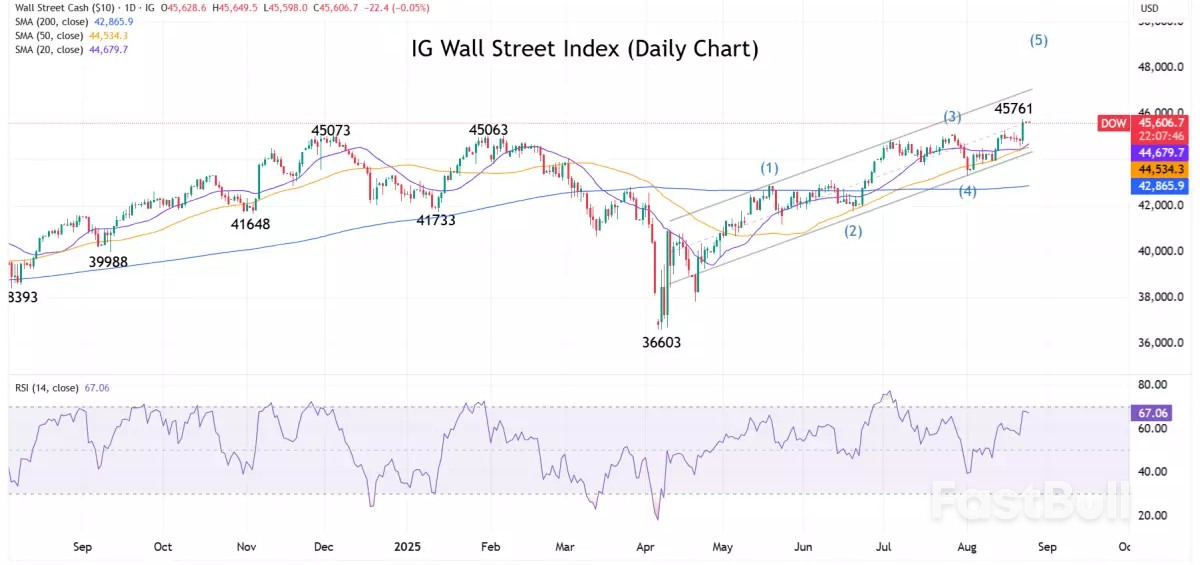
          Despite recovering 25% from April's trough, the Wall Street Index's rebound magnitude remains significantly below the US Tech 100's 43% advance. The ongoing sector rotation may provide additional upside potential for the blue-chip index. Technical analysis reveals an Elliott Wave pattern, with price action since 31 July resembling Wave 5. A 61.8% Fibonacci extension of Waves 1 and 3 combined suggests an optimistic price target of 48,578. However, the index must first overcome resistance at the ascending channel's upper boundary near 47,000. Any pullback should find support at the 20-day moving average (MA) at 43,146.
          Figure 1: Wall Street Index (daily) price chart
          Market navigator: week of 25 August 2025_1

          as of 25 August 2025. Past performance is not a reliable indicator of future performance.

          Surge in HIBOR constrains Hang Seng performance

          Hong Kong's one-month Hong Kong Interbank Offered Rate (HIBOR) rebounded sharply from approximately 0.9% to 2.9% last week as the aggregate balance in Hong Kong's banking system contracted to HK$53.7 billion following Hong Kong Monetary Authority intervention to prevent HKD weakening beyond HK$7.85 per USD.
          The sharp increase in borrowing costs dampened investment appetite, particularly affecting investors utilising margin accounts or leveraged strategies. Consequently, the Hang Seng Index advanced only 0.3% despite the robust rally in onshore markets.
          Technology stocks led gains as investors positioned for increased demand for domestic semiconductors amid exponential artificial intelligence growth and reports that Chinese authorities have discouraged use of NVIDIA's H20 chips on national security grounds. Corporate earnings also drove market movements, with Pop Mart shares reaching a record high of HK$328 after the Chinese toy manufacturer reported nearly 400% net profit growth, driven by surging global demand for its Labubu products.
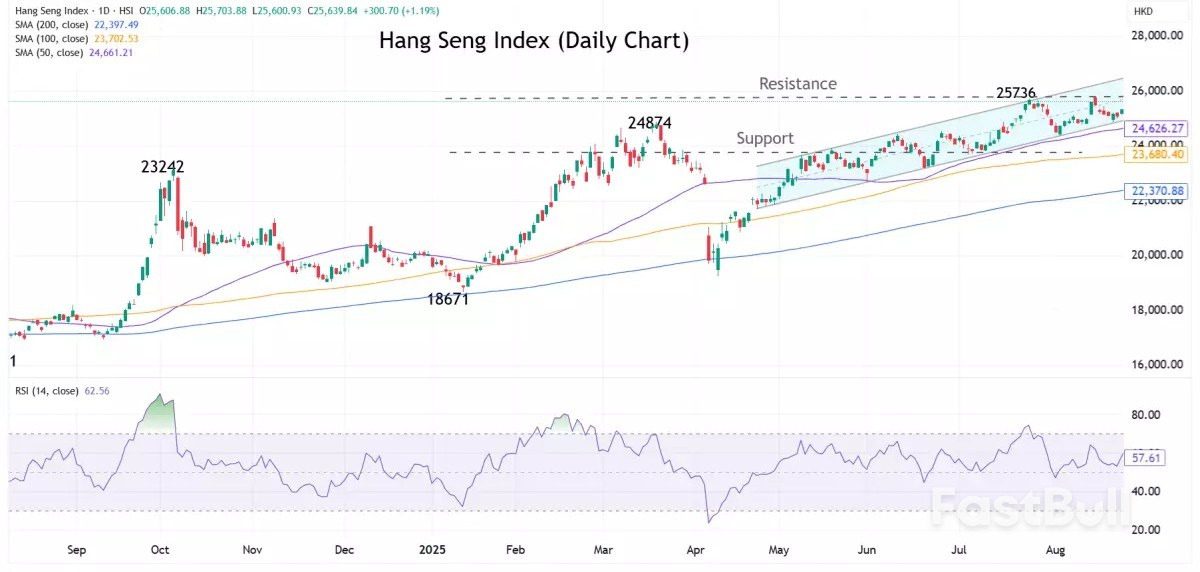
          From a technical perspective, 25,750 has established itself as a key resistance level for the Hang Seng Index. Should the index breach this threshold, it will encounter major resistance at 26,300 — a level that proved formidable during 2021. The Relative Strength Index (RSI) warrants close monitoring as early signs of bearish divergence emerge. Should the RSI peak below 64 in upcoming sessions, this would signal diminished price momentum, potentially driving the index toward 24,626 near the 50-day moving average.
          Figure 2: Hang Seng Index (daily) price chart

          Market navigator: week of 25 August 2025_2as of 25 August 2025. Past performance is not a reliable indicator of future performance.

          AUD/USD under pressure from regional headwinds

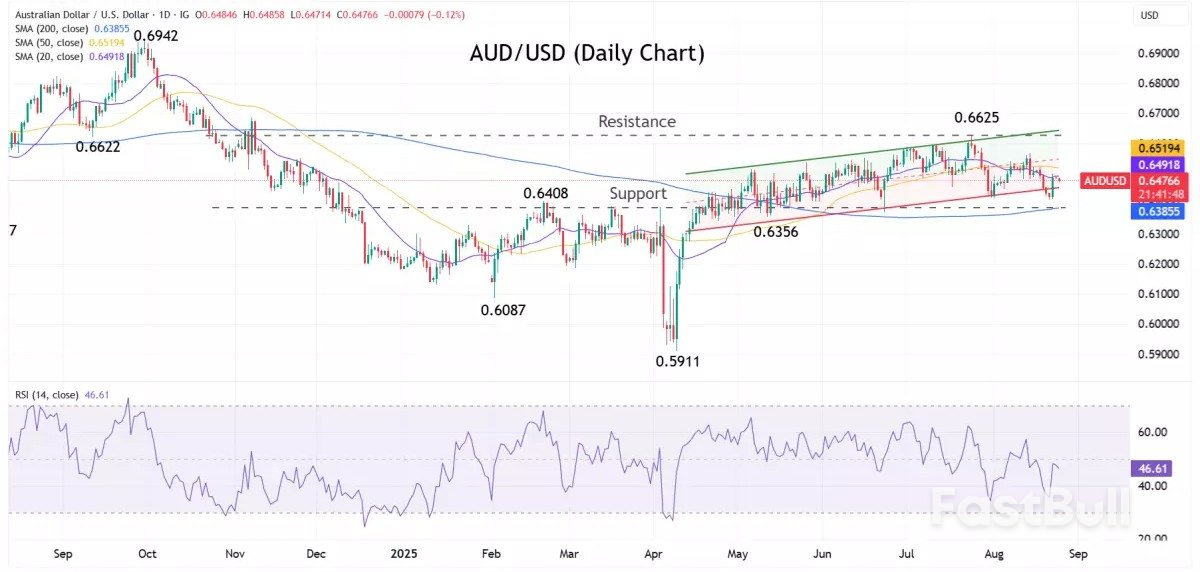
          AUD/USD declined 0.4% last week, closing at 0.6485 as weak Chinese economic activity and spillover effects from the dovish Reserve Bank of New Zealand rate cut weighed on the Australian dollar. Chair Powell's Jackson Hole address pressured the USD, enabling AUD/USD to recover from Thursday's low of 0.6412. The Reserve Bank of Australia's (RBA) August meeting minutes, scheduled for Tuesday, and Wednesday's monthly inflation indicator will determine the currency pair's near-term direction.
          Technical analysis shows AUD/USD briefly fell below its ascending channel on Wednesday, risking a test of the 200-day moving average at 0.6380. While Friday's recovery restored the pair within the ascending channel, sustained momentum above the 20-day moving average at 0.6492 is required to rebuild confidence in AUD/USD's gradual ascent toward 0.67. Immediate support is positioned at 0.6450, followed by 0.6386.
          Figure 3: AUD/USD (daily) price chart

          Market navigator: week of 25 August 2025_3 as of 25 August 2025. Past performance is not a reliable indicator of future performance.

          The week ahead

          This week presents a critical assessment of global economic momentum and inflation dynamics, with high-impact data releases and corporate earnings influencing market sentiment.
          In the US, focus centres on the Fed's preferred inflation measure — the core Personal Consumption Expenditure (PCE) Index, which will provide essential input for the Fed's interest rates decision on 17 September. Personal income and spending data, released alongside the PCE, will further clarify consumer resilience.
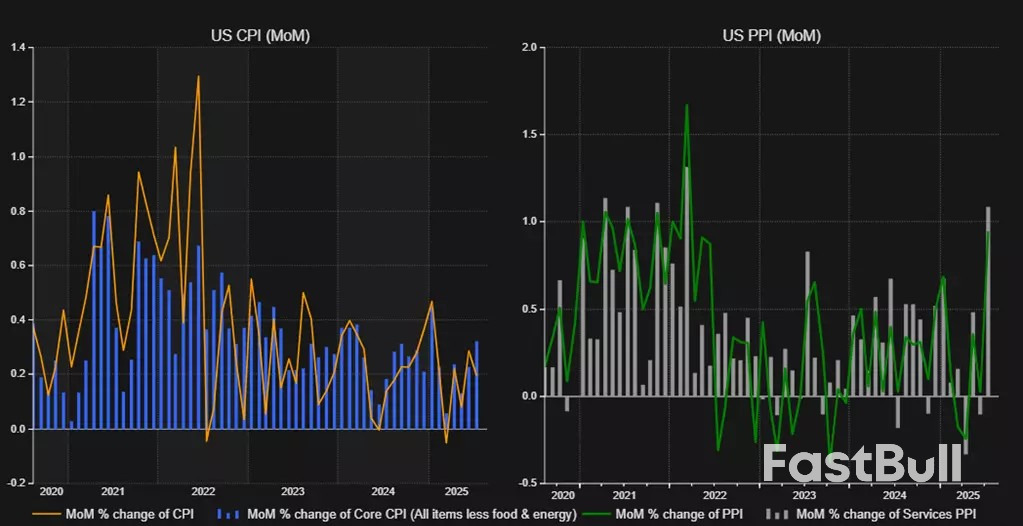
          Recent inflation reports revealed core CPI growth of 0.3% month-on-month (MoM), while the Producer Price Index (PPI) surged 0.9% monthly, driven by services sector inflation. Producer prices recorded their sharpest monthly increase since March 2022, significantly exceeding expectations as businesses adjust pricing to accommodate higher tariff-related costs. This development raises the possibility that the forthcoming core PCE reading may exceed the market consensus of 0.3% MoM.
          China's manufacturing sector faces scrutiny on Sunday with the release of the official Purchasing Managers' Index (PMI) for August. Particular attention will focus on the manufacturing component, which has remained in contractionary territory since April. Investors will analyse the data for insights into the impact of uncertain US-China trade policy developments.
          On the corporate front, NVIDIA is scheduled to report quarterly results after market close on Wednesday, 27 August, with analysts anticipating revenue of $45.8 billion (representing 52% YoY growth). These results will prove pivotal for technology sector sentiment, particularly regarding whether continued artificial intelligence enthusiasm can justify elevated valuations.
          Concurrently, China's earnings season reaches its climax. Alibaba will announce June quarter results on Friday, while other prominent names including BYD, Meituan, and major Chinese banks are expected to release results, providing insights into consumer trends, industrial performance, and financial sector health.
          Figure 4: US consumer and producer price trends
          Market navigator: week of 25 August 2025_4

          Source: ig

          To stay updated on all economic events of today, please check out our Economic calendar
          Risk Warnings and Disclaimers
          You understand and acknowledge that there is a high degree of risk involved in trading. Following any strategies or investment methods may lead to potential losses. The content on the site is provided by our contributors and analysts for information purposes only. You are solely responsible for determining whether any trading assets, securities, strategy, or any other product is suitable for investing based on your own investment objectives and financial situation.
          Add to Favorites
          Share

          Treasuries Fall As Traders Weigh Rate-Cut Outlook After Powell

          James Whitman

          Economic

          Bond

          US Treasuries slipped ahead of a series of government bond auctions this week, pulling back from the rally unleashed Friday when Federal Reserve Chair Jerome Powell indicated that interest rate cuts may come as soon as next month.

          Yields were up by one to three basis points across tenors Monday morning in New York, with the benchmark 10 year’s rising to about 4.28%. The market tracked a similar move in European government bonds, led by France, where 10-year yields were up seven basis points as the prime minister said he would call for a vote of no confidence on Sept. 8.

          The US pullback ate away at some of the gains that came when Powell used his speech at Jackson Hole, Wyoming, to indicate a rate cut may be warranted to support the labor market. In response, traders increased wagers on a reduction at September’s meeting and Wall Street strategists said to expect a steeper yield curve — a typical reaction to a more dovish Fed.

          Some strategists, however, warned that any move will depend on upcoming releases on inflation and the labor market.

          Fed officials “are going to keep a very, very close eye on the data,” Gennadiy Goldberg, head of US rates strategy at TD Securities, told Bloomberg Radio. “This cutting cycle breaks the mold of most cutting cycles.”

          Even with Powell’s pivot, there’s the possibility of a repeat of last year, when the Fed started easing policy, only to stop in January when the economy kept exhibiting surprising strength.

          Futures traders don’t see a quarter-point cut at its Sept. 17 interest-rate decision as a sure thing, pricing in the odds at around 80%. They are pricing in two cuts by the end of the year.

          This week, demand for Treasuries will get a fresh test as the government holds auctions for a combined $183 billion of two-,five- and seven-year notes, with the first sale scheduled for Tuesday.

          On Friday, investors will also get a read on inflation when the personal consumer expenditure index — which is the Fed’s favored inflation gauge — is released for July.

          Source: Bloomberg

          To stay updated on all economic events of today, please check out our Economic calendar
          Risk Warnings and Disclaimers
          You understand and acknowledge that there is a high degree of risk involved in trading. Following any strategies or investment methods may lead to potential losses. The content on the site is provided by our contributors and analysts for information purposes only. You are solely responsible for determining whether any trading assets, securities, strategy, or any other product is suitable for investing based on your own investment objectives and financial situation.
          Add to Favorites
          Share
          FastBull
          Copyright © 2025 FastBull Ltd

          728 RM B 7/F GEE LOK IND BLDG NO 34 HUNG TO RD KWUN TONG KLN HONG KONG

          TelegramInstagramTwitterfacebooklinkedin
          App Store Google Play Google Play
          Products
          Charts

          Chats

          Q&A with Experts
          Screeners
          Economic Calendar
          Data
          Tools
          Membership
          Features
          Function
          Markets
          Copy Trading
          Latest Signals
          Contests
          News
          Analysis
          24/7
          Columns
          Education
          Company
          Careers
          About Us
          Contact Us
          Advertising
          Help Center
          Feedback
          User Agreement
          Privacy Policy
          Business

          White Label

          Data API

          Web Plug-ins

          Poster Maker

          Affiliate Program

          Risk Disclosure

          The risk of loss in trading financial instruments such as stocks, FX, commodities, futures, bonds, ETFs and crypto can be substantial. You may sustain a total loss of the funds that you deposit with your broker. Therefore, you should carefully consider whether such trading is suitable for you in light of your circumstances and financial resources.

          No decision to invest should be made without thoroughly conducting due diligence by yourself or consulting with your financial advisors. Our web content might not suit you since we don't know your financial conditions and investment needs. Our financial information might have latency or contain inaccuracy, so you should be fully responsible for any of your trading and investment decisions. The company will not be responsible for your capital loss.

          Without getting permission from the website, you are not allowed to copy the website's graphics, texts, or trademarks. Intellectual property rights in the content or data incorporated into this website belong to its providers and exchange merchants.

          Not Logged In

          Log in to access more features

          FastBull Membership

          Not yet

          Purchase

          Become a signal provider
          Help Center
          Customer Service
          Dark Mode
          Price Up/Down Colors

          Log In

          Sign Up

          Position
          Layout
          Fullscreen
          Default to Chart
          The chart page opens by default when you visit fastbull.com