Markets
News
Analysis
User
24/7
Economic Calendar
Education
Data
- Names
- Latest
- Prev


Signal Accounts for Members
All Signal Accounts
All Contests


U.K. Trade Balance Non-EU (SA) (Oct)A:--
F: --
P: --
U.K. Trade Balance (Oct)A:--
F: --
P: --
U.K. Services Index MoMA:--
F: --
P: --
U.K. Construction Output MoM (SA) (Oct)A:--
F: --
P: --
U.K. Industrial Output YoY (Oct)A:--
F: --
P: --
U.K. Trade Balance (SA) (Oct)A:--
F: --
P: --
U.K. Trade Balance EU (SA) (Oct)A:--
F: --
P: --
U.K. Manufacturing Output YoY (Oct)A:--
F: --
P: --
U.K. GDP MoM (Oct)A:--
F: --
P: --
U.K. GDP YoY (SA) (Oct)A:--
F: --
P: --
U.K. Industrial Output MoM (Oct)A:--
F: --
P: --
U.K. Construction Output YoY (Oct)A:--
F: --
P: --
France HICP Final MoM (Nov)A:--
F: --
P: --
China, Mainland Outstanding Loans Growth YoY (Nov)A:--
F: --
P: --
China, Mainland M2 Money Supply YoY (Nov)A:--
F: --
P: --
China, Mainland M0 Money Supply YoY (Nov)A:--
F: --
P: --
China, Mainland M1 Money Supply YoY (Nov)A:--
F: --
P: --
India CPI YoY (Nov)A:--
F: --
P: --
India Deposit Gowth YoYA:--
F: --
P: --
Brazil Services Growth YoY (Oct)A:--
F: --
P: --
Mexico Industrial Output YoY (Oct)A:--
F: --
P: --
Russia Trade Balance (Oct)A:--
F: --
P: --
Philadelphia Fed President Henry Paulson delivers a speech
Canada Building Permits MoM (SA) (Oct)A:--
F: --
P: --
Canada Wholesale Sales YoY (Oct)A:--
F: --
P: --
Canada Wholesale Inventory MoM (Oct)A:--
F: --
P: --
Canada Wholesale Inventory YoY (Oct)A:--
F: --
P: --
Canada Wholesale Sales MoM (SA) (Oct)A:--
F: --
P: --
Germany Current Account (Not SA) (Oct)A:--
F: --
P: --
U.S. Weekly Total Rig CountA:--
F: --
P: --
U.S. Weekly Total Oil Rig CountA:--
F: --
P: --
Japan Tankan Large Non-Manufacturing Diffusion Index (Q4)--
F: --
P: --
Japan Tankan Small Manufacturing Outlook Index (Q4)--
F: --
P: --
Japan Tankan Large Non-Manufacturing Outlook Index (Q4)--
F: --
P: --
Japan Tankan Large Manufacturing Outlook Index (Q4)--
F: --
P: --
Japan Tankan Small Manufacturing Diffusion Index (Q4)--
F: --
P: --
Japan Tankan Large Manufacturing Diffusion Index (Q4)--
F: --
P: --
Japan Tankan Large-Enterprise Capital Expenditure YoY (Q4)--
F: --
P: --
U.K. Rightmove House Price Index YoY (Dec)--
F: --
P: --
China, Mainland Industrial Output YoY (YTD) (Nov)--
F: --
P: --
China, Mainland Urban Area Unemployment Rate (Nov)--
F: --
P: --
Saudi Arabia CPI YoY (Nov)--
F: --
P: --
Euro Zone Industrial Output YoY (Oct)--
F: --
P: --
Euro Zone Industrial Output MoM (Oct)--
F: --
P: --
Canada Existing Home Sales MoM (Nov)--
F: --
P: --
Euro Zone Total Reserve Assets (Nov)--
F: --
P: --
U.K. Inflation Rate Expectations--
F: --
P: --
Canada National Economic Confidence Index--
F: --
P: --
Canada New Housing Starts (Nov)--
F: --
P: --
U.S. NY Fed Manufacturing Employment Index (Dec)--
F: --
P: --
U.S. NY Fed Manufacturing Index (Dec)--
F: --
P: --
Canada Core CPI YoY (Nov)--
F: --
P: --
Canada Manufacturing Unfilled Orders MoM (Oct)--
F: --
P: --
Canada Manufacturing New Orders MoM (Oct)--
F: --
P: --
Canada Core CPI MoM (Nov)--
F: --
P: --
Canada Manufacturing Inventory MoM (Oct)--
F: --
P: --
Canada CPI YoY (Nov)--
F: --
P: --
Canada CPI MoM (Nov)--
F: --
P: --
Canada CPI YoY (SA) (Nov)--
F: --
P: --
Canada Core CPI MoM (SA) (Nov)--
F: --
P: --


No matching data
Latest Views
Latest Views
Trending Topics
Top Columnists
Latest Update
White Label
Data API
Web Plug-ins
Affiliate Program
View All

No data
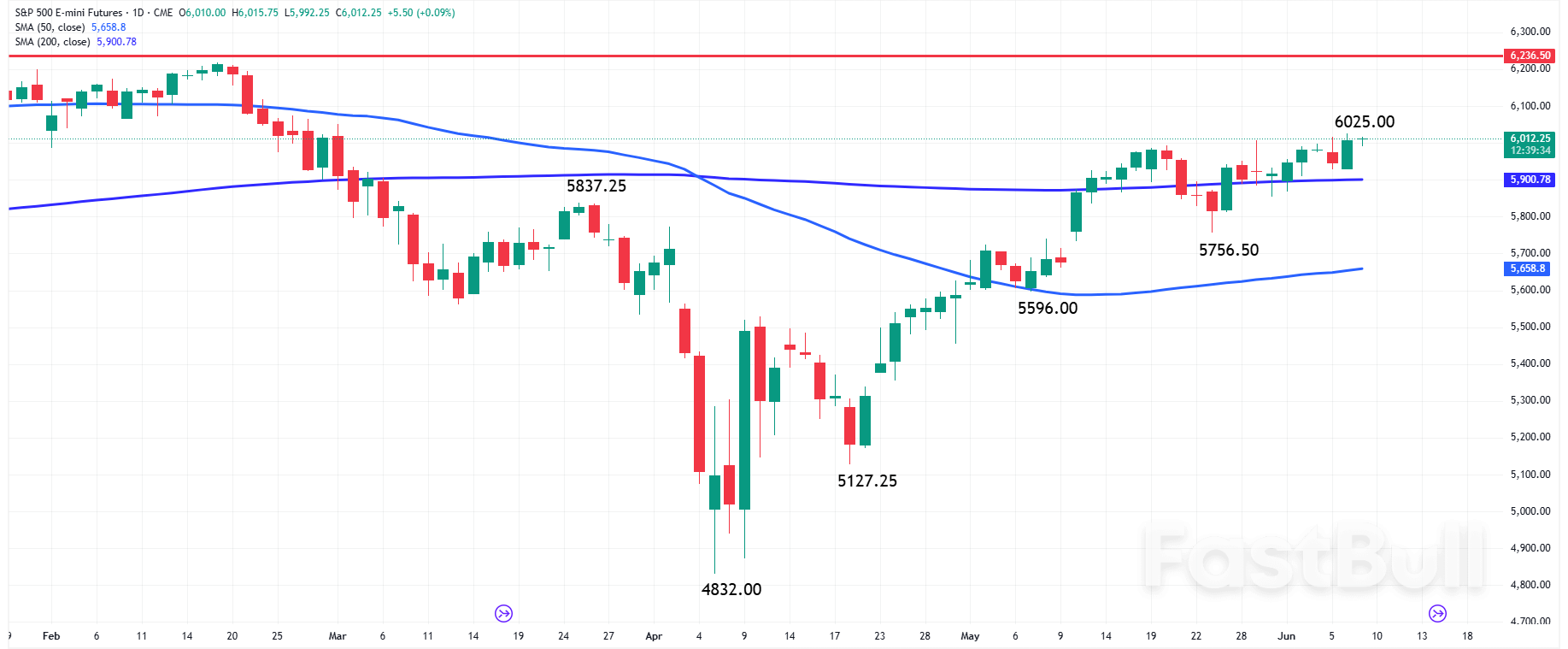
The S&P 500 reclaimed the 6000 level, nearing record highs after strong jobs data and easing tariff fears. Markets may see further gains, though inflation data and earnings will shape outlook.
The chances of an acceleration in inflation numbers in the coming months are growing as President Donald Trump’s aggressive tariff regime begins to drive prices higher, according to analysts at JPMorgan Chase (NYSE:JPM).
In a note to clients on Monday, the analysts led by Mislav Matejka added that this trend, along with the risk of softening growth figures, could put the Federal Reserve in a "difficult position" as it assesses the future path of interest rates.
Should the dilemma facing the Fed worsen over the summer, U.S. equities and other international markets would likely be impacted, they said.
"JPM’s call is that recession will be avoided, but at 40% our economists believe the chances are not insignificant, and the current market pricing is probably underplaying this," the strategists wrote. "We believe the above combination of softer activity and at the same time higher inflation will drive a stalling in equity rebound that was in force over the past two months."
Against this backdrop, some of the brokerage’s top picks included European names like materials group Air Liquide (OTC:AIQUY), lenders Deutsche Bank and Societe Generale (OTC:SCGLY), carrier Ryanair, and consumer staples firm Unilever (LON:ULVR).
On the economic calendar this week, all eyes will be on the release of May’s reading of U.S. consumer price, which could provide a glimpse into the impact of Trump’s aggressive tariff policies on inflation.
The Labor Department’s consumer price index is tipped to speed up slightly to 2.5% from 2.3%, while the month-on-month gauge is expected to match April’s pace of 0.2%.
Cutting out more volatile items like food and fuel, the index is seen edging up to 2.9% year-over year and 0.3% on a monthly basis.
Following the release of the data on Wednesday, further data points are due out that track producer prices and consumer expectations for inflation in the months ahead.
Separate data last week showed that the U.S. added 139,000 jobs in May, falling from 147,000 in April but above economists’ estimates of 126,000, Labor Department data showed on Friday. April’s figure had originally stood at 177,000, while March’s total was also brought down by 65,000 to 120,000.
Federal employment declined by 22,000, reflecting an ongoing push by the White House to cut away at the size of the U.S. government workforce. Employment in the sector has slipped by 59,000 since January, when Trump returned to office for a second term in office.
Hiring in the health care, hospitality, and social assistance segments were trending up, the Labor Department’s Bureau of Labor Statistics said in a statement.
The unemployment rate was 4.2%, matching the previous month’s pace, while average hourly wage growth edged up to 0.4% month-on-month from 0.2%.

Gold prices edged higher in early trading today, despite rising optimism that the US and China may soon bury the hatchet and reach a trade accord. That renewed optimism has been fuelling a robust rally in global equities of late, which in turn has dulled some of the appeal for safe-haven assets like gold and yen.
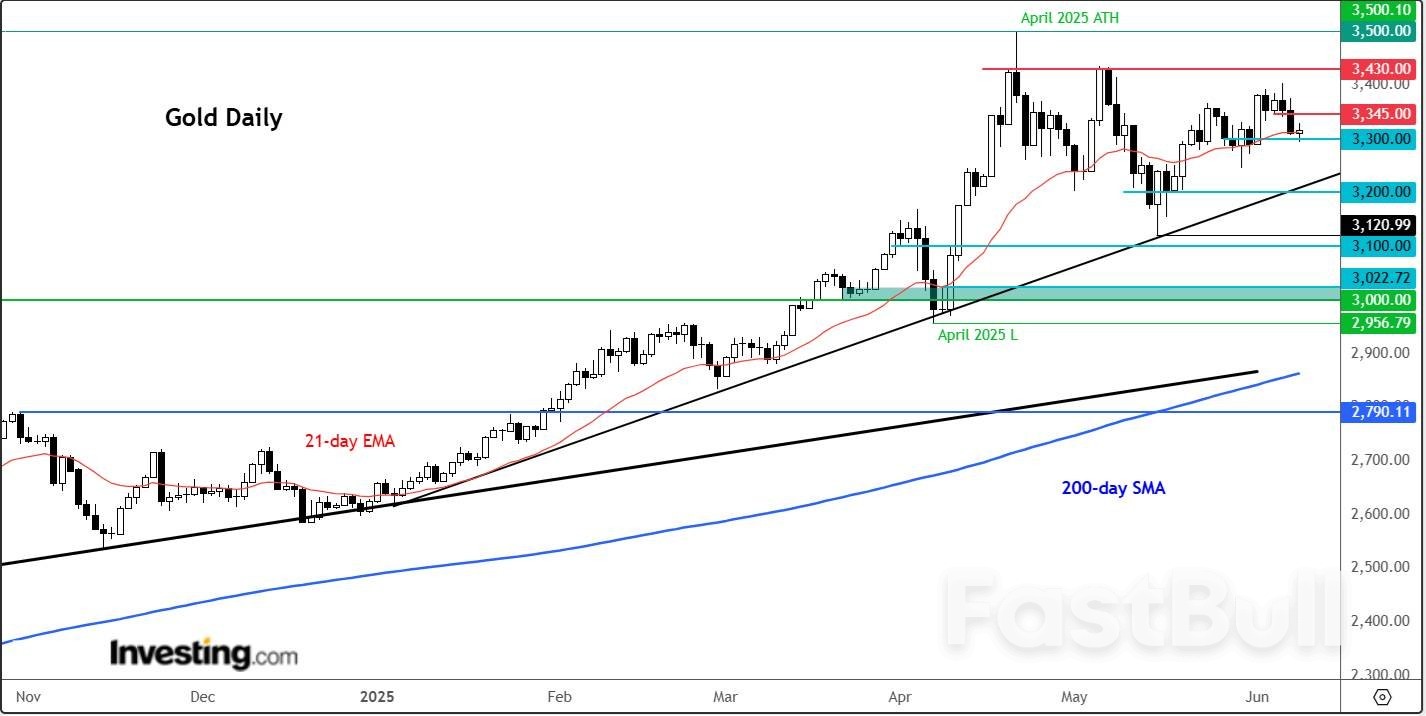
Indeed, we haven’t seen a new record high since gold hit $3,500 back in April, even though other precious metals like silver and platinum have rallied strongly.
Now, with high-level trade talks between Washington and Beijing scheduled to take place in London today—following what’s been described as a “very positive” call between Presidents Trump and Xi last week—there’s room for sentiment to improve further. Meanwhile, Friday’s better-than-expected US jobs report could encourage dollar dip buyers today, potentially putting pressure on gold prices.
In that context, a short-term correction wouldn’t be a shocker. But could we see a more significant move towards the psychologically significant $3,000 level in the coming weeks?
Gold’s been struggling to reclaim the $3,400 mark, despite silver’s breakout last week to its highest level since 2012—around $36 per ounce. There’s also been some action in other precious metals, with platinum especially catching a bid thanks to tightening supply and a surge in jewellery demand as a cheaper alternative to gold.
Yet, despite being the first to make headlines with successive record highs in recent years, gold now appears to be lagging behind its shinier cousins. While the yellow metal has found some traction this morning as US wakes up, the overall lack of momentum and the improved appetite for risk suggest it might face more pressure.
Investors seem to be reallocating to riskier assets, leaving gold vulnerable to a potential deeper pullback – though, so far, we haven’t seen such a move.
A strengthening US dollar—particularly against currencies like the pound, euro, and yen—could exacerbate the weakness. These currencies outperformed during times of global trade anxiety in the last few months, so with tensions easing, the greenback may come back into favour. And a stronger dollar usually spells trouble for dollar-denominated assets like gold.
After last week’s barrage of economic figures, this week’s calendar is looking a little more relaxed—especially with much of Europe enjoying a public holiday today. For gold traders, attention will shift to the US CPI figures on Wednesday and the University of Michigan’s consumer sentiment survey on Friday.
Last month’s CPI came in lighter than expected at 2.3%, versus a forecast of 2.4%, and several other indicators disappointed as well, raising hopes of a rate cut from the Fed. But it was really the uncertainty around tariffs that had the most pronounced impact on the dollar.
Now, with the US and China back at the negotiating table, that uncertainty is receding. A strong inflation print this week could breathe fresh life into the dollar, putting some downward pressure on gold.
Friday’s consumer sentiment report will be closely watched too. With equity markets roaring back in recent weeks, traders will want to see whether consumer confidence is also on the up. A strong showing here could reinforce bullish dollar bets and sap demand for safe-haven assets like gold.
Gold’s modest bounce this morning follows a two-day slide late last week. While we haven’t seen any screaming sell signals just yet, the failure to notch fresh highs since April’s peak certainly raises the risk of further downside—particularly if risk sentiment continues to improve.

At the moment, the $3,300 support level is just about holding. But if that gives way, things could get lively. The next real level of support doesn’t come into play until the trendline around $3,200. A decisive break could see gold drop $100 in fairly short order. Below that, the mid-May low of $3,120 will be key, and after that we’re looking at the big psychological level—$3,000.
That said, the broader trend remains bullish. So while there’s short-term downside risk, don’t write off gold just yet. Resistance to watch includes the $3,345 area—last week’s former support turned resistance. Beyond that, $3,400 is back in play, with $3,430 the next level up.
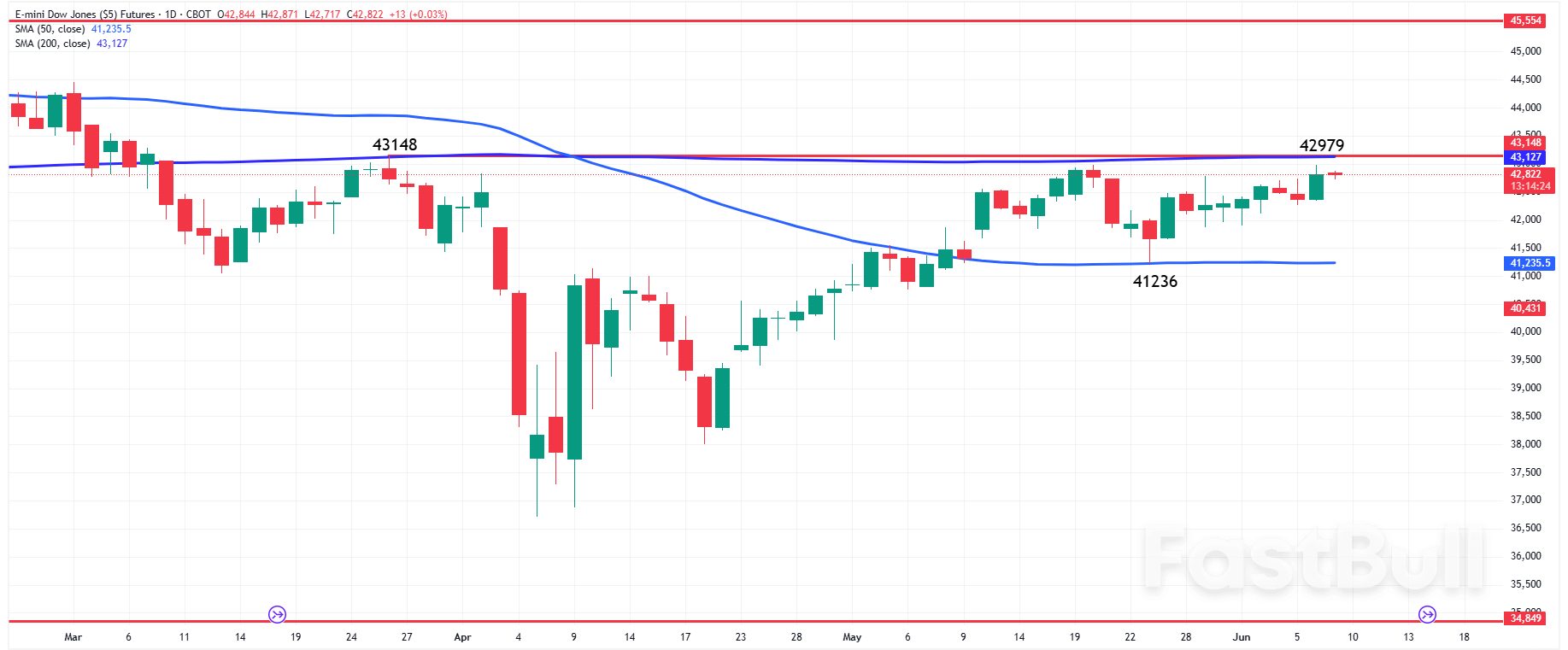
Daily E-mini S&P 500 Index

White Label
Data API
Web Plug-ins
Poster Maker
Affiliate Program
The risk of loss in trading financial instruments such as stocks, FX, commodities, futures, bonds, ETFs and crypto can be substantial. You may sustain a total loss of the funds that you deposit with your broker. Therefore, you should carefully consider whether such trading is suitable for you in light of your circumstances and financial resources.
No decision to invest should be made without thoroughly conducting due diligence by yourself or consulting with your financial advisors. Our web content might not suit you since we don't know your financial conditions and investment needs. Our financial information might have latency or contain inaccuracy, so you should be fully responsible for any of your trading and investment decisions. The company will not be responsible for your capital loss.
Without getting permission from the website, you are not allowed to copy the website's graphics, texts, or trademarks. Intellectual property rights in the content or data incorporated into this website belong to its providers and exchange merchants.
Not Logged In
Log in to access more features

FastBull Membership
Not yet
Purchase
Log In
Sign Up