• Trade
  • Markets
  • Copy
  • Contests
  • News
  • 24/7
  • Calendar
  • Q&A
  • Chats
Trending
Screeners
SYMBOL
LAST
BID
ASK
HIGH
LOW
NET CHG.
%CHG.
SPREAD
SPX
S&P 500 Index
6827.42
6827.42
6827.42
6899.86
6801.80
-73.58
-1.07%
--
DJI
Dow Jones Industrial Average
48458.04
48458.04
48458.04
48886.86
48334.10
-245.98
-0.51%
--
IXIC
NASDAQ Composite Index
23195.16
23195.16
23195.16
23554.89
23094.51
-398.69
-1.69%
--
USDX
US Dollar Index
97.950
98.030
97.950
98.500
97.950
-0.370
-0.38%
--
EURUSD
Euro / US Dollar
1.17394
1.17409
1.17394
1.17496
1.17192
+0.00011
+ 0.01%
--
GBPUSD
Pound Sterling / US Dollar
1.33707
1.33732
1.33707
1.33997
1.33419
-0.00148
-0.11%
--
XAUUSD
Gold / US Dollar
4299.39
4299.39
4299.39
4353.41
4257.10
+20.10
+ 0.47%
--
WTI
Light Sweet Crude Oil
57.233
57.485
57.233
58.011
56.969
-0.408
-0.71%
--

Community Accounts

Signal Accounts
--
Profit Accounts
--
Loss Accounts
--
View More

Become a signal provider

Sell trading signals to earn additional income

View More

Guide to Copy Trading

Get started with ease and confidence

View More

Signal Accounts for Members

All Signal Accounts

Best Return
  • Best Return
  • Best P/L
  • Best MDD
Past 1W
  • Past 1W
  • Past 1M
  • Past 1Y

All Contests

  • All
  • Trump Updates
  • Recommend
  • Stocks
  • Cryptocurrencies
  • Central Banks
  • Featured News
Top News Only
Share

Thai Leader Anutin: Landmine Blast That Killed Thai Soldiers 'Not A Roadside Accident'

Share

Thai Leader Anutin: Thailand To Continue Military Action Until 'We Feel No More Harm'

Share

Cambodian Prime Minister Hun Manet Says He Had Phone Calls With Trump And Malaysian Leader Anwar About Ceasefire

Share

Cambodia's Hun Manet Says USA, Malaysia Should Verify 'Which Side Fired First' In Latest Conflict

Share

Cambodia's Hun Manet: Cambodia Maintains Its Stance In Seeking Peaceful Resolution Of Disputes

Share

Nasdaq Companies: Allergan, Ferrovia, Insmed, Monolithic Power Systems, Seagate Technology, And Western Digital Will Be Added To The NASDAQ 100 Index. Biogen, CdW, GlobalFoundries, Lululemon, ON Semiconductor, And Tradedesk Will Be Removed From The NASDAQ 100 Index

Share

Witkoff Headed To Berlin This Weekend To Meet With Zelenskiy, European Leaders -Wsj Reporter On X

Share

Russia Attacks Two Ukrainian Ports, Damaging Three Turkish-Owned Vessels

Share

[Historic Flooding Occurs In At Least Four Rivers In Washington State Due To Days Of Torrential Rains] Multiple Areas In Washington State Have Been Hit By Severe Flooding Due To Days Of Torrential Rains, With At Least Four Rivers Experiencing Historic Flooding. Reporters Learned On The 12th That The Floods Caused By The Torrential Rains In Washington State Have Destroyed Homes And Closed Several Highways. Experts Warn That Even More Severe Flooding May Occur In The Future. A State Of Emergency Has Been Declared In Washington State

Share

Trump Says Proposed Free Economic Zone In Donbas Would Work

Share

Trump: I Think My Voice Should Be Heard

Share

Trump Says Will Be Choosing New Fed Chair In Near Future

Share

Trump Says Proposed Free Economic Zone In Donbas Complex But Would Work

Share

Trump Says Land Strikes In Venezuela Will Start Happening

Share

US President Trump: Thailand And Cambodia Are In A Good Situation

Share

State Media: North Korean Leader Kim Hails Troops Returning From Russia Mission

Share

The 10-year Treasury Yield Rose About 5 Basis Points During The "Fed Rate Cut Week," And The 2/10-year Yield Spread Widened By About 9 Basis Points. On Friday (December 12), In Late New York Trading, The Yield On The Benchmark 10-year US Treasury Note Rose 2.75 Basis Points To 4.1841%, A Cumulative Increase Of 4.90 Basis Points For The Week, Trading Within A Range Of 4.1002%-4.2074%. It Rose Steadily From Monday To Wednesday (before The Fed Announced Its Rate Cut And Treasury Bill Purchase Program), Subsequently Exhibiting A V-shaped Recovery. The 2-year Treasury Yield Fell 1.82 Basis Points To 3.5222%, A Cumulative Decrease Of 3.81 Basis Points For The Week, Trading Within A Range Of 3.6253%-3.4989%

Share

Trump: Lots Of Progress Being Made On Russia-Ukraine

Share

NOPA November US Soybean Crush Estimated At 220.285 Million Bushels

Share

SPDR Gold Trust Reports Holdings Up 0.22%, Or 2.28 Tonnes, To 1053.11 Tonnes By Dec 12

TIME
ACT
FCST
PREV
U.K. Trade Balance Non-EU (SA) (Oct)

A:--

F: --

P: --

U.K. Trade Balance (Oct)

A:--

F: --

P: --

U.K. Services Index MoM

A:--

F: --

P: --

U.K. Construction Output MoM (SA) (Oct)

A:--

F: --

P: --

U.K. Industrial Output YoY (Oct)

A:--

F: --

P: --

U.K. Trade Balance (SA) (Oct)

A:--

F: --

P: --

U.K. Trade Balance EU (SA) (Oct)

A:--

F: --

P: --

U.K. Manufacturing Output YoY (Oct)

A:--

F: --

P: --

U.K. GDP MoM (Oct)

A:--

F: --

P: --

U.K. GDP YoY (SA) (Oct)

A:--

F: --

P: --

U.K. Industrial Output MoM (Oct)

A:--

F: --

P: --

U.K. Construction Output YoY (Oct)

A:--

F: --

P: --

France HICP Final MoM (Nov)

A:--

F: --

P: --

China, Mainland Outstanding Loans Growth YoY (Nov)

A:--

F: --

P: --

China, Mainland M2 Money Supply YoY (Nov)

A:--

F: --

P: --

China, Mainland M0 Money Supply YoY (Nov)

A:--

F: --

P: --

China, Mainland M1 Money Supply YoY (Nov)

A:--

F: --

P: --

India CPI YoY (Nov)

A:--

F: --

P: --

India Deposit Gowth YoY

A:--

F: --

P: --

Brazil Services Growth YoY (Oct)

A:--

F: --

P: --

Mexico Industrial Output YoY (Oct)

A:--

F: --

P: --

Russia Trade Balance (Oct)

A:--

F: --

P: --

Philadelphia Fed President Henry Paulson delivers a speech
Canada Building Permits MoM (SA) (Oct)

A:--

F: --

P: --

Canada Wholesale Sales YoY (Oct)

A:--

F: --

P: --

Canada Wholesale Inventory MoM (Oct)

A:--

F: --

P: --

Canada Wholesale Inventory YoY (Oct)

A:--

F: --

P: --

Canada Wholesale Sales MoM (SA) (Oct)

A:--

F: --

P: --

Germany Current Account (Not SA) (Oct)

A:--

F: --

P: --

U.S. Weekly Total Rig Count

A:--

F: --

P: --

U.S. Weekly Total Oil Rig Count

A:--

F: --

P: --

Japan Tankan Large Non-Manufacturing Diffusion Index (Q4)

--

F: --

P: --

Japan Tankan Small Manufacturing Outlook Index (Q4)

--

F: --

P: --

Japan Tankan Large Non-Manufacturing Outlook Index (Q4)

--

F: --

P: --

Japan Tankan Large Manufacturing Outlook Index (Q4)

--

F: --

P: --

Japan Tankan Small Manufacturing Diffusion Index (Q4)

--

F: --

P: --

Japan Tankan Large Manufacturing Diffusion Index (Q4)

--

F: --

P: --

Japan Tankan Large-Enterprise Capital Expenditure YoY (Q4)

--

F: --

P: --

U.K. Rightmove House Price Index YoY (Dec)

--

F: --

P: --

China, Mainland Industrial Output YoY (YTD) (Nov)

--

F: --

P: --

China, Mainland Urban Area Unemployment Rate (Nov)

--

F: --

P: --

Saudi Arabia CPI YoY (Nov)

--

F: --

P: --

Euro Zone Industrial Output YoY (Oct)

--

F: --

P: --

Euro Zone Industrial Output MoM (Oct)

--

F: --

P: --

Canada Existing Home Sales MoM (Nov)

--

F: --

P: --

Euro Zone Total Reserve Assets (Nov)

--

F: --

P: --

U.K. Inflation Rate Expectations

--

F: --

P: --

Canada National Economic Confidence Index

--

F: --

P: --

Canada New Housing Starts (Nov)

--

F: --

P: --

U.S. NY Fed Manufacturing Employment Index (Dec)

--

F: --

P: --

U.S. NY Fed Manufacturing Index (Dec)

--

F: --

P: --

Canada Core CPI YoY (Nov)

--

F: --

P: --

Canada Manufacturing Unfilled Orders MoM (Oct)

--

F: --

P: --

Canada Manufacturing New Orders MoM (Oct)

--

F: --

P: --

Canada Core CPI MoM (Nov)

--

F: --

P: --

Canada Manufacturing Inventory MoM (Oct)

--

F: --

P: --

Canada CPI YoY (Nov)

--

F: --

P: --

Canada CPI MoM (Nov)

--

F: --

P: --

Canada CPI YoY (SA) (Nov)

--

F: --

P: --

Canada Core CPI MoM (SA) (Nov)

--

F: --

P: --

Q&A with Experts
    • All
    • Chatrooms
    • Groups
    • Friends
    Connecting
    .
    .
    .
    Type here...
    Add Symbol or Code

      No matching data

      All
      Trump Updates
      Recommend
      Stocks
      Cryptocurrencies
      Central Banks
      Featured News
      • All
      • Russia-Ukraine Conflict
      • Middle East Flashpoint
      • All
      • Russia-Ukraine Conflict
      • Middle East Flashpoint
      Search
      Products

      Charts Free Forever

      Chats Q&A with Experts
      Screeners Economic Calendar Data Tools
      Membership Features
      Data Warehouse Market Trends Institutional Data Policy Rates Macro

      Market Trends

      Market Sentiment Order Book Forex Correlations

      Top Indicators

      Charts Free Forever
      Markets

      News

      News Analysis 24/7 Columns Education
      From Institutions From Analysts
      Topics Columnists

      Latest Views

      Latest Views

      Trending Topics

      Top Columnists

      Latest Update

      Signals

      Copy Rankings Latest Signals Become a signal provider AI Rating
      Contests
      Brokers

      Overview Brokers Assessment Rankings Regulators News Claims
      Broker listing Forex Brokers Comparison Tool Live Spread Comparison Scam
      Q&A Complaint Scam Alert Videos Tips to Detect Scam
      More

      Business
      Events
      Careers About Us Advertising Help Center

      White Label

      Data API

      Web Plug-ins

      Affiliate Program

      Awards Institution Evaluation IB Seminar Salon Event Exhibition
      Vietnam Thailand Singapore Dubai
      Fans Party Investment Sharing Session
      FastBull Summit BrokersView Expo
      Recent Searches
        Top Searches
          Markets
          News
          Analysis
          User
          24/7
          Economic Calendar
          Education
          Data
          • Names
          • Latest
          • Prev

          View All

          No data

          Scan to Download

          Faster Charts, Chat Faster!

          Download App
          English
          • English
          • Español
          • العربية
          • Bahasa Indonesia
          • Bahasa Melayu
          • Tiếng Việt
          • ภาษาไทย
          • Français
          • Italiano
          • Türkçe
          • Русский язык
          • 简中
          • 繁中
          Open Account
          Search
          Products
          Charts Free Forever
          Markets
          News
          Signals

          Copy Rankings Latest Signals Become a signal provider AI Rating
          Contests
          Brokers

          Overview Brokers Assessment Rankings Regulators News Claims
          Broker listing Forex Brokers Comparison Tool Live Spread Comparison Scam
          Q&A Complaint Scam Alert Videos Tips to Detect Scam
          More

          Business
          Events
          Careers About Us Advertising Help Center

          White Label

          Data API

          Web Plug-ins

          Affiliate Program

          Awards Institution Evaluation IB Seminar Salon Event Exhibition
          Vietnam Thailand Singapore Dubai
          Fans Party Investment Sharing Session
          FastBull Summit BrokersView Expo

          South Korea Unleashes Supplementary Budget to Shield Exporters and Small Businesses

          Gerik

          Economic

          Summary:

          South Korea’s Ministry of Finance and Economy will disburse 70% of a newly approved 13.8 trillion won ($9.9 billion) supplementary budget within three months...

          Swift Fiscal Action to Stabilize Domestic Economy

          In response to heightened global trade uncertainty, notably triggered by U.S. tariff expansions, the South Korean government is deploying an aggressive fiscal support package. The Ministry of Finance and Economy (MOEF) confirmed it will accelerate disbursement of 70% of the supplementary budget—amounting to 9.66 trillion won—within the next three months.
          This rapid fiscal rollout was announced during an economic strategy meeting between key cabinet ministers, where officials emphasized the importance of timing in enhancing policy effectiveness. By ensuring funds reach businesses and households quickly, the government hopes to buffer external shocks and stimulate domestic demand.

          Dual-Track Support for Exporters and Microbusinesses

          The budget includes targeted allocations for both export-driven firms and vulnerable microbusinesses. Approximately 400 billion won is earmarked for issuing discount vouchers to stimulate small retail businesses. Another 89.8 billion won will be used to distribute export support coupons to companies adversely affected by rising trade protectionism and shifting global supply chains.
          Exporters will be eligible to utilize these support vouchers starting in June. The initiative is designed to offset rising logistics and compliance costs associated with global tariff disputes, including those originating from recent U.S. trade measures.
          Meanwhile, beginning in July, small business owners—particularly in sectors with thin margins and high fixed costs—will receive direct financial assistance of up to 500,000 won each. This aid is intended to cover essential expenses such as utility bills and insurance premiums, reducing immediate cash flow pressure and preventing closures.

          Policy Response to External Trade Headwinds

          This policy maneuver comes amid growing fears that escalating protectionism—especially from the U.S.—could undermine South Korea’s export-led growth model. With the Korean won facing volatility and global demand becoming uneven, export-dependent SMEs have struggled with squeezed margins and delayed payments.
          The supplementary budget is South Korea’s fiscal response to restore momentum in critical sectors, particularly as trade with traditional partners becomes less predictable. While short-term, the government’s plan seeks to create breathing space for domestic producers to adjust their strategies in the evolving global environment.

          A Tactical Boost for Resilience

          South Korea’s move to inject liquidity into export and microenterprise sectors underscores its commitment to proactive economic stabilization. By pre-empting the adverse effects of global tariff shifts and energy costs, the government is not only attempting to secure economic resilience but also maintain public trust in fiscal responsiveness.
          Whether the support measures translate into lasting growth will depend on external trade developments and the ability of local firms to reconfigure their operations in a more protectionist global economy.

          Source: The Korea Times

          To stay updated on all economic events of today, please check out our Economic calendar
          Risk Warnings and Disclaimers
          You understand and acknowledge that there is a high degree of risk involved in trading. Following any strategies or investment methods may lead to potential losses. The content on the site is provided by our contributors and analysts for information purposes only. You are solely responsible for determining whether any trading assets, securities, strategy, or any other product is suitable for investing based on your own investment objectives and financial situation.
          Add to Favorites
          Share

          Who Won The Latest Indo-Pak Conflict?

          Catherine Richards

          Political

          Opinions are mixed about who came out on top in the latest Indo-Pak conflict, but one thing is for certain, and it's that India's new doctrine is the lasting takeaway.
          According to reports, India will regard all future acts of terrorism as acts of war by Pakistan, which will result in cross-border strikes.
          That might not deter Pakistan, whose military leadership relies on the unresolved Kashmir Conflict to legitimize its outsized influence, but it could still make them think twice about orchestrating future attacks.
          Moreover, the Indus Waters Treaty remains suspended despite the fragile ceasefire/”understanding” between them, which collectively contributes to the new reality in South Asia. Reports also suggest that it was Pakistan, not India, which asked the US to diplomatically intervene in the latest conflict. About that, India denied that any mediation took place despite the US’ claims, but the US probably passed along messages from Pakistan to India on Islamabad's behalf during talks between their officials.
          CNN claimed that Vance called Modi after receiving “alarming intelligence”, which hints that Pakistan told the US that it might use of nuclear weapons in desperation, likely due to India bombing multiple bases across the country. If that's indeed what happened, then it would imply that Pakistan believed that was losing, thus lending credence to perceptions that India got the best of it. After all, the aforesaid strikes weren't intercepted, which shows that India achieved escalatory dominance over Pakistan.
          Although some Pakistani drones and missiles hit targets inside of India, Russia's S-400s were praised by national media for neutralizing many of the incoming attacks. Likewise, the jointly produced BrahMos supersonic cruise missiles were used in India's successful attacks against Pakistani bases, thus proving that Russian military equipment is truly some of the best in the world. By contrast, Pakistan's mostly Chinese equipment fell short of some observers' lofty expectations, which reflects negatively on both.
          Nevertheless, many in the Alt-Media Community – including some top “Non-Russian Pro-Russians” – insist that Pakistan defeated India, though there are reasons to suspect that they don't actually believe this but are driven by ulterior motives in claiming otherwise. Most of these same figures are known for their support of Palestine and/or China, and given that India is close to Israel and at odds with China, supporting Pakistan is “ideologically consistent” with their views and precludes accusations of hypocrisy.
          No matter how reliable their takes on Ukraine, Palestine, and whatever else might be, their views on the latest Indo-Pak conflict should therefore be taken with lots of salt. This is important to keep in mind since Putin and Modi “emphasised the need to uncompromisingly fight terrorism in all its forms” during their call last week, which isn't reflected by these top “Non-Russian Pro-Russians” who present themselves as interpreters of Russian foreign policy.
          Their support of Pakistan over India contradicts Russian interests.
          All told, while opinions are mixed about who came out on top in the latest Indo-Pak conflict, India arguably won seeing as how it punished Pakistan for the Pahalgam terrorist attack by bombing multiple bases, the Indus Waters Treaty remains suspended, and a new military doctrine has entered into effect. Pakistan achieved no comparable outcomes despite its supporters' claims. Even though it lost, Pakistan might not have learned its lesson, so a re-eruption of hostilities at some future time can't be ruled out.

          Source: Zero Hedge

          Risk Warnings and Disclaimers
          You understand and acknowledge that there is a high degree of risk involved in trading. Following any strategies or investment methods may lead to potential losses. The content on the site is provided by our contributors and analysts for information purposes only. You are solely responsible for determining whether any trading assets, securities, strategy, or any other product is suitable for investing based on your own investment objectives and financial situation.
          Add to Favorites
          Share

          India’s Textile Paradox: Tariff Advantage Faces Domestic Constraints Amid US Trade Shifts

          Gerik

          Economic

          Tariffs Present India with a Unique Market Opening

          India’s textile industry is at the heart of a global supply chain realignment catalyzed by Washington’s aggressive tariff measures. As President Trump prepares to impose a 26% tariff on Indian textile and apparel products starting July—significantly lower than the 37% for Bangladesh and 145% for China—India is emerging as an increasingly attractive supplier for U.S. importers.
          According to 2024 U.S. textile import data, adjusted post-tariff export prices place India’s apparel at $4.31/m²—comparable to Bangladesh at $4.24/m² and more competitive than China at $4.35/m². This narrow price gap signals India’s strengthened appeal in the tariff era.
          Retail giants such as Walmart and Costco are actively diversifying their supplier base, with India gaining prominence. A survey by the U.S. Fashion Industry Association (USFIA) in 2024 found nearly 60% of U.S. brands plan to expand sourcing from India. This trend aligns with broader geopolitical risk aversion and the gradual move away from China-dependent supply chains.
          Shipping data further reinforces India’s rise. Between April 2 and May 4, Walmart imported over 1,100 containers of garments and household goods from India—nearly twice the volume from the same period last year. Given that the U.S. accounts for 28% of India’s $36 billion in annual textile exports, these dynamics could reshape the sector’s trajectory.

          Structural Barriers Threaten to Derail Momentum

          Despite favorable trade winds, India’s textile sector is constrained by deep-rooted inefficiencies. Labor shortage is the most critical bottleneck. In Tiruppur—India’s knitwear hub with over one million workers—the industry still needs at least 100,000 additional employees to meet demand, according to the Tiruppur Exporters’ Association.
          Many firms report idle production lines due to the lack of skilled labor. Workers often leave larger factories for smaller, informal setups offering more overtime and higher pay. This movement undermines training efforts and affects product consistency, making it difficult to meet international labor standards and cost expectations simultaneously.
          Moreover, over 90% of India’s labor force is employed in the informal sector. This reality complicates Prime Minister Narendra Modi’s “Make in India” campaign, especially in labor-intensive industries like textiles that demand scale, regulation, and consistency.

          Capacity Limitations and Cost Pressures Persist

          India’s textile enterprises also struggle with production scale. Whereas the average factory in Bangladesh employs over 1,200 workers, Indian facilities often range between 600–800. In Tiruppur, just 100 exporters contribute half of the region’s $5 billion in annual exports, with the rest coming from thousands of fragmented smaller players—highlighting the sector’s lack of consolidation.
          Operational costs also weigh heavily. Labor costs in India average $180 per month—far higher than Bangladesh’s $139. Regulatory compliance related to overtime and shift limits further drives up expenses, reducing India’s price competitiveness.
          American buyers are increasingly price-sensitive. Suppliers report pressure from U.S. clients demanding pricing parity with Bangladesh, regardless of India’s higher costs. Without a significant reduction in unit costs or productivity improvements, India’s long-term ability to capture market share remains uncertain.
          As Mahesh Kumar Jegadeesan of Balu Exports noted, U.S. retailers will only shift orders to India if it matches Bangladesh’s pricing. Raft Garments’ CEO echoed this concern, stating that pricing remains the biggest hurdle, even with a surge of inquiries from new clients.

          Bangladesh Remains a Key Competitor Despite Tariffs

          While political unrest and rising tariffs are affecting Bangladesh’s reputation, it continues to hold ground due to its mature infrastructure, consistent quality, and economies of scale. According to Anwar-ul-Alam Chowdhury of Dhaka-based Evince Group, American buyers remain loyal due to lower costs and delivery reliability.
          For India, this underscores that tariff advantage alone does not equate to market dominance. Unless India addresses productivity bottlenecks and narrows the cost gap, it may struggle to convert its current opportunity into sustainable growth.
          India stands at a crossroads: a rare tariff-induced opportunity could help it displace traditional textile giants, but only if longstanding issues around labor, scale, and cost are systematically resolved. As global supply chains rebalance and protectionism reshapes trade, India’s challenge will be to align internal capacity with external demand.

          Source: The Economic Times

          To stay updated on all economic events of today, please check out our Economic calendar
          Risk Warnings and Disclaimers
          You understand and acknowledge that there is a high degree of risk involved in trading. Following any strategies or investment methods may lead to potential losses. The content on the site is provided by our contributors and analysts for information purposes only. You are solely responsible for determining whether any trading assets, securities, strategy, or any other product is suitable for investing based on your own investment objectives and financial situation.
          Add to Favorites
          Share

          May 12th Financial News

          FastBull Featured

          Daily News

          [Quick Facts]

          1. Candidate registration for South Korea's presidential election closes with seven candidates in the race
          2. Putin proposes restarting talks with Ukraine
          3. The U.S. government may exhaust its cash reserves and debt management tools by August, with the Treasury Secretary warning of a potential "X-date" in August
          4. Medicaid cuts bill aims to seek Republican middle ground
          5. Cook: Tariffs may reduce productivity and fuel inflation
          6. Japan's Prime Minister reiterates call for zero tariffs on U.S. exports
          7. Trump's announcement of India-Pakistan ceasefire sparks resentment in India, leaving risk of future conflict alive
          8. China and the U.S. have reached an important consensus

          [News Details]

          Candidate registration for South Korea's presidential election closes with seven candidates in the race
          The South Korean National Election Commission announced on the 11th local time that the registration process for candidates in the 21st presidential election had concluded. A total of seven presidential candidates completed the registration, including Lee Jae-myung from the Democratic Party, Kim Moon-soo from the People Power Party, Lee Jun-seok from the Reform Party, Kwon Young-guk from the Democratic Labor Party, and Gu Ju-wha from the Free Unification Party, along with independent candidates Song Jin-ho and Hwang Kyo-ahn. The National Election Commission stated that the official campaign period for the candidates would commence at midnight on the 12th local time, lasting for 22 days.
          Putin proposes restarting talks with Ukraine
          President Putin of Russia has stated that Russia has, on multiple occasions, proposed ceasefire initiatives to Ukraine, which Kyiv has subsequently violated. Russia had previously indicated a potential extension of the recent ceasefire, a proposition to which Kyiv did not respond. During the three-day ceasefire, Ukraine attempted incursions into Russian border territories. These attacks were repelled. Kyiv has sought to intimidate international leaders scheduled to attend the Victory Day celebrations in Moscow. Russia has consistently maintained an openness to dialogue with Ukraine. President Putin has proposed that Kyiv recommence negotiations, suggesting direct talks in Istanbul on May 15. The objective is to engage in substantive negotiations, addressing the fundamental causes of the conflict. These negotiations do not preclude the possibility of achieving a genuine cessation of hostilities. The onus is now on Ukraine to make a decisive determination.
          The U.S. government may exhaust its cash reserves and debt management tools by August, with the Treasury Secretary warning of a potential "X-date" in August
          Multiple foreign media outlets reported on the 10th that U.S. Treasury Secretary Bessent wrote to the U.S. Congress on the 9th, stating that the federal government's cash reserves and its means of controlling debt within the statutory limit could be depleted in August. He urged the U.S. Congress to take action to raise or suspend the debt ceiling before the mid-July congressional recess. Fortune magazine reported on the 10th that the U.S. had reached the current statutory debt ceiling of US$36.1 trillion at the beginning of January this year, and the Treasury Department has been taking so-called extraordinary measures to avoid a possible default on federal debt. According to The Wall Street Journal, Republicans are advancing legislation that could raise the debt ceiling by US$5 trillion, but the report suggests that a vote on the debt ceiling could be politically challenging.
          Medicaid cuts bill aims to seek Republican middle ground
          House Republicans are poised to unveil their strategy for curtailing Medicaid expenditures, with advocates within the Republican party appearing to gain ground in the internal debate over the extent of reforms to the program. Medicaid provides healthcare coverage to over 70 million individuals with low incomes and disabilities.
          A section-by-section summary of the bill, reviewed by The Wall Street Journal, encompasses certain adjustments to Medicaid that Republicans had previously contemplated, including work requirements and more frequent eligibility verifications. However, the bill does not diminish the minimum federal contribution to state Medicaid programs, nor does it establish a per capita federal spending cap for the program, and it refrains from adopting other measures sought by fiscal hawks.
          In an interview, House Energy and Commerce Committee Chairman Brett Guthrie characterized these adjustments as a means to decelerate the escalating growth of Medicaid, rather than outright expenditure reductions, while cautioning that the program's annual costs could surpass US$1 trillion within the next decade if lawmakers fail to control spending. The Kentucky Republican acknowledged that the Republican plan to reduce Medicaid spending might be more palatable to moderates and centrists compared to conservatives who advocate for more substantial cuts to the program. "I think the people who are the hardest to get on board will feel like it doesn't go far enough, and we'll do everything we can to get to 218 votes," Guthrie stated in a conference room filled with the committee's policy staff.
          Cook: Tariffs may reduce productivity and fuel inflation
          Federal Reserve Governor Cook stated last Friday that the trade policies enacted by U.S. President Trump could potentially impede U.S. productivity, necessitating an increase in interest rates to curb inflation within a less efficient economic framework. I anticipate that alterations in trade policies, coupled with the ensuing uncertainties, will exert a drag on productivity in the near term.
          The ambiguity surrounding Trump's plans may deter investment, while the escalating costs of imported intermediate goods and equipment could also postpone projects that would otherwise enhance productivity. Uncertainty in trade policy may diminish future business investments, as enterprises currently lack clarity regarding the ultimate tariff levels, their scope, and duration.
          Elevated costs for imported materials and components could also prompt businesses to defer or curtail investment initiatives. Reduced capital investment may lead to a deceleration in technological innovation and adoption, resulting in an overall decline in efficiency. Simultaneously, heightened trade barriers could bolster less efficient enterprises, thereby diminishing economic competitiveness.
          Supply chain disruptions may further exacerbate inefficiencies. Cook indicated that while artificial intelligence holds the potential to augment productivity, its ultimate long-term effects remain uncertain. Tariffs themselves could lead to a reduction in potential output. Just as recent productivity gains have contributed to economic expansion and a decrease in U.S. inflation, a decline in potential GDP signifies a reduction in economic slack, consequently intensifying inflationary pressures and potentially leading to higher interest rates.
          Japan's Prime Minister reiterates call for zero tariffs on U.S. exports
          On the 11th, local time, Japanese Prime Minister Shigeru Ishiba reiterated his intention to demand the complete elimination of all imposed tariffs during negotiations with the U.S., with a particular focus on automotive tariffs. Ishiba emphasized that Japanese automakers currently contribute significantly to the U.S. economy through investments and job creation. He further stated that any weakening of Japan's automotive industry due to U.S. tariff measures would render Japanese companies "unable to invest in the U.S." Ishiba also acknowledged the recent trade agreement between the U.S. and the UK as a potential model, while firmly maintaining Japan's demand for zero tariffs on exports to the U.S.
          Trump's announcement of India-Pakistan ceasefire sparks resentment in India, leaving risk of future conflict alive
          Over the weekend, President Trump purportedly proclaimed that India and Pakistan had reached a "comprehensive and immediate ceasefire agreement." This announcement, however, engendered considerable consternation among senior officials in New Delhi. Sources indicate that Trump's pronouncement caught key Indian officials off guard. Their ire was not merely directed at the U.S.'s mediation efforts, but rather at Trump's perceived usurpation of Prime Minister Modi's authority. Furthermore, it undermined India's longstanding policy of resolving the Kashmir territorial dispute through bilateral negotiations. Most critically, Trump's actions appeared to place the two adversaries on equal footing, a proposition that New Delhi officials have consistently resisted, given India's superior economic standing relative to Pakistan.
          While financial markets may applaud any ceasefire accord, its durability remains uncertain. Mere hours after Trump's declaration, both sides reported drone attacks along the Line of Control in Kashmir, although the ceasefire appeared to hold through Sunday. India has also declined to reinstate a decades-old water treaty, vital to Pakistan's economy. Moreover, the very nature of the ceasefire may inadvertently lay the groundwork for future, more intense hostilities.
          China and the U.S. have reached an important consensus
          The high-level economic and trade talks between China and the U.S. convened in Geneva, Switzerland, from May 10 to 11. He Lifeng, the lead representative for the Chinese side in these discussions and Vice Premier of the State Council, stated during a press conference held by the Chinese delegation on the evening of May 11 that the talks were candid, in-depth, and constructive, resulting in significant consensus and tangible progress. Both parties concurred on establishing a mechanism for economic and trade consultations. The specifics will be finalized promptly by both China and the U.S., with a joint statement on the outcomes of the talks scheduled for release on May 12.
          He Lifeng noted that the current circumstances have garnered considerable international attention for these talks. Through the collaborative efforts of both nations, the discussions proved fruitful, marking a crucial step towards resolving disagreements through equitable dialogue and consultation, thereby laying the groundwork for further reconciliation and enhanced cooperation. He emphasized the substantial importance of the China-U.S. economic and trade relationship for both countries, as well as its critical impact on global economic stability and development. China is prepared to collaborate with the U.S. to actively implement the significant consensus reached during the phone call between the two heads of state on January 17 of this year. This will be done by adopting a pragmatic approach to problem-solving, engaging in candid dialogue, conducting equal consultations, managing differences, exploring avenues for cooperation, expanding the scope of collaboration, and amplifying the benefits of cooperation. The aim is to foster new advancements in China-U.S. economic and trade relations, thereby injecting greater certainty and stability into the global economy.

          [Today's Focus]

          UTC+8 16:00 BOE Deputy Governor Lombardelli Speaks
          UTC+8 18:30 BOE Monetary Policy Committee Member Greene Speaks
          UTC+8 20:50 BOE Monetary Policy Committee Member Mann Speaks
          UTC+8 22:25 Federal Reserve Governor Kugler Speaks
          Risk Warnings and Disclaimers
          You understand and acknowledge that there is a high degree of risk involved in trading. Following any strategies or investment methods may lead to potential losses. The content on the site is provided by our contributors and analysts for information purposes only. You are solely responsible for determining whether any trading assets, securities, strategy, or any other product is suitable for investing based on your own investment objectives and financial situation.
          Add to Favorites
          Share

          Dollar Rebounds Against Yen on US–China Trade Optimism; Kiwi and Aussie Also Gain

          Gerik

          Economic

          Forex

          Dollar Gains Amid Trade Progress and Cooling Geopolitical Tensions

          In early Asian trading, the dollar rose 0.6% to 146.19 yen and edged 0.1% higher on the broader dollar index, which now sits near a one-month high. The greenback’s resurgence follows a turbulent month in which sweeping tariffs imposed by the U.S. under President Trump rattled confidence in American financial assets and triggered a global market selloff. Since those April 2 announcements, the dollar index remains down 3.5%, though signs of stabilization are emerging.
          The reversal in sentiment was sparked by weekend trade talks between Washington and Beijing in Geneva. U.S. Treasury Secretary Scott Bessent and Trade Representative Jamieson Greer signaled a deal to reduce the trade deficit with China, setting the stage for further details expected Monday. Though specifics remain vague, the shift in tone provided a psychological lift for markets seeking clarity.

          Key Data Ahead May Influence Fed Expectations

          Beyond trade headlines, market focus will soon shift to upcoming U.S. economic data, particularly Tuesday’s release of the Consumer Price Index (CPI) and Thursday’s retail sales and jobless claims. These indicators will shape expectations for future Federal Reserve policy moves, especially after inflationary concerns and rate hike speculation have buffeted markets throughout 2025.
          Michael McCarthy, CEO of trading platform Moomoo Australia, noted that while inflation remains critical, the evolving narrative around global trade will likely dominate investor behavior this week. He added that recent fears about the dollar’s status as a reserve currency may have been overblown and predicted a return to more stable trading conditions once trade relationships are clarified.

          Risk Sentiment Lifts the Kiwi and Aussie Dollars

          The New Zealand dollar—often viewed as a proxy for global risk appetite—rose 0.3% to $0.5924, while the Australian dollar gained 0.2% to $0.6425. Both currencies benefited from improved risk sentiment tied to the positive trade tone and relative calm on the geopolitical front.
          In addition to trade news, recent global flashpoints appear to be cooling. India and Pakistan declared a ceasefire over the weekend following several days of border clashes, and Ukrainian President Volodymyr Zelensky announced plans for direct talks with Russian President Vladimir Putin in Turkey—potentially the first since early 2022.
          This broader geopolitical de-escalation has complemented the improved trade outlook, reducing demand for safe-haven assets like the yen and bolstering higher-yielding or risk-sensitive currencies.

          Euro and Pound Retreat Amid Dollar Strength

          The euro fell 0.2% to $1.1224, while the British pound slid 0.3% to $1.3277, retreating alongside the broad resurgence of the dollar. As expectations mount for a more assertive Fed stance—pending key inflation and spending data—European currencies may face renewed downward pressure, particularly if U.S. yields begin to firm up again.
          While optimism around U.S.–China trade negotiations has helped stabilize currency markets and revive dollar strength, investors remain cautious. With CPI and retail sales data approaching, the extent to which macroeconomic fundamentals align with improving sentiment will be pivotal in determining whether the dollar rally has staying power.

          Source: Reuters

          To stay updated on all economic events of today, please check out our Economic calendar
          Risk Warnings and Disclaimers
          You understand and acknowledge that there is a high degree of risk involved in trading. Following any strategies or investment methods may lead to potential losses. The content on the site is provided by our contributors and analysts for information purposes only. You are solely responsible for determining whether any trading assets, securities, strategy, or any other product is suitable for investing based on your own investment objectives and financial situation.
          Add to Favorites
          Share

          Oil Prices Rebound as US–China Trade Progress Fuels Market Optimism

          Gerik

          Commodity

          China–U.S. Trade War

          Market Sentiment Buoyed by US–China Trade Dialogue

          Brent crude rose by 27 cents (0.4%) to $64.18 per barrel, while West Texas Intermediate (WTI) crude gained 28 cents (0.5%) to reach $61.30 in early Monday trading. The rally followed a week in which both benchmarks surged more than 4%, their first weekly gain since mid-April, driven by a growing belief that trade frictions between the world’s two largest oil consumers may be easing.
          Investor confidence was lifted after US and Chinese officials signaled progress during weekend negotiations in Geneva. American representatives touted a deal aimed at reducing the US trade deficit, while Chinese authorities acknowledged an “important consensus” had been reached. While specifics were withheld, a joint statement is expected to be released, suggesting continued diplomatic engagement.
          The trade detente has fueled expectations that global trade flows—disrupted by tariffs exceeding 100% on some goods—may gradually recover, thereby strengthening demand for crude. Analysts like Toshitaka Tazawa of Fujitomi Securities noted that optimism around the negotiations helped bolster oil sentiment in early trading sessions.

          OPEC+ Supply Strategy Moderates Bullish Momentum

          Despite positive signals from the trade front, oil’s upward momentum is being restrained by supply-side factors. The Organization of the Petroleum Exporting Countries and its allies (OPEC+) are moving ahead with a plan to raise output in May and June, aiming to stabilize prices while meeting expected demand. Increased supply tends to limit price growth, especially in an environment of fragile recovery.
          However, according to a Reuters production survey, OPEC’s output in April actually edged slightly lower, indicating that actual supply increases may lag official targets. This temporary shortfall could offer some near-term support for prices, though the medium-term effect of rising supply remains a bearish factor.

          Geopolitical Tensions Add Mixed Signals

          Oil markets are also navigating geopolitical developments with conflicting implications for price trends. Talks between US and Iranian officials over Tehran’s nuclear program concluded in Oman with further discussions planned. Although the talks kept diplomatic channels open, Iran’s continued insistence on uranium enrichment reduces the likelihood of a swift deal.
          Should a nuclear agreement be reached, it could pave the way for Iranian oil exports to return to global markets, potentially alleviating supply concerns and exerting downward pressure on prices. For now, uncertainty around the negotiations adds to market volatility.
          At the same time, US energy production continues to slow. Baker Hughes reported that the number of operating oil and gas rigs has dropped to its lowest since January. A sustained decline in US drilling activity could counteract some of the upward pressure from OPEC+ and help maintain price stability.
          The modest rise in oil prices reflects a delicate balance between improving demand prospects driven by US–China diplomacy and structural concerns over rising supply and geopolitical instability. While investor optimism has returned, the sustainability of the rally depends on follow-through in trade agreements, clarity from OPEC+ on production plans, and the trajectory of US–Iran relations.

          Source: Reuters

          Risk Warnings and Disclaimers
          You understand and acknowledge that there is a high degree of risk involved in trading. Following any strategies or investment methods may lead to potential losses. The content on the site is provided by our contributors and analysts for information purposes only. You are solely responsible for determining whether any trading assets, securities, strategy, or any other product is suitable for investing based on your own investment objectives and financial situation.
          Add to Favorites
          Share

          Trader's Week Ahead: Markets React To US-China Progress & CPI Data

          Fiona Harper

          Economic

          Political

          China–U.S. Trade War

          This same constructive outlook is also true of Bitcoin, where we see the price taken to $105k on Sunday before increased supply kicked in - a further squeeze higher in the S&P500 or NAS100 futures through Asia, could see price push towards the ATHs of $109k soon enough.
          Despite the fundamentals hardly screaming out for long positions, Brent crude rallied 4% last week, and I take the view that a daily close above $65.22 could see a further push into $68 and the top of the recent range.
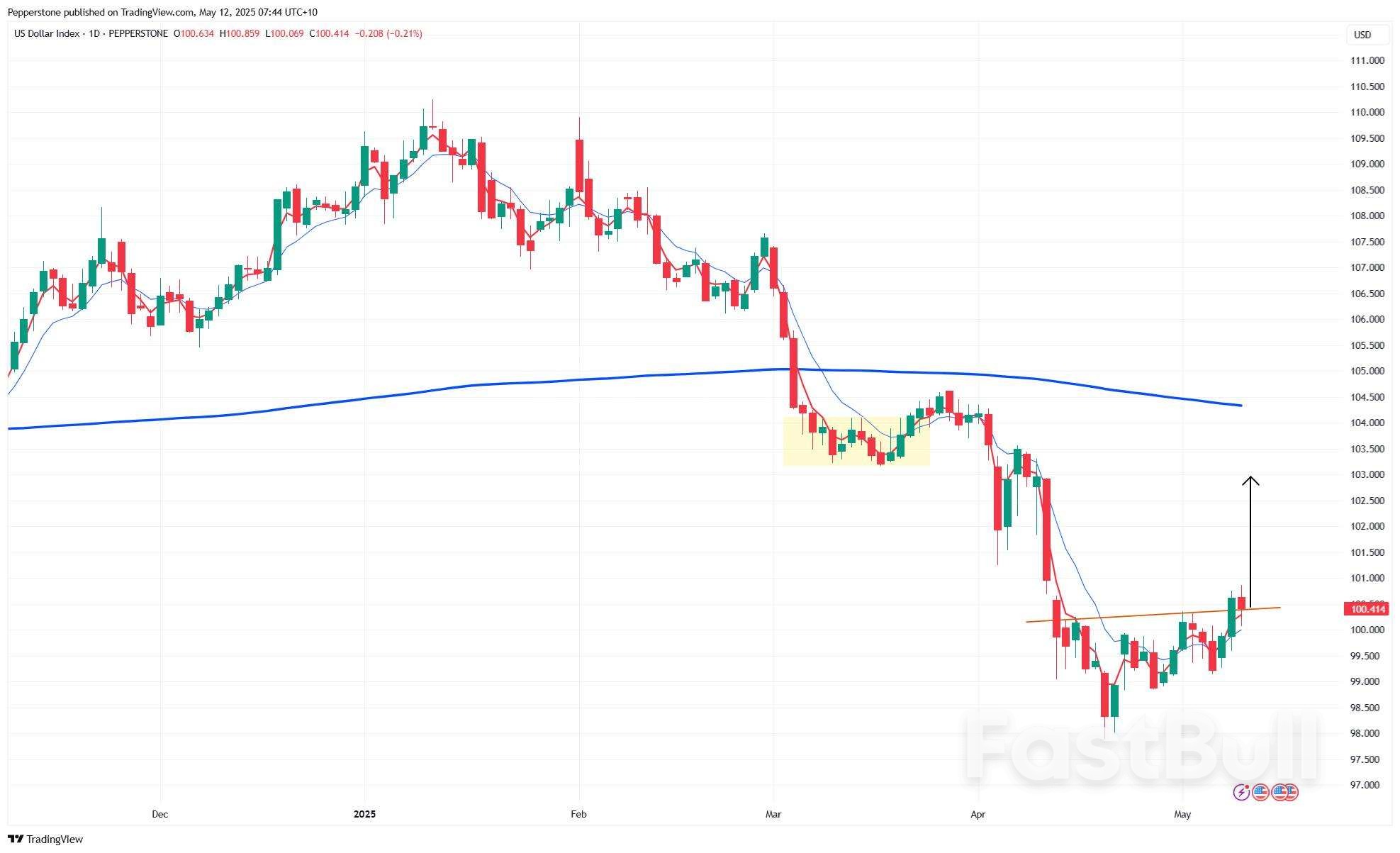
          The USD index (DXY) closed a touch above the neckline of the inverse head and shoulders pattern on Thursday and Friday, but needs to kick to confirm the reversal set-up, which could target the 103 level. Early signs from interbank FX trade favour USD longs, certainly vs CHF, JPY and EUR, and we head into US core CPI and retail sales with the wind at the back of the USD.
          Gold may face some downside pressure early through Asia, with eyes on Friday's low of $3274.

          Assessing The Key Event Risks for the Week Ahead

          Headlines on tariffs will remain a constant input that drives market sentiment, with the initial reaction to the weekend US-China talks predictably encouraging, with both the China and US camps remarking that substantial progress was made, achieving a consensus and establishing a consultation mechanism for trade and economic issues. While this was always the likely outcome, it does represent an important step forward in the dialogue process and is obviously constructive, and we now look for the necessary substance and whether the two countries will take the tangible step towards the speculated US import tariff rates of 60% (from 145%).
          We can be assured of further dialogue between the two camps, and headline risk/noise, but markets will have a low tolerance for inaction – market players want the tariff rates taken down to 60% swiftly and in one action (over a staggered approach). Let's see, because the lower Bessent goes on China tariffs, the lower the scope for removing income taxes on a broad array of US taxpayers.
          On the equity side, US earnings will dissipate in frequency, although Walmart's Q126 Earnings (released premarket on Thursday) will be well-watched, and have the potential to move the dial.
          With macro markets now comfortable with the idea that we're all watching the incoming US hard economic data, and that data will take time to crack – if at all – however, if we're going to listen to any of the US corporates on the tariff impact, it's the US retailers. Walmart is a bellwether in this regard, although, as we heard on its investor day (on 9 April), around two-thirds of its products are assembled and produced in the US, which cushions the effects of tariffs. The market will still be sensitive to Walmart's outlook and guidance and how it's managing tariffs, and as such, we see the implied move (from options pricing) for the day of earnings set at -/+5.3% - a premium to the 4.8% average move recorded in the past 8 quarterly earnings reports.

          Can Nvidia Run Hot(er) Despite the AI Diffusion Ruling?

          We also hear the conclusion to the AI Diffusion ruling (due on Thursday). The recent speculation is that Trump will scrap Biden's chip export rules and look to replace them with a new ruling on chip controls. Investors expect the new controls to be simplified, and no more onerous than the Biden-era controls. Whether the Diffusion Day findings impacts Nvidia, and the US AI plays is a factor to watch, but the real test for the AI-giant falls on its Q126 earnings report on 28 May - where for the first time in recent memory there is real debate if they'll miss the consensus expectations on revenue for $43.22b – a 9.9% increase from Q425.
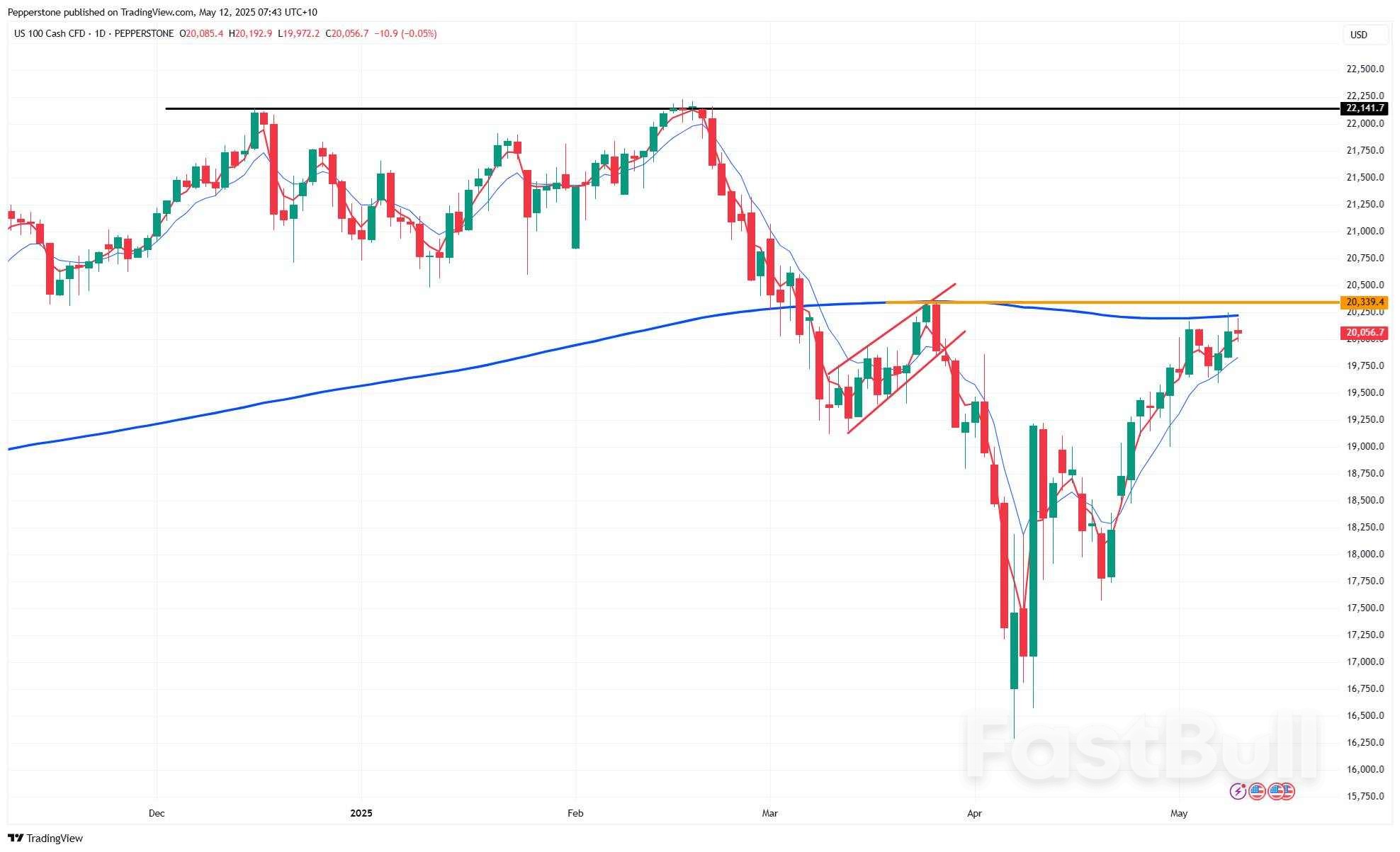
          Nvidia has rallied a lazy 34% from the April lows, but the real kicker awaits on the 28 April – if they can beat and raise, we could feasibly be looking at this former market darling showing full leadership once again. Many in the investment world have this name on their buy list, but are holding off until they clear the earnings hurdle, subsequently reacting with increased conviction should this major overhang be removed. If Nvidia can kick this week into and above $125, then NAS100 futures should break above the 200- and 100-day MA and the 26 March swing high of 20,045.

          Trading the HK50 - Eyes on Tencent and Alibaba

          Another focus this week is on the HK50 index, which has fully closed the gap seen on 7 April and the 61.8 fibo of the 23% drawdown seen from March to April. I am skewed for further upside, where a closing break above 23k would increase my bullish conviction, while conversely looking to reassess and potentially reverse that view on a move below 22,589. With both Tencent and Alibaba reporting earnings through the week, when two of the three biggest index weights report earnings, the HK50 has the potential to see increased volatility at an index level.

          Traders Set to Navigate US CPI and Retail Sales

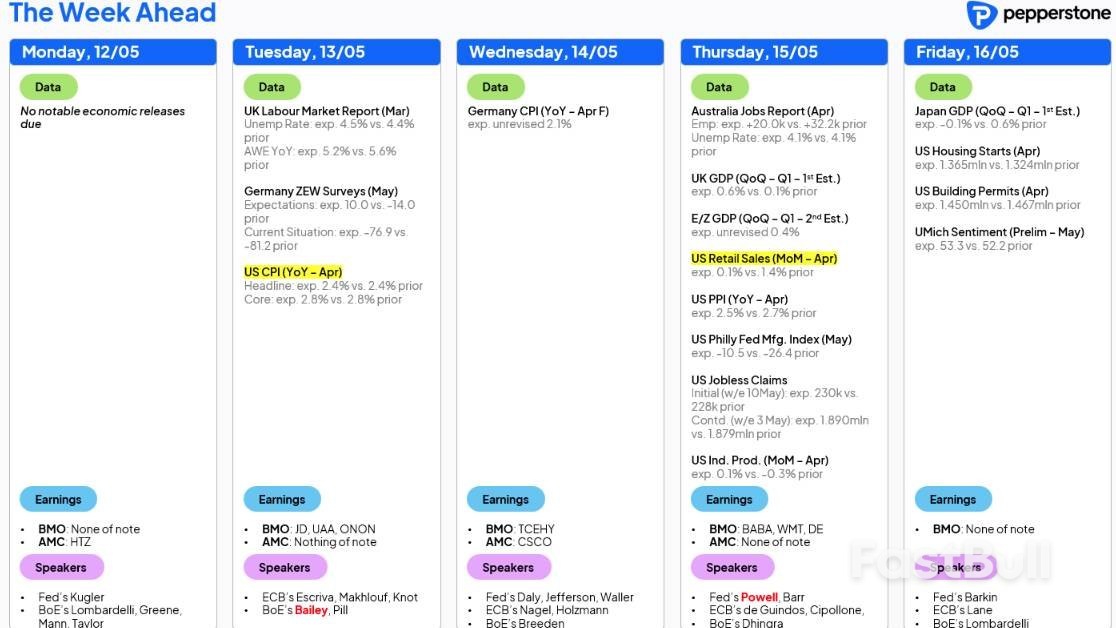
          On the US economic data risk, US CPI, PPI and retail sales could move markets and pose risk to positioning. US core CPI is seen as the marquee event risk, although it feels too early to expect the anticipated tariff price lift to play into this CPI release, with the US forward inflation swaps market pricing the price lift from July and building towards 3.60% by November. That said, with markets concerned about a future stagflation state, there could still be a high sensitivity to inflation and retail sales data.
          Simplistically, a US core CPI print that shows progress in April, with the year-on-year clip coming in below 2.7% should reinvigorate the prospect for a cut at the July FOMC meeting, an outcome implied at 68%. Should the US core CPI come in above 3% y/y, and the USD should find solid buyers, with equity unlikely to take to that kindly. Again, the US retail sales print could also impact – those positioned long of US equity would want to see both a weaker CPI print and a hotter retail sales release. USD longs would be looking for hotter numbers in both data points, albeit not so hot on the inflation outcome that it promotes a sharp pick up in volatility, which could see the USD rollover vs the CHF and JPY. There is also a strong line-up of Fed speakers, but I'd say it's still too early for them to offer anything new that we haven't recently heard.

          Key Event Risk Outside of the US

          The UK data flow will get a strong focus from GBP traders, with the wages/employment report and Q1 GDP due through the week, although the numbers would need to be sufficiently weak to bring a June cut (from the MPC) onto the table.
          In Australia, we get consumer and business confidence, Q1 wages and the April employment report. A 25bp cut in the May RBA meeting is seen as a done deal, but the data could see rates/swaps trader's massage expectations for policy action in the July RBA meeting, where there is a 56% implied chance of a 25bp cut here. Further out and after the May cut, traders see 3 more 25bp cuts by December.

          Source: Pepperstone

          To stay updated on all economic events of today, please check out our Economic calendar
          Risk Warnings and Disclaimers
          You understand and acknowledge that there is a high degree of risk involved in trading. Following any strategies or investment methods may lead to potential losses. The content on the site is provided by our contributors and analysts for information purposes only. You are solely responsible for determining whether any trading assets, securities, strategy, or any other product is suitable for investing based on your own investment objectives and financial situation.
          Add to Favorites
          Share
          FastBull
          Copyright © 2025 FastBull Ltd

          728 RM B 7/F GEE LOK IND BLDG NO 34 HUNG TO RD KWUN TONG KLN HONG KONG

          TelegramInstagramTwitterfacebooklinkedin
          App Store Google Play Google Play
          Products
          Charts

          Chats

          Q&A with Experts
          Screeners
          Economic Calendar
          Data
          Tools
          Membership
          Features
          Function
          Markets
          Copy Trading
          Latest Signals
          Contests
          News
          Analysis
          24/7
          Columns
          Education
          Company
          Careers
          About Us
          Contact Us
          Advertising
          Help Center
          Feedback
          User Agreement
          Privacy Policy
          Business

          White Label

          Data API

          Web Plug-ins

          Poster Maker

          Affiliate Program

          Risk Disclosure

          The risk of loss in trading financial instruments such as stocks, FX, commodities, futures, bonds, ETFs and crypto can be substantial. You may sustain a total loss of the funds that you deposit with your broker. Therefore, you should carefully consider whether such trading is suitable for you in light of your circumstances and financial resources.

          No decision to invest should be made without thoroughly conducting due diligence by yourself or consulting with your financial advisors. Our web content might not suit you since we don't know your financial conditions and investment needs. Our financial information might have latency or contain inaccuracy, so you should be fully responsible for any of your trading and investment decisions. The company will not be responsible for your capital loss.

          Without getting permission from the website, you are not allowed to copy the website's graphics, texts, or trademarks. Intellectual property rights in the content or data incorporated into this website belong to its providers and exchange merchants.

          Not Logged In

          Log in to access more features

          FastBull Membership

          Not yet

          Purchase

          Become a signal provider
          Help Center
          Customer Service
          Dark Mode
          Price Up/Down Colors

          Log In

          Sign Up

          Position
          Layout
          Fullscreen
          Default to Chart
          The chart page opens by default when you visit fastbull.com