Markets
News
Analysis
User
24/7
Economic Calendar
Education
Data
- Names
- Latest
- Prev


Signal Accounts for Members
All Signal Accounts
All Contests


France HICP Final MoM (Nov)A:--
F: --
P: --
China, Mainland Outstanding Loans Growth YoY (Nov)A:--
F: --
P: --
China, Mainland M2 Money Supply YoY (Nov)A:--
F: --
P: --
China, Mainland M0 Money Supply YoY (Nov)A:--
F: --
P: --
China, Mainland M1 Money Supply YoY (Nov)A:--
F: --
P: --
India CPI YoY (Nov)A:--
F: --
P: --
India Deposit Gowth YoYA:--
F: --
P: --
Brazil Services Growth YoY (Oct)A:--
F: --
P: --
Mexico Industrial Output YoY (Oct)A:--
F: --
P: --
Russia Trade Balance (Oct)A:--
F: --
P: --
Philadelphia Fed President Henry Paulson delivers a speech
Canada Building Permits MoM (SA) (Oct)A:--
F: --
P: --
Canada Wholesale Sales YoY (Oct)A:--
F: --
P: --
Canada Wholesale Inventory MoM (Oct)A:--
F: --
P: --
Canada Wholesale Inventory YoY (Oct)A:--
F: --
P: --
Canada Wholesale Sales MoM (SA) (Oct)A:--
F: --
P: --
Germany Current Account (Not SA) (Oct)A:--
F: --
P: --
U.S. Weekly Total Rig CountA:--
F: --
P: --
U.S. Weekly Total Oil Rig CountA:--
F: --
P: --
Japan Tankan Small Manufacturing Outlook Index (Q4)A:--
F: --
P: --
Japan Tankan Large Non-Manufacturing Diffusion Index (Q4)A:--
F: --
P: --
Japan Tankan Large Non-Manufacturing Outlook Index (Q4)A:--
F: --
P: --
Japan Tankan Large Manufacturing Outlook Index (Q4)A:--
F: --
P: --
Japan Tankan Small Manufacturing Diffusion Index (Q4)A:--
F: --
P: --
Japan Tankan Large Manufacturing Diffusion Index (Q4)A:--
F: --
P: --
Japan Tankan Large-Enterprise Capital Expenditure YoY (Q4)A:--
F: --
P: --
U.K. Rightmove House Price Index YoY (Dec)A:--
F: --
P: --
China, Mainland Industrial Output YoY (YTD) (Nov)A:--
F: --
P: --
China, Mainland Urban Area Unemployment Rate (Nov)A:--
F: --
P: --
Saudi Arabia CPI YoY (Nov)A:--
F: --
P: --
Euro Zone Industrial Output YoY (Oct)--
F: --
P: --
Euro Zone Industrial Output MoM (Oct)--
F: --
P: --
Canada Existing Home Sales MoM (Nov)--
F: --
P: --
Euro Zone Total Reserve Assets (Nov)--
F: --
P: --
U.K. Inflation Rate Expectations--
F: --
P: --
Canada National Economic Confidence Index--
F: --
P: --
Canada New Housing Starts (Nov)--
F: --
P: --
U.S. NY Fed Manufacturing Employment Index (Dec)--
F: --
P: --
U.S. NY Fed Manufacturing Index (Dec)--
F: --
P: --
Canada Core CPI YoY (Nov)--
F: --
P: --
Canada Manufacturing Unfilled Orders MoM (Oct)--
F: --
P: --
U.S. NY Fed Manufacturing Prices Received Index (Dec)--
F: --
P: --
U.S. NY Fed Manufacturing New Orders Index (Dec)--
F: --
P: --
Canada Manufacturing New Orders MoM (Oct)--
F: --
P: --
Canada Core CPI MoM (Nov)--
F: --
P: --
Canada Trimmed CPI YoY (SA) (Nov)--
F: --
P: --
Canada Manufacturing Inventory MoM (Oct)--
F: --
P: --
Canada CPI YoY (Nov)--
F: --
P: --
Canada CPI MoM (Nov)--
F: --
P: --
Canada CPI YoY (SA) (Nov)--
F: --
P: --
Canada Core CPI MoM (SA) (Nov)--
F: --
P: --
Canada CPI MoM (SA) (Nov)--
F: --
P: --
Federal Reserve Board Governor Milan delivered a speech
U.S. NAHB Housing Market Index (Dec)--
F: --
P: --
Australia Composite PMI Prelim (Dec)--
F: --
P: --
Australia Services PMI Prelim (Dec)--
F: --
P: --
Australia Manufacturing PMI Prelim (Dec)--
F: --
P: --
Japan Manufacturing PMI Prelim (SA) (Dec)--
F: --
P: --
U.K. Unemployment Claimant Count (Nov)--
F: --
P: --
U.K. Unemployment Rate (Nov)--
F: --
P: --
U.K. 3-Month ILO Unemployment Rate (Oct)--
F: --
P: --


No matching data
Latest Views
Latest Views
Trending Topics
Top Columnists
Latest Update
White Label
Data API
Web Plug-ins
Affiliate Program
View All

No data
Russia’s oil exports rose for the first time in four weeks, with flows from key ports climbing to multi-week highs.
Crude flows from all Russian ports in the four weeks to April 20 rebounded to 3.21 million barrels a day, recovering about one-quarter of the losses seen over the previous three weeks. Flows remain about 240,000 barrels a day, or 7%, below the recent peak seen a month ago.
The increase was driven by higher shipments from key ports — Kozmino in the Pacific and Primorsk in the Baltic. The number of tankers hauling ESPO crude from Kozmino was the highest in five weeks, while departures from Primorsk were the most in three weeks.
The uptick comes as US officials signal they are losing patience with the pace of peacemaking in Ukraine, raising concerns that the administration will abandon sanctions, including those targeting Russia’s oil exports.
The White House has signaled that it’s comfortable with almost all Russia’s demands in Ukraine. These include recognition of the territories it has seized from Ukraine since 2014, the easing of sanctions, a suspension of arms deliveries to Kyiv and a block on the country’s path to NATO membership.
Both President Donald Trump and Secretary of State Marco Rubio suggested on Friday that the administration is prepared to move on from its peace-brokering efforts unless progress is made quickly. US officials are due to meet with Ukrainian and European representatives to discuss US proposals to end the war.
The US has already scaled back its sanctions enforcement. In February, Trump shut down the KleptoCapture task force, a team formed shortly after Moscow’s 2022 invasion of its neighbor to implement measures imposed on Russia.
A total of 31 tankers loaded 23.45 million barrels of Russian crude in the week to April 20, vessel-tracking data and port-agent reports show. The volume was up from 21.93 million barrels on 29 ships the previous week.
Crude flows in the seven days to April 20 stood at about 3.35 million barrels a day, a week-on-week increase of about 220,000 barrels a day.
The less volatile four-week average flows were also up, rising for the first time in four weeks to about 3.21 million barrels a day from 3.13 million a day in the period to April 13.
There were two shipments of Kazakhstan’s KEBCO crude during the week from Novorossiysk.
The gross value of Moscow’s exports recovered about two-thirds of the previous week’s drop, rising by about $130 million, or 12%, to $1.28 billion in the week to April 20, reflecting increases in both weekly average prices and shipments.
Export prices of Russian Urals crude from the Baltic rose by about $2.30 a barrel, while cargoes loading in the Black Sea were up by about $1.80 a barrel. The price of key Pacific grade ESPO increased by about $2.40. Delivered prices in India were about $2 higher, all according to numbers from Argus Media.
On a four-week average basis, income was little changed in the period to April 20, edging higher to about $1.3 billion a week from $1.29 billion in the period to April 13. Using this measure, higher flows were almost completely offset by lower prices.
Observed shipments to Russia’s Asian customers, including those showing no final destination, rose to 2.92 million barrels a day in the four weeks to April 20.
The figures include about 410,000 barrels a day on ships from Western ports showing their destination as Port Said or the Suez Canal, or those from Pacific ports with no clear delivery point. They’re also boosted by another 50,000 barrels a day on vessels yet to show any destination.
Flows to Turkey in the four weeks to April 20 averaged about 290,000 barrels a day, up by about 50,000 barrels a day from the revised figure for the previous week and the highest since the period ending Feb. 9.
This story forms part of a weekly series tracking shipments of crude from Russian export terminals and the gross value of those flows. The next update will be on Tuesday, April 29.
All figures exclude cargoes identified as Kazakhstan’s KEBCO grade. Those are shipments made by KazTransoil JSC that transit Russia for export through Novorossiysk and Ust-Luga and are not subject to European Union sanctions or a price cap. The Kazakh barrels are blended with crude of Russian origin to create a uniform export stream. Since Russia’s invasion of Ukraine, Kazakhstan has rebranded its cargoes to distinguish them from those shipped by Russian companies.
Bloomberg classifies ship-to-ship transfers as clandestine if automated position signals appear to be switched off or falsified — a tactic known as spoofing — to hide the two vessels involved coming together to make the cargo switch.
Vessel-tracking data are cross-checked against port-agent reports as well as flows and ship movements reported by other information providers including Kpler and Vortexa Ltd.
If you are reading this story on the Bloomberg terminal, click for a link to a PDF file of four-week average flows from Russia to key destinations.
Euro zone business growth has stalled this month, a survey showed on Wednesday, with activity in the bloc's dominant services industry contracting and the prolonged downturn in manufacturing continuing.
HCOB's preliminary composite euro zone Purchasing Managers' Index, compiled by S&P Global, dropped to 50.1 this month from March's 50.9. It was barely above the 50 mark separating growth from contraction and short of the median estimate for 50.3 in a Reuters poll.
"The service sector has turned into a bit of a party pooper," said Cyrus de la Rubia, chief economist at Hamburg Commercial Bank.
"Activity has shrunk instead of growing, which it had been doing almost continuously since February 2024. This has pushed the whole economy into stagnation territory."
A PMI covering services sank to 49.7 from 51.0, missing the poll estimate for a more modest decline to 50.5.
Optimism among services firms plummeted with the business outlook index falling to 53.1 from 57.8, the lowest since mid-2020 when the COVID-19 pandemic was tightening its grip on the world.
Manufacturing activity, in decline for nearly three years, saw some improvement. The sector's PMI rose to a 27-month high of 48.7 from 48.6, confounding expectations in the Reuters poll for a decline to 47.5.
An index measuring output, which feeds into the composite PMI, jumped to 51.2 from 50.5, its highest in almost three years.
"Manufacturing seems to be holding up better than expected. Despite the U.S. introducing general tariffs of 10% and car tariffs of 25% at the start of April, most manufacturers in the euro zone are not too fazed," de la Rubia said.
"Instead of falling off a cliff, they've actually increased production for the second month in a row, and even more robustly than in March."
Firms have suffered from uncertainty as U.S. President Donald Trump flip-flops on his tariff policy.
But some of the activity was from factories completing past orders. The backlogs of work index dropped to a three-month low of 46.8 from 47.7.
As overall demand fell again, firms returned to reducing headcount. The composite employment index dipped to 49.9 after being just above breakeven at 50.4 in March.
Silver rose 1% toward $33 per ounce on Wednesday, recouping losses from the previous session and tracking a broader rally in commodities amid signs of easing US-China trade tensions.
The white metal also decoupled from gold, which pulled back from record highs amid waning demand for safe-haven assets.
Instead, silver benefited from its dual role as both a precious and industrial metal, making it more responsive to improving macroeconomic conditions.
Investor optimism was sparked after US President Donald Trump downplayed the scale of future tariffs on Chinese imports, saying they “won’t be anywhere near as high as 145%,” though he clarified they “won’t be 0%” either.
Further lifting market sentiment, Trump affirmed he has no plans to remove Federal Reserve Chair Jerome Powell, easing concerns about central bank independence and policy direction.
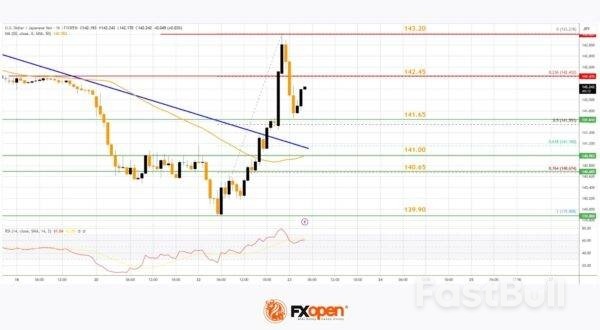
The Euro started a fresh decline after a strong surge above the 1.1500 zone.There was a break below a key bullish trend line with support at 1.1440 on the hourly chart of EUR/USD at FXOpen.USD/JPY climbed higher above the 141.00 and 141.65 levels.There was a break above a connecting bearish trend line with resistance at 141.20 on the hourly chart at FXOpen.


Euro area benchmark Bund yields rose on Wednesday to levels seen after last week's ECB policy meeting, ahead of PMI data later in the session.
The ECB warned that economic growth will take a big hit from U.S. tariffs, bolstering bets for even more policy easing in the months ahead.
U.S. President Donald Trump on Tuesday backed off from threats to fire Federal Reserve Chair Jerome Powell after days of intensifying criticisms of the central bank chief for not cutting interest rates.
U.S. Treasury long-term yields fell in early London trade - with the 10-yeardown 3 basis points (bps) - after slipping on Tuesday as fears that Trump's trade policies could trigger a U.S. economic slowdown provided some demand for bonds.
Germany's 10-year yield (DE10YT=RR), the euro area's benchmark, rose 3 bps to 2.46%.
Money markets priced in a European Central Bank deposit facility rate at 1.57% in December (EURESTECBM5X6=ICAP), down from 1.72% last week before the ECB policy meeting.
Germany's 2-year yield (DE2YT=RR), more sensitive to expectations for ECB policy rates, rose 2.5 bps to 1.69%. It hit 1.622% on Tuesday, its lowest level since October 2022.
The yield spread between French and German 10-year bond yields (DE10FR10=RR) - a market gauge of the risk premium investors demand for holding French assets – stood at 77 bps, around the middle of its recent range since June.
The gap between Italian and German 10-year bond yields (DE10IT10=RR) dropped to 111 bps.
The Swiss franc's rapid appreciation on US policy uncertainty could force the Swiss National Bank to intervene soon, as Swiss industry hopes the safe haven currency's surge can be tamed before it deals another blow to a tariff-threatened sector.
The franc has surged roughly 9% against the dollar so far this month, and is set for the biggest monthly gain since the 2008 financial crisis. Last week it hit its strongest level since January 2015 when the SNB scrapped its minimum exchange rate.
That has pulled the franc, also known as the Swissie, up 2.6% against the euro in April, taking it close to its strongest level in more than 10 years.
But the rush into the franc, spurred by concerns about US President Donald Trump's trade policy gyrations, puts the SNB's 0%-2% inflation target at risk by depressing the cost of imports at a time when inflation is already near zero.
It also hurts Swiss exporters potentially facing 31% US tariffs by making their goods dearer abroad.
"The rise of the Swiss franc is the final ingredient for a poisonous cocktail for Swiss industry," said Jean-Philippe Kohl, vice director of industry association Swissmem.
"Companies are already struggling with weak demand abroad, the threat of massive American tariffs on Switzerland, and uncertainty caused by President Trump's trade policy."
Swissmem refrained from demanding SNB action, but would welcome any moves by the central bank to mitigate the franc's rise, Kohl said.
Interventions, rather than rate cuts, are probably the SNB's best tool, with its key rate already at 0.25% and expected to dip further, analysts say.
"If everybody is fearful and insecurity is high, nobody really cares about the interest rate in Switzerland," said Thomas Stucki, former head of asset management at the SNB and Chief Investment Officer at St Galler Kantonalbank.
Selling francs to weaken the currency would be a shift for the SNB, which bought only 1.2 billion francs of forex last year and sold foreign currencies worth nearly 133 billion francs in 2023 as it sought to shore up the Swissie to cool inflation.
Interventions carry their own risks, such as Washington branding Switzerland a currency manipulator. This occurred in 2020 during Trump's first administration.
ING's global head of markets Chris Turner said one factor in the background driving Swissie strength, on top of safe-haven flows, was markets questioning "whether the SNB will be as able to undertake large scale FX buying as they have in the past."
The SNB said this month it does not engage in currency manipulation and only intervenes to foster price stability. It has also said it could return to negative rates.
But negative rates were unpopular with banks, savers and pension funds when the SNB imposed them from late 2014 to 2022, making interventions look easier to manage.
UBS economist Maxime Botteron did not rule out that limited sales of francs by the SNB were already underway, but he did not expect systematic interventions.
"Interventions are more flexible than interest rate cuts – the SNB can go into the market, sell some francs to ease the appreciation, and then stop," he said.
The SNB declined to comment on the franc's value or how it would react.
It's the currency's rally against the euro that policymakers are likely watching most since the bulk of Swiss trade is with eurozone members, giving euro-denominated imports more influence over inflation. In 2023, 57% of Swiss imports were invoiced in euros, compared with 13% in dollars.
The central bank has said it does not look at particular currency pairs, but a basket of currencies when deciding policy, and would act to meet its inflation target.
Swiss Re's Head of Macro Strategy Patrick Saner said intervention was likely, especially with the real effective exchange rate of the franc reaching post-2015 highs.
"The speed and magnitude of the recent Swiss franc rally, particularly since April 2, significantly raises the odds that the SNB is close to seeing this as a "threshold moment" for intervention," he said.
"While political optics matter.... intervention remains likely if price stability is at risk."
White Label
Data API
Web Plug-ins
Poster Maker
Affiliate Program
The risk of loss in trading financial instruments such as stocks, FX, commodities, futures, bonds, ETFs and crypto can be substantial. You may sustain a total loss of the funds that you deposit with your broker. Therefore, you should carefully consider whether such trading is suitable for you in light of your circumstances and financial resources.
No decision to invest should be made without thoroughly conducting due diligence by yourself or consulting with your financial advisors. Our web content might not suit you since we don't know your financial conditions and investment needs. Our financial information might have latency or contain inaccuracy, so you should be fully responsible for any of your trading and investment decisions. The company will not be responsible for your capital loss.
Without getting permission from the website, you are not allowed to copy the website's graphics, texts, or trademarks. Intellectual property rights in the content or data incorporated into this website belong to its providers and exchange merchants.
Not Logged In
Log in to access more features

FastBull Membership
Not yet
Purchase
Log In
Sign Up