• Trade
  • Markets
  • Copy
  • Contests
  • News
  • 24/7
  • Calendar
  • Q&A
  • Chats
Trending
Screeners
SYMBOL
LAST
BID
ASK
HIGH
LOW
NET CHG.
%CHG.
SPREAD
SPX
S&P 500 Index
6827.42
6827.42
6827.42
6899.86
6801.80
-73.58
-1.07%
--
DJI
Dow Jones Industrial Average
48458.04
48458.04
48458.04
48886.86
48334.10
-245.98
-0.51%
--
IXIC
NASDAQ Composite Index
23195.16
23195.16
23195.16
23554.89
23094.51
-398.69
-1.69%
--
USDX
US Dollar Index
97.950
98.030
97.950
98.500
97.950
-0.370
-0.38%
--
EURUSD
Euro / US Dollar
1.17394
1.17409
1.17394
1.17496
1.17192
+0.00011
+ 0.01%
--
GBPUSD
Pound Sterling / US Dollar
1.33707
1.33732
1.33707
1.33997
1.33419
-0.00148
-0.11%
--
XAUUSD
Gold / US Dollar
4299.39
4299.39
4299.39
4353.41
4257.10
+20.10
+ 0.47%
--
WTI
Light Sweet Crude Oil
57.233
57.485
57.233
58.011
56.969
-0.408
-0.71%
--

Community Accounts

Signal Accounts
--
Profit Accounts
--
Loss Accounts
--
View More

Become a signal provider

Sell trading signals to earn additional income

View More

Guide to Copy Trading

Get started with ease and confidence

View More

Signal Accounts for Members

All Signal Accounts

Best Return
  • Best Return
  • Best P/L
  • Best MDD
Past 1W
  • Past 1W
  • Past 1M
  • Past 1Y

All Contests

  • All
  • Trump Updates
  • Recommend
  • Stocks
  • Cryptocurrencies
  • Central Banks
  • Featured News
Top News Only
Share

USA Embassy In Lithuania: Maria Kalesnikava Is Not Going To Vilnius

Share

USA Embassy In Lithuania: Other Prisoners Are Being Sent From Belarus To Ukraine

Share

Ukraine President Zelenskiy: Five Ukrainians Released By Belarus In US-Brokered Deal

Share

USA Vilnius Embassy: USA Stands Ready For "Additional Engagement With Belarus That Advances USA Interests"

Share

USA Vilnius Embassy: Belarus, USA, Other Citizens Among The Prisoners Released Into Lithuania

Share

USA Vilnius Embassy: USA Will Continue Diplomatic Efforts To Free The Remaining Political Prisoners In Belarus

Share

USA Vilnius Embassy: Belarus Releases 123 Prisoners Following Meeting Of President Trump's Envoy Coale And Belarus President Lukashenko

Share

USA Vilnius Embassy: Masatoshi Nakanishi, Aliaksandr Syrytsa Are Among The Prisoners Released By Belarus

Share

USA Vilnius Embassy: Maria Kalesnikava And Viktor Babaryka Are Among The Prisoners Released By Belarus

Share

USA Vilnius Embassy: Nobel Peace Prize Laureate Ales Bialiatski Is Among The Prisoners Released By Belarus

Share

Belarusian Presidential Administration Telegram Channel: Lukashenko Has Pardoned 123 Prisoners As Part Of Deal With US

Share

Two Local Syrian Officials: Joint US-Syrian Military Patrol In Central Syria Came Under Fire From Unknown Assailants

Share

Israeli Military Says It Targeted 'Key Hamas Terrorist' In Gaza City

Share

Rwanda's Actions In Eastern Drc Are A Clear Violation Of Washington Accords Signed By President Trump - Secretary Of State Rubio

Share

Israeli Military Issues Evacuation Warning In Southern Lebanon Village Ahead Of Strike - Spokesperson On X

Share

Belarusian State Media Cites US Envoy Coale As Saying He Discussed Ukraine And Venezuela With Lukashenko

Share

Belarusian State Media Cites US Envoy Coale As Saying That US Removes Sanctions On Belarusian Potassium

Share

Thai Prime Minister: No Ceasefire Agreement With Cambodia

Share

US, Ukraine To Discuss Ceasefire In Berlin Ahead Of European Summit

Share

Incoming Czech Prime Minister Babis: Czech Republic Will Not Take On Guarantees For Ukraine Financing, European Commission Must Find Alternatives

TIME
ACT
FCST
PREV
U.K. Trade Balance Non-EU (SA) (Oct)

A:--

F: --

P: --

U.K. Trade Balance (Oct)

A:--

F: --

P: --

U.K. Services Index MoM

A:--

F: --

P: --

U.K. Construction Output MoM (SA) (Oct)

A:--

F: --

P: --

U.K. Industrial Output YoY (Oct)

A:--

F: --

P: --

U.K. Trade Balance (SA) (Oct)

A:--

F: --

P: --

U.K. Trade Balance EU (SA) (Oct)

A:--

F: --

P: --

U.K. Manufacturing Output YoY (Oct)

A:--

F: --

P: --

U.K. GDP MoM (Oct)

A:--

F: --

P: --

U.K. GDP YoY (SA) (Oct)

A:--

F: --

P: --

U.K. Industrial Output MoM (Oct)

A:--

F: --

P: --

U.K. Construction Output YoY (Oct)

A:--

F: --

P: --

France HICP Final MoM (Nov)

A:--

F: --

P: --

China, Mainland Outstanding Loans Growth YoY (Nov)

A:--

F: --

P: --

China, Mainland M2 Money Supply YoY (Nov)

A:--

F: --

P: --

China, Mainland M0 Money Supply YoY (Nov)

A:--

F: --

P: --

China, Mainland M1 Money Supply YoY (Nov)

A:--

F: --

P: --

India CPI YoY (Nov)

A:--

F: --

P: --

India Deposit Gowth YoY

A:--

F: --

P: --

Brazil Services Growth YoY (Oct)

A:--

F: --

P: --

Mexico Industrial Output YoY (Oct)

A:--

F: --

P: --

Russia Trade Balance (Oct)

A:--

F: --

P: --

Philadelphia Fed President Henry Paulson delivers a speech
Canada Building Permits MoM (SA) (Oct)

A:--

F: --

P: --

Canada Wholesale Sales YoY (Oct)

A:--

F: --

P: --

Canada Wholesale Inventory MoM (Oct)

A:--

F: --

P: --

Canada Wholesale Inventory YoY (Oct)

A:--

F: --

P: --

Canada Wholesale Sales MoM (SA) (Oct)

A:--

F: --

P: --

Germany Current Account (Not SA) (Oct)

A:--

F: --

P: --

U.S. Weekly Total Rig Count

A:--

F: --

P: --

U.S. Weekly Total Oil Rig Count

A:--

F: --

P: --

Japan Tankan Large Non-Manufacturing Diffusion Index (Q4)

--

F: --

P: --

Japan Tankan Small Manufacturing Outlook Index (Q4)

--

F: --

P: --

Japan Tankan Large Non-Manufacturing Outlook Index (Q4)

--

F: --

P: --

Japan Tankan Large Manufacturing Outlook Index (Q4)

--

F: --

P: --

Japan Tankan Small Manufacturing Diffusion Index (Q4)

--

F: --

P: --

Japan Tankan Large Manufacturing Diffusion Index (Q4)

--

F: --

P: --

Japan Tankan Large-Enterprise Capital Expenditure YoY (Q4)

--

F: --

P: --

U.K. Rightmove House Price Index YoY (Dec)

--

F: --

P: --

China, Mainland Industrial Output YoY (YTD) (Nov)

--

F: --

P: --

China, Mainland Urban Area Unemployment Rate (Nov)

--

F: --

P: --

Saudi Arabia CPI YoY (Nov)

--

F: --

P: --

Euro Zone Industrial Output YoY (Oct)

--

F: --

P: --

Euro Zone Industrial Output MoM (Oct)

--

F: --

P: --

Canada Existing Home Sales MoM (Nov)

--

F: --

P: --

Euro Zone Total Reserve Assets (Nov)

--

F: --

P: --

U.K. Inflation Rate Expectations

--

F: --

P: --

Canada National Economic Confidence Index

--

F: --

P: --

Canada New Housing Starts (Nov)

--

F: --

P: --

U.S. NY Fed Manufacturing Employment Index (Dec)

--

F: --

P: --

U.S. NY Fed Manufacturing Index (Dec)

--

F: --

P: --

Canada Core CPI YoY (Nov)

--

F: --

P: --

Canada Manufacturing Unfilled Orders MoM (Oct)

--

F: --

P: --

Canada Manufacturing New Orders MoM (Oct)

--

F: --

P: --

Canada Core CPI MoM (Nov)

--

F: --

P: --

Canada Manufacturing Inventory MoM (Oct)

--

F: --

P: --

Canada CPI YoY (Nov)

--

F: --

P: --

Canada CPI MoM (Nov)

--

F: --

P: --

Canada CPI YoY (SA) (Nov)

--

F: --

P: --

Canada Core CPI MoM (SA) (Nov)

--

F: --

P: --

Q&A with Experts
    • All
    • Chatrooms
    • Groups
    • Friends
    Connecting
    .
    .
    .
    Type here...
    Add Symbol or Code

      No matching data

      All
      Trump Updates
      Recommend
      Stocks
      Cryptocurrencies
      Central Banks
      Featured News
      • All
      • Russia-Ukraine Conflict
      • Middle East Flashpoint
      • All
      • Russia-Ukraine Conflict
      • Middle East Flashpoint
      Search
      Products

      Charts Free Forever

      Chats Q&A with Experts
      Screeners Economic Calendar Data Tools
      Membership Features
      Data Warehouse Market Trends Institutional Data Policy Rates Macro

      Market Trends

      Market Sentiment Order Book Forex Correlations

      Top Indicators

      Charts Free Forever
      Markets

      News

      News Analysis 24/7 Columns Education
      From Institutions From Analysts
      Topics Columnists

      Latest Views

      Latest Views

      Trending Topics

      Top Columnists

      Latest Update

      Signals

      Copy Rankings Latest Signals Become a signal provider AI Rating
      Contests
      Brokers

      Overview Brokers Assessment Rankings Regulators News Claims
      Broker listing Forex Brokers Comparison Tool Live Spread Comparison Scam
      Q&A Complaint Scam Alert Videos Tips to Detect Scam
      More

      Business
      Events
      Careers About Us Advertising Help Center

      White Label

      Data API

      Web Plug-ins

      Affiliate Program

      Awards Institution Evaluation IB Seminar Salon Event Exhibition
      Vietnam Thailand Singapore Dubai
      Fans Party Investment Sharing Session
      FastBull Summit BrokersView Expo
      Recent Searches
        Top Searches
          Markets
          News
          Analysis
          User
          24/7
          Economic Calendar
          Education
          Data
          • Names
          • Latest
          • Prev

          View All

          No data

          Scan to Download

          Faster Charts, Chat Faster!

          Download App
          English
          • English
          • Español
          • العربية
          • Bahasa Indonesia
          • Bahasa Melayu
          • Tiếng Việt
          • ภาษาไทย
          • Français
          • Italiano
          • Türkçe
          • Русский язык
          • 简中
          • 繁中
          Open Account
          Search
          Products
          Charts Free Forever
          Markets
          News
          Signals

          Copy Rankings Latest Signals Become a signal provider AI Rating
          Contests
          Brokers

          Overview Brokers Assessment Rankings Regulators News Claims
          Broker listing Forex Brokers Comparison Tool Live Spread Comparison Scam
          Q&A Complaint Scam Alert Videos Tips to Detect Scam
          More

          Business
          Events
          Careers About Us Advertising Help Center

          White Label

          Data API

          Web Plug-ins

          Affiliate Program

          Awards Institution Evaluation IB Seminar Salon Event Exhibition
          Vietnam Thailand Singapore Dubai
          Fans Party Investment Sharing Session
          FastBull Summit BrokersView Expo

          Retail Sales in Canada Sprang Back in March With 0.7% Gain

          Michelle

          Economic

          Forex

          Summary:

          Canadian consumers defied tariff-war uncertainty last month, with the biggest spending growth since the holiday shopping season.

          Canadian consumers defied tariff-war uncertainty last month, with the biggest spending growth since the holiday shopping season.

          An advance estimate suggests receipts for retailers rose 0.7% in March, Statistics Canada said Friday. That more than made up for a 0.4% decline in February, which matched a median estimate in a Bloomberg survey of economists and followed a 0.6% drop in January.

          With the rebound at the end of the first quarter, retail sales avoided three straight monthly decreases and were up 1.1% on a quarterly basis. Still, that’s the weakest pace since the second quarter of 2024 when the Bank of Canada started its aggressive easing campaign, which helped buoy spending in the latter half of last year.

          The central bank’s policymakers last week paused their rate-cutting cycle for the first time since they began reducing borrowing costs in June. Officials said they wanted to step to the sidelines to await clarity on the impact of tariffs on inflation and the economy.

          But while first-quarter retail sales showed some strength, the Canadian Federation of Independent Business sees receipts contracting by 2.3% in the second quarter. Economists also expect the bank to cut its policy rate again in the coming meetings to stimulate spending as consumers turn more cautious amid growing concern about their job security and financial outlook.

          In February, sales were down in four of nine subsectors and were led by declines at car and parts dealers. Excluding autos, sales grew 0.5%, beating economist estimates for a drop of 0.2%. Sales at gas stations were up 0.3% in February, rising for a fifth consecutive month.

          Core retail sales, which exclude gas stations and car dealers, increased 0.5% in February due to higher sales at supermarkets and grocery stores as well as beer, wine and liquor retailers. In volume terms, retail sales decreased 0.4%.

          Regionally, retail sales fell in seven of 10 provinces, with the largest provincial drop of 0.9% seen in Quebec. Sales plunged 2.5% in that province’s biggest city, Montreal. On Canada’s west coast, retailers in British Columbia saw receipts declining 0.6%, led by lower sales at furniture, electronics and appliance retailers. In its most populous city, Vancouver, sales were down 0.9%.

          The statistics agency didn’t provide sectorial or provincial details for the March estimate. The figure was based on responses from 67.1% of companies surveyed, versus the average final response rate of 91.2% over the previous 12 months.

          Source: Bloomberg Europe

          To stay updated on all economic events of today, please check out our Economic calendar
          Risk Warnings and Disclaimers
          You understand and acknowledge that there is a high degree of risk involved in trading. Following any strategies or investment methods may lead to potential losses. The content on the site is provided by our contributors and analysts for information purposes only. You are solely responsible for determining whether any trading assets, securities, strategy, or any other product is suitable for investing based on your own investment objectives and financial situation.
          Add to Favorites
          Share

          China May Shift From US Treasurys Toward Gold, Crypto — BlackRock Exec

          Warren Takunda

          Cryptocurrency

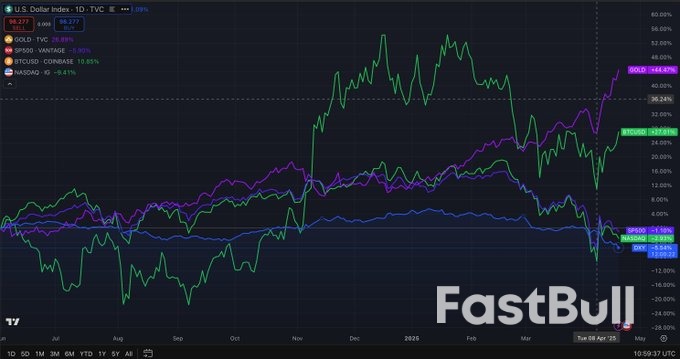
          Central banks, particularly China, may start to shift away from US Treasurys, exploring alternatives such as gold and Bitcoin, according to Jay Jacobs, BlackRock’s head of thematics and active ETFs.
          In a recent interview with CNBC, Jacobs said that geopolitical tensions and rising global uncertainty are accelerating diversification strategies among central banks.
          He pointed to a long-term trend where countries have been reducing their reliance on dollar-based reserves in favor of assets like gold and, increasingly, Bitcoin “This whole diversification away from traditional assets and into things like gold and also crypto [...] probably began three, four years ago,” Jacobs explained.
          He said that recent geopolitical fragmentation has intensified the push toward alternative stores of value.
          Jacobs referenced growing concerns about the freezing of $300 billion in Russian central bank assets following its invasion of Ukraine, suggesting that such events have prompted countries like China to rethink their reserve strategies.

          Geopolitical fragmentation to shape global markets

          During the interview, Jacobs said BlackRock, the world’s largest asset manager, has identified geopolitical fragmentation as a defining force for global markets over the coming decades:
          “We really identified geopolitical fragmentation as a mega force that is driving the world forward over the next several decades.”
          He noted that this environment is fueling demand for uncorrelated assets, with Bitcoin increasingly viewed alongside gold as a safe-haven asset.
          “We’ve seen significant inflows into gold ETFs. We’ve seen significant inflows into Bitcoin. And this is all because people are looking for those assets that will behave differently,” Jacobs said.

          Investors highlight Bitcoin decoupling

          Notably, Jacobs is not alone in stressing Bitcoin’s declining correlation with US equities. Several analysts have also observed that Bitcoin is beginning to decouple from the US stock market.
          On April 22, Alex Svanevik, co-founder and CEO of the Nansen crypto intelligence platform, said Bitcoin’s price is showcasing its growing maturity as a global asset, becoming “less Nasdaq — more gold.”
          He added that Bitcoin was “surprisingly resilient” amid the trade war compared to altcoins and indexes like the S&P 500, but remains vulnerable to economic recession concerns.China May Shift From US Treasurys Toward Gold, Crypto — BlackRock Exec_1

          Source: Alex Svanevik

          Echoing this sentiment, QCP Capital said in an April 21 Telegram note that Bitcoin seemed to be sharing some of gold’s limelight as a hedge against macroeconomic uncertainty.
          “With equities finishing last week in the red and extending an April drawdown, the narrative of BTC as a safe haven or inflation hedge is once again gaining traction. Should this dynamic hold, it could provide a fresh tailwind for institutional BTC allocation,” it wrote.

          Source: Cointelegraph

          Risk Warnings and Disclaimers
          You understand and acknowledge that there is a high degree of risk involved in trading. Following any strategies or investment methods may lead to potential losses. The content on the site is provided by our contributors and analysts for information purposes only. You are solely responsible for determining whether any trading assets, securities, strategy, or any other product is suitable for investing based on your own investment objectives and financial situation.
          Add to Favorites
          Share

          The US stock market’s tariff exposure is about to be laid bare

          Adam

          Stocks

          China–U.S. Trade War

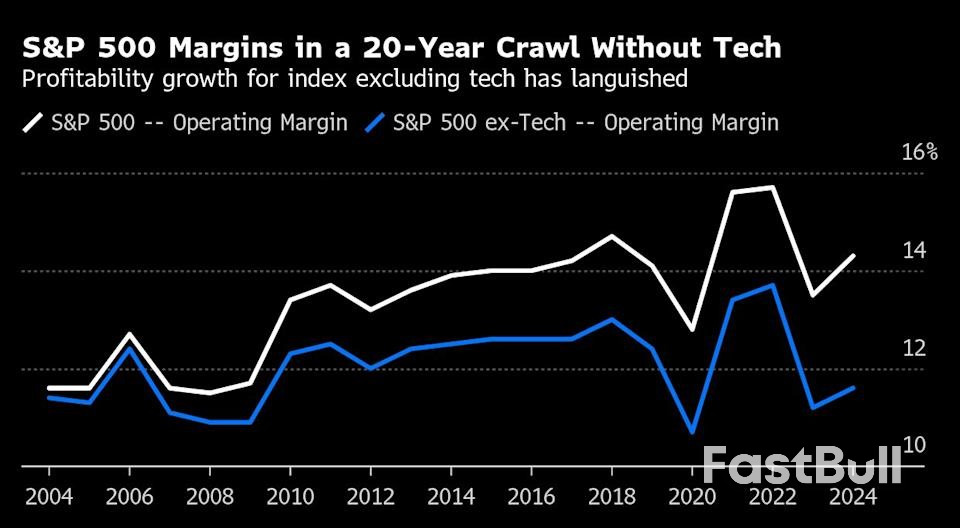
          The track record of S&P 500 (^GSPC) Index companies over the past two decades suggests their ability to withstand additional levies is fragile, at least by one measure. Nearly all of the margin growth eked out from corporate sales on the gauge since 2004 has come from the booming technology sector, according to Bloomberg Intelligence. Removing the group, profitability barely rose.
          The consequences for the US economy and corporate profits from the proposed tariffs is one of the top concerns that investors have been grappling with this month. The first-quarter earnings season so far has shown that companies themselves are unsure of the fallout, further adding to the angst.
          The US stock market’s tariff exposure is about to be laid bare_1
          “Not only is the S&P 500’s ability to absorb the tariff shock weaker than it appears, I would argue that because of tech, the index is also more vulnerable to tariffs,” said Paul Nolte, market strategist and senior wealth manager at Murphy & Sylvest Wealth Management.
          Before the Bell: China Mulls Some Exemptions, Stocks Set to Rise
          While Trump and his administration are currently in talks with more than 50 countries, the average tariff rate stands at around 22.8% and could go as high as 32.6% depending on how negotiations resolve, Bloomberg Economics estimates. Such high levies are likely to be extremely disruptive for American businesses, raising their costs and squeezing profitability.
          Thin Cushion
          The unremarkable expansion of operating margins across the rest of the S&P 500 over the past two decades means, if tariffs turn into a major headwind, the majority of the remaining US companies in the index barely have any cushion left to absorb the impact and grow further.
          S&P 500 companies are estimated by BI to have an operating margin of 16.4% in 2025, which drops to 13.5% when excluding technology, though the estimates likely don’t yet reflect the full impact of the potential new trade regime. The tech sector by itself is estimated to generate a margin of 34.1% this year.
          “There was a reason why the mega-cap tech stocks were dominating the rally in 2023 and 2024 — they were making huge profits, while almost everybody else was floundering,” said Matt Maley, chief strategist at Miller Tabak + Co.
          Maley sees more reason for caution with overall earnings estimates for the year being reined in. Analysts now estimate 2025 profits for the S&P 500 will rise 7.9%, down from an expectation of nearly 13% growth at the beginning of the year, data compiled by BI show.
          “If the one area that was still driving increases losses steam, it’s going to catch a lot of investors off guard, even after this outsized decline,” Maley said, pointing to the recent selloff ignited by Trump’s tariffs on the country’s trade partners on April 2.
          It’s a wake-up call for investors who have been enjoying the tremendous run in US stocks over the past few years, driven largely by technology companies. The group now wields a massive influence on the overall S&P 500 given its market-cap weighted composition.
          Technology stocks themselves are also highly susceptible to declines in share prices given their still-steep valuations and risk dragging down the overall gauge, given the sector’s hefty weighting.
          “Tariffs will hinder the benchmark’s largest earnings growth engine,” said Michael O’Rourke, chief market strategist at JonesTrading. “Tech will likely be the source of the largest margin drag within the index.”

          Source: yahoo

          Risk Warnings and Disclaimers
          You understand and acknowledge that there is a high degree of risk involved in trading. Following any strategies or investment methods may lead to potential losses. The content on the site is provided by our contributors and analysts for information purposes only. You are solely responsible for determining whether any trading assets, securities, strategy, or any other product is suitable for investing based on your own investment objectives and financial situation.
          Add to Favorites
          Share

          Stock Market Today: Wall Street Ticks Lower in Premarket, but Still Poised for a Winning Week

          Warren Takunda

          Stocks

          Wall Street is on track to open with modest losses Friday, though the retreat before the bell is not enough to negate a broad rebound in market s this week.
          Futures for the S&P 500 fell 0.1%, while futures for the Dow Jones Industrial Average lost 0.4%. Nasdaq futures also ticked down 0.1%.
          The slight downturn follows three straight days of gains, propelled by strong corporate earnings and hopes for the Federal Reserve to cut interest rates.
          Shares of Alphabet jumped 5% overnight after Google’s parent company reported late Thursday that its profit soared 50% in the first quarter. Google’s stellar results come as the tech giant faces competitive and legal threats amid an economy roiled by a global trade war. Before Friday’s after-hours gain, Alphabet shares had fallen by 16% since the end of last year.
          On the losing side in premarket trading was Intel, which beat Wall Street’s quarterly projections, but issued conservative guidance for 2025. Executives cited an “increasingly uncertain” economic landscape driven by shifting trade policies, persistent inflation and increased regulatory risks. Intel shares slid 6.8% before markets opened.
          President Donald Trump’s tariff announcements, often followed by reversals or pauses of those policies, have been roiling markets since Trump took office in January. Though companies have largely continued to post strong earnings, many have cut or pulled their guidance for the year, citing economic uncertainty around Trump’s trade policy.
          Elsewhere, in Europe at midday, the CAC 40 in Paris added 0.7%, while Germany’s DAX was 0.4% higher. The British FTSE 100 was unchanged after the country reported better-than-expectation retail sales in March.
          Tokyo’s Nikkei 225 surged 1.9% to 35,705.74 and the Kospi in South Korea gained 0.9% to 2,546.15.
          Hong Kong’s Hang Seng picked up 0.3% to 21,980.74, while the Shanghai Composite Index inched down 0.1% to 3,295.06.
          The rally was boosted by hopes that Trump was softening his approach on tariffs and his criticism of the Federal Reserve, but China denied Thursday it’s involved in active trade negotiations with the U.S.
          Tech stocks rose in China after some semiconductor import companies told Caijing Magazine that some chips made in the U.S. had been quietly exempted from the country’s 125% retaliatory tariffs.
          The Lenovo Group rose 3.4% while the Chinese search engine company Baidu added 3.9%.
          However, the shares of China’s largest semiconductor foundry, Semiconductor Manufacturing International Corporation, lost 2.8%.
          Taiwan’s Taiex added 2%. India’s Sensex sank 0.4% after tensions with Pakistan over the Pahalgam terror attack.
          The market in Australia was closed because of Anzac Day.
          In other moves early Friday, U.S. benchmark crude oil shed 80 cents to $61.99 per barrel in electronic trading on the New York Mercantile Exchange.
          Brent crude, the international standard, slid 81 cents to $64.84 per barrel.
          The U.S dollar rose to 143.29 Japanese yen from 142.69 yen. The euro edged lower, to $1.1363 from $1.1391.

          Source: AP

          Risk Warnings and Disclaimers
          You understand and acknowledge that there is a high degree of risk involved in trading. Following any strategies or investment methods may lead to potential losses. The content on the site is provided by our contributors and analysts for information purposes only. You are solely responsible for determining whether any trading assets, securities, strategy, or any other product is suitable for investing based on your own investment objectives and financial situation.
          Add to Favorites
          Share

          5 things to know before the stock market opens Friday

          Adam

          Stocks

          Here are five key things investors need to know to start the trading day:

          Jump around

          Stocks are on a three-day winning streak and poised to end the week higher heading into Friday trading. The Dow Jones Industrial Average is up 2.5% so far this week, the S&P 500 has gained 3.8% and the Nasdaq Composite has added 5.4%. That jump in the Nasdaq follows a recovery in megacap tech stocks, though they may see more turbulence ahead. “I think we’re still in for a period of choppiness around stock trading, and I think heading into next week, it’s really going to be the big tech earnings that are going to really influence where the major averages go,” said Anthony Saglimbene, chief market strategist at Ameriprise. Follow live market updates.

          Alphabet advertising

          Google parent Alphabet reported 12% revenue growth for the first quarter, boosted by strength in search and advertising. The two segments brought in $50.7 billion and $66.89 billion, respectively, up roughly 9% each from the year earlier. But Alphabet executives warned its ad business could feel the impacts of the ongoing trade war, if advertisers pull back. Sectors like retail, health care and travel helped boost Google ad revenue and are likely to face increased costs under a high-tariff scheme.

          Center demand

          Demand for AI data centers isn’t slowing down in the face of recession fears, according to executives from Amazon and Nvidia . “We continue to see very strong demand, and we’re looking both in the next couple years as well as long term and seeing the numbers only going up,” Amazon Web Services Vice President of Global Data Centers Kevin Miller said on Thursday. Likewise, “We haven’t seen a pullback,” Nvidia Senior Director of Corporate Sustainability Josh Parker said. The comments came at a conference organized by the Hamm Institute for American Energy in Oklahoma City and run counter to recent worries that tech companies would pull back if belts get tightened.

          Off the market

          Home sales last month notched their slowest March since 2009. Sales fell 5.9% month-over-month to a seasonally adjusted 4.02 million units, according to the National Association of Realtors. Every region of the country saw sales declines, even as inventory rose. As of the end of last month, there were 1.33 million active listing, up nearly 20% year-over-year. “March numbers are bad,” said Robert Frick, corporate economist with Navy Federal Credit Union, adding, “they’re likely to get worse.”

          Big-ticket buying

          March was the month for big-ticket purchases. Durable goods orders soared a seasonally adjusted 9.2% month over month, according to data from the Commerce Department, far surpassing the 1.6% gain that Dow Jones economists expected. In February, the measure rose less than 1% year over year. The surge is the result of a pull-forward in big buying ahead of President Donald Trump’s promised “Liberation Day” duties on April 2. An appliance bought in March was a safer bet than the same appliance subject to ever-evolving tariff rates in April.

          Source: cnbc

          Risk Warnings and Disclaimers
          You understand and acknowledge that there is a high degree of risk involved in trading. Following any strategies or investment methods may lead to potential losses. The content on the site is provided by our contributors and analysts for information purposes only. You are solely responsible for determining whether any trading assets, securities, strategy, or any other product is suitable for investing based on your own investment objectives and financial situation.
          Add to Favorites
          Share

          The Kashmir Attack Will Renew Hostilities Between India And Pakistan

          Glendon

          Political

          On 22 April, a terror attack in the Baisaran Valley near Pahalgam in Indian-administered Jammu & Kashmir claimed the lives of 26 people, mostly Indian tourists. This is the deadliest attack in the disputed territory since 2019 when a car bomb targeting a convoy of buses carrying Indian paramilitary soldiers killed 40 people in Pulwama. More alarmingly, it is the biggest attack targeting civilians in over two decades. The Resistance Front (TRF), a proxy for Lashkar-e-Taiba – a Pakistan-based terrorist organization – has claimed responsibility for the attack, while the civilian government in Pakistan has denied any involvement.

          Benign neglect or strategic restraint?

          When the government of Prime Minister Narendra Modi assumed power in 2014, it extended an olive branch to Pakistan, inviting then Pakistani Prime Minister Nawaz Sharif and other South Asian leaders to Modi’s inauguration. Modi even visited Sharif on his birthday in 2015.

          But relations between India and Pakistan have since deteriorated. In 2016, India carried out so-called ‘surgical strikes’ inside Pakistan-administered Kashmir in response to an attack on an Indian army facility in Uri. In 2019, India launched airstrikes inside Pakistani territory following the Pulwama terror attack. The Modi government’s decision to end the special autonomous status of Indian-administered Kashmir in August 2019 further soured relations between New Delhi and Islamabad.

          A degree of benign neglect has since crept into the bilateral relationship with Islamabad preoccupied with internal instabilities and tensions on its borders with Afghanistan and Iran, while New Delhi has sought to focus on India’s global role and aspirations rather than its chronically difficult relationship with Pakistan. This became apparent during last month’s Raisina Dialogue – India’s premier foreign policy conference – where there was hardly any discussion on India’s neighbourhood.

          Whether due to the deterrent effect of the two countries’ nuclear arsenals or simply due to other priorities, there has been a degree of strategic restraint in the India–Pakistan relationship in recent years. A ceasefire along the Line of Control (LoC) demarcating Indian and Pakistan-administered Kashmir has largely held since 2021. In 2022, a missile accidentally launched by India landed in Pakistani territory, but did not trigger a retaliatory response by Islamabad. And despite its more assertive posturing, New Delhi has sought to minimize collateral damage in its retaliatory actions. Of all the countries that Pakistan shares borders with, the border with India has been the most stable in recent years.

          Political and geopolitical undercurrents

          The attack comes at a time when the Pakistani military is on the back foot following a string of terrorist attacks inside Pakistan and eroding public support for the army following the arrest and imprisonment of former prime minister Imran Khan and the persecution of his supporters. Pakistani army chief Asim Munir has sought to reaffirm the importance of the military to the preservation of the Pakistani state. In a speech last week he also referred to Kashmir as Pakistan’s ‘jugular vein’.

          Although the civilian government in Islamabad has denied involvement, there is precedent for attacks on India taking place during periods when the Pakistani military feels it is being marginalized. In 1999, an attempt at rapprochement between the civilian governments in Islamabad and New Delhi – referred to the Lahore bus diplomacy – was derailed after Pakistani military-backed militants launched attacks in the Kargil area of Kashmir, leading both countries to war for the fourth time

          The attack also took place when US Vice President JD Vance was visiting India, suggesting it was timed to draw international attention to the Kashmir issue while the spotlight was on India. Similarly, a terror attack took place in Kashmir shortly before President Clinton’s India visit in 2000.

          Expect a robust Indian response and Pakistani retaliation

          The Modi government has been tough on security since assuming power and Modi himself has been referred to as India’s ‘chowkidar’ (or guard) – akin to Israeli Prime Minister Benjamin Netanyahu’s ‘Mr Security’ moniker. The government has pledged to pursue terrorists wherever they may be (‘ghus ke marenge’). In a speech earlier this week, Modi stated that ‘India will identify, track and punish every terrorist and their backers,’ and would pursue the perpetrators ‘to the ends of the earth’. A robust response by India should therefore be expected – including possible military action.

          The Indian government has already taken the unprecedented step of suspending the 1960 Indus Water Treaty. This World Bank-brokered water-sharing agreement for rivers that traverse both countries has survived several periods of hostility between India and Pakistan. The Pakistani government has declared any attempt by India to divert waterflows in violation of the treaty an ‘act of war’. New Delhi has also ordered the closure of the Attari-Wagah border crossing, reduced the diplomatic presence in both countries, and imposed further restrictions on Pakistani nationals travelling to India.

          Pakistan has responded in kind and has also closed its airspace to Indian-owned and operated airlines and suspended trade with India, including through third countries. It has also announced that it is suspending all bilateral agreements with India, including the Simla Agreement, which established the LoC. A breakdown of the ceasefire along the LoC and a broader tit-for-tat military escalation cannot be ruled out. Limited skirmishes have already been reported.

          New Delhi had been lauding the return of stability to Kashmir in recent years. Elections held in the territory last autumn were largely peaceful with a high voter turnout. Investment and tourism have flourished. This progress will be derailed by the latest attack.

          Beyond the impact on Kashmir and India–Pakistan relations, this incident will also have broader regional implications. South Asia is among the least economically integrated regions of the world. The South Asian Association for Regional Cooperation (SAARC) has not held a summit in over a decade, attributed in large part to mistrust in the India–Pakistan relationship.

          While New Delhi has tried to develop workaround solutions, such as promoting other regional initiatives, South Asian countries continue to lobby for the resumption of SAARC as the region’s most inclusive and all-encompassing regional forum. But the Pahalgam attack makes this even less likely to happen anytime soon.

          For now, there are limited signs of external pressure on India to show restraint in its response to the attack. During previous periods of heightened tensions, the US has played a prominent role in de-escalating tensions, but not this time.

          The US recently extradited a Canadian national convicted of complicity in a 2008 attack by Pakistan-based militants in Mumbai, something New Delhi had been demanding for many years. While this demonstrates the Trump administration’s more forthcoming approach to working with India on anti-terrorism cooperation, the US is unlikely to get involved beyond possible intelligence sharing.

          Without significant international pressure to de-escalate, the only real restraints on both parties are concerns of a possible nuclear escalation and the impact of a conflict on their economies.

          Source: Chatham House

          Risk Warnings and Disclaimers
          You understand and acknowledge that there is a high degree of risk involved in trading. Following any strategies or investment methods may lead to potential losses. The content on the site is provided by our contributors and analysts for information purposes only. You are solely responsible for determining whether any trading assets, securities, strategy, or any other product is suitable for investing based on your own investment objectives and financial situation.
          Add to Favorites
          Share

          China Urges U.S. to Stop Misleading Public on Tariff Talks

          Michelle

          Political

          Economic

          China–U.S. Trade War

          The foreign ministry of China has called on Washington to cease misleading the public about the status of bilateral tariff negotiations. Guo Jiakun, a spokesperson for the ministry, stated in a press briefing that China and the United States are not currently engaged in discussions or consultations regarding the tariff issue.

          This statement comes after U.S. President Donald Trump claimed on Thursday that trade talks between the two nations were in progress. However, both China’s foreign and commerce ministries have denied the existence of such negotiations.

          In addition, Guo mentioned that he was not aware of any plans by China to exempt tariffs on certain U.S. imports. The recent exchange of remarks between Beijing and Washington has added to the uncertainty about the commencement and possibility of talks on high tariffs imposed on each other’s goods.

          Source: Investing

          To stay updated on all economic events of today, please check out our Economic calendar
          Risk Warnings and Disclaimers
          You understand and acknowledge that there is a high degree of risk involved in trading. Following any strategies or investment methods may lead to potential losses. The content on the site is provided by our contributors and analysts for information purposes only. You are solely responsible for determining whether any trading assets, securities, strategy, or any other product is suitable for investing based on your own investment objectives and financial situation.
          Add to Favorites
          Share
          FastBull
          Copyright © 2025 FastBull Ltd

          728 RM B 7/F GEE LOK IND BLDG NO 34 HUNG TO RD KWUN TONG KLN HONG KONG

          TelegramInstagramTwitterfacebooklinkedin
          App Store Google Play Google Play
          Products
          Charts

          Chats

          Q&A with Experts
          Screeners
          Economic Calendar
          Data
          Tools
          Membership
          Features
          Function
          Markets
          Copy Trading
          Latest Signals
          Contests
          News
          Analysis
          24/7
          Columns
          Education
          Company
          Careers
          About Us
          Contact Us
          Advertising
          Help Center
          Feedback
          User Agreement
          Privacy Policy
          Business

          White Label

          Data API

          Web Plug-ins

          Poster Maker

          Affiliate Program

          Risk Disclosure

          The risk of loss in trading financial instruments such as stocks, FX, commodities, futures, bonds, ETFs and crypto can be substantial. You may sustain a total loss of the funds that you deposit with your broker. Therefore, you should carefully consider whether such trading is suitable for you in light of your circumstances and financial resources.

          No decision to invest should be made without thoroughly conducting due diligence by yourself or consulting with your financial advisors. Our web content might not suit you since we don't know your financial conditions and investment needs. Our financial information might have latency or contain inaccuracy, so you should be fully responsible for any of your trading and investment decisions. The company will not be responsible for your capital loss.

          Without getting permission from the website, you are not allowed to copy the website's graphics, texts, or trademarks. Intellectual property rights in the content or data incorporated into this website belong to its providers and exchange merchants.

          Not Logged In

          Log in to access more features

          FastBull Membership

          Not yet

          Purchase

          Become a signal provider
          Help Center
          Customer Service
          Dark Mode
          Price Up/Down Colors

          Log In

          Sign Up

          Position
          Layout
          Fullscreen
          Default to Chart
          The chart page opens by default when you visit fastbull.com