• Trade
  • Markets
  • Copy
  • Contests
  • News
  • 24/7
  • Calendar
  • Q&A
  • Chats
Trending
Screeners
SYMBOL
LAST
BID
ASK
HIGH
LOW
NET CHG.
%CHG.
SPREAD
SPX
S&P 500 Index
6861.71
6861.71
6861.71
6878.28
6858.25
-8.69
-0.13%
--
DJI
Dow Jones Industrial Average
47876.59
47876.59
47876.59
47971.51
47771.72
-78.39
-0.16%
--
IXIC
NASDAQ Composite Index
23583.20
23583.20
23583.20
23698.93
23579.88
+5.08
+ 0.02%
--
USDX
US Dollar Index
99.070
99.150
99.070
99.110
98.730
+0.120
+ 0.12%
--
EURUSD
Euro / US Dollar
1.16280
1.16287
1.16280
1.16717
1.16245
-0.00146
-0.13%
--
GBPUSD
Pound Sterling / US Dollar
1.33158
1.33166
1.33158
1.33462
1.33087
-0.00154
-0.12%
--
XAUUSD
Gold / US Dollar
4191.76
4192.10
4191.76
4218.85
4175.92
-6.15
-0.15%
--
WTI
Light Sweet Crude Oil
59.041
59.071
59.041
60.084
58.892
-0.768
-1.28%
--

Community Accounts

Signal Accounts
--
Profit Accounts
--
Loss Accounts
--
View More

Become a signal provider

Sell trading signals to earn additional income

View More

Guide to Copy Trading

Get started with ease and confidence

View More

Signal Accounts for Members

All Signal Accounts

Best Return
  • Best Return
  • Best P/L
  • Best MDD
Past 1W
  • Past 1W
  • Past 1M
  • Past 1Y

All Contests

  • All
  • Trump Updates
  • Recommend
  • Stocks
  • Cryptocurrencies
  • Central Banks
  • Featured News
Top News Only
Share

The S&P 500 Opened 4.80 Points Higher, Or 0.07%, At 6875.20; The Dow Jones Industrial Average Opened 16.52 Points Higher, Or 0.03%, At 47971.51; And The Nasdaq Composite Opened 60.09 Points Higher, Or 0.25%, At 23638.22

Share

Reuters Poll - Swiss National Bank Policy Rate To Be 0.00% At End-2026, Said 21 Of 25 Economists, Four Said It Would Be Cut To -0.25%

Share

USGS - Magnitude 7.6 Earthquake Strikes Misawa, Japan

Share

Reuters Poll - Swiss National Bank To Hold Policy Rate At 0.00% On December 11, Said 38 Of 40 Economists, Two Said Cut To -0.25%

Share

Traders Believe There Is A 20% Chance That The European Central Bank Will Raise Interest Rates Before The End Of 2026

Share

Toronto Stock Index .GSPTSE Rises 11.99 Points, Or 0.04 Percent, To 31323.40 At Open

Share

Japan Meteorological Agency: A Tsunami With A Maximum Height Of Three Meters Is Expected Following The Earthquake In Japan

Share

Japan Meteorological Agency: A 7.2-magnitude Earthquake Struck Off The Coast Of Northern Japan, And A Tsunami Warning Has Been Issued

Share

Japan Finance Minister Katayama: G7 Expected To Hold Another Meeting By The End Of This Year

Share

The Japan Meteorological Agency Reported That An Earthquake Occurred In The Sea Near Aomori

Share

Japan Finance Minister Katayama: The G7 Finance Ministers' Meeting Discussed The Critical Mineral Supply Chain And Support For Ukraine

Share

Japan Finance Minister Katayama: Held Onlinemeeting With G7 Finance Ministers

Share

Fed Data - USA Effective Federal Funds Rate At 3.89 Percent On 05 December On $88 Billion In Trades Versus 3.89 Percent On $87 Billion On 04 December

Share

Chinese Foreign Minister Wang Yi: One-China Principle Is An Important Political Foundation For China-Germany Relations, And There Is No Room For Ambiguity

Share

Chinese Foreign Minister Wang Yi: Hopes Germany To Understand, Support China's Position Regarding Japan Prime Minister's Remark On Taiwan

Share

Chinese Foreign Minister Wang Yi: Hopes Germany Will View China More Objectively And Rationally, Adhere To The Positioning Of China-Germany Partnership

Share

China Foreign Ministry: China's Foreign Minister Wang Yi Meets German Counterpart

Share

Israeli Government Spokesperson: Netanyahu Will Meet Trump On December 29

Share

Stc Did Not Ask Internationally-Government To Leave Aden - Senior Stc Official To Reuters

Share

Members Of Internationally-Recognised Government, Opposed To Northern Houthis, Have Left Aden - Senior Stc Official To Reuters

TIME
ACT
FCST
PREV
France Trade Balance (SA) (Oct)

A:--

F: --

P: --
Euro Zone Employment YoY (SA) (Q3)

A:--

F: --

P: --
Canada Part-Time Employment (SA) (Nov)

A:--

F: --

P: --

Canada Unemployment Rate (SA) (Nov)

A:--

F: --

P: --

Canada Full-time Employment (SA) (Nov)

A:--

F: --

P: --

Canada Labor Force Participation Rate (SA) (Nov)

A:--

F: --

P: --

Canada Employment (SA) (Nov)

A:--

F: --

P: --

U.S. PCE Price Index MoM (Sept)

A:--

F: --

P: --

U.S. Personal Income MoM (Sept)

A:--

F: --

P: --

U.S. Core PCE Price Index MoM (Sept)

A:--

F: --

P: --

U.S. PCE Price Index YoY (SA) (Sept)

A:--

F: --

P: --

U.S. Core PCE Price Index YoY (Sept)

A:--

F: --

P: --

U.S. Personal Outlays MoM (SA) (Sept)

A:--

F: --

P: --
U.S. 5-10 Year-Ahead Inflation Expectations (Dec)

A:--

F: --

P: --

U.S. Real Personal Consumption Expenditures MoM (Sept)

A:--

F: --

P: --
U.S. Weekly Total Rig Count

A:--

F: --

P: --

U.S. Weekly Total Oil Rig Count

A:--

F: --

P: --

U.S. Consumer Credit (SA) (Oct)

A:--

F: --

P: --
China, Mainland Foreign Exchange Reserves (Nov)

A:--

F: --

P: --

Japan Trade Balance (Oct)

A:--

F: --

P: --

Japan Nominal GDP Revised QoQ (Q3)

A:--

F: --

P: --

China, Mainland Imports YoY (CNH) (Nov)

A:--

F: --

P: --

China, Mainland Exports (Nov)

A:--

F: --

P: --

China, Mainland Imports (CNH) (Nov)

A:--

F: --

P: --

China, Mainland Trade Balance (CNH) (Nov)

A:--

F: --

P: --

China, Mainland Exports YoY (USD) (Nov)

A:--

F: --

P: --

China, Mainland Imports YoY (USD) (Nov)

A:--

F: --

P: --

Germany Industrial Output MoM (SA) (Oct)

A:--

F: --

P: --
Euro Zone Sentix Investor Confidence Index (Dec)

A:--

F: --

P: --

Canada National Economic Confidence Index

A:--

F: --

P: --

U.K. BRC Like-For-Like Retail Sales YoY (Nov)

--

F: --

P: --

U.K. BRC Overall Retail Sales YoY (Nov)

--

F: --

P: --

Australia Overnight (Borrowing) Key Rate

--

F: --

P: --

RBA Rate Statement
RBA Press Conference
Germany Exports MoM (SA) (Oct)

--

F: --

P: --

U.S. NFIB Small Business Optimism Index (SA) (Nov)

--

F: --

P: --

Mexico 12-Month Inflation (CPI) (Nov)

--

F: --

P: --

Mexico Core CPI YoY (Nov)

--

F: --

P: --

Mexico PPI YoY (Nov)

--

F: --

P: --

U.S. Weekly Redbook Index YoY

--

F: --

P: --

U.S. JOLTS Job Openings (SA) (Oct)

--

F: --

P: --

China, Mainland M1 Money Supply YoY (Nov)

--

F: --

P: --

China, Mainland M0 Money Supply YoY (Nov)

--

F: --

P: --

China, Mainland M2 Money Supply YoY (Nov)

--

F: --

P: --

U.S. EIA Short-Term Crude Production Forecast For The Year (Dec)

--

F: --

P: --

U.S. EIA Natural Gas Production Forecast For The Next Year (Dec)

--

F: --

P: --

U.S. EIA Short-Term Crude Production Forecast For The Next Year (Dec)

--

F: --

P: --

EIA Monthly Short-Term Energy Outlook
U.S. API Weekly Gasoline Stocks

--

F: --

P: --

U.S. API Weekly Cushing Crude Oil Stocks

--

F: --

P: --

U.S. API Weekly Crude Oil Stocks

--

F: --

P: --

U.S. API Weekly Refined Oil Stocks

--

F: --

P: --

South Korea Unemployment Rate (SA) (Nov)

--

F: --

P: --

Japan Reuters Tankan Non-Manufacturers Index (Dec)

--

F: --

P: --

Japan Reuters Tankan Manufacturers Index (Dec)

--

F: --

P: --

Japan Domestic Enterprise Commodity Price Index MoM (Nov)

--

F: --

P: --

Japan Domestic Enterprise Commodity Price Index YoY (Nov)

--

F: --

P: --

China, Mainland PPI YoY (Nov)

--

F: --

P: --

China, Mainland CPI MoM (Nov)

--

F: --

P: --

Q&A with Experts
    • All
    • Chatrooms
    • Groups
    • Friends
    Connecting
    .
    .
    .
    Type here...
    Add Symbol or Code

      No matching data

      All
      Trump Updates
      Recommend
      Stocks
      Cryptocurrencies
      Central Banks
      Featured News
      • All
      • Russia-Ukraine Conflict
      • Middle East Flashpoint
      • All
      • Russia-Ukraine Conflict
      • Middle East Flashpoint
      Search
      Products

      Charts Free Forever

      Chats Q&A with Experts
      Screeners Economic Calendar Data Tools
      Membership Features
      Data Warehouse Market Trends Institutional Data Policy Rates Macro

      Market Trends

      Market Sentiment Order Book Forex Correlations

      Top Indicators

      Charts Free Forever
      Markets

      News

      News Analysis 24/7 Columns Education
      From Institutions From Analysts
      Topics Columnists

      Latest Views

      Latest Views

      Trending Topics

      Top Columnists

      Latest Update

      Signals

      Copy Rankings Latest Signals Become a signal provider AI Rating
      Contests
      Brokers

      Overview Brokers Assessment Rankings Regulators News Claims
      Broker listing Forex Brokers Comparison Tool Live Spread Comparison Scam
      Q&A Complaint Scam Alert Videos Tips to Detect Scam
      More

      Business
      Events
      Careers About Us Advertising Help Center

      White Label

      Data API

      Web Plug-ins

      Affiliate Program

      Awards Institution Evaluation IB Seminar Salon Event Exhibition
      Vietnam Thailand Singapore Dubai
      Fans Party Investment Sharing Session
      FastBull Summit BrokersView Expo
      Recent Searches
        Top Searches
          Markets
          News
          Analysis
          User
          24/7
          Economic Calendar
          Education
          Data
          • Names
          • Latest
          • Prev

          View All

          No data

          Scan to Download

          Faster Charts, Chat Faster!

          Download App
          English
          • English
          • Español
          • العربية
          • Bahasa Indonesia
          • Bahasa Melayu
          • Tiếng Việt
          • ภาษาไทย
          • Français
          • Italiano
          • Türkçe
          • Русский язык
          • 简中
          • 繁中
          Open Account
          Search
          Products
          Charts Free Forever
          Markets
          News
          Signals

          Copy Rankings Latest Signals Become a signal provider AI Rating
          Contests
          Brokers

          Overview Brokers Assessment Rankings Regulators News Claims
          Broker listing Forex Brokers Comparison Tool Live Spread Comparison Scam
          Q&A Complaint Scam Alert Videos Tips to Detect Scam
          More

          Business
          Events
          Careers About Us Advertising Help Center

          White Label

          Data API

          Web Plug-ins

          Affiliate Program

          Awards Institution Evaluation IB Seminar Salon Event Exhibition
          Vietnam Thailand Singapore Dubai
          Fans Party Investment Sharing Session
          FastBull Summit BrokersView Expo

          Q2 Earnings Preview: Can Corporate Profits Justify S&P 500’s Record-Setting Rally?

          Adam

          Stocks

          Summary:

          With S&P 500 at record highs, Q2 earnings season will test if corporate profits can justify the rally. Tariffs, cost pressures, and weak guidance may challenge growth across key sectors.
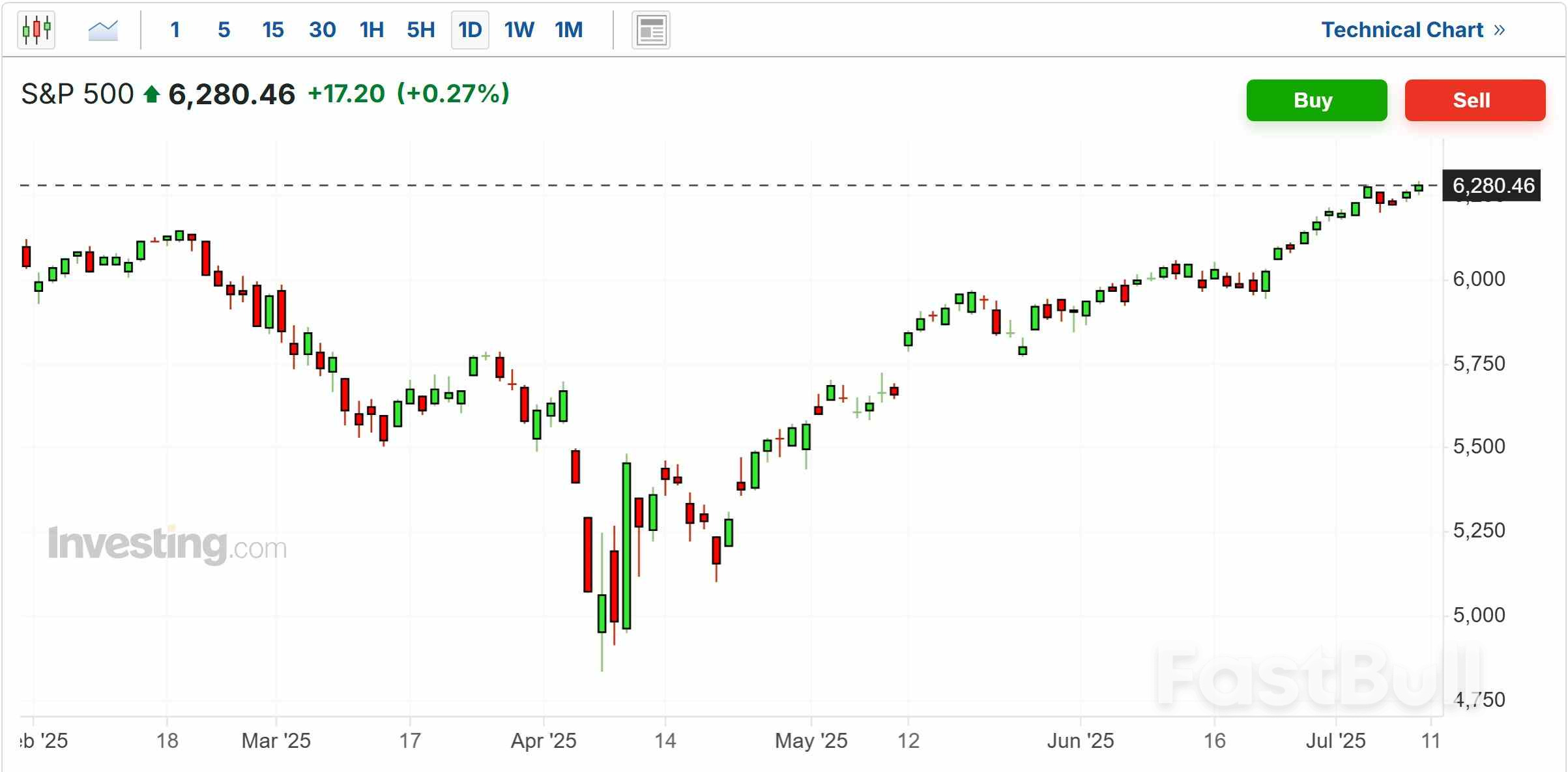
          Wall Street’s second quarter earnings season begins next week, when notable names like JPMorgan Chase, Citigroup, Wells Fargo & Company, BlackRock, Bank of America, Goldman Sachs, Morgan Stanley, Johnson & Johnson, United Airlines, and Netflix all deliver their financial results.
          With the S&P 500 trading at all-time highs after a robust rally from its April lows, investors are now looking to corporate earnings to determine whether the market’s momentum is sustainable.
          Q2 Earnings Preview: Can Corporate Profits Justify S&P 500’s Record-Setting Rally?_1
          From technology to manufacturing, each S&P 500 sector is facing significant headwinds this quarter, and the upcoming earnings season will be a telling indicator of how these companies are adapting and forecasting future demand.
          Here’s what to watch as the Q2 earnings season unfolds:

          Tariffs: The Unseen Earnings Villain

          The biggest wild card this quarter is the sudden escalation in U.S. trade tariffs under President Donald Trump. On July 8, sweeping new 50% tariffs were announced on imported copper, with threats of more to come on semiconductors and pharmaceuticals. The deadline for 14 nations to cut deals is set for Aug. 1, but so far, only the UK and Vietnam have reached agreements.
          The risk: these tariffs could squeeze profit margins and disrupt supply chains, especially for multinationals and manufacturers. Analysts estimate that tariffs could reduce S&P 500 earnings growth by approximately 2 percentage points in Q2.
          Q2 Earnings Preview: Can Corporate Profits Justify S&P 500’s Record-Setting Rally?_2
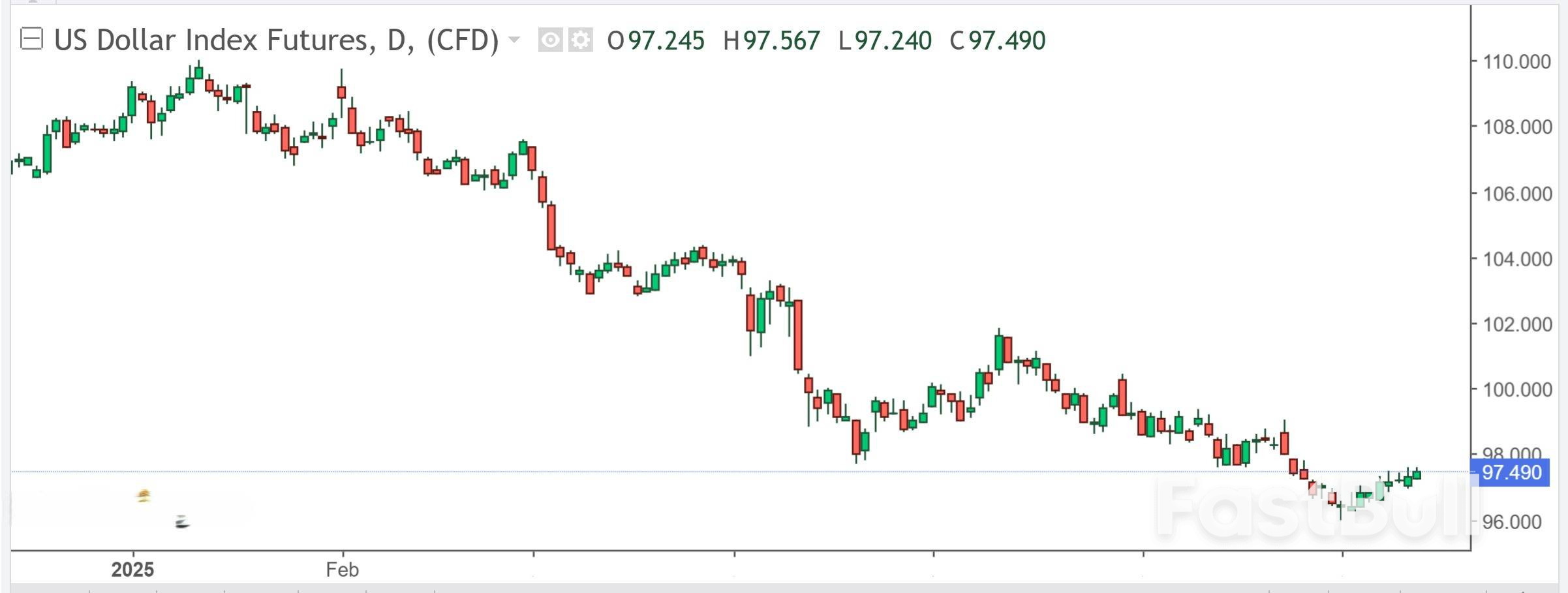
          While a 7% drop in the dollar index during Q2 provides some offset for U.S. exporters, the true bottom-line impact will only start to show up in these earnings reports.

          Earnings Growth Expectations

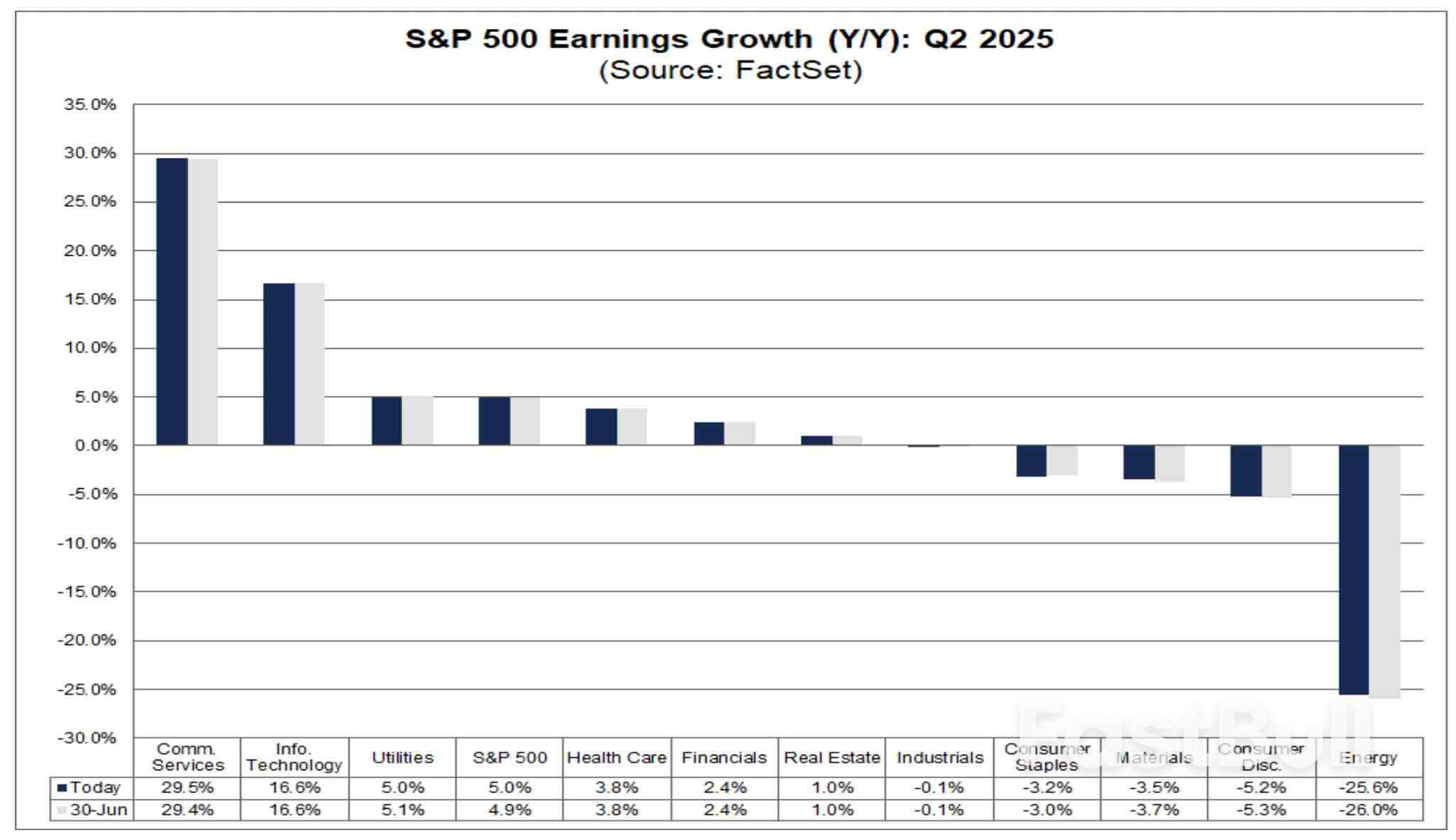
          S&P 500 earnings are expected to grow by 5.0% year-over-year in Q2, according to FactSet, a sharp deceleration from the 13.7% growth posted in Q1. While this marks the slowest growth pace since Q4 2023, a low bar could provide opportunities for companies to exceed expectations, provided they navigate the season’s challenges effectively.
          Q2 Earnings Preview: Can Corporate Profits Justify S&P 500’s Record-Setting Rally?_3

          Sector Performance

          Communication Services: The sector is expected to report the highest annual earnings growth rate, at +29.5%. Some of the biggest names in the space include Meta Platforms, Netflix, Walt Disney, as well as Verizon, and AT&T.
          Technology: The information technology sector is also set to report robust earnings growth, driven by continued demand for AI and cloud computing. Companies like Nvidia, Microsoft, Alphabet, and Advanced Micro Devices are likely to post strong results.
          Consumer Discretionary: Retailers and e-commerce companies face challenges from slowing consumer spending and rising costs. The sector includes notable companies like Amazon, Walmart, Home Depot, McDonald’s Corporation, and Coca-Cola.
          Energy: Energy companies, which includes oil and gas giants such as ExxonMobil, Chevron, and ConocoPhillips, may see lower profits due to declining oil and gas prices compared to last year.

          Guidance for the Second Half

          Monitoring corporate guidance will be critical, as forward-looking commentary on tariffs, cost pressures, and consumer demand could drive significant stock price swings.
          Companies that signal resilience in the face of economic uncertainty will likely be rewarded, while those that fail to meet or beat consensus estimates risk outsized downside moves. In this environment, even minor disappointments in results or outlooks can trigger sharp pullbacks.

          Key Stocks to Watch for Q2 Earnings Season

          The U.S. stock market enters Q2 earnings season in a precarious position. The S&P 500’s nearly 28% rebound from April lows has pushed valuations to elevated levels, with the forward price-to-earnings (P/E) ratio hovering around 20.6, well above its long-term average of 15.8.
          This frothy backdrop leaves little room for disappointment, particularly for the dominant tech and growth stocks that led the recent rally, as investors demand robust earnings growth to justify current prices.
          Some of the notable names to make the cut include Capital One Financial, CoreWeave, Truist Financial, Circle Internet Group, AngloGold Ashanti, Credo Technology, Xpeng, Astera Labs, TKO Group Holdings, IONQ, Celsius Holdings, Hims Hers Health, and Tempus AI .

          The Bottom Line

          As investors navigate this high-stakes season, resilience and adaptability will be key. Whether the market can clear the low earnings bar or succumbs to policy-driven volatility remains to be seen, but Q2 earnings will undoubtedly shape the trajectory of 2025’s second half.
          Savvy investors will need to be highly discerning, focusing on companies with clear visibility into their future earnings power and resilience to external shocks.
          Be sure to check out InvestingPro to stay in sync with the market trend and what it means for your trading. Leveraging InvestingPro can unlock a world of investment opportunities while minimizing risks amid the challenging market backdrop.

          Source: investing

          Risk Warnings and Disclaimers
          You understand and acknowledge that there is a high degree of risk involved in trading. Following any strategies or investment methods may lead to potential losses. The content on the site is provided by our contributors and analysts for information purposes only. You are solely responsible for determining whether any trading assets, securities, strategy, or any other product is suitable for investing based on your own investment objectives and financial situation.
          Add to Favorites
          Share

          USDJPY Moves Above The 38.2% Of The Move Down From The 2025 Trading Range

          Blue River

          Technical Analysis

          Forex

          Economic

          USDJPY moves above 38.2% retracement

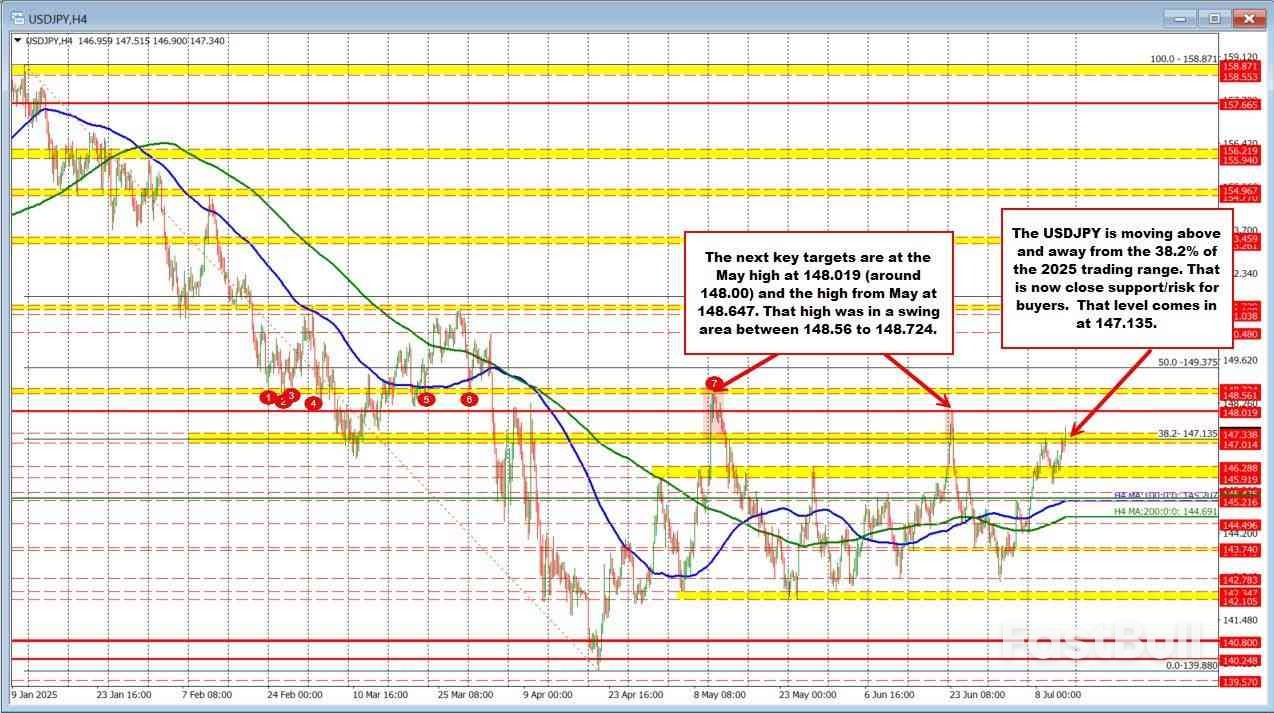
          The USDJPY has moved above the 38.2% retracement of the 2025 trading range, measured from the January 10 high to the April 22 low. That retracement level comes in at 147.135, and it's aligned with a key swing area between 147.014 and 147.338. The pair has extended to a high of 147.515, marking the third attempt to break and hold above this level since the April low.

          Previous moves above the 38.2% retracement—on May 12 and June 23—ultimately failed to hold, but this renewed push gives buyers another opportunity to seize control. From a technical perspective, staying above 147.135 is now critical. If that support holds, upside targets include the June high at 148.019, followed by the May high at 148.647, which sits within a notable swing area between 148.56 and 148.724 (highlighted by red circles on the chart). That swing area increases the May highs importance

          The market is once again testing the waters for a bullish breakout. The question now is: Will buyers finally maintain momentum above the 38.2% retracement, or will this be another failed attempt? The close risk level for USD bulls is clear—hold above 147.135 to keep the bullish case alive.

          Source: ForexLive

          To stay updated on all economic events of today, please check out our Economic calendar
          Risk Warnings and Disclaimers
          You understand and acknowledge that there is a high degree of risk involved in trading. Following any strategies or investment methods may lead to potential losses. The content on the site is provided by our contributors and analysts for information purposes only. You are solely responsible for determining whether any trading assets, securities, strategy, or any other product is suitable for investing based on your own investment objectives and financial situation.
          Add to Favorites
          Share

          Fall in UK GDP Puts Focus Back on Expectations of Tax Rises in Autumn Budget

          Warren Takunda

          Economic

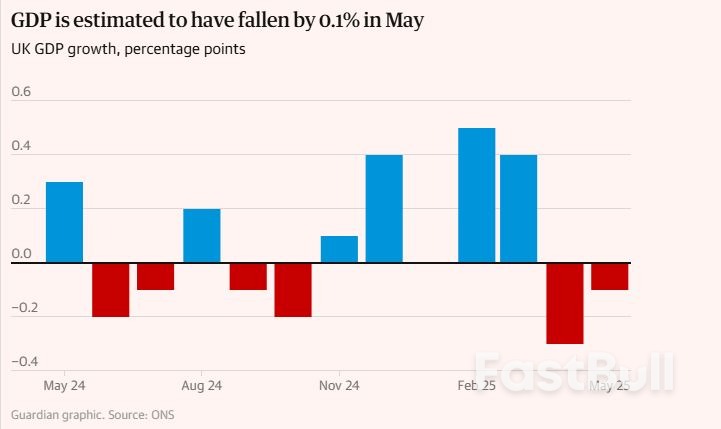
          May’s unexpected 0.1% decline in GDP will make depressing reading for Rachel Reeves before a tough budget in the autumn.
          Stronger-than-expected growth would have helped to alleviate the squeeze on the public finances – but there is nothing in this latest data pointing to an upturn.
          The 0.1% fall in May is marginal, but it follows a 0.3% contraction in April. The Office for National Statistics (ONS) has revised up March’s growth, to 0.4% – but barring a bumper June, it looks like the economy may well have been going backwards in the second quarter of the year.
          “May’s downbeat outturn means a contraction in GDP across the second quarter looks a racing certainty,” said Suren Thiru of the Institute of Chartered Accountants in England and Wales.
          The news comes just as Reeves and her team were daring to hope that business confidence was recovering after a tough few months despite the uncertain global backdrop.
          It makes a rate cut from the Bank of England in August, which was already anticipated, look all but certain. It also appears to strengthen the arguments of the monetary policy committee’s more dovish members, including Alan Taylor and Swati Dhingra, who have raised concerns of late about the weakness of the economy.
          Taylor used a speech last week to suggest the MPC should make three more cuts in 2025 because of the “deteriorating outlook”.Fall in UK GDP Puts Focus Back on Expectations of Tax Rises in Autumn Budget_1
          These monthly figures are frequently revised, but the ONS attributes May’s contraction to a sharp fall in industrial production, which was down 0.9%. That was partly offset by a modest 0.1% increase in services output.
          Within industrial production the decline was driven by a contraction in manufacturing, which was down 1%, after a 0.7% fall in April.
          The manufacturing contraction included a very sharp 3.7% decline in vehicle manufacturing, after a 9.5% drop in April, which the ONS said reflected model changeovers by carmakers – as well as the effect of car tariffs, which have since been lifted under the trade deal struck with the US.
          At this point it is all but impossible to disentangle the economic impacts of Donald Trump’s tariffs, and the increases in business taxes and the minimum wage that came in April.
          However, fresh speculation about tax rises, after a U-turn on Reeves’s £5bn welfare cuts package to head off a Commons defeat last week, risks dampening the mood for consumers and companies in the run-up to the autumn. The shadow chancellor Mel Stride’s response to the GDP figures called this a “ticking tax timebomb”.
          Or as the chief economist of the Institute of Directors, Anna Leach, put it: “Despite the welcome launch of a plethora of government strategies, and a spending review which stuck to the pre-set envelope, we’re back worrying about tax rises in the forthcoming budget,” while underlying growth in the economy, for the moment, remains “tepid and beset with risk”.

          Source: Theguardian

          To stay updated on all economic events of today, please check out our Economic calendar
          Risk Warnings and Disclaimers
          You understand and acknowledge that there is a high degree of risk involved in trading. Following any strategies or investment methods may lead to potential losses. The content on the site is provided by our contributors and analysts for information purposes only. You are solely responsible for determining whether any trading assets, securities, strategy, or any other product is suitable for investing based on your own investment objectives and financial situation.
          Add to Favorites
          Share

          Can The US Avoid Recession? A Lot Depends On The Dollar

          Damon

          Economic

          Forex

          Near-term US recession risk is low, but there are pockets of weakness that could mutate into a downturn later this year. The weaker dollar, though, will be key to whether the US avoids that fate and stocks a significant decline.

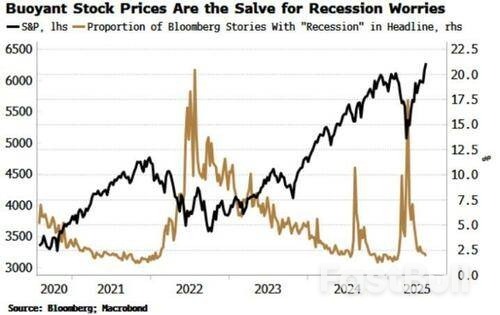
          For now, it’s gone quiet on the recession front.

          Not long ago, there was febrile speculation that a downturn was imminent, despite a lack of support from leading data.

          Since then, the clamour has died down, and that can make one a little uneasy. Not necessarily because we should be worried about an imminent recession, but it does imply the market is now less prepared for bad news, which increases the likelihood of a disproportionate impact on asset prices.

          My Recession Gauge – an amalgamation of 14 separate recession indicators – has fallen and is well under the activation threshold. But there are areas of weakness in the economy that could trigger anxiety and cause stock markets to drop, at least temporarily.

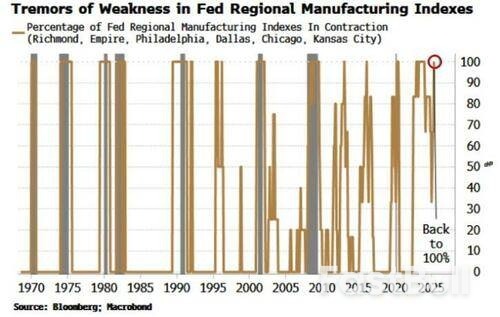
          One notable point can be found in the Federal Reserve’s regional manufacturing indexes. Individually they are very volatile. But when they act in concert, they give a more reliable indication. The combined signal has recently jumped back to 100%, with all the indexes now in the contraction zone.

          As we can see from the chart above, this particular data point has given a few false positives in the past, so it is not perfect. But equally it’s not something that should be ignored, as manufacturing is one of the most leading sectors in the economy. Moreover, recessions are pervasive. So a nationwide decline in manufacturing is best monitored.

          We might also see other signs of economic weakness in the coming months. One point to focus on might be whether the rise in WARN (advance layoff) notices presages weakness in unemployment claims and the wider labour market. Another area to watch is the housing market, and whether that starts to become a wider problem.

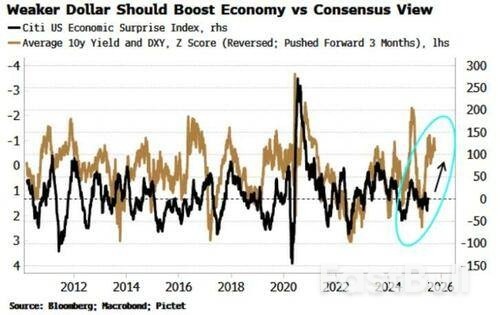
          None of these guarantee a recession however, especially if the weaker dollar eases financial conditions to keep a downturn at bay. The drop in the US currency should also translate into a boost for stock earnings.

          More broadly, though, dollar weakness and (at least for now) relatively stable yields are typically consistent with economic data improving relative to the consensus.

          There are more malign effects from the weaker dollar also in the pipeline such as higher inflation, but at least through the rest of this year, it might be enough to forestall a return of recession angst.

          Source: Zero Hedge

          To stay updated on all economic events of today, please check out our Economic calendar
          Risk Warnings and Disclaimers
          You understand and acknowledge that there is a high degree of risk involved in trading. Following any strategies or investment methods may lead to potential losses. The content on the site is provided by our contributors and analysts for information purposes only. You are solely responsible for determining whether any trading assets, securities, strategy, or any other product is suitable for investing based on your own investment objectives and financial situation.
          Add to Favorites
          Share

          Trump’s Brazil Tariffs Risk Upending Trade From Coffee to Beef

          Adam

          Economic

          Commodity

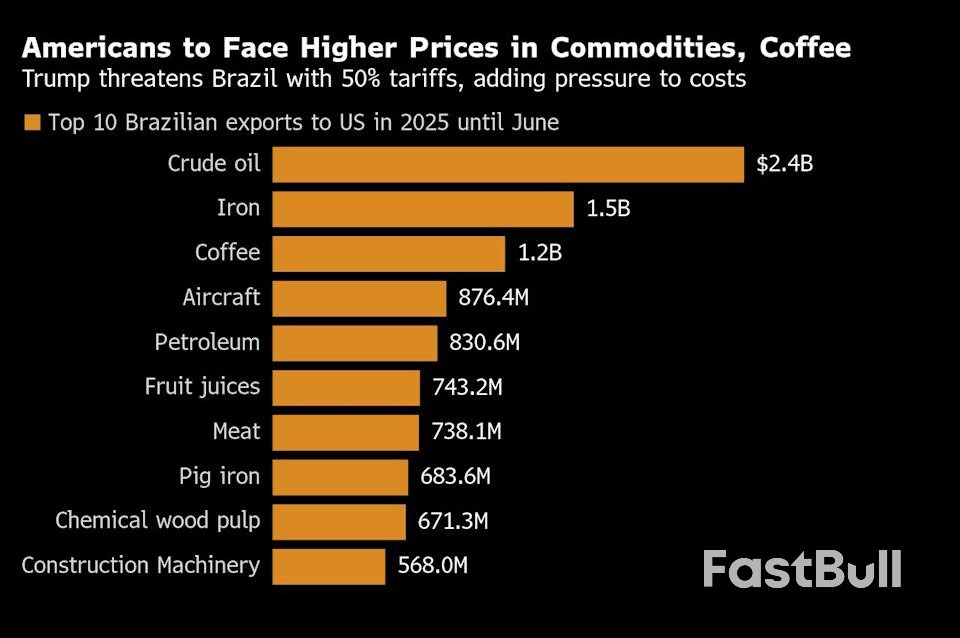
          President Donald Trump’s unexpected move to threaten a 50% tariff on Brazil risks roiling global commodity markets, disrupting trade on everything from beef to coffee.
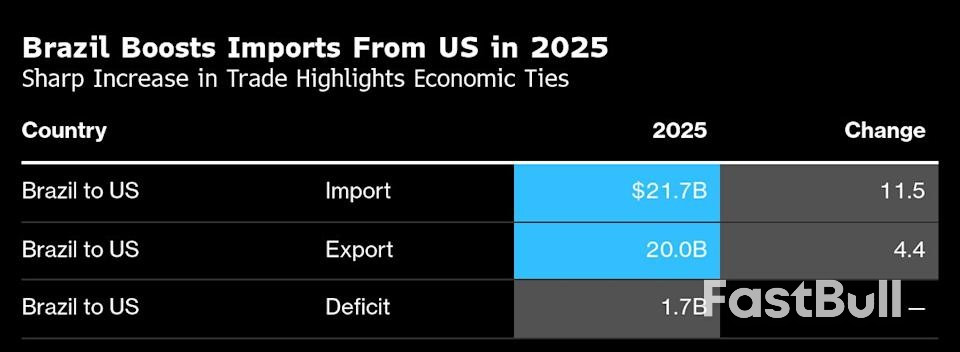
          The US is Brazil’s second-largest trading partner, trailing only China. But while the two nations compete directly in some markets like corn and cotton, Brazil — an agricultural powerhouse — also produces tropical goods like coffee that can’t be grown in the continental US.
          Brazil has been ramping up beef shipments to meet growing US demand, and is a key supplier of wood pulp used in everything from books to toilet paper. That’s spurring hopes that some sectors could be singled out or exempted from tariffs.
          Still, Brazil’s strength in commodities gives it some flexibility, and the country could ease the impact by finding buyers elsewhere.
          “It’s likely that these products will have to be redirected,” said Marcos Fava Neves, a professor at the University of Sao Paulo’s Ribeirao Preto Business School. “Beef is being exported to many places, orange juice is in short supply and coffee is in short supply.”
          Brazil’s energy and metal industries are also evaluating potential impacts. Here’s how the tariffs could ripple through key commodities:

          Coffee

          The US imported nearly $2 billion worth of coffee from Brazil in 2024, according to the US Department of Agriculture. The shipments are roughly 30% of US coffee consumption, Brazilian coffee exporters group Cecafé said.
          “It’s a loss to our companies, and it means more costs and more inflation to American consumers,” Cecafé Chief Executive Officer Marcos Matos said.
          Trump’s Brazil Tariffs Risk Upending Trade From Coffee to Beef_1
          Brazil is the world’s top grower of the premium arabica variety favored by Starbucks Corp. (SBUX) and most specialty coffee shops. Prices for the bean have already surged over the past year as poor weather in Brazil threatened supplies.
          Tariffs on Brazil could result in coffee prices rising “quite a lot,” Giuseppe Lavazza, chairman of Italian roaster Lavazza, said on Bloomberg Television.

          Beef

          American meatpackers, facing the smallest US cattle herd since the 1950s, have been relying more on supplies from countries like Brazil. Demand is also rising as consumers on weight-loss drugs seek out high-protein foods. In 2024, about $1.4 billion of beef was imported into the US from Brazil, according to the US Department of Agriculture.
          Trump’s Brazil Tariffs Risk Upending Trade From Coffee to Beef_2
          Brazilian producers will likely redirect shipments, with meatpacker Minerva SA saying it can also supply the US market with its operations in Argentina, Paraguay, Uruguay and Australia. Still, the Brazilian Association of Meat Exporters pointed to risks for “global supply and food security” while pledging for more dialogue between the two countries.

          Oil

          Brazilian crude exports eclipsed all other foreign sales for Latin America’s biggest economy for the first time last year, with oil and derivatives shipments to the US totaling $7.6 billion in 2024.
          Brazil’s oil lobby group IBP said in a statement that the tariff move “brings uncertainty to the oil and gas sector, which today accounts for 17% of Brazil’s industrial GDP and 1.6 million direct and indirect jobs in the country.”
          But analysts see little structural risk to the country’s production, given Brazil’s ability to divert export flow.
          “Brazil has the capacity to redirect barrels currently exported to the US to refineries in Asia (China, India), Europe, or the Middle East, which demand light, low-sulfur crude such as those produced in Brazil’s pre-salt fields,” BTG Pactual analysts led by Luiz Carvalho wrote in a note to clients.
          Analysts also see limited impact for state-controlled oil producer Petrobras, which exports most of its crude to China.

          Orange Juice

          Brazil accounts for roughly 70% of global orange juice exports, and has played a more sizable role in the US supply as a deadly citrus greening disease spread through Florida’s groves. While the same disease is also impacting some areas of Brazil, the northeastern part of the country has been largely untouched and is expanding production. Orange juice futures rose as much as 6% on Thursday to the highest price in nearly a month.
          The new tariff would be a lot higher than the existing rate of $415 per ton applied to Brazilian juice shipments, meaning a charge equivalent to more than 70% of the value of the product, industry group CitrusBR said. This would make shipments “unfeasible,” Executive Director Ibiapaba Netto said.
          “Now we have to speed up production to ship the orders we still have as quickly as possible before the taxes come into effect,” said Bryan Souza, head of global operations at Sumo Brasil, a company that produces frozen concentrated orange juice.

          Ethanol

          Brazil has been expanding its capacity to convert corn and sugar cane into ethanol, a biofuel often blended with gasoline. The US is a key market, with incentives in California for low-carbon fuels helping to propel ethanol shipments to about 300 million liters last year. A risk of retaliation would also limit shipments to Brazil from the US, and even tighten supplies in the South American nation this year, said Bruno Lima, soft commodities business director at StoneX.

          Pulp and paper

          Brazil is home to Suzano SA, the world’s largest exporter of the pulp that goes into products like toilet paper. Pulp is Brazil’s fourth-largest agricultural export to the US, and paper and plywood are also among the top goods, according to Brazil’s Ministry of Agriculture and Livestock. Suzano Chief Executive Officer João Alberto de Abreu said in May that the company was passing the costs of tariffs — which were 10% at the time — on to US buyers. Suzano is the most exposed to tariffs among Brazilian commodity producers, as about 15% of the company’s revenue comes from the US, Citi analyst Gabriel Barra wrote in a note.

          Sugar

          While much of America’s sugar has historically been produced domestically or imported from Mexico, shipments from Brazil, the world’s top sugar grower, have boomed. The US imported a record amount from the country in 2024, topping a million metric tons, according to the USDA.
          The US limits the amount of sugar that can be imported under low fees, and allocated about 14% of that supply to Brazil in the 2025 fiscal year. Additional Brazilian shipments, which are subject to higher fees, have totaled over 265,000 tons as of the end of May, said Mike McDougall, an analyst at McDougall Global View.

          Steel

          Brazil’s steel industry doesn’t see any direct impact from the tariff announced by Trump, since the sector was already subject to that rate under Section 232 of the Trade Expansion Act, said Marco Polo de Mello Lopes, chief executive officer of industry association Aço Brasil.
          The move, however, may sour relations between Brazil and the US, making it more difficult to re-establish steel trade negotiations that may involve export quotas on semi-finished products, Lopes said. Brazilian steel mills produced around 60% of all slabs imported by the US last year to feed its industry.
          Mining and steel stocks gained in Sao Paulo on bets that rising commodity prices and limited exposure to the US will help them weather the storm.

          Bloomberg :source

          To stay updated on all economic events of today, please check out our Economic calendar
          Risk Warnings and Disclaimers
          You understand and acknowledge that there is a high degree of risk involved in trading. Following any strategies or investment methods may lead to potential losses. The content on the site is provided by our contributors and analysts for information purposes only. You are solely responsible for determining whether any trading assets, securities, strategy, or any other product is suitable for investing based on your own investment objectives and financial situation.
          Add to Favorites
          Share

          Australian Dollar Looking Attractive Here

          Warren Takunda

          Economic

          The Australian dollar is a 'buy' with two major financial institutions, where analysts cite supportive macroeconomic conditions, 'hawkish' monetary policy signals, and improving sentiment toward China.
          A central theme among strategists is the close correlation between the Australian dollar and Chinese market sentiment:
          "Since the start of the year, the Australian dollar has closely followed the trajectory of Chinese equities," says Société Générale, noting that recent relief over U.S. tariff delays has buoyed risk assets. "The upward trend seen since the ‘Liberation Day’ drawdown is not yet over."
          Bank of America's bullish stance on China's economic recovery prompts it to back Australian Dollar upside."
          "We were already bullish AUD/USD given the positive outlook for China's growth and our forecast for USD/CNY to remain rangebound (7.10–7.30).
          "China growth rebound, super fund dynamics and risk resilience are other tailwinds."
          Also potentially boosting the Australian dollar is the Reserve Bank of Australia's (RBA) unexpected decision to hold interest rates steady at 3.85% this week, defying widespread expectations of a rate cut.
          "The RBA surprised markets this week by keeping interest rates steady," Société Générale noted, adding that the RBA’s more cautious approach could provide support:
          "The AUD-USD three-year yield differential appears to be bottoming out… and the RBA’s cautious approach could support both AUD yields and the Australian dollar in the weeks ahead."
          Australian Dollar Looking Attractive Here_1

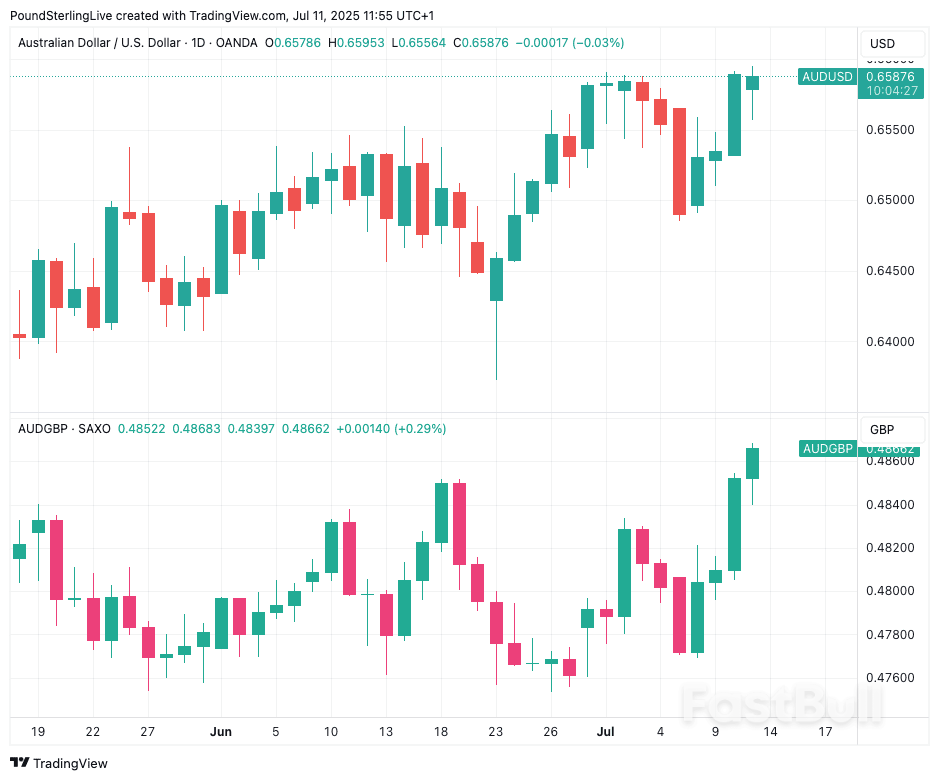
          Above: AUD vs. USD (top) and AUD vs. GBP at daily intervals.

          Bank of America took a similar view, recommending a long position on the currency following the central bank’s decision. "We recommended buying AUDUSD this week, following the RBA's decision to keep rates on hold," said analysts.
          Both institutions emphasise that the AUD remains undervalued relative to macro fundamentals. "In our view, the FX market looks particularly mispriced," Bank of America wrote, targeting a move toward 0.68 by year-end.
          Société Générale highlighted the potential for positive growth surprises, despite strong global demand for Australia's abundant natural resources.
          "The market has revised Australian growth forecasts down a long way, providing room for positive surprises," Soc Gen says. "The world is fighting over natural resources."
          Bank of America cautions that the biggest risk to its constructive AUD view is U.S.-China trade escalation, something that cannot be entirely discounted given U.S. President Donald Trump is again proving to be highly unpredictable in his tariff policy.
          "But with the relevant deadline a month away, there is a window for AUD to outperform," says Bank of America.

          Source: Poundsterlinglive

          To stay updated on all economic events of today, please check out our Economic calendar
          Risk Warnings and Disclaimers
          You understand and acknowledge that there is a high degree of risk involved in trading. Following any strategies or investment methods may lead to potential losses. The content on the site is provided by our contributors and analysts for information purposes only. You are solely responsible for determining whether any trading assets, securities, strategy, or any other product is suitable for investing based on your own investment objectives and financial situation.
          Add to Favorites
          Share

          US Equity Fund Inflows Ease on Caution Over Tariff Threats

          Michelle

          Economic

          Stocks

          U.S. equity funds saw a significant drop in net investments in the week through July 9 on caution over President Donald Trump's threats of fresh tariffs on trading partners, even though stocks surged to new records on rising demand in the artificial intelligence sector.

          Investors acquired just $2.1 billion worth of U.S. equity funds during the week when compared with a robust $31.6 billion worth of net accumulations in the prior week, data from LSEG Lipper showed.

          President Trump this week extended the tariff deadline until August 1 to facilitate trade negotiations, but announced noticeably higher duties for some key trading partners including Japan, South Korea, Canada and Brazil alongside a 50% tariff on copper.

          U.S. multi-cap funds saw the first weekly net investment in four weeks to the tune of $1.8 billion. Large-cap, mid-cap and small-cap funds, meanwhile, suffered net outflows of $2.83 billion, $785 million and $472 million, respectively.

          Sectoral funds saw net purchases extended into a second successive week, with approximately $1.28 billion flowing into these funds. Tech drew in $1.7 billion but healthcare saw net outflows of $874 million.

          U.S. money market funds faced a net $9.78 billion weekly outflow, ending two weeks of buying.

          Inflows into U.S. bond funds, meanwhile, cooled to a three-week low of $4.34 billion.

          Short-to-intermediate investment-grade funds received $1.76 billion with weekly net investments dropping by 57% over the week. General domestic taxable fixed income funds received just $634 million compared with a net $3.03 billion purchase in the prior week.

          Short-to-intermediate government and treasury funds, meanwhile, attracted $982 million, the largest amount in four weeks.

          Source: Yahoo Finance

          To stay updated on all economic events of today, please check out our Economic calendar
          Risk Warnings and Disclaimers
          You understand and acknowledge that there is a high degree of risk involved in trading. Following any strategies or investment methods may lead to potential losses. The content on the site is provided by our contributors and analysts for information purposes only. You are solely responsible for determining whether any trading assets, securities, strategy, or any other product is suitable for investing based on your own investment objectives and financial situation.
          Add to Favorites
          Share
          FastBull
          Copyright © 2025 FastBull Ltd

          728 RM B 7/F GEE LOK IND BLDG NO 34 HUNG TO RD KWUN TONG KLN HONG KONG

          TelegramInstagramTwitterfacebooklinkedin
          App Store Google Play Google Play
          Products
          Charts

          Chats

          Q&A with Experts
          Screeners
          Economic Calendar
          Data
          Tools
          Membership
          Features
          Function
          Markets
          Copy Trading
          Latest Signals
          Contests
          News
          Analysis
          24/7
          Columns
          Education
          Company
          Careers
          About Us
          Contact Us
          Advertising
          Help Center
          Feedback
          User Agreement
          Privacy Policy
          Business

          White Label

          Data API

          Web Plug-ins

          Poster Maker

          Affiliate Program

          Risk Disclosure

          The risk of loss in trading financial instruments such as stocks, FX, commodities, futures, bonds, ETFs and crypto can be substantial. You may sustain a total loss of the funds that you deposit with your broker. Therefore, you should carefully consider whether such trading is suitable for you in light of your circumstances and financial resources.

          No decision to invest should be made without thoroughly conducting due diligence by yourself or consulting with your financial advisors. Our web content might not suit you since we don't know your financial conditions and investment needs. Our financial information might have latency or contain inaccuracy, so you should be fully responsible for any of your trading and investment decisions. The company will not be responsible for your capital loss.

          Without getting permission from the website, you are not allowed to copy the website's graphics, texts, or trademarks. Intellectual property rights in the content or data incorporated into this website belong to its providers and exchange merchants.

          Not Logged In

          Log in to access more features

          FastBull Membership

          Not yet

          Purchase

          Become a signal provider
          Help Center
          Customer Service
          Dark Mode
          Price Up/Down Colors

          Log In

          Sign Up
          Position
          Layout
          Fullscreen
          Default to Chart
          The chart page opens by default when you visit fastbull.com