

Markets
News
Analysis
User
24/7
Economic Calendar
Education
Data
- Names
- Latest
- Prev



Signal Accounts for Members
All Signal Accounts
All Contests
 Japan Tankan Small Manufacturing Outlook Index (Q4)
A:--
F: --
P: --
Japan Tankan Large Non-Manufacturing Outlook Index (Q4)A:--
F: --
P: --
Japan Tankan Large Manufacturing Outlook Index (Q4)A:--
F: --
P: --
Japan Tankan Small Manufacturing Diffusion Index (Q4)A:--
F: --
P: --
Japan Tankan Large Manufacturing Diffusion Index (Q4)A:--
F: --
P: --
Japan Tankan Large-Enterprise Capital Expenditure YoY (Q4)A:--
F: --
P: --
 U.K. Rightmove House Price Index YoY (Dec)
A:--
F: --
P: --
 China, Mainland Industrial Output YoY (YTD) (Nov)
A:--
F: --
P: --
China, Mainland Urban Area Unemployment Rate (Nov)A:--
F: --
P: --
 Saudi Arabia CPI YoY (Nov)
A:--
F: --
P: --
 Euro Zone Industrial Output YoY (Oct)
A:--
F: --
P: --
Euro Zone Industrial Output MoM (Oct)A:--
F: --
P: --
 Canada Existing Home Sales MoM (Nov)
A:--
F: --
P: --
Canada National Economic Confidence IndexA:--
F: --
P: --
Canada New Housing Starts (Nov)A:--
F: --
 U.S. NY Fed Manufacturing Employment Index (Dec)
A:--
F: --
P: --
U.S. NY Fed Manufacturing Index (Dec)A:--
F: --
P: --
Canada Core CPI YoY (Nov)A:--
F: --
P: --
Canada Manufacturing Unfilled Orders MoM (Oct)A:--
F: --
P: --
U.S. NY Fed Manufacturing Prices Received Index (Dec)A:--
F: --
P: --
U.S. NY Fed Manufacturing New Orders Index (Dec)A:--
F: --
P: --
Canada Manufacturing New Orders MoM (Oct)A:--
F: --
P: --
Canada Core CPI MoM (Nov)A:--
F: --
P: --
Canada Trimmed CPI YoY (SA) (Nov)A:--
F: --
P: --
Canada Manufacturing Inventory MoM (Oct)A:--
F: --
P: --
Canada CPI YoY (Nov)A:--
F: --
P: --
Canada CPI MoM (Nov)A:--
F: --
P: --
Canada CPI YoY (SA) (Nov)A:--
F: --
P: --
Canada Core CPI MoM (SA) (Nov)A:--
F: --
P: --
Canada CPI MoM (SA) (Nov)A:--
F: --
P: --
Federal Reserve Board Governor Milan delivered a speech U.S. NAHB Housing Market Index (Dec)--
F: --
P: --
 Australia Composite PMI Prelim (Dec)
--
F: --
P: --
Australia Services PMI Prelim (Dec)--
F: --
P: --
Australia Manufacturing PMI Prelim (Dec)--
F: --
P: --
Japan Manufacturing PMI Prelim (SA) (Dec)--
F: --
P: --
U.K. 3-Month ILO Employment Change (Oct)--
F: --
P: --
U.K. Unemployment Claimant Count (Nov)--
F: --
P: --
U.K. Unemployment Rate (Nov)--
F: --
P: --
U.K. 3-Month ILO Unemployment Rate (Oct)--
F: --
P: --
U.K. Average Weekly Earnings (3-Month Average, Including Bonuses) YoY (Oct)--
F: --
P: --
U.K. Average Weekly Earnings (3-Month Average, Excluding Bonuses) YoY (Oct)--
F: --
P: --
 France Services PMI Prelim (Dec)
--
F: --
P: --
France Composite PMI Prelim (SA) (Dec)--
F: --
P: --
France Manufacturing PMI Prelim (Dec)--
F: --
P: --
 Germany Services PMI Prelim (SA) (Dec)
--
F: --
P: --
Germany Manufacturing PMI Prelim (SA) (Dec)--
F: --
P: --
Germany Composite PMI Prelim (SA) (Dec)--
F: --
P: --
Euro Zone Composite PMI Prelim (SA) (Dec)--
F: --
P: --
Euro Zone Services PMI Prelim (SA) (Dec)--
F: --
P: --
Euro Zone Manufacturing PMI Prelim (SA) (Dec)--
F: --
P: --
U.K. Services PMI Prelim (Dec)--
F: --
P: --
U.K. Manufacturing PMI Prelim (Dec)--
F: --
P: --
U.K. Composite PMI Prelim (Dec)--
F: --
P: --
Euro Zone ZEW Economic Sentiment Index (Dec)--
F: --
P: --
Germany ZEW Current Conditions Index (Dec)--
F: --
P: --
Germany ZEW Economic Sentiment Index (Dec)--
F: --
P: --
Euro Zone Trade Balance (Not SA) (Oct)--
F: --
P: --
Euro Zone ZEW Current Conditions Index (Dec)--
F: --
P: --
Euro Zone Trade Balance (SA) (Oct)--
F: --
P: --
U.S. Retail Sales MoM (Excl. Automobile) (SA) (Oct)--
F: --
P: --


No matching data

Latest Views
Latest Views
Trending Topics
Top Columnists
Latest Update
White Label
Data API
Web Plug-ins
Affiliate Program
View All
No data
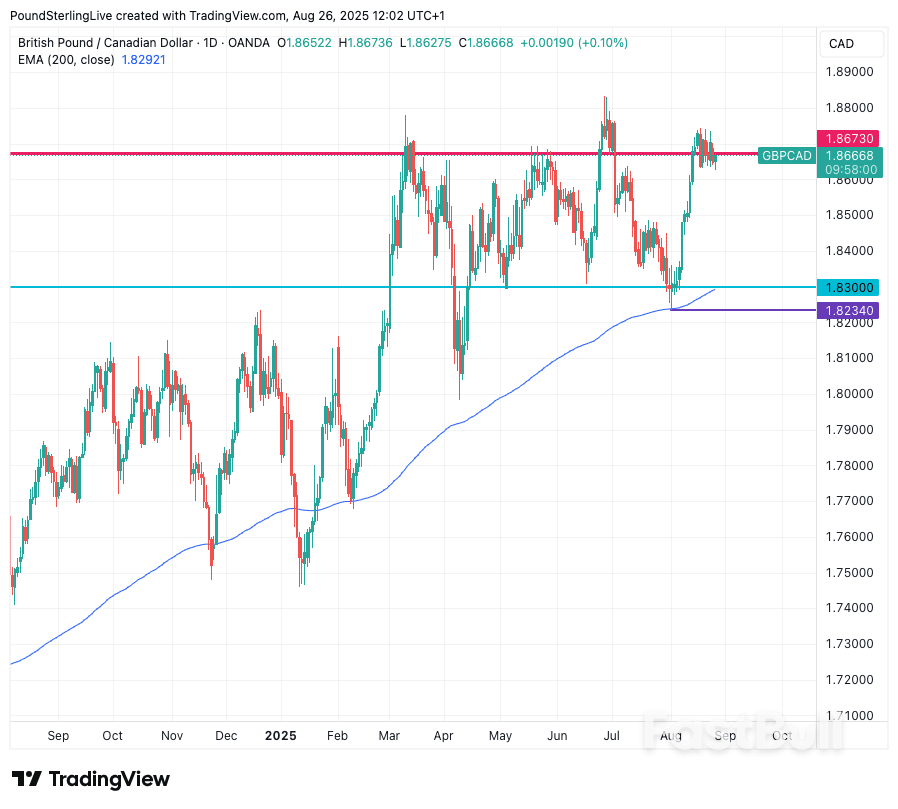
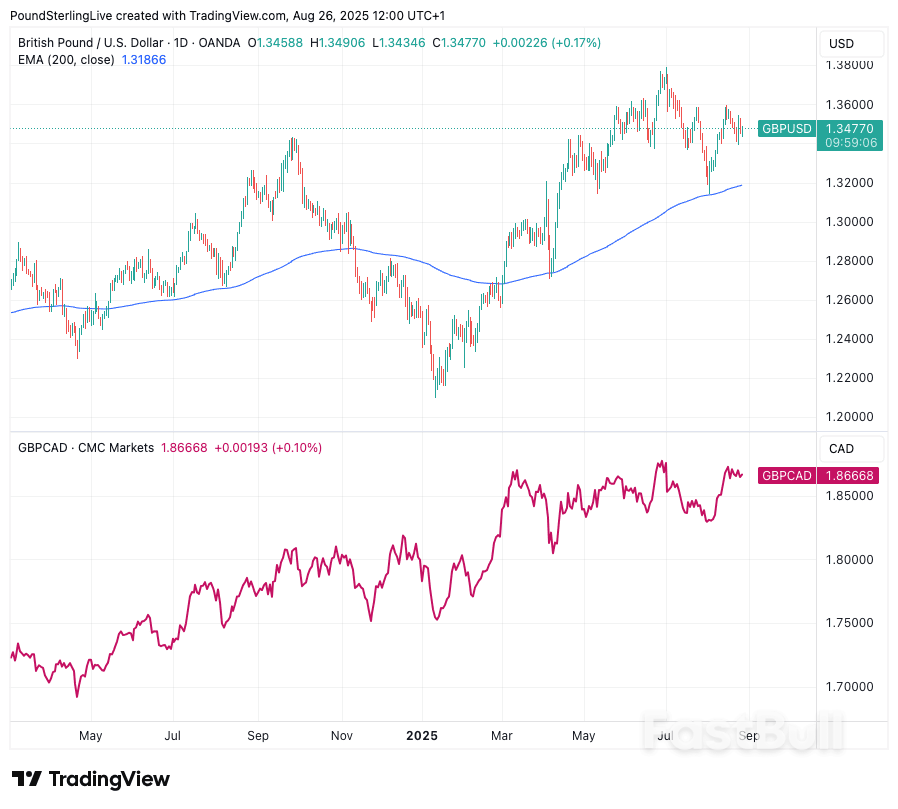
The Pound to Canadian Dollar pair (GBP/CAD) is at a key technical moment.
The traditional end of the US summer is days away and the kids are returning to school. So here are three things I have on my mind as the steamy August tariff nights give way to what may end up being a defining autumn.
One of the oft-repeated lines in recent weeks has been that while Trump’s tariffs may have steadily ratcheted up to a level not seen since the 1930s at least they’ve brought an end to a dreaded uncertainty.
Yet with so-called secondary tariffs of 50% on Indian goods about to take effect at a minute past midnight tonight in Washington because of India’s imports of oil from Russia and major sectors like pharmaceuticals and semiconductors still waiting to learn what duties they will face, it seems premature to call an end to uncertain times. Or any top for that matter.
Moreover, in recent days Trump has announced new national security investigations into wind turbines and imported furniture. Late Monday he turned to social media to threaten nations that apply digital taxes with retaliation as well. Also looming this week is the end to immunity for small packages from US duties.
Then there’s the legal uncertainty hanging over Trump’s original Liberation Day tariffs with an appellate panel and the Supreme Court set to rule in the coming months whether the power Trump invoked was even legal.
Treasury Secretary Scott Bessent declared last week that he was satisfied with the state of tariffs and trade talks with China. And yet even the truce that Trump extended earlier this month feels fragile.
Trump on Monday hinted plans were afoot for him to visit Beijing either later this year or early next. Which may be the best signal that the coming months will see relative calm in relations between the world’s two largest economies.
But after that?
Maybe this is really what a new economic Cold War feels like. Perennial uncertainty and fear that either side could suddenly do something rash. Or that any misplayed incident could escalate quickly into economic Armageddon.
Trump’s comments Monday pointed to both an eagerness for peace through strength and a comfort with potential Armageddon.
“We have much bigger and better cards than they do,” he told reporters.
He also added later: “If we want to put 100%, 200% tariffs on, we wouldn’t do any business with China. And you know, it would be OK too.”
Which won’t comfort anyone who remembers how financial markets slumped the last time Trump imposed tariffs of more than 100% on imports from China.
This is the biggest question on my mind.
Federal Reserve Chair Jerome Powell offered a fairly grim picture in his Jackson Hole speech last week. The US economy, he said, is seeing inflation rising again thanks to the clear effect of tariffs, growth and consumer spending slowing and the labor market weakening.
The good news came only for those who interpreted Powell’s description of a weaker US as a sign the Fed will rescue the economy and cut rates as soon as September. Which is what it did in 2019, the last time it saw tariffs dragging on growth.
The economy in the first half of this year grew at half the rate it did in the same six months of 2024. It’s hard to predict things getting better with even apparent good news recently looking uglier once you account for the oddness of this year.
In a note to clients yesterday Goldman Sachs economists pointed out that a weaker dollar this year has inflated corporate earnings with many companies’ offshore revenues looking stronger when converted into dollars .
On a year-on-year basis, real revenues for the S&P 500 minus a volatile energy sector were up 4.8% based on the just-concluded earnings season. And yet, they added: “On a constant-currency basis, real revenue growth slowed to 2.7% for the S&P 500 while revenue declined for mid- and small-cap companies.”
Beyond Wall Street you have to wonder about the impact on the US economy of having a million fewer immigrants, as the Pew Research Center recently calculated. Which is the first decline in America’s immigrant population since the 1960s.
Beyond that, what of a rural economy in which American soybean farmers are again getting restless over lost overseas markets?
There are, of course, other things on my mind.
Given the indignant responses to Trump’s tariff hikes of Indian Prime Minister Narendra Modi and Brazil’s Luiz Inacio Lula da Silva, are the BRICS about to accelerate their push back against American hegemony?
And where will all those Chinese goods once headed for American shores go?
Those first three, however, do feel like enough to contemplate for now as the summer sound of crickets fades.
—Shawn Donnan in Washington
Cambodia’s National Assembly yesterday passed a controversial legal provision giving the government the authority to revoke the citizenship of any Cambodian national accused of “colluding” with foreign powers.The amendment to Cambodia’s 1996 Law on Nationality passed the parliament with the unanimous support of the 120 lawmakers present.
As with so many other changes to Cambodian laws, the amendment follows a call by former Prime Minister Hun Sen, who, during a visit to troops serving along the disputed border with Thailand in late June, said that the country needed a law to strip the citizenship of those who “side with foreign nations to harm our country.”
The change required an amendment to the country’s Constitution that was passed nearly unanimously through both houses of parliament and signed by King Norodom Sihamoni last month. Article 33 of the Constitution previously stated that Khmer citizens “shall not be deprived of their nationality.” This line has now been removed and replaced with a phrase stating that “acquisition and loss of Cambodian citizenship, including withdrawal, shall be determined by law.”
The amendment has been opposed by Cambodian civil society groups, 50 of which claimed in a statement earlier this week that the new provisions are “vaguely written, and will have a disastrously chilling effect on the freedom of speech of all Cambodian citizens.”“The potential for abuse in the implementation of this vaguely worded law to target people on the basis of their ethnicity, political opinions, speech, and activism is simply too high to accept,” the groups stated. “The government has many powers, but they should not have the power to arbitrarily decide who is and is not a Cambodian.”
In responding to these criticisms, Justice Minister Keut Rith told lawmakers ahead of yesterday’s vote that the bill was aimed at safeguarding sovereignty and national security and would “only apply to individuals who collude with foreign powers to damage Cambodia’s national interests.” He added, “Its purpose is to protect patriotism and the loyalty of the Khmer people.” Interior Minister Sar Sokha similarly told the Assembly that the conditions outlined in the law would “apply only to traitors.”
None of this is very reassuring given the Cambodian People’s Party (CPP)’s history of using accusations of “treason” and “collusion” to silence dissenters and political opponents. As I noted after last month’s constitutional amendment, the law will most likely be used against Cambodian opposition figures living abroad, many of whom also hold or have sought to acquire foreign citizenship.
The attempt to proscribe foreign collusion takes on additional salience in the context of the current border dispute with Thailand, which flared into a five-day conflict in late July. The conflict has prompted a remarkable alignment of Cambodian media and expert opinion behind Prime Minister Hun Manet’s government, and a widespread sense of national emergency.
These new legal powers will give the CPP government ever more powers to police the bounds of political discourse, while the border dispute will only lower the threshold of what constitutes foreign “collusion” or “treason.” Given the prevailing atmosphere of patriotic fervor, few are likely to sound any note of opposition if the government accuses a certain group or individual of undermining national security or colluding with any other foreign power.
Morgan Stanley predicts the Federal Reserve will cut interest rates by 25 basis points in both September and December 2025. This forecast shift follows Fed Chair Jerome Powell's focus on labor market risks over inflation at the Jackson Hole symposium.
This outlook matters due to potential shifts in financial markets, liquidity impacts, and the broader economic narrative following increased labor market focus.
Morgan Stanley has shifted its perspective based on Jerome Powell's remarks at the Jackson Hole symposium. Powell emphasized labor market risks over inflation concerns. This adjustment follows previous skepticism about rate cuts, as the bank initially favored a higher rate stance.
Powell's comments prompted Morgan Stanley to change its expectations. The investment bank now anticipates rate cuts will occur in both September and December 2025. These projections align with shifts seen in options and futures markets.
Financial markets have reacted with options and futures markets pricing an 82–87% probability of a September rate cut. Such cuts historically correlate with bullish trends in cryptocurrencies like BTC and ETH, which are sensitive to liquidity changes.
The focus on labor markets implies a careful balancing act for the Federal Reserve. An emphasis on employment rather than inflation signals a strategic shift. Rate cuts could catalyze additional capital inflows as the Fed adjusts its policy stance.
This updated outlook from Morgan Stanley could influence various sectors, including cryptocurrencies and financial markets, which respond to liquidity signals. History suggests that rate cuts can lead to bullish runs in non-sovereign assets like BTC and ETH, as well as potential resurgence in digital finance.
Trump’s move to oust Federal Reserve Governor Lisa Cook on allegations she falsified mortgage documents is a marked escalation in his battle to exert more control over the central bank, and could open the door for even more sweeping board changes.
To Michael Feroli, chief US economist at JPMorgan, a successful sacking would be “momentous” and carry huge implications for the entire Fed make up.
That’s because the slate of terms for the presidents of the 12 regional Fed banks are recertified every five years by the seven-member Board of Governors, in February of years beginning with a 1 or 6 (i.e. 2026).
Doing the math, any replacement for Cook could join Stephen Miran (assuming he’s approved by the Senate when it returns from the summer recess), and Governors Christopher Waller and Michelle Bowman who were appointed by Trump in his first term and dissented to last month’s decision to hold interest rates steady. Those votes were based on differing opinions over the balance of economic risks, but such a quartet would theoretically be able to remove all 12 Fed presidents if they were to vote as a block, “thereby dramatically reshaping the FOMC,” Feroli wrote.
A lot of ifs and buts loom before any such theoretical moves can take place.
For one thing, Cook said Trump has no authority to fire her, and she won’t quit.
Her lawyer, Abbe Lowell, pledged to take “whatever actions are needed to prevent” Trump’s “illegal action.” And Bloomberg Intelligence US policy analyst Nathan R Dean reckons Cook can win.
“Mere allegations of fraud are likely insufficient to meet the ‘for cause’ removal standard unless actual wrongdoing is established, which at minimum likely requires an investigation and possibly a conviction,” Dean wrote.
With lengthy litigation and an uncertain outcome looming, Dean doubts a Cook suit would be resolved by the Board of Governors vote in February.
In a ruling earlier this year, the Supreme Court signaled it would shield the central bank from the type of at-will removals of board members that Trump has undertaken at other independent federal agencies.
There’s also a risk that US markets could buckle if concerns over the Fed’s independence deepen, forcing a TACO-style moderation in Trump’s salvos.
S&P Global Ratings, in a note earlier this month affirming the US at AA+, warned that its sovereign credit rating could “come under pressure if political developments weigh on the strength of American institutions and the effectiveness of long-term policymaking or independence of the Federal Reserve.”
Markets gave a tiny taste of that in the wake of the Cook news. The Treasury curve steepened, with a drop in two-year yields reflecting growing speculation of a Fed rate cut as soon as next month, while 30-year yields climbed on concern looser monetary policy would risk fueling inflation.
“If Trump’s piercing of the Board stokes fears of inflation, bond prices would fall, sending interest rates sharply higher,” said Sarah Binder, political science professor at George Washington University and co-author of The Myth of Independence: How Congress Governs the Federal Reserve. “Central bankers surely prefer to stick to their knitting, but Fed officials can't duck out of the political spotlight.”
Among criticisms the Fed has faced from politicians this year is the operational losses it’s incurring. Those losses are due in large part to the Fed paying out higher interest to banks on the cash they park with it than what it gets from low-yielding bonds that it bought years ago.
So, what if the Fed just stopped paying out interest on the cash that financial institutions place with it? The TD Securities US rates team recently took a look at this issue, which is already in debate in the UK. It “would likely be a low-probability, high-impact event for markets,” they concluded. The Fed’s immediate challenge would be a loss of control of interest rates.
Banks would seek better returns elsewhere, such as in Treasury bills. That would drive short-term rates down, putting in peril the Fed’s benchmark. Policymakers would likely have to sell bonds from the Fed’s portfolio in order to get rates where they want, the TD Securities team, led by Gennadiy Goldberg, wrote. Some of the sales would likely be in mortgage securities, and that would drive up mortgage rates. Banks, facing an earnings hit, may also cut the rates they pay to consumers, the team wrote.
728 RM B 7/F GEE LOK IND BLDG NO 34 HUNG TO RD KWUN TONG KLN HONG KONG


White Label
Data API
Web Plug-ins
Poster Maker
Affiliate Program
The risk of loss in trading financial instruments such as stocks, FX, commodities, futures, bonds, ETFs and crypto can be substantial. You may sustain a total loss of the funds that you deposit with your broker. Therefore, you should carefully consider whether such trading is suitable for you in light of your circumstances and financial resources.
No decision to invest should be made without thoroughly conducting due diligence by yourself or consulting with your financial advisors. Our web content might not suit you since we don't know your financial conditions and investment needs. Our financial information might have latency or contain inaccuracy, so you should be fully responsible for any of your trading and investment decisions. The company will not be responsible for your capital loss.
Without getting permission from the website, you are not allowed to copy the website's graphics, texts, or trademarks. Intellectual property rights in the content or data incorporated into this website belong to its providers and exchange merchants.
Not Logged In
Log in to access more features

FastBull Membership
Not yet
Purchase


Log In
Sign Up


