• Trade
  • Markets
  • Copy
  • Contests
  • News
  • 24/7
  • Calendar
  • Q&A
  • Chats
Trending
Screeners
SYMBOL
LAST
BID
ASK
HIGH
LOW
NET CHG.
%CHG.
SPREAD
SPX
S&P 500 Index
6819.19
6819.19
6819.19
6861.30
6801.50
-8.22
-0.12%
--
DJI
Dow Jones Industrial Average
48383.33
48383.33
48383.33
48679.14
48285.67
-74.71
-0.15%
--
IXIC
NASDAQ Composite Index
23110.41
23110.41
23110.41
23345.56
23012.00
-84.75
-0.37%
--
USDX
US Dollar Index
97.960
98.040
97.960
98.070
97.740
+0.010
+ 0.01%
--
EURUSD
Euro / US Dollar
1.17442
1.17451
1.17442
1.17686
1.17262
+0.00048
+ 0.04%
--
GBPUSD
Pound Sterling / US Dollar
1.33694
1.33702
1.33694
1.34014
1.33546
-0.00013
-0.01%
--
XAUUSD
Gold / US Dollar
4302.74
4303.15
4302.74
4350.16
4285.08
+3.35
+ 0.08%
--
WTI
Light Sweet Crude Oil
56.371
56.401
56.371
57.601
56.233
-0.862
-1.51%
--

Community Accounts

Signal Accounts
--
Profit Accounts
--
Loss Accounts
--
View More

Become a signal provider

Sell trading signals to earn additional income

View More

Guide to Copy Trading

Get started with ease and confidence

View More

Signal Accounts for Members

All Signal Accounts

Best Return
  • Best Return
  • Best P/L
  • Best MDD
Past 1W
  • Past 1W
  • Past 1M
  • Past 1Y

All Contests

  • All
  • Trump Updates
  • Recommend
  • Stocks
  • Cryptocurrencies
  • Central Banks
  • Featured News
Top News Only
Share

Turkey: Shoots Down A Drone In The Black Sea Using F-16 Fighter Jets

Share

Goldman Sachs Says They Believe That The Copper Price Is Vulnerable To An Ai-Linked Price Correction

Share

Goldman Sachs Upgrades 2026 Copper Price Forecast To $11400 From $10,650

Share

Attempts By Ukrainian Troops To Advance From The South-West To Outskirts Of Kupiansk Are Being Thwarted

Share

Russian Troops Control All Of Kupiansk - IFX Cites Russian Military

Share

On Monday (December 15), The South Korean Won Ultimately Rose 0.60% Against The US Dollar, Closing At 1468.91 Won. The Won Was On An Upward Trend Throughout The Day, Rising Significantly At 17:00 Beijing Time And Reaching A Daily High Of 1463.04 Won At 17:36

Share

Health Ministry: Israeli Forces Kill Palestinian Teen In West Bank

Share

New York Federal Reserve President Williams: Over Time, The Size Of Reserves Could Grow From $2.9 Trillion

Share

New York Fed President Williams: AI Valuations Are High, But There Is A Real Driving Factor

Share

New York Federal Reserve President Williams: The Job Market Is In Very Good Shape

Share

New York Fed President Williams: 'Very Supportive' Of USA Central Bank's Decision To Cut Interest Rates Last Week

Share

New York Fed President Williams: 'Too Early To Say' What Central Bank Should Do At January Meeting

Share

New York Fed President Williams: Strong Markets Part Of Reason Why Economy Will Grow Robustly In 2026

Share

New York Fed President Williams: What Constitutes Ample Reserves Will Change Over Time

Share

New York Fed President Williams: Market Valuations 'Elevated,' But There Are Reasons For Pricing

Share

New York Fed President Williams: Ample Reserves System Working Very Well

Share

New York Fed President Williams: Some Signs That Parts Of Underlying Economy Not As Strong As GDP Data Suggests

Share

New York Fed President Williams: Expects Coming Job Data Will Show Gradual Cooling

Share

Ukraine President Zelenskiy: Monitoring Of Ceasefire Should Be Part Of Security Guarantees

Share

Ukraine President Zelenskiy: Ukraine Needs Clear Understanding On Security Guarantees Before Taking Any Decisions Regarding Frontlines

TIME
ACT
FCST
PREV
Japan Tankan Small Manufacturing Outlook Index (Q4)

A:--

F: --

P: --

Japan Tankan Large Non-Manufacturing Outlook Index (Q4)

A:--

F: --

P: --

Japan Tankan Large Manufacturing Outlook Index (Q4)

A:--

F: --

P: --

Japan Tankan Small Manufacturing Diffusion Index (Q4)

A:--

F: --

P: --

Japan Tankan Large-Enterprise Capital Expenditure YoY (Q4)

A:--

F: --

P: --

U.K. Rightmove House Price Index YoY (Dec)

A:--

F: --

P: --

China, Mainland Industrial Output YoY (YTD) (Nov)

A:--

F: --

P: --

China, Mainland Urban Area Unemployment Rate (Nov)

A:--

F: --

P: --

Saudi Arabia CPI YoY (Nov)

A:--

F: --

P: --

Euro Zone Industrial Output YoY (Oct)

A:--

F: --

P: --

Euro Zone Industrial Output MoM (Oct)

A:--

F: --

P: --

Canada Existing Home Sales MoM (Nov)

A:--

F: --

P: --

Canada National Economic Confidence Index

A:--

F: --

P: --

Canada New Housing Starts (Nov)

A:--

F: --

P: --
U.S. NY Fed Manufacturing Employment Index (Dec)

A:--

F: --

P: --

U.S. NY Fed Manufacturing Index (Dec)

A:--

F: --

P: --

Canada Core CPI YoY (Nov)

A:--

F: --

P: --

Canada Manufacturing Unfilled Orders MoM (Oct)

A:--

F: --

P: --

U.S. NY Fed Manufacturing Prices Received Index (Dec)

A:--

F: --

P: --

U.S. NY Fed Manufacturing New Orders Index (Dec)

A:--

F: --

P: --

Canada Manufacturing New Orders MoM (Oct)

A:--

F: --

P: --

Canada Core CPI MoM (Nov)

A:--

F: --

P: --

Canada Trimmed CPI YoY (SA) (Nov)

A:--

F: --

P: --

Canada Manufacturing Inventory MoM (Oct)

A:--

F: --

P: --

Canada CPI YoY (Nov)

A:--

F: --

P: --

Canada CPI MoM (Nov)

A:--

F: --

P: --

Canada CPI YoY (SA) (Nov)

A:--

F: --

P: --

Canada Core CPI MoM (SA) (Nov)

A:--

F: --

P: --

Canada CPI MoM (SA) (Nov)

A:--

F: --

P: --

Federal Reserve Board Governor Milan delivered a speech
U.S. NAHB Housing Market Index (Dec)

A:--

F: --

P: --

Australia Composite PMI Prelim (Dec)

--

F: --

P: --

Australia Services PMI Prelim (Dec)

--

F: --

P: --

Australia Manufacturing PMI Prelim (Dec)

--

F: --

P: --

Japan Manufacturing PMI Prelim (SA) (Dec)

--

F: --

P: --

U.K. 3-Month ILO Employment Change (Oct)

--

F: --

P: --

U.K. Unemployment Claimant Count (Nov)

--

F: --

P: --

U.K. Unemployment Rate (Nov)

--

F: --

P: --

U.K. 3-Month ILO Unemployment Rate (Oct)

--

F: --

P: --

U.K. Average Weekly Earnings (3-Month Average, Including Bonuses) YoY (Oct)

--

F: --

P: --

U.K. Average Weekly Earnings (3-Month Average, Excluding Bonuses) YoY (Oct)

--

F: --

P: --

France Services PMI Prelim (Dec)

--

F: --

P: --

France Composite PMI Prelim (SA) (Dec)

--

F: --

P: --

France Manufacturing PMI Prelim (Dec)

--

F: --

P: --

Germany Services PMI Prelim (SA) (Dec)

--

F: --

P: --

Germany Manufacturing PMI Prelim (SA) (Dec)

--

F: --

P: --

Germany Composite PMI Prelim (SA) (Dec)

--

F: --

P: --

Euro Zone Composite PMI Prelim (SA) (Dec)

--

F: --

P: --

Euro Zone Services PMI Prelim (SA) (Dec)

--

F: --

P: --

Euro Zone Manufacturing PMI Prelim (SA) (Dec)

--

F: --

P: --

U.K. Services PMI Prelim (Dec)

--

F: --

P: --

U.K. Manufacturing PMI Prelim (Dec)

--

F: --

P: --

U.K. Composite PMI Prelim (Dec)

--

F: --

P: --

Euro Zone ZEW Economic Sentiment Index (Dec)

--

F: --

P: --

Germany ZEW Current Conditions Index (Dec)

--

F: --

P: --

Germany ZEW Economic Sentiment Index (Dec)

--

F: --

P: --

Euro Zone Trade Balance (Not SA) (Oct)

--

F: --

P: --

Euro Zone ZEW Current Conditions Index (Dec)

--

F: --

P: --

Euro Zone Trade Balance (SA) (Oct)

--

F: --

P: --

Euro Zone Total Reserve Assets (Nov)

--

F: --

P: --

U.K. Inflation Rate Expectations

--

F: --

P: --

Q&A with Experts
    • All
    • Chatrooms
    • Groups
    • Friends
    Connecting
    .
    .
    .
    Type here...
    Add Symbol or Code

      No matching data

      All
      Trump Updates
      Recommend
      Stocks
      Cryptocurrencies
      Central Banks
      Featured News
      • All
      • Russia-Ukraine Conflict
      • Middle East Flashpoint
      • All
      • Russia-Ukraine Conflict
      • Middle East Flashpoint
      Search
      Products

      Charts Free Forever

      Chats Q&A with Experts
      Screeners Economic Calendar Data Tools
      Membership Features
      Data Warehouse Market Trends Institutional Data Policy Rates Macro

      Market Trends

      Market Sentiment Order Book Forex Correlations

      Top Indicators

      Charts Free Forever
      Markets

      News

      News Analysis 24/7 Columns Education
      From Institutions From Analysts
      Topics Columnists

      Latest Views

      Latest Views

      Trending Topics

      Top Columnists

      Latest Update

      Signals

      Copy Rankings Latest Signals Become a signal provider AI Rating
      Contests
      Brokers

      Overview Brokers Assessment Rankings Regulators News Claims
      Broker listing Forex Brokers Comparison Tool Live Spread Comparison Scam
      Q&A Complaint Scam Alert Videos Tips to Detect Scam
      More

      Business
      Events
      Careers About Us Advertising Help Center

      White Label

      Data API

      Web Plug-ins

      Affiliate Program

      Awards Institution Evaluation IB Seminar Salon Event Exhibition
      Vietnam Thailand Singapore Dubai
      Fans Party Investment Sharing Session
      FastBull Summit BrokersView Expo
      Recent Searches
        Top Searches
          Markets
          News
          Analysis
          User
          24/7
          Economic Calendar
          Education
          Data
          • Names
          • Latest
          • Prev

          View All

          No data

          Scan to Download

          Faster Charts, Chat Faster!

          Download App
          English
          • English
          • Español
          • العربية
          • Bahasa Indonesia
          • Bahasa Melayu
          • Tiếng Việt
          • ภาษาไทย
          • Français
          • Italiano
          • Türkçe
          • Русский язык
          • 简中
          • 繁中
          Open Account
          Search
          Products
          Charts Free Forever
          Markets
          News
          Signals

          Copy Rankings Latest Signals Become a signal provider AI Rating
          Contests
          Brokers

          Overview Brokers Assessment Rankings Regulators News Claims
          Broker listing Forex Brokers Comparison Tool Live Spread Comparison Scam
          Q&A Complaint Scam Alert Videos Tips to Detect Scam
          More

          Business
          Events
          Careers About Us Advertising Help Center

          White Label

          Data API

          Web Plug-ins

          Affiliate Program

          Awards Institution Evaluation IB Seminar Salon Event Exhibition
          Vietnam Thailand Singapore Dubai
          Fans Party Investment Sharing Session
          FastBull Summit BrokersView Expo

          Pound Sterling Jumps Against Euro and Dollar on Unprecedented Bank of England Decision

          Warren Takunda

          Economic

          Summary:

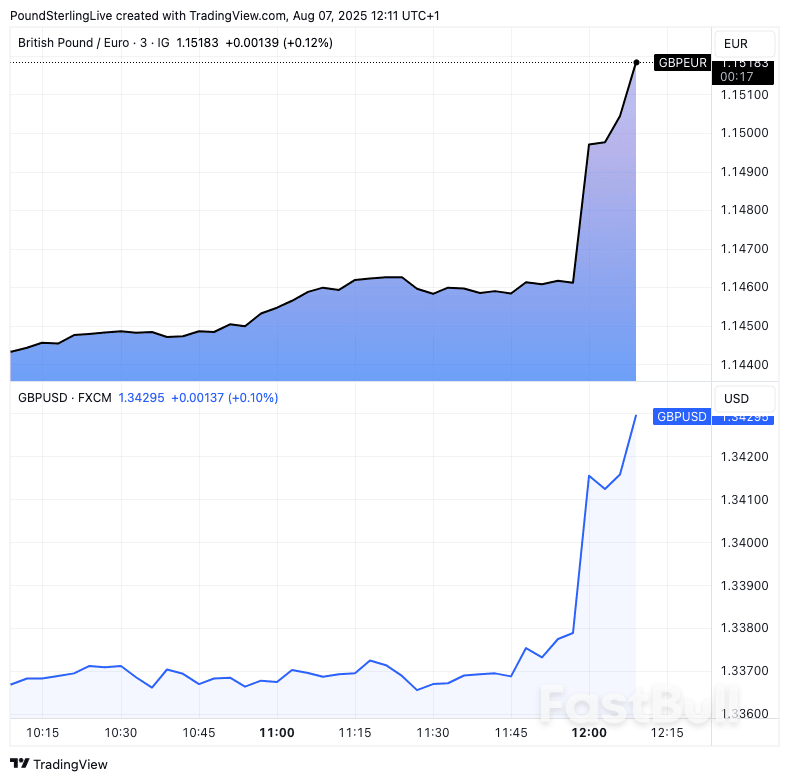
          The British Pound rises against the Euro and Dollar as an initial response to the August policy decision.
          The Bank cut interest rates 25 basis points, but the decision was not nearly as straightforward as the market anticipated, as 4 members of the Monetary Policy Committee (MPC) voted to keep interest rates unchanged.
          One member voted to slash interest rates by 50bp (Alan Taylor), but that he was not joined by fellow dove Swati Dhingra suggests there might not be as much appetite to accelerate the process that was speculated in the run-up to the decision.
          The vote split was always going to lay down the initial markers for a market that expected a cut but was unsure of what comes next. That the MPC just scraped a cut through the door draws question marks on a follow-up cut in November.
          So close was the decision that a second vote was called for to break the tie between the holders and the cutters, with Taylor flipping his vote from 50bp to get a 25bp move across the line.
          "BoE vote was recast after a split! I don't think that's ever happened," says Viraj Patel, a strategist at Vanda Research. "Taylor voted originally to cut 50 and then went 25. But it was finely balanced - shows that this was a hawkish 25bps cut. Most likely rules out September cut unless substantial miss in jobs/CPI in August."
          The vote dynamics reveal a strong conviction on the MPC that inflation is too much of a risk to warrant cutting interest rates. The market is recalibrating its expectations, with rising short-term bond yields suggesting the scope for further cuts has diminished.
          "The Bank of England has struck a hawkish surprise. In an extraordinary turn of events, the vote on rates was unexpectedly gridlocked, and an unprecedented second round of voting was required in order to reach a majority decision - a first since the inception of the MPC in 1997. Market participants had braced for no more than a couple of dissenters in favour of no change, and it's safe to say that the razor-thin 5-4 vote has turned a few heads," says Matthew Ryan, Head of Market Strategy at Ebury.
          Rising short-term bond yields are pulling the Pound higher: The Pound to Euro exchange rate is 0.43% higher on the day at the time of writing at 1.15. The Pound to Dollar exchange rate is half a per cent higher at 1.3421.
          Pound Sterling Jumps Against Euro and Dollar on Unprecedented Bank of England Decision_1
          Underscoring the more cautious approach to the interest rate path on the MPC is the view that slightly higher upside risks to medium-term inflation have evolved since May.
          The hawkish minority (4 members who voted for a hold) are concerned about inflation persistence, driven by food and energy costs, and elevated inflation expectations. This outweighs the Bank's acknowledgement that the labour market is weakening, which would typically be associated with lower inflation down the line.
          What is clear is that rising food prices are becoming an issue. In the post-decision press conference, Governor Andrew Bailey said the Bank was concerned that higher food and energy prices would lead to secondary round inflation effects that prompt higher wages and price setting at British companies.
          The Bank notes that food prices have a particularly direct influence on how people and businesses perceive the direction in inflation. After all, we are more aware of our weekly shopping basket's behaviour than most other elements that make up our sense of inflation.
          The Bank MPR warns that even temporary spikes in food prices may be "salient" to households, influencing their inflation expectations more than warranted by fundamentals.
          Food & non-alcoholic beverages inflation rose 4.5% year-on-year in June 2025, the highest since February 2024. Retail food inflation for 2025 is expected to average 4.0%, up from a previous estimate of 3.4%, and could peak at 5.1% in late summer, according to updated forecasts from IGD.
          The quarterly Monetary Policy Report reveals the important economic forecasts to which the Bank sets its policy against, and what is clear is that inflation is seen as more as a problem than previously thought.
          For instance, headline CPI Inflation is now expected to peak slightly higher than anticipated back in May's forecast, at 4.0% in September, due to upside surprises in energy, food, and administered prices.
          Medium-term inflation risks are judged to be slightly higher than in May, particularly due to concerns that temporary inflation spikes might influence wage and price-setting behaviour.
          Underlying services inflation is moderating, but more slowly than projected in May. Pay growth has eased more than expected, yet remains elevated—a key determinant of inflation persistence.
          Looking ahead, the MPC maintains that policy is not on a preset path and future decisions will depend on the pace of disinflation and incoming data, and a "gradual and careful" approach to easing remains the Committee’s stated stance.

          Source: Poundsterlinglive

          To stay updated on all economic events of today, please check out our Economic calendar
          Risk Warnings and Disclaimers
          You understand and acknowledge that there is a high degree of risk involved in trading. Following any strategies or investment methods may lead to potential losses. The content on the site is provided by our contributors and analysts for information purposes only. You are solely responsible for determining whether any trading assets, securities, strategy, or any other product is suitable for investing based on your own investment objectives and financial situation.
          Add to Favorites
          Share

          What’s At Stake As Trump Tests India’s Ties With Russia

          Glendon

          Political

          President Donald Trump’s move to penalize India for buying oil from Russia will increase economic risks for the South Asian nation and test its longstanding ties with Moscow.

          Indian exports to the US have already been hit with a 25% duty as part of Trump’s broader “reciprocal tariffs.” He’s now followed through on a threat to impose so-called secondary tariffs to punish India’s purchases of Russian crude, signing an executive order to apply an additional 25% levy on Indian goods from Aug. 27.

          The US and its partners see India’s imports of Russian oil as a form of tacit support for Russia’s ongoing war in Ukraine, weakening the impact of sanctions on the Russian economy. The Indian government has called the extra tariffs “unfair, unjustified and unreasonable,” and defended its consumption of Russian oil as necessary for energy security.

          India has had a strong and stable relationship with Russia over the last seven decades. India’s External Affairs Minister Subrahmanyam Jaishankar has referred to it as the one constant in global politics over the last half century.

          Their ties have roots in the Cold War era, when India maintained cordial relations with Russia as the US moved closer to India’s arch-rival Pakistan. Despite New Delhi’s avowed non-alignment with either of the era’s two superpowers, US backing of Pakistan in its 1971 civil war that led to the independence of Bangladesh drew New Delhi closer to Moscow.

          The ties between India and Russia deepened over the next three decades as they collaborated in critical areas such as space, nuclear energy and defense. As India’s relations with the US began to improve in recent decades, it has reduced its overwhelming reliance on Russian weapons by acquiring more arms from the US and European nations.

          Indian Prime Minister Narendra Modi has maintained his country’s longstanding ties to Moscow, while pursuing deeper links with the US, which it sees as a partner in standing up to a more assertive China.

          After Russian forces invaded Ukraine in 2022 and Western nations tightened sanctions on Moscow, India began buying large volumes of Russian oil. India has stood out among major democracies for its reluctance to criticize Russian President Vladimir Putin, and has abstained from United Nations votes condemning his war in Ukraine. It has also refused to participate in punitive measures against Russia.

          Modi has sustained close ties with the Russian leader — he visited Russia in October and Putin is scheduled to go to India later this year.

          Trade between India and Russia reached a record-high $68.7 billion in the year to March 31. India’s exports to Russia totaled $4.9 billion, while its imports from Russia amounted to $63.8 billion.

          Russia’s biggest investments in India are in oil and gas, petrochemicals, banking, railways and steel. Indian investments in Russia focus mainly on oil, gas and pharmaceuticals.

          India is the world’s third-largest consumer of oil. It buys about 37% of its crude from Russia, according to data analytics firm Kpler, up from a negligible percentage before the full-scale invasion of Ukraine.

          The South Asian nation overtook China as the largest buyer of Russian seaborne crude oil. It became hooked on these cheaper barrels as Western sanctions and a price cap pushed them to a discount to market rates.

          India traditionally relied on suppliers from the Middle East, such as Saudi Arabia, to meet its oil requirements. Shifting away from Russian barrels would push India back to those Middle Eastern producers and likely lead to an increase in the cost of imports.

          However, the discounts on Russian oil have narrowed. In May, Indian buyers paid $4.50 a barrel less for their Russian crude imports than they did for Saudi purchases. In 2023, the gap was more than $23 a barrel.

          India saved a modest $3.8 billion in the year to March 2025 on its oil purchases as the discount on Russian crude shrank, according to credit ratings agency ICRA. But it exported roughly $87 billion worth of goods to the US, its largest trading partner, last year.

          “If you look at the size of India’s trade with the US, and look at how much savings India gets from buying Russia crude, it’s pretty clear what India would do,” said Warren Patterson, head of commodities strategy at ING Groep NV in Singapore. “Are you going to risk up to $87 billion worth of exports to the US in order to save a few billion from oil discounts?”

          Russia is the largest supplier of weapons to India, according to a March report from the Stockholm International Peace Research Institute, an independent think tank that studies global weapon sales. India has purchased fighter jets, battle tanks and missiles from Russia, and the two countries also formed a joint venture to produce Kalashnikov assault rifles for India’s armed forces.

          However, India — the world’s second-biggest arms importer — has slowly been reducing its dependence on Russian weapons in recent years. There have been no new major arms deals between the two countries for the last few years, and India’s push to diversify looks set to continue after delays in the delivery of Russian S-400 air defense systems.

          Many of India’s weapons now come from the US. India has contracted at least $24 billion worth of US-origin defense articles, according to a 2025 report from the US Congressional Research Service. Major purchases include attack helicopters, transport aircraft and howitzers, according to the report, and more weapons sales are being considered, such as of anti-submarine warfare, communication and land-attack equipment.

          “Since 2008, defense trade has emerged as a major pillar of the US-India security partnership, and bilateral military exercises across all services are now routine,” the report said.

          Modi must now walk a geopolitical tightrope. If he allows India’s refiners to keep buying Russian oil, he risks a direct blow to the economy and damage to the ties with his country’s top trade partner. On the other hand, yielding to US pressure could undermine India’s long-standing relationship with Moscow.

          If India continues to trade with Russia, a 50% duty on its goods shipped to the US — the combined hit of the reciprocal and secondary tariffs — could reduce its exports to America by 60% and lower its gross domestic product by 0.9%, according to Bloomberg Economics.

          But economists also calculate that shifting away from Russia to other oil suppliers would have implications for India’s inflation and economic growth. Standard Chartered Plc estimates that a 100% pivot from Russian oil could increase India’s annual import bill by $4 billion to $6.5 billion. If India stops buying Russian crude and higher fuel prices are passed on fully to consumers, inflation would be 3-5 basis points higher, Standard Chartered’s economist Anubhuti Sahay wrote in a report.

          The governor of India’s central bank, Sanjay Malhotra, has a different view. He doesn’t see a major impact on inflation for now, as India also sources crude from other countries.

          Source: Bloomberg Europe

          Risk Warnings and Disclaimers
          You understand and acknowledge that there is a high degree of risk involved in trading. Following any strategies or investment methods may lead to potential losses. The content on the site is provided by our contributors and analysts for information purposes only. You are solely responsible for determining whether any trading assets, securities, strategy, or any other product is suitable for investing based on your own investment objectives and financial situation.
          Add to Favorites
          Share

          Trump Plans 100% Tariff on Computer Chips, Unless Companies Build in US

          Warren Takunda

          Economic

          China–U.S. Trade War

          President Donald Trump said Wednesday that he will impose a 100% tariff on computer chips, raising the specter of higher prices for electronics, autos, household appliances and other essential products dependent on the processors powering the digital age.
          “We’ll be putting a tariff of approximately 100% on chips and semiconductors,” Trump said in the Oval Office while meeting with Apple CEO Tim Cook. “But if you’re building in the United States of America, there’s no charge.”
          The announcement came more than three months after Trump temporarily exempted most electronics from his administration’s most onerous tariffs.
          The Republican president said companies that make computer chips in the U.S. would be spared the import tax. During the COVID-19 pandemic, a shortage of computer chips increased the price of autos and contributed to higher inflation.
          Investors seemed to interpret the potential tariff exemptions as a positive for Apple and other major tech companies that have been making huge financial commitments to manufacture more chips and other components in the U.S..
          Big Tech already has made collective commitments to invest about $1.5 trillion in the U.S. since Trump moved back into the White House in January. That figure includes a $600 billion promise from Apple after the iPhone maker boosted its commitment by tacking another $100 billion on to a previous commitment made in February.
          Now the question is whether the deal brokered between Cook and Trump will be enough to insulate the millions of iPhones made in China and India from the tariffs that the administration has already imposed and reduce the pressure on the company to raise prices on the new models expected to be unveiled next month.
          Wall Street certainly seems to think so. After Apple’s stock price gained 5% in Wednesday regular trading sessions, the shares rose by another 3% in extended trading after Trump announced some tech companies won’t be hit with the latest tariffs while Cook stood alongside him.
          The shares of AI chipmaker Nvidia, which also has recently made big commitments to the U.S., rose slightly in extended trading to add to the $1 trillion gain in market value the Silicon Valley company has made since the start of Trump’s second administration.
          The stock price of computer chip pioneer Intel, which has fallen on hard times, also climbed in extended trading.
          Inquiries sent to chip makers Nvidia and Intel were not immediately answered. The chip industry’s main trade group, the Semiconductor Industry Association, declined to comment on Trump’s latest tariffs.
          Demand for computer chips has been climbing worldwide, with sales increasing 19.6% in the year-ended in June, according to the World Semiconductor Trade Statistics organization.
          Trump’s tariff threats mark a significant break from existing plans to revive computer chip production in the U.S. that were drawn up during the administration of President Joe Biden.
          Since taking over from Biden, Trump has been deploying tariffs to incentivize more domestic production. Essentially, the president is betting that the threat of dramatically higher chip costs would force most companies to open factories domestically, despite the risk that tariffs could squeeze corporate profits and push up prices for mobile phones, TVs and refrigerators.
          By contrast, the bipartisan CHIPS and Science Act that Biden signed into law in 2022 provided more than $50 billion to support new computer chip plants, fund research and train workers for the industry. The mix of funding support, tax credits and other financial incentives were meant to draw in private investment, a strategy that Trump has vocally opposed.

          Source: AP

          To stay updated on all economic events of today, please check out our Economic calendar
          Risk Warnings and Disclaimers
          You understand and acknowledge that there is a high degree of risk involved in trading. Following any strategies or investment methods may lead to potential losses. The content on the site is provided by our contributors and analysts for information purposes only. You are solely responsible for determining whether any trading assets, securities, strategy, or any other product is suitable for investing based on your own investment objectives and financial situation.
          Add to Favorites
          Share

          Aussie Bourse Fat-finger Flub Rings Alarming Bell

          Samantha Luan

          Stocks

          Forex

          Economic

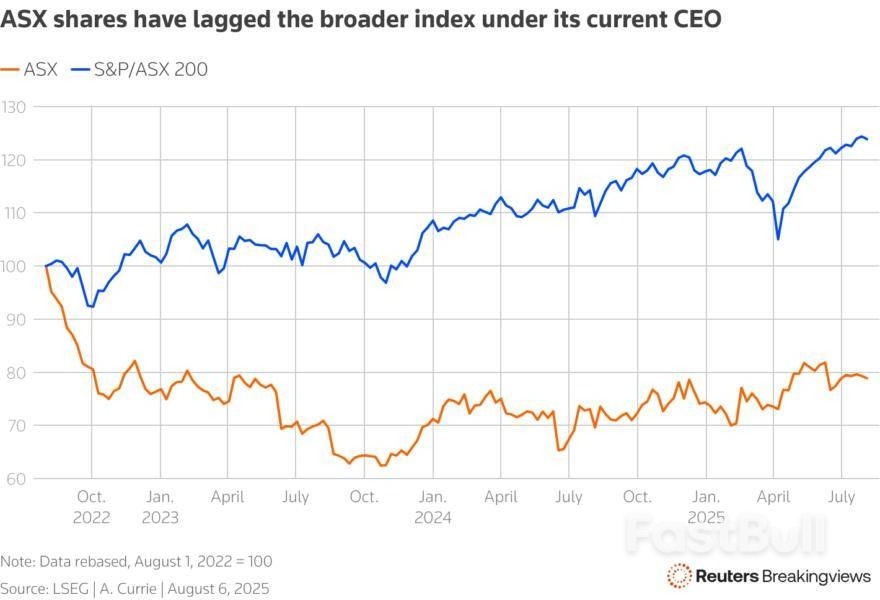
          Everyone gets names wrong sometimes. That's little consolation to the poor souls at the Australian Stock Exchange who on Wednesday mistook TPG Telecom, the country's third-largest phone company, for U.S. private equity firm TPG Capital as the buyer in an M&A deal. The resulting A$520 million ($338 million) hit to the erroneously identified suitor's market value rings some alarming bells.

          It was a simple case of human error, the bourse admitted, when staff at the ASX published the official statement about TPG Capital's A$621 million buyout of automotive software outfit Infomediaunder TPG Telecom's ticker. Shares of the company formerly known as Vodafone Hutchison Australia fell 4% before trading was halted - two hours later - so that the ASX could fess up and nix the trades; even so they closed down 5%.

          Granted, the loss pales in comparison to past so-called fat-fingered financial blunders. In 2018, a Samsung Securitiesemployee mistakenly sent 1000 shares instead of 1000 won as dividends to employees, resulting in an $81 billion error, using current exchange rates. Deutsche Bankmistakenly sent a hedge fund $6 billion a decade ago - though got it back. Citigrouptopped that last year, wiring a customer $81 trillion instead of a mere $280, before it was reversed at the last minute.

          Trouble is, ASX's goof is not an anomaly for the company. It is already under fire for repeated problems trying to replace its ageing clearing and settlement systems, including an outage in December. The Australian Securities and Investment Commission in June launched an investigation into governance and risk management, following its decision last year to sue the exchange alleging it made misleading statements about the project's progress.

          Thomson ReutersASX shares have lagged the broader index under its current CEO

          Wall Street banks usually pay for their errors with lower earnings, fines or reputational hits - or all of them. The ASX's latest gaffe could have more significant consequences. CEO Helen Lofthouse's position looks insecure - ASX's stock has fallen 20% in her three years in charge. The bourse's monopolistic grip on the domestic stock market also appears fragile. Australian Securities and Investments Commission is in the final stages of considering Chicago-based Cboe Global Markets'application to list, rather than just trade, Australian stocks. The fat finger at the ASX makes an approval look even more likely.

          CONTEXT NEWS

          Shares in TPG Telecom fell more than 4% in early trading on August 6 after a market announcement from the Australian Stock Exchange wrongly identified the company as the buyer of another ASX-listed firm, Infomedia, for A$651 million ($423 million). The actual purchaser of the automotive software outfit is U.S. private equity firm TPG Capital.The bourse cancelled the trades after taking some two hours before explaining the mistake. TPG Telecom's stock initially recovered most of the losses but then closed down more than 5%.

          Source: TradingView

          To stay updated on all economic events of today, please check out our Economic calendar
          Risk Warnings and Disclaimers
          You understand and acknowledge that there is a high degree of risk involved in trading. Following any strategies or investment methods may lead to potential losses. The content on the site is provided by our contributors and analysts for information purposes only. You are solely responsible for determining whether any trading assets, securities, strategy, or any other product is suitable for investing based on your own investment objectives and financial situation.
          Add to Favorites
          Share

          US Continuing Jobless Claims Rise to Highest Since End of 2021

          Michelle

          Economic

          Forex

          Recurring applications for unemployment benefits surged to the highest since November 2021, adding to recent signs that the labor market is weakening.

          Continuing claims, a proxy for the number of people receiving benefits, rose by 38,000 to 1.97 million in the week ended July 26, according to Labor Department data released Thursday. An elevated level of recurring filings indicates unemployed workers have more difficulty in finding a new job.

          Initial claims also rose, to 226,000, last week, slightly higher than economists expected. Weekly data tends to be volatile, and the four-week moving average was little changed.

          Investors and economists are on high alert for any indication that the labor market is further deteriorating after the government’s July employment report showed a more significant cooldown in job creation than originally thought.

          That report, which included outsized downwards revisions to May and June numbers, prompted President Donald Trump to fire the Bureau of Labor Statistics commissioner and raised expectations that the Federal Reserve would cut interest rates at their next policy meeting in September.

          Job growth has slowed over the last few months as businesses have grown more cautious about staffing decisions in reaction to Trump’s economic policies and uncertainty around them, particularly tariffs.

          Overall, layoffs have remained subdued this year. However, some large companies have recently announced staff cuts, including Merck & Co. and Intel Corp. Stanford University also plans to reduce its workforce by more than 300 people, adding to the list of schools that have announced headcount reductions due to federal funding cuts.

          Source: Bloomberg Europe

          To stay updated on all economic events of today, please check out our Economic calendar
          Risk Warnings and Disclaimers
          You understand and acknowledge that there is a high degree of risk involved in trading. Following any strategies or investment methods may lead to potential losses. The content on the site is provided by our contributors and analysts for information purposes only. You are solely responsible for determining whether any trading assets, securities, strategy, or any other product is suitable for investing based on your own investment objectives and financial situation.
          Add to Favorites
          Share

          London Midday: Stocks Extend Losses as BoE Cuts Rates

          Warren Takunda

          Stocks

          London stocks had extended losses just after midday on Thursday after the Bank of England cut interest rates by 25 basis points to 4.0%, as expected.
          The FTSE 100 was down 0.7% at 9,100.44, falling further into the red. Meanwhile, sterling picked against the dollar, trading 0.5% higher at 1.3420.
          The Monetary Policy Committee voted 5-4 to cut the rate. Andrew Bailey, Sarah Breeden, Swati Dhingra and Dave Ramsden voted in favour of the 25 basis rate cut, while Megan Greene, Clare Lombardelli, Catherine L Mann and Huw Pill opted for the rate to remain unchanged.
          Alan Taylor initially voted for a cut to 3.75% but in order to secure a majority decision, a second round of voting was held and the Committee was asked to vote on either a 25bp cut or for the rate to remain at 4.25%. Taylor then voted for the quarter-point cut.
          The Bank also revised up its forecast for inflation, saying it now expects consumer price inflation to peak at 4.0% in September - having previously forecast a peak of 3.7% - before falling back thereafter towards the 2% target.
          "There has been substantial disinflation over the past two and a half years, following previous external shocks, supported by the restrictive stance of monetary policy," the BoE said. "That progress has allowed for reductions in Bank Rate over the past year. The Committee remains focused on squeezing out any existing or emerging persistent inflationary pressures, to return inflation sustainably to its 2% target in the medium term."
          Jake Finney, senior economist at PwC, said the voting split among committee members shows how finely balanced the decision was, but the direction of travel is still clear.
          "We anticipate one or two additional cuts this year, most likely in November and December, as the Bank proceeds with its cautious easing cycle that its forward guidance states will be ‘gradual and careful’," he said.
          "The devil, as ever, is in the detail. The statement that ‘monetary policy is not on a pre-set path’ underscores the Bank’s data-dependent stance and signals that future rate cuts cannot be taken for granted. This caution is understandable given the Bank’s own forecasts show inflation could rise to 4% in September, double the 2% target.
          "Alongside the rate decision, the Bank made modest adjustments to its forecasts. It acknowledged that inflation has proven marginally stickier than anticipated, but the labour market has loosened more quickly, with wage growth declining further. Crucially, the medium-term outlook for the UK remains broadly unchanged. That matters because it’s the medium-term picture that will shape the Chancellor’s choices ahead of the Autumn Budget."
          Elsewhere, figures released earlier by Halifax showed that house prices rose in July at the fastest monthly pace since the start of the year.
          In equity markets, Hikma Pharmaceuticals tumbled after reporting a 7% drop in first-half core operating profit and cutting the outlook for the operating margin in its injectables segment.
          Defence stocks Babcock and BAE Systems slumped after German defence firm Rheinmetall’s second-quarter results fell short of estimates.
          WPP fell sharply as the advertising agency reported a slump in half-year earnings as clients spent less and the use of artificial intelligence hit the bottom line. Operating profit fell 48% to £221m on the back of a 7.8% decline in revenue to £6.6bn.
          Morgan Advanced Materials fell as it warned that full-year adjusted operating profit was set to be around the bottom of the consensus range due to weak market conditions, mix effects and foreign exchange headwinds.
          AstraZeneca, BT and Segro lost ground as they traded without entitlement to the dividend.
          On the upside, CRH was the standout gainer on the FTSE 100 as it lifted its financial guidance for 2025, noting that underlying demand in its key end-use markets remains positive.
          InterContinental Hotels rallied as it posted a 34.1% jump in first-half pre-tax profit and said it remains on track to meet full-year consensus profit and earnings expectations.
          Flutter Entertainment gained following well-received results from US sports betting firm DraftKings.
          Harbour Energy surged as it narrowed upwards production guidance, unveiled a $100m share buyback and reported a jump in half-year adjusted earnings.
          Serco pushed higher as the government contractor held updated guidance, posted a rise in half-year earnings and unveiled a £50m share buyback.

          Source: Sharecast

          Risk Warnings and Disclaimers
          You understand and acknowledge that there is a high degree of risk involved in trading. Following any strategies or investment methods may lead to potential losses. The content on the site is provided by our contributors and analysts for information purposes only. You are solely responsible for determining whether any trading assets, securities, strategy, or any other product is suitable for investing based on your own investment objectives and financial situation.
          Add to Favorites
          Share

          XAU/USD: Gold Cracks Key Resistance Zone on Fresh Wave of Safe Haven Demand

          Golden Gleam

          Technical Analysis

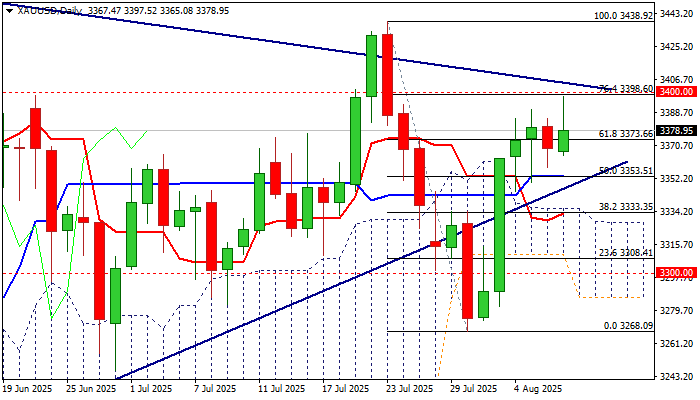
          Gold price rose on Thursday morning as new packages of increased US import tariffs took effect, adding to high global uncertainty and prompting investors into safety.

          Fresh rise cracked strong resistances at $3400 zone (Fibo 76.4% of $3438/$3268 / psychological /upper triangle boundary) but failed to break higher on first attempt.

          As expected, bulls faced headwinds and metal’s price eased to the mid-point of congestion that extends into third straight day.

          Technical picture on daily chart has improved, but flat momentum (slightly above the centreline) and overbought stochastic warning, after gold faced a double false break below and above triangle recently.

          However, triangle is narrowing, and eventual clear break is likely to be seen in coming sessions that would generate fresh direction signal.

          Current favorable fundamentals contribute to bullish scenario, with sustained break above $3400 zone to signal bullish continuation and expose targets at $3438 and $3452 (tops of July 23 / June 16) guarding key barrier at $3500 (new record high, posted on Apr 22).

          Conversely, violation of triangle support line ($3347) would weaken near-term structure, but extension below daily cloud top ($3335) will be required to verify fresh negative signal and shift focus towards key supports at $3300 / $3286 / $3268 (psychological /daily cloud base / July 30 multi-week low).

          Res: 3400; 3405; 3414; 3438.Sup: 3365; 3353; 3347; 3335.

          Source: ACTIONFOREX

          Risk Warnings and Disclaimers
          You understand and acknowledge that there is a high degree of risk involved in trading. Following any strategies or investment methods may lead to potential losses. The content on the site is provided by our contributors and analysts for information purposes only. You are solely responsible for determining whether any trading assets, securities, strategy, or any other product is suitable for investing based on your own investment objectives and financial situation.
          Add to Favorites
          Share
          FastBull
          Copyright © 2025 FastBull Ltd

          728 RM B 7/F GEE LOK IND BLDG NO 34 HUNG TO RD KWUN TONG KLN HONG KONG

          TelegramInstagramTwitterfacebooklinkedin
          App Store Google Play Google Play
          Products
          Charts

          Chats

          Q&A with Experts
          Screeners
          Economic Calendar
          Data
          Tools
          Membership
          Features
          Function
          Markets
          Copy Trading
          Latest Signals
          Contests
          News
          Analysis
          24/7
          Columns
          Education
          Company
          Careers
          About Us
          Contact Us
          Advertising
          Help Center
          Feedback
          User Agreement
          Privacy Policy
          Business

          White Label

          Data API

          Web Plug-ins

          Poster Maker

          Affiliate Program

          Risk Disclosure

          The risk of loss in trading financial instruments such as stocks, FX, commodities, futures, bonds, ETFs and crypto can be substantial. You may sustain a total loss of the funds that you deposit with your broker. Therefore, you should carefully consider whether such trading is suitable for you in light of your circumstances and financial resources.

          No decision to invest should be made without thoroughly conducting due diligence by yourself or consulting with your financial advisors. Our web content might not suit you since we don't know your financial conditions and investment needs. Our financial information might have latency or contain inaccuracy, so you should be fully responsible for any of your trading and investment decisions. The company will not be responsible for your capital loss.

          Without getting permission from the website, you are not allowed to copy the website's graphics, texts, or trademarks. Intellectual property rights in the content or data incorporated into this website belong to its providers and exchange merchants.

          Not Logged In

          Log in to access more features

          FastBull Membership

          Not yet

          Purchase

          Become a signal provider
          Help Center
          Customer Service
          Dark Mode
          Price Up/Down Colors

          Log In

          Sign Up

          Position
          Layout
          Fullscreen
          Default to Chart
          The chart page opens by default when you visit fastbull.com