• Trade
  • Markets
  • Copy
  • Contests
  • News
  • 24/7
  • Calendar
  • Q&A
  • Chats
Trending
Screeners
SYMBOL
LAST
BID
ASK
HIGH
LOW
NET CHG.
%CHG.
SPREAD
SPX
S&P 500 Index
6827.42
6827.42
6827.42
6899.86
6801.80
-73.58
-1.07%
--
DJI
Dow Jones Industrial Average
48458.04
48458.04
48458.04
48886.86
48334.10
-245.98
-0.51%
--
IXIC
NASDAQ Composite Index
23195.16
23195.16
23195.16
23554.89
23094.51
-398.69
-1.69%
--
USDX
US Dollar Index
97.950
98.030
97.950
98.500
97.950
-0.370
-0.38%
--
EURUSD
Euro / US Dollar
1.17394
1.17409
1.17394
1.17496
1.17192
+0.00011
+ 0.01%
--
GBPUSD
Pound Sterling / US Dollar
1.33707
1.33732
1.33707
1.33997
1.33419
-0.00148
-0.11%
--
XAUUSD
Gold / US Dollar
4299.39
4299.39
4299.39
4353.41
4257.10
+20.10
+ 0.47%
--
WTI
Light Sweet Crude Oil
57.233
57.485
57.233
58.011
56.969
-0.408
-0.71%
--

Community Accounts

Signal Accounts
--
Profit Accounts
--
Loss Accounts
--
View More

Become a signal provider

Sell trading signals to earn additional income

View More

Guide to Copy Trading

Get started with ease and confidence

View More

Signal Accounts for Members

All Signal Accounts

Best Return
  • Best Return
  • Best P/L
  • Best MDD
Past 1W
  • Past 1W
  • Past 1M
  • Past 1Y

All Contests

  • All
  • Trump Updates
  • Recommend
  • Stocks
  • Cryptocurrencies
  • Central Banks
  • Featured News
Top News Only
Share

Norwegian Nobel Committee: Calls On The Belarusian Authorities To Release All Political Prisoners

Share

Norwegian Nobel Committee: His Freedom Is A Deeply Welcome And Long-Awaited Moment

Share

Ukraine Says It Received 114 Prisoners From Belarus

Share

USA Embassy In Lithuania: Maria Kalesnikava Is Not Going To Vilnius

Share

USA Embassy In Lithuania: Other Prisoners Are Being Sent From Belarus To Ukraine

Share

Ukraine President Zelenskiy: Five Ukrainians Released By Belarus In US-Brokered Deal

Share

USA Vilnius Embassy: USA Stands Ready For "Additional Engagement With Belarus That Advances USA Interests"

Share

USA Vilnius Embassy: Belarus, USA, Other Citizens Among The Prisoners Released Into Lithuania

Share

USA Vilnius Embassy: USA Will Continue Diplomatic Efforts To Free The Remaining Political Prisoners In Belarus

Share

USA Vilnius Embassy: Belarus Releases 123 Prisoners Following Meeting Of President Trump's Envoy Coale And Belarus President Lukashenko

Share

USA Vilnius Embassy: Masatoshi Nakanishi, Aliaksandr Syrytsa Are Among The Prisoners Released By Belarus

Share

USA Vilnius Embassy: Maria Kalesnikava And Viktor Babaryka Are Among The Prisoners Released By Belarus

Share

USA Vilnius Embassy: Nobel Peace Prize Laureate Ales Bialiatski Is Among The Prisoners Released By Belarus

Share

Belarusian Presidential Administration Telegram Channel: Lukashenko Has Pardoned 123 Prisoners As Part Of Deal With US

Share

Two Local Syrian Officials: Joint US-Syrian Military Patrol In Central Syria Came Under Fire From Unknown Assailants

Share

Israeli Military Says It Targeted 'Key Hamas Terrorist' In Gaza City

Share

Rwanda's Actions In Eastern Drc Are A Clear Violation Of Washington Accords Signed By President Trump - Secretary Of State Rubio

Share

Israeli Military Issues Evacuation Warning In Southern Lebanon Village Ahead Of Strike - Spokesperson On X

Share

Belarusian State Media Cites US Envoy Coale As Saying He Discussed Ukraine And Venezuela With Lukashenko

Share

Belarusian State Media Cites US Envoy Coale As Saying That US Removes Sanctions On Belarusian Potassium

TIME
ACT
FCST
PREV
U.K. Trade Balance Non-EU (SA) (Oct)

A:--

F: --

P: --

U.K. Trade Balance (Oct)

A:--

F: --

P: --

U.K. Services Index MoM

A:--

F: --

P: --

U.K. Construction Output MoM (SA) (Oct)

A:--

F: --

P: --

U.K. Industrial Output YoY (Oct)

A:--

F: --

P: --

U.K. Trade Balance (SA) (Oct)

A:--

F: --

P: --

U.K. Trade Balance EU (SA) (Oct)

A:--

F: --

P: --

U.K. Manufacturing Output YoY (Oct)

A:--

F: --

P: --

U.K. GDP MoM (Oct)

A:--

F: --

P: --

U.K. GDP YoY (SA) (Oct)

A:--

F: --

P: --

U.K. Industrial Output MoM (Oct)

A:--

F: --

P: --

U.K. Construction Output YoY (Oct)

A:--

F: --

P: --

France HICP Final MoM (Nov)

A:--

F: --

P: --

China, Mainland Outstanding Loans Growth YoY (Nov)

A:--

F: --

P: --

China, Mainland M2 Money Supply YoY (Nov)

A:--

F: --

P: --

China, Mainland M0 Money Supply YoY (Nov)

A:--

F: --

P: --

China, Mainland M1 Money Supply YoY (Nov)

A:--

F: --

P: --

India CPI YoY (Nov)

A:--

F: --

P: --

India Deposit Gowth YoY

A:--

F: --

P: --

Brazil Services Growth YoY (Oct)

A:--

F: --

P: --

Mexico Industrial Output YoY (Oct)

A:--

F: --

P: --

Russia Trade Balance (Oct)

A:--

F: --

P: --

Philadelphia Fed President Henry Paulson delivers a speech
Canada Building Permits MoM (SA) (Oct)

A:--

F: --

P: --

Canada Wholesale Sales YoY (Oct)

A:--

F: --

P: --

Canada Wholesale Inventory MoM (Oct)

A:--

F: --

P: --

Canada Wholesale Inventory YoY (Oct)

A:--

F: --

P: --

Canada Wholesale Sales MoM (SA) (Oct)

A:--

F: --

P: --

Germany Current Account (Not SA) (Oct)

A:--

F: --

P: --

U.S. Weekly Total Rig Count

A:--

F: --

P: --

U.S. Weekly Total Oil Rig Count

A:--

F: --

P: --

Japan Tankan Large Non-Manufacturing Diffusion Index (Q4)

--

F: --

P: --

Japan Tankan Small Manufacturing Outlook Index (Q4)

--

F: --

P: --

Japan Tankan Large Non-Manufacturing Outlook Index (Q4)

--

F: --

P: --

Japan Tankan Large Manufacturing Outlook Index (Q4)

--

F: --

P: --

Japan Tankan Small Manufacturing Diffusion Index (Q4)

--

F: --

P: --

Japan Tankan Large Manufacturing Diffusion Index (Q4)

--

F: --

P: --

Japan Tankan Large-Enterprise Capital Expenditure YoY (Q4)

--

F: --

P: --

U.K. Rightmove House Price Index YoY (Dec)

--

F: --

P: --

China, Mainland Industrial Output YoY (YTD) (Nov)

--

F: --

P: --

China, Mainland Urban Area Unemployment Rate (Nov)

--

F: --

P: --

Saudi Arabia CPI YoY (Nov)

--

F: --

P: --

Euro Zone Industrial Output YoY (Oct)

--

F: --

P: --

Euro Zone Industrial Output MoM (Oct)

--

F: --

P: --

Canada Existing Home Sales MoM (Nov)

--

F: --

P: --

Euro Zone Total Reserve Assets (Nov)

--

F: --

P: --

U.K. Inflation Rate Expectations

--

F: --

P: --

Canada National Economic Confidence Index

--

F: --

P: --

Canada New Housing Starts (Nov)

--

F: --

P: --

U.S. NY Fed Manufacturing Employment Index (Dec)

--

F: --

P: --

U.S. NY Fed Manufacturing Index (Dec)

--

F: --

P: --

Canada Core CPI YoY (Nov)

--

F: --

P: --

Canada Manufacturing Unfilled Orders MoM (Oct)

--

F: --

P: --

Canada Manufacturing New Orders MoM (Oct)

--

F: --

P: --

Canada Core CPI MoM (Nov)

--

F: --

P: --

Canada Manufacturing Inventory MoM (Oct)

--

F: --

P: --

Canada CPI YoY (Nov)

--

F: --

P: --

Canada CPI MoM (Nov)

--

F: --

P: --

Canada CPI YoY (SA) (Nov)

--

F: --

P: --

Canada Core CPI MoM (SA) (Nov)

--

F: --

P: --

Q&A with Experts
    • All
    • Chatrooms
    • Groups
    • Friends
    Connecting
    .
    .
    .
    Type here...
    Add Symbol or Code

      No matching data

      All
      Trump Updates
      Recommend
      Stocks
      Cryptocurrencies
      Central Banks
      Featured News
      • All
      • Russia-Ukraine Conflict
      • Middle East Flashpoint
      • All
      • Russia-Ukraine Conflict
      • Middle East Flashpoint
      Search
      Products

      Charts Free Forever

      Chats Q&A with Experts
      Screeners Economic Calendar Data Tools
      Membership Features
      Data Warehouse Market Trends Institutional Data Policy Rates Macro

      Market Trends

      Market Sentiment Order Book Forex Correlations

      Top Indicators

      Charts Free Forever
      Markets

      News

      News Analysis 24/7 Columns Education
      From Institutions From Analysts
      Topics Columnists

      Latest Views

      Latest Views

      Trending Topics

      Top Columnists

      Latest Update

      Signals

      Copy Rankings Latest Signals Become a signal provider AI Rating
      Contests
      Brokers

      Overview Brokers Assessment Rankings Regulators News Claims
      Broker listing Forex Brokers Comparison Tool Live Spread Comparison Scam
      Q&A Complaint Scam Alert Videos Tips to Detect Scam
      More

      Business
      Events
      Careers About Us Advertising Help Center

      White Label

      Data API

      Web Plug-ins

      Affiliate Program

      Awards Institution Evaluation IB Seminar Salon Event Exhibition
      Vietnam Thailand Singapore Dubai
      Fans Party Investment Sharing Session
      FastBull Summit BrokersView Expo
      Recent Searches
        Top Searches
          Markets
          News
          Analysis
          User
          24/7
          Economic Calendar
          Education
          Data
          • Names
          • Latest
          • Prev

          View All

          No data

          Scan to Download

          Faster Charts, Chat Faster!

          Download App
          English
          • English
          • Español
          • العربية
          • Bahasa Indonesia
          • Bahasa Melayu
          • Tiếng Việt
          • ภาษาไทย
          • Français
          • Italiano
          • Türkçe
          • Русский язык
          • 简中
          • 繁中
          Open Account
          Search
          Products
          Charts Free Forever
          Markets
          News
          Signals

          Copy Rankings Latest Signals Become a signal provider AI Rating
          Contests
          Brokers

          Overview Brokers Assessment Rankings Regulators News Claims
          Broker listing Forex Brokers Comparison Tool Live Spread Comparison Scam
          Q&A Complaint Scam Alert Videos Tips to Detect Scam
          More

          Business
          Events
          Careers About Us Advertising Help Center

          White Label

          Data API

          Web Plug-ins

          Affiliate Program

          Awards Institution Evaluation IB Seminar Salon Event Exhibition
          Vietnam Thailand Singapore Dubai
          Fans Party Investment Sharing Session
          FastBull Summit BrokersView Expo

          Opec+ Could Carry Out A Reset, A Rebound Or A Revolution

          Samantha Luan

          Economic

          Commodity

          Forex

          Summary:

          Is Opec+ carrying out a reset, a rebound or a revolution? By the middle of next year, we will have a clearer idea of which of the three Rs it favours – but that is a long time to wait.

          Is Opec+ carrying out a reset, a rebound or a revolution? By the middle of next year, we will have a clearer idea of which of the three Rs it favours – but that is a long time to wait. Even the ministers and strategists who meet in their virtual Vienna may not be sure, but deciphering the question is crucial to the oil exporters’ diverging prospects.This month, the extended Opec+ group agreed to start easing the next 1.65 million barrels per day tranche of voluntary cuts. These were made by an eight-member subset of the leading producers: Saudi Arabia, Iraq, the UAE, Kuwait, Russia, Kazakhstan, Algeria and Oman. They had already eliminated the first of 2.2 million barrels of these voluntary cuts the month before.

          Now, from October, allowable production will increase by 137,000 bpd. If this were repeated each month, then after a year, the second tranche will be eliminated. That would leave only the third set of cuts, totalling 2 million bpd, chronologically the first made, which date from October 2022. Unlike the voluntary cuts, these were binding on all Opec+ members, except three exempt for political reasons – Iran, Libya and Venezuela.In case this simplification might make the sums too easy for analysts, it is complicated by the revision of “compensation cuts”, through which some countries are meant to fill in for overshooting. Most of this falls on Kazakhstan and Iraq, and to a lesser extent, the UAE and Russia. The latest update largely defers this compensation to next year.

          If taken literally, the new compensation schedule would actually reduce production from Opec+ next year, even accounting for the latest permitted increase. But no one really expects Kazakhstan to follow through.These production increases have been a success, from the point of view of Opec+. The group announced the first step of its more aggressive easing policy just hours after US President Donald Trump’s April 2 tariff headline had brought down oil prices sharply. Since then, prices are actually up slightly. Production from the group of eight has increased almost 4.5 per cent from April to August, translating to an overall revenue gain.

          Stronger than expected demand, and, probably, large gains in Chinese inventories, have helped soak up any surplus. That could change in the fourth quarter, as Middle Eastern oil consumption for power drops, permitting higher exports, while demand generally is expected to soften. The International Energy Agency sees a fourth-quarter glut as high as 3.1 million bpd, although that is not apparent in the data yet.

          The next moves by Opec+ will show what approach it has in mind: reset, rebound or revolution. In the case of reset, it will continue to increase allowable production month by month, and monitor the market. By next June, it would have worked off all the voluntary cuts. The real oil flowing to market will be much less than the headline 1.65 million bpd, perhaps half that, as several members of the group of eight hit the limits of their capacity.

          Saudi Arabia could then seek a general realignment of production baselines. These date from October 2018, with a few adjustments, and have become ever more outdated. The group has already planned for an independent consultancy to assess real production capacities, to inform new baselines in 2027. Nevertheless, such a reset will be very controversial.

          The UAE, Iraq and Kazakhstan would expect substantial increases because of their investment in new capacity – but why should Kazakhstan, which has heavily overproduced, be rewarded? If the heralded oversupply arrives and Opec+ then decides on an overall cut in output from its new, higher level, others would have to give some ground. Riyadh will not want to bear the burden again, so to have an impact, reductions would have to come from other large producers, notably Russia.

          The required consensus could be achieved in three ways. A period of low oil prices, say below $60 or even $50 a barrel – would convince waverers that a new framework for cuts was required. To sustain oil prices to fund its continuing war, Moscow might have to concede on production levels. Or, the end of the voluntary cuts would reveal who can live up to their production targets, and who cannot. Alternatively, stiffer sanctions on Russian oil or intensified Ukrainian attacks might finally cut its exports substantially.

          Outside the group of eight and the exempted three, the other Opec+ adherents are mostly small producers without spare capacity. The main exception, Nigeria, has enjoyed a good year and might have a case for a stronger baseline. Libya, though exempt, could also prove tricky if its recent period of relative stability in the oil sector persists, and if it is able to mobilise its planned production gains. Can it remain outside the baseline system indefinitely?

          The rebound case would result in Saudi Arabia and its main allies recovering market share to around the 2022 level, before the two big wedges of voluntary cuts were made. That might come at the cost of significantly lower prices next year, depending on the trajectory of the global economy. Production would be set ad hoc as it becomes clear who really has spare capacity.The revolution scenario is the most intriguing. The leading lights in Opec+ would make a sustained push for higher output levels and gaining – not just regaining – market share. They would move to eliminate not only the voluntary cuts, but the remaining 2 million bpd of group-wide reductions. Of course, that would mean prices dropping substantially, probably to below $50 a barrel.

          Such a strategic shift would aim to moderate inflation and hence prop up economic growth in the short term. In the longer term, it should sustain oil demand, and squeeze out competing supply. US shale production could be deterred during the next year. But it would take some years to diminish the longer lead-time output from countries such as Canada, Brazil and Guyana. A bigger impact might be within the Opec+ group itself, by starving budgets for more costly projects.Opec+, and within it Opec, have generally moved flexibly, both anticipating and reacting to market developments. The group still faces all the difficulties of co-ordinating a disparate group of countries. Whichever of the three Rs it opts for, all the key members need to see that the sums add up.

          Source: THENATIONALNEWS

          To stay updated on all economic events of today, please check out our Economic calendar
          Risk Warnings and Disclaimers
          You understand and acknowledge that there is a high degree of risk involved in trading. Following any strategies or investment methods may lead to potential losses. The content on the site is provided by our contributors and analysts for information purposes only. You are solely responsible for determining whether any trading assets, securities, strategy, or any other product is suitable for investing based on your own investment objectives and financial situation.
          Add to Favorites
          Share

          Pound-to-Australian Dollar Week Ahead Forecast: Big Support Level Risks Breaking

          Warren Takunda

          Economic

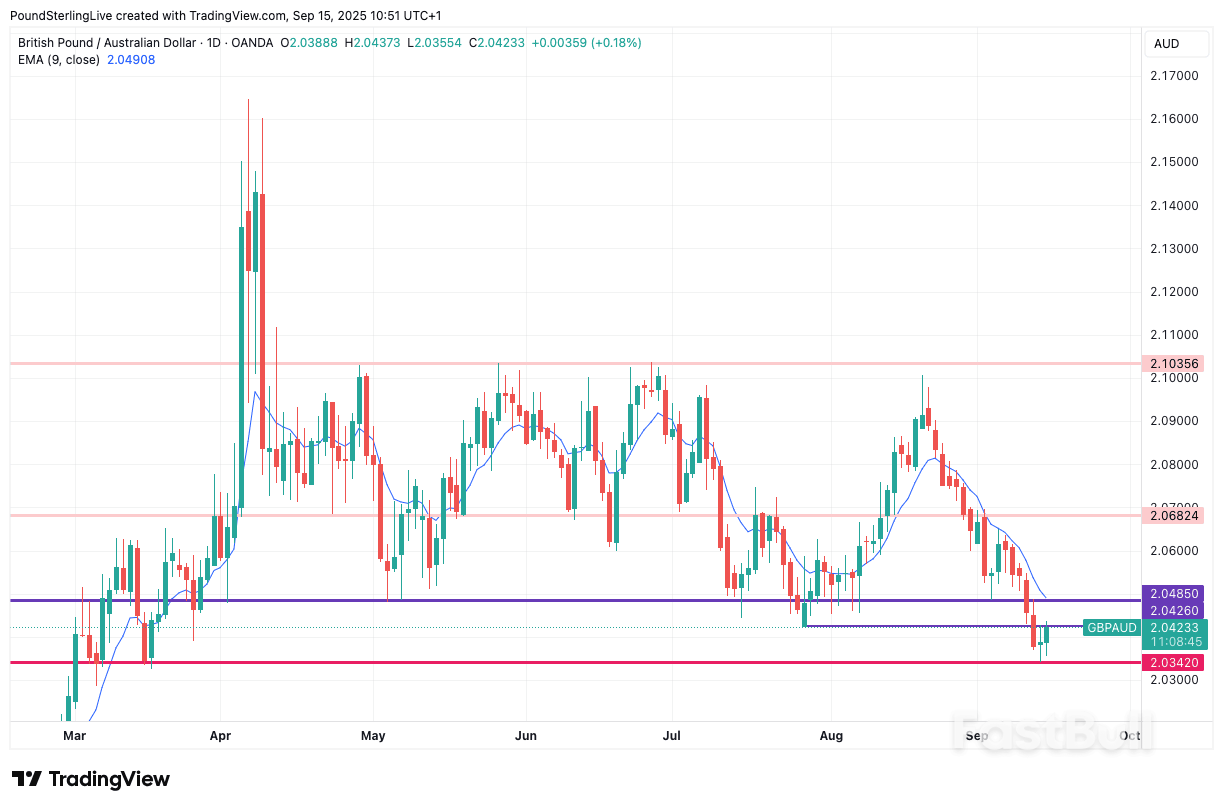
          The Aussie has had a good run of it lately against the pound, advancing for a straight five days into last Friday's close.
          This advance pushed the Pound to Australian Dollar exchange rate (GBP/AUD) through an area of resistance at 2.0485-2.0419 and to the big 'line in the sand' that starts at 2.0342.
          Pound-to-Australian Dollar Week Ahead Forecast: Big Support Level Risks Breaking_1

          Above: Big support holds for now.

          It is here that support stretches right back to March, and it is here that Sterling must mount a last-ditch attempt if it is to avoid completely relinquishing its long-term period of appreciation.
          The exchange rate started the new week at 2.0388, a level that is below the nine-day exponential moving average (EMA) at 2.0489. The Week Ahead Forecast model judges an exchange rate to be in a near-term downtrend while below this level, which leaves us bearish ahead of the new week.
          To be sure, GBP/AUD is rising off the big support zone we mentioned at the time of writing, helped by AUD's negative reaction to a disappointing data dump out of China.
          The world's second-largest economy reported an above-consensus expectation unemployment rate of 5.3%. Industrial production disappointed at 5.2% y/y, massively undershooting the conesensus bet for 5.7%. Retail sales missed at 3.4% vs. 3.8% expected.
          So we have consumer-facing and industrial sectors disappointing, which is leading Chinese proxies like the Aussie dollar to underperform.
          Although GBP/AUD starts the week with a rise, we think the pressure can build again through the middle part of the week as investors face up to the reality of a Federal Reserve rate cut.
          The cut should be the first in a series of cuts, which will lower the cost of capital in the world's largest economy and boost the global economic pulse.
          This is highly beneficial to risk-sensitive and global-facing currencies like the Aussie. In fact, GBP/AUD's steady decline since mid-August can be linked to improving sentiment linked to growing odds of further Fed rate cuts.
          The best hope for a GBP/AUD break higher would rest with a disappointing Federal Reserve decision whereby rates are cut but the Fed pushes back against generous market expectations for further such moves.
          "With an estimated three 25bp cuts by year-end — starting at this week's Fed meeting — and c.150bp by the end of next year, however, even larger downside misses in employment statistics are required from here for policy to enter accommodative territory, which is a nontrivial bar to clear," say foreign exchange strategists at Barclays in a weekly note.
          Much will also depend on the UK side of the GBP/AUD equation, with labour market, inflation and retail sales data all due this week.
          The Bank of England's Thursday policy decision could also be consequential, particularly if the Bank reaffirms a committemnt to keeping interest rates unchanged owing to fears that inflation is rising too far from the 2.0% target.
          The UK's base interest rates is superior to that of Australia's, and this can limit GBP/AUD downside, even if the pair looks to be under short-term pressure.

          Source: Poundsterlinglive

          To stay updated on all economic events of today, please check out our Economic calendar
          Risk Warnings and Disclaimers
          You understand and acknowledge that there is a high degree of risk involved in trading. Following any strategies or investment methods may lead to potential losses. The content on the site is provided by our contributors and analysts for information purposes only. You are solely responsible for determining whether any trading assets, securities, strategy, or any other product is suitable for investing based on your own investment objectives and financial situation.
          Add to Favorites
          Share

          New York Factory Activity Contracts on Weak Orders, Shipments

          Michelle

          Economic

          Forex

          A measure of New York state factory activity fell sharply in September as demand slumped, reflected in faltering new orders and shipments.

          The Federal Reserve Bank of New York’s general business conditions index decreased nearly 21 points to -8.7, figures issued Monday showed. Readings below zero indicate contraction, and the figure was lower than all estimates in a Bloomberg survey of economists.

          The measures of current new orders as well as shipments both dropped to the worst readings since April 2024.

          Manufacturing has struggled and the sector lost jobs for the past four months amid lingering uncertainty from President Donald Trump’s erratic trade policy and crackdown on immigration. The Institute for Supply Management’s manufacturing index shrank in August for a sixth straight month.

          The New York Fed’s index had reached a nine-month high in August after languishing in contraction territory for the prior four months.

          Meanwhile, gauges of prices paid for materials as well as those received by state manufacturers edged down somewhat but were still elevated, according to the Monday report.

          A gauge of factory employment contracted for the first time since May and a measure of hours worked also fell.

          The six-month outlook index for overall activity in New York state looks somewhat more positive than current conditions, but “optimism remains subdued,” according to the statement.

          The survey responses were collected between Sept. 2 and 9.

          Source: Bloomberg Europe

          To stay updated on all economic events of today, please check out our Economic calendar
          Risk Warnings and Disclaimers
          You understand and acknowledge that there is a high degree of risk involved in trading. Following any strategies or investment methods may lead to potential losses. The content on the site is provided by our contributors and analysts for information purposes only. You are solely responsible for determining whether any trading assets, securities, strategy, or any other product is suitable for investing based on your own investment objectives and financial situation.
          Add to Favorites
          Share

          London Midday: FTSE Flat; Central Bank Policy Announcements Eyed

          Warren Takunda

          Economic

          London stocks had pared earlier small gains to trade flat by midday on Monday as investors awaited a string of central bank policy announcements this week.
          The FTSE 100 was steady at 9,284.31.
          Russ Mould, investment director at AJ Bell, said: "The FTSE 100 was flat at the start of what could be a crunch week for financial markets.
          "Later this week the Bank of England and US Federal Reserve are set to announce their latest decision on interest rates. Most of the recent progress made by US stocks has been founded on an expectation that a US rate cut is coming on Wednesday, but UK rates are expected to remain unchanged.
          "Expectations for a US rate cut have been heavily influenced by the Fed’s messaging. The big unknown is whether this will be a standard cut or a bumper one.
          "The other big draw this week is likely to be Trump’s state visit to the UK, which has already been heralded by news of tie-ups between companies on both sides of the Atlantic."
          Policy announcements are also due this week from the Bank of Canada on Wednesday, Norges Bank on Thursday and the Bank of Japan on Friday.
          Investors were mulling the latest data out of China, which showed the economic slowdown deepened in August.
          According to figures from the National Bureau of Statistics, growth in industrial output slowed to 5.2% from 5.7% in July, while retail sales growth slowed to 3.4% from 3.7%.
          Economists were expecting industrial output growth to be unchanged and retail sales growth of 3.9%
          Fixed-asset investment expanded by 0.5% year-on-year in January to August, down from 1.6% growth in the January to July period.
          On home shores, the latest house price index from Rightmove showed that prices ticked modestly higher in September on the back of improved affordability.
          The national average asking price rose 0.4% on the month to £370,257. It was the first monthly increase since May and a notable improvement on August's 1.3% decline.
          Rightmove said the market was being supported by improved buyer affordability, sensible pricing and a high choice of property.
          However, year-on-year and prices softened by 0.1%, driven by London and the south. The number of homes for sale in the south of England jumped 9% in September, compared to a more moderate 2% rise elsewhere.
          The number of sales agreed was up 4% year-on-year.
          Rightmove’s Colleen Babcock said: "We expect to see a slight uptick in new seller asking prices in September, with the traditionally back-to-school season boosting activity heading into autumn.
          "This year’s price rise is a little lower than the average of 0.6% for this time of year…after a summer of competitive pricing by sellers. It’s the south which is driving this small dip.
          "Static house prices, rising wages and lower mortgage rates all assist buyer affordability, which has led to an increase in the number of sales agreed compared to a year ago."
          In equity markets, Sainsbury’s rallied as it said talks with China’s JD.com over the potential sale of Argos have collapsed.
          In a brief statement, the retailer said JD.com was now only prepared to engage on a "materially revised" set of terms and commitments, which were not in the best interest of shareholders.
          Centrica gained after it struck a major deal with America’s X-energy to build modular nuclear reactors in the UK.
          Electrical retailer AO World surged as it lifted the lower end of earnings guidance and announced its first-ever share buyback on the back of strong cash generation.
          Full-year adjusted profit before tax is now expected to be £45m to £50m, up from prior guidance of £40m to £50m. Group revenue is expected to be up 13%.
          The company said it would buy back £10m in shares after generating £70m in cash with a revolving credit facility of £120m still undrawn.
          On the downside, AstraZeneca slumped after announcing a pause in its plans to invest £200m at its Cambridge research site.
          Richard Hunter, head of markets at Interactive Investor, said this was "hot on the heels of other pharmaceutical strategic withdrawals given the perceived lack of interest from the government".
          He added: "Despite the dip, the shares are up by 21% so far this year, but from a UK perspective such moves add to the possibility that Astra could seek to reflect its US exposure by switching its primary listing, which would be a major reputational blow."
          BT Group fell as it said two representatives from major shareholder Bharti Global - Indian telecoms billionaire Sunil Bharti Mittal and Gopal Vittal - have joined the board as non-executives directors.

          Source: Sharecast

          To stay updated on all economic events of today, please check out our Economic calendar
          Risk Warnings and Disclaimers
          You understand and acknowledge that there is a high degree of risk involved in trading. Following any strategies or investment methods may lead to potential losses. The content on the site is provided by our contributors and analysts for information purposes only. You are solely responsible for determining whether any trading assets, securities, strategy, or any other product is suitable for investing based on your own investment objectives and financial situation.
          Add to Favorites
          Share

          Dollar Slips Ahead of Central Bank Decisions, French Downgrade Weighs on Euro

          Glendon

          Economic

          Forex

          The dollar slipped on Monday at the start of a week of central bank policy decisions, including from the U.S. Federal Reserve, while the euro eased slightly after Fitch downgraded France's credit rating late last week.

          Sterlingrose 0.5% to $1.3619, its strongest since early July, while the dollar was down 0.2% against the Japanese yenat 147.38 yen.

          The euro nudged up against the dollar, but slipped about 0.1% each against sterlingand the yen. The common currency was also down about 0.3% each against the Norwegianand Swedish crowns.

          Fitch Ratings downgraded France's sovereign credit score after hours on Friday, citing the government's rising debt burden. The move strips the euro zone's second-largest economy of its AA- status.

          The downgrade was largely priced in by the markets in advance, as reflected in the muted reaction seen in the euro to the announcement, said Nick Rees, head of macro research at Monex Europe.

          Analysts have pointed out that while fiscal worries in France could limit the euro's gains in the near term, they are unlikely to spur a meaningful decline in the currency.

          Data shows that speculative net long positions on the euro against the U.S. dollar (EURNETUSD=) continue to hold strong, ticking up to $18.4 billion as of the week ended September 8, near a two-year peak.

          The euro's resilience is underpinned by expectations of Federal Reserve policy easing alongside diminishing prospects for further European Central Bank rate cuts.

          "The widening policy divergence opening up between the ECB and Fed heading into year-end will help to lift EUR/USD towards the 1.2000-level although the pair is currently struggling to break out of the recent trading range between 1.1500 and 1.1800," analysts at MUFG said in a note.

          Investors are closely monitoring this week's key rate decisions in the U.S., Japan, United Kingdom, Canada and Norway, with the Federal Reserve's decision on Wednesday taking centre stage.

          Money markets are fully pricing in a 25 basis-point Fed rate cut, with a 5% chance of an outsized 50 bp reduction.

          Just as important will be Fed members' "dot plot" projections for rates, and guidance from Fed Chair Jerome Powell for gauging the extent and pace of further easing.

          "We expect the statement to acknowledge the softening in the labour market, but do not expect a change to the policy guidance or a nod to an October cut," analysts at Goldman Sachs said in a note.

          Both the Bank of England and Bank of Japan are expected to keep policy rates unchanged this week. Analysts are focusing on the BoE's plans to slow its reduction of government bond holdings and the BOJ's commentary to gauge the likelihood of a rate hike over the remainder of the year.

          Among other currencies, the dollar was weaker against the Swiss franc, as well as the Norwegianand Swedish crowns.

          The onshore yuanmeanwhile got a slight lift from a weaker greenback despite Monday's grim economic data, which showed China's factory output and retail sales in August logged their weakest growth since last year.

          Also on investors' radars were talks between U.S. and Chinese officials, who concluded a first day of talks in Madrid on Sunday on their strained trade ties and a looming divestiture deadline for Chinese short-video app TikTok.

          Source: Reuters

          To stay updated on all economic events of today, please check out our Economic calendar
          Risk Warnings and Disclaimers
          You understand and acknowledge that there is a high degree of risk involved in trading. Following any strategies or investment methods may lead to potential losses. The content on the site is provided by our contributors and analysts for information purposes only. You are solely responsible for determining whether any trading assets, securities, strategy, or any other product is suitable for investing based on your own investment objectives and financial situation.
          Add to Favorites
          Share

          Economy Weakens As Consumer Spending And Factory Output Slows

          Samantha Luan

          Political

          Economic

          China–U.S. Trade War

          China’s economy showed further signs of weakness last month, with important data revealing factory output and consumption rising at their weakest pace for about a year.The disappointing data adds pressure on Beijing to roll out more stimulus to fend off a sharp slowdown in the world’s second-largest economy, which has struggled to fully recover from the Covid-19 pandemic, with a debt crisis denting its once-booming property sector and exports facing stronger headwinds.Economists were split over whether policymakers should introduce more near-term fiscal support to hit their annual 5% growth target, with manufacturers awaiting more clarity on a US trade deal and domestic demand curbed by an uncertain job market and property crisis.

          Industrial output grew by 5.2% year-on-year last month, National Bureau of Statistics data showed on Monday, the lowest reading since August 2024 and below the 5.7% rise in July. Retail sales, a gauge of consumption, expanded 3.4%, the slowest pace since November 2024, and cooling from a 3.7% rise in the previous month.“The activity data point to a further loss of momentum,” Zichun Huang, China economist at Capital Economics, wrote in a note. “While some of this reflects temporary weather-related disruptions, underlying growth is clearly sliding, raising pressure on policymakers to step in with additional support.”

          Factory activity was hit by the hottest conditions since 1961 and the longest rainy season for the same period.Authorities are leaning on manufacturers to find new markets to offset Donald Trump’s unpredictable trade policy and weak consumer spending.Separate data this month showed factory owners have had some success diverting US-bound shipments to south-east Asia, Africa and Latin America, but the drag from the property crisis continues.“Lynn Song, chief economist, Greater China at ING, suggested the weak data indicated “further stimulus support could be needed to ensure a strong finish to the year”.

          She said: “While it is too early to gauge the impact of the consumer loan subsidies coming into effect in September, it is likely that more policy support is still needed, given the broader slowdown across the board.” Song said there was a “high possibility” of further interest rate cuts in coming weeks.However, Zhaopeng Xing, senior China strategist at ANZ, said that while the data showed momentum in the world’s second-largest economy was weakening, it was not yet bad enough to trigger a new round of stimulus.

          “Policies and measures to support service consumption are expected to offset the impact of aggregate demand this month,” he said, adding an official crackdown on firms aggressively cutting prices made domestic demand appear worse than it was.Chinese households, which have seen their wealth shrink in the real estate downturn, have tightened their purse strings as business confidence falters, dampening the jobs market.Unemployment edged up to a six-month high of 5.3% in August, from 5.2% a month prior and 5.0% in June.Meanwhile, new home prices fell 0.3% last month from July and 2.5% on an annual basis, a different NBS dataset showed.

          Source: GUARDIAN

          To stay updated on all economic events of today, please check out our Economic calendar
          Risk Warnings and Disclaimers
          You understand and acknowledge that there is a high degree of risk involved in trading. Following any strategies or investment methods may lead to potential losses. The content on the site is provided by our contributors and analysts for information purposes only. You are solely responsible for determining whether any trading assets, securities, strategy, or any other product is suitable for investing based on your own investment objectives and financial situation.
          Add to Favorites
          Share

          Why South Korea Cannot Make The Same US Trade Deal As Japan

          Michelle

          Economic

          Forex

          South Korea's negotiations with the U.S. on a trade deal to lower tariffs have stalled amid concerns over the foreign exchange implications of a $350 billion investment fund, part of an agreement reached with President Donald Trump in July.

          WHAT HAS JAPAN AGREED TO?

          South Korean officials, who had argued that the package would mostly comprise loans and guarantees with limited direct investment, said last week they could not accept terms similar to those of a $550 billion investment package finalised this month by Japan.

          Tokyo agreed to transfer money within 45 days after the U.S. selects a project, and that available free cash flows from investments would be split evenly until they reached an allocated amount, after which 90% would go to the U.S.

          U.S. Commerce Secretary Howard Lutnick said on Thursday that there would be no flexibility for Seoul. "The Japanese signed the contract. The Koreans either accept that deal or pay the tariffs. Black and white, pay the tariffs or accept the deal."

          HOW IS SOUTH KOREA'S SITUATION DIFFERENT FROM JAPAN'S?

          Since South Korea's deal was announced in late July, there have been concerns among market participants that the resulting dollar demand will overwhelm the domestic currency market, depressing the won.

          Since suffering traumatic capital flight during a financial crisis in the late 1990s, South Korea has retained a tight grip on its currency market. It started opening it to foreigners last year but there is still no offshore market to trade the won.

          The daily average global won trade stood at $142 billion in 2022, compared with $1.25 trillion for the Japanese yen, according to a triennial survey by the Bank for International Settlements. The won accounted for 2% of global market share, against 17% for the yen.

          WHY IS IT SOUTH KOREA PARTICULARLY WORRIED?

          The wonhit a 15-year low at the end of last year at around 1,476 to the dollar and now stands around 1,390.

          Market participants say the $40 billion needed by the state pension fund every year for its overseas investments is already a heavy burden on the currency. Citi estimated that the investment package would generate dollar demand of around $100 billion each year from 2026 to 2028.

          South Korea's economy is much smaller than Japan's. It had a current account surplus of $99 billion last year, compared with Japan's surplus of nearly $200 billion, and central bank foreign reserves of $416 billion in August, compared with Japan's $1.3 trillion.

          HOW IS SOUTH KOREA TRYING TO MITIGATE THE IMPACT?

          The idea of seeking a foreign exchange swap line with the U.S. was raised publicly by Presidential Policy Secretary Kim Yong-beom last week, when he said the yen's status as a key international currency and an unlimited swap line between Japan and the U.S. put Tokyo in a stronger position.

          Finance Minister Koo said last week there would be an announcement on foreign currency when tariff negotiations conclude and he told Reuters on Monday he thought the U.S. would "contemplate" a currency swap line, after a local media outlet said the government had passed the request to the U.S.

          WHICH COUNTRIES HAVE FX SWAP LINES WITH THE US?

          The U.S. Federal Reserve has standing swap line arrangements with the central banks of Canada, Britain, Japan, the European Union and Switzerland.

          It established temporary swap lines of $60 billion each with the Bank of Korea and eight other central banks in March 2020 during the COVID-19 pandemic.

          After the swap line expired in December 2021, the Fed offered the Bank of Korea a safety net of $60 billion through repurchase agreements, enabling it to borrow dollars with its holdings of U.S. Treasuries as collateral.

          Source: Reuters

          To stay updated on all economic events of today, please check out our Economic calendar
          Risk Warnings and Disclaimers
          You understand and acknowledge that there is a high degree of risk involved in trading. Following any strategies or investment methods may lead to potential losses. The content on the site is provided by our contributors and analysts for information purposes only. You are solely responsible for determining whether any trading assets, securities, strategy, or any other product is suitable for investing based on your own investment objectives and financial situation.
          Add to Favorites
          Share
          FastBull
          Copyright © 2025 FastBull Ltd

          728 RM B 7/F GEE LOK IND BLDG NO 34 HUNG TO RD KWUN TONG KLN HONG KONG

          TelegramInstagramTwitterfacebooklinkedin
          App Store Google Play Google Play
          Products
          Charts

          Chats

          Q&A with Experts
          Screeners
          Economic Calendar
          Data
          Tools
          Membership
          Features
          Function
          Markets
          Copy Trading
          Latest Signals
          Contests
          News
          Analysis
          24/7
          Columns
          Education
          Company
          Careers
          About Us
          Contact Us
          Advertising
          Help Center
          Feedback
          User Agreement
          Privacy Policy
          Business

          White Label

          Data API

          Web Plug-ins

          Poster Maker

          Affiliate Program

          Risk Disclosure

          The risk of loss in trading financial instruments such as stocks, FX, commodities, futures, bonds, ETFs and crypto can be substantial. You may sustain a total loss of the funds that you deposit with your broker. Therefore, you should carefully consider whether such trading is suitable for you in light of your circumstances and financial resources.

          No decision to invest should be made without thoroughly conducting due diligence by yourself or consulting with your financial advisors. Our web content might not suit you since we don't know your financial conditions and investment needs. Our financial information might have latency or contain inaccuracy, so you should be fully responsible for any of your trading and investment decisions. The company will not be responsible for your capital loss.

          Without getting permission from the website, you are not allowed to copy the website's graphics, texts, or trademarks. Intellectual property rights in the content or data incorporated into this website belong to its providers and exchange merchants.

          Not Logged In

          Log in to access more features

          FastBull Membership

          Not yet

          Purchase

          Become a signal provider
          Help Center
          Customer Service
          Dark Mode
          Price Up/Down Colors

          Log In

          Sign Up

          Position
          Layout
          Fullscreen
          Default to Chart
          The chart page opens by default when you visit fastbull.com