Markets
News
Analysis
User
24/7
Economic Calendar
Education
Data
- Names
- Latest
- Prev


Signal Accounts for Members
All Signal Accounts
All Contests


U.K. Trade Balance Non-EU (SA) (Oct)A:--
F: --
P: --
U.K. Trade Balance (Oct)A:--
F: --
P: --
U.K. Services Index MoMA:--
F: --
P: --
U.K. Construction Output MoM (SA) (Oct)A:--
F: --
P: --
U.K. Industrial Output YoY (Oct)A:--
F: --
P: --
U.K. Trade Balance (SA) (Oct)A:--
F: --
P: --
U.K. Trade Balance EU (SA) (Oct)A:--
F: --
P: --
U.K. Manufacturing Output YoY (Oct)A:--
F: --
P: --
U.K. GDP MoM (Oct)A:--
F: --
P: --
U.K. GDP YoY (SA) (Oct)A:--
F: --
P: --
U.K. Industrial Output MoM (Oct)A:--
F: --
P: --
U.K. Construction Output YoY (Oct)A:--
F: --
P: --
France HICP Final MoM (Nov)A:--
F: --
P: --
China, Mainland Outstanding Loans Growth YoY (Nov)A:--
F: --
P: --
China, Mainland M2 Money Supply YoY (Nov)A:--
F: --
P: --
China, Mainland M0 Money Supply YoY (Nov)A:--
F: --
P: --
China, Mainland M1 Money Supply YoY (Nov)A:--
F: --
P: --
India CPI YoY (Nov)A:--
F: --
P: --
India Deposit Gowth YoYA:--
F: --
P: --
Brazil Services Growth YoY (Oct)A:--
F: --
P: --
Mexico Industrial Output YoY (Oct)A:--
F: --
P: --
Russia Trade Balance (Oct)A:--
F: --
P: --
Philadelphia Fed President Henry Paulson delivers a speech
Canada Building Permits MoM (SA) (Oct)A:--
F: --
P: --
Canada Wholesale Sales YoY (Oct)A:--
F: --
P: --
Canada Wholesale Inventory MoM (Oct)A:--
F: --
P: --
Canada Wholesale Inventory YoY (Oct)A:--
F: --
P: --
Canada Wholesale Sales MoM (SA) (Oct)A:--
F: --
P: --
Germany Current Account (Not SA) (Oct)A:--
F: --
P: --
U.S. Weekly Total Rig CountA:--
F: --
P: --
U.S. Weekly Total Oil Rig CountA:--
F: --
P: --
Japan Tankan Large Non-Manufacturing Diffusion Index (Q4)--
F: --
P: --
Japan Tankan Small Manufacturing Outlook Index (Q4)--
F: --
P: --
Japan Tankan Large Non-Manufacturing Outlook Index (Q4)--
F: --
P: --
Japan Tankan Large Manufacturing Outlook Index (Q4)--
F: --
P: --
Japan Tankan Small Manufacturing Diffusion Index (Q4)--
F: --
P: --
Japan Tankan Large Manufacturing Diffusion Index (Q4)--
F: --
P: --
Japan Tankan Large-Enterprise Capital Expenditure YoY (Q4)--
F: --
P: --
U.K. Rightmove House Price Index YoY (Dec)--
F: --
P: --
China, Mainland Industrial Output YoY (YTD) (Nov)--
F: --
P: --
China, Mainland Urban Area Unemployment Rate (Nov)--
F: --
P: --
Saudi Arabia CPI YoY (Nov)--
F: --
P: --
Euro Zone Industrial Output YoY (Oct)--
F: --
P: --
Euro Zone Industrial Output MoM (Oct)--
F: --
P: --
Canada Existing Home Sales MoM (Nov)--
F: --
P: --
Euro Zone Total Reserve Assets (Nov)--
F: --
P: --
U.K. Inflation Rate Expectations--
F: --
P: --
Canada National Economic Confidence Index--
F: --
P: --
Canada New Housing Starts (Nov)--
F: --
P: --
U.S. NY Fed Manufacturing Employment Index (Dec)--
F: --
P: --
U.S. NY Fed Manufacturing Index (Dec)--
F: --
P: --
Canada Core CPI YoY (Nov)--
F: --
P: --
Canada Manufacturing Unfilled Orders MoM (Oct)--
F: --
P: --
Canada Manufacturing New Orders MoM (Oct)--
F: --
P: --
Canada Core CPI MoM (Nov)--
F: --
P: --
Canada Manufacturing Inventory MoM (Oct)--
F: --
P: --
Canada CPI YoY (Nov)--
F: --
P: --
Canada CPI MoM (Nov)--
F: --
P: --
Canada CPI YoY (SA) (Nov)--
F: --
P: --
Canada Core CPI MoM (SA) (Nov)--
F: --
P: --


No matching data
Latest Views
Latest Views
Trending Topics
Top Columnists
Latest Update
White Label
Data API
Web Plug-ins
Affiliate Program
View All

No data
Oil prices surged amid fears of supply disruption from the Israel-Iran conflict, while gold dipped on profit-taking despite geopolitical risks. Investors await Fed and BoE decisions, keeping currencies and equities cautious.
US retail sales fell by the most since the start of the year in May, suggesting new tariffs deterred consumers from spending, especially on cars.
The value of retail purchases, not adjusted for inflation, decreased 0.9% after a downwardly revised 0.1% decline in April, Commerce Department data showed Tuesday. Excluding autos, sales fell 0.3%.
Seven of the report’s 13 categories posted declines, restrained most by building materials and motor vehicles — which came after a buying spree in anticipation of tariffs. Spending at restaurants and bars, the only service-sector category in the retail report, fell by the most since early 2023.
After loading up on purchases for cars and other goods to front-run President Donald Trump’s tariffs, the figures suggest consumers are now pulling back spending. While the duties so far haven’t boosted US inflation, consumer sentiment is still shaky and household finances have worsened amid a persistent rise in the cost of living and high interest rates.
While the administration made a trade deal with China this month and talks continue with other counties, Trump said last week he may raise US auto tariffs “in the not too distant future” and is looking to set unilateral tariff rates in the coming weeks. A poll conducted for Bloomberg News last month showed three in five respondents reported cutting back due to concerns around a potential recession, largely on services like dining out and entertainment.
The specter of an Israeli attack on oil producer Iran has haunted crude markets for decades — but now that it’s finally arrived, prices seem oddly subdued.
True, futures saw their biggest surge in three years when Israel launched airstrikes June 13. But despite five days of hostilities, the US benchmark’s gains have stalled near $73 a barrel.
When oil hit record levels approaching $150 in 2008, it was driven in part by fears over an Israeli military training exercise. Traders appear less perturbed by the real thing.
This insouciance partly reflects the lack of disruption to facilities and exports, and the perceived improbability of extreme scenarios such as a closure of the critical Strait of Hormuz.
It’s also a matter of experience.
When the two adversaries exchanged missile fire a year ago, crude traders similarly held their nerve, refusing to be spooked while regional flows continued unabated.
Furthermore, oil markets have been toughened by an array of crises, from the 2019 drone attack on Saudi Arabia’s Abqaiq processing plant to sanctions on Russia following its invasion of Ukraine.
But two reports published today by the International Energy Agency — the watchdog of consuming nations — illustrate the deeper dynamics at play.
In its latest monthly update, the IEA noted that, unless the crisis strikes exports, “oil markets in 2025 look well supplied” as demand cools and OPEC+ ramps up production. World inventories ballooned by 1 million barrels a day in recent months, it said.
More importantly, the agency’s annual medium-term outlook reaffirmed that surplus conditions are set to persist for the rest of this decade.
Consumption in China, the engine of demand growth this century, is set to peak in 2027, a few years earlier than previously expected, as the country pivots more toward electric cars.
Meanwhile, oil supplies will continue swelling even as America’s shale boom fades, amid growing output in Brazil, Canada and Guyana, it said.
In short, crude traders’ calm amid the Persian Gulf turmoil fits the industry’s shift to an era of plenty.
Tanker rates for vessels carrying refined oil products from the Middle East surged as missile strikes between Israel and Iran made hauling fuel through the Strait of Hormuz more risky. The cost to ship fuels to East Asia climbed almost 20% in three sessions, according to data from the Baltic Exchange. Rates to East Africa jumped more than 40%.
Oil fluctuated between gains and losses as traders parsed comments from US President Donald Trump on the Middle East conflict. A gauge of market volatility is the highest since 2022.
Two tankers collided off the United Arab Emirates and caught fire, rattling oil and shipping markets that are monitoring navigation in the region. The incident is apparently unrelated to the Israel-Iran fighting.
US Senate Republicans released a bill to end tax credits for wind and solar in 2028 — years earlier than those for other clean-energy sources such as nuclear, hydropower and geothermal.
Gold is expected to sink below $3,000 an ounce in the coming quarters as a record-setting run peters out, Citigroup Inc. said, calling time on one of the standout rallies in commodities.
The US Strategic Petroleum Reserve is half empty after being used like an ATM, and Republicans are budgeting a fraction of the money needed to refill it, Bloomberg Opinion’s Javier Blas writes.
Global passenger jet fuel demand for June 17-23 will rise 1.1% week-on-week, reaching about 7.13 million barrels per day, BloombergNEF projects. This reflects growth of 3.9% year-on-year, based on schedules and implied demand derived from Bloomberg Terminal data. BNEF expects an increase across all regions except Sub-Saharan Africa. North America will lead the gains with about 21,800 barrels per day.
Keir Starmer stooping to recover the latest iteration of the UK’s trade agreement with President Donald Trump was an awkward symbol of the current shape of the negotiations. The deal must continually be dealt with. And the British prime minister will have do most of the bending.
The papers that slipped from Trump’s hands — a fumble he blamed on the wind on the sidelines of Group of Seven meetings in Kananaskis, Canada — give the UK something that has eluded other trading partners: a signed document promising preferential relief from US tariffs.
But even those reduced rates remain far above the levels British goods enjoyed before Trump’s return to office. And key elements such as a 25% tax on steel and aluminum remain subject to potentially difficult negotiations about the origins of materials.
Trump further complicated British efforts to make the most of a relative win, when he mistakenly described the deal as a “trade agreement with the European Union,” the bloc that the UK left five years ago. If the remark surprised Starmer, he didn’t let it shake the smile from his face.
“This a very good day for both of our countries, a real sign of strength,” Starmer said.
“Great people, great people,” Trump replied, pointing at Starmer.
More than three months after Trump and Starmer announced talks on a “new economic deal,” which the British side said would be focused on technology and AI, the discussions continue to morph with Trump’s evolving trade agenda.
Unveiled in hastily arranged speakerphone briefings in May, the first version of the agreement was immediately followed by questions about what it would take to remove elevated tariffs already then being paid by importers of British cars and metals.
The latest version, signed by both leaders to give it an added gloss of formality, committed them to measures to ease the trade of cars, agricultural and aerospace products. But it again fell short of an immediate cut to steel tariffs. Instead, the US agreed to exempt UK metals up to a certain quota that has not yet been set.
The UK in turn committed to “working to meet American requirements on the security of the supply chains of steel and aluminum” including on the “nature of ownership” of relevant steel plants.
That raises thorny issues for both of the UK’s main steel manufacturers: the Chinese-owned British Steel and the Indian-owned Tata Group, the latter of which can’t for the moment meet American requirements for its products to be entirely “melted and poured” in Britain.
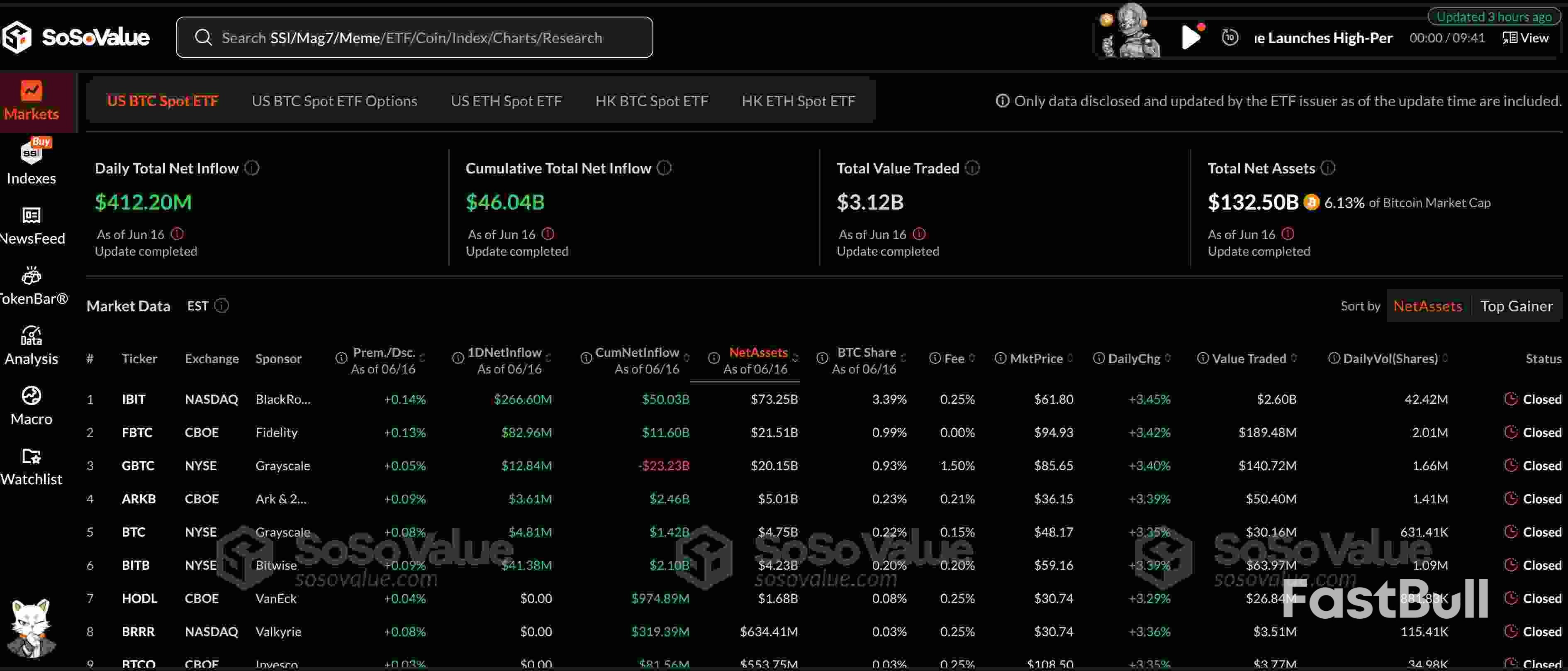
US spot Bitcoin exchange‑traded funds (ETFs) recorded $412.2 million in net inflows on June 16, extending their streak to six days and pushing total cumulative inflows to $46.04 billion.
The six-day run of inflows began on June 9 and has now absorbed over $1.8 billion in capital, according to data from SoSoValue. The run has continued despite escalating geopolitical tensions, including renewed conflict between Iran and Israel.
Daily contributions included $386.27 million on June 9, followed by a $431.12 million surge on June 10. Despite a slight dip mid-week, inflows rebounded sharply with $322.60 million on June 13 and the most recent $412.20 million on June 16.
Total net assets across all US Bitcoin (BTC) ETFs have reached $132.50 billion, now representing 6.13% of Bitcoin’s total market cap. Trading volume remained strong as well, with $3.12 billion in value exchanged on June 16 alone.
Spot Bitcoin ETF Inflows. Source: SoSoValueBlackRock’s iShares Bitcoin Trust (IBIT) led the charge, which recorded a $266.60 million net inflow on June 16 and has now accumulated $50.03 billion in total.
Fidelity’s FBTC followed with $82.96 million, while Grayscale’s GBTC lagged behind with just $12.84 million and still shows a net outflow of $23.23 billion since inception.
“Despite rising tensions between Israel and Iran, institutions are looking past short-term volatility and focusing on long-term positioning,” Vincent Liu, chief investment officer of the Taiwan-based company Kronos Research, told Cointelegraph, adding:
“Steady Bitcoin ETF inflows reflect growing trust in BTC’s resilience, accessibility, and role as a hedge in a shifting macro environment.”
The unexpected Israeli strike on Iran on June 13 triggered a market sell-off, pulling Bitcoin down over 7% and ending the week in negative territory.
Under the hood, metrics showed signs of capitulation, Bitfinex analysts said in a June 16 report. They noted that Net Taker Volume hit a multi-week low at –$197 million, indicating aggressive selling.
“This selling, however, combined with a spike in liquidations, resembles past capitulation-style setups that often mark local bottoms,” the analysts said.
They added that if Bitcoin manages to hold the $102,000–$103,000 zone, it may suggest that selling pressure is being absorbed and that the market could be primed for recovery.
White Label
Data API
Web Plug-ins
Poster Maker
Affiliate Program
The risk of loss in trading financial instruments such as stocks, FX, commodities, futures, bonds, ETFs and crypto can be substantial. You may sustain a total loss of the funds that you deposit with your broker. Therefore, you should carefully consider whether such trading is suitable for you in light of your circumstances and financial resources.
No decision to invest should be made without thoroughly conducting due diligence by yourself or consulting with your financial advisors. Our web content might not suit you since we don't know your financial conditions and investment needs. Our financial information might have latency or contain inaccuracy, so you should be fully responsible for any of your trading and investment decisions. The company will not be responsible for your capital loss.
Without getting permission from the website, you are not allowed to copy the website's graphics, texts, or trademarks. Intellectual property rights in the content or data incorporated into this website belong to its providers and exchange merchants.
Not Logged In
Log in to access more features

FastBull Membership
Not yet
Purchase
Log In
Sign Up