• Trade
  • Markets
  • Copy
  • Contests
  • News
  • 24/7
  • Calendar
  • Q&A
  • Chats
Trending
Screeners
SYMBOL
LAST
BID
ASK
HIGH
LOW
NET CHG.
%CHG.
SPREAD
SPX
S&P 500 Index
6921.45
6921.45
6921.45
6931.27
6899.71
+0.52
+ 0.01%
--
DJI
Dow Jones Industrial Average
49266.10
49266.10
49266.10
49357.74
48792.34
+270.03
+ 0.55%
--
IXIC
NASDAQ Composite Index
23480.01
23480.01
23480.01
23558.17
23353.46
-104.26
-0.44%
--
USDX
US Dollar Index
98.660
98.740
98.660
98.710
98.620
+0.090
+ 0.09%
--
EURUSD
Euro / US Dollar
1.16537
1.16544
1.16537
1.16618
1.16458
-0.00043
-0.04%
--
GBPUSD
Pound Sterling / US Dollar
1.34355
1.34365
1.34355
1.34421
1.34241
-0.00043
-0.03%
--
XAUUSD
Gold / US Dollar
4462.98
4463.43
4462.98
4483.85
4452.75
-14.81
-0.33%
--
WTI
Light Sweet Crude Oil
58.005
58.035
58.005
58.318
57.857
-0.243
-0.42%
--

Community Accounts

Signal Accounts
--
Profit Accounts
--
Loss Accounts
--
View More

Become a signal provider

Sell trading signals to earn additional income

View More

Guide to Copy Trading

Get started with ease and confidence

View More

Signal Accounts for Members

All Signal Accounts

Best Return
  • Best Return
  • Best P/L
  • Best MDD
Past 1W
  • Past 1W
  • Past 1M
  • Past 1Y

All Contests

  • All
  • Trump Updates
  • Recommend
  • Stocks
  • Cryptocurrencies
  • Central Banks
  • Featured News
Top News Only
Share

South Korea's Ministry Of Finance Announced A $350 Billion Investment Plan In The United States To Boost The Shipbuilding And Nuclear Energy Industries

Share

South Korea's Ministry Of Finance: South Korea Will Launch A Spot ETF For Digital Assets

Share

South Korea's Ministry Of Finance Announced It Will Develop Policies To Support The Semiconductor, Defense, Biopharmaceutical, Petrochemical, And Steel Industries

Share

South Korea's Ministry Of Finance Announced That It Will Implement Several Improvements To The Stock And Foreign Exchange Markets In Order To Enhance The Inclusion Of These Markets In The MSCI Index

Share

South Korea's Ministry Of Finance: South Korea Will Explore The Possibility Of Joining The Comprehensive And Progressive Agreement For Trans-Pacific Partnership (CPTPP)

Share

South Korea's Ministry Of Finance: South Korea Will Implement 24-hour Foreign Exchange Trading Starting In July

Share

South Korea Finance Ministry Says $350 Billion USA Investment Package To Bolster Shipbuilding, Nuclear Energy Sectors

Share

South Korea Finance Ministry Raises 2026 GDP Growth Forecast To 2.0% From 1.8%

Share

South Korea's Blue House: South Korea, Japan May Discuss China-Japan Dispute At Summit Next Week

Share

[Ding Xuexiang Meets With Walt Disney Company CEO Iger] Ding Xuexiang, Member Of The Standing Committee Of The Political Bureau Of The CPC Central Committee And Vice Premier Of The State Council, Met With Walt Disney Company CEO Iger In Beijing On The 9th

Share

Strong Baht, Low Spending To Weigh On Thailand GDP Growth In 2026

Share

Thailand Expects Sugar Output To Reach 10.3 Million Metric Tons In 2025/26 Production Year - Sugar Board

Share

Malaysia November Unemployment Rate Eases To 11-Year Low At 2.9%, Labor Force Expands

Share

South Korea Foreign Ministry: USA, South Korea Set Up Nuclear Power Cooperation Task Force, Discussed Fuel Enrichment And Reprocessing

Share

Malaysia's November Industrial Production Rose Slower-Than Expected 4.3% On Year

Share

Malaysia's November Factory Output +4.3% From Year Ago Versus Reuters Poll +5.2%

Share

India's NIFTY IT Index Rises 0.75%

Share

India's Nifty Bank Futures Up 0.01% In Pre-Open Trade

Share

India 10-Year Benchmark Government Bond Yield At 6.6305%, Previous Close 6.6290%

Share

Indonesia Dec Consumer Confidence Index At 123.5 Versus 124.0 In Nov

TIME
ACT
FCST
PREV
France 10-Year OAT Auction Avg. Yield

A:--

F: --

P: --

Euro Zone Consumer Inflation Expectations (Dec)

A:--

F: --

P: --

Euro Zone Unemployment Rate (Nov)

A:--

F: --

P: --

Euro Zone Selling Price Expectations (Dec)

A:--

F: --

P: --

Euro Zone PPI YoY (Nov)

A:--

F: --

P: --

Mexico 12-Month Inflation (CPI) (Dec)

A:--

F: --

P: --

Mexico Core CPI YoY (Dec)

A:--

F: --

P: --

Mexico PPI YoY (Dec)

A:--

F: --

P: --

Mexico CPI YoY (Dec)

A:--

F: --

P: --

U.S. Challenger Job Cuts MoM (Dec)

A:--

F: --

P: --

U.S. Challenger Job Cuts (Dec)

A:--

F: --

P: --

U.S. Challenger Job Cuts YoY (Dec)

A:--

F: --

P: --

U.S. Exports (Oct)

A:--

F: --

P: --

U.S. Trade Balance (Oct)

A:--

F: --

P: --
U.S. Initial Jobless Claims 4-Week Avg. (SA)

A:--

F: --

P: --
Canada Imports (SA) (Oct)

A:--

F: --

P: --
U.S. Weekly Initial Jobless Claims (SA)

A:--

F: --

P: --
U.S. Weekly Continued Jobless Claims (SA)

A:--

F: --

P: --
Canada Exports (SA) (Oct)

A:--

F: --

P: --
Canada Trade Balance (SA) (Oct)

A:--

F: --

P: --
U.S. Unit Labor Cost Prelim (SA) (Q3)

A:--

F: --

P: --

U.S. Wholesale Sales MoM (SA) (Oct)

A:--

F: --

P: --

U.S. EIA Weekly Natural Gas Stocks Change

A:--

F: --

P: --

U.S. Consumer Credit (SA) (Nov)

A:--

F: --

P: --
U.S. Weekly Treasuries Held by Foreign Central Banks

A:--

F: --

P: --

Japan Foreign Exchange Reserves (Dec)

A:--

F: --

P: --

China, Mainland CPI YoY (Dec)

A:--

F: --

P: --

China, Mainland PPI YoY (Dec)

A:--

F: --

P: --

China, Mainland CPI MoM (Dec)

A:--

F: --

P: --

Japan Leading Indicators Prelim (Nov)

A:--

F: --

P: --

Germany Industrial Output MoM (SA) (Nov)

--

F: --

P: --

Germany Exports MoM (SA) (Nov)

--

F: --

P: --
France Industrial Output MoM (SA) (Nov)

--

F: --

P: --

Italy Retail Sales MoM (SA) (Nov)

--

F: --

P: --

Euro Zone Retail Sales MoM (Nov)

--

F: --

P: --

Euro Zone Retail Sales YoY (Nov)

--

F: --

P: --

Italy 12-Month BOT Auction Avg. Yield

--

F: --

P: --

India Deposit Gowth YoY

--

F: --

P: --

Brazil IPCA Inflation Index YoY (Dec)

--

F: --

P: --

Mexico Industrial Output YoY (Nov)

--

F: --

P: --

Brazil CPI YoY (Dec)

--

F: --

P: --

U.S. Building Permits Revised YoY (SA) (Sept)

--

F: --

P: --

U.S. Building Permits Revised MoM (SA) (Sept)

--

F: --

P: --

U.S. Average Hourly Wage MoM (SA) (Dec)

--

F: --

P: --

U.S. Average Weekly Working Hours (SA) (Dec)

--

F: --

P: --

U.S. Total Building Permits (SA) (Oct)

--

F: --

P: --

U.S. Annual New Housing Starts (SA) (Oct)

--

F: --

P: --

U.S. U6 Unemployment Rate (SA) (Dec)

--

F: --

P: --

U.S. Manufacturing Employment (SA) (Dec)

--

F: --

P: --

U.S. Labor Force Participation Rate (SA) (Dec)

--

F: --

P: --

U.S. Private Nonfarm Payrolls (SA) (Dec)

--

F: --

P: --

U.S. Unemployment Rate (SA) (Dec)

--

F: --

P: --

U.S. Nonfarm Payrolls (SA) (Dec)

--

F: --

P: --

U.S. Average Hourly Wage YoY (Dec)

--

F: --

P: --

Canada Full-time Employment (SA) (Dec)

--

F: --

P: --

Canada Part-Time Employment (SA) (Dec)

--

F: --

P: --

Canada Unemployment Rate (SA) (Dec)

--

F: --

P: --

Canada Labor Force Participation Rate (SA) (Dec)

--

F: --

P: --

U.S. Government Employment (Dec)

--

F: --

P: --

Canada Employment (SA) (Dec)

--

F: --

P: --

Q&A with Experts
    • All
    • Chatrooms
    • Groups
    • Friends
    RPGFX flag
    SNYPPER_TRADES™️
    @SNYPPER_TRADES™️ Yeah, that is actually the exact way I intend to do it
    RPGFX flag
    SNYPPER_TRADES™️
    @SNYPPER_TRADES™️ For example if I decide to pick XAGUSD, I will then go and do my analysis before coming to check theirs
    RPGFX flag
    SNYPPER_TRADES™️
    I am definitely not going to trade all that so I will not analyze all that @SNYPPER_TRADES™️
    RPGFX flag
    SNYPPER_TRADES™️
    Except if I can not find something good in my own analysis on the one I picked then I will come to check for another @SNYPPER_TRADES™️
    Vibhav Rai flag
    good morning
    SNYPPER_TRADES™️ flag
    RPGFX
    @RPGFXhow accurate are there analysis if u were rate this?
    SNYPPER_TRADES™️ flag
    RPGFX
    @RPGFXI guess this method might help you start seeing the market from a logical standpoint
    SNYPPER_TRADES™️ flag
    RPGFX
    all the best@RPGFX
    Ashok flag
    now time to fly again gold
    Victor flag
    Vibhav Rai
    good morning
    @Vibhav RaiGood morning bro
    Ashok flag
    4500 will hit gold
    Victor flag
    Ashok
    now time to fly again gold
    @AshokYeah, but I don't quite agree with rushing into buying right now
    Victor flag
    @AshokIn fact, it might need a pullback to 4300-4350 to breathe before continuing its flight, otherwise it's very easy to get a painful fakeout friend
    Victor flag
    RPGFX flag
    Vibhav Rai
    good morning
    @Vibhav RaiGood morning brother, how are you getting ready for today's trading activity?
    RPGFX flag
    SNYPPER_TRADES™️
    @SNYPPER_TRADES™️I think the last time I checked it was approximately 60% win rate
    RPGFX flag
    SNYPPER_TRADES™️
    @SNYPPER_TRADES™️ Yeah
    RPGFX flag
    SNYPPER_TRADES™️
    @SNYPPER_TRADES™️ Thank you very much All the best for you too even today
    RPGFX flag
    Ashok
    now time to fly again gold
    @AshokDid you just take a buy at current market price?
    RPGFX flag
    Ashok
    4500 will hit gold
    @AshokThis is a target we have long been waiting for on gold but it kept playing around instead of heading for the target 🎯
    Type here...
    Add Symbol or Code

      No matching data

      All
      Trump Updates
      Recommend
      Stocks
      Cryptocurrencies
      Central Banks
      Featured News
      • All
      • Russia-Ukraine Conflict
      • Middle East Flashpoint
      • All
      • Russia-Ukraine Conflict
      • Middle East Flashpoint
      Search
      Products

      Charts Free Forever

      Chats Q&A with Experts
      Screeners Economic Calendar Data Tools
      Membership Features
      Data Warehouse Market Trends Institutional Data Policy Rates Macro

      Market Trends

      Market Sentiment Order Book Forex Correlations

      Top Indicators

      Charts Free Forever
      Markets

      News

      News Analysis 24/7 Columns Education
      From Institutions From Analysts
      Topics Columnists

      Latest Views

      Latest Views

      Trending Topics

      Top Columnists

      Latest Update

      Signals

      Copy Rankings Latest Signals Become a signal provider AI Rating
      Contests
      Brokers

      Overview Brokers Assessment Rankings Regulators News Claims
      Broker listing Forex Brokers Comparison Tool Live Spread Comparison Scam
      Q&A Complaint Scam Alert Videos Tips to Detect Scam
      More

      Business
      Events
      Careers About Us Advertising Help Center

      White Label

      Data API

      Web Plug-ins

      Affiliate Program

      Awards Institution Evaluation IB Seminar Salon Event Exhibition
      Vietnam Thailand Singapore Dubai
      Fans Party Investment Sharing Session
      FastBull Summit BrokersView Expo
      Recent Searches
        Top Searches
          Markets
          News
          Analysis
          User
          24/7
          Economic Calendar
          Education
          Data
          • Names
          • Latest
          • Prev

          View All

          No data

          Scan to Download

          Faster Charts, Chat Faster!

          Download App
          English
          • English
          • Español
          • العربية
          • Bahasa Indonesia
          • Bahasa Melayu
          • Tiếng Việt
          • ภาษาไทย
          • Français
          • Italiano
          • Türkçe
          • Русский язык
          • 简中
          • 繁中
          Open Account
          Search
          Products
          Charts Free Forever
          Markets
          News
          Signals

          Copy Rankings Latest Signals Become a signal provider AI Rating
          Contests
          Brokers

          Overview Brokers Assessment Rankings Regulators News Claims
          Broker listing Forex Brokers Comparison Tool Live Spread Comparison Scam
          Q&A Complaint Scam Alert Videos Tips to Detect Scam
          More

          Business
          Events
          Careers About Us Advertising Help Center

          White Label

          Data API

          Web Plug-ins

          Affiliate Program

          Awards Institution Evaluation IB Seminar Salon Event Exhibition
          Vietnam Thailand Singapore Dubai
          Fans Party Investment Sharing Session
          FastBull Summit BrokersView Expo

          New inflation trackers decipher key trends driving global prices

          Justin
          Summary:

          New S&P Global PMI™ Comment Trackers provide unique insights into the key macroeconomic trends shaping the global economy. The trackers are derived from qualitative evidence provided by PMI survey panellists around the world, comprising in excess of 30,000 business executives and decision makers in over 40 countries. The trackers help to better understand the causes of changing business conditions, including the impact of changing supply chain conditions, price and demand drivers and recession risks. Inflation trackers, analysed in more detail here, are invaluable tools for understanding why global inflation is running at multi-decade highs in key economic regions.
          Calculating the trackers

          Alongside the standard response data to S&P Global's monthly Purchasing Managers' Index™ (PMI) business surveys, companies are invited to provide additional qualitative information on the reasons as to why these variables (such as output, new orders and employment) have changed from the previous month. A panel comments tool tracks the frequency of words or phrases mentioned in these qualitative replies.
          Every index is calculated as a multiple of its long run average (from 2005), which is set equal to a value of 1.0. A reading of 5.0, for example, therefore suggests that the issue being tracked is being mentioned by survey participants five times the average amount.

          Inflation indices

          The Global PMI Comment Trackers are organised into five themes to demonstrate the state of the global business cycle. These themes are: 1) Capacity Expansion, 2) Demand Shortfall, 3) Inflation, 4) Supply Shortages and 5) Inventories. In November, we focus on trackers that give unique insights into the key drivers of inflation around the globe.
          With many countries facing their highest inflation levels since the 1980s, it is important to understand the factors behind rising prices and the severity of their impact. Our Inflation Comment Trackers aim to measure these factors by analysing the responses from our global survey panellists to questions specifically on input prices and output charges. Combining these responses provide valuable information about how underlying costs are affecting inflation over time.
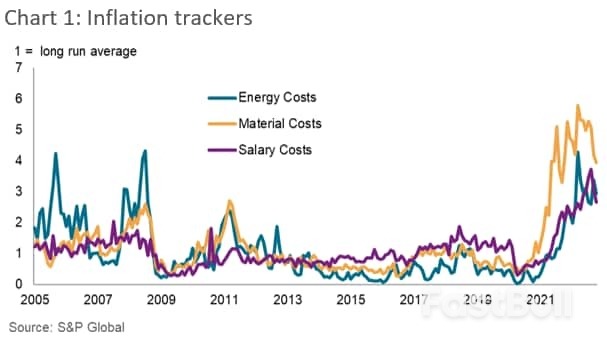
          Chart 1 shows three of these comment trackers which look at mentions of energy costs, material costs and salary pressures in the anecdotal reasons. While these trackers are not comparable with each other, they illustrate the relative magnitude of impact on global prices over time, showing if this is growing or diminishing.
          New inflation trackers decipher key trends driving global prices_1
          While all three trackers have climbed to or close to series peaks in 2022, the Material Costs tracker provided the greatest evidence that inflationary pressures have started to soften. At 3.93 in October, the tracker was down from a record high of 5.78 in March in the immediate aftermath of Russia's invasion of Ukraine, though still signalling that cost pressures from firms' material purchases were around four times the long-run average level.
          Similarly, the Energy Costs tracker spiked in March in response to the Russia-Ukraine war, posting 4.27 which was comparable with the height of the oil price shock in July 2008. Since then, the tracker has hovered close to a reading of 3.00, suggesting that firms globally are still reeling from the impact of higher energy prices on their input costs and selling charges.
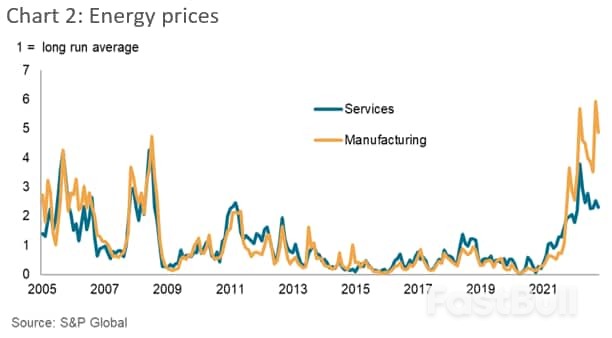
          Splitting this tracker by sector in chart 2 shows that manufacturers have unequally felt the burden of higher energy costs in the latest spike of inflation, with this tracker rising to a record high of 5.94 in September. By contrast, energy cost pressures at global services have gradually softened since March, though they also remained well above the long-run trend. With energy price volatility largely tied to the war in Ukraine, it is unclear whether these price pressures have peaked or not.
          New inflation trackers decipher key trends driving global prices_2
          Sharp rises in inflation combined with tight labour markets meant that firms have also been facing considerable pressure to boost employee wages. This was demonstrated by the Salary Costs tracker in chart 1 which was well above historical trends, reaching a record high of 3.72 in August (prior to August 2021, the tracker's peak was 2.04). Since then, it has slipped to 2.67 in October, suggesting that wage pressures may have eased as businesses globally faced a slowdown in demand. Manufacturers are particularly reporting higher wages more often than usual, with this tracker at 4.35 in October.

          Inflation poses headache for businesses expectations

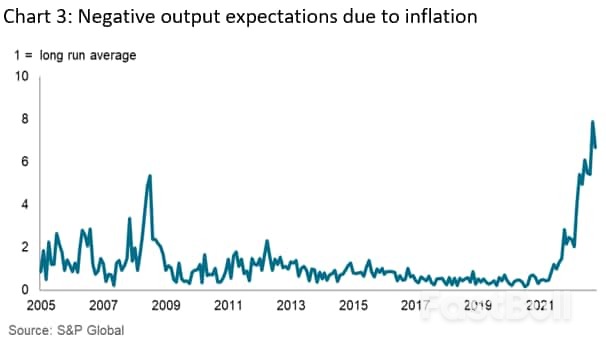
          Our PMI Comment Trackers also showed how businesses are adapting their projections for future activity based on inflation levels. Firms expecting output to fall over the next 12 months are increasingly mentioning higher prices as an underlying factor, measured by the tracker in chart 3 which rose sharply to a series record of 9.27 in September. This compared with a reading of 2.49 at the turn of the year and signals that firms expect price pressures to drive a slowdown in demand as clients reassess their spending in the face of rising costs.
          New inflation trackers decipher key trends driving global prices_3
          Notably, the inflation impact is expected to be much higher than that seen during 2008 and is leading to increased expectations of a global recession - a separate comment tracker shows that "recession" comments are now 4.40 times the usual level and the highest since May 2009. While there are some signs that inflation drivers are beginning to soften, our trackers suggest that price pressures are still well above normal levels, raising the prospect of further monetary policy tightening around the world and subsequent falls in household budgets and business investment.

          Source:IHS Markit Inc

          Risk Warnings and Disclaimers
          You understand and acknowledge that there is a high degree of risk involved in trading. Following any strategies or investment methods may lead to potential losses. The content on the site is provided by our contributors and analysts for information purposes only. You are solely responsible for determining whether any trading assets, securities, strategy, or any other product is suitable for investing based on your own investment objectives and financial situation.
          Comments
          Add to Favorites
          Share

          Australia: Further Strong Employment Gains

          Ukadike Micheal

          Despite labour shortages, employment growth is still happening

          On casual inspection, Australia is running out of available labour. Retail outlets and F&B establishments uniformly display "we are hiring" signs, and it looks very much as if the economy is hitting labour supply constraints. But despite this, it still appears that there is enough labour available, not only to fill more jobs than there is growth in the population of working age, but that those jobs are also predominantly, full-time, and typically higher quality and better-paid jobs.
          In terms of the numbers: The total gain in employment in October from the previous months was 32,200. but this understates the boost to household spending, as the full-time employment gain was 47,100, which must have included some conversion of part-time jobs to full-time. Part-time employment fell by 14,900.
          The total number of unemployed broadly mirrored the employment gains, falling 20,500, though there was also a very small drop in labour force participation which helped to bring the unemployment rate down to 3.4%, equal to its previous record low.Australia: Further Strong Employment Gains_1

          Australia's unemployment rate and forecasts

          Labour market probably close to its maximum tightness

          It is difficult to see how the labour market is going to tighten significantly further from here. This month may be one of the last to show solid employment gains, though we may need to wait until early 2023 for softening to become more apparent and for the unemployment rate to start nosing higher.
          In the meantime, we don't expect today's data to have any material bearing on how the Reserve Bank of Australia conducts its monetary policy in the coming months. We still anticipate further tightening and at a moderate 25bp per meeting pace now that rates are already at 2.85%, with the RBA signalling that they can take more measured approach from here on.
          We still anticipate rates rising into the early part of 2023, with the cash rate target peaking at 3.6% in 1Q23 amidst signs of inflation topping out and growth beginning to slow.

          Source: think.ing

          Risk Warnings and Disclaimers
          You understand and acknowledge that there is a high degree of risk involved in trading. Following any strategies or investment methods may lead to potential losses. The content on the site is provided by our contributors and analysts for information purposes only. You are solely responsible for determining whether any trading assets, securities, strategy, or any other product is suitable for investing based on your own investment objectives and financial situation.
          Comments
          Add to Favorites
          Share

          End of the American Century?

          Damon
          With Russia out of the superpower game, the United States will be faced instead with the challenge of standing up to China. To many Americans, this will be construed as a battle of values. And in that battle, the thinking goes, the U.S. will be sure to prevail. American superiority is defined not only in moral terms. American values have also been associated with superior performance characteristics, ensuring that America will remain ahead of the competition.
          These propositions have become hardwired into American self-imagery, and the imagery of America in many other countries. In his January 11, 1989, farewell speech, President Ronald Reagan (1981-1989) exulted in America as a beacon of freedom for all. Democracy promoters have since been hard at work seeking to spread American values worldwide.
          The American magazine magnate Henry Luce provided an eloquent formulation of the missionary role of the U.S. In a February 1941 editorial in "Life Magazine," captioned "The American Century," he made a strong plea for America to assume the role of a Good Samaritan for the world. Under American hegemony, democracy and other American ideals would "do their mysterious work of lifting the life of mankind from the level of the beasts to what the psalmist called a little lower than the angels."
          Since its entry into World War II in 1941, America has certainly had a good run. But will it last? The key to answering this crucial question lies in what the American political scientist Joseph Nye refers to as "power conversion capability," defined as the ability of a country to transform resources into power and influence.

          The role of values

          America remains more powerful than China. Yet, the growth of the Middle Kingdom over the last three decades has been spectacular, while America has been in the process of relative decline. Both observations entail important messages concerning the prospects for America to remain ahead.
          They raise questions about the presumed link between American values and economic performance. China has achieved its tremendous record of growth despite refusing to emulate the core institutions of a market economy, and its power conversion capability is beyond doubt. The comparison highlights the impact of eroding values on American performance. While Mr. Nye is convinced that by the end of the American Century, in 2041, America will still play the central role in the global balance of power, he also expresses concern about "a decrease in relative external power and domestic deterioration or decay."
          The key to what the future may hold lies in understanding that what matters to economic performance are those internalized personal values that guide individual action. They differ significantly from noble public values like freedom, democracy, the rule of law and human rights. And it is far from clear how and whether the promotion of such public values will also lead to a transformation in personal values. This is why democracy promotion has failed to gain traction.

          From survival to self-realization

          The long-term path to modern Western society was associated with two parallel shifts in basic value formation. One saw society move from survival to self-realization values, and the other entailed traditional values being replaced by secular-rational values.
          The former is well in line with modernization theory. Increasing material welfare results in a gradual shift from absolute social norms toward increasingly rational, tolerant and trusting values. As individuals become less concerned with securing their daily material basic needs, they develop values that relate to subjective well-being, quality of life and self-identification. Such new values range from environmental protection, feminism and LGBT rights to animal rights, veganism and climate change activism.
          The poorest and least developed nations score high on survival and traditional values, while the best achievers score high on self-realization and secular-rational values.
          In the transformation from a prevalence of traditional values to embracing secular-rational ones, the lines crossed were of profound significance. Societies marked by traditional values tend to emphasize religion, absolute standards and family. They favor large families, reject divorce and take a pro-life stance on abortion, euthanasia and suicide. They value social conformity over individualistic achievement, prefer consensus rather than open conflict, support deference to authority and have high levels of national pride and a nationalistic outlook. Societies with secular-rational values have opposite preferences on all these topics. And they are the high performers.
          Given that it captures a transformation of fundamental moral norms, this shift is more complex than the shift from survival to self-realization values. It suggests a dynamic that stands in sharp contrast to the argument on modernization and is more in line with the Weberian scholars who hold that cultural traditions are remarkably enduring and shape the political and economic behavior of societies today.
          Evidence from the World Values Survey shows that while the poorest and least developed nations score high on survival and traditional values, the best achievers score high on self-realization and secular-rational values. Despite lavishly funded Western policies of value promotion, these lines of division have proven to be highly resilient over time, ensuring that underachieving countries have remained poor.
          What makes these observations relevant today is that the development of American society over the past three decades has been associated with an accelerating erosion in the quality of institutions. The enterprise sector and the complex of research and higher education have both remained strong, but political scientists have expressed growing concern over a decline in "social capital," an erosion of those internalized personal values that combine to make up what Adam Smith once referred to as the "immense fabric of human society."End of the American Century?_1

          Three trajectories of societal erosion

          That has proceeded along three interacting trajectories.
          The first is the shift from survival to self-realization values. The first couple of centuries after the Declaration of Independence saw American society score substantial gains from this shift in personal values. It was conducive to the development of democracy because such values favor interpersonal trust, tolerance and participation. In recent decades, the proliferation of various forms of political activism has suggested that focusing on self-realization is becoming a problem rather than an asset. While the variety of causes that mark the intensifying cultural wars are both worthy and of great personal importance, the formation of such values has also been associated with distrust, moral condemnations, ostracism and deplatforming (denying opponents access to social media fora or other discussion venues).
          The second trajectory is where America deviates most strongly from other high achievers. Despite increasing affluence, large segments of American society have remained beholden to traditional values. In contrast to the predictions of modernization theory, which suggests a reduced role of religion and associated family values, the resilience of traditional values has become stronger over recent decades. The process has been fueled by the Republican Tea Party movement and the religious right. It has focused on deeply moral issues like abortion and LGBT rights and has provided fertile ground for demagoguery. When Donald Trump launched his campaign to "make America great again," he surfed on the role of family values. When campaigning to "drain the swamp," he tapped into mounting feelings of distrust of the federal government that also fueled the formation of armed militias.
          The third trajectory where America has suffered serious erosion in the quality of institutions refers to the foundations of the rules-based market economy. Proponents of free markets have been keen on quoting Adam Smith on the vital role of self-interest as a driving force in market development. However, they have not been equally keen on citing his dire warnings about the negative consequences of unconstrained self-interest seeking. The actual key to the success story of the West was that its market societies provided room for creative self-interest while upholding strong moral norms to constrain such interests. The collapse in moral standards against the greed that marked the roaring 1980s was an important watershed, setting the stage for a form of unbridled self-interest seeking that would result in a fundamental transformation of American society. At a time, discussions on income distribution featured talk about the top 1 percent of wealthy people, and now there is talk of the top 1 percent of the top 1 percent.
          Although this process has been associated with forming a class of destitute people amid tremendous affluence and with a savaging of the middle class held to be the bedrock of democracy, the political elites have not been overly concerned.
          If U.S. society descends into tribal warfare, it will not only become harder to convince other nations of the superiority of the American way, it will also entail a gradual deterioration in economic performance.
          When Barack Obama ran for president in 2008, he campaigned harshly against Wall Street greed. After he had moved into the White House, that was soon forgotten and replaced with personal wealth building. When Donald Trump ran for office, he could tap into an ample supply of discontent from what Hillary Clinton called a "basket of deplorables."
          These three trajectories may come across as extreme or even sensational. And it must be hedged that media amplify fringe phenomena alien to the majority. That said, they still highlight the nature of the slow-moving erosion of Smith's "immense fabric of human society," which may have a profound longer-term impact on the quality of institutions.

          Scenarios

          In a worst-case scenario, American society will develop along a trajectory where both traditional and self-realization values are turbocharged and where there will be little room for interpersonal trust, tolerance and broad participation. Battlegrounds will range from local school boards to elite academic establishments. In the former, advocates of creationism will stand against those who favor gender reassignment. In the latter, battles will rage over divisive issues like white privilege, Critical race theory, and the Black Lives Matter movement.
          As the two camps sink ever deeper into outright demonization of the other side, the inability to cohabit space with neighbors who hold the "wrong" values will trigger interstate migration that will cement the emerging pattern of "pure" red and blue states. One implication of such migration is that the outcome of presidential and congressional elections will be determined by a shrinking number of battleground states, implying that to most voters, such elections become less and less important. Another is that increasing challenges against election results will cause an erosion in the legitimacy of the electoral process and the vital role of federal government institutions.
          It is possible to envision a counter scenario, where the dominant parties assume responsibility for curbing the proliferation of narrow interests in personal agendas and agree on the restoration of those encompassing interests in the public good that emerged to create modern high-performing societies and economies. Economic policymakers could also recall the wisdom of Adam Smith: "Society may subsist, though not in the most comfortable state, without beneficence; but the prevalence of injustice must utterly destroy it." For as long as the most corrosive processes remain fringe phenomena, it is still possible to envision a return to the good path if the ills are cured rather than merely the symptoms alleviated.
          The main implication for American foreign policy and its "power conversion capability" is that it will become increasingly difficult to explain what hides behind the facade of the elusive "American values." If American society descends into something that looks more like tribal warfare, it will not only become harder to convince other nations of the superiority of the American way. Given that the quality of institutions will determine the quality of economic performance, it will also entail a gradual deterioration in economic performance beyond relative decline.

          Source: gisreportsonline

          Risk Warnings and Disclaimers
          You understand and acknowledge that there is a high degree of risk involved in trading. Following any strategies or investment methods may lead to potential losses. The content on the site is provided by our contributors and analysts for information purposes only. You are solely responsible for determining whether any trading assets, securities, strategy, or any other product is suitable for investing based on your own investment objectives and financial situation.
          Comments
          Add to Favorites
          Share

          India's Data Protection Dilemma

          Glendon
          The Indian government's Personal Data Protection Bill of 2019 (PDP Bill) was withdrawn in August 2022 after criticism from the opposition, tech giants and civil society. The government admitted the Bill could not address digital privacy in a country poised to become a US$1 trillion digital economy by 2026.
          After the Supreme Court of India declared privacy a fundamental right in 2017, the country saw two drafts of the PDP Bill — the first in 2018 and another in 2019. The draft 2018 Bill authorised 10 national agencies to intercept, monitor, or decrypt any digital information. The PDP draft Bill in 2019 granted central government agencies the same powers over personal and non-personal data.
          The 2019 draft Bill stoked criticism for the excessive powers granted to central government agencies to access personal data without consent. Former justice of the Supreme Court of India, Bellur Narayanaswamy Srikrishna, who headed the committee that drafted the Personal Data Protection Bill, warned in late 2019 that the legislation could lead to personal data being misused by the government.
          India's data and internet economy started flourishing in the late 2000s. Data protection was then based on the Information Technology (IT) Act of 2000, which only had provisions for the punishment of negligent data handling. In the years since, regulations pertaining to data privacy in India have largely been sectoral, leading to disparate ways of interpreting privacy and data protection.
          India's National Unique Digital Identity system, Aadhaar, based on voluntarily registered biometric data (fingerprint and iris scans), now includes over 1 billion people, making it indispensable to aggregating and delivering government services. When mobile internet users reached close to 500 million in 2018, the increased use and storage of personal data by the government, tech and telecom giants exposed the inadequacy of the existing laws in preventing data vulnerability and privacy breaches.
          With the increasing demand for a stricter regulatory regime, the 2019 PDP Bill proposed a legal framework along the lines of the European Union's 2016 General Data Protection Regulations (GDPR). The Bill covered personal data, attributable information (name, age, gender, sexual orientation, biometrics) and other genetic details but had limited provision for non-personal data in anonymised form. The Bill then underwent 81 amendments from a Joint Parliamentary Committee before being withdrawn from the Lok Sabha (lower house of the Indian parliament). The provisions of the Data Privacy Bill were expected to address three major concerns.
          The first was the usage and protection of personal data and its vulnerability to data breaches by tech companies. India reported 313,000 cybersecurity incidents in 2019, making it the third largest destination for data breaches worldwide. Those facing data breaches included both private company such as Domino's Pizza and public enterprises such as the State Bank of India.
          The new Bill proposed to deal with this issue through stringent regulations on cross border data flows and stricter regulations for tech giants. These changes concerned tech companies with servers outside the country. They would have faced the burden of compliance and had difficulty accessing data from India, one of their rapidly growing markets.
          The second concern was that the government, which holds the largest amounts of personal data relating to its residents, including biometrics, would use the data for surveillance or to infringe on privacy. Aadhaar health data is susceptible to cyber-attacks, having experienced accidental data leaks and unauthorised access by government employees. Yet Chapter VIII clause 35 of the proposed Bill exempted the government from compliance with all provisions to protect the 'sovereignty and integrity of India, national security, friendly relations with foreign states and public order'.
          The final issue was the stringent data localisation provisions that sought all data fiduciaries to store a copy of personal data collected in India. 'Critical personal data' — a category left undefined at the time — could only be kept in India. That faced pushback from tech giants that, while operating in India, store user data in foreign jurisdictions favourable to individual privacy rights. Data localisation is a sensitive issue for the government because there are concerns about the non-availability of data preventing the investigation of serious crimes involving citizens outside the country.
          On the one hand, ordinary citizens or users of social media sites and other internet users are worried about their data security and privacy. On the other hand, governments are concerned about national security and protecting basic rights of citizens when tech giants hold reams of personal data. Corporates and tech giants worry about how excessive data regulations and government surveillance could lead to a loss of trust in their services if the personal data they hold is compromised.
          India has a peculiar national security problem — most of its citizens use foreign owned social networking sites such as Facebook, Instagram, Whatsapp and Google. But their internet hardware, network infrastructure and mobile phones are dominated by Chinese players.
          While the revised PDP Bill will be released for consultation by the end of 2022, lawmakers are expected to water down the data localisation component to make it more palatable to multinational corporations. They are also expected to permit government access to personal data for national security reasons and keep social media platforms under check through grievance appellate committees.
          Dharish David (PhD) Associate Faculty for the University of London at the Singapore Institute of Management Global Education (SIM GE). He is also a Research Manager at Global Angle, a market research and consulting firm in Singapore.

          Source: eastasiaforum

          Risk Warnings and Disclaimers
          You understand and acknowledge that there is a high degree of risk involved in trading. Following any strategies or investment methods may lead to potential losses. The content on the site is provided by our contributors and analysts for information purposes only. You are solely responsible for determining whether any trading assets, securities, strategy, or any other product is suitable for investing based on your own investment objectives and financial situation.
          Comments
          Add to Favorites
          Share

          The Next Wave of Mass Migration

          Ukadike Micheal

          Energy

          Hurricane Ian, which disrupted the lives of millions when it swept over the Gulf of Mexico in late September this year, will not soon be forgotten. Torrential rains and winds of up to 240 kilometers per hour produced an extraordinary surge that flooded not only coastal areas but also their hinterland.
          At the same time, Typhoon Noru was slamming into the Philippines. Earlier this year, Hurricane Fiona formed near Puerto Rico and hit Canada with unprecedented force, and Typhoon Nanmadol drove 9 million people to evacuate from their homes in Japan. Typhoon Merbok devastated Alaska with waves more than 50 feet high. Pakistan saw dramatic floods, aggravated by melting local glaciers. Leaving as much as one third of the country underwater, and more than 1,600 people and 800,000 livestock dead, the disaster will change the face of Pakistan for decades. The United Nations has called these phenomena the footprint of climate change.

          Climate change and migration

          Although Africa's 54 states have not contributed significantly to the global emissions that accelerated climate change, the continent is one of the hardest hit. Desertification, dust storms and rising sea levels are poised to wreak havoc on large segments of the African populace.
          By 2100, Africa is expected to account for 40 percent of the global population, which will grow to 11 billion. There will likely be 2.5 billion Africans by 2050. Amar Bhattacharya of the Brookings Institution writes that this growth will require an extraordinary increase in investment in "three critical areas: energy transitions and related investments in sustainable infrastructure; investments in climate change adaptation and resilience; and restoration of natural capital (through agriculture, food and land use practices) and biodiversity. … Altogether, Africa will need to invest around $200 billion per year by 2025 and close to $400 billion per year by 2030 on these priorities."
          Water will become a commodity over which wars are fought.
          African governments will be the first line of defense to safeguard the continent's biological heritage, such as the rainforest of the Congo River Basin, which like the Amazon is crucial to removing carbon dioxide from the atmosphere.
          Africa's worst climate-related changes in recent decades are not hurricanes, but rather a persistent drought. The near extinction of Lake Chad is a prime example, as are the widening of the Sahel desert belt southward and the increasingly long periods without rain throughout the Maghreb. The population will grow but rainfall will decrease, thus rapidly shrinking the amount of arable land. And temperatures will rise – in a continent where only half of the 1.2 billion residents have access to electricity.
          If these trends continue unchecked, much of Africa will ultimately become uninhabitable. In the Lake Chad basin, 5.3 million people (mostly fishermen and farmers) were displaced by climate-related changes. Experts predict that Africa's glaciers will disappear: those of Mount Kenya by 2030 and those of Mount Kilimanjaro by 2040.
          Already, small rural communities in the Maghreb struggle to produce enough to subsist. The same goes for intensive agriculture, which in Morocco, Tunisia and Algeria, generates up to a fifth of gross domestic product. Even slight disruptions will have exponential effects on those societies.
          In an area where water availability is already limited, population growth will drive not only an increase in demand for water but also accelerate desertification, barring significant investment in creating a viable supply. Here, advances in technologies hold great promise, from space-based surveillance to AI-supported genetic modification of crops to make them more resistant to drought and heat.
          Rising sea levels will exacerbate the problem for coastal cities, river mouths and deltas by salinizing estuaries. Water will become a commodity over which wars are fought.

          Fortress Europe

          Between 2015 and 2016, Europe was subject to uncontrolled migration flows, recording nearly 1.5 million arrivals. Migrants came mainly from Africa, creating a deep political crisis among European governments. The most notable consequence was the partial suspension of the Schengen Agreement. Even though fewer people arrived via the three classic Mediterranean routes in the following years, many European states continued to carry out border checks (in part because of the Covid-19 pandemic). But, in 2022 the number of migrants seeking to enter Europe is on the rise again.
          It will become increasingly difficult, and in some areas impossible, to grow crops and raise animals.
          It is estimated that in 15 years, more than half of Africa's 375 million young people will live in rural areas. These are the same areas that will be most affected by climate change. They will be forced to migrate to urban centers, but existing cities will not be able to accommodate such numbers. They will have no choice but to migrate.

          Scenarios

          As climate-related phenomena become more frequent, the number of internally and externally displaced persons in Africa will grow. In the Horn of Africa area, some 1.2 million people have been displaced already, largely because of floods, storms and droughts. The World Bank's 2021 Groundswell report states that, due to climate change alone, 216 million people could migrate internally by 2050. Climate migrants will outnumber labor and security migrants, historically the most prevalent.
          There are three scenarios for North Africa alone: pessimistic (13 million internal migrants by 2050), moderate (9.9 million) and optimistic (4.5 million). To these numbers, the rest of the continent must be added. Of these millions of internal migrants, hundreds of thousands, if not millions, will attempt to cross the Mediterranean.
          Rising temperatures will have a far-reaching impact: the loss or even extinction of animal and plant species with the disappearance of entire ecosystems, including marine environments that are fundamental to the survival of fishing communities.
          It will become increasingly difficult, and in some areas impossible, to grow crops and raise animals. This will be devastating for those who do not have the means to invest in the technology needed to cope with drought and higher temperatures. Food security will be profoundly affected. Societies will face major economic crises as a result, which, in turn, will create political instability. Once again, the most vulnerable segments of these populations – the poorest, minorities, women and children – will inevitably bear the brunt of the crisis.

          Source: gisreportsonline

          Risk Warnings and Disclaimers
          You understand and acknowledge that there is a high degree of risk involved in trading. Following any strategies or investment methods may lead to potential losses. The content on the site is provided by our contributors and analysts for information purposes only. You are solely responsible for determining whether any trading assets, securities, strategy, or any other product is suitable for investing based on your own investment objectives and financial situation.
          Comments
          Add to Favorites
          Share

          CEE sovereign debt outlook positive despite rising borrowing costs

          Justin
          Speaking at the virtual CEE event hosted OMFIF’s Sovereign Debt Institute, CEE sovereign debt management heads outlined their concerns over rising borrowing costs and what they were doing in response to the volatility.
          Marjan Divjak, director general of the Treasury directorate at Slovenia’s ministry of finance, said rising costs were ‘a very important factor’. ‘We are doing everything possible to contain the credit spread,’ said Divjak. ‘We are designing the debt management strategy in the medium term to do everything on our side to prevent the credit spread significantly widening from here.’
          Zoltán Kuráli, chief executive officer of Hungary’s debt management agency, said they are structuring their debt to ensure that they are well positioned for when the cycle turns and inflation peaks.
          ‘Our answer to that is in the past we issued very little floating rate debt and now we are issuing more floating rate debt,’ said Kuráli. ‘Obviously it is a bet going very wrong if yields continue to rise for years but I guess it is reasonable to expect that there is going to be a peaking of inflation and a peaking yield environment at some point.’
          Stefan Nanu, head of public debt management and state Treasury at Romania’s ministry of finance, said it was important ‘to try to find that mix of instruments’ as well as a combination of external and domestic debt which does not put too much pressure on one curve.
          ‘The funding costs are very important because it’s the taxpayer’s money which we have to finance and therefore the lowest possible costs over the medium to long term is a clear goal from the debt management strategy,’ said Markus Stix, managing director at the Austrian Treasury.
          Stix also agreed that a diversification of funding was important, highlighting the launch of Austria’s T-bill programme last year. In October, Austria issued its green T-bill – the world’s first such instrument.
          For investors, the rising funding costs in the region present a different proposition. Carlos de Sousa, emerging market debt strategist and portfolio manager at Vontobel, said high borrowing costs for CEE sovereigns were not a huge concern but rather an attractive opportunity.
          ‘When you go to a primary issue and if the macro is not looking very bad and, in most countries, it’s looking okay, then higher borrowing costs in the primary issue is actually an attractive entry point,’ said de Sousa. ‘In this region in particular, I’m not very concerned about high borrowing costs undermining debt sustainability in the medium term assuming global inflation comes down.’
          Simon Quijano-Evans, chief economist at Gemcorp Capital, echoed de Sousa’s positivity and said he was ‘optimistic’ on inflation, saying by the middle of next year, year-on-year inflation will be way lower than it is now.
          Quijano-Evans said that, despite conditions being sour, with the largest outflows ever from emerging market bond funds this year and net issuance down to about a fifth of normal supply, the outlook was brighter.
          Both Quijano-Evans and de Sousa said the debt sustainability of CEE sovereigns was not a major concern. ‘If you look at debt to GDP and the fiscal backdrop, all the countries present here are among the top performers globally with lower than 80% of debt to GDP levels and a in number of cases lower than 60%, so I don’t there is a question of [debt] sustainability here,’ said Quijano-Evans.
          ‘I don’t have particular concerns about debt sustainability in the region,’ said de Sousa. ‘One country that looks a bit less good in a way – I’m not saying their debt burden is not sustainable – but where I could have some concerns is Montenegro. But the effective interest rate is so low that it compensates for a very high debt to GDP ratio. But I’m still concerned about not having a clear path for fiscal consolidation in the long term there.’

          Source:OMFIF

          Risk Warnings and Disclaimers
          You understand and acknowledge that there is a high degree of risk involved in trading. Following any strategies or investment methods may lead to potential losses. The content on the site is provided by our contributors and analysts for information purposes only. You are solely responsible for determining whether any trading assets, securities, strategy, or any other product is suitable for investing based on your own investment objectives and financial situation.
          Comments
          Add to Favorites
          Share

          How the World Health Organization Might Fight Future Pandemics

          Cohen
          Negotiations on new rules for dealing with pandemics are underway at the World Health Organization (WHO), with a target date of May 2024 for a legally binding agreement to be adopted by the U.N. health agency's 194 member countries.
          A new pact is a priority for WHO chief Tedros Adhanom Ghebreyesus as his second five-year term at the head of the global health agency gets underway. It seeks to shore up the world's defences against new pathogens following the COVID-19 pandemic that has killed more than 6.5 million people, according to the WHO.
          The global health agency itself is facing calls for reform after an independent panel described it as "underpowered" when COVID-19 struck, with limited ability to investigate outbreaks and coordinate containment measures.

          What is the so-called pandemic treaty?

          The WHO already has binding rules known as the International Health Regulations (2005) which set out countries' obligations where public health events have the potential to cross borders. These include advising the WHO immediately of a health emergency and measures on trade and travel.
          Adopted after the 2002/3 SARS outbreak, these regulations are still seen as functional for regional epidemics like Ebola but inadequate for a global pandemic.
          Suggested proposals for the pact include the sharing of data and genome sequences of emerging viruses and rules on equitable vaccine distribution.
          Member states agreed in July that the new agreement should be legally binding. Another key meeting is scheduled for December.
          It would be only the second such health accord after the 2003 Framework Convention on Tobacco Control, a treaty which aims to reduce smoking via taxation and rules on labelling and advertising.

          How do countries view the pact?

          The EU proposed the accord and is seen as its biggest backer. Developing countries are keen to use the negotiations as an opportunity to secure better access to vaccines, following allegations of "vaccine apartheid" from the WHO's Director-General Tedros.
          Members are due to give their initial feedback to the draft in a public meeting between Dec. 5-7. With so many member countries involved, securing agreement is likely to be tricky.

          How would it work?

          It is not yet clear how the 2005 regulations and the new pandemic accord might fit together.
          One suggestion is that they should be complementary, so that existing rules apply to local outbreaks with the new rules kicking in if the WHO declares a pandemic -- something it does not currently have a mandate to do.
          It remains to be determined whether negotiators will include measures such as sanctions to ensure compliance.

          What other reforms are in the works?

          Separate talks on an initiative to overhaul the 2005 rules are taking place, with proposals submitted by the United States, the European Union and at least a dozen others, diplomats say.
          Washington's proposals aim to boost transparency and grant the WHO quicker access to outbreak sites. Several diplomats said they are likely to prove too ambitious, with opposition from China and others expected on national sovereignty grounds.
          China did allow WHO-led expert teams to visit the COVID-19 epicentre in Wuhan, but the WHO says it is still withholding clinical data from early cases that may hold clues about the origins of the SARS-CoV-2 virus.

          Source: Reuters

          Risk Warnings and Disclaimers
          You understand and acknowledge that there is a high degree of risk involved in trading. Following any strategies or investment methods may lead to potential losses. The content on the site is provided by our contributors and analysts for information purposes only. You are solely responsible for determining whether any trading assets, securities, strategy, or any other product is suitable for investing based on your own investment objectives and financial situation.
          Comments
          Add to Favorites
          Share
          FastBull
          Copyright © 2026 FastBull Ltd

          728 RM B 7/F GEE LOK IND BLDG NO 34 HUNG TO RD KWUN TONG KLN HONG KONG

          TelegramInstagramTwitterfacebooklinkedin
          App Store Google Play Google Play
          Products
          Charts

          Chats

          Q&A with Experts
          Screeners
          Economic Calendar
          Data
          Tools
          Membership
          Features
          Function
          Markets
          Copy Trading
          Latest Signals
          Contests
          News
          Analysis
          24/7
          Columns
          Education
          Company
          Careers
          About Us
          Contact Us
          Advertising
          Help Center
          Feedback
          User Agreement
          Privacy Policy
          Personal Information Protection Statement
          Business

          White Label

          Data API

          Web Plug-ins

          Poster Maker

          Affiliate Program

          Risk Disclosure

          The risk of loss in trading financial instruments such as stocks, FX, commodities, futures, bonds, ETFs and crypto can be substantial. You may sustain a total loss of the funds that you deposit with your broker. Therefore, you should carefully consider whether such trading is suitable for you in light of your circumstances and financial resources.

          No decision to invest should be made without thoroughly conducting due diligence by yourself or consulting with your financial advisors. Our web content might not suit you since we don't know your financial conditions and investment needs. Our financial information might have latency or contain inaccuracy, so you should be fully responsible for any of your trading and investment decisions. The company will not be responsible for your capital loss.

          Without getting permission from the website, you are not allowed to copy the website's graphics, texts, or trademarks. Intellectual property rights in the content or data incorporated into this website belong to its providers and exchange merchants.

          Not Logged In

          Log in to access more features

          FastBull Membership

          Not yet

          Purchase

          Become a signal provider
          Help Center
          Customer Service
          Dark Mode
          Price Up/Down Colors

          Log In

          Sign Up

          Position
          Layout
          Fullscreen
          Default to Chart
          The chart page opens by default when you visit fastbull.com