• Trade
  • Markets
  • Copy
  • Contests
  • News
  • 24/7
  • Calendar
  • Q&A
  • Chats
Trending
Screeners
SYMBOL
LAST
BID
ASK
HIGH
LOW
NET CHG.
%CHG.
SPREAD
SPX
S&P 500 Index
6844.24
6844.24
6844.24
6878.28
6841.15
-26.16
-0.38%
--
DJI
Dow Jones Industrial Average
47740.73
47740.73
47740.73
47971.51
47709.38
-214.25
-0.45%
--
IXIC
NASDAQ Composite Index
23516.62
23516.62
23516.62
23698.93
23505.52
-61.50
-0.26%
--
USDX
US Dollar Index
99.140
99.220
99.140
99.160
98.730
+0.190
+ 0.19%
--
EURUSD
Euro / US Dollar
1.16201
1.16208
1.16201
1.16717
1.16169
-0.00225
-0.19%
--
GBPUSD
Pound Sterling / US Dollar
1.33084
1.33092
1.33084
1.33462
1.33053
-0.00228
-0.17%
--
XAUUSD
Gold / US Dollar
4178.79
4179.20
4178.79
4218.85
4175.92
-19.12
-0.46%
--
WTI
Light Sweet Crude Oil
58.909
58.939
58.909
60.084
58.837
-0.900
-1.50%
--

Community Accounts

Signal Accounts
--
Profit Accounts
--
Loss Accounts
--
View More

Become a signal provider

Sell trading signals to earn additional income

View More

Guide to Copy Trading

Get started with ease and confidence

View More

Signal Accounts for Members

All Signal Accounts

Best Return
  • Best Return
  • Best P/L
  • Best MDD
Past 1W
  • Past 1W
  • Past 1M
  • Past 1Y

All Contests

  • All
  • Trump Updates
  • Recommend
  • Stocks
  • Cryptocurrencies
  • Central Banks
  • Featured News
Top News Only
Share

Fox Corp CFO Says Co Does Not Want To Operate Sports Betting License On Our Own - UBS Conf

Share

New York Fed: November Home Price Rise Expectation Steady At 3%

Share

New York Fed: US Households' Personal Finance Worries Grew In November

Share

New York Fed: November Five-Year-Ahead Expected Inflation Rate Unchanged At 3%

Share

New York Fed: Households More Pessimistic On Current, Future Financial Situations In November

Share

New York Fed Report: USA Households' Year-Ahead Expected Inflation Rate Unchanged At 3.2% In November

Share

New York Fed: November Year-Ahead Expected Rise In Medical Costs Highest Since January 2014

Share

New York Fed: Labor Market Expectations Improved In November

Share

New York Fed: November Three-Year-Ahead Expected Inflation Rate Unchanged At 3%

Share

Traders Expect The Federal Reserve To Have Less Than 75 Basis Points Of Room To Cut Interest Rates Before The End Of 2026

Share

African Stock Market Closing Report | On Monday (December 8), The South African FTSE/Jse Africa Leading 40 Traded Index Closed Down 1.57%, Nearing 103,000 Points. It Opened Roughly Flat At 15:00 Beijing Time And Then Continued To Decline

Share

Spot Gold Briefly Plunged From Above $4,210 To $4,176.42, Hitting A New Daily Low, With An Overall Intraday Decline Of Over 0.2%

Share

The Athens Stock Exchange Composite Index Closed Up 0.17% At 2108.30 Points

Share

Money Markets No Longer Expect The European Central Bank To Cut Interest Rates In 2026, And The Probability Of A Rate Cut In July Has Dropped To Zero, Compared To 15% Last Friday

Share

Hungarian Prime Minister Orban: We Have Transported 7.5 Billion Cubic Meters Of Gas To Hungary This Year Through Turkey

Share

French Presidential Residence Elysee: Zelenskiy, European Leaders Continued Work On USA Peace Plan In London

Share

All Three Major U.S. Stock Indexes Fell, With The S&P 500 Dropping 0.3% To A New Daily Low

Share

German Spy Chief: No Need To 'Break' With US Over Security Policy

Share

United Arab Emirates Official To Reuters: The United Arab Emirates Asserts That The Governance And Territorial Integrity Of Yemen Must Be Determined By Yemenis

Share

United Arab Emirates Official To Reuters: The United Arab Emirates's Position On The Yemen Crisis Is In Line With Saudi Arabia In Supporting A Political Process Based On An Initiative Backed By Gulf States

TIME
ACT
FCST
PREV
France Trade Balance (SA) (Oct)

A:--

F: --

P: --
Euro Zone Employment YoY (SA) (Q3)

A:--

F: --

P: --
Canada Part-Time Employment (SA) (Nov)

A:--

F: --

P: --

Canada Unemployment Rate (SA) (Nov)

A:--

F: --

P: --

Canada Full-time Employment (SA) (Nov)

A:--

F: --

P: --

Canada Labor Force Participation Rate (SA) (Nov)

A:--

F: --

P: --

Canada Employment (SA) (Nov)

A:--

F: --

P: --

U.S. PCE Price Index MoM (Sept)

A:--

F: --

P: --

U.S. Personal Income MoM (Sept)

A:--

F: --

P: --

U.S. Core PCE Price Index MoM (Sept)

A:--

F: --

P: --

U.S. PCE Price Index YoY (SA) (Sept)

A:--

F: --

P: --

U.S. Core PCE Price Index YoY (Sept)

A:--

F: --

P: --

U.S. Personal Outlays MoM (SA) (Sept)

A:--

F: --

P: --
U.S. 5-10 Year-Ahead Inflation Expectations (Dec)

A:--

F: --

P: --

U.S. Real Personal Consumption Expenditures MoM (Sept)

A:--

F: --

P: --
U.S. Weekly Total Rig Count

A:--

F: --

P: --

U.S. Weekly Total Oil Rig Count

A:--

F: --

P: --

U.S. Consumer Credit (SA) (Oct)

A:--

F: --

P: --
China, Mainland Foreign Exchange Reserves (Nov)

A:--

F: --

P: --

Japan Trade Balance (Oct)

A:--

F: --

P: --

Japan Nominal GDP Revised QoQ (Q3)

A:--

F: --

P: --

China, Mainland Imports YoY (CNH) (Nov)

A:--

F: --

P: --

China, Mainland Exports (Nov)

A:--

F: --

P: --

China, Mainland Imports (CNH) (Nov)

A:--

F: --

P: --

China, Mainland Trade Balance (CNH) (Nov)

A:--

F: --

P: --

China, Mainland Exports YoY (USD) (Nov)

A:--

F: --

P: --

China, Mainland Imports YoY (USD) (Nov)

A:--

F: --

P: --

Germany Industrial Output MoM (SA) (Oct)

A:--

F: --

P: --
Euro Zone Sentix Investor Confidence Index (Dec)

A:--

F: --

P: --

Canada National Economic Confidence Index

A:--

F: --

P: --

U.K. BRC Like-For-Like Retail Sales YoY (Nov)

--

F: --

P: --

U.K. BRC Overall Retail Sales YoY (Nov)

--

F: --

P: --

Australia Overnight (Borrowing) Key Rate

--

F: --

P: --

RBA Rate Statement
RBA Press Conference
Germany Exports MoM (SA) (Oct)

--

F: --

P: --

U.S. NFIB Small Business Optimism Index (SA) (Nov)

--

F: --

P: --

Mexico 12-Month Inflation (CPI) (Nov)

--

F: --

P: --

Mexico Core CPI YoY (Nov)

--

F: --

P: --

Mexico PPI YoY (Nov)

--

F: --

P: --

U.S. Weekly Redbook Index YoY

--

F: --

P: --

U.S. JOLTS Job Openings (SA) (Oct)

--

F: --

P: --

China, Mainland M1 Money Supply YoY (Nov)

--

F: --

P: --

China, Mainland M0 Money Supply YoY (Nov)

--

F: --

P: --

China, Mainland M2 Money Supply YoY (Nov)

--

F: --

P: --

U.S. EIA Short-Term Crude Production Forecast For The Year (Dec)

--

F: --

P: --

U.S. EIA Natural Gas Production Forecast For The Next Year (Dec)

--

F: --

P: --

U.S. EIA Short-Term Crude Production Forecast For The Next Year (Dec)

--

F: --

P: --

EIA Monthly Short-Term Energy Outlook
U.S. API Weekly Gasoline Stocks

--

F: --

P: --

U.S. API Weekly Cushing Crude Oil Stocks

--

F: --

P: --

U.S. API Weekly Crude Oil Stocks

--

F: --

P: --

U.S. API Weekly Refined Oil Stocks

--

F: --

P: --

South Korea Unemployment Rate (SA) (Nov)

--

F: --

P: --

Japan Reuters Tankan Non-Manufacturers Index (Dec)

--

F: --

P: --

Japan Reuters Tankan Manufacturers Index (Dec)

--

F: --

P: --

Japan Domestic Enterprise Commodity Price Index MoM (Nov)

--

F: --

P: --

Japan Domestic Enterprise Commodity Price Index YoY (Nov)

--

F: --

P: --

China, Mainland PPI YoY (Nov)

--

F: --

P: --

China, Mainland CPI MoM (Nov)

--

F: --

P: --

Q&A with Experts
    • All
    • Chatrooms
    • Groups
    • Friends
    Connecting
    .
    .
    .
    Type here...
    Add Symbol or Code

      No matching data

      All
      Trump Updates
      Recommend
      Stocks
      Cryptocurrencies
      Central Banks
      Featured News
      • All
      • Russia-Ukraine Conflict
      • Middle East Flashpoint
      • All
      • Russia-Ukraine Conflict
      • Middle East Flashpoint
      Search
      Products

      Charts Free Forever

      Chats Q&A with Experts
      Screeners Economic Calendar Data Tools
      Membership Features
      Data Warehouse Market Trends Institutional Data Policy Rates Macro

      Market Trends

      Market Sentiment Order Book Forex Correlations

      Top Indicators

      Charts Free Forever
      Markets

      News

      News Analysis 24/7 Columns Education
      From Institutions From Analysts
      Topics Columnists

      Latest Views

      Latest Views

      Trending Topics

      Top Columnists

      Latest Update

      Signals

      Copy Rankings Latest Signals Become a signal provider AI Rating
      Contests
      Brokers

      Overview Brokers Assessment Rankings Regulators News Claims
      Broker listing Forex Brokers Comparison Tool Live Spread Comparison Scam
      Q&A Complaint Scam Alert Videos Tips to Detect Scam
      More

      Business
      Events
      Careers About Us Advertising Help Center

      White Label

      Data API

      Web Plug-ins

      Affiliate Program

      Awards Institution Evaluation IB Seminar Salon Event Exhibition
      Vietnam Thailand Singapore Dubai
      Fans Party Investment Sharing Session
      FastBull Summit BrokersView Expo
      Recent Searches
        Top Searches
          Markets
          News
          Analysis
          User
          24/7
          Economic Calendar
          Education
          Data
          • Names
          • Latest
          • Prev

          View All

          No data

          Scan to Download

          Faster Charts, Chat Faster!

          Download App
          English
          • English
          • Español
          • العربية
          • Bahasa Indonesia
          • Bahasa Melayu
          • Tiếng Việt
          • ภาษาไทย
          • Français
          • Italiano
          • Türkçe
          • Русский язык
          • 简中
          • 繁中
          Open Account
          Search
          Products
          Charts Free Forever
          Markets
          News
          Signals

          Copy Rankings Latest Signals Become a signal provider AI Rating
          Contests
          Brokers

          Overview Brokers Assessment Rankings Regulators News Claims
          Broker listing Forex Brokers Comparison Tool Live Spread Comparison Scam
          Q&A Complaint Scam Alert Videos Tips to Detect Scam
          More

          Business
          Events
          Careers About Us Advertising Help Center

          White Label

          Data API

          Web Plug-ins

          Affiliate Program

          Awards Institution Evaluation IB Seminar Salon Event Exhibition
          Vietnam Thailand Singapore Dubai
          Fans Party Investment Sharing Session
          FastBull Summit BrokersView Expo

          Japan’s Q3 GDP Revised Sharply Downward: Worst Drop in Two Years, But BOJ Stance Unchanged

          Gerik

          Economic

          Summary:

          Japan’s economy contracted by 2.3% in Q3 2025 worse than the initial estimate of 1.8% marking the sharpest drop since Q3 2023. The downward revision was mainly due to a slump in capital spending....

          Capital Spending Leads to Deeper GDP Contraction

          Japan’s Cabinet Office revised its Q3 GDP figure down to a 2.3% annualized decline, significantly worse than the initial 1.8% estimate and the market forecast of -2.0%. This marks the steepest quarterly decline in two years, mainly driven by a notable revision in capital expenditure, which fell by 0.2%. The initial estimate had projected a 1.0% rise, while analysts had expected a more modest 0.4% increase. The discrepancy in investment spending was the primary driver behind the deeper-than-expected economic contraction.
          On a quarter-over-quarter basis, GDP dropped 0.6%, exceeding both the original estimate of -0.4% and the consensus forecast of -0.5%. Despite the disappointing data, experts believe the drop reflects a temporary correction rather than structural weakness.

          Private Consumption Improves Slightly, But Exports Face US Tariff Pressure

          Private consumption which accounts for over half of Japan’s economy rose 0.2% in Q3 after adjustments were made for dining-out spending, offering a modest boost to domestic demand. However, Japan’s export sector now faces new headwinds after the United States implemented a 15% base tariff on nearly all Japanese goods in September. This replaces a previously planned 27.5% tariff on cars and 25% on other major exports. While lower than initially feared, the broad scope of these tariffs still poses a threat to Japan’s trade outlook.
          Meanwhile, residential investment remained under pressure, affected by stricter energy efficiency regulations that took effect in April. That said, the pace of decline eased slightly to 8.2% from the prior estimate of 9.4%.

          BOJ Policy Normalization Still on Track

          Despite the weak GDP revision, economists widely believe that the Bank of Japan (BOJ) will proceed with its policy normalization path. According to Reuters sources, the BOJ is expected to raise interest rates in its upcoming policy meeting on December 18–19, and the government is likely to support this move.
          Uichiro Nozaki, an analyst at Nomura Securities, emphasized that “this data does not meaningfully alter the overall economic outlook. Expectations for a December rate hike remain strong, largely due to anticipated wage hikes in the upcoming spring season.” As such, the BOJ is unlikely to change course.

          Looking Ahead: Modest Q4 Recovery Expected, But External Pressures Remain

          Economists expect Japan’s economy to return to growth in Q4 2025, supported by a slow but steady recovery in household consumption. However, the external environment remains challenging, particularly due to trade friction and lower corporate earnings.
          Masato Koike of Sompo Institute Plus noted that “while demand for digital technology and automation remains strong, declining corporate profits are likely to weigh on capital investment. Therefore, investment growth may remain moderate.” This highlights a cause-and-effect link between falling business earnings and restrained investment momentum.
          Japan’s Q3 economic performance signals a fragile recovery, with investment declines and trade policy risks outweighing small gains in consumption. Nonetheless, expectations for a BOJ rate hike remain intact, driven by projected wage growth and domestic demand resilience. The final quarter of 2025 will be critical in determining whether Japan’s economy can sustain a recovery path or remains exposed to external shocks.

          Source: Reuters

          To stay updated on all economic events of today, please check out our Economic calendar
          Risk Warnings and Disclaimers
          You understand and acknowledge that there is a high degree of risk involved in trading. Following any strategies or investment methods may lead to potential losses. The content on the site is provided by our contributors and analysts for information purposes only. You are solely responsible for determining whether any trading assets, securities, strategy, or any other product is suitable for investing based on your own investment objectives and financial situation.
          Add to Favorites
          Share

          Berkshire Hathaway Shakes Up Management As Buffett Prepares Handover to Abel

          Michelle

          Stocks

          Economic

          Berkshire Hathaway (BRKa.N), opens new tab announced a shakeup of its top management team on Monday, just weeks before Warren Buffett hands over the reins of the company to Greg Abel.

          The company's longtime finance chief Marc Hamburg, who joined in 1987, will retire on June 1, 2027 after four decades at the conglomerate, while Todd Combs will leave for JPMorgan Chase (JPM.N), opens new tab, Berkshire Hathaway said.

          Charles Chang, CFO of Berkshire Hathaway Energy, will succeed Hamburg next year.

          "Marc has been indispensable to Berkshire and to me. His integrity and judgment are priceless," Buffett said in a statement.

          Abel's transition to CEO on January 1 closes Buffett's extraordinary six decades heading Berkshire Hathaway, where he became a household name, a multi-billionaire and an American success story.

          Combs and another Berkshire investment manager Ted Weschler were once expected to take over the company's equity portfolio, having helped Buffett invest in stocks, but the CEO had in recent years said Abel could handle it.

          The appointments underscore Berkshire's tradition of choosing leaders who uphold its culture, show strong business judgment and support its distinctive operating model, the company said, adding it remains well positioned for the future.

          Berkshire Hathaway also announced changes in its insurance and non insurance operations and named Michael O'Sullivan as the general counsel, marking the creation of a new position at the company.

          However, the lot of non-insurance businesses - including industrial products, building products, BNSF, Berkshire Hathaway Energy, Pilot and McLane - will remain under Abel's direct oversight once he takes over as CEO.

          COMBS TO LEAD JPMORGAN'S NEW INITIATIVE

          JPMorgan said on Monday that Combs, an investment manager of Berkshire, will head the strategic investment group of the firm's new security and resiliency initiative.

          At JPMorgan, Combs will partner with the firm's Commercial & Investment Bank and Asset & Wealth Management units to pursue opportunities spanning middle-market and large corporate clients in defense, aerospace, healthcare and energy, the bank said.

          Earlier this year, the Wall Street giant launched its Security and Resiliency Initiative, a $1.5 trillion, decade-long plan to support industries deemed vital to U.S. economic security and resilience.

          As part of the program, the bank said it will commit up to $10 billion in direct equity and venture capital investments to help selected U.S. companies expand growth, drive innovation and accelerate strategic manufacturing.

          Separately, JPMorgan Chase said it has set up an external advisory council of public- and private-sector leaders to help steer the bank's Security and Resiliency Initiative.

          The council will be chaired by JPMorgan CEO Jamie Dimon, and include members such as Amazon(AMZN.O), opens new tab founder Jeff Bezos, Dell Technologies (DELL.N), opens new tab CEO Michael Dell and former U.S. Secretary of State Condoleezza Rice. Combs will also be a part of this advisory council.

          Combs, who previously served on the JPMorgan board, will join the bank in January and report to Dimon.
          Source: Reuters

          To stay updated on all economic events of today, please check out our Economic calendar
          Risk Warnings and Disclaimers
          You understand and acknowledge that there is a high degree of risk involved in trading. Following any strategies or investment methods may lead to potential losses. The content on the site is provided by our contributors and analysts for information purposes only. You are solely responsible for determining whether any trading assets, securities, strategy, or any other product is suitable for investing based on your own investment objectives and financial situation.
          Add to Favorites
          Share

          Market navigator: week of 8 December 2025

          Adam

          Economic

          What happened last week

          Mixed employment signals: The ADP report revealed 32,000 US private sector job losses in November, the weakest since March 2023, driven by small business contractions. Conversely, continuing jobless claims fell to 1.94 million, a seven-week low. While the labour market has decelerated, the 'low hire, low fire' dynamic indicates resilience, supporting the 2026 economic outlook.
          Inflation meets expectations: The Federal Reserve's (Fed) preferred inflation gauge — core personal consumption expenditures (PCE) index — rose 0.2% month-on-month (MoM) in September, matching expectations. Combined with employment moderation, this strengthens the case for a 25 basis-point December rate cut, with market probability at 86%.
          Oil prices edge higher: WTI crude oil futures climbed 3% to $60.08, the highest since 18 November, supported by rate cut expectations and geopolitical tensions from Russia-Ukraine talks and Venezuelan sanction risks, though OPEC+ supplies capped gains.
          Distress in China's property sector deepens: Following a 42% year-on-year (YoY) decline in new home sales amongst the top 100 developers in October, Shenzhen state-backed Vanke is now seeking to postpone repayment of a RMB 2 billion bond due 15 December by one year. Without 90% bondholder approval, the property conglomerate faces imminent default risk.

          Markets in focus

          Range-bound US market ahead of Fed meeting
          US equity markets traded within a narrow range as investors awaited the Fed's 10 December decision. The S&P 500 advanced 0.3% while the Nasdaq 100 and Dow Jones gained 1.0% and 0.5% respectively. Market breadth indicators, particularly the advance/decline line, rebounded sharply from November's sell-off, signalling support for further index appreciation.
          Technology stocks spearheaded gains last week. Salesforce rallied 13% as the software enterprise exceeded Q3 earnings and revenue expectations, elevated full-year guidance, and revealed robust demand for its new artificial intelligence (AI) agent platform. Meta reportedly plans to reduce metaverse division budgets by 30% in 2026, reallocating resources within Reality Labs. Meta's share price recovered 4% last week, though remains 15% below its previous peak.
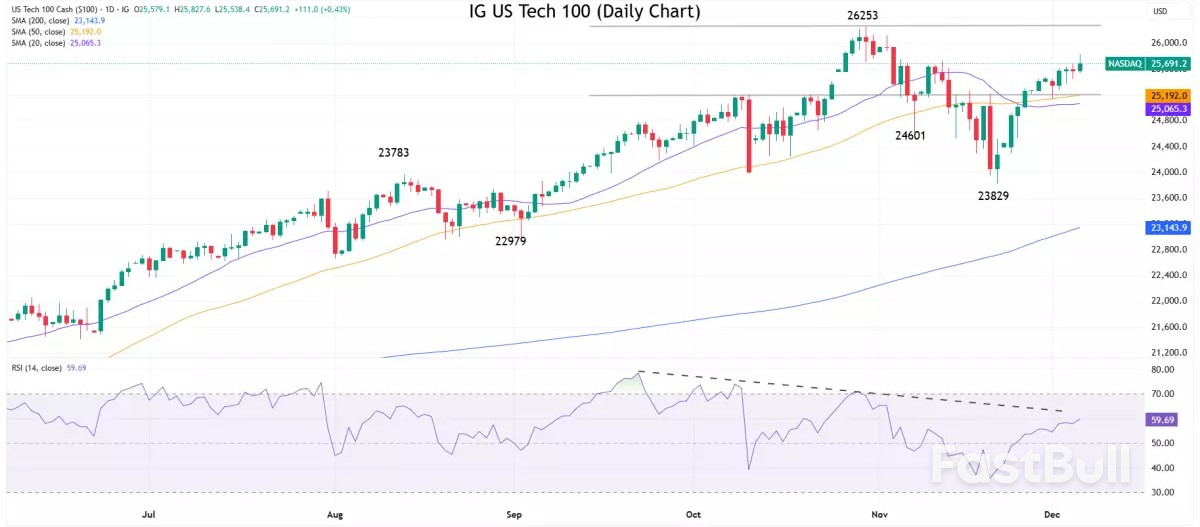
          Following the two-week recovery, the US Tech 100 index trades just 500+ points below its historic high. The index currently tests resistance highlighted in our previous Market Navigator — a decisive break above 25,700 would establish a trajectory towards 26,253. However, we continue monitoring diminishing index momentum, evidenced by lower highs in the relative strength index (RSI). Any corrective movement should encounter support from the 50-day moving average (MA) positioned around 25,200.
          Figure 1: US Tech 100 index (daily) price chart

          Market navigator: week of 8 December 2025_1as of 7 December 2025. Past performance is not a reliable indicator of future performance.
          Low trading volume in Hong Kong equities
          Having delivered more than 30% gains year-to-date in the Hang Seng Index (HSI), investors have initiated profit-taking as the year closes. Trading volume on the Hong Kong Exchange main board has declined substantially since late November. Average daily turnover contracted to HK$187 billion last week, a 27% reduction compared to the HK$256 billion average recorded across the first eleven months of 2025.
          The HSI maintained a sideways trajectory, advancing modestly by 0.9% last week. The Materials sector led gains, benefiting from rebounding metal prices. Zijin Mining surged 12.1% while China Hongqiao rose 9.3%. Conversely, Shenzhou International emerged as the worst-performing HSI constituent, declining 6.9% as investors secured profits following analyst target price adjustments.
          Market enthusiasm for the initial public offering (IPO) market has similarly waned. Three of four newly listed stocks last week traded below their listing price, with noodle chain operator Guangzhou Xiao Noodles plummeting 27.8% on its inaugural trading day.
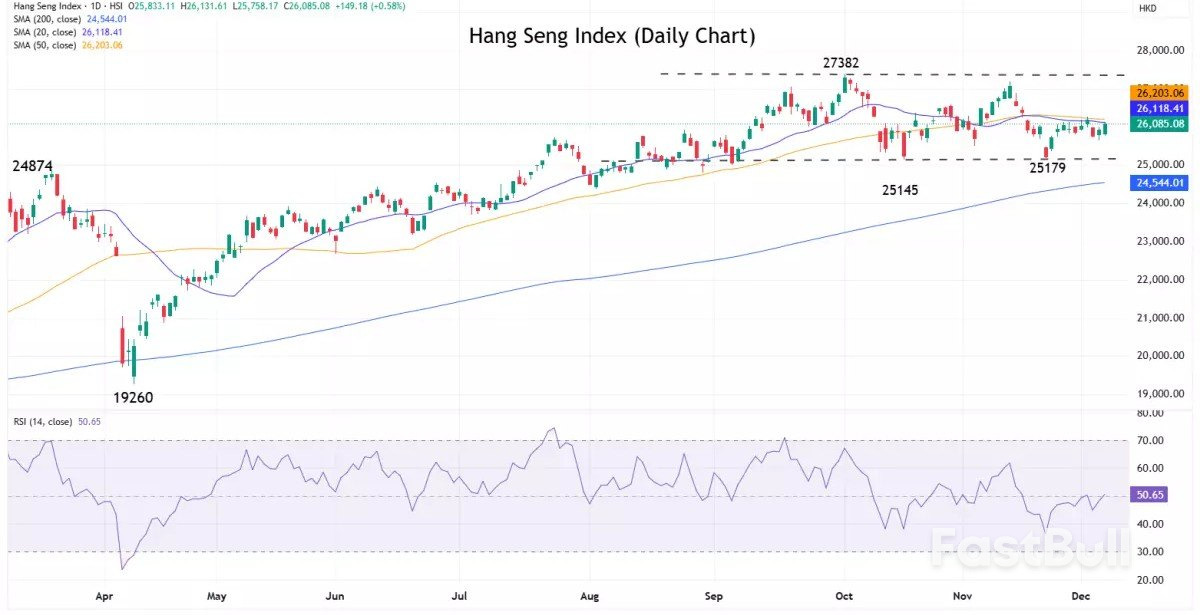
          The flat 20-day and 50-day moving averages combined with the neutral RSI on the HSI daily chart underscore the prevailing sideways trend. The index appears positioned to trade within the 25,150 to 27,400 range in the near term. The short-term moving averages will likely present resistance around 26,200 while November's low establishes support near 25,180.
          Figure 2: Hang Seng Index (daily) price chart

          Market navigator: week of 8 December 2025_2as of 7 December 2025. Past performance is not a reliable indicator of future performance.
          Yen recovers on rate hike expectations
          Bank of Japan (BOJ) Governor Ueda signalled last week that a rate increase may be imminent, as the board weighs the merits of raising interest rates at its 18–19 December meeting. Although Japan's headline inflation has persisted above the 2% target for over three years, the BOJ has exercised caution while awaiting clarity on US tariff implications and sustainable wage growth indicators. Governor Ueda believes tariff risks have diminished and expressed concern that recent yen weakness could elevate import costs, intensifying inflationary pressures. Market participants increased December rate hike probability from approximately 35% to 75%.
          Two-year Japanese Government Bond (JGB) yields, most sensitive to policy rate adjustments, rose above 1% for the first time since 2008 while 10-year JGB yields surged to 1.84%, exceeding China's government bond yield for the first time in history.
          As JGB yields advance, concerns regarding yen carry trade unwinding have intensified. US Treasury yields similarly increased — the 10-year benchmark rose 11 basis points to 4.14% while the 30-year benchmark climbed from 4.67% to 4.79%.
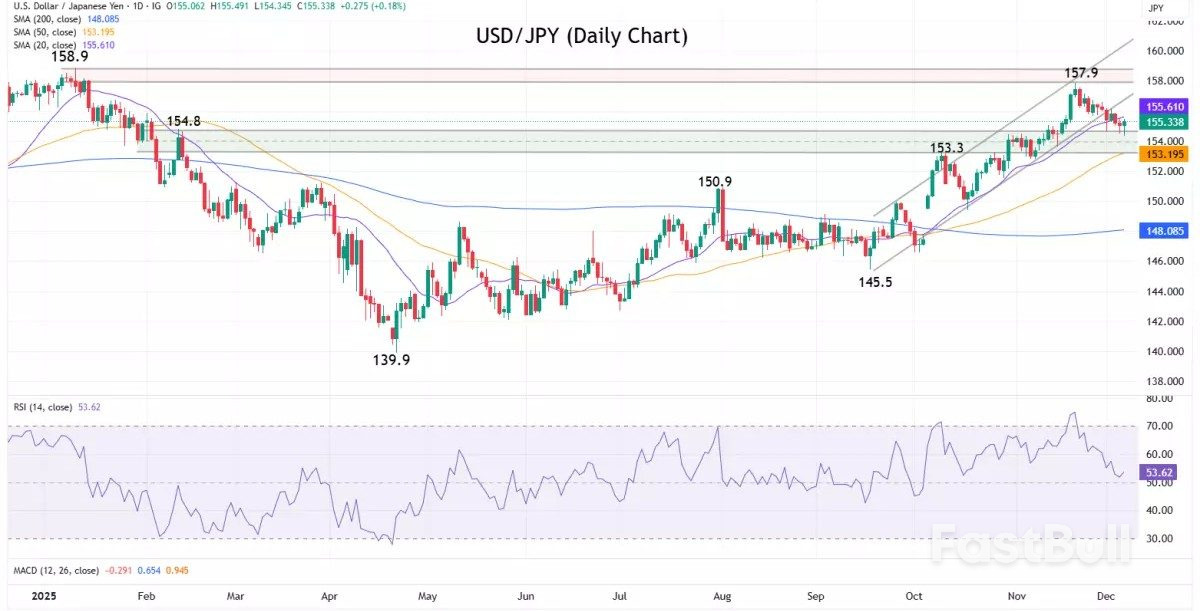
          The yen strengthened against the dollar as central bank policies diverge. USD/JPY breached the ascending channel established since mid-September, declining 0.5% to 155.3 last week. The currency pair approaches the support zone between 153.3 and 154.6. USD/JPY appears positioned to trade sideways within or above this zone unless the BOJ articulates a more hawkish-than-anticipated 2026 stance. The recent high at 157.9 will function as resistance should dovish surprises materialise.
          Figure 3: USD/JPY (daily) price chart

          Market navigator: week of 8 December 2025_3as of 7 December 2025. Past performance is not a reliable indicator of future performance.
          The week ahead

          The coming week centres on pivotal monetary policy decisions from the Reserve Bank of Australia (RBA) and Fed, alongside crucial Chinese inflation data that will shape market expectations across major economies.
          The RBA convenes on Tuesday amid mounting inflationary pressures. October's trimmed mean consumer price index (CPI) surge to 3.3% YoY has fundamentally altered the policy landscape. Markets anticipate the central bank will maintain rates at 3.6% in December. More significantly, investors have begun pricing potential rate increases in 2026 as inflation is projected to rise further before moderating during the first half of next year. Hawkish forward guidance from the RBA would support the Australian dollar but potentially pressure domestic equity markets.
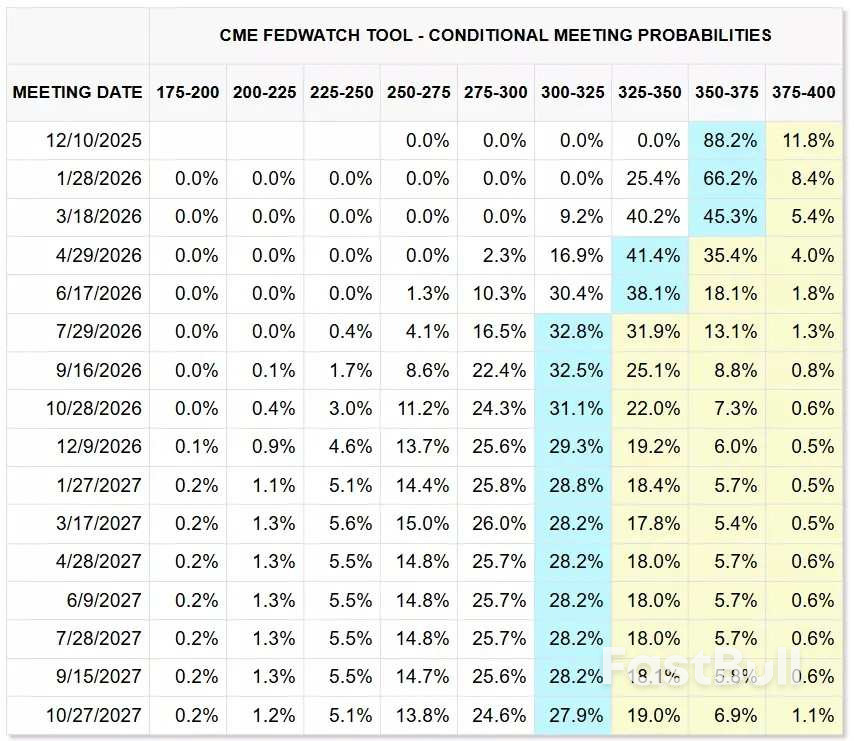
          The Federal Open Market Committee's (FOMC) decision on Thursday early morning carries substantial weight beyond the widely anticipated 25 basis-point reduction to 3.5%–3.75%. Market participants will scrutinise Chair Jerome Powell's press conference for clarity on the 2026 policy trajectory, particularly given uncertainty surrounding potential leadership transitions. Speculation regarding Kevin Hassett as a possible successor has elevated expectations for a more accommodative path. Most market participants anticipate two additional rate cuts next year. The Fed's Summary of Economic Projections will also illuminate the US economic growth trajectory in 2026.
          China's November inflation data on Wednesday provides essential insight into deflationary pressures following October's modest 0.2% YoY reading. The producer price index (PPI) will indicate whether industrial pricing power is stabilising after 37 consecutive months of contraction. These readings arrive alongside trade data on Monday, offering comprehensive perspective on China's economic health as policymakers evaluate further support measures.
          Corporate earnings attention focuses on technology infrastructure leaders Oracle and Broadcom. Both companies' guidance on AI-related revenue growth, cash flow and capital expenditure trends will influence broader technology sector valuations as investors assess the sustainability of the current AI investment cycle.
          Figure 4: US interest rate probabilities
          Market navigator: week of 8 December 2025_4

          Source: ig

          To stay updated on all economic events of today, please check out our Economic calendar
          Risk Warnings and Disclaimers
          You understand and acknowledge that there is a high degree of risk involved in trading. Following any strategies or investment methods may lead to potential losses. The content on the site is provided by our contributors and analysts for information purposes only. You are solely responsible for determining whether any trading assets, securities, strategy, or any other product is suitable for investing based on your own investment objectives and financial situation.
          Add to Favorites
          Share

          Rising Delistings Signal Market Strain as Home Sellers Retreat and Buyers Shift to Affordable ‘Refuge Markets’

          Gerik

          Economic

          Sellers Retreat as Housing Market Conditions Tighten

          The U.S. housing market is witnessing a pronounced pullback from sellers, with October 2025 marking a sharp rise in listing withdrawals. According to Realtor.com, delistings were up 45.5% year-to-date and nearly 38% compared to October 2024 reaching the highest levels since tracking began in 2022. This rate of retreat, typically seen only in deep winter, reflects sellers’ increasing reluctance to compete in a high-rate, price-sensitive environment.
          Approximately 6% of active listings are now being removed monthly, indicating sellers are either holding out for more favorable market conditions or unable to attract offers at listed prices. The prolonged nature of this trend five consecutive months of elevated delistings since June points to a structural shift rather than a seasonal anomaly.

          Buyers Pivot to Refuge Markets for Affordability

          In parallel, buyers are adjusting their search behavior, gravitating toward so-called “refuge markets” where home prices remain relatively low and inflationary price shocks were muted during the pandemic. Cities such as Grand Rapids, Michigan (up 5.5% YoY), St. Louis, Missouri (up 5%), and Cleveland, Ohio, are now outperforming in price growth, while still remaining 20-30% below the national median.
          This migration reflects a correlation between buyer price sensitivity and the long-term affordability of local markets. As interest rates continue to pressure monthly mortgage payments, homebuyers are being priced out of once-hot metros like Miami, Denver, and Houston cities now seeing the highest rates of delisted properties.

          Contract Cancellations Climb, Reflecting Market Volatility

          Adding to the strain, home purchase cancellations also spiked. Redfin reports that 15% of pending sales fell through in October 2025, up from 14% the year prior and well above pre-pandemic levels. This rise suggests greater buyer hesitation, potentially due to last-minute financing issues, inflated appraisals, or inspection disputes. Regional hotspots for cancellations include San Antonio (21% of deals canceled), Fort Lauderdale (20%), and Fort Worth (19.7%), with Las Vegas and Jacksonville close behind.
          The increase in failed contracts illustrates a direct consequence of tightening affordability and broader economic uncertainty. The feedback loop is clear: sellers are delisting due to lack of serious offers, while buyers are either backing out or looking elsewhere.

          Price Correction Underway but Still Elevated

          Nationally, home prices are beginning to stabilize, with the median list price in November 2025 down 0.4% from the same month in 2024. However, prices remain elevated still 36% higher than in November 2019, before the pandemic-era boom. New listings rose slightly (up 1.7% YoY), but the modest increase does little to offset broader imbalances between supply, affordability, and demand.
          Danielle Hale, chief economist at Realtor.com, noted that the dual trend of seller fatigue and buyer migration “captures the push and pull defining today’s housing market.” In her forecast, 2026 may see gradual rebalancing as mortgage rates soften and inventory becomes more consistent.
          The latest housing data signals a market under pressure, with high delisting rates, growing contract failures, and affordability concerns driving both sellers and buyers into retreat. While “refuge markets” provide a lifeline for affordability-seeking buyers, many traditional hotspots are seeing waning activity. The near-term outlook depends heavily on the trajectory of interest rates and consumer confidence, but the current environment suggests a broader reset is already underway.

          Source: CNBC

          To stay updated on all economic events of today, please check out our Economic calendar
          Risk Warnings and Disclaimers
          You understand and acknowledge that there is a high degree of risk involved in trading. Following any strategies or investment methods may lead to potential losses. The content on the site is provided by our contributors and analysts for information purposes only. You are solely responsible for determining whether any trading assets, securities, strategy, or any other product is suitable for investing based on your own investment objectives and financial situation.
          Add to Favorites
          Share

          Tensions Escalate as Trump Criticizes Zelenskyy Over U.S. Peace Proposal: Key Issues Still Unresolved

          Gerik

          Political

          Russia-Ukraine Conflict

          Trump's Comments Spark Diplomatic Friction Amid Peace Deadlock

          In a striking statement on Sunday, U.S. President Donald Trump expressed disappointment with Ukrainian President Volodymyr Zelenskyy, claiming he “hasn’t yet read” the latest U.S. peace proposal aimed at ending the war with Russia. Trump added that Zelenskyy’s aides were supportive of the plan, but the Ukrainian leader himself had not fully engaged with it. The comments added a layer of public tension to already fragile negotiations, which have so far failed to yield consensus.
          The peace plan in question remains ambiguous, with multiple versions under discussion. Talks in Miami between U.S. and Ukrainian officials ended without resolution, with disagreements centered on two critical issues: control over Ukraine’s eastern Donbas region and the Russian-occupied Zaporizhzhia nuclear power plant.

          Ukraine Demands Security Guarantees as U.S. Pushes for Concessions

          Zelenskyy responded cautiously but firmly. In his nightly address, he described the talks led by Ukraine’s chief negotiator Rustem Umerov and General Andriy Hnatov with U.S. envoy Steve Witkoff and Trump’s son-in-law Jared Kushner as “constructive, though not easy.” He insisted that certain matters could only be discussed in person, hinting at a lack of trust or discomfort with the U.S. proposal’s terms.
          The Ukrainian president has repeatedly emphasized the need for binding security guarantees, particularly from the U.S., before making any territorial concessions. This demand reflects Ukraine’s core strategic fear: without firm post-war defense commitments, any peace could be short-lived and leave the country vulnerable to future aggression.

          European Leaders Step In Amid Growing Concerns

          As pressure mounts on Ukraine to accept a deal perceived by many as favorable to Moscow, Zelenskyy has launched a diplomatic tour to rally support in Europe. He is meeting U.K. Prime Minister Keir Starmer, French President Emmanuel Macron, and German Chancellor Friedrich Merz in London, with further stops planned in Brussels and Rome.
          European allies are increasingly anxious that the U.S. may push for a resolution that compromises Ukraine’s sovereignty. The U.K. and France, both members of the self-styled “Coalition of the Willing,” have advocated for the establishment of a post-war reassurance force to secure Ukraine. However, Russia strongly opposes any deployment of foreign troops, calling them legitimate military targets.
          This divergence sets up a geopolitical split between Europe and the U.S., especially in light of Trump’s recently released national security strategy, which questions Europe’s reliability as an ally and calls for strategic rebalancing with Russia.

          Moscow Talks Show Progress, But Peace Remains Distant

          Earlier meetings in Moscow between Witkoff, Kushner, and Russian officials, including President Vladimir Putin and aide Yuri Ushakov, were described by the Kremlin as “useful and constructive,” but no breakthrough was reported. Putin’s spokesperson Dmitry Peskov emphasized the importance of continuing negotiations discreetly to avoid media disruption and ensure substantive progress.
          Moscow appears to have embraced elements of Trump’s national security doctrine, viewing it as aligned with Russia’s strategic outlook. This alignment raises concerns in Kyiv and Europe that U.S. positioning may gradually tilt toward appeasement of Russian territorial claims in exchange for broader geopolitical stability.

          Uneasy Diplomacy, High Stakes

          The standoff between Washington and Kyiv reflects deeper disagreements not just over peace terms, but over the broader architecture of post-war security in Europe. Trump’s public criticism of Zelenskyy underscores a widening gap in expectations, as Ukraine resists pressure to accept a deal that could undermine its territorial integrity and future deterrence posture.
          With no breakthrough in sight and rising diplomatic stakes, the next phase of negotiations particularly Zelenskyy’s meetings in Europe may prove decisive in determining whether Ukraine can secure a peace on its terms, or be forced to accept one shaped by competing superpower interests.

          Source: CNBC

          Risk Warnings and Disclaimers
          You understand and acknowledge that there is a high degree of risk involved in trading. Following any strategies or investment methods may lead to potential losses. The content on the site is provided by our contributors and analysts for information purposes only. You are solely responsible for determining whether any trading assets, securities, strategy, or any other product is suitable for investing based on your own investment objectives and financial situation.
          Add to Favorites
          Share

          Bond Traders Defy Fed and Spark Heated Debate on Wall Street

          Adam

          Bond

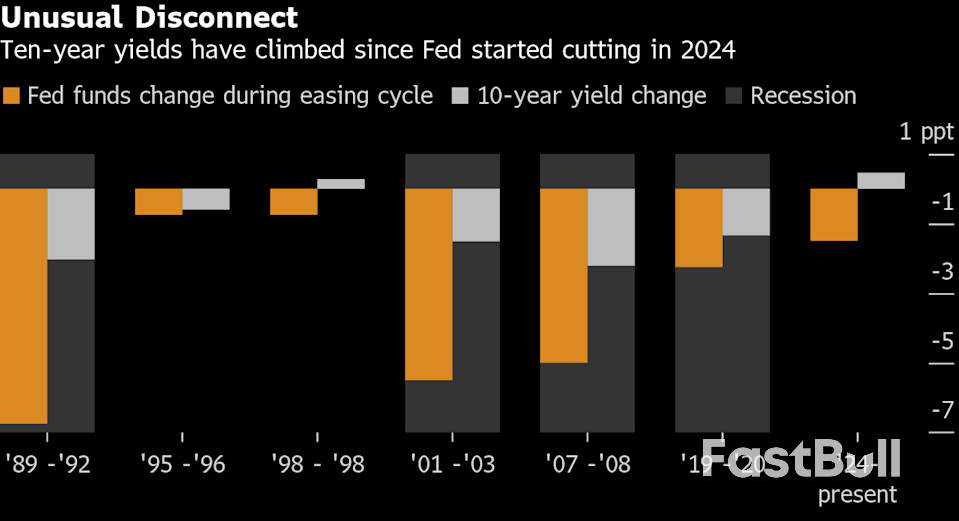
          The bond market’s reaction to the Federal Reserve’s interest-rate cuts has been highly unusual. By some measures, a disconnect like this, with Treasury yields climbing as the central bank lowers rates, hasn’t been seen since the 1990s.
          What the divergence indicates is a matter of heated debate. Opinions are all over the place, from the bullish (a sign of confidence that recession will be averted) to the more neutral (a return to pre-2008 market norms) to the favorite culprit of the so-called bond vigilantes (investors are losing confidence the US will ever rein in the constantly swelling national debt).
          But one thing is clear: the bond market isn’t buying President Donald Trump’s idea that faster rate cuts will send bond yields sliding down and, in turn, slash the rates on mortgages, credit cards and other types of loans.
          With Trump soon able to replace Chair Jerome Powell with his own nominee, on top of everything else is the risk of the Fed squandering its credibility by caving to political pressure to ease policy more aggressively — which could backfire by fanning already elevated inflation and pushing yields higher.
          “Trump 2.0 is all about getting long-term yields down,” said Steven Barrow, head of G10 strategy at Standard Bank in London. “Putting a political figure at the Fed will not get bond yields down.”
          Bond Traders Defy Fed and Spark Heated Debate on Wall Street_1
          The Fed started pulling its benchmark rate down from a more than two-decade high in September 2024 and has since cut it by 1.5 percentage points to a range of 3.75% to 4%. Traders see another quarter point cut after the next meeting on Wednesday as virtually assured and are pricing in two more such moves next year, which would bring its rate to around 3%.
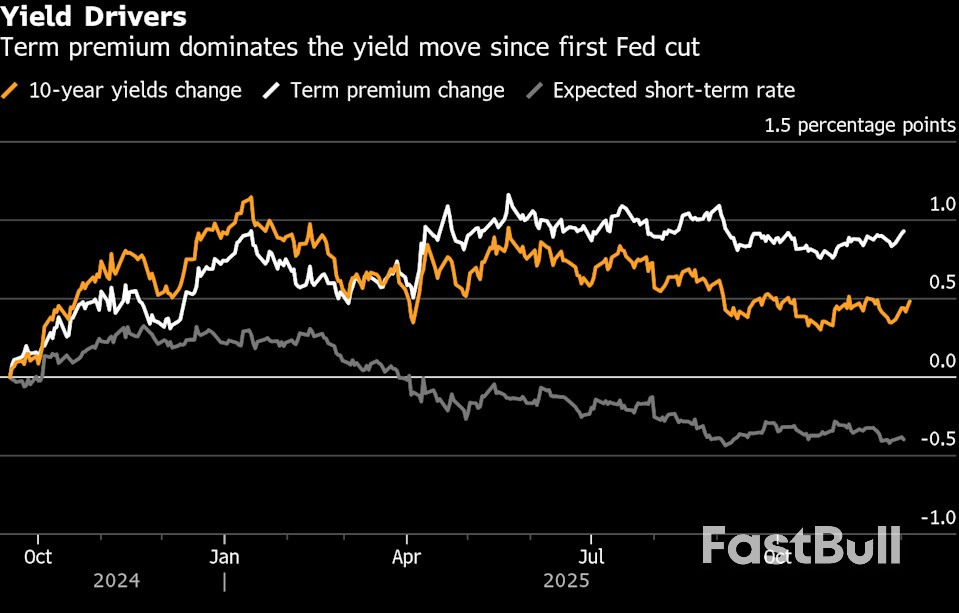
          Yet, key Treasury yields — which serve as the main baseline for the borrowing costs paid by American consumers and corporations — haven’t come down at all. Ten-year yields have risen nearly half a percentage point to 4.1% since the Fed started easing policy and 30-year yields are up over 0.8 percentage point.
          Normally, when the Fed moves short-term policy rates up and down, long-term bond yields tend to follow. Even in the only two easing cycles outside of recessions over the past four decades – in 1995 and 1998, when the Fed cut only 75 basis points each time — the 10-year yield dropped outright or rose less than they have during the current episode.
          Jay Barry, head of global rates strategy at JPMorgan Chase & Co., sees two factors behind it. The scale of the Fed’s hikes during the post-pandemic inflation surge was so steep that markets started pricing-in the Fed’s about-face well before it started, with 10-year yields peaking in late 2023. That blunted the impact once it began.
          Moreover, by slashing interest rates even when inflation remains elevated, he said, the Fed is lessening the risk of a recession, limiting the scope for yields to fall.
          “The Fed is looking to sustain this expansion, not end it,” said Barry. “That’s why rates have not moved aggressively lower.”
          Others see a less benign interpretation in the so-called term premium, a measure of the extra yield investors demand in return for holding long-term bonds.
          That compensates them for potential risks down the line — like elevated inflation or an unsustainable federal debt load. And that premium has risen nearly a full percentage point since the rate-cut cycle began, according to the New York Fed estimates.
          Bond Traders Defy Fed and Spark Heated Debate on Wall Street_2
          For Jim Bianco, president of Bianco Research, it’s a signal that bond traders are worried that the Fed is cutting rates even as inflation remains stubbornly above its 2% target and the economy keeps defying recession fears.
          “The market is really concerned about the policy,” said Bianco. “The concern is that the Fed has gone too far.”
          If the Fed continues to cut rates, the mortgage rates will go “vertical,” he added.
          There’s also angst that Trump — after breaking sharply from his predecessor’s deference to the Fed’s independence — will succeed in pressuring policymakers to continue cutting rates. Kevin Hassett, the White House National Economic Council Director and a Trump loyalist, is the betting market’s favorite to succeed Powell when his term ends in May.
          What Bloomberg Strategists say...
          If rate cuts increase the likelihood of stronger growth, they won’t be met with lower yields. We’ll end up with higher ones. In many respects, this is because we’re going back to a normal interest rate regime, where 2% real returns and a 2% Fed inflation target produces a 4% floor for long-term yields. Add in stronger growth and the numbers go higher from there.
          So far, though, the broader bond market has remained relatively stable, with 10-year yields hovering not far from 4% over the past few months. And breakeven rates — a main gauge of the bond market’s inflation expectations — have been stable as well, indicating that fears of a Fed-fueled inflation surge down the line may be overstated.
          Treasury Secretary Scott Bessent told CBS’ Face the Nation that the “bond market just had the best year since 2020” and that he expects inflation to “roll down strongly” next year.
          The yield on 10-year Treasuries rose one basis point to 4.15% at 5:45 a.m. in New York
          Robert Tipp, chief investment strategist fixed income at PGIM, said it looks more than anything like a return to the normal levels seen before the Global Financial Crisis, which ushered in a long era of unusually low interest rates that abruptly ended after the pandemic.
          “We’re back at the normal level of rates world,” he said.
          Standard Bank’s Barrow said the Fed’s lack of control over the longer-term yields reminds him of a similar — if opposite — bind the central bank faced in the mid-2000s that became known as the Greenspan conundrum.
          At that time, Chair Alan Greenspan was puzzled why the long-term yields remained low even as he jacked up the short-term policy rate. Greenspan’s successor Ben Bernanke later attributed the conundrum to too much savings from overseas flooding into Treasuries.
          Today, Barrow said, that dynamic is reversed as governments around major economies are borrowing too much. That saving glut, in other words, has turned into a bond-supply glut that’s keeping consistently upward pressure on yields.
          “It’s possibly a structural move that bond yields are not going down,” Barrow said. “At the end of the day, central banks don’t determine the long term rate.”

          Source: Bloomberg

          Risk Warnings and Disclaimers
          You understand and acknowledge that there is a high degree of risk involved in trading. Following any strategies or investment methods may lead to potential losses. The content on the site is provided by our contributors and analysts for information purposes only. You are solely responsible for determining whether any trading assets, securities, strategy, or any other product is suitable for investing based on your own investment objectives and financial situation.
          Add to Favorites
          Share

          Global Brands Fight Legality of Trump’s 'Liberation Day' Tariffs

          Warren Takunda

          Economic

          A number of well-known consumer and industrial groups — including Costco, Revlon, Kawasaki Motors, and Bumble Bee Foods — are mounting a wave of legal challenges to Donald Trump’s sweeping “Liberation Day” tariffs. The goal is to seek refunds for the duties they have paid so far and prevent further costs.
          Court records from the US Court of International Trade show that more than 70 companies have now filed lawsuits asking judges to declare the tariffs unlawful, order refunds, and block the administration from levying the duties in the future.
          Many of the filings have been lodged in recent weeks, as the US Supreme Court deliberates on whether Trump had the authority to impose the measures under the International Emergency Economic Powers Act (IEEPA).
          The IEEPA is a 1977 US law that lets the president declare a national emergency over an external threat and then use broad economic tools — like sanctions and asset freezes — against foreign countries, entities, or individuals.
          The companies filing the lawsuits believe the IEEPA is designed for targeted sanctions in emergencies, not classic, across-the-board tariffs on imports.
          These recent filings mark a shift in the corporate response to the tariff regime, with earlier cases being brought mainly by smaller importers. The stakes have significantly shifted now that major multinationals with global supply chains are joining in, arguing that the duties have distorted trade flows and driven up costs across multiple markets.
          Costco, the US-based warehouse retailer with operations in Asia and Europe, sued the administration in November, demanding a full refund of tariffs it has paid and an injunction against future collections.
          It argued that the IEEPA does not clearly authorise the White House to set customs duties and that the tariffs, imposed via emergency powers, should therefore be struck down.
          Revlon, the cosmetics group with production and distribution hubs in North America, Europe and Asia, is also seeking reimbursement and a ruling that Trump’s use of IEEPA is unlawful.
          In its filing, the company warned that some of the entries on which it has paid duties could be finalised or liquidated as early as mid-December, which would sharply limit its ability to seek refunds later.
          Multinational manufacturers in the automotive and industrial sectors are heavily represented among the plaintiffs.
          Court filings show that subsidiaries of Japan’s Toyota Group are suing US Customs and Border Protection over higher levies on car parts and metals, while Kawasaki Motors and a cluster of auto suppliers argue that the tariffs on vehicles, steel, and aluminium have significantly increased their costs.
          Aluminium producer Alcoa, packaging group Berlin Packaging, fitness equipment maker iFit and plumbing supplier Ferguson Enterprises have also joined the fray.
          Food companies with far-flung sourcing networks say they have been hit particularly hard. Bumble Bee Foods, which buys seafood from Brazil, Ecuador, Panama, Mexico, Indonesia, China and India for its global brands, contends that its import costs increased when the tariffs took effect.
          The Supreme Court has already heard arguments on the core legal question, namely whether a president can rely on IEEPA to levy broad, country-wide tariffs.
          Three lower courts have already ruled against the Trump administration. Several Supreme Court justices also signalled scepticism about the administration’s position during the hearing, but raised concerns about the complexity of any refund process if the duties are overturned, warning that unwinding years of collections could be disruptive.
          Costco’s case has drawn additional attention after the retailer recently nominated Gina Raimondo, who served as commerce secretary under President Joe Biden, to its board of directors.
          Raimondo’s appointment will be put to a shareholder vote in January, while the Supreme Court’s ruling on the legality of Trump’s tariff strategy is due no later than the end of its term in June 2026.

          Source: Euronews

          To stay updated on all economic events of today, please check out our Economic calendar
          Risk Warnings and Disclaimers
          You understand and acknowledge that there is a high degree of risk involved in trading. Following any strategies or investment methods may lead to potential losses. The content on the site is provided by our contributors and analysts for information purposes only. You are solely responsible for determining whether any trading assets, securities, strategy, or any other product is suitable for investing based on your own investment objectives and financial situation.
          Add to Favorites
          Share
          FastBull
          Copyright © 2025 FastBull Ltd

          728 RM B 7/F GEE LOK IND BLDG NO 34 HUNG TO RD KWUN TONG KLN HONG KONG

          TelegramInstagramTwitterfacebooklinkedin
          App Store Google Play Google Play
          Products
          Charts

          Chats

          Q&A with Experts
          Screeners
          Economic Calendar
          Data
          Tools
          Membership
          Features
          Function
          Markets
          Copy Trading
          Latest Signals
          Contests
          News
          Analysis
          24/7
          Columns
          Education
          Company
          Careers
          About Us
          Contact Us
          Advertising
          Help Center
          Feedback
          User Agreement
          Privacy Policy
          Business

          White Label

          Data API

          Web Plug-ins

          Poster Maker

          Affiliate Program

          Risk Disclosure

          The risk of loss in trading financial instruments such as stocks, FX, commodities, futures, bonds, ETFs and crypto can be substantial. You may sustain a total loss of the funds that you deposit with your broker. Therefore, you should carefully consider whether such trading is suitable for you in light of your circumstances and financial resources.

          No decision to invest should be made without thoroughly conducting due diligence by yourself or consulting with your financial advisors. Our web content might not suit you since we don't know your financial conditions and investment needs. Our financial information might have latency or contain inaccuracy, so you should be fully responsible for any of your trading and investment decisions. The company will not be responsible for your capital loss.

          Without getting permission from the website, you are not allowed to copy the website's graphics, texts, or trademarks. Intellectual property rights in the content or data incorporated into this website belong to its providers and exchange merchants.

          Not Logged In

          Log in to access more features

          FastBull Membership

          Not yet

          Purchase

          Become a signal provider
          Help Center
          Customer Service
          Dark Mode
          Price Up/Down Colors

          Log In

          Sign Up

          Position
          Layout
          Fullscreen
          Default to Chart
          The chart page opens by default when you visit fastbull.com