• Trade
  • Markets
  • Copy
  • Contests
  • News
  • 24/7
  • Calendar
  • Q&A
  • Chats
Trending
Screeners
SYMBOL
LAST
BID
ASK
HIGH
LOW
NET CHG.
%CHG.
SPREAD
SPX
S&P 500 Index
6870.39
6870.39
6870.39
6895.79
6858.28
+13.27
+ 0.19%
--
DJI
Dow Jones Industrial Average
47954.98
47954.98
47954.98
48133.54
47871.51
+104.05
+ 0.22%
--
IXIC
NASDAQ Composite Index
23578.12
23578.12
23578.12
23680.03
23506.00
+72.99
+ 0.31%
--
USDX
US Dollar Index
98.920
99.000
98.920
98.960
98.730
-0.030
-0.03%
--
EURUSD
Euro / US Dollar
1.16489
1.16496
1.16489
1.16717
1.16341
+0.00063
+ 0.05%
--
GBPUSD
Pound Sterling / US Dollar
1.33180
1.33188
1.33180
1.33462
1.33136
-0.00132
-0.10%
--
XAUUSD
Gold / US Dollar
4209.35
4209.78
4209.35
4218.85
4190.61
+11.44
+ 0.27%
--
WTI
Light Sweet Crude Oil
59.256
59.286
59.256
60.084
59.181
-0.553
-0.92%
--

Community Accounts

Signal Accounts
--
Profit Accounts
--
Loss Accounts
--
View More

Become a signal provider

Sell trading signals to earn additional income

View More

Guide to Copy Trading

Get started with ease and confidence

View More

Signal Accounts for Members

All Signal Accounts

Best Return
  • Best Return
  • Best P/L
  • Best MDD
Past 1W
  • Past 1W
  • Past 1M
  • Past 1Y

All Contests

  • All
  • Trump Updates
  • Recommend
  • Stocks
  • Cryptocurrencies
  • Central Banks
  • Featured News
Top News Only
Share

Brazil Economists See Brazilian Real At 5.40 Per Dollar By Year-End 2025 Versus 5.40 In Previous Estimate - Central Bank Poll

Share

Brazil Economists See Year-End 2026 Interest Rate Selic At 12.25% Versus 12.00% In Previous Estimate - Central Bank Poll

Share

Brazil Economists See Year-End 2025 Interest Rate Selic At 15.00% Versus 15.00% In Previous Estimate - Central Bank Poll

Share

EU Commission Says Meta Has Committed To Give EU Users Choice On Personalised Ads

Share

Sources Revealed That The Bank Of England Has Invited Employees To Voluntarily Apply For Layoffs

Share

The Bank Of England Plans To Cut Staff Due To Budget Pressures

Share

Traders Believe There Is Less Than A 10% Chance That The European Central Bank Will Cut Interest Rates By 25 Basis Points In 2026

Share

Egypt, European Bank For Reconstruction And Development Sign $100 Million Financing Agreement

Share

Israel Budget Deficit 4.5% Of GDP In November Over Past 12 Months Versus 4.9% Deficit In October

Share

JPMorgan - Council Chaired By Jamie Dimon Includes Jeff Bezos

Share

UK Government: UK Health Security Agency Identified New Recombinant Mpox Virus In England In Individual Who Had Recently Travelled To Asia

Share

European Central Bank Governing Council Member Kazimir: I See No Reason To Change Rates In The Coming Months, Definitely No In December

Share

European Central Bank Governing Council Member Kazimir: Overengineering Policy Around Small Inflation Deviations Would Introduce Unnecessary Policy Uncertainty

Share

European Central Bank Governing Council Member Kazimir: European Central Bank Must Be Vigilant About Some Upside Risks To Inflation

Share

European Central Bank Governing Council Member Kazimir: Forex Pass Through To Prices May Not Be As Strong As Expected

Share

Document: EU Looking At Options For Boosting Lebanon's Internal Security Forces

Share

Thai Foreign Ministry: Military Action Will Continue Until Thai Sovereignty, Territorial Integrity Secure

Share

Ukraine President Zelenskiy: No Accord So Far On Eastern Ukraine In US Talks

Share

NATO: Ukrainian President Zelenskiy Will Meet NATO's Rutte And EU Commission Chief Von Der Leyen And Costa In Brussels On Monday

Share

China Finance Ministry: To Reopen 119 Billion Yuan 10-Year Bonds On Dec 12

TIME
ACT
FCST
PREV
France Industrial Output MoM (SA) (Oct)

A:--

F: --

P: --
France Trade Balance (SA) (Oct)

A:--

F: --

P: --
Euro Zone Employment YoY (SA) (Q3)

A:--

F: --

P: --
Canada Part-Time Employment (SA) (Nov)

A:--

F: --

P: --

Canada Unemployment Rate (SA) (Nov)

A:--

F: --

P: --

Canada Full-time Employment (SA) (Nov)

A:--

F: --

P: --

Canada Labor Force Participation Rate (SA) (Nov)

A:--

F: --

P: --

Canada Employment (SA) (Nov)

A:--

F: --

P: --

U.S. PCE Price Index MoM (Sept)

A:--

F: --

P: --

U.S. Personal Income MoM (Sept)

A:--

F: --

P: --

U.S. Core PCE Price Index MoM (Sept)

A:--

F: --

P: --

U.S. PCE Price Index YoY (SA) (Sept)

A:--

F: --

P: --

U.S. Core PCE Price Index YoY (Sept)

A:--

F: --

P: --

U.S. Personal Outlays MoM (SA) (Sept)

A:--

F: --

P: --
U.S. 5-10 Year-Ahead Inflation Expectations (Dec)

A:--

F: --

P: --

U.S. Real Personal Consumption Expenditures MoM (Sept)

A:--

F: --

P: --
U.S. Weekly Total Rig Count

A:--

F: --

P: --

U.S. Weekly Total Oil Rig Count

A:--

F: --

P: --

U.S. Consumer Credit (SA) (Oct)

A:--

F: --

P: --
China, Mainland Foreign Exchange Reserves (Nov)

A:--

F: --

P: --

Japan Trade Balance (Oct)

A:--

F: --

P: --

Japan Nominal GDP Revised QoQ (Q3)

A:--

F: --

P: --

China, Mainland Imports YoY (CNH) (Nov)

A:--

F: --

P: --

China, Mainland Exports (Nov)

A:--

F: --

P: --

China, Mainland Imports (CNH) (Nov)

A:--

F: --

P: --

China, Mainland Trade Balance (CNH) (Nov)

A:--

F: --

P: --

China, Mainland Exports YoY (USD) (Nov)

A:--

F: --

P: --

China, Mainland Imports YoY (USD) (Nov)

A:--

F: --

P: --

Germany Industrial Output MoM (SA) (Oct)

A:--

F: --

P: --
Euro Zone Sentix Investor Confidence Index (Dec)

A:--

F: --

P: --

Canada National Economic Confidence Index

--

F: --

P: --

U.K. BRC Like-For-Like Retail Sales YoY (Nov)

--

F: --

P: --

U.K. BRC Overall Retail Sales YoY (Nov)

--

F: --

P: --

Australia Overnight (Borrowing) Key Rate

--

F: --

P: --

RBA Rate Statement
RBA Press Conference
Germany Exports MoM (SA) (Oct)

--

F: --

P: --

U.S. NFIB Small Business Optimism Index (SA) (Nov)

--

F: --

P: --

Mexico 12-Month Inflation (CPI) (Nov)

--

F: --

P: --

Mexico Core CPI YoY (Nov)

--

F: --

P: --

Mexico PPI YoY (Nov)

--

F: --

P: --

U.S. Weekly Redbook Index YoY

--

F: --

P: --

U.S. JOLTS Job Openings (SA) (Oct)

--

F: --

P: --

China, Mainland M1 Money Supply YoY (Nov)

--

F: --

P: --

China, Mainland M0 Money Supply YoY (Nov)

--

F: --

P: --

China, Mainland M2 Money Supply YoY (Nov)

--

F: --

P: --

U.S. EIA Short-Term Crude Production Forecast For The Year (Dec)

--

F: --

P: --

U.S. EIA Natural Gas Production Forecast For The Next Year (Dec)

--

F: --

P: --

U.S. EIA Short-Term Crude Production Forecast For The Next Year (Dec)

--

F: --

P: --

EIA Monthly Short-Term Energy Outlook
U.S. API Weekly Gasoline Stocks

--

F: --

P: --

U.S. API Weekly Cushing Crude Oil Stocks

--

F: --

P: --

U.S. API Weekly Crude Oil Stocks

--

F: --

P: --

U.S. API Weekly Refined Oil Stocks

--

F: --

P: --

South Korea Unemployment Rate (SA) (Nov)

--

F: --

P: --

Japan Reuters Tankan Non-Manufacturers Index (Dec)

--

F: --

P: --

Japan Reuters Tankan Manufacturers Index (Dec)

--

F: --

P: --

Japan Domestic Enterprise Commodity Price Index MoM (Nov)

--

F: --

P: --

Japan Domestic Enterprise Commodity Price Index YoY (Nov)

--

F: --

P: --

China, Mainland PPI YoY (Nov)

--

F: --

P: --

China, Mainland CPI MoM (Nov)

--

F: --

P: --

Q&A with Experts
    • All
    • Chatrooms
    • Groups
    • Friends
    Connecting
    .
    .
    .
    Type here...
    Add Symbol or Code

      No matching data

      All
      Trump Updates
      Recommend
      Stocks
      Cryptocurrencies
      Central Banks
      Featured News
      • All
      • Russia-Ukraine Conflict
      • Middle East Flashpoint
      • All
      • Russia-Ukraine Conflict
      • Middle East Flashpoint
      Search
      Products

      Charts Free Forever

      Chats Q&A with Experts
      Screeners Economic Calendar Data Tools
      Membership Features
      Data Warehouse Market Trends Institutional Data Policy Rates Macro

      Market Trends

      Market Sentiment Order Book Forex Correlations

      Top Indicators

      Charts Free Forever
      Markets

      News

      News Analysis 24/7 Columns Education
      From Institutions From Analysts
      Topics Columnists

      Latest Views

      Latest Views

      Trending Topics

      Top Columnists

      Latest Update

      Signals

      Copy Rankings Latest Signals Become a signal provider AI Rating
      Contests
      Brokers

      Overview Brokers Assessment Rankings Regulators News Claims
      Broker listing Forex Brokers Comparison Tool Live Spread Comparison Scam
      Q&A Complaint Scam Alert Videos Tips to Detect Scam
      More

      Business
      Events
      Careers About Us Advertising Help Center

      White Label

      Data API

      Web Plug-ins

      Affiliate Program

      Awards Institution Evaluation IB Seminar Salon Event Exhibition
      Vietnam Thailand Singapore Dubai
      Fans Party Investment Sharing Session
      FastBull Summit BrokersView Expo
      Recent Searches
        Top Searches
          Markets
          News
          Analysis
          User
          24/7
          Economic Calendar
          Education
          Data
          • Names
          • Latest
          • Prev

          View All

          No data

          Scan to Download

          Faster Charts, Chat Faster!

          Download App
          English
          • English
          • Español
          • العربية
          • Bahasa Indonesia
          • Bahasa Melayu
          • Tiếng Việt
          • ภาษาไทย
          • Français
          • Italiano
          • Türkçe
          • Русский язык
          • 简中
          • 繁中
          Open Account
          Search
          Products
          Charts Free Forever
          Markets
          News
          Signals

          Copy Rankings Latest Signals Become a signal provider AI Rating
          Contests
          Brokers

          Overview Brokers Assessment Rankings Regulators News Claims
          Broker listing Forex Brokers Comparison Tool Live Spread Comparison Scam
          Q&A Complaint Scam Alert Videos Tips to Detect Scam
          More

          Business
          Events
          Careers About Us Advertising Help Center

          White Label

          Data API

          Web Plug-ins

          Affiliate Program

          Awards Institution Evaluation IB Seminar Salon Event Exhibition
          Vietnam Thailand Singapore Dubai
          Fans Party Investment Sharing Session
          FastBull Summit BrokersView Expo

          Japan’s Inflation Shift: From Apologies to Acceptance in the Age of Persistent Price Hikes

          Gerik

          Economic

          Summary:

          After decades of deflation and cultural resistance to rising prices, Japan is entering a new era of inflation acceptance. Bolstered by historically strong wage growth, Japanese consumers and businesses alike are adjusting to regular price increases...

          Changing Cultural Norms Around Price Increases

          In the past, even minor price hikes in Japan were met with public apologies and social unease. A striking example was Akagi Nyugyo’s 2016 somber apology campaign for a mere 10-yen increase in its Garigari-kun popsicle. Fast-forward to 2025, the same company now uses humorous ads that lightly parody the old norm, reflecting a broader shift in public sentiment. The normalization of price increases signals a psychological break from the deflationary mindset that long dominated post-bubble Japan.
          This transformation has been catalyzed by three consecutive years of strong wage growth, which has empowered companies to raise prices more confidently. According to marketing leader Hideyuki Okamoto at Akagi Nyugyo, the belief that price hikes are inherently negative is fading a sentiment echoed across Japan's corporate landscape.

          Wage Growth as the Foundation for Inflation Persistence

          Consumer inflation has held above 2% for three years, led by food price increases and external shocks like supply chain disruptions and the war in Ukraine. Importantly, unlike the cost-push inflation of previous decades, today’s inflation is partially demand-tolerant due to higher wages and stronger household earnings. Surveys show that Japanese consumers, once the most resistant globally to price increases, are now more aligned with international norms in their response to inflation.
          However, wage-driven inflation momentum is still tenuous. Although food manufacturers like Meiji have executed multiple price hikes nine since 2022 recent moves are showing signs of diminishing returns. A 20% increase in June led to a corresponding 20% drop in sales at some retailers. This suggests price elasticity is returning, especially for non-essential or treat-like goods such as chocolate.

          Constraints and Cracks in the New Inflation Era

          While price hikes are more broadly accepted, real wages (adjusted for inflation) remain negative. Japan’s Engel coefficient hit 28.3% in 2024, the highest since 1981, indicating food now takes up a disproportionately large share of household budgets. This has led to behavioral changes consumers are shifting from beef to cheaper chicken and cutting back on discretionary spending.
          Compounding the issue are new U.S. tariffs, which have limited Japanese exporters’ ability to pass costs on to American consumers. If profit margins remain compressed, wage hikes may be unsustainable in 2026, risking a reversion to price stagnation.

          A Fragile but Pivotal Inflation Transition

          Japan’s willingness to embrace inflation and let go of its deflationary legacy represents a rare economic turning point. The societal shift is enabling companies to adjust pricing strategies more freely, and the Bank of Japan is monitoring this development closely as it weighs future rate hikes. However, the durability of this transition depends critically on whether wage growth can keep pace with inflation.
          As Professor Tsutomu Watanabe aptly summarized, this is a “once-in-a-lifetime” window for Japan to lock in a positive inflation cycle. Without sustained wage momentum, this newfound pricing freedom may erode, and with it, the hopes for finally breaking free from decades of deflationary inertia.

          Source: Reuters

          To stay updated on all economic events of today, please check out our Economic calendar
          Risk Warnings and Disclaimers
          You understand and acknowledge that there is a high degree of risk involved in trading. Following any strategies or investment methods may lead to potential losses. The content on the site is provided by our contributors and analysts for information purposes only. You are solely responsible for determining whether any trading assets, securities, strategy, or any other product is suitable for investing based on your own investment objectives and financial situation.
          Add to Favorites
          Share

          GBPUSD Wave Analysis – 28 July 2025

          FxPro

          Forex

          Economic

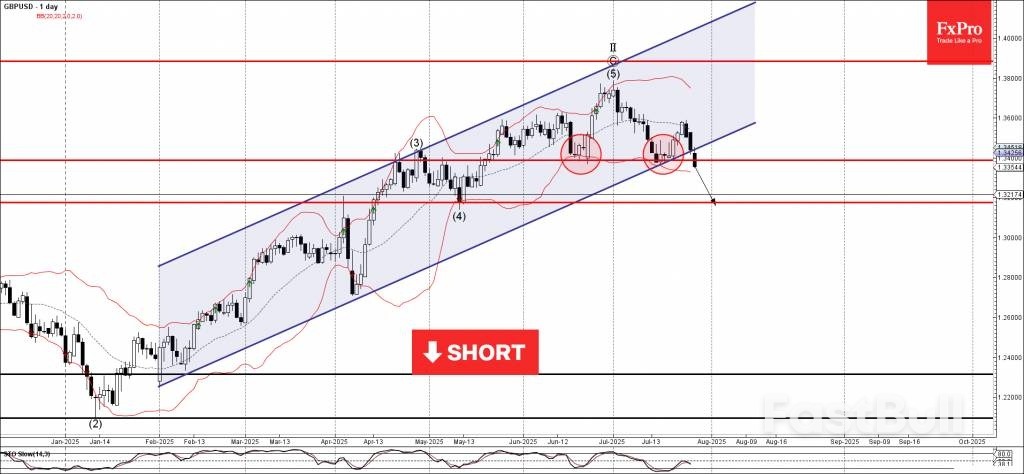
          GBPUSD: ⬇️ Sell

          – GBPUSD broke support zone

          – Likely fall to support level 1.3175

          GBPUSD currency pair recently broke the support zone between the support level 1.3385 (which has been reversing the price from June) and the support trendline of the daily up channel from January.The breakout of this support zone should accelerate the active intermediate impulse wave (1) from the start of July.

          GBPUSD currency pair can be expected to fall to the next support level 1.3175 (former multi-month low from May, low of the earlier correction (4)).

          Source: FxPro

          To stay updated on all economic events of today, please check out our Economic calendar
          Risk Warnings and Disclaimers
          You understand and acknowledge that there is a high degree of risk involved in trading. Following any strategies or investment methods may lead to potential losses. The content on the site is provided by our contributors and analysts for information purposes only. You are solely responsible for determining whether any trading assets, securities, strategy, or any other product is suitable for investing based on your own investment objectives and financial situation.
          Add to Favorites
          Share

          Trump Set New Deadline of Russia-Ukraine Ceasefire, Limited to 12 Days

          FastBull Featured

          Daily News

          [Quick Facts]

          1. U.S. Treasury Department significantly raises quarterly borrowing estimate to replenish cash reserves.
          2. Canadian Prime Minister says Trade Talks with U.S. are at an intense phase.
          3. Iran: Europe has no authority to invoke the Snapback Sanctions Mechanism.
          4. The Thailand-Cambodia Ceasefire Agreement officially takes effect.
          5. Trump limits Russia-Ukraine ceasefire to 12 days.
          6. Trump says to announce pharmaceutical tariffs soon.
          7. Timiraos: Fed not ready to cut rates this week.

          [News Details]

          U.S. Treasury Department significantly raises quarterly borrowing estimate to replenish cash reserves
          The U.S. Treasury Department has sharply increased its estimate for federal borrowing in the current quarter to $1 trillion, primarily due to the impact of the debt ceiling. In a statement released Monday, the Treasury said it now expects net borrowing of $1.01 trillion from July to September, up from the $554 billion projected in April. The government had to reduce bond issuance in the first half of the year to avoid breaching the debt ceiling. Since Congress raised the debt ceiling by $5 trillion earlier this month, the Treasury has accelerated bond sales to rebuild cash reserves. By convention, the Treasury's April estimate did not account for debt ceiling constraints. At the time, it assumed a cash balance of $850 billion at the end of June, but the actual balance was only $457 billion. The Treasury noted that even without factoring in lower-than-expected initial cash balances for the quarter, its current borrowing estimate is $60 billion higher than the figure announced in April.
          Canadian Prime Minister says Trade Talks with U.S. are at an intense phase
          Canadian Prime Minister Mark Carney stated that although U.S. President Donald Trump recently remarked that reaching an agreement with Canada was not a priority, the two governments are still engaged in in-depth trade negotiations. Regarding Trump's comments last week that the U.S. is not focused on Canada and may not reach a tariff agreement, Carney downplayed the remarks. Speaking to reporters on Monday, he said, "It's a complex negotiation," and added that publicly stated remarks should be considered in that context. He explained that talks with the U.S. are at an "intense phase" and reiterated that an agreement would only be signed if it is beneficial to Canada.
          Iran: Europe has no authority to invoke the Snapback Sanctions Mechanism
          On July 28, Iranian Foreign Ministry spokesperson Esmail Baghaei held a press conference on the Iranian nuclear issue and the regional situation. Baghaei emphasized that Britain, France, and Germany have no right to use the snapback sanctions mechanism to pressure Iran. In response to continued pressure from the E3 (Britain, France, and Germany) and their threats to invoke the snapback mechanism to reinstate UN sanctions on Iran, Baghaei stated that during the previous round of negotiations, the focus of talks between Iran and the three European countries was on the nuclear issue and sanctions relief. Iran has consistently emphasized that European parties have no right to invoke this mechanism. If they abuse it, it will only complicate the nuclear issue further. Iranian Foreign Ministry spokesperson Esmail Baghaei noted: "The European parties have long attempted to exploit certain provisions of UN Security Council Resolution 2231 as bargaining chips to pressure Iran. In essence, the European parties have no authority to use this tool to reimpose sanctions. We made this clear in the latest round of negotiations and prior discussions. If the three European countries misuse this issue, they will face an appropriate response from Iran."
          The Thailand-Cambodia Ceasefire Agreement officially takes effect
          The ceasefire agreement between Thailand and Cambodia officially came into force at 24:00 on July 28th. In the afternoon of that day, Cambodian Prime Minister Hun Manet and Thai Acting Prime Minister Phumtham led senior delegations to attend a special meeting on the Cambodia-Thailand border situation held in Putrajaya, Malaysia. The Malaysian prime minister stated that both Thailand and Cambodia had agreed to the ceasefire, which would take effect at midnight (24:00 local time on July 28th). Later the same day, both Thai and Cambodian sides confirmed that they had reached a consensus on the ceasefire and would halt hostilities starting from midnight.
          Trump limits Russia-Ukraine ceasefire to 12 days
          According to a report by Russia's Sputnik News Agency on July 28th, U.S. President Donald Trump said that due to a lack of progress in mediating the Russia-Ukraine conflict, he would shorten the previously set 50-day ceasefire period to 10-12 days. "I’m going to make a new deadline of about … 10 or 12 days from today," Trump told reporters during a meeting with British Prime Minister Keir Starmer. "There’s no reason in waiting… We just don’t see any progress being made." Earlier that day, Trump, who was holding talks in Scotland, said he decided to cut the original 50-day timeline due to disappointment with Russian President Vladimir Putin.
          Trump says to announce pharmaceutical tariffs soon
          U.S. President Donald Trump announced on Monday that he plans to soon impose drug tariffs, though he did not specify a date. Trump met with British Prime Minister Keir Starmer a day after declaring a trade deal with the European Union. Following his meeting with Starmer in Scotland, Trump told reporters that he would announce something on drugs in the near future, and he had a major plan for pharmaceuticals, aiming to bring many drugs back to the United States.
          Timiraos: Fed not ready to cut rates this week
          In an article, Nick Timiraos wrote that Federal Reserve officials expect they will ultimately need to continue lowering interest rates, but they are not prepared to do so by Wednesday. Disagreements among them center on what evidence they need to see first and whether waiting for clearer conditions would be a mistake. Officials are now split into three camps over resuming rate cuts. The key focus will be whether Chair Jerome Powell signals a potential September rate cut in his press conference and whether his colleagues begin laying the groundwork for a rate reduction at the next meeting in the coming days and weeks.

          [Today's Focus]

          UTC+8 13:30 France Q2 GDP First Estimate
          UTC+8 16:00 Germany Q2 GDP First Estimate
          UTC+8 17:00 Eurozone Q2 GDP First Estimate
          UTC+8 20:15 U.S. July ADP Employment Change
          UTC+8 20:30 U.S. Q2 Real GDP First Estimate
          UTC+8 21:45 Bank of Canada July Interest Rate Decision
          UTC+8 22:00 U.S. June Pending Home Sales Index MoM
          Risk Warnings and Disclaimers
          You understand and acknowledge that there is a high degree of risk involved in trading. Following any strategies or investment methods may lead to potential losses. The content on the site is provided by our contributors and analysts for information purposes only. You are solely responsible for determining whether any trading assets, securities, strategy, or any other product is suitable for investing based on your own investment objectives and financial situation.
          Add to Favorites
          Share

          Singapore Airlines Shares Slide Over 8% as Profits Fall Sharply Amid Air India Drag

          Gerik

          Economic

          Stocks

          Earnings Slump Amid Associate Losses and Lower Yields

          SIA posted a net profit of S$186 million (US$144 million) for the quarter ending June 30, marking a significant year-on-year drop from last year’s performance. Operating profit also declined by 13.8% to S$405 million, reflecting higher cost pressures despite stable passenger and cargo demand. The company attributed the earnings deterioration to lower cash balances and the impact of falling interest rates on investment income.
          A key contributor to the decline was SIA’s share of losses from associated companies, particularly Air India. In contrast to the previous year, when associate contributions boosted profits, this quarter reflected the financial burden of Air India, which was brought under SIA’s equity accounting framework in December 2024 following the merger of Vistara into the Tata Group carrier. SIA now holds a 25.1% stake in Air India.

          Market Reaction and Broader Implications

          Investors reacted swiftly to the disappointing results. SIA shares dropped as much as 8% intraday the sharpest fall since August 2024 before settling at a 7.11% loss. The stock's negative momentum reflects concerns that the integration with Air India may continue to weigh on SIA’s profitability in the near term, especially if restructuring costs and operational inefficiencies persist.
          Moreover, the sharp drop in interest income raises questions about SIA’s liquidity management strategy amid a more dovish interest rate environment. With lower yields on deposits and investments, carriers like SIA that traditionally held significant cash reserves may face pressure to rebalance their capital allocation strategies.

          Positive Signs in Demand Outlook

          Despite the earnings setback, SIA offered a cautiously optimistic outlook. The airline noted that demand for both passenger and cargo services remained robust, supported by resilient global travel appetite despite ongoing geopolitical uncertainties. Forward bookings and cargo volumes continue to trend positively, which could help buffer earnings in subsequent quarters if capacity and cost control measures are effectively managed.
          While the first quarter results reveal short-term profitability challenges for Singapore Airlines, particularly due to associate losses and macro-financial headwinds, the underlying strength in travel demand offers a supportive backdrop for recovery. Nonetheless, investors will remain watchful of how the Air India partnership evolves and whether SIA can mitigate the risks of further financial drag while maintaining competitive operational margins.

          Source: CNBC

          To stay updated on all economic events of today, please check out our Economic calendar
          Risk Warnings and Disclaimers
          You understand and acknowledge that there is a high degree of risk involved in trading. Following any strategies or investment methods may lead to potential losses. The content on the site is provided by our contributors and analysts for information purposes only. You are solely responsible for determining whether any trading assets, securities, strategy, or any other product is suitable for investing based on your own investment objectives and financial situation.
          Add to Favorites
          Share

          The Rally Hits Resistance Amid Shifting ECB Rhetoric

          ACY

          Forex

          Economic

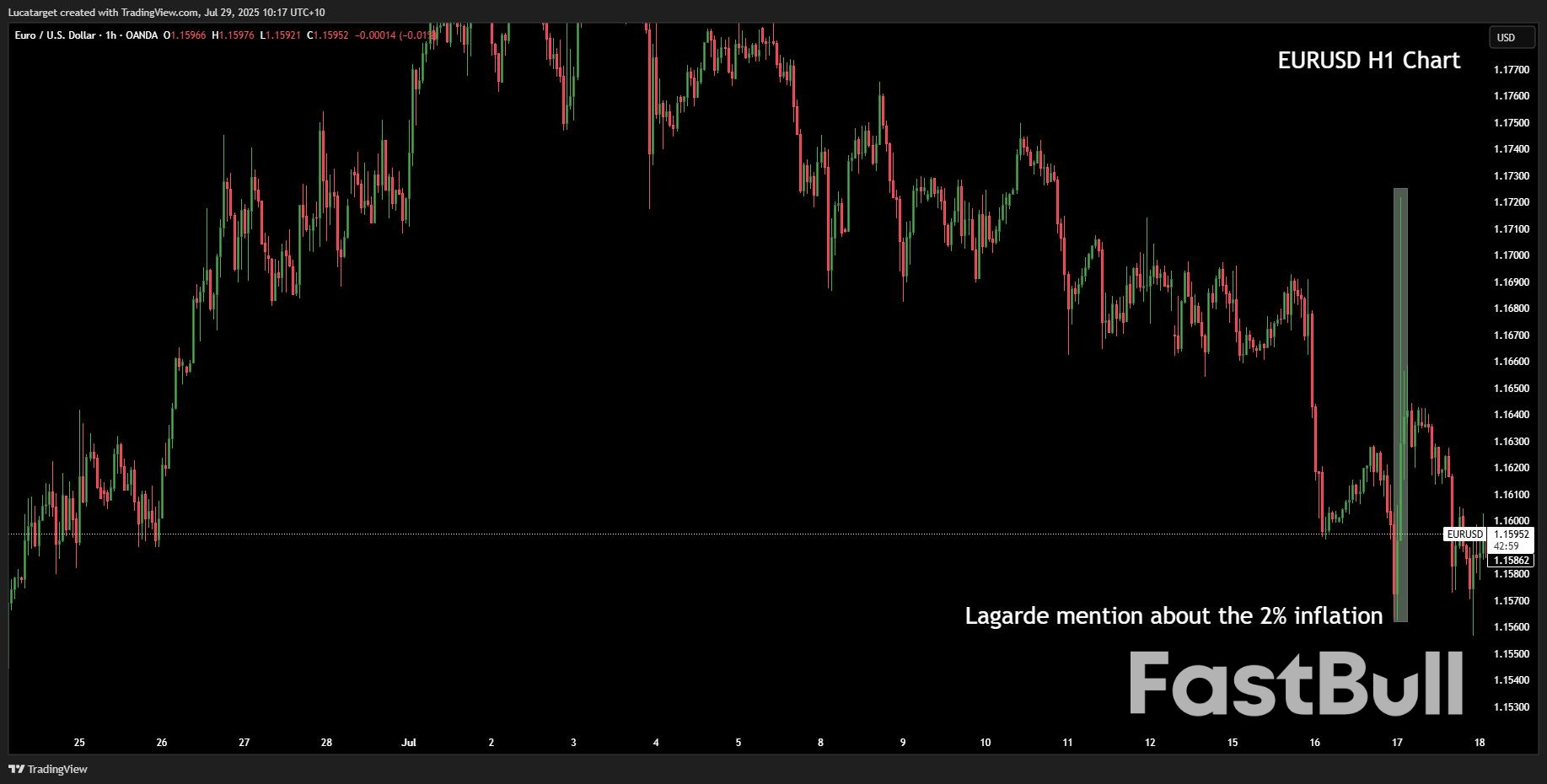
          I've been closely tracking the EUR/USD pair lately, especially after the European Central Bank’s recent tone shift. It’s fascinating to see how market expectations have evolved from no hikes at all this year to pricing in a December move. But let’s take a step back.
          The Rally Hits Resistance Amid Shifting ECB Rhetoric_1

          Source: TradingView

          Well, ECB members have since been walking that back. Lagarde herself emphasized there’s "no need to rush to premature conclusions," and Villeroy de Galhau called market reactions “too high.” That commentary was enough to push the 1-year forward OIS down by 12bps to 0.00% a sign that traders are starting to temper their rate hike bets again.So where does this leave EUR/USD? We're now caught in a tug-of-war between tightening expectations and cautious ECB communication. Unless inflation data forces their hand, I don’t expect a broad trend breakout soon. Especially with 62% of December’s euro-area inflation tied to volatile categories like energy and food, the underlying core remains tame.

          GBP: Is the BoE Hike Already Priced In?

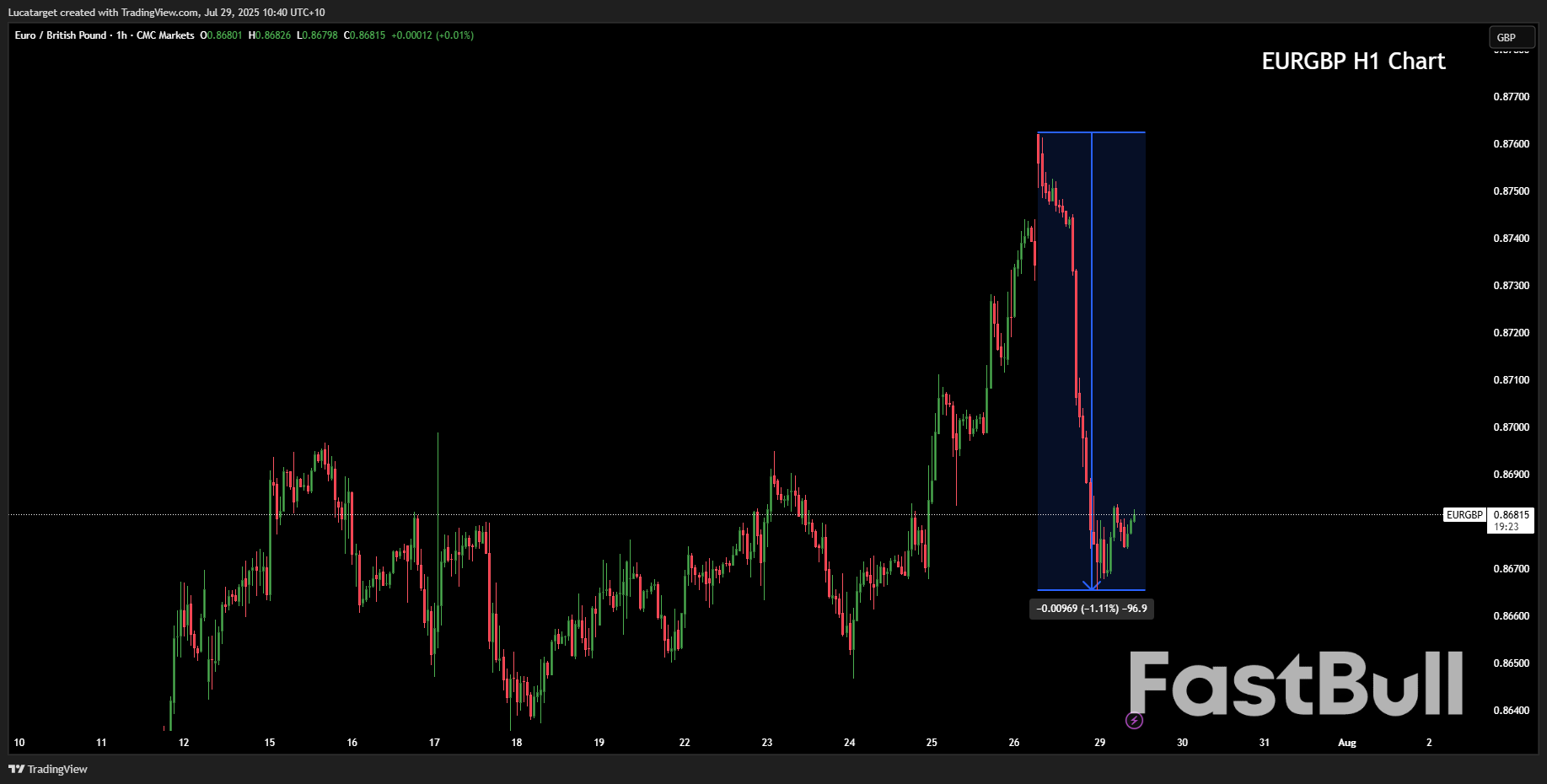
          If you were expecting fireworks after the Bank of England's rate hike, you probably felt let down. I know I did.Despite a 25bps increase, GBP/USD actually slipped. And the pound lost over 1% against the euro. Why the underperformance?
          The Rally Hits Resistance Amid Shifting ECB Rhetoric_2

          Source: TradingView

          The market had already priced in the move. More importantly, the details from the BoE’s Monetary Policy Report tell a more cautious story: tightening beyond current expectations could actually undershoot the inflation target.This is a critical point for traders. It’s not just about whether a central bank is raising rates it’s about the trajectory and the messaging behind it.
          Chief Economist Huw Pill’s speech (titled “UK Monetary Policy Outlook”) further drove home that excessive tightening isn’t warranted. That’s why we saw the 1-year forward GBP OIS fall 11bps last week.So, while real yields still favor GBP/USD, broader growth risks like tax hikes and spiking energy bills are likely to limit upside potential. I’m staying nimble on this pair, especially ahead of upcoming UK retail and labor data.
          In FX, narratives are changing fast. A central bank comment or a data surprise can reverse trends in a matter of hours. That’s why I stay grounded in both fundamentals and sentiment shifts. Right now, it feels like the market is hunting for clarity in a fog of conflicting signals.I’ll be keeping a close eye on upcoming inflation releases and central bank speeches this week particularly for signs that market pricing (especially in Europe and the UK) may be running ahead of policy reality.
          Q1: Why did the EUR/USD rally stall after the ECB's hawkish comments?Even though ECB President Lagarde signaled a shift toward tightening, subsequent comments from other officials dialed back expectations. This inconsistency reduced momentum, and the market started to doubt whether the ECB would follow through aggressively especially given that eurozone inflation is still largely driven by energy and food.
          Q2: If the BoE raised rates, why did GBP weaken?Markets had already priced in the BoE’s 25bps hike. More importantly, the Bank’s guidance emphasized that excessive tightening could actually harm the economy and undershoot inflation. This cautious tone weighed on the pound, despite a seemingly hawkish headline.
          Q3: What does the BTP/Bund spread tell us about ECB policy risks?The widening spread between Italian and German bonds (BTP/Bund) signals stress in the periphery. If it continues, it could pressure the ECB to slow or adjust its tightening plans to avoid fragmenting financial conditions across the eurozone.
          Q4: How do real yield spreads influence currency pairs like GBP/USD?In theory, higher real yields should support a currency. But in practice, broader economic concerns such as slowing growth, tax hikes, and energy costs can offset that support. That’s what’s happening with GBP/USD: strong real yields, weak price action.
          Q5: What should traders focus on this week?Stay alert for speeches by central bank officials (BoE, Fed, BoC), inflation data releases (especially in the US and eurozone), and geopolitical developments. Markets are highly reactive to shifts in forward guidance, and volatility can pick up quickly when expectations change.

          Source:ACY

          To stay updated on all economic events of today, please check out our Economic calendar
          Risk Warnings and Disclaimers
          You understand and acknowledge that there is a high degree of risk involved in trading. Following any strategies or investment methods may lead to potential losses. The content on the site is provided by our contributors and analysts for information purposes only. You are solely responsible for determining whether any trading assets, securities, strategy, or any other product is suitable for investing based on your own investment objectives and financial situation.
          Add to Favorites
          Share

          Oil Prices Steady as Trump Threatens Deadline on Russia-Ukraine Truce

          Gerik

          Economic

          Commodity

          Crude Prices Buoyed by Geopolitical Risk

          Brent crude hovered near $70 per barrel after a sharp 2.3% increase in the previous session, its largest two-week jump, while West Texas Intermediate (WTI) traded around $67. This upward momentum follows President Trump’s announcement of a 10–12 day deadline for Moscow to cease military operations in Ukraine or face new U.S. sanctions, including potential “secondary sanctions” that could affect non-Russian entities engaging in oil trade with Russia.
          Markets have interpreted this stance as a precursor to further supply disruptions from Russia, a key member of OPEC+ and one of the largest global oil exporters. Trump’s public frustration with President Vladimir Putin marks a renewed hardline approach after previous diplomatic attempts yielded no significant progress toward a ceasefire.

          Supply Concerns Amplified by Sanctions and Summer Demand

          The threat of U.S. secondary sanctions builds on fresh EU penalties against Russian-linked companies, including India's Nayara Energy, and adds another layer of uncertainty to oil supply chains. This comes at a time when global inventories are already tightening due to summer-driven demand peaks in the Northern Hemisphere. Refineries are running near full capacity in several Asian and U.S. regions, drawing down stocks of gasoline and diesel.
          Oil's rally is also underpinned by the August 1 trade deadline for several U.S. agreements and anticipation surrounding the upcoming OPEC+ policy meeting. The cartel is set to decide its production strategy for September, with analysts divided on whether output will be held steady or slightly increased. A conservative production stance by OPEC+ in light of Trump’s threat could further bolster oil prices in the short term.

          Volatility Expected Amid Mixed Fundamentals

          Despite recent price support, the oil market faces the possibility of oversupply in Q4 if OPEC+ continues to raise production and global demand begins to plateau. The International Energy Agency (IEA) and other forecasters have warned of a potential return to surplus later this year, especially if Chinese consumption weakens or if macroeconomic uncertainty limits industrial activity.
          However, the immediate focus remains on Russia’s compliance with U.S. pressure. Should Moscow ignore Trump’s deadline, broader sanctions could cut into Russian crude exports likely forcing refiners in Asia to seek alternative sources, tightening supplies in key regions. Conversely, a swift truce could alleviate supply concerns and trigger a retracement in prices.
          Traders will closely monitor diplomatic developments in the next two weeks as well as signals from the upcoming OPEC+ meeting. In the interim, geopolitical tensions are expected to keep crude prices supported, but underlying fundamentals suggest limited room for sustained upside unless further supply shocks occur.

          Source: Bloomberg

          To stay updated on all economic events of today, please check out our Economic calendar
          Risk Warnings and Disclaimers
          You understand and acknowledge that there is a high degree of risk involved in trading. Following any strategies or investment methods may lead to potential losses. The content on the site is provided by our contributors and analysts for information purposes only. You are solely responsible for determining whether any trading assets, securities, strategy, or any other product is suitable for investing based on your own investment objectives and financial situation.
          Add to Favorites
          Share

          Euro Falters as U.S.-EU Trade Pact Rattles Confidence

          Gerik

          Economic

          Forex

          Market Response: A Lopsided Deal Spurs Euro Weakness

          The European currency suffered its steepest one-day drop in over two months, falling 1.3% on Monday and hovering near $1.1594 on Tuesday morning in Asia. The immediate trigger was the backlash from European leaders against the recently announced U.S.-EU trade deal, which imposes a 15% tariff on most EU goods. French officials denounced the agreement as a betrayal of European interests, calling it a “dark day,” while German Chancellor Friedrich Merz warned of “significant damage” to Germany’s export-reliant economy.
          This political dissatisfaction swiftly translated into bearish sentiment in financial markets. As euro-area government bond yields fell, traders reduced exposure to the euro, shifting capital toward the dollar as a safe haven.

          Investor Sentiment and Dollar Momentum

          The euro's slump coincided with a sharp rise in the dollar index, which climbed 1% overnight and stabilized around 98.67. The euro's underperformance also spilled over to other currencies. Sterling fell to a two-month low at $1.3349, while the Japanese yen remained flat around 148.49. This price action reflects a consensus that, despite superficial progress, the deal has not improved growth prospects for the eurozone and may worsen them.
          As Ray Attrill from National Australia Bank explained, the trade agreement may appear to signal cooperation, but its tangible effects undermine European economic recovery, especially at a time of weakening industrial production and subdued consumer demand in the region.

          Political Dynamics and Global Repercussions

          President Trump’s rhetoric has further complicated the global outlook. He warned that trading partners without specific bilateral deals with the U.S. would soon face tariffs of 15–20%, far higher than the blanket 10% tariff set in April. This aggressive trade posture reinforces the perception of a protectionist U.S. strategy and may further depress trade activity with Europe.
          Meanwhile, global currency traders remained cautious ahead of key interest rate decisions from the Federal Reserve and the Bank of Japan later in the week. Although no changes are expected, any hints about policy direction especially from the Fed could influence dollar strength and emerging market stability.

          Europe Faces an Uneven Path Forward

          The euro’s sharp reaction underscores the market's concern about Europe’s vulnerability in an increasingly unilateral global trade environment. The imbalance in the U.S.-EU deal, combined with heightened trade uncertainty and weak eurozone fundamentals, creates downward pressure on the euro and casts doubt on any near-term economic revival.
          Unless the European Union can counteract these external pressures with cohesive fiscal policy or stimulus measures, the bloc may continue to face capital flight and a weaker currency. Investors will closely watch ECB commentary in the coming weeks for any signal of countermeasures to offset the trade-driven drag on growth.

          Source: Reuters

          To stay updated on all economic events of today, please check out our Economic calendar
          Risk Warnings and Disclaimers
          You understand and acknowledge that there is a high degree of risk involved in trading. Following any strategies or investment methods may lead to potential losses. The content on the site is provided by our contributors and analysts for information purposes only. You are solely responsible for determining whether any trading assets, securities, strategy, or any other product is suitable for investing based on your own investment objectives and financial situation.
          Add to Favorites
          Share
          FastBull
          Copyright © 2025 FastBull Ltd

          728 RM B 7/F GEE LOK IND BLDG NO 34 HUNG TO RD KWUN TONG KLN HONG KONG

          TelegramInstagramTwitterfacebooklinkedin
          App Store Google Play Google Play
          Products
          Charts

          Chats

          Q&A with Experts
          Screeners
          Economic Calendar
          Data
          Tools
          Membership
          Features
          Function
          Markets
          Copy Trading
          Latest Signals
          Contests
          News
          Analysis
          24/7
          Columns
          Education
          Company
          Careers
          About Us
          Contact Us
          Advertising
          Help Center
          Feedback
          User Agreement
          Privacy Policy
          Business

          White Label

          Data API

          Web Plug-ins

          Poster Maker

          Affiliate Program

          Risk Disclosure

          The risk of loss in trading financial instruments such as stocks, FX, commodities, futures, bonds, ETFs and crypto can be substantial. You may sustain a total loss of the funds that you deposit with your broker. Therefore, you should carefully consider whether such trading is suitable for you in light of your circumstances and financial resources.

          No decision to invest should be made without thoroughly conducting due diligence by yourself or consulting with your financial advisors. Our web content might not suit you since we don't know your financial conditions and investment needs. Our financial information might have latency or contain inaccuracy, so you should be fully responsible for any of your trading and investment decisions. The company will not be responsible for your capital loss.

          Without getting permission from the website, you are not allowed to copy the website's graphics, texts, or trademarks. Intellectual property rights in the content or data incorporated into this website belong to its providers and exchange merchants.

          Not Logged In

          Log in to access more features

          FastBull Membership

          Not yet

          Purchase

          Become a signal provider
          Help Center
          Customer Service
          Dark Mode
          Price Up/Down Colors

          Log In

          Sign Up

          Position
          Layout
          Fullscreen
          Default to Chart
          The chart page opens by default when you visit fastbull.com