• Trade
  • Markets
  • Copy
  • Contests
  • News
  • 24/7
  • Calendar
  • Q&A
  • Chats
Trending
Screeners
SYMBOL
LAST
BID
ASK
HIGH
LOW
NET CHG.
%CHG.
SPREAD
SPX
S&P 500 Index
6870.39
6870.39
6870.39
6895.79
6858.28
+13.27
+ 0.19%
--
DJI
Dow Jones Industrial Average
47954.98
47954.98
47954.98
48133.54
47871.51
+104.05
+ 0.22%
--
IXIC
NASDAQ Composite Index
23578.12
23578.12
23578.12
23680.03
23506.00
+72.99
+ 0.31%
--
USDX
US Dollar Index
98.930
99.010
98.930
98.960
98.730
-0.020
-0.02%
--
EURUSD
Euro / US Dollar
1.16484
1.16491
1.16484
1.16717
1.16341
+0.00058
+ 0.05%
--
GBPUSD
Pound Sterling / US Dollar
1.33156
1.33165
1.33156
1.33462
1.33136
-0.00156
-0.12%
--
XAUUSD
Gold / US Dollar
4211.68
4212.11
4211.68
4218.85
4190.61
+13.77
+ 0.33%
--
WTI
Light Sweet Crude Oil
59.224
59.254
59.224
60.084
59.160
-0.585
-0.98%
--

Community Accounts

Signal Accounts
--
Profit Accounts
--
Loss Accounts
--
View More

Become a signal provider

Sell trading signals to earn additional income

View More

Guide to Copy Trading

Get started with ease and confidence

View More

Signal Accounts for Members

All Signal Accounts

Best Return
  • Best Return
  • Best P/L
  • Best MDD
Past 1W
  • Past 1W
  • Past 1M
  • Past 1Y

All Contests

  • All
  • Trump Updates
  • Recommend
  • Stocks
  • Cryptocurrencies
  • Central Banks
  • Featured News
Top News Only
Share

India Foreign Ministry: New Deputy USA Trade Representative Will Visit India On Dec 10-11

Share

India Foreign Ministry: Advise Indian Nationals To Exercise Caution While Travelling To Or Transiting Through China

Share

Agrural - Brazil's 2025/26 Total Corn Output Seen At 135.3 Million Tonnes Versus 141.1 Million Tonnes In Previous Season

Share

Agrural - Brazil's 2025/26 Soybean Planting Hits 94% Of Expected Area As Of Last Thursday

Share

SEBI: Modalities For Migration To Ai Only Schemes And Relaxations To Large Value Funds For Accredited Investors

Share

All 6 Bank Of Israel Monetary Policy Committee Members Voted To Lower Benchmark Interest Rate 25 Bps To 4.25% On Nov 24

Share

India Government: Cancellations Are On Account Of Developer Delays And Not Due To Transmission Side Delays

Share

Fitch: We See Moderation Of Export Performance In China In 2026

Share

India Government: Revokes Grid Access Permissions For Renewable Energy Projects

Share

Stats Office - Tanzania Inflation At 3.4% Year-On-Year In November

Share

Temasek CEO Dilhan Pillay: We Are Taking A Conservative Stance On Allocating Capital

Share

Brazil Economists See Brazilian Real At 5.40 Per Dollar By Year-End 2025 Versus 5.40 In Previous Estimate - Central Bank Poll

Share

Brazil Economists See Year-End 2026 Interest Rate Selic At 12.25% Versus 12.00% In Previous Estimate - Central Bank Poll

Share

Brazil Economists See Year-End 2025 Interest Rate Selic At 15.00% Versus 15.00% In Previous Estimate - Central Bank Poll

Share

EU Commission Says Meta Has Committed To Give EU Users Choice On Personalised Ads

Share

Sources Revealed That The Bank Of England Has Invited Employees To Voluntarily Apply For Layoffs

Share

The Bank Of England Plans To Cut Staff Due To Budget Pressures

Share

Traders Believe There Is Less Than A 10% Chance That The European Central Bank Will Cut Interest Rates By 25 Basis Points In 2026

Share

Egypt, European Bank For Reconstruction And Development Sign $100 Million Financing Agreement

Share

Israel Budget Deficit 4.5% Of GDP In November Over Past 12 Months Versus 4.9% Deficit In October

TIME
ACT
FCST
PREV
France Industrial Output MoM (SA) (Oct)

A:--

F: --

P: --
France Trade Balance (SA) (Oct)

A:--

F: --

P: --
Euro Zone Employment YoY (SA) (Q3)

A:--

F: --

P: --
Canada Part-Time Employment (SA) (Nov)

A:--

F: --

P: --

Canada Unemployment Rate (SA) (Nov)

A:--

F: --

P: --

Canada Full-time Employment (SA) (Nov)

A:--

F: --

P: --

Canada Labor Force Participation Rate (SA) (Nov)

A:--

F: --

P: --

Canada Employment (SA) (Nov)

A:--

F: --

P: --

U.S. PCE Price Index MoM (Sept)

A:--

F: --

P: --

U.S. Personal Income MoM (Sept)

A:--

F: --

P: --

U.S. Core PCE Price Index MoM (Sept)

A:--

F: --

P: --

U.S. PCE Price Index YoY (SA) (Sept)

A:--

F: --

P: --

U.S. Core PCE Price Index YoY (Sept)

A:--

F: --

P: --

U.S. Personal Outlays MoM (SA) (Sept)

A:--

F: --

P: --
U.S. 5-10 Year-Ahead Inflation Expectations (Dec)

A:--

F: --

P: --

U.S. Real Personal Consumption Expenditures MoM (Sept)

A:--

F: --

P: --
U.S. Weekly Total Rig Count

A:--

F: --

P: --

U.S. Weekly Total Oil Rig Count

A:--

F: --

P: --

U.S. Consumer Credit (SA) (Oct)

A:--

F: --

P: --
China, Mainland Foreign Exchange Reserves (Nov)

A:--

F: --

P: --

Japan Trade Balance (Oct)

A:--

F: --

P: --

Japan Nominal GDP Revised QoQ (Q3)

A:--

F: --

P: --

China, Mainland Imports YoY (CNH) (Nov)

A:--

F: --

P: --

China, Mainland Exports (Nov)

A:--

F: --

P: --

China, Mainland Imports (CNH) (Nov)

A:--

F: --

P: --

China, Mainland Trade Balance (CNH) (Nov)

A:--

F: --

P: --

China, Mainland Exports YoY (USD) (Nov)

A:--

F: --

P: --

China, Mainland Imports YoY (USD) (Nov)

A:--

F: --

P: --

Germany Industrial Output MoM (SA) (Oct)

A:--

F: --

P: --
Euro Zone Sentix Investor Confidence Index (Dec)

A:--

F: --

P: --

Canada National Economic Confidence Index

--

F: --

P: --

U.K. BRC Like-For-Like Retail Sales YoY (Nov)

--

F: --

P: --

U.K. BRC Overall Retail Sales YoY (Nov)

--

F: --

P: --

Australia Overnight (Borrowing) Key Rate

--

F: --

P: --

RBA Rate Statement
RBA Press Conference
Germany Exports MoM (SA) (Oct)

--

F: --

P: --

U.S. NFIB Small Business Optimism Index (SA) (Nov)

--

F: --

P: --

Mexico 12-Month Inflation (CPI) (Nov)

--

F: --

P: --

Mexico Core CPI YoY (Nov)

--

F: --

P: --

Mexico PPI YoY (Nov)

--

F: --

P: --

U.S. Weekly Redbook Index YoY

--

F: --

P: --

U.S. JOLTS Job Openings (SA) (Oct)

--

F: --

P: --

China, Mainland M1 Money Supply YoY (Nov)

--

F: --

P: --

China, Mainland M0 Money Supply YoY (Nov)

--

F: --

P: --

China, Mainland M2 Money Supply YoY (Nov)

--

F: --

P: --

U.S. EIA Short-Term Crude Production Forecast For The Year (Dec)

--

F: --

P: --

U.S. EIA Natural Gas Production Forecast For The Next Year (Dec)

--

F: --

P: --

U.S. EIA Short-Term Crude Production Forecast For The Next Year (Dec)

--

F: --

P: --

EIA Monthly Short-Term Energy Outlook
U.S. API Weekly Gasoline Stocks

--

F: --

P: --

U.S. API Weekly Cushing Crude Oil Stocks

--

F: --

P: --

U.S. API Weekly Crude Oil Stocks

--

F: --

P: --

U.S. API Weekly Refined Oil Stocks

--

F: --

P: --

South Korea Unemployment Rate (SA) (Nov)

--

F: --

P: --

Japan Reuters Tankan Non-Manufacturers Index (Dec)

--

F: --

P: --

Japan Reuters Tankan Manufacturers Index (Dec)

--

F: --

P: --

Japan Domestic Enterprise Commodity Price Index MoM (Nov)

--

F: --

P: --

Japan Domestic Enterprise Commodity Price Index YoY (Nov)

--

F: --

P: --

China, Mainland PPI YoY (Nov)

--

F: --

P: --

China, Mainland CPI MoM (Nov)

--

F: --

P: --

Q&A with Experts
    • All
    • Chatrooms
    • Groups
    • Friends
    Connecting
    .
    .
    .
    Type here...
    Add Symbol or Code

      No matching data

      All
      Trump Updates
      Recommend
      Stocks
      Cryptocurrencies
      Central Banks
      Featured News
      • All
      • Russia-Ukraine Conflict
      • Middle East Flashpoint
      • All
      • Russia-Ukraine Conflict
      • Middle East Flashpoint
      Search
      Products

      Charts Free Forever

      Chats Q&A with Experts
      Screeners Economic Calendar Data Tools
      Membership Features
      Data Warehouse Market Trends Institutional Data Policy Rates Macro

      Market Trends

      Market Sentiment Order Book Forex Correlations

      Top Indicators

      Charts Free Forever
      Markets

      News

      News Analysis 24/7 Columns Education
      From Institutions From Analysts
      Topics Columnists

      Latest Views

      Latest Views

      Trending Topics

      Top Columnists

      Latest Update

      Signals

      Copy Rankings Latest Signals Become a signal provider AI Rating
      Contests
      Brokers

      Overview Brokers Assessment Rankings Regulators News Claims
      Broker listing Forex Brokers Comparison Tool Live Spread Comparison Scam
      Q&A Complaint Scam Alert Videos Tips to Detect Scam
      More

      Business
      Events
      Careers About Us Advertising Help Center

      White Label

      Data API

      Web Plug-ins

      Affiliate Program

      Awards Institution Evaluation IB Seminar Salon Event Exhibition
      Vietnam Thailand Singapore Dubai
      Fans Party Investment Sharing Session
      FastBull Summit BrokersView Expo
      Recent Searches
        Top Searches
          Markets
          News
          Analysis
          User
          24/7
          Economic Calendar
          Education
          Data
          • Names
          • Latest
          • Prev

          View All

          No data

          Scan to Download

          Faster Charts, Chat Faster!

          Download App
          English
          • English
          • Español
          • العربية
          • Bahasa Indonesia
          • Bahasa Melayu
          • Tiếng Việt
          • ภาษาไทย
          • Français
          • Italiano
          • Türkçe
          • Русский язык
          • 简中
          • 繁中
          Open Account
          Search
          Products
          Charts Free Forever
          Markets
          News
          Signals

          Copy Rankings Latest Signals Become a signal provider AI Rating
          Contests
          Brokers

          Overview Brokers Assessment Rankings Regulators News Claims
          Broker listing Forex Brokers Comparison Tool Live Spread Comparison Scam
          Q&A Complaint Scam Alert Videos Tips to Detect Scam
          More

          Business
          Events
          Careers About Us Advertising Help Center

          White Label

          Data API

          Web Plug-ins

          Affiliate Program

          Awards Institution Evaluation IB Seminar Salon Event Exhibition
          Vietnam Thailand Singapore Dubai
          Fans Party Investment Sharing Session
          FastBull Summit BrokersView Expo

          Japan Moves Toward Restarting the World’s Largest Nuclear Plant in Early 2026

          Gerik

          Economic

          Summary:

          Japan is set to restart reactors 6 and 7 at the Kashiwazaki-Kariwa nuclear power plant as early as January 2026, pending local approval, marking a major milestone in the country’s post-Fukushima energy strategy.....

          Kashiwazaki-Kariwa Nuclear Plant Nears Restart After More Than a Decade

          Japan is preparing to resume operations at the world’s largest nuclear power facility, the Kashiwazaki-Kariwa plant, signaling a significant step in the country's gradual return to nuclear energy. The restart of units 6 and 7, managed by Tokyo Electric Power Company (TEPCO), is scheduled for January 2026, contingent upon approval from Niigata’s local council, which is expected to vote during its December 2 session.
          Before the Fukushima Daiichi nuclear disaster in 2011, nuclear energy contributed around 30% of Japan’s electricity supply. However, following the radiation leak, the government mandated a nationwide suspension of all nuclear reactors for safety reviews. Since 2015, only 14 of the country's 33 reactors have resumed operations, with 11 more under review. The cautious pace illustrates a reactive shift in energy governance driven by safety and public trust concerns, a clear causal response to a major technological disaster.
          The recent endorsement by Niigata Governor Hideyo Hanazumi marks a political turning point. His decision to allow TEPCO to restart two reactors reflects changing attitudes at the provincial leadership level and a potential recalibration of Japan’s energy mix to reduce fossil fuel dependence. However, ultimate implementation still hinges on local legislative approval, underscoring the importance of decentralized political support in Japan’s energy policy.

          TEPCO’s Revival Plan and Safety Compliance

          TEPCO, which operated the ill-fated Fukushima plant, has been pushing for the restart of Kashiwazaki-Kariwa for years. In October, the company announced that it had completed safety checks and fuel loading for reactor 6, with key operational criteria deemed compliant. This suggests a cause-effect link between improved safety systems and growing institutional confidence in resuming operations.
          Nevertheless, TEPCO’s reputation remains controversial. Community skepticism continues to shadow the company’s plans, partly due to its recent proposal to make financial contributions to local economic development in exchange for project support. Critics argue that such offers resemble financial coercion, undermining the legitimacy of public consent and fueling concerns about transparency.

          Public Opinion Remains Deeply Divided

          Despite official momentum, local sentiment remains fractured. Anti-nuclear groups and some residents have voiced opposition to the restart, citing unresolved fears over nuclear safety and transparency in TEPCO’s conduct. Public surveys reveal that resistance persists, though exact figures were not disclosed. This indicates a correlation between past nuclear trauma and persistent distrust toward industry stakeholders, particularly when those stakeholders also control crisis-era plants.
          If approved, the restart of Kashiwazaki-Kariwa’s reactors will mark a major development in Japan’s post-Fukushima energy realignment. The move carries significant economic and strategic implications, including the potential to stabilize energy supply and reduce import reliance. However, it also exposes deep-seated public anxieties and governance dilemmas. The balancing act between safety assurances, energy independence, and community consent will determine whether Japan can achieve a sustainable return to nuclear power, or whether societal resistance will stall further progress.
          To stay updated on all economic events of today, please check out our Economic calendar
          Risk Warnings and Disclaimers
          You understand and acknowledge that there is a high degree of risk involved in trading. Following any strategies or investment methods may lead to potential losses. The content on the site is provided by our contributors and analysts for information purposes only. You are solely responsible for determining whether any trading assets, securities, strategy, or any other product is suitable for investing based on your own investment objectives and financial situation.
          Add to Favorites
          Share

          Gold Poised to Hit New All-Time Highs in 2026 Amid Central Bank Demand and Rate Cuts

          Gerik

          Economic

          Commodity

          Strong Market Signals Point to Historic Gold Rally in 2026

          Major financial institutions are increasingly confident that gold prices will reach unprecedented levels in 2026, as key structural drivers remain firmly in place. These include the ongoing trend of net gold purchases by central banks and a widely anticipated continuation of interest rate cuts by the US Federal Reserve, both of which reinforce investor demand for the non-yielding metal.
          Deutsche Bank has sharply revised its 2026 gold price forecast upward to an average of USD 4,450 per ounce, from a previous estimate of USD 4,000. The projected trading range is set between USD 3,950 and USD 4,950. According to Michael Hsueh, the bank’s strategist, recent technical indicators suggest that the correction phase has concluded, while stable investment flows and a persistent supply-demand imbalance highlighted by consistent third-quarter central bank buying continue to support price growth. This reflects a causal relationship between structural gold accumulation and bullish price momentum.

          Historical Surge Underpinned by Macroeconomic Factors

          This optimistic outlook follows a year in which gold experienced a historically significant surge, briefly topping USD 4,380 per ounce before undergoing a short-term correction. The early 2025 rally was fueled by investor flight to safety amid geopolitical instability and persistent doubts over the long-term strength of the US dollar. These conditions have created a strong psychological foundation for continued inflows into gold markets, where both institutional and retail investors seek security against systemic volatility.
          Goldman Sachs analyst Daan Struyven echoed Deutsche Bank’s optimism, projecting a nearly 20% increase in gold prices to approximately USD 4,900 by the end of 2026. Struyven attributes this growth to the same factors seen in 2025, particularly the structural shift in central bank behavior following the 2022 freezing of Russian assets. This event fundamentally altered reserve strategies, prompting a diversification away from US dollar holdings. In addition, the Fed’s dovish policy trajectory lowers the opportunity cost of holding non-yield-bearing assets like gold, reinforcing investor interest. The analysis here indicates a causal mechanism: declining interest rates reduce holding costs, thus increasing gold’s attractiveness.
          Bank of America, meanwhile, has provided one of the most aggressive forecasts, suggesting gold could touch USD 5,000 per ounce. Michael Widmer, Head of Metals Research, contextualized the recent price pullback as a normal feature of historical upcycles. He noted that past gold bull markets since the 1970s have commonly included temporary corrections of around 10%, followed by substantial recoveries a pattern consistent with current price dynamics.

          China’s Central Bank Maintains Strategic Accumulation

          The People's Bank of China has emerged as a significant player in this global trend. October marked the twelfth consecutive month of gold purchases, adding another 30,000 ounces and lifting total reserves to 74.09 million ounces, valued at approximately USD 297.2 billion. This sustained accumulation provides a strong foundation of structural demand that underpins global price levels. The implication here is not merely correlation but a direct influence: China’s steady purchases provide floor support and add upward pressure in times of market uncertainty.
          Since resuming its rate-cutting cycle in September following two previous 25-basis-point reductions earlier in the year the Fed has strengthened market conviction that interest rates will continue to decline into 2026. CME Group’s FedWatch tool shows over 80% market consensus for further cuts at the next policy meeting. This anticipated monetary easing contributes to the positive sentiment surrounding gold, as lower rates tend to weaken the dollar and encourage shifts into hard assets.
          In sum, the confluence of central bank accumulation, geopolitical uncertainty, investor demand, and a dovish US monetary policy creates ideal conditions for gold’s sustained rally into 2026. The causal relationships between structural demand, lower interest rates, and price momentum suggest that gold’s next chapter will be shaped not just by short-term speculation, but by enduring shifts in how global institutions manage reserves and hedge against macroeconomic risk. The consensus across Deutsche Bank, Goldman Sachs, and Bank of America highlights a rare alignment in market outlooks, signaling that the USD 5,000 threshold may no longer be speculative it could be imminent.
          To stay updated on all economic events of today, please check out our Economic calendar
          Risk Warnings and Disclaimers
          You understand and acknowledge that there is a high degree of risk involved in trading. Following any strategies or investment methods may lead to potential losses. The content on the site is provided by our contributors and analysts for information purposes only. You are solely responsible for determining whether any trading assets, securities, strategy, or any other product is suitable for investing based on your own investment objectives and financial situation.
          Add to Favorites
          Share

          UK Retailers Call for Faster Action on E-Commerce Tax Loophole

          Gerik

          Economic

          E-Commerce Tax Loophole Puts UK Retailers at a Disadvantage

          For years, UK retailers have faced a growing threat from ultra-cheap e-commerce platforms such as Shein, Temu, and AliExpress, which ship goods directly from Chinese manufacturers to British consumers. These parcels have been able to bypass customs duties thanks to a loophole that exempts packages valued under £135 (approximately USD 179). As a result, international sellers gained a significant price advantage over local brick-and-mortar stores that must pay import taxes.
          Chancellor Rachel Reeves recently announced in Parliament that the government will end this competitive imbalance by applying customs duties to all imported parcels, regardless of value. The reform aims to level the playing field between local and foreign sellers. However, the full implementation is not scheduled until March 2029, with consultations running through March 2026. This sluggish approach has drawn sharp criticism from domestic retailers and trade bodies.

          Retail Industry's Strong Opposition to the Delay

          The British Retail Consortium’s director general, Helen Dickinson, stressed the urgency of the matter, noting that nearly 1.6 million parcels are currently exploiting the loophole daily double the volume from the previous year. She warned that further delays will deepen losses for domestic retailers, many of whom are already under pressure. Her argument highlights a cause-effect relationship: the continued influx of duty-free parcels directly contributes to declining competitiveness and financial strain among UK retailers.
          In contrast, other major economies have acted more swiftly. The United States, which is the largest market for Shein and Temu, ended its tax exemption on imports under USD 800 starting in May 2024 for goods from China and Hong Kong, later extending it globally. This rapid policy shift initially disrupted logistics, evidenced by over one million packages being delayed at JFK airport due to short notice.
          Similarly, the European Union accelerated its own plans to eliminate the VAT exemption for goods under €150, moving the deadline forward from 2028 to 2026. South Africa and Brazil have already imposed VAT and a 20% import tax respectively on low-value international purchases. The UK's deferred timeline risks isolating it from these aligned international trade standards, as emphasized by retailers like Sainsbury’s and Boohoo, who argue the delay invites continued fiscal losses and undermines regulatory fairness.

          Implications for Market Dynamics and Consumer Behavior

          According to customs tax expert Andrew Thurston, removing the duty-free threshold will raise the cost of direct international shipping, narrowing the price difference between imported goods and domestic offerings. This shift could gradually nudge consumers back toward local stores, assuming prices become more competitive and product availability remains strong. The implication here is a correlation: while higher tariffs won’t guarantee behavioral change, they are expected to reduce the appeal of cheap imports, especially if combined with other pro-retail initiatives.
          In summary, while the UK government’s intent to reform e-commerce tariffs aligns with global regulatory movements, its protracted timeline risks continued damage to domestic retail and long-term loss of tax revenue. The causal link between delayed reform and market distortion is evident in the mounting daily volume of untaxed parcels and shrinking sales for domestic retailers. Unless action is expedited, the UK may find itself out of step with global trade enforcement trends, to the detriment of its retail sector.
          To stay updated on all economic events of today, please check out our Economic calendar
          Risk Warnings and Disclaimers
          You understand and acknowledge that there is a high degree of risk involved in trading. Following any strategies or investment methods may lead to potential losses. The content on the site is provided by our contributors and analysts for information purposes only. You are solely responsible for determining whether any trading assets, securities, strategy, or any other product is suitable for investing based on your own investment objectives and financial situation.
          Add to Favorites
          Share

          Ukrainian Forces Fighting in Kupiansk, Despite Russian Claims, Top Commander Says

          Manuel

          Political

          Russia-Ukraine Conflict

          Ukrainian forces are defending their positions and hunting down sabotage groups in the northeastern city of Kupiansk despite Moscow's statements that its troops are fully in control of it, Ukraine's top commander said on Friday.
          Russia seized Kupiansk in the first weeks of the 2022 invasion, but Ukrainian troops recaptured it later that year. Russian President Vladimir Putin said last week it was back in Moscow's hands and on Thursday, while visiting Kyrgyzstan in Central Asia, he said the city was "fully in our hands."
          Ukrainian commander Oleksandr Syrskyi rejected the claims.
          "Our soldiers continue to conduct both defensive and search and strike actions," Syrskyi wrote on Telegram after visiting the area in Kharkiv region.
          "These actions take place daily as part of comprehensive measures to stabilise the situation in Kupiansk. The scale of lies from the Russian leadership about the situation in Kupiansk is astonishing."
          He said Ukrainian forces were "holding designated lines and intensifying fire pressure to block the enemy's supply routes."

          RUSSIANS ALSO TARGET POKROVSK

          Moscow's forces control about one-fifth of Ukraine's territory amid diplomatic efforts to settle the war, including a peace plan put forward by the United States and now including input from Ukraine's European allies.
          In addition to the largely destroyed city of Kupiansk, another Russian target is Pokrovsk, a logistics hub farther south in Donetsk region.
          Putin said on Thursday that Russian forces controlled 70% of Pokrovsk, known in Russia by its Soviet-era name, Krasnoarmeysk.
          On Friday, the Russian Defence Ministry said its forces had captured two outlying districts of the city.
          Syrskyi on Thursday said Ukrainian troops had been blocking attempts by Russian forces to stage new assaults on Pokrovsk and the adjacent town of Myrnohrad. The Ukrainian military, in a late evening report on Friday, said Russian forces had launched 65 attacks to try to pierce Ukrainian defences in the area.
          Russia has also been making gains further south in Zaporizhzhia region.
          The Ukrainian military blog DeepState, which uses open-source reports to track the positions of both armies, said Ukrainian forces were trying to set up an additional defensive line around the town of Huliaipole to withstand Russian attacks.

          Source: Reuters

          Risk Warnings and Disclaimers
          You understand and acknowledge that there is a high degree of risk involved in trading. Following any strategies or investment methods may lead to potential losses. The content on the site is provided by our contributors and analysts for information purposes only. You are solely responsible for determining whether any trading assets, securities, strategy, or any other product is suitable for investing based on your own investment objectives and financial situation.
          Add to Favorites
          Share

          Oil Notches Fourth Monthly Drop on Glut as WTI Trading Resumes

          Manuel

          Commodity

          Political

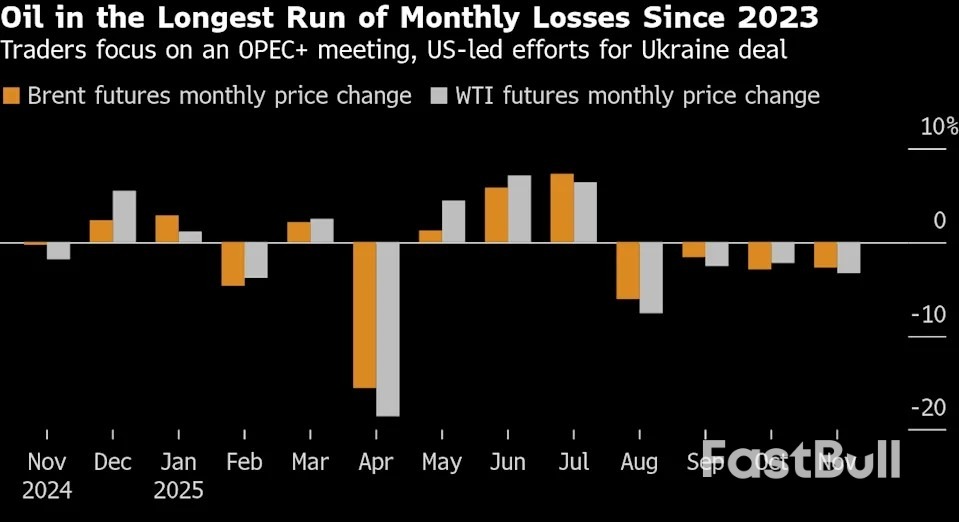
          Oil posted a fourth monthly loss as traders looked ahead to an OPEC+ meeting this weekend and assessed how the potential of easing geopolitical tensions from Kyiv to Caracas may impact an oversupplied market.
          West Texas Intermediate edged down to settle below $59 a barrel, after earlier gaining as much as 1.7%, to close out the longest streak of monthly drops since March 2023. The commodity slid to intra-day lows minutes before settlement as The New York Times reported that US President Donald Trump and Venezuelan counterpart Nicolás Maduro discussed a potential meeting in a call last week. A de-escalation between the Trump administration and the oil-rich South American country would sap a major risk premium out of oil prices.
          The late-day dip capped off a choppy trading session, marked by thin holiday volumes and an hours-long outage on Chicago Mercantile Exchange’s trading platform that roiled global markets. The halt — which the company said was a result of a cooling issue in a data center — also impacted gasoline and diesel futures that are due to expire on Friday.Oil Notches Fourth Monthly Drop on Glut as WTI Trading Resumes_1
          OPEC+ nations are set to meet virtually on Sunday and will probably stick with a plan to pause output increases in early 2026, delegates said. With that decision locked in, a key focus may be a long-term review of members’ capacity.
          US oil has fallen 18% this year, with prices hurt by expectations for a global glut after OPEC+ restarted capacity, while drillers outside the alliance also added supplies.
          On Ukraine, Russian President Vladimir Putin said that US President Donald Trump’s proposals for ending Moscow’s war could be the basis for future agreements and expressed an openness to talks, though sticking points that led to stalemates in previous rounds remain. US presidential envoy Steve Witkoff is expected to visit Moscow next week.
          The peace talks have hit other hurdles, including an embezzlement scandal involving several of Kyiv’s leading public figures. Ukrainian President Volodymyr Zelenskiy on Friday said the nation’s lead negotiator in peace talks, Andriy Yermak, resigned after becoming ensnared in the on-going corruption probe.
          An end to the conflict would have significant ramifications for the oil market. Russia is one of the world’s leading producers and its flows are subject to heavy Western sanctions. Any easing of curbs following a deal could unleash restricted supplies to buyers such as China, India and Turkey.
          “It may take some time for a potential Ukraine-Russia peace deal to go through as Russia may look to store up some barrels instead of rushing to sell them,” said Mukesh Sahdev, the founder and chief executive officer of XAnalysts Pty, an energy market analysis firm. That could make prompt prices slightly bullish, before it gets bearish, he said.

          Source: Bloomberg

          Risk Warnings and Disclaimers
          You understand and acknowledge that there is a high degree of risk involved in trading. Following any strategies or investment methods may lead to potential losses. The content on the site is provided by our contributors and analysts for information purposes only. You are solely responsible for determining whether any trading assets, securities, strategy, or any other product is suitable for investing based on your own investment objectives and financial situation.
          Add to Favorites
          Share

          The Private Equity-Owned Data Center Behind Giant CME Outage

          Manuel

          Stocks

          About 45 minutes west of downtown Chicago lies a rather unassuming, glass-encased data center that some of the world’s largest markets depend on. By one 2018 estimate, at least $25 quadrillion of notional trade volume passes through the facility every day.
          The Aurora, Illinois, complex has served as the primary hub of digital operations for the world’s largest futures exchange operator CME Group Inc. for nearly two decades. The 450,000-square-foot facility is famous among high-frequency traders and Wall Street firms, who’ve long jostled for position around the site to gain a leg up on competitors. At one point, DRW Holdings mounted an antenna on a utility pole near the complex to cut down on the latency. Rival Jump Trading bought property across the street for its own antenna. Scientel erected a tower, too.
          Traders want to be close to the data center to reduce latency, minimizing the distance data must travel in order to shave microseconds off their trades. As a former executive of the data center’s operator once put it: “If you read the book , you can get a real quick lesson on what’s going on.”
          On Friday, the data center — located in the Chicago suburb probably best known for serving as the setting of the comedy film — became infamous to all who trade across equities, foreign exchange, bonds and commodities markets globally. A malfunction in the cooling system at the complex took down virtually all CME futures and options trading platforms, wreaking havoc for traders around the world. The operator of the data center, CyrusOne, said that its teams were working “around the clock” to respond to the cooling system issue but didn’t respond to further questions.
          This critical piece of infrastructure to global markets dates back to 2009, when CME started building the facility to host its electronic trading infrastructure, essentially serving as the backbone for CME’s futures and options trading platform Globex.
          In 2016, CME decided it wanted to shift away from owning infrastructure and sold the site to Dallas-based CyrusOne. As part of the deal, CME agreed to rent space from CyrusOne for 15 years so it could continue to house the computers at the site that keep its markets running, essentially outsourcing its day-to-day operations.
          CyrusOne knew what it was getting into. Gary Wojtaszek, the company’s chief executive officer at the time, described the data center to analysts as “ground zero” for high-speed trading and the “epicenter for all the futures trading.” In laying out the business case for a new tower that the company was building there in 2018 to boost connectivity, he emphasized that “speed is of the essence there.”
          With that, CyrusOne added Aurora to a broader portfolio of roughly 50 data centers across the US, UK, Germany and Singapore that serve customers spanning the technology, financial services, energy, medical, research and consulting industries.
          CyrusOne’s business case is built on going after big clients like CME that are buying virtually all of the space in a data center, according to Tobias Bopp, a manager of strategy and transactions at the consulting firm EY-Parthenon. “They’re building a lot of new data centers, and their position in the market right now is pretty important,” Bopp said in an interview.
          Lauren Eccles, a senior principal consultant specializing in data center recruiting for First Point Group, described CyrusOne as one “the big boys in the game,” pointing to the company’s strong presence in Germany in particular. Generally speaking, she said, “They’re a big player, and they’ve got a really good name.”
          In 2021, that reputation caught the attention of private equity. As the artificial intelligence boom began sending data center demand soaring, KKR & Co. and Global Infrastructure Partners agreed to buy CyrusOne in a deal that was worth roughly $11.4 billion. It was held up at the time as an illustration of how private equity investors were looking to cash in on the surging computing needs of AI model developers and tech giants such as Amazon.com Inc., Alphabet Inc.’s Google and Meta Platforms Inc. Wojtaszek had resigned a year earlier.
          It wouldn’t be the only, or the largest, data center deal for GIP. This year, after BlackRock Inc. bought the investment firm, GIP agreed to buy Aligned Data Centers in a $40 billion deal, marking one of the asset manager’s largest infrastructure investments ever.
          KKR referred all questions on CyrusOne to the data center operator. A spokesperson for GIP owner BlackRock declined to comment.
          It’s unclear whether CyrusOne tried to migrate CME’s operations at Aurora to another data center after the cooling units failed on Thursday.
          And while CME’s disaster recovery plan calls for moving operations to a data center in the New York area, the exchange opted to restart its matching engine from Aurora, according to a person familiar with the matter. The decision was made because the information the exchange had at the time signaled that the cooling issue would be resolved more quickly than it was, the person said.
          According to CyrusOne’s website, the data center features additional chiller units to protect against failures.
          The cooling failure might suggest an issue with the design of the system, according to Thomas Solelhac, a partner at EY-Parthenon. “Normally, in data centers of this type, there is a lot of redundancy to avoid this kind of problem with power and cooling,” Solelhac said.
          CME had expected its 2016 deal with CyrusOne to open it up to more computing resources. While fighting a proposal by Illinois lawmakers to tax trading on exchanges in 2016, CME Executive Chairman Terry Duffy, who is now CEO, suggested that the firm’s deal with CyrusOne would give it access to CyrusOne’s other data centers and not just Aurora.
          “If we need to leave Illinois because of any irrational decisions coming out of the state,” Duffy had said at the time, “we have 29 data centers to choose from.”

          Source: Bloomberg

          Risk Warnings and Disclaimers
          You understand and acknowledge that there is a high degree of risk involved in trading. Following any strategies or investment methods may lead to potential losses. The content on the site is provided by our contributors and analysts for information purposes only. You are solely responsible for determining whether any trading assets, securities, strategy, or any other product is suitable for investing based on your own investment objectives and financial situation.
          Add to Favorites
          Share

          Dow Rises in Shortened Black Friday Trading

          Manuel

          Stocks

          U.S. stocks gained in a shortened session, as investors shrugged off a CME Group outage that disrupted futures trading overnight.
          The Dow industrials, Nasdaq composite and S&P 500 rose 0.5% or more. Some chip makers, including Micron Technology, Analog Devices and Intel, logged bigger gains.
          Nonetheless, the Nasdaq composite registered its first monthly loss since March, after a choppy period when concerns about an AI bubble fueled market volatility. The index fell about 1.5% in November; the S&P 500 and Dow industrials posted small monthly gains.
          CME said its derivatives markets reopened at 8:30 a.m. ET. Before then, traders hadn’t been able to buy or sell CME futures and options, including for U.S. indexes, Treasurys, gold and oil due to cooling problems at a key data center.
          Analysts said the CME outage lowered trading volumes on what was already expected to be one of the quietest trading days of the year.
          Global markets were little changed, with the Stoxx Europe 600 and Japan’s Nikkei 225 gaining less than 0.3%. Hong Kong’s Hang Seng Index fell 0.3%.
          Shares in some U.S. retailers rose as shoppers flocked to snap up Black Friday bargains. Walmart was up over 1%. The National Retail Federation forecasts a record 186.9 million people to shop between Thanksgiving and “Cyber Monday” on Dec. 1.
          Markets expect the Federal Reserve to cut interest rates again next week, following signs that the labor market is cooling. Allies of Fed Chair Jerome Powell have laid the groundwork for him to push a cut through a divided committee. Traders have doubled their bets over the last week on a cut to around 87%, according to the CME’s FedWatch tool.
          Silver futures jumped Friday, topping $55 per troy ounce. Analysts attributed the surge to a supply squeeze, with Chinese inventories at the lowest level in a decade, as well as expectations for another Fed cut. Gold futures also rallied.
          The dollar held broadly steady against a basket of other currencies, after slipping earlier this week. Treasury yields edged up, but remained around their lowest levels since late October.
          Bitcoin topped $92,000 before paring some gains. It has regained ground after sliding toward $80,000 last week, but remains far off its October peak above $126,000. Shares in Coinbase and bitcoin-buyer Strategy gained.

          Source: TWSJ

          Risk Warnings and Disclaimers
          You understand and acknowledge that there is a high degree of risk involved in trading. Following any strategies or investment methods may lead to potential losses. The content on the site is provided by our contributors and analysts for information purposes only. You are solely responsible for determining whether any trading assets, securities, strategy, or any other product is suitable for investing based on your own investment objectives and financial situation.
          Add to Favorites
          Share
          FastBull
          Copyright © 2025 FastBull Ltd

          728 RM B 7/F GEE LOK IND BLDG NO 34 HUNG TO RD KWUN TONG KLN HONG KONG

          TelegramInstagramTwitterfacebooklinkedin
          App Store Google Play Google Play
          Products
          Charts

          Chats

          Q&A with Experts
          Screeners
          Economic Calendar
          Data
          Tools
          Membership
          Features
          Function
          Markets
          Copy Trading
          Latest Signals
          Contests
          News
          Analysis
          24/7
          Columns
          Education
          Company
          Careers
          About Us
          Contact Us
          Advertising
          Help Center
          Feedback
          User Agreement
          Privacy Policy
          Business

          White Label

          Data API

          Web Plug-ins

          Poster Maker

          Affiliate Program

          Risk Disclosure

          The risk of loss in trading financial instruments such as stocks, FX, commodities, futures, bonds, ETFs and crypto can be substantial. You may sustain a total loss of the funds that you deposit with your broker. Therefore, you should carefully consider whether such trading is suitable for you in light of your circumstances and financial resources.

          No decision to invest should be made without thoroughly conducting due diligence by yourself or consulting with your financial advisors. Our web content might not suit you since we don't know your financial conditions and investment needs. Our financial information might have latency or contain inaccuracy, so you should be fully responsible for any of your trading and investment decisions. The company will not be responsible for your capital loss.

          Without getting permission from the website, you are not allowed to copy the website's graphics, texts, or trademarks. Intellectual property rights in the content or data incorporated into this website belong to its providers and exchange merchants.

          Not Logged In

          Log in to access more features

          FastBull Membership

          Not yet

          Purchase

          Become a signal provider
          Help Center
          Customer Service
          Dark Mode
          Price Up/Down Colors

          Log In

          Sign Up

          Position
          Layout
          Fullscreen
          Default to Chart
          The chart page opens by default when you visit fastbull.com