• Trade
  • Markets
  • Copy
  • Contests
  • News
  • 24/7
  • Calendar
  • Q&A
  • Chats
Trending
Screeners
SYMBOL
LAST
BID
ASK
HIGH
LOW
NET CHG.
%CHG.
SPREAD
SPX
S&P 500 Index
6827.42
6827.42
6827.42
6899.86
6801.80
-73.58
-1.07%
--
DJI
Dow Jones Industrial Average
48458.04
48458.04
48458.04
48886.86
48334.10
-245.98
-0.51%
--
IXIC
NASDAQ Composite Index
23195.16
23195.16
23195.16
23554.89
23094.51
-398.69
-1.69%
--
USDX
US Dollar Index
97.950
98.030
97.950
98.500
97.950
-0.370
-0.38%
--
EURUSD
Euro / US Dollar
1.17394
1.17409
1.17394
1.17496
1.17192
+0.00011
+ 0.01%
--
GBPUSD
Pound Sterling / US Dollar
1.33707
1.33732
1.33707
1.33997
1.33419
-0.00148
-0.11%
--
XAUUSD
Gold / US Dollar
4299.39
4299.39
4299.39
4353.41
4257.10
+20.10
+ 0.47%
--
WTI
Light Sweet Crude Oil
57.233
57.485
57.233
58.011
56.969
-0.408
-0.71%
--

Community Accounts

Signal Accounts
--
Profit Accounts
--
Loss Accounts
--
View More

Become a signal provider

Sell trading signals to earn additional income

View More

Guide to Copy Trading

Get started with ease and confidence

View More

Signal Accounts for Members

All Signal Accounts

Best Return
  • Best Return
  • Best P/L
  • Best MDD
Past 1W
  • Past 1W
  • Past 1M
  • Past 1Y

All Contests

  • All
  • Trump Updates
  • Recommend
  • Stocks
  • Cryptocurrencies
  • Central Banks
  • Featured News
Top News Only
Share

Thai Leader Anutin: Landmine Blast That Killed Thai Soldiers 'Not A Roadside Accident'

Share

Thai Leader Anutin: Thailand To Continue Military Action Until 'We Feel No More Harm'

Share

Cambodian Prime Minister Hun Manet Says He Had Phone Calls With Trump And Malaysian Leader Anwar About Ceasefire

Share

Cambodia's Hun Manet Says USA, Malaysia Should Verify 'Which Side Fired First' In Latest Conflict

Share

Cambodia's Hun Manet: Cambodia Maintains Its Stance In Seeking Peaceful Resolution Of Disputes

Share

Nasdaq Companies: Allergan, Ferrovia, Insmed, Monolithic Power Systems, Seagate Technology, And Western Digital Will Be Added To The NASDAQ 100 Index. Biogen, CdW, GlobalFoundries, Lululemon, ON Semiconductor, And Tradedesk Will Be Removed From The NASDAQ 100 Index

Share

Witkoff Headed To Berlin This Weekend To Meet With Zelenskiy, European Leaders -Wsj Reporter On X

Share

Russia Attacks Two Ukrainian Ports, Damaging Three Turkish-Owned Vessels

Share

[Historic Flooding Occurs In At Least Four Rivers In Washington State Due To Days Of Torrential Rains] Multiple Areas In Washington State Have Been Hit By Severe Flooding Due To Days Of Torrential Rains, With At Least Four Rivers Experiencing Historic Flooding. Reporters Learned On The 12th That The Floods Caused By The Torrential Rains In Washington State Have Destroyed Homes And Closed Several Highways. Experts Warn That Even More Severe Flooding May Occur In The Future. A State Of Emergency Has Been Declared In Washington State

Share

Trump Says Proposed Free Economic Zone In Donbas Would Work

Share

Trump: I Think My Voice Should Be Heard

Share

Trump Says Will Be Choosing New Fed Chair In Near Future

Share

Trump Says Proposed Free Economic Zone In Donbas Complex But Would Work

Share

Trump Says Land Strikes In Venezuela Will Start Happening

Share

US President Trump: Thailand And Cambodia Are In A Good Situation

Share

State Media: North Korean Leader Kim Hails Troops Returning From Russia Mission

Share

The 10-year Treasury Yield Rose About 5 Basis Points During The "Fed Rate Cut Week," And The 2/10-year Yield Spread Widened By About 9 Basis Points. On Friday (December 12), In Late New York Trading, The Yield On The Benchmark 10-year US Treasury Note Rose 2.75 Basis Points To 4.1841%, A Cumulative Increase Of 4.90 Basis Points For The Week, Trading Within A Range Of 4.1002%-4.2074%. It Rose Steadily From Monday To Wednesday (before The Fed Announced Its Rate Cut And Treasury Bill Purchase Program), Subsequently Exhibiting A V-shaped Recovery. The 2-year Treasury Yield Fell 1.82 Basis Points To 3.5222%, A Cumulative Decrease Of 3.81 Basis Points For The Week, Trading Within A Range Of 3.6253%-3.4989%

Share

Trump: Lots Of Progress Being Made On Russia-Ukraine

Share

NOPA November US Soybean Crush Estimated At 220.285 Million Bushels

Share

SPDR Gold Trust Reports Holdings Up 0.22%, Or 2.28 Tonnes, To 1053.11 Tonnes By Dec 12

TIME
ACT
FCST
PREV
U.K. Trade Balance Non-EU (SA) (Oct)

A:--

F: --

P: --

U.K. Trade Balance (Oct)

A:--

F: --

P: --

U.K. Services Index MoM

A:--

F: --

P: --

U.K. Construction Output MoM (SA) (Oct)

A:--

F: --

P: --

U.K. Industrial Output YoY (Oct)

A:--

F: --

P: --

U.K. Trade Balance (SA) (Oct)

A:--

F: --

P: --

U.K. Trade Balance EU (SA) (Oct)

A:--

F: --

P: --

U.K. Manufacturing Output YoY (Oct)

A:--

F: --

P: --

U.K. GDP MoM (Oct)

A:--

F: --

P: --

U.K. GDP YoY (SA) (Oct)

A:--

F: --

P: --

U.K. Industrial Output MoM (Oct)

A:--

F: --

P: --

U.K. Construction Output YoY (Oct)

A:--

F: --

P: --

France HICP Final MoM (Nov)

A:--

F: --

P: --

China, Mainland Outstanding Loans Growth YoY (Nov)

A:--

F: --

P: --

China, Mainland M2 Money Supply YoY (Nov)

A:--

F: --

P: --

China, Mainland M0 Money Supply YoY (Nov)

A:--

F: --

P: --

China, Mainland M1 Money Supply YoY (Nov)

A:--

F: --

P: --

India CPI YoY (Nov)

A:--

F: --

P: --

India Deposit Gowth YoY

A:--

F: --

P: --

Brazil Services Growth YoY (Oct)

A:--

F: --

P: --

Mexico Industrial Output YoY (Oct)

A:--

F: --

P: --

Russia Trade Balance (Oct)

A:--

F: --

P: --

Philadelphia Fed President Henry Paulson delivers a speech
Canada Building Permits MoM (SA) (Oct)

A:--

F: --

P: --

Canada Wholesale Sales YoY (Oct)

A:--

F: --

P: --

Canada Wholesale Inventory MoM (Oct)

A:--

F: --

P: --

Canada Wholesale Inventory YoY (Oct)

A:--

F: --

P: --

Canada Wholesale Sales MoM (SA) (Oct)

A:--

F: --

P: --

Germany Current Account (Not SA) (Oct)

A:--

F: --

P: --

U.S. Weekly Total Rig Count

A:--

F: --

P: --

U.S. Weekly Total Oil Rig Count

A:--

F: --

P: --

Japan Tankan Large Non-Manufacturing Diffusion Index (Q4)

--

F: --

P: --

Japan Tankan Small Manufacturing Outlook Index (Q4)

--

F: --

P: --

Japan Tankan Large Non-Manufacturing Outlook Index (Q4)

--

F: --

P: --

Japan Tankan Large Manufacturing Outlook Index (Q4)

--

F: --

P: --

Japan Tankan Small Manufacturing Diffusion Index (Q4)

--

F: --

P: --

Japan Tankan Large Manufacturing Diffusion Index (Q4)

--

F: --

P: --

Japan Tankan Large-Enterprise Capital Expenditure YoY (Q4)

--

F: --

P: --

U.K. Rightmove House Price Index YoY (Dec)

--

F: --

P: --

China, Mainland Industrial Output YoY (YTD) (Nov)

--

F: --

P: --

China, Mainland Urban Area Unemployment Rate (Nov)

--

F: --

P: --

Saudi Arabia CPI YoY (Nov)

--

F: --

P: --

Euro Zone Industrial Output YoY (Oct)

--

F: --

P: --

Euro Zone Industrial Output MoM (Oct)

--

F: --

P: --

Canada Existing Home Sales MoM (Nov)

--

F: --

P: --

Euro Zone Total Reserve Assets (Nov)

--

F: --

P: --

U.K. Inflation Rate Expectations

--

F: --

P: --

Canada National Economic Confidence Index

--

F: --

P: --

Canada New Housing Starts (Nov)

--

F: --

P: --

U.S. NY Fed Manufacturing Employment Index (Dec)

--

F: --

P: --

U.S. NY Fed Manufacturing Index (Dec)

--

F: --

P: --

Canada Core CPI YoY (Nov)

--

F: --

P: --

Canada Manufacturing Unfilled Orders MoM (Oct)

--

F: --

P: --

Canada Manufacturing New Orders MoM (Oct)

--

F: --

P: --

Canada Core CPI MoM (Nov)

--

F: --

P: --

Canada Manufacturing Inventory MoM (Oct)

--

F: --

P: --

Canada CPI YoY (Nov)

--

F: --

P: --

Canada CPI MoM (Nov)

--

F: --

P: --

Canada CPI YoY (SA) (Nov)

--

F: --

P: --

Canada Core CPI MoM (SA) (Nov)

--

F: --

P: --

Q&A with Experts
    • All
    • Chatrooms
    • Groups
    • Friends
    Connecting
    .
    .
    .
    Type here...
    Add Symbol or Code

      No matching data

      All
      Trump Updates
      Recommend
      Stocks
      Cryptocurrencies
      Central Banks
      Featured News
      • All
      • Russia-Ukraine Conflict
      • Middle East Flashpoint
      • All
      • Russia-Ukraine Conflict
      • Middle East Flashpoint
      Search
      Products

      Charts Free Forever

      Chats Q&A with Experts
      Screeners Economic Calendar Data Tools
      Membership Features
      Data Warehouse Market Trends Institutional Data Policy Rates Macro

      Market Trends

      Market Sentiment Order Book Forex Correlations

      Top Indicators

      Charts Free Forever
      Markets

      News

      News Analysis 24/7 Columns Education
      From Institutions From Analysts
      Topics Columnists

      Latest Views

      Latest Views

      Trending Topics

      Top Columnists

      Latest Update

      Signals

      Copy Rankings Latest Signals Become a signal provider AI Rating
      Contests
      Brokers

      Overview Brokers Assessment Rankings Regulators News Claims
      Broker listing Forex Brokers Comparison Tool Live Spread Comparison Scam
      Q&A Complaint Scam Alert Videos Tips to Detect Scam
      More

      Business
      Events
      Careers About Us Advertising Help Center

      White Label

      Data API

      Web Plug-ins

      Affiliate Program

      Awards Institution Evaluation IB Seminar Salon Event Exhibition
      Vietnam Thailand Singapore Dubai
      Fans Party Investment Sharing Session
      FastBull Summit BrokersView Expo
      Recent Searches
        Top Searches
          Markets
          News
          Analysis
          User
          24/7
          Economic Calendar
          Education
          Data
          • Names
          • Latest
          • Prev

          View All

          No data

          Scan to Download

          Faster Charts, Chat Faster!

          Download App
          English
          • English
          • Español
          • العربية
          • Bahasa Indonesia
          • Bahasa Melayu
          • Tiếng Việt
          • ภาษาไทย
          • Français
          • Italiano
          • Türkçe
          • Русский язык
          • 简中
          • 繁中
          Open Account
          Search
          Products
          Charts Free Forever
          Markets
          News
          Signals

          Copy Rankings Latest Signals Become a signal provider AI Rating
          Contests
          Brokers

          Overview Brokers Assessment Rankings Regulators News Claims
          Broker listing Forex Brokers Comparison Tool Live Spread Comparison Scam
          Q&A Complaint Scam Alert Videos Tips to Detect Scam
          More

          Business
          Events
          Careers About Us Advertising Help Center

          White Label

          Data API

          Web Plug-ins

          Affiliate Program

          Awards Institution Evaluation IB Seminar Salon Event Exhibition
          Vietnam Thailand Singapore Dubai
          Fans Party Investment Sharing Session
          FastBull Summit BrokersView Expo

          It’s TACO Tuesday, as markets ignore Trump’s tariff threats

          Adam

          Economic

          Summary:

          Markets shrugged off Trump’s tariff threats as the deadline shifted to August 1. Japanese stocks rose, EUR/USD neared 1.20 amid EU–US trade deal hopes, and bond yields surged on improved risk sentiment.

          This week was all about Wednesday’s reciprocal tariff deadline in the US. Except, Donald Trump has now kicked the can down the road to August 1st. This means that countries who have yet to secure a deal, or a letter, will have three weeks for more negotiations. The President may have hit Japan, South Korea and other trade allies with tough tariff rates on Monday, but even these aren’t set in stone, and the market reaction on Tuesday reflects this.

          Japan fights fire with fire on trade talks, as stocks remain calm

          Japanese stocks are higher, the Nikkei is higher by 0.25%, and the loss in the last 5 days is a mere 0.75%. This suggests that we are not repeating the sharp sell off and spike in volatility that we saw in April. After falling sharply on Monday, US equity futures are also pointing to a higher open later today, and the Vix is stable and below the average rate for the last 12 months.
          As negotiations continue, officials in Japan have stood firm against Trump’s tariffs and set out their red lines earlier today. They said that they will not sacrifice Japanese agriculture in trade talks with the US, and an agreement with the US will not be reached until there is a better agreement regarding the car sector. This is worth noting. Japan is fighting fire with fire and is not backing down to get a quick trade deal with the US on better terms. This suggests that Japan thinks that Trump will back down and lower their tariff rates in the coming weeks. The market is aligned with this view, hence the mild reaction to yesterday’s tariff news.

          EU/US trade agreement could push EUR/USD to $1.20

          The dollar is erasing Monday’s gains, and the yen is down a mere 0.1% on Tuesday, the South Korean won is in recovery mode and is higher by 0.8% vs. the USD this morning. The euro is also higher on Tuesday, and EUR/USD is a mere 140 points away from $1.20. Reports suggest that a trade agreement is in the wings between the EU and the US. The US has offered the EU a 10% baseline tariff rate, except for aircraft and sprits. This is a rate that the EU could cope with and may not have major economic ramifications.
          This deal has not been officially announced, and the EU could still come under pressure from tariffs if the US announce more sector specific tariffs, including on pharma. However, for now, the news is positive, and unless something changes that, today could be a good day for the single currency, with $1.20 a possibility. Hopes for a trade deal means that weakness in Germany’s imports and exports for May have been sidelined, as traders favour the euro over safe havens.

          Bond yields surge as Trump’s trade deals weigh on bonds

          The bond market is also reflecting a potential EU/ US trade agreement. European bond yields are rising sharply on Tuesday. The 10-year German Bund yield is higher by 5bps and yields are rising at a faster pace in Germany than in the UK and the US. Japanese long end bond yields are also rising sharply. Whereas German yields are rising because of a rumored positive trade deal between the EU and the US, Japanese yields are rising because there are concerns that a bad trade deal with the US will push up Japan’s government borrowing needs.

          Is this the peak for the Swissie?

          The FX market is in risk on mode today, the Swiss franc is one of the weakest currencies in the G10 FX space on Tuesday, after reaching multiyear highs vs. the USD and the EUR. This is a sign that risk sentiment is back on, and it will be worth watching to see if the Swissie loses ground from here, as the existential threat from tariffs recedes.
          Ahead today, the focus will be on trade headlines and the potential for an announcement of an EU/US trade deal. Will Trump be as lenient to the EU as reports suggests? If yes, then this is a big win for the currency bloc.

          source :xtb

          To stay updated on all economic events of today, please check out our Economic calendar
          Risk Warnings and Disclaimers
          You understand and acknowledge that there is a high degree of risk involved in trading. Following any strategies or investment methods may lead to potential losses. The content on the site is provided by our contributors and analysts for information purposes only. You are solely responsible for determining whether any trading assets, securities, strategy, or any other product is suitable for investing based on your own investment objectives and financial situation.
          Add to Favorites
          Share

          Auto Winners and Losers of Proposed EU-US Export Mechanism

          Warren Takunda

          Economic

          China–U.S. Trade War

          Brussels is considering pursuing a potential arrangement that would allow European automakers that produce and export cars from the United States to import vehicles from the EU at reduced tariff rates, according to two sources familiar with the matter.
          The discussion is part of the European Commission's efforts to broker a trade deal with U.S. President Donald Trump and would replace the hefty 25% tariff on car and car part imports the U.S. administration implemented in April.
          This would be a clear positive for those carmakers with major U.S. production facilities, who would be able to use their U.S. production to lower their exposure to tariffs.
          This is what a trade deal means for the EU and how individual European automakers would be affected:

          WHAT'S AT STAKE FOR EU?

          According to data from European auto association ACEA, nearly 758,000 cars worth 38.9 billion euros ($45.55 billion) were exported to the U.S. from Europe in 2024, more than four times as many as in the other direction.
          One EU diplomat said cars were a "red line" for the bloc, making a concession on cars a caveat of any deal. However, Brussels and Washington have conflicting goals as Trump wants to revive U.S. auto production while Brussels wants open markets for its sector, which is struggling with high energy costs and competition from China.

          WHO STANDS TO WIN?

          Germany's BMW and Mercedes-Benz would benefit most from a mechanism counting U.S. exports against imports from the EU, as both companies operate large factories in the United States.
          BMW, for example, exported around 225,000 vehicles produced at its Spartanburg, South Carolina, plant in 2024, while it sold around 400,000 autos in the U.S. market. It imported around 175,000 autos from other markets, less than what it exported.
          Mercedes-Benz exports around two thirds of the vehicles it makes at its plant in Tuscaloosa, Alabama, or around 170,000 based on 2024 production.
          It sold around 324,528 vehicles in the United States last year and imported around 235,000 from other countries.

          WHO WOULD BE THE LOSERS?

          Volkswagen, Europe's biggest carmaker, would not benefit, as it mostly sells cars produced at its Chattanooga, Tennessee, plant locally rather than exporting them.
          An industry source said for that reason, there has also been a push to get Washington to agree to investment credits, which would support foreign automakers' plans to expand to boost local production.
          Volkswagen, for example, is currently deciding whether to localise production of its Audi brand - which imports all of its cars into the U.S. market - either via a new factory or expanding existing sites.
          Porsche would also see no benefit: it has no local production and imports all of its cars from Europe.

          LITTLE IMPACT FOR STELLANTIS

          Stellantis, the world's No. 4 automaker, owner of brands including Jeep, Ram and Chrysler, would not be seriously affected by such an arrangement.
          Stellantis operates a number of U.S. plants, mostly serving the local market, while import and export flows of its cars between the U.S. and the European Union have historically been very low - typically small volumes of U.S.-made trucks versus European-made models from the Alfa Romeo, Maserati and Fiat brands.
          The group is far more vulnerable to any U.S. tariffs on Mexico and Canada, as it manufactures around 40% of its North American vehicles in those two countries, particularly in Mexico.

          CLEAR LOSS FOR VOLVO CARS

          Volvo Cars is one of the most exposed European automakers to U.S. tariffs, as most of the cars it sells there are imported from Europe. The U.S. accounted for 16% of group sales last year.
          The company has said it will expand production at its Charleston, South Carolina factory, adding a new model alongside the electric EX90 that is currently made there.
          Volvo has said the new vehicle would most likely be a plug-in hybrid mid-sized SUV, a popular option with U.S. consumers.
          Last year Polestar, which like Volvo Cars is part of China's Geely group, started producing the Polestar 3 SUV at the Charleston plant to avoid hefty U.S. tariffs on Chinese-made cars.

          Source: Reuters

          To stay updated on all economic events of today, please check out our Economic calendar
          Risk Warnings and Disclaimers
          You understand and acknowledge that there is a high degree of risk involved in trading. Following any strategies or investment methods may lead to potential losses. The content on the site is provided by our contributors and analysts for information purposes only. You are solely responsible for determining whether any trading assets, securities, strategy, or any other product is suitable for investing based on your own investment objectives and financial situation.
          Add to Favorites
          Share

          RBA Governor Bullock Hints at August Cut After Surprise Hold; AUD/USD Jumps

          Adam

          Economic

          Central Bank

          RBA Governor Michele Bullock Toes Cautious Policy Line

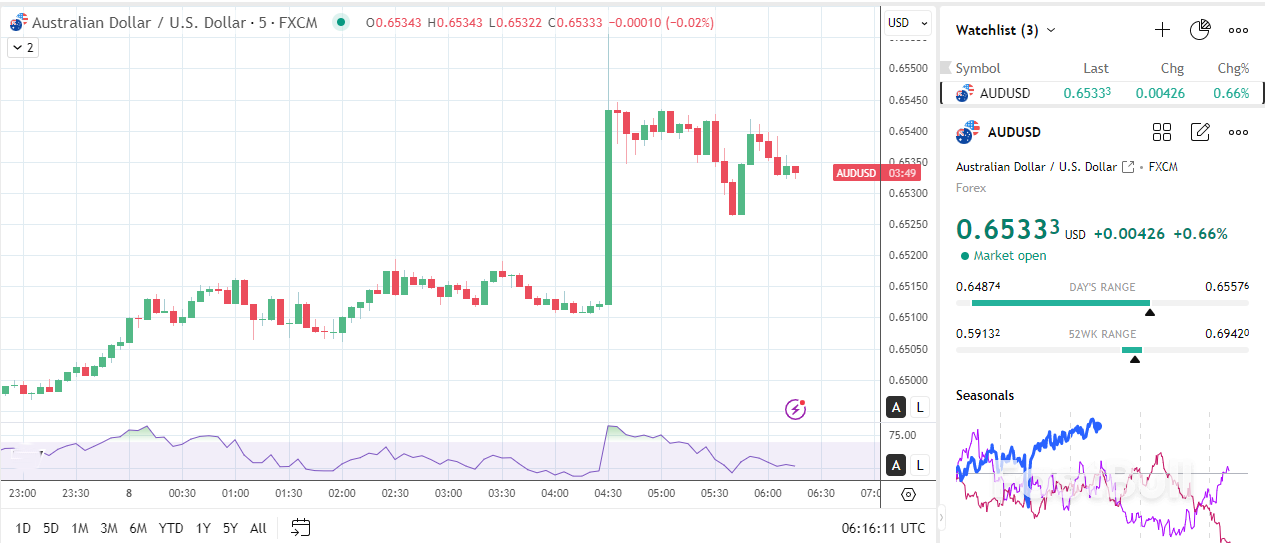
          RBA Governor Michele Bullock held a test press conference after the Bank unexpectedly held interest rates at 3.85%. Falling bets on multiple rate cuts in H2 2025 drove the AUD/USD pair higher, exposing the pair to heightened volatility during the press conference. However, the pair dipped during the press conference as RBA Governor Bullock hinted at a possible August rate cut.
          Key Takeaways from the media Q&A:
          If the quarterly CPI shows inflation falling toward the middle of the band over time, the RBA can cut interest rates in the next meeting.
          We have the opportunity to cut rates cautiously and gradually as the RBA didn’t hike rates to levels seen elsewhere.
          The RBA could cut rates more aggressively if needed.
          On tariffs, there will be an impact on us, partly driving deflationary forecasts, but the impact on Australia will likely be less severe than on the US. Trade terms with China remain crucial.
          The Reserve Bank can’t go out and warn markets against rate cut bets before the interest rate decision.
          Differences among board members relate to the timing of rate cuts, not the direction.
          Households should be banking on us to ensure inflation doesn’t get out of hand again.
          We’ve still got a low unemployment rate relative to history.
          Provided we are still on top of inflation and we are getting confirmation, then an easing cycle is coming.
          House building costs and durable goods in the monthly CPI numbers were higher than the RBA thought, contributing to the rate cut delay.
          If there is an external shock, the RBA has room to react.
          We are not keeping interest rates high just in case. We are reacting to the data.
          If China bolsters its economy with fiscal stimulus, that could cushion the impact of tariffs on Australia’s economy.

          RBA Surprises Markets, Fueling Aussie Dollar Demand

          Earlier on Tuesday, the RBA caught markets by surprise, leaving the cash rate at 3.85%. Economists expected a 25-basis point rate cut. The RBA Rate Statement set the stage for a testy press conference for RBA Governor Michele Bullock.

          Expert Views on the RBA Rate Path

          Shane Oliver, Head of Investment Strategy and Chief Economist at AMP, remarked on the RBA’s interest rate decision, stating:
          “RBA surprised on hold waiting for a more info inflation is on track for 2.5%. With the RBA seeing inflation risks more balanced, remaining “cautious” & noting heightened uncertainty & the cash rate > neutral we still it falling to 2.85% but more slowly with next cut in Aug.”
          AUD/USD Reacts to Governor Michele Bullock’s Q&A Session
          The AUD/USD pair soared in reaction to the RBA’s interest rate decision, climbing from $0.65120 to a pre-press conference high of 0.65567.
          The AUD/USD gave up some gains during the RBA press conference, falling from $0.65427 to a low of $0.65263 before steadying. The market reaction reflected hopes of an August rate cut but a potentially less dovish RBA policy stance, narrowing the US-Australia interest rate differential in favor of the Aussie dollar.
          On Tuesday, July 8, the AUD/USD was up 0.66% to $0.65333.
          RBA Governor Bullock Hints at August Cut After Surprise Hold; AUD/USD Jumps_1

          AUDUSD – 5 Minute Chart – 080725

          Source: fxempire

          To stay updated on all economic events of today, please check out our Economic calendar
          Risk Warnings and Disclaimers
          You understand and acknowledge that there is a high degree of risk involved in trading. Following any strategies or investment methods may lead to potential losses. The content on the site is provided by our contributors and analysts for information purposes only. You are solely responsible for determining whether any trading assets, securities, strategy, or any other product is suitable for investing based on your own investment objectives and financial situation.
          Add to Favorites
          Share

          ’It’s Dangerous to Underestimate Corporate America’: BofA Ups S&P 500 Target

          Glendon

          Economic

          Stocks

          Bank of America raised its S&P 500 year-end target to 6,300 from 5,600, citing the resilience of U.S. corporations despite persistent macroeconomic uncertainty.

          In a note Tuesday, the bank’s analysts wrote, “It’s dangerous to underestimate Corporate America,” and admitted, “Mea culpa for ignoring our own advice (above) on Liberation Day.”

          The firm also introduced a 12-month target of 6,600, saying a lower equity risk premium (ERP) assumption now offsets the headwinds from elevated sovereign yields.

          “The resiliency of large public companies in the face of macro uncertainty leads us to lower our equity risk premium (ERP) assumption,” BofA said.

          While acknowledging that “policy uncertainty is near all-time highs and sovereign yields are at multi-decade highs,” BofA believes the outlook is brighter for equities than bonds.

          “Price return is only half the story – dividends are likely to contribute more from here,” the analysts wrote. “Aging demographics and sticky inflation create a compelling supply/demand case for inflation-proof income and easily favors stocks over bonds.”

          In the near term, BofA noted that momentum could slow, saying the S&P 500’s run “into Q3” lacks an obvious catalyst. “Negative guidance and revisions in April/May have improved to average levels but economic surprises have broken down,” it said.

          However, looking further ahead, BofA is more constructive: “Deregulation and a pick-up in business investment could buoy markets ahead of mid-term elections.”

          Even with modest long-term price returns projected from today’s elevated multiples, BofA remains bullish. “Corporate transparency has remained intact,” the analysts concluded, adding that since COVID, “corporates either adapted or dropped out of the index.”

          Source: Yahoo Finance

          To stay updated on all economic events of today, please check out our Economic calendar
          Risk Warnings and Disclaimers
          You understand and acknowledge that there is a high degree of risk involved in trading. Following any strategies or investment methods may lead to potential losses. The content on the site is provided by our contributors and analysts for information purposes only. You are solely responsible for determining whether any trading assets, securities, strategy, or any other product is suitable for investing based on your own investment objectives and financial situation.
          Add to Favorites
          Share

          Stocks supported by tariff "cliff edge" delay

          Adam

          Stocks

          European equities traded largely higher heading into Tuesday afternoon, with a tariff implementation delay supporting shares, but uncertainty over the future of US trade policy keeping a lid on the enthusiasm.
          "While new levies were announced for 14 trading partners, news of a pause until 1 August to allow for further negotiations was received positively. This removes the immediate cliff edge created by a 9 July deadline and US president Trump has indicated that even this new date is not set in stone," AJ Bell analyst Dan Coatsworth commented.
          The FTSE 100 index rose 17.61 points, 0.2%, to 8,824.14. The FTSE 250 was up just 7.48 points at 21,545.96, and the AIM All-Share was up 3.41 points, 0,4%, at 775.37.
          The Cboe UK 100 was up 0.2% at 879.93. The Cboe UK 250 was also up 0.2% at 19,063.73, and the Cboe Small Companies added 0.1% to 17,527.56.
          In European equities on Tuesday, the CAC 40 in Paris fell 0.1%, while the DAX 40 in Frankfurt rose 0.4%.
          The pound traded at USD1.3581 on Tuesday afternoon, down from USD1.3641 at the time of the London equities close on Monday. The euro slipped to USD1.1726 from USD1.1735. Against the yen, the dollar rose to JPY146.34 from JPY145.86.
          The yield on the US 10-year Treasury was quoted at 4.41% early Tuesday afternoon UK time, widening from 4.39%, where it stood at the time of the London equities close on Monday. The yield on the US 30-year Treasury was quoted at 4.95%, stretching from 4.92%.
          The Dow Jones Industrial Average is called down 0.1%, the S&P 500 is called to open slightly higher, and the Nasdaq Composite up 0.2%.
          "This week was all about Wednesday's reciprocal tariff deadline in the US. Except, Donald Trump has now kicked the can down the road to August 1st. This means that countries who have yet to secure a deal, or a letter, will have three weeks for more negotiations. The president may have hit Japan, South Korea and other trade allies with tough tariff rates on Monday, but even these aren't set in stone, and the market reaction on Tuesday reflects this," XTB analyst Kathleen Brooks commented.
          "This suggests that we are not repeating the sharp sell off and spike in volatility that we saw in April. After falling sharply on Monday, US equity futures are also pointing to a higher open later today, and the Vix is stable and below the average rate for the last 12 months."
          Politico reported that the US has offered the EU a deal that will keep a 10% baseline tariffs on all goods, with the exception of some sectors such as aircraft and spirits.
          Berenberg analyst Holger Schmieding commented: "The EU is reportedly rushing to conclude a deal with the US, possibly by the end of this week already. Amid media reports about significant progress in these talks, major stumbling blocks remain. The EU seems to have grudgingly accepted that the current 10% US base tariff in addition to some sectoral tariffs cannot be negotiated away. The EU still hopes to get some limited exemptions from these tariffs, for example for aircraft and aircraft parts, so that the overall rise in the average US tariff on imports from the EU this year will be below 10 percentage points. The US is so far threatening to impose higher tariffs than that.
          "Unsurprisingly, the negotiations are apparently complicated by some internal disagreements within the EU. Countries with a high exposure to the US goods market such as Germany and most countries to the north and east of Germany favour a softer line to conclude a deal fast whereas France and other countries mostly in southern Europe favour a harder line, including a threat to retaliate significantly against the extra US tariffs. Of course, some internal disagreements are par for the course, within the US administration as much as within the EU."
          In London, Entain was the best FTSE 100 performer, rising 3.4% after Bank of America lifted the stock to 'buy'. Former FTSE 100 listing Flutter climbed 1.4% after Jefferies resumed the gambling firm at 'buy'.
          Miners traded higher, with Glencore among the best of the lot, up 2.5%.
          Rio Tinto advanced 0.6%. The miner is looking for a new chief executive who will improve productivity and cut costs while also being open to transformative mergers and acquisitions, Reuters reported on Tuesday.
          Rio back in May said Jakob Stausholm will step down as chief executive "later this year". Stausholm joined Rio in 2018 as chief financial officer and became CEO at the start of 2021. He continues to lead the London-based miner while a successor is found.
          Chair Dominic Barton is leading the search. CEO contenders will present to the Rio board this week, Reuters said, citing two sources. An announcement of a new CEO could come as soon as this month, one source said.
          Barton wants a CEO who will sharpen productivity and cut costs and be open to transformative M&A deals, Reuters said, citing "two people aware of the chair's priorities".
          Rio Tinto is among the FTSE 100's largest constituents. Among the other index powerhouses to trade higher were lender HSBC, up 0.9%, and oil major Shell, 0.8% higher after a 2.9% decline on Monday.
          Begbies Traynor added 8.1%. It reported growth in annual earnings and the professional services consultancy said "activity levels are encouraging".
          The Manchester, England-based insolvency advisor said in the financial year ended April 30, pretax profit roughly doubled to GBP11.5 million from GBP5.8 million. Revenue rose 12% to GBP153.7 million from GBP136.7 million,
          Executive Chair Ric Traynor said: "Looking forward, activity levels are encouraging with positive momentum across the group. We have increased the scale of our teams and market conditions are supportive. We currently expect revenue will be at the upper end of the range of market expectations, with a further year of profit growth in line with expectations, as we continue to invest in growing the business."
          Begbies lifted its final dividend by 7.4% to 2.9 pence per share from 2.7p. Its total dividend was 7.5% higher at 4.3p from 4.0p.
          A barrel of Brent rose to USD69.09 early Tuesday afternoon, from USD68.84 late Monday afternoon. Gold traded at USD3,325.55 an ounce, up from USD3,320.60.
          UK public finances were back in focus on Tuesday. The UK's public finances are in a "relatively vulnerable position" amid pressure from recent U-turns on planned spending cuts, the UK's official forecaster has warned.
          The Office for Budget Responsibility said the state finances were facing "mounting risks" but that recent governments have had only limited success in improving the fiscal outlook.
          UK public sector debt stood at 96.4% of GDP, gross domestic product, in May, according to latest figures from the Office for National Statistics, ONS.
          The OBR said its annual fiscal risks and sustainability report that debt is projected to be "above 270% of GDP by the early 2070s".
          The yield on the 10-year gilt stood at 4.64%, stretching from 4.58% late Monday.

          Source: Alliance News

          Risk Warnings and Disclaimers
          You understand and acknowledge that there is a high degree of risk involved in trading. Following any strategies or investment methods may lead to potential losses. The content on the site is provided by our contributors and analysts for information purposes only. You are solely responsible for determining whether any trading assets, securities, strategy, or any other product is suitable for investing based on your own investment objectives and financial situation.
          Add to Favorites
          Share

          BCA Sees More Downside for Brent in H2

          Michelle

          Commodity

          Crude oil prices had a difficult first half of 2025, and BCA Research sees more downside as the year progresses as bearish demand developments dominate.

          The main global benchmark Brent lost over 6% in the first half of the year, to trade just below the $70 a barrel level, with a clear outperformance of defensive commodities (precious metals) relative to their more cyclically sensitive peers (energy and industrial metals).

          Oil markets only flinched in the face of the ultimate supply risk in June (the potential closure of the Strait of Hormuz), according to analysts at BCA Research, in a note dated July 8.

          “Therefore, the bar is now higher for market participants to become concerned about possible supply disruptions. Tensions would need to escalate substantially to faze oil investors,” BCA Research said.

          Instead, crude fundamentals will dominate oil market dynamics over the remainder of the year. In particular, bearish demand-side developments will maintain downside pressure on crude prices.

          For its part, the Organization of Petroleum Exporting Countries cannot be counted on to prevent a selloff, BCA said. Instead, OPEC’s pivot to outsized production hikes reveals a shift in its primary policy objective from defending a floor in crude prices to geopolitical and oil market share considerations.

          “Bearish demand fundamentals will dominate crude’s price trajectory in H2,” BCA Research said. “OPEC is unlikely to backstop oil prices. Meanwhile, geopolitical risks will take a backseat in shaping oil market developments.”

          BCA Research advises investors to go short Brent, with a stop loss at $75/bbl.

          Source: Investing

          Risk Warnings and Disclaimers
          You understand and acknowledge that there is a high degree of risk involved in trading. Following any strategies or investment methods may lead to potential losses. The content on the site is provided by our contributors and analysts for information purposes only. You are solely responsible for determining whether any trading assets, securities, strategy, or any other product is suitable for investing based on your own investment objectives and financial situation.
          Add to Favorites
          Share

          Australian Dollar Jumps on Surprise RBA Hold

          Warren Takunda

          Economic

          Central Bank

          The market thought today would see another interest rate cut from the RBA, but the central bank opted to leave the cash rate at 3.85%.
          Expectations were for another 25 basis point cut, but Pound Sterling Live has been reporting over recent days that this assumption was at risk of being proven wrong as the RBA would be too concerned about inflation, and that the Australian Dollar might rally as a result.
          The call was proven correct, and we are seeing widespread AUD gains:
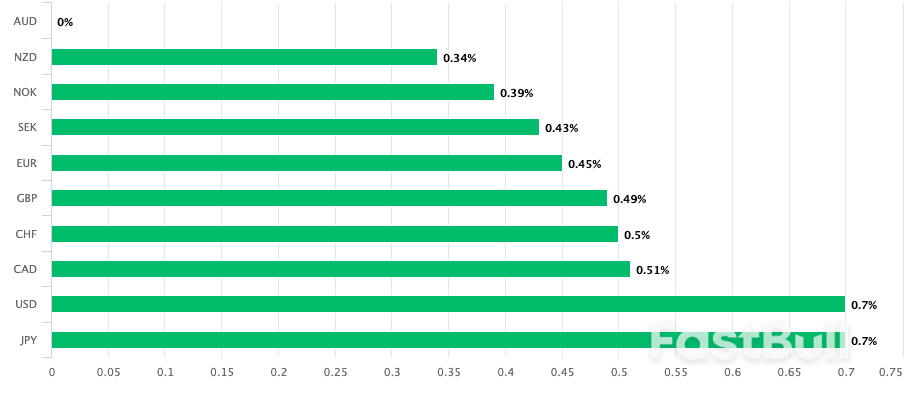
          The Pound to Australian Dollar exchange rate (GBP/AUD) is down half a per cent on the day at 2.0841, the Euro to Australian Dollar is down a similar margin at 1.7946 and against the U.S. Dollar, the Aussie is up three-quarters of a per cent at 0.6538.
          "Australian swap rates jump more than 12 bps at the front end of the curve, allowing AUD/USD to recover most of the losses incurred yesterday and thereby preserving the upward sloping trend channel," says an analyst note from KBC Bank.
          "Following the announcement, the Australian dollar strengthened," says Shane Strowmatt, analyst at LGT Bank. "The market had anticipated a 25-basis-point cut, but recent inflation figures, while at a four-year low, showed slightly stronger-than-expected trends."
          The statement reveals the RBA has been watching the flow of monthly inflation data releases, which inform the more complete quarterly inflation prints. It is the central bank's view that "they were, at the margin, slightly stronger than expected."
          "With the cash rate 50 basis points lower than five months ago and wider economic conditions evolving broadly as expected, the Board judged that it could wait for a little more information to confirm that inflation remains on track to reach 2.5 per cent on a sustainable basis," said the RBA.
          Australian Dollar Jumps on Surprise RBA Hold_1
          The labour market is also judged to be healthy by the RBA, lessening the need to cut. Central banks tend to cut interest rates in order to support the economy, but it is the judgment that there is no need to rush at the RBA.
          This can keep Australian bond yields, which take a lead from the cash rate, relatively elevated compared to elsewhere. Given money chases higher bond yields, such a development is considered supportive of the Australian Dollar.
          Constantin Bolz, Strategist at UBS Switzerland, says on this basis, the Aussie looks attractive: "The Australian dollar should also profit from a weakening USD, as Australian yields remain among the highest in the G10, while Australia's low position on the U.S. trade deficit list should limit the direct impact of the trade war."
          There has been a flurry of trade headlines for the currencies to consider, with the U.S. unveiling the tariff levels it has decided.
          However, markets have taken the developments in their stride, noting that the U.S. has pushed back a final deadline for tariffs to August 01, while strongly hinting that it continues to negotiate.
          This means the overall tariff rate should continue to come down.
          For currencies that are highly sensitive to tariff-induced sentiment shifts, such as AUD, the news is supportive.

          Source: Poundsterlinglive

          To stay updated on all economic events of today, please check out our Economic calendar
          Risk Warnings and Disclaimers
          You understand and acknowledge that there is a high degree of risk involved in trading. Following any strategies or investment methods may lead to potential losses. The content on the site is provided by our contributors and analysts for information purposes only. You are solely responsible for determining whether any trading assets, securities, strategy, or any other product is suitable for investing based on your own investment objectives and financial situation.
          Add to Favorites
          Share
          FastBull
          Copyright © 2025 FastBull Ltd

          728 RM B 7/F GEE LOK IND BLDG NO 34 HUNG TO RD KWUN TONG KLN HONG KONG

          TelegramInstagramTwitterfacebooklinkedin
          App Store Google Play Google Play
          Products
          Charts

          Chats

          Q&A with Experts
          Screeners
          Economic Calendar
          Data
          Tools
          Membership
          Features
          Function
          Markets
          Copy Trading
          Latest Signals
          Contests
          News
          Analysis
          24/7
          Columns
          Education
          Company
          Careers
          About Us
          Contact Us
          Advertising
          Help Center
          Feedback
          User Agreement
          Privacy Policy
          Business

          White Label

          Data API

          Web Plug-ins

          Poster Maker

          Affiliate Program

          Risk Disclosure

          The risk of loss in trading financial instruments such as stocks, FX, commodities, futures, bonds, ETFs and crypto can be substantial. You may sustain a total loss of the funds that you deposit with your broker. Therefore, you should carefully consider whether such trading is suitable for you in light of your circumstances and financial resources.

          No decision to invest should be made without thoroughly conducting due diligence by yourself or consulting with your financial advisors. Our web content might not suit you since we don't know your financial conditions and investment needs. Our financial information might have latency or contain inaccuracy, so you should be fully responsible for any of your trading and investment decisions. The company will not be responsible for your capital loss.

          Without getting permission from the website, you are not allowed to copy the website's graphics, texts, or trademarks. Intellectual property rights in the content or data incorporated into this website belong to its providers and exchange merchants.

          Not Logged In

          Log in to access more features

          FastBull Membership

          Not yet

          Purchase

          Become a signal provider
          Help Center
          Customer Service
          Dark Mode
          Price Up/Down Colors

          Log In

          Sign Up

          Position
          Layout
          Fullscreen
          Default to Chart
          The chart page opens by default when you visit fastbull.com