• Trade
  • Markets
  • Copy
  • Contests
  • News
  • 24/7
  • Calendar
  • Q&A
  • Chats
Trending
Screeners
SYMBOL
LAST
BID
ASK
HIGH
LOW
NET CHG.
%CHG.
SPREAD
SPX
S&P 500 Index
6827.42
6827.42
6827.42
6899.86
6801.80
-73.58
-1.07%
--
DJI
Dow Jones Industrial Average
48458.04
48458.04
48458.04
48886.86
48334.10
-245.98
-0.51%
--
IXIC
NASDAQ Composite Index
23195.16
23195.16
23195.16
23554.89
23094.51
-398.69
-1.69%
--
USDX
US Dollar Index
97.950
98.030
97.950
98.500
97.950
-0.370
-0.38%
--
EURUSD
Euro / US Dollar
1.17394
1.17409
1.17394
1.17496
1.17192
+0.00011
+ 0.01%
--
GBPUSD
Pound Sterling / US Dollar
1.33707
1.33732
1.33707
1.33997
1.33419
-0.00148
-0.11%
--
XAUUSD
Gold / US Dollar
4299.39
4299.39
4299.39
4353.41
4257.10
+20.10
+ 0.47%
--
WTI
Light Sweet Crude Oil
57.233
57.485
57.233
58.011
56.969
-0.408
-0.71%
--

Community Accounts

Signal Accounts
--
Profit Accounts
--
Loss Accounts
--
View More

Become a signal provider

Sell trading signals to earn additional income

View More

Guide to Copy Trading

Get started with ease and confidence

View More

Signal Accounts for Members

All Signal Accounts

Best Return
  • Best Return
  • Best P/L
  • Best MDD
Past 1W
  • Past 1W
  • Past 1M
  • Past 1Y

All Contests

  • All
  • Trump Updates
  • Recommend
  • Stocks
  • Cryptocurrencies
  • Central Banks
  • Featured News
Top News Only
Share

USA Embassy In Lithuania: Maria Kalesnikava Is Not Going To Vilnius

Share

USA Embassy In Lithuania: Other Prisoners Are Being Sent From Belarus To Ukraine

Share

Ukraine President Zelenskiy: Five Ukrainians Released By Belarus In US-Brokered Deal

Share

USA Vilnius Embassy: USA Stands Ready For "Additional Engagement With Belarus That Advances USA Interests"

Share

USA Vilnius Embassy: Belarus, USA, Other Citizens Among The Prisoners Released Into Lithuania

Share

USA Vilnius Embassy: USA Will Continue Diplomatic Efforts To Free The Remaining Political Prisoners In Belarus

Share

USA Vilnius Embassy: Belarus Releases 123 Prisoners Following Meeting Of President Trump's Envoy Coale And Belarus President Lukashenko

Share

USA Vilnius Embassy: Masatoshi Nakanishi, Aliaksandr Syrytsa Are Among The Prisoners Released By Belarus

Share

USA Vilnius Embassy: Maria Kalesnikava And Viktor Babaryka Are Among The Prisoners Released By Belarus

Share

USA Vilnius Embassy: Nobel Peace Prize Laureate Ales Bialiatski Is Among The Prisoners Released By Belarus

Share

Belarusian Presidential Administration Telegram Channel: Lukashenko Has Pardoned 123 Prisoners As Part Of Deal With US

Share

Two Local Syrian Officials: Joint US-Syrian Military Patrol In Central Syria Came Under Fire From Unknown Assailants

Share

Israeli Military Says It Targeted 'Key Hamas Terrorist' In Gaza City

Share

Rwanda's Actions In Eastern Drc Are A Clear Violation Of Washington Accords Signed By President Trump - Secretary Of State Rubio

Share

Israeli Military Issues Evacuation Warning In Southern Lebanon Village Ahead Of Strike - Spokesperson On X

Share

Belarusian State Media Cites US Envoy Coale As Saying He Discussed Ukraine And Venezuela With Lukashenko

Share

Belarusian State Media Cites US Envoy Coale As Saying That US Removes Sanctions On Belarusian Potassium

Share

Thai Prime Minister: No Ceasefire Agreement With Cambodia

Share

US, Ukraine To Discuss Ceasefire In Berlin Ahead Of European Summit

Share

Incoming Czech Prime Minister Babis: Czech Republic Will Not Take On Guarantees For Ukraine Financing, European Commission Must Find Alternatives

TIME
ACT
FCST
PREV
U.K. Trade Balance Non-EU (SA) (Oct)

A:--

F: --

P: --

U.K. Trade Balance (Oct)

A:--

F: --

P: --

U.K. Services Index MoM

A:--

F: --

P: --

U.K. Construction Output MoM (SA) (Oct)

A:--

F: --

P: --

U.K. Industrial Output YoY (Oct)

A:--

F: --

P: --

U.K. Trade Balance (SA) (Oct)

A:--

F: --

P: --

U.K. Trade Balance EU (SA) (Oct)

A:--

F: --

P: --

U.K. Manufacturing Output YoY (Oct)

A:--

F: --

P: --

U.K. GDP MoM (Oct)

A:--

F: --

P: --

U.K. GDP YoY (SA) (Oct)

A:--

F: --

P: --

U.K. Industrial Output MoM (Oct)

A:--

F: --

P: --

U.K. Construction Output YoY (Oct)

A:--

F: --

P: --

France HICP Final MoM (Nov)

A:--

F: --

P: --

China, Mainland Outstanding Loans Growth YoY (Nov)

A:--

F: --

P: --

China, Mainland M2 Money Supply YoY (Nov)

A:--

F: --

P: --

China, Mainland M0 Money Supply YoY (Nov)

A:--

F: --

P: --

China, Mainland M1 Money Supply YoY (Nov)

A:--

F: --

P: --

India CPI YoY (Nov)

A:--

F: --

P: --

India Deposit Gowth YoY

A:--

F: --

P: --

Brazil Services Growth YoY (Oct)

A:--

F: --

P: --

Mexico Industrial Output YoY (Oct)

A:--

F: --

P: --

Russia Trade Balance (Oct)

A:--

F: --

P: --

Philadelphia Fed President Henry Paulson delivers a speech
Canada Building Permits MoM (SA) (Oct)

A:--

F: --

P: --

Canada Wholesale Sales YoY (Oct)

A:--

F: --

P: --

Canada Wholesale Inventory MoM (Oct)

A:--

F: --

P: --

Canada Wholesale Inventory YoY (Oct)

A:--

F: --

P: --

Canada Wholesale Sales MoM (SA) (Oct)

A:--

F: --

P: --

Germany Current Account (Not SA) (Oct)

A:--

F: --

P: --

U.S. Weekly Total Rig Count

A:--

F: --

P: --

U.S. Weekly Total Oil Rig Count

A:--

F: --

P: --

Japan Tankan Large Non-Manufacturing Diffusion Index (Q4)

--

F: --

P: --

Japan Tankan Small Manufacturing Outlook Index (Q4)

--

F: --

P: --

Japan Tankan Large Non-Manufacturing Outlook Index (Q4)

--

F: --

P: --

Japan Tankan Large Manufacturing Outlook Index (Q4)

--

F: --

P: --

Japan Tankan Small Manufacturing Diffusion Index (Q4)

--

F: --

P: --

Japan Tankan Large Manufacturing Diffusion Index (Q4)

--

F: --

P: --

Japan Tankan Large-Enterprise Capital Expenditure YoY (Q4)

--

F: --

P: --

U.K. Rightmove House Price Index YoY (Dec)

--

F: --

P: --

China, Mainland Industrial Output YoY (YTD) (Nov)

--

F: --

P: --

China, Mainland Urban Area Unemployment Rate (Nov)

--

F: --

P: --

Saudi Arabia CPI YoY (Nov)

--

F: --

P: --

Euro Zone Industrial Output YoY (Oct)

--

F: --

P: --

Euro Zone Industrial Output MoM (Oct)

--

F: --

P: --

Canada Existing Home Sales MoM (Nov)

--

F: --

P: --

Euro Zone Total Reserve Assets (Nov)

--

F: --

P: --

U.K. Inflation Rate Expectations

--

F: --

P: --

Canada National Economic Confidence Index

--

F: --

P: --

Canada New Housing Starts (Nov)

--

F: --

P: --

U.S. NY Fed Manufacturing Employment Index (Dec)

--

F: --

P: --

U.S. NY Fed Manufacturing Index (Dec)

--

F: --

P: --

Canada Core CPI YoY (Nov)

--

F: --

P: --

Canada Manufacturing Unfilled Orders MoM (Oct)

--

F: --

P: --

Canada Manufacturing New Orders MoM (Oct)

--

F: --

P: --

Canada Core CPI MoM (Nov)

--

F: --

P: --

Canada Manufacturing Inventory MoM (Oct)

--

F: --

P: --

Canada CPI YoY (Nov)

--

F: --

P: --

Canada CPI MoM (Nov)

--

F: --

P: --

Canada CPI YoY (SA) (Nov)

--

F: --

P: --

Canada Core CPI MoM (SA) (Nov)

--

F: --

P: --

Q&A with Experts
    • All
    • Chatrooms
    • Groups
    • Friends
    Connecting
    .
    .
    .
    Type here...
    Add Symbol or Code

      No matching data

      All
      Trump Updates
      Recommend
      Stocks
      Cryptocurrencies
      Central Banks
      Featured News
      • All
      • Russia-Ukraine Conflict
      • Middle East Flashpoint
      • All
      • Russia-Ukraine Conflict
      • Middle East Flashpoint
      Search
      Products

      Charts Free Forever

      Chats Q&A with Experts
      Screeners Economic Calendar Data Tools
      Membership Features
      Data Warehouse Market Trends Institutional Data Policy Rates Macro

      Market Trends

      Market Sentiment Order Book Forex Correlations

      Top Indicators

      Charts Free Forever
      Markets

      News

      News Analysis 24/7 Columns Education
      From Institutions From Analysts
      Topics Columnists

      Latest Views

      Latest Views

      Trending Topics

      Top Columnists

      Latest Update

      Signals

      Copy Rankings Latest Signals Become a signal provider AI Rating
      Contests
      Brokers

      Overview Brokers Assessment Rankings Regulators News Claims
      Broker listing Forex Brokers Comparison Tool Live Spread Comparison Scam
      Q&A Complaint Scam Alert Videos Tips to Detect Scam
      More

      Business
      Events
      Careers About Us Advertising Help Center

      White Label

      Data API

      Web Plug-ins

      Affiliate Program

      Awards Institution Evaluation IB Seminar Salon Event Exhibition
      Vietnam Thailand Singapore Dubai
      Fans Party Investment Sharing Session
      FastBull Summit BrokersView Expo
      Recent Searches
        Top Searches
          Markets
          News
          Analysis
          User
          24/7
          Economic Calendar
          Education
          Data
          • Names
          • Latest
          • Prev

          View All

          No data

          Scan to Download

          Faster Charts, Chat Faster!

          Download App
          English
          • English
          • Español
          • العربية
          • Bahasa Indonesia
          • Bahasa Melayu
          • Tiếng Việt
          • ภาษาไทย
          • Français
          • Italiano
          • Türkçe
          • Русский язык
          • 简中
          • 繁中
          Open Account
          Search
          Products
          Charts Free Forever
          Markets
          News
          Signals

          Copy Rankings Latest Signals Become a signal provider AI Rating
          Contests
          Brokers

          Overview Brokers Assessment Rankings Regulators News Claims
          Broker listing Forex Brokers Comparison Tool Live Spread Comparison Scam
          Q&A Complaint Scam Alert Videos Tips to Detect Scam
          More

          Business
          Events
          Careers About Us Advertising Help Center

          White Label

          Data API

          Web Plug-ins

          Affiliate Program

          Awards Institution Evaluation IB Seminar Salon Event Exhibition
          Vietnam Thailand Singapore Dubai
          Fans Party Investment Sharing Session
          FastBull Summit BrokersView Expo

          Israel-Iran Conflict Highlights Asia's Dependence on Middle East Oil

          Warren Takunda

          Economic

          Middle East Situation

          Summary:

          The Israel-Iran conflict exposes Asia’s heavy dependence on Middle East oil via the Strait of Hormuz, highlighting energy security risks and the urgent need for a faster shift to renewable energy across the region.

          Asia’s dependence on Middle East oil and gas — and its relatively slow shift to clean energy — make it vulnerable to disruptions in shipments through the Strait of Hormuz, a strategic weakness highlighted by the war between Israel and Iran.
          Iran sits on the strait, which handles about 20% of shipments of the world’s oil and liquefied natural gas, or LNG. Four countries — China, India, Japan and South Korea — account for 75% of those imports.
          Japan and South Korea face the highest risk, according to analysis by the research group Zero Carbon Analytics, followed by India and China. All have been slow to scale up use of renewable energy.
          In 2023, renewables made up just 9% of South Korea’s power mix, well below the 33% average among other members of the Organization for Economic Cooperation and Development, or OECD. In the same year, Japan relied more heavily on fossil fuels than any other country in the Group of Seven, or G7.
          A truce in the 12-day Israel-Iran war appears to be holding at the time of writing, reducing the potential for trouble for now. But experts say the only way to counter lingering uncertainty is to scale back reliance on imported fossil fuels and accelerate Asia's shift to clean, domestic energy sources.
          “These are very real risks that countries should be alive to — and should be thinking about in terms of their energy and economic security,” said Murray Worthy, a research analyst at Zero Carbon Analytics.

          Japan and South Korea are vulnerable

          China and India are the biggest buyers of oil and LNG passing through the potential chokepoint at the Strait of Hormuz, but Japan and South Korea are more vulnerable.
          Japan depends on imported fossil fuels for 87% of its total energy use and South Korea imports 81%. China relies on only 20% and India 35%, according to Ember, an independent global energy think tank that promotes clean energy.
          “When you bring that together — the share of energy coming through the strait and how much oil and gas they rely on — that’s where you see Japan really rise to the top in terms of vulnerability,” said Worthy.
          Three-quarters of Japan’s oil imports and more than 70% of South Korea’s oil imports — along with a fifth of its LNG — pass through the strait, said Sam Reynolds of the Institute for Energy Economics and Financial Analysis.
          Both countries have focused more on diversifying fossil fuel sources than on shifting to clean energy.
          Japan still plans to get 30-40% of its energy from fossil fuels by 2040. It's building new LNG plants and replacing old ones. South Korea plans to get 25.1% of its electricity from LNG by 2030, down from 28% today, and reduce it further to 10.6% by 2038.
          To meet their 2050 targets for net-zero carbon emissions, both countries must dramatically ramp up use of solar and wind power. That means adding about 9 gigawatts of solar power each year through 2030, according to the thinktank Agora Energiewende. Japan also needs an extra 5 gigawatts of wind annually, and South Korea about 6 gigawatts.
          ADVERTISEMENT
          Japan's energy policies are inconsistent. It still subsidises gasoline and diesel, aims to increase its LNG imports and supports oil and gas projects overseas. Offshore wind is hampered by regulatory barriers. Japan has climate goals, but hasn't set firm deadlines for cutting power industry emissions.
          “Has Japan done enough? No, they haven’t. And what they do is not really the best,” said Tim Daiss, at the APAC Energy Consultancy, citing Japan's program to increase use of hydrogen fuel made from natural gas.
          South Korea's low electricity rates hinder the profitability of solar and wind projects, discouraging investment, a “key factor” limiting renewables, said Kwanghee Yeom of Agora Energiewende. He said fair pricing, stronger policy support and other reforms would help speed up adoption of clean energy.

          China and India have done more — but gaps remain

          China and India have moved to shield themselves from shocks linked to changing global energy prices or trade disruptions.
          China led global growth in wind and solar in 2024 and generating capacity rose 45% and 18%, respectively. It has also boosted domestic gas output even as its reserves have dwindled.
          By making more electricity at home from clean sources and producing more gas domestically, China has managed to reduce imports of LNG, though it still is the world's largest oil importer, with about half of the more than 11 million barrels per day that it brings in coming from the Middle East. Russia and Malaysia are other major suppliers.
          India relies heavily on coal and aims to boost coal production by around 42% from now to 2030. But its use of renewables is growing faster, with 30 additional gigawatts of clean power coming online last year, enough to power nearly 18 million Indian homes.
          By diversifying its suppliers with more imports from the US, Russia and other countries in the Middle East, it has somewhat reduced its risk, said Vibhuti Garg of the Institute for Energy Economics and Financial Analysis.
          “But India still needs a huge push on renewables if it wants to be truly energy secure,” she said.

          Risks for the rest of Asia

          A blockade of the Strait of Hormuz could affect other Asian countries and building up their renewable power generating capacity will be a “crucial hedge” against the volatility intrinsic to importing oil and gas, said Reynolds of the Institute for Energy Economics and Financial Analysis.
          Southeast Asia has become a net oil importer as demand in Malaysia and Indonesia has outstripped supplies, according to the ASEAN Centre for Energy in Jakarta, Indonesia. The 10-nation Association of Southeast Asian Nations still exports more LNG than it imports due to production by Brunei, Indonesia, Malaysia, and Myanmar. But rising demand means the region will become a net LNG importer by 2032, according to consulting firm Wood Mackenzie.
          Use of renewable energy is not keeping up with rising demand and production of oil and gas is faltering as older fields run dry.
          The International Energy Agency has warned that ASEAN's oil import costs could rise from $130 billion in 2024 to over $200bn by 2050 if stronger clean energy policies are not enacted.
          "Clean energy is not just an imperative for the climate — it’s an imperative for national energy security,” said Reynolds.
          On Friday, the price of Brent crude oil, the international benchmark, was up 0.55% on the day at $68.10 a barrel. Over the month, the fuel has risen by 6.26% in value, although prices have pulled back from last week’s peak.

          Source: Euronews

          To stay updated on all economic events of today, please check out our Economic calendar
          Risk Warnings and Disclaimers
          You understand and acknowledge that there is a high degree of risk involved in trading. Following any strategies or investment methods may lead to potential losses. The content on the site is provided by our contributors and analysts for information purposes only. You are solely responsible for determining whether any trading assets, securities, strategy, or any other product is suitable for investing based on your own investment objectives and financial situation.
          Add to Favorites
          Share

          Weak Eurozone Bank Lending Suggests Uncertainty Is Hampering Monetary Easing

          ING

          Economic

          Forex

          While the European Central Bank reports year-on-year growth in bank lending in its press release, we like to compare slightly shorter time frames to better capture developments in recent months. We notice some weakening effects of monetary transmission in the numbers.

          In May, bank lending to non-financial corporates declined compared to April - the first decline since July last year. While volatile, the three-month average growth rate has been dropping steadily, indicating that bank lending to corporates is not seeing many positive effects from the ECB moving its interest rates to neutral at this point.

          Meanwhile, there is a break from the trend with bank lending growth to households, which accelerated over the course of 2024 but seems to have plateaued at just over 0.2% month-on-month this year. May saw a small tick down in the growth pace, which is now at the weakest level since November. Overall, we're seeing a levelling off effect, which suggests that monetary easing conditions are not translating as forcefully through the lending channel anymore.

          Uncertainty has prompted businesses to become more reluctant to borrow for investment purposes, as the bank lending survey from April showed. Since then, uncertainty has only increased, which makes a downturn for borrowing in May understandable. The big question is how long this uncertainty will continue to suppress borrowing appetite among businesses, as this suppresses investment in the eurozone economy.

          The ECB is widely expected to pause its rate cuts in July. This is not necessarily to see how its policies are playing out, but mainly to see how the economic environment is shaping up in times of huge uncertainty. If economic uncertainty has become so large that it starts to weaken lending and investment substantially, that could provide another dovish argument for a further rate cut in September.

          Source: ING

          To stay updated on all economic events of today, please check out our Economic calendar
          Risk Warnings and Disclaimers
          You understand and acknowledge that there is a high degree of risk involved in trading. Following any strategies or investment methods may lead to potential losses. The content on the site is provided by our contributors and analysts for information purposes only. You are solely responsible for determining whether any trading assets, securities, strategy, or any other product is suitable for investing based on your own investment objectives and financial situation.
          Add to Favorites
          Share

          London Midday: Stocks Steady Amid UK Data Slew, Trade Deal Hopes

          Warren Takunda

          Stocks

          London stocks had pared earlier small gains to trade flat by midday on Monday, as investors mulled a raft of UK data releases and amid hopes of a US-Canada trade deal.
          The FTSE 100 was steady at 8,796.43.
          Dan Coatsworth, investment analyst at AJ Bell, said: "There is a lot going on to influence markets before the summer lull and investors’ animal spirits continue to fuel the equities space.
          "Investors seem confident trade deals will be struck, geopolitical tensions ease, and a major economic slump is avoided. The big unknown is whether investors are correct or are simply being too complacent.
          "Following yet another bust-up between the US and Canada, the latter has now scrapped its digital services tax aimed at US tech firms and resumed trade talks. This has brought a sense of calm to markets, also helped by an extended deadline for negotiations whereby Canada has an extra week and a bit to agree a trade deal. It also provides some hope that other countries will get extra time to deal with the Trump administration beyond the 9 July cut-off."
          On home shores, investors mulled the latest monthly Money and Credit report from the Bank of England, which showed mortgage approvals nudged higher in May, beating expectations.
          Net mortgage approvals were 63,032 last month. That was a 2,376 increase on April, and higher than forecasts for 59,750.
          Net borrowing of mortgage debt was also higher. It rose £2.8bn to £2.1bn, following April’s £13.8bn slump. The slide had been prompted by buyers rushing to complete in March ahead of changes to stamp duty thresholds.
          The effective interest rate - the actual interest paid - on newly drawn mortgages decreased marginally in May to 4.47% from 4.49%.
          Earlier, figures from the Office for National Statistics showed the economy grew 0.7% in the first three months of the year, confirming a preliminary estimate released in May.
          Growth was driven by a 0.7% increase in the services sector, while production also grew, by 1.3%, and the construction sector saw 0.3% growth.
          ONS director of economic statistics Liz McKeown said: "While overall quarterly growth was unrevised, our updated set of figures show the economy still grew strongly in February, with growth now coming in a little higher in March too.
          "There was broad based growth across services, while manufacturing also had a strong quarter.
          "The saving ratio fell for the first time in two years this quarter, as rising costs for items such as fuel, rent and restaurant meals contributed to higher spending, although it remains relatively strong."
          Investors were also digesting the latest growth indicator from the Confederation of British Industry, which showed that UK companies remain deeply uncertain about their near-term growth prospects as they continue to battle higher costs and global headwinds.
          In equity markets, defence firms Rolls-Royce and Babcock were among the risers.
          Babcock in particular got a boost as Citi hiked its price target on the shares to 1,338p from 730p and reiterated its ‘buy’ rating as it said growth is likely to accelerate over the next 10 years.
          Chemring advanced after announcing the acquisition of Hampshire-based software-defined radio systems manufacturer Landguard Nexus in a deal worth as much as £20m.
          Water company Pennon rallied after an upgrade to ‘buy’ at Deutsche Bank.
          On the downside, British Gas owner Centrica was knocked lower by a downgrade to ‘neutral’ from ‘overweight' at JPMorgan, which cited limited valuation upside.
          WH Smith tumbled after it sold its high street business for £12m less than expected following a period of "softer trading".

          Source: Sharecast

          Risk Warnings and Disclaimers
          You understand and acknowledge that there is a high degree of risk involved in trading. Following any strategies or investment methods may lead to potential losses. The content on the site is provided by our contributors and analysts for information purposes only. You are solely responsible for determining whether any trading assets, securities, strategy, or any other product is suitable for investing based on your own investment objectives and financial situation.
          Add to Favorites
          Share

          Israel Steps Up Gaza Bombardment Ahead of White House Talks on Ceasefire

          Glendon

          Political

          Palestinians in northern Gaza reported one of the worst nights of Israeli bombardment in weeks after the military issued mass evacuation orders on Monday, while Israeli officials were due in Washington for a new ceasefire push by the Trump administration.

          A day after U.S. President Donald Trump urged an end to the 20-month-old war, a confidant of Prime Minister Benjamin Netanyahu was expected at the White House for talks on a Gaza ceasefire, Iran, and possible wider regional diplomatic deals.

          But on the ground in the Palestinian enclave there was no sign of fighting letting up.

          "Explosions never stopped; they bombed schools and homes. It felt like earthquakes," said Salah, 60, a father of five children, from Gaza City. "In the news we hear a ceasefire is near, on the ground we see death and we hear explosions."

          Israeli tanks pushed into the eastern areas of Zeitoun suburb in Gaza City and shelled several areas in the north, while aircraft bombed at least four schools after ordering hundreds of families sheltering inside to leave, residents said.

          At least 25 people were killed in Israeli strikes on Monday, health authorities said, including 10 people killed in Zeitoun.

          There was no immediate comment from the Israeli military, which says Palestinian militants embed among civilians. The militant groups deny this.

          The heavy bombardment followed new evacuation orders to vast areas in the north, where Israeli forces had operated before and left behind wide-scale destruction. The military ordered people there to head south, saying that it planned to fight Hamas militants operating in northern Gaza, including in the heart of Gaza City.

          NEXT STEPS

          A day after Trump called to "Make the deal in Gaza, get the hostages back", Israel's strategic affairs minister Ron Dermer, a confidant of Netanyahu's, was expected on Monday at the White House for talks on Iran and Gaza, an Israeli official said.

          In Israel, Netanyahu's security cabinet was expected to convene to discuss the next steps in Gaza.

          On Friday, Israel's military chief said the present ground operation was close to having achieved its goals, and on Sunday, Netanyahu said new opportunities had opened up for recovering the hostages, 20 of whom are believed to still be alive.

          Palestinian and Egyptian sources with knowledge of the latest ceasefire efforts said that mediators Qatar and Egypt have stepped up their contacts with the two warring sides, but that no date has been set yet for a new round of truce talks.

          A Hamas official said that progress depends on Israel changing its position and agreeing to end the war and withdraw from Gaza. Israel says it can end the war only when Hamas is disarmed and dismantled. Hamas refuses to lay down its arms.

          The war began when Hamas fighters stormed in to Israel on October 7 2023, killed 1,200 people, most of them civilians, and took 251 hostages back to Gaza in a surprise attack that led to Israel's single deadliest day.

          Israel's subsequent military assault has killed more than 56,000 Palestinians, most of them civilians, according to the Gaza health ministry, has displaced almost the entire 2.3 million population and plunged the enclave into a humanitarian crisis.

          More than 80% of the territory is now an Israeli-militarized zone or under displacement orders, according to the United Nations.

          Source: Reuters

          Risk Warnings and Disclaimers
          You understand and acknowledge that there is a high degree of risk involved in trading. Following any strategies or investment methods may lead to potential losses. The content on the site is provided by our contributors and analysts for information purposes only. You are solely responsible for determining whether any trading assets, securities, strategy, or any other product is suitable for investing based on your own investment objectives and financial situation.
          Add to Favorites
          Share

          Polish CPI Inflation Picks Up Unexpectedly In June, Driven By The Core Component

          ING

          Forex

          Economic

          According to the preliminary estimate, Polish CPI inflation in June rose to 4.1% year-on-year (ING: 4.0%, consensus: 4.0%) from 4.0% YoY in May. Food and non-alcoholic beverage price growth slowed, in line with our forecast, to 4.9% YoY from 5.5% YoY a month earlier. The year-on-year fall in fuel prices was 10.0% compared with 11.4% in May; this was steeper than our expectations, which took into account increases in petrol station prices in the second half of the month due to conflict in the Middle East. Energy prices increased by 12.8% YoY versus 13.0% a month earlier, in line with our forecasts. According to our estimates, core inflation – the main source of today's inflation surprise – rose to 3.4% YoY in July, up from 3.3% YoY in May.

          Significantly lower-than-expected wage pressure in May and the government's decision to maintain the electricity price freeze for households in 2025 are signs of improvements made in the inflation outlook from the previous month. Despite today's data, our estimate is that CPI should be close to the National Bank of Poland's inflation target in July. This means that the Monetary Policy Council has room for further monetary easing.

          In contrast, recent opinions from MPC members indicate that the chances of rate cuts in the coming months are low. They see wage growth above 6%, expansionary fiscal policy and tightening by other central banks in the region as arguments for a no-change policy. This week, the new NBP staff macroeconomic projection will be released, which, alongside NBP Governor Adam Glapiński's press conference on Thursday, should provide more insight into future monetary policy decisions.

          We expect further interest rate cuts to be made in 25bp increments, occurring in September and November. At the end of 2025, we expect the reference rate to drop to 4.75%. Rate cuts should continue in 2026, when we estimate the main rate will hit 4.25%.

          Source: ING

          To stay updated on all economic events of today, please check out our Economic calendar
          Risk Warnings and Disclaimers
          You understand and acknowledge that there is a high degree of risk involved in trading. Following any strategies or investment methods may lead to potential losses. The content on the site is provided by our contributors and analysts for information purposes only. You are solely responsible for determining whether any trading assets, securities, strategy, or any other product is suitable for investing based on your own investment objectives and financial situation.
          Add to Favorites
          Share

          China Sticks to Stainless-steel Levies Despite Indonesia Pain

          Glendon

          Economic

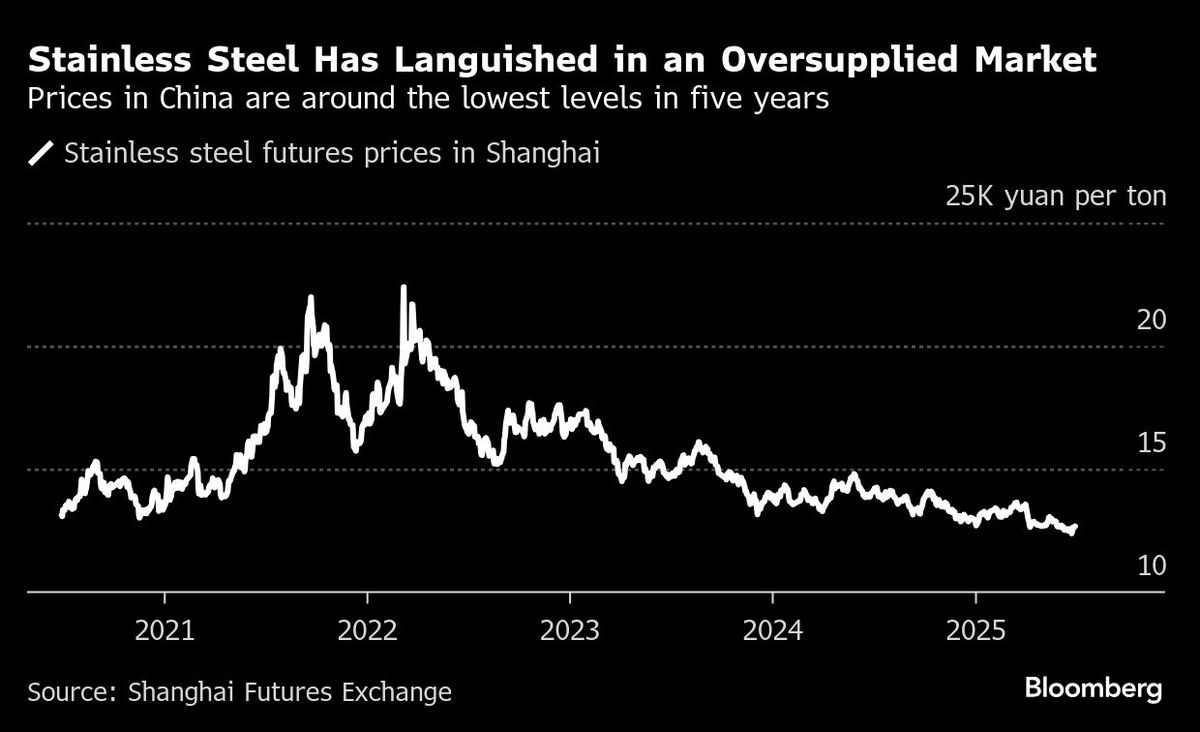
          China will press on with levying anti-dumping duties on imports of stainless-steel products, including from Indonesia, as it seeks to protect a domestic industry battered by persistent oversupply and trade uncertainty.

          Some traders and industry executives had expressed hopes the world’s largest metal consumer would reconsider its tariffs, particularly for Indonesia, given the role that Chinese companies have played in expanding nickel and stainless steel production in Indonesia, today among the top suppliers of both.

          Beijing, however, has now ruled that lifting the measures would risk hurting its industry at home, according to a statement posted on the commerce ministry website on Monday. The levies — which cover stainless steel billet and hot-rolled coil from the European Union, the UK, South Korea and Indonesia — will remain in place for another five years.

          When they were introduced in July 2019, China’s tariffs surprised the industry, given almost all stainless steel products from Indonesia in particular come from local ventures of large Chinese companies including Tsingshan Holding Group Co. Together, the two nations produce close to three-quarters of the world’s stainless steel.

          But China’s slowing economy has hit demand, and both countries are threatened by the Trump administration’s aggressive tariff policies. Both nickel traded on the London Metal Exchange and stainless steel in Shanghai hit their five-year lows earlier this year amid sluggish demand and squeezed production margins. Tsingshan has been compelled to start suspending some stainless steel production at the Indonesia Morowali Industrial Park on the island of Sulawesi.

          The levies on Indonesian producers will remain unchanged at 20.2%, China’s statement said. The trade ministry also kept a 43% duty on all stainless-steel products from EU and UK companies and 103.1% for most South Korean companies, according to the statement. Levies on products by Posco Holdings Inc, which has a price commitment with the Chinese government, will be kept at 23.1%.

          In the domestic stainless market, privately owned Tsingshan and rival Jiangsu Delong Nickel Industry Co compete with state-owned titan China Baowu Steel Group Co.

          Source: Theedgemarkets

          To stay updated on all economic events of today, please check out our Economic calendar
          Risk Warnings and Disclaimers
          You understand and acknowledge that there is a high degree of risk involved in trading. Following any strategies or investment methods may lead to potential losses. The content on the site is provided by our contributors and analysts for information purposes only. You are solely responsible for determining whether any trading assets, securities, strategy, or any other product is suitable for investing based on your own investment objectives and financial situation.
          Add to Favorites
          Share

          Markets Hit Record Highs Ahead of Critical US Jobs Data and Tariff Deadline

          Gerik

          Economic

          Stock Market Reaches New Peaks Amid Softening Rate Outlook

          The S&P 500, Nasdaq Composite, and Dow Jones Industrial Average all closed last week at all-time highs, buoyed by increasing market confidence that the Federal Reserve will soon initiate interest rate cuts. The S&P 500 climbed 3.5% for the week, while the Nasdaq added over 4.1%, driven largely by waning inflation fears and a retreat in global tariff threats. This rally marks a 23% rebound from the market’s low on April 8, highlighting bullish investor sentiment even as economic indicators show signs of cooling.
          Investor positioning suggests a growing belief that a rate cut could come as early as September. The CME FedWatch Tool shows a 93% chance of a rate cut by then, sharply up from 70% last week, reflecting a fast-changing policy outlook.

          Fed’s Mixed Messaging Spurs Debate

          Federal Reserve officials have recently offered a mixed view of upcoming policy action. Fed Governor Michelle Bowman noted that the labor market "appears less dynamic" and emphasized rising downside risks to employment. In contrast, Fed Chair Jerome Powell maintained a cautious stance, stressing the Fed is "well-positioned to wait." This divergence has left markets speculative but hopeful that softness in consumer demand and labor could prompt more dovish action by late summer.
          EY’s Chief Economist Greg Daco expects a September rate cut, predicting further economic deceleration and weaker consumer spending as the quarter unfolds.

          June Jobs Report in the Spotlight

          This week’s economic focal point will be Thursday’s June nonfarm payrolls report, which analysts expect to show 116,000 new jobs added — a deceleration from May's 139,000. The unemployment rate is forecast to tick up to 4.3%, from 4.2% previously, suggesting further signs of slack in the labor market. Wage growth is expected to cool modestly to 3.8% year-over-year.
          This jobs data will be critical for both the Federal Reserve’s interest rate path and investor confidence, especially as markets are closed Friday for Independence Day.

          Tariff Pause Deadline Adds Geopolitical Risk

          Investors are also closely monitoring President Trump’s July 9 deadline for resolving various global trade negotiations. The current 90-day pause on new tariffs is set to expire, and although deals with the UK, Canada, and potentially others are progressing, uncertainty remains—particularly concerning Europe and China.
          The administration’s trade strategy has created planning instability, but for now, markets are betting on extensions or modest agreements to prevent major disruption.

          Capital Flows Reflect Strategic Shifts

          Despite US equity highs, global capital flows suggest cautious repositioning. As of late June, more than $100 billion has flowed into European equity funds—triple the amount from the same period last year—while US funds saw net outflows of nearly $87 billion. This underscores growing investor concern over US political volatility and a pivot toward perceived European stability.
          The stock market’s momentum reflects optimism over easing monetary policy and calming trade tensions, but the foundation remains fragile. The June jobs report, upcoming service and manufacturing indices, and tariff decisions will all test the durability of current investor confidence. Markets may continue to climb in the short term, but unexpected softness in labor data or tariff escalations could prompt swift corrections. Investors are advised to stay cautious and closely monitor economic and political signals over the coming two weeks.

          Source: Yahoo Finance

          To stay updated on all economic events of today, please check out our Economic calendar
          Risk Warnings and Disclaimers
          You understand and acknowledge that there is a high degree of risk involved in trading. Following any strategies or investment methods may lead to potential losses. The content on the site is provided by our contributors and analysts for information purposes only. You are solely responsible for determining whether any trading assets, securities, strategy, or any other product is suitable for investing based on your own investment objectives and financial situation.
          Add to Favorites
          Share
          FastBull
          Copyright © 2025 FastBull Ltd

          728 RM B 7/F GEE LOK IND BLDG NO 34 HUNG TO RD KWUN TONG KLN HONG KONG

          TelegramInstagramTwitterfacebooklinkedin
          App Store Google Play Google Play
          Products
          Charts

          Chats

          Q&A with Experts
          Screeners
          Economic Calendar
          Data
          Tools
          Membership
          Features
          Function
          Markets
          Copy Trading
          Latest Signals
          Contests
          News
          Analysis
          24/7
          Columns
          Education
          Company
          Careers
          About Us
          Contact Us
          Advertising
          Help Center
          Feedback
          User Agreement
          Privacy Policy
          Business

          White Label

          Data API

          Web Plug-ins

          Poster Maker

          Affiliate Program

          Risk Disclosure

          The risk of loss in trading financial instruments such as stocks, FX, commodities, futures, bonds, ETFs and crypto can be substantial. You may sustain a total loss of the funds that you deposit with your broker. Therefore, you should carefully consider whether such trading is suitable for you in light of your circumstances and financial resources.

          No decision to invest should be made without thoroughly conducting due diligence by yourself or consulting with your financial advisors. Our web content might not suit you since we don't know your financial conditions and investment needs. Our financial information might have latency or contain inaccuracy, so you should be fully responsible for any of your trading and investment decisions. The company will not be responsible for your capital loss.

          Without getting permission from the website, you are not allowed to copy the website's graphics, texts, or trademarks. Intellectual property rights in the content or data incorporated into this website belong to its providers and exchange merchants.

          Not Logged In

          Log in to access more features

          FastBull Membership

          Not yet

          Purchase

          Become a signal provider
          Help Center
          Customer Service
          Dark Mode
          Price Up/Down Colors

          Log In

          Sign Up

          Position
          Layout
          Fullscreen
          Default to Chart
          The chart page opens by default when you visit fastbull.com