• Trade
  • Markets
  • Copy
  • Contests
  • News
  • 24/7
  • Calendar
  • Q&A
  • Chats
Trending
Screeners
SYMBOL
LAST
BID
ASK
HIGH
LOW
NET CHG.
%CHG.
SPREAD
SPX
S&P 500 Index
6827.42
6827.42
6827.42
6899.86
6801.80
-73.58
-1.07%
--
DJI
Dow Jones Industrial Average
48458.04
48458.04
48458.04
48886.86
48334.10
-245.98
-0.51%
--
IXIC
NASDAQ Composite Index
23195.16
23195.16
23195.16
23554.89
23094.51
-398.69
-1.69%
--
USDX
US Dollar Index
97.990
98.070
97.990
98.020
97.980
+0.040
+ 0.04%
--
EURUSD
Euro / US Dollar
1.17378
1.17389
1.17378
1.17385
1.17285
-0.00016
-0.01%
--
GBPUSD
Pound Sterling / US Dollar
1.33668
1.33682
1.33668
1.33732
1.33580
-0.00039
-0.03%
--
XAUUSD
Gold / US Dollar
4304.04
4304.48
4304.04
4304.65
4294.68
+4.65
+ 0.11%
--
WTI
Light Sweet Crude Oil
57.297
57.334
57.297
57.348
57.194
+0.064
+ 0.11%
--

Community Accounts

Signal Accounts
--
Profit Accounts
--
Loss Accounts
--
View More

Become a signal provider

Sell trading signals to earn additional income

View More

Guide to Copy Trading

Get started with ease and confidence

View More

Signal Accounts for Members

All Signal Accounts

Best Return
  • Best Return
  • Best P/L
  • Best MDD
Past 1W
  • Past 1W
  • Past 1M
  • Past 1Y

All Contests

  • All
  • Trump Updates
  • Recommend
  • Stocks
  • Cryptocurrencies
  • Central Banks
  • Featured News
Top News Only
Share

Nomura CEO: Aim To Develop Japanese Direct Lending Market

Share

Nomura CEO: Aim To Bring Private Debt Know-How From Overseas

Share

HSBC - Scheme Consideration Refers To Proposal For Privatisation Of Hang Seng Bank

Share

[Report: SpaceX Launches Bake-Off Process To Select Underwriters For Potential IPO] According To Sources Familiar With The Matter, SpaceX Executives Have Initiated A Process To Select Wall Street Investment Banks To Advise The Company On Its Initial Public Offering (IPO). Several Investment Banks Are Scheduled To Submit Their First Round Of Proposals This Week, A Process Known As "bake-off," Which Represents The Most Concrete Step The Rocket Maker Has Taken Towards A Potentially "blockbuster IPO," According To The Sources

Share

RBNZ: ASB Has Co-Operated With The Reserve Bank And Has Admitted Liability For All Seven Causes Of Action

Share

RBNZ: Court Proceedings For Breaches Of Core Requirements Under Anti-Money Laundering And Countering Financing Of Terrorism Act From At Least December 2019

Share

Jose Antonio Kast Leads Chile Presidential Election's Runoff Vote With 4.46% Of Ballots Counted: Official Count

Share

Mayor: Russian Air Defence Units Destroy Drone Heading For Moscow

Share

Australia's ASIC - ASIC And Reserve Bank Of Australia Will Step Up Their Review To Uplift Their Joint Supervisory Model

Share

US Envoy Witkoff Says A Lot Of Progress Was Made At Berlin Talks On Russia/Ukraine War

Share

Syria's President Sharaa Sends Condolences To Trump Over Killing Of USA Soldiers In Syria - Syrian Presidency

Share

ECOWAS Commission President: ECOWAS Rejects Guinea-Bissau Junta Transition Plan, Demands Return To Constitutional Order

Share

On Sunday (December 14), The Bangladesh DSE Broad Index Closed Down 0.62% At 4932.97 Points

Share

US President Trump: A New Federal Reserve Chairman Will Be Chosen Soon

Share

US President Trump: Inflation Is “completely Offset” And You Don’t Want To See Deflation

Share

Trump: Will Be A Lot Of Damage Done To The People That Attacked Troops In Syria

Share

Trump: Terrible Attack In Bondi Beach

Share

Interior Ministry - Syria Arrests Five Suspects In Shooting Of USA And Syrian Troops In Palmyra

Share

France Says Conditions For EU Vote On MERCOSUR Deal Not Yet Met, Despite Recent Progress — Prime Minister's Office

Share

CEO: Tokyo Gas To Steer More Than Half Of Overseas Investments To US In Next 3 Years

TIME
ACT
FCST
PREV
U.K. Trade Balance (Oct)

A:--

F: --

P: --

U.K. Services Index MoM

A:--

F: --

P: --

U.K. Construction Output MoM (SA) (Oct)

A:--

F: --

P: --

U.K. Industrial Output YoY (Oct)

A:--

F: --

P: --

U.K. Trade Balance (SA) (Oct)

A:--

F: --

P: --

U.K. Trade Balance EU (SA) (Oct)

A:--

F: --

P: --

U.K. Manufacturing Output YoY (Oct)

A:--

F: --

P: --

U.K. GDP MoM (Oct)

A:--

F: --

P: --

U.K. GDP YoY (SA) (Oct)

A:--

F: --

P: --

U.K. Industrial Output MoM (Oct)

A:--

F: --

P: --

U.K. Construction Output YoY (Oct)

A:--

F: --

P: --

France HICP Final MoM (Nov)

A:--

F: --

P: --

China, Mainland Outstanding Loans Growth YoY (Nov)

A:--

F: --

P: --

China, Mainland M2 Money Supply YoY (Nov)

A:--

F: --

P: --

China, Mainland M0 Money Supply YoY (Nov)

A:--

F: --

P: --

China, Mainland M1 Money Supply YoY (Nov)

A:--

F: --

P: --

India CPI YoY (Nov)

A:--

F: --

P: --

India Deposit Gowth YoY

A:--

F: --

P: --

Brazil Services Growth YoY (Oct)

A:--

F: --

P: --

Mexico Industrial Output YoY (Oct)

A:--

F: --

P: --

Russia Trade Balance (Oct)

A:--

F: --

P: --

Philadelphia Fed President Henry Paulson delivers a speech
Canada Building Permits MoM (SA) (Oct)

A:--

F: --

P: --

Canada Wholesale Sales YoY (Oct)

A:--

F: --

P: --

Canada Wholesale Inventory MoM (Oct)

A:--

F: --

P: --

Canada Wholesale Inventory YoY (Oct)

A:--

F: --

P: --

Canada Wholesale Sales MoM (SA) (Oct)

A:--

F: --

P: --

Germany Current Account (Not SA) (Oct)

A:--

F: --

P: --

U.S. Weekly Total Rig Count

A:--

F: --

P: --

U.S. Weekly Total Oil Rig Count

A:--

F: --

P: --

Japan Tankan Large Non-Manufacturing Diffusion Index (Q4)

--

F: --

P: --

Japan Tankan Small Manufacturing Outlook Index (Q4)

--

F: --

P: --

Japan Tankan Large Non-Manufacturing Outlook Index (Q4)

--

F: --

P: --

Japan Tankan Large Manufacturing Outlook Index (Q4)

--

F: --

P: --

Japan Tankan Small Manufacturing Diffusion Index (Q4)

--

F: --

P: --

Japan Tankan Large Manufacturing Diffusion Index (Q4)

--

F: --

P: --

Japan Tankan Large-Enterprise Capital Expenditure YoY (Q4)

--

F: --

P: --

U.K. Rightmove House Price Index YoY (Dec)

--

F: --

P: --

China, Mainland Industrial Output YoY (YTD) (Nov)

--

F: --

P: --

China, Mainland Urban Area Unemployment Rate (Nov)

--

F: --

P: --

Saudi Arabia CPI YoY (Nov)

--

F: --

P: --

Euro Zone Industrial Output YoY (Oct)

--

F: --

P: --

Euro Zone Industrial Output MoM (Oct)

--

F: --

P: --

Canada Existing Home Sales MoM (Nov)

--

F: --

P: --

Euro Zone Total Reserve Assets (Nov)

--

F: --

P: --

U.K. Inflation Rate Expectations

--

F: --

P: --

Canada National Economic Confidence Index

--

F: --

P: --

Canada New Housing Starts (Nov)

--

F: --

P: --

U.S. NY Fed Manufacturing Employment Index (Dec)

--

F: --

P: --

U.S. NY Fed Manufacturing Index (Dec)

--

F: --

P: --

Canada Core CPI YoY (Nov)

--

F: --

P: --

Canada Manufacturing Unfilled Orders MoM (Oct)

--

F: --

P: --

Canada Manufacturing New Orders MoM (Oct)

--

F: --

P: --

Canada Core CPI MoM (Nov)

--

F: --

P: --

Canada Manufacturing Inventory MoM (Oct)

--

F: --

P: --

Canada CPI YoY (Nov)

--

F: --

P: --

Canada CPI MoM (Nov)

--

F: --

P: --

Canada CPI YoY (SA) (Nov)

--

F: --

P: --

Canada Core CPI MoM (SA) (Nov)

--

F: --

P: --

Canada CPI MoM (SA) (Nov)

--

F: --

P: --

Q&A with Experts
    • All
    • Chatrooms
    • Groups
    • Friends
    Connecting
    .
    .
    .
    Type here...
    Add Symbol or Code

      No matching data

      All
      Trump Updates
      Recommend
      Stocks
      Cryptocurrencies
      Central Banks
      Featured News
      • All
      • Russia-Ukraine Conflict
      • Middle East Flashpoint
      • All
      • Russia-Ukraine Conflict
      • Middle East Flashpoint
      Search
      Products

      Charts Free Forever

      Chats Q&A with Experts
      Screeners Economic Calendar Data Tools
      Membership Features
      Data Warehouse Market Trends Institutional Data Policy Rates Macro

      Market Trends

      Market Sentiment Order Book Forex Correlations

      Top Indicators

      Charts Free Forever
      Markets

      News

      News Analysis 24/7 Columns Education
      From Institutions From Analysts
      Topics Columnists

      Latest Views

      Latest Views

      Trending Topics

      Top Columnists

      Latest Update

      Signals

      Copy Rankings Latest Signals Become a signal provider AI Rating
      Contests
      Brokers

      Overview Brokers Assessment Rankings Regulators News Claims
      Broker listing Forex Brokers Comparison Tool Live Spread Comparison Scam
      Q&A Complaint Scam Alert Videos Tips to Detect Scam
      More

      Business
      Events
      Careers About Us Advertising Help Center

      White Label

      Data API

      Web Plug-ins

      Affiliate Program

      Awards Institution Evaluation IB Seminar Salon Event Exhibition
      Vietnam Thailand Singapore Dubai
      Fans Party Investment Sharing Session
      FastBull Summit BrokersView Expo
      Recent Searches
        Top Searches
          Markets
          News
          Analysis
          User
          24/7
          Economic Calendar
          Education
          Data
          • Names
          • Latest
          • Prev

          View All

          No data

          Scan to Download

          Faster Charts, Chat Faster!

          Download App
          English
          • English
          • Español
          • العربية
          • Bahasa Indonesia
          • Bahasa Melayu
          • Tiếng Việt
          • ภาษาไทย
          • Français
          • Italiano
          • Türkçe
          • Русский язык
          • 简中
          • 繁中
          Open Account
          Search
          Products
          Charts Free Forever
          Markets
          News
          Signals

          Copy Rankings Latest Signals Become a signal provider AI Rating
          Contests
          Brokers

          Overview Brokers Assessment Rankings Regulators News Claims
          Broker listing Forex Brokers Comparison Tool Live Spread Comparison Scam
          Q&A Complaint Scam Alert Videos Tips to Detect Scam
          More

          Business
          Events
          Careers About Us Advertising Help Center

          White Label

          Data API

          Web Plug-ins

          Affiliate Program

          Awards Institution Evaluation IB Seminar Salon Event Exhibition
          Vietnam Thailand Singapore Dubai
          Fans Party Investment Sharing Session
          FastBull Summit BrokersView Expo

          Israel Running Low on Missile Interceptors As Iran Proves A Stronger Foe Than Expected

          Michelle

          Political

          Summary:

          Following multiple rounds of Iranian missile barrages that have proven far more effective than many "experts" anticipated, the Israeli Defense Forces are already running low on defensive Arrow interceptor missiles, making Israel all the more desperate for the United States to join the war Prime Minister Benjamin Netanyahu's government initiated on Friday the 13th.

          Following multiple rounds of Iranian missile barrages that have proven far more effective than many "experts" anticipated, the Israeli Defense Forces are already running low on defensive Arrow interceptor missiles, making Israel all the more desperate for the United States to join the war Prime Minister Benjamin Netanyahu's government initiated on Friday the 13th. Meanwhile, as Iran's retaliation continues, reports of war-fatigue among Israel's population are already emerging.

          Interceptor missiles in the sky over Tel Aviv during an early-Wednesday Iranian barrage (Leo Correa via Associated Press)

          Against that backdrop, President Trump has been dialing up the intensity of his rhetoric as he pushes Iran to capitulate to demands that it cease all uranium enrichment -- a demand that Iran has long ruled out as a violation of its sovereignty, while insisting its nuclear program isn't focused on creating a weapon. The US intelligence community assessed that to be true in March. "UNCONDITIONAL SURRENDER!" exclaimed Trump in a terse Tuesday social media post. Trump, who spoke with Netanyahu by phone on Tuesday, is considering options that include a US strike on Iran, the Wall Street Journal reports. As his deliberations continue -- while some members of Congress are backing a resolution that would bar a US attack without congressional authorization -- the Pentagon continues shifting a variety of assets toward the region. The DOD insists they're for defensive use, which includes shielding Israel from the consequences of starting a war with Iran.

          According to an individual briefed on US and Israeli intelligence, Israel is on pace to run out of defensive missiles in 10 to 12 days. “They will need to select what they want to intercept,” that person told the Washington Post. “The system is already overwhelmed.” Arrow interceptors are manufactured by Israel Aerospace Industries. The United States has been pushing other missile defense assets into Israel over the last week, but the Wall Street Journal reports that practice is already raising concerns about the effect on US military readiness.

          Israel is running low on Arrow interceptor missiles fired from mobile launchers like this one (AP Photo: Eitan Hess-Ashkenazi)

          “Neither the U.S. nor the Israelis can continue to sit and intercept missiles all day,” Tom Karako of the Center for Strategic and International Studies (CSIS) told the Journal. “The Israelis and their friends need to move with all deliberate haste to do whatever needs to be done, because we cannot afford to sit and play catch.” (CSIS is funded in part by the US government and major weapons manufacturers.) According to Israeli financial newspaper The Marker, the ongoing missile defense is costing Israel about $285 million a night, though ZeroHedge readers will reasonably brace for the day that American taxpayers are presented with the bill.

          Even ahead of running out of interceptors, Israel is struggling to consistently defend its citizens and assets from Iran's arsenal, and especially its cutting-edge hypersonic missiles. Videos of the missiles repeatedly hammering Israel have been making jaws drop around the world and across social media since Iran began retaliating for Israel's unprovoked launch of a war on Iran.

          Iran's Islamic Revolution Guards Corps (IRGC) said that strikes over Tuesday night used "a new advanced missile." According to state media, the first-generation Fattah hypersonic ballistic missile has a two-stage solid-fuel system, a 1,400-kilometer range, a top speed of Mach 13-15, and a maximum time-to-target of just 336 seconds. Claiming it repeatedly and easily penetrated Israel's defenses, the IRGC boasted that “tonight’s missile strike demonstrated that we have achieved total control over the skies of the occupied territories."

          Of course, there's also the question of how long Iran's inventory of offensive missiles can last -- but it's far from clear how much of the arsenal remains after accounting for missiles already launched and others destroyed by Israeli strikes. Iran's pace of strikes has reportedly eased over the past two nights. “Iran has to make a very, very difficult calculation, because they have a limited amount of missiles, and considering the rate of fire, they cannot replenish in real time,” said International Institute for Strategic Studies analyst Fabian Hinz told the Post. Working to accelerate the math to Iran's detriment, Israel said it struck missile factories on Tuesday, along with a centrifuge production center.

          As Israel runs low on defensive missiles, the Israeli population is already running low on the psychological wherewithal to carry on in the face of a level of bombardment the country hasn't seen in a generation. Dozens have been killed and several hundred wounded, alongside startling destruction of government buildings, apartment towers and power plants. In a quote that echoes the desperation of Palestinian and other populations on the receiving end of IDF destruction, Israeli nurse and mother Ella Keren told the Post, “The fact that you don’t know if the missiles are about to fall on you, that we are now living with this feeling of helplessness, it’s insane.” Weary of the nightly blasts and hours spent in bomb shelters, some Israelis are opting to leave Tel Aviv to seek refuge in the relatively safer suburbs and countryside.

          Source: Zero Hedge

          Risk Warnings and Disclaimers
          You understand and acknowledge that there is a high degree of risk involved in trading. Following any strategies or investment methods may lead to potential losses. The content on the site is provided by our contributors and analysts for information purposes only. You are solely responsible for determining whether any trading assets, securities, strategy, or any other product is suitable for investing based on your own investment objectives and financial situation.
          Add to Favorites
          Share

          Housing Starts Plunge as Layoffs Rise—Is the U.S. Economy Losing Its Momentum?

          Adam

          Economic

          Housing Starts Tumble, Jobless Claims Hold Firm—What’s the Outlook for Builders and the Broader Market?

          New U.S. residential construction data for May 2025 delivered a mixed signal to markets, highlighting a slowdown in housing starts but relative stability in jobless claims, reinforcing expectations of a flat-to-cautious Fed stance ahead of its next policy meeting.

          Housing Starts Slump—Is the Real Estate Sector Losing Steam?

          Housing starts fell sharply to a seasonally adjusted annual rate of 1.256 million in May, marking a 9.8% drop from April and a 4.6% decrease year-over-year. The weakness was most pronounced in multi-family construction, with starts for buildings with five or more units plunging to 316,000. This signals declining confidence from developers facing rising material costs and tighter financing conditions.
          Single-family starts edged up slightly to 924,000—just 0.4% above April—offering minimal relief.
          Building permits, a forward-looking indicator, also declined by 2% to 1.393 million, suggesting the slowdown may persist into the summer. Single-family permits dropped 2.7%, while multi-family authorizations fell to 444,000 units.
          Completions Rise, But Can Builders Keep Pace?
          Housing completions offered a short-term boost, rising 5.4% to 1.526 million units. Single-family completions jumped 8.1% to over 1 million units for the first time this year. While this may temporarily ease housing inventory constraints, it’s unclear if developers can maintain this momentum given the cooling in permit activity and ongoing input cost pressures.

          Unemployment Claims Data Show No Immediate Stress—But Cracks Emerge

          Jobless claims ticked down by 5,000 to 245,000 for the week ending June 14, with the 4-week moving average rising to 245,500—the highest since August 2023. Insured unemployment was 1.945 million, down modestly from the prior week, though the 4-week average is trending higher at 1.926 million. Layoff-driven increases in claims across states like California (+8,930), Minnesota (+4,809), and Pennsylvania (+3,939) are red flags, especially in service-heavy and logistics sectors.

          Outlook: Bearish for Builders, Neutral for Broader Equities

          The downturn in housing starts and permits suggests a bearish short-term outlook for homebuilder stocks and construction-linked sectors. While completions may sustain current projects, the lack of new authorizations signals limited pipeline growth. Meanwhile, labor market data remains stable enough to prevent panic but shows early signs of sector-specific stress. This dual trend supports a neutral-to-cautious outlook for broader equities and may reinforce a wait-and-see stance from the Federal Reserve.

          Source: fxempire

          To stay updated on all economic events of today, please check out our Economic calendar
          Risk Warnings and Disclaimers
          You understand and acknowledge that there is a high degree of risk involved in trading. Following any strategies or investment methods may lead to potential losses. The content on the site is provided by our contributors and analysts for information purposes only. You are solely responsible for determining whether any trading assets, securities, strategy, or any other product is suitable for investing based on your own investment objectives and financial situation.
          Add to Favorites
          Share

          Stocks are back near record highs. Investors still aren't buying this rally.

          Adam

          Stocks

          Stocks came under pressure Tuesday but continue to hover near record highs, staging a ferocious comeback since their April lows.
          But despite the rally, investor sentiment remains cautious as markets contend with a wave of uncertainty ranging from Trump’s tariff rollout and its inflationary ripple effects to the Fed’s murky rate-cutting path and, most recently, renewed geopolitical tensions in the Middle East.
          Even as consumer sentiment has begun to rebound from its early-year lows, investor positioning tells a different story.
          Data from market research firms SentimenTrader, Ned Davis Research, and Vanda, cited by Charles Schwab, show that equity exposure remains below historical averages, with mutual funds, hedge funds, and retail traders slowly rebuilding their risk positions.
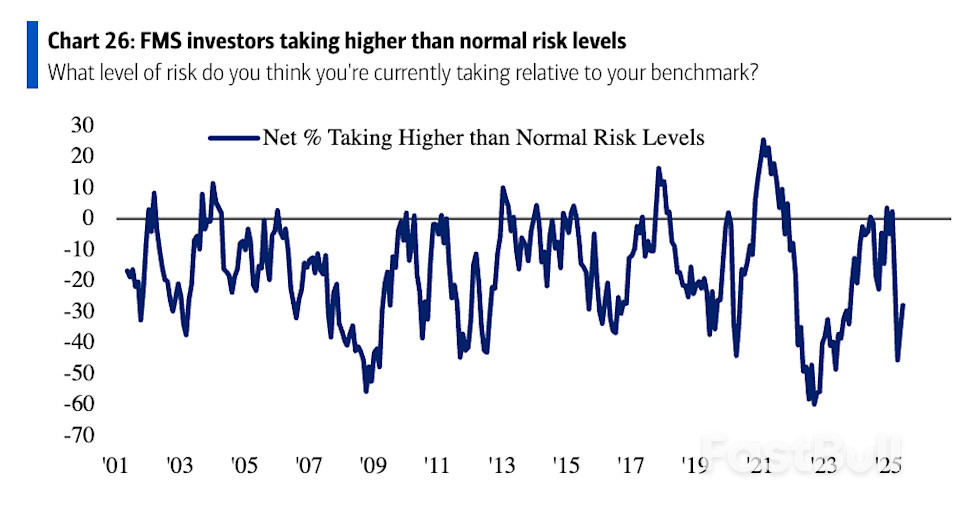
          That caution was echoed in Bank of America’s latest Global Fund Manager Survey released Tuesday, which showed a sharp drop in risk appetite with a net 28% of investors taking a more-cautious-than-normal level of risk in their portfolios.
          Stocks are back near record highs. Investors still aren't buying this rally._1
          The survey also revealed that equity allocations remain well below average, currently sitting one standard deviation below their long-term norm.
          However, that caution, some strategists argue, may be more of a tailwind than a headwind for stocks.
          "Sentiment can still be negative even with stocks back at all-time highs," Kevin Gordon, senior investment strategist at Charles Schwab, told Yahoo Finance.
          Gordon described the recent rally as "definitely still hated," but a dynamic that's not unusual following sharp, unexpected sell-offs.
          Tom Lee, head of research at Fundstrat, wrote in a recent client note that investors may be overlooking a stronger investment backdrop compared to early 2025, with more clarity on trade and tax policy and a potentially more dovish Fed.
          "We’re so close to all-time highs, and yet investors are mostly negative still," he said. "This remains one of the most-hated rallies."
          Strategists across Wall Street have also grown more bullish on stocks in recent weeks.
          No fewer than 11 Wall Street firms lowered their S&P 500 targets amid the market sell-off in April, but at least eight of those have since raised their bets on where the index ends 2025.
          The median S&P 500 target now sits at 6,100, signaling further upside potential.
          While investors are participating in the rebound, Schwab's Gordon said the gains have been concentrated in sectors outside of Big Tech, which has led the bull market over the past two years. He called out strength in commercial services like logistics and airlines, while more economically sensitive sectors like freight and goods production continue to lag.
          According to Gordon, that points to a more selective rally and could be a contrarian signal that stocks still have room to run.
          "The pain trade," he added, "is probably still supportive for the equity market to go a little bit higher."

          Source: finance.yahoo

          Risk Warnings and Disclaimers
          You understand and acknowledge that there is a high degree of risk involved in trading. Following any strategies or investment methods may lead to potential losses. The content on the site is provided by our contributors and analysts for information purposes only. You are solely responsible for determining whether any trading assets, securities, strategy, or any other product is suitable for investing based on your own investment objectives and financial situation.
          Add to Favorites
          Share

          IEA Doubles Down on Peak Oil Demand Forecast

          Glendon

          Commodity

          • The International Energy Agency forecasts global oil demand to peak and plateau by the end of this decade, with China's demand peaking earlier than previously anticipated.

          • While oil supply is expected to outpace demand growth, geopolitical risks and trade tensions introduce significant uncertainties to the oil market.

          • There is a notable divergence in viewpoints between the IEA and OPEC regarding future oil demand, with OPEC predicting continued growth beyond the current decade.

          A peak in global oil demand is still on the horizon, the International Energy Agency (IEA) said on Tuesday, doubling down on its forecast that demand will plateau by the end of the decade.

          China’s oil demand, which increased by a cumulative 6 million barrels per day (bpd) in the decade to 2024, is set to peak earlier than previously expected, the agency said in its annual Oil 2025 report for the medium term.

          While China – the world’s top crude oil importer – accounted for 60% of the global increase in oil consumption in 2015-2024, “the picture to 2030 looks very different,” the IEA said.

          China’s demand is on track to peak in 2027 – two years earlier than previously thought – amid “an extraordinary surge in EV sales, the continued deployment of trucks running on liquefied natural gas (LNG), as well as strong growth in the country’s high-speed rail network, along with structural shifts in its economy.”

          Global oil demand is forecast to rise by 2.5 million bpd from 2024 to 2030, reaching a plateau around 105.5 million bpd by the end of the decade, per the agency’s latest estimates.

          Annual global growth will slow from about 700,000 bpd in 2025 and 2026 “to just a trickle over the next several years, with a small decline expected in 2030, based on today’s policy settings and market trends,” the IEA said.

          The agency expects below-trend economic growth, weighed down by global trade tensions and fiscal imbalances, and accelerating substitution away from oil in the transport and power generation sectors.

          At the same time, the increase in global oil supply is “set to far outpace demand growth in coming years,” according to the agency.

          “Based on the fundamentals, oil markets look set to be well-supplied in the years ahead – but recent events sharply highlight the significant geopolitical risks to oil supply security,” IEA Executive Director Fatih Birol said.

          If no major supply disruptions occur, the oil market will be comfortably supplied through 2030, the agency reckons, but warned that “significant uncertainties remain, especially given rising geopolitical risks and heightened trade tensions.”

          The IEA’s “peak demand on the horizon” narrative once again clashes with OPEC’s view of growing oil demand at least into the 2040s.

          Just last week, OPEC Secretary General, Haitham Al Ghais, said that oil demand would continue growing over the coming decades as the world’s population increases.

          “Simply put, there is no ‘peak in oil demand’ on the horizon,” Al Ghais said at The Global Energy Show Canada in Calgary, Canada.

          Source: Zero Hedge

          Risk Warnings and Disclaimers
          You understand and acknowledge that there is a high degree of risk involved in trading. Following any strategies or investment methods may lead to potential losses. The content on the site is provided by our contributors and analysts for information purposes only. You are solely responsible for determining whether any trading assets, securities, strategy, or any other product is suitable for investing based on your own investment objectives and financial situation.
          Add to Favorites
          Share

          Wall Street Fears Hawkish Fed Will Trigger Stock Market Selloff

          Adam

          Economic

          Stocks

          Not much seems to faze the stock market these days even as risks abound, from war in the Middle East, to trade tensions, to slowing growth. But Wall Street’s biggest fear arrives today when the Federal Reserve meeting ends and Chair Jerome Powell explains the central bank’s outlook.
          There’s pretty much no expectation that the Fed will reduce interest rates at this meeting after holding steady in the past three instances. But between the so-called dot plot, which outlines where central bankers think the fed funds rate is headed, and Powell’s press conference after the meeting, traders expect to have a much clearer idea of what they’re thinking.
          Wall Street’s hope is that the Fed see cuts coming in the fall, with swaps traders pricing roughly 56% odds of a reduction in September. The fear is that it doesn’t — and that a hawkish tone from Powell will be the trigger that sends equities prices tumbling from near all-time highs.
          “If Powell signals the Fed is going to keep playing the ‘wait-and-see’ game before cutting rates, the market will hate that and stocks will likely sell off,” said Dennis Dick, head of markets structure and a proprietary trader at Triple D Trading. “His tone is crucial. Trade wars. Geopolitics. Growth. No one knows how all of this will play out. Any signals cuts are coming would ignite a rally.”
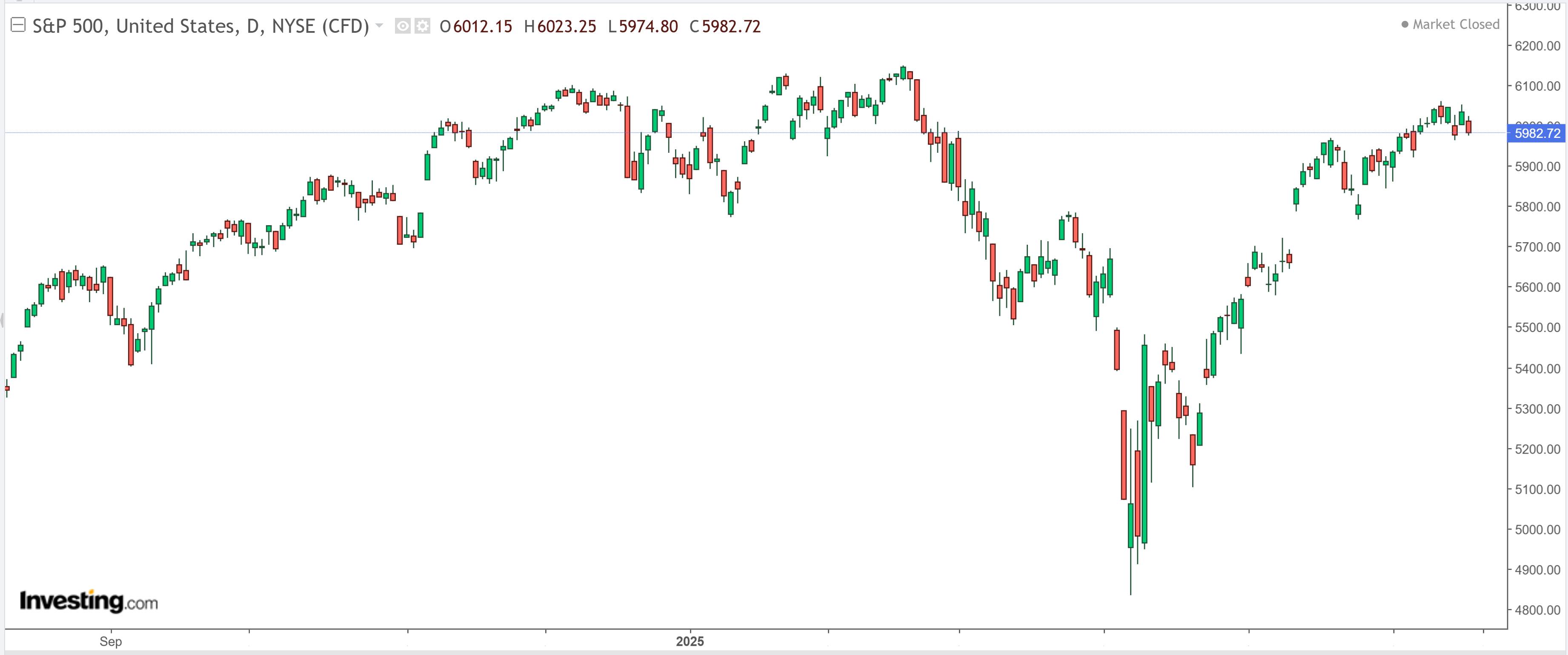
          It’s been a wild 2025 for the stock market. The S&P 500 Index is up 1.7% for the year and stands less than 3% from a record. It almost slammed into a bear market in April after President Donald Trump unveiled his sweeping global tariffs, but it immediately took off a week later when he delayed most of his levies.
          The S&P 500 has traded sideways for the last five weeks, rising 0.7% since May 20. Even the fighting between Israel and Iran hasn’t really knocked the market off its pins, with the S&P 500 down just 1% since Israel launched its bombing campaign last Thursday, even as oil soars to its highest level since January. But at the same time, optimism on global trade, resilient inflation data and solid corporate earnings are already largely priced in, leaving little fuel to power stocks higher.
          “If the conflict in the Middle East turns into a full-scale war leading to a lasting rise in oil prices, it’s going to be a long slog for stocks this summer if inflation pressures pick up,” said Seth Merrill, chief investment officer at Crewe Advisors. He’s betting that bond proxy shares like utilities and real estate will be more susceptible to swings today, given their sensitivity to the rates outlook.
          Hawkish Fear
          That’s why investors will pore over the Summary of Economic Projections, the formal name of the dot plot, and carefully parse Powell’s remarks. The central bank’s announcement is scheduled at 2 p.m. in Washington, with Powell’s press conference 30 minutes later.
          Wall Street is largely bracing for the Fed to take a hawkish stance.
          Bloomberg Intelligence chief US economist Anna Wong thinks the central bank “won’t flinch” because of policy uncertainty tied to the Trump administration’s trade, tax and regulatory policies. Mark Cabana, head of US rates strategy at Bank of America, wrote in a note to clients Monday that he and his team see the Fed remaining “comfortably in wait-and-see mode,” with just one rate cut planned for 2025. And Andrew Tyler, head of global market intelligence at JPMorgan Chase & Co., sees heightens potential for a pullback creating a buy-the dip moment.
          Other money managers like Jim Worden, chief investment officer at the Wealth Consulting Group, have argued for Powell to shift the focus back to the employment part of the Fed’s dual mandate.
          Indeed, inflation pressures have improved after the Fed last cut rates in December, with US consumer prices rising in May by less than forecast for the fourth month in a row. But this comes at a time when other parts of the economy are showing signs of weakness in the aftermath of tariffs, including a plunge in May retail sales and reduced US services and manufacturing activity, along with slowing private payrolls growth.
          “If Powell acknowledges the labor market is softening while inflation is cooling — that’s a buy signal for stocks because it means he is open to rate cuts later this year,” Worden said. “But if he pours cold water all over that idea, or even alludes to no cuts the rest of year, markets will be rattled. Traders will wonder ‘What does he know that we don’t? Does he expect inflation to pick in the second half of the year?’”
          Betting On Calm
          That leaves options pros betting on a calmer than normal Fed day, with the S&P 500 projected to move 1% in either direction, according to data compiled by Piper Sandler & Co. That’s the smallest implied swing ahead of a Fed day since January and just below the average realized move of 1.1% over the past 18 months.
          That said, Wall Street pros see an upside if the market falls on hawkish chatter. Triple D Trading’s Dick is using any selloffs to pile into high-flying technology shares tied to the artificial-intelligence boom. While, the Wealth Consulting’s Worden is looking to buy cheaper big tech shares like Broadcom Inc. and Marvell Technology Inc., although he’ll wait until the dust settles if the market gets too volatile after the Fed chief’s presser.
          Powell has repeatedly described the economy as “solid.” But US job expansion moderated in May while private payrolls growth slowed. Yet the stock market has been blowing all of this off as economists and sell-slide strategists lower their odds that trade wars will rekindle what traders fear most: stagflation.
          The bottom line is at this point so much is unknown, from the Fed’s rate path, to earnings growth, to how White House policy is implemented and affects Corporate America. So just about any interpretation of where we are has validity.
          Jamie Cox, managing partner at Harris Financial Group, is running counter to the consensus and betting that Powell may open the door to cutting rates as early as July.
          “Markets have things priced all wrong thinking cuts will come even further out beyond September,” Cox argued, who plans to pile into US tech shares if the market sells off, or rallies on Wednesday. “I’m hoping to hear him say ‘inflation data has come in better-than-expected,’ which to me signals they’re not as fearful of stagflation.”

          Source: Bloomberg

          To stay updated on all economic events of today, please check out our Economic calendar
          Risk Warnings and Disclaimers
          You understand and acknowledge that there is a high degree of risk involved in trading. Following any strategies or investment methods may lead to potential losses. The content on the site is provided by our contributors and analysts for information purposes only. You are solely responsible for determining whether any trading assets, securities, strategy, or any other product is suitable for investing based on your own investment objectives and financial situation.
          Add to Favorites
          Share

          FOMC Preview: Fed in Wait-And-See Mode As Powell Faces Barrage of Uncertainty

          Michelle

          Forex

          Economic

          The Federal Reserve’s June policy meeting arrives at a critical moment for the stock market, with the benchmark S&P 500 sitting around 3% below its February record high despite a barrage of lingering uncertainty, including persistent trade war fears and fresh geopolitical headwinds between Israel and Iran.FOMC Preview: Fed in Wait-And-See Mode As Powell Faces Barrage of Uncertainty_1

          Source: Investing.com

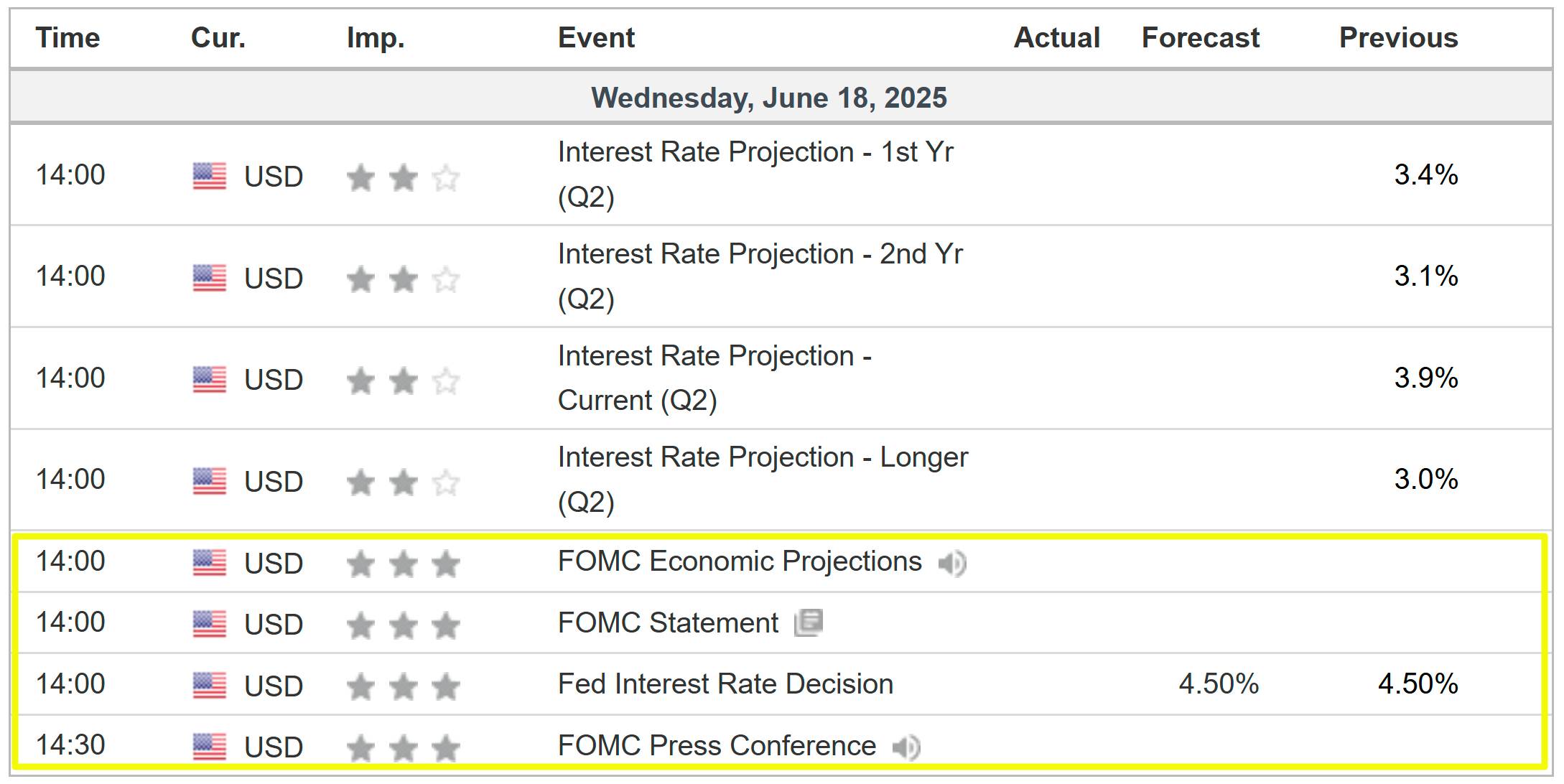
          As such, a lot will be on the line when the Fed delivers its latest interest rate decision at 2:00 PM ET on Wednesday. While the US central bank is widely expected to hold rates steady at 4.25%-4.50%, investors are eager for any hints about whether it might be poised to lower borrowing costs in the coming months.

          Markets currently expect two rate cuts by the end of this year, with the next one likely in September, as per the Investing.com Fed Rate Monitor Tool.

          Alongside the rate decision, Federal Open Market Committee (FOMC) officials will also release their new quarterly economic projections for interest rates, inflation, and unemployment, known as the ‘dot plot’.

          The last dot plot, released in March, revealed a consensus among Fed officials for two cuts in 2025.

          If FOMC policymakers stick with that forecast, it could reinforce bullish sentiment—especially since recent economic data shows some softening. But if the outlook shifts to just one cut (or pushes the timeline further out), expect a market recalibration and possible pressure on stocks and risk assets.FOMC Preview: Fed in Wait-And-See Mode As Powell Faces Barrage of Uncertainty_2

          Source: Investing.com

          Post-meeting comments from Fed Chair Jerome Powell at 2:30 PM ET will be closely watched and could move the market as his words often carry as much weight as the policy decision itself. Powell is likely to emphasize a data-dependent approach, citing the need for further clarity on the economic and inflationary impact of President Donald Trump’s trade tariffs before adjusting rates.

          Speaking of Trump, the president’s repeated public calls for rate cuts and criticism of Powell could complicate the Fed’s messaging, though Powell is expected to reaffirm the central bank’s independence.

          Market Implications

          Financial markets may see muted initial reactions to a widely anticipated hold, but equities, bonds, gold, and the US Dollar could move based on the updated dot plot and Powell’s comments.

          If the Fed signals a dovish pivot—hinting at potential rate cuts in the near future due to confidence in declining inflation—equity markets could rally, as lower borrowing costs typically support corporate earnings and valuations. Growth stocks, particularly in technology, which are sensitive to interest rates, would likely see the most benefit.

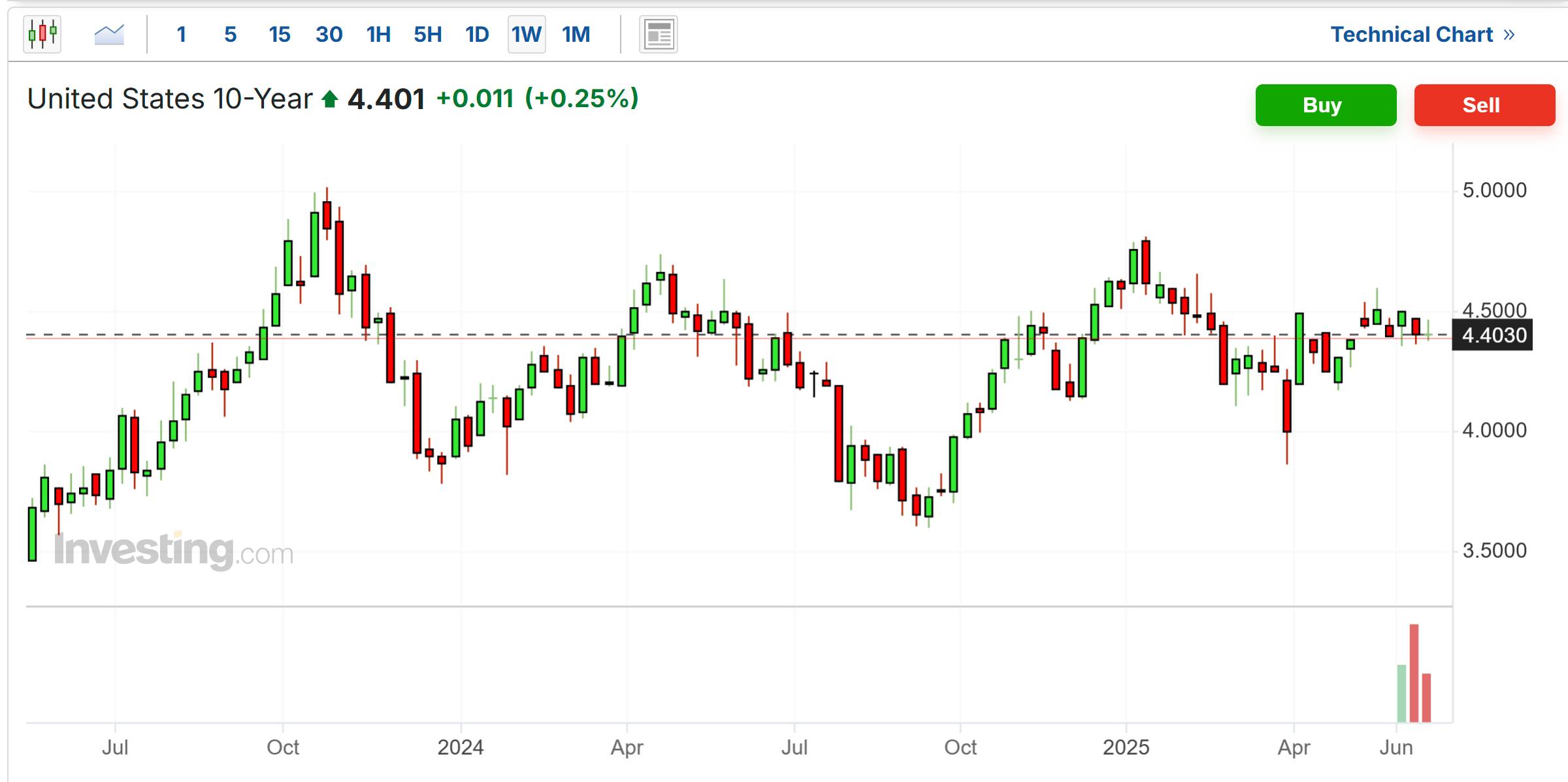
          Bond yields, such as those on the 10-year Treasury, could decline in anticipation of looser monetary policy, boosting fixed-income assets.FOMC Preview: Fed in Wait-And-See Mode As Powell Faces Barrage of Uncertainty_3

          Source: Investing.com

          Conversely, a hawkish stance—suggesting that rates will remain higher for longer to combat stubborn inflation—could pressure risk assets like stocks, as higher interest rates increase borrowing costs and dampen economic growth prospects.

          In this scenario, the US dollar might strengthen, as elevated rates attract capital inflows, while commodities like gold could face headwinds due to a stronger currency and higher opportunity costs.FOMC Preview: Fed in Wait-And-See Mode As Powell Faces Barrage of Uncertainty_4

          Source: Investing.com

          Source: Investing

          To stay updated on all economic events of today, please check out our Economic calendar
          Risk Warnings and Disclaimers
          You understand and acknowledge that there is a high degree of risk involved in trading. Following any strategies or investment methods may lead to potential losses. The content on the site is provided by our contributors and analysts for information purposes only. You are solely responsible for determining whether any trading assets, securities, strategy, or any other product is suitable for investing based on your own investment objectives and financial situation.
          Add to Favorites
          Share

          Borrowers Looking for Lower Costs Will Have to Wait as the Fed Is Unlikely to Cut Rates

          Warren Takunda

          Economic

          China–U.S. Trade War

          The inflation-fighters at the Federal Reserve are expected to keep their key interest rate unchanged Wednesday for the fourth straight time. That’s likely to shift attention to how many interest rate cuts they forecast for this year.
          It’s widely expected that the 19 Fed officials that participate in the central bank’s interest-rate decisions will project two rate cuts for this year, as they did in December and March. But some economists expect that one or both of those cuts could be pushed back to 2026.
          The Fed will almost certainly keep the short-term rate it controls at about 4.3%, economists say, where it has stood since the central bank last cut rates in December. Since then, it has stayed on the sidelines while it evaluates the impact of President Donald Trump’s tariffs and other policy changes on the economy and prices.
          Inflation has been cooling since January, and many economists say that without the higher import taxes, the Fed would likely be cutting its rate further. According to the Fed’s preferred measure, inflation dropped to just 2.1% in April, the lowest since last September. Core inflation — which exclude the volatile food and energy categories — was 2.5%.
          Those figures suggest inflation is largely coming under control, for now. Yet the Fed’s short-term interest rate remains at an elevated level intended to slow growth and inflation. Some economists argue that with inflation cooling, the Fed could resume its rate reductions.
          When the Fed reduces its rate, it often — though not always — leads to lower costs for consumer and business borrowing, including for mortgages, auto loans, and credit cards. Yet financial markets also influence the level of longer-term rates and can keep them elevated even if the Fed reduces the shorter-term rate it controls.
          But Fed officials have said they want to see whether Trump’s tariffs boost inflation and for how long. Economists generally believe a tariff hike should at least lead to a one-time increase in prices, as companies seek to offset the cost of higher duties. Many Fed officials, however, are worried that the tariffs could lead to more sustained inflation.
          “While theory might suggest that (the Fed) should look through a one-time increase in prices, I would be uncomfortable staking the Fed’s reputation and credibility on theory,” Jeffrey Schmid, president of the Fed’s Kansas City branch and a voting member of the Fed’s interest-rate setting committee, said earlier this month.
          The Trump White House has sharply ramped up pressure on Powell to reduce borrowing costs, with Trump himself calling the Fed chair a “numbskull” last week for not cutting. Other officials, including Vice President JD Vance and Commerce Secretary Howard Lutnick, are also calling for a rate reduction.
          Pushing the Fed to cut rates simply to save the government on its interest payments typically raises alarms among economists, because it would threaten the Fed’s congressional mandate to focus on stable prices and maximum employment.
          One of Trump’s complaints is that the Fed isn’t cutting rates even as other central banks around the world have reduced their borrowing costs, including in Europe, Canada, and the U.K. On Tuesday, the Bank of Japan kept its key short-term rate unchanged at 0.5%, after actually raising it recently.
          But the European Central Bank, Bank of Canada, and Bank of England have reduced their rates this year in part because U.S. tariffs are weakening their economies. So far the U.S. economy is mostly solid, with the unemployment rate low.
          The Bank of England has cut its rate twice this year but is expected to keep it unchanged at 4.25% when it meets Thursday.

          Source: AP

          To stay updated on all economic events of today, please check out our Economic calendar
          Risk Warnings and Disclaimers
          You understand and acknowledge that there is a high degree of risk involved in trading. Following any strategies or investment methods may lead to potential losses. The content on the site is provided by our contributors and analysts for information purposes only. You are solely responsible for determining whether any trading assets, securities, strategy, or any other product is suitable for investing based on your own investment objectives and financial situation.
          Add to Favorites
          Share
          FastBull
          Copyright © 2025 FastBull Ltd

          728 RM B 7/F GEE LOK IND BLDG NO 34 HUNG TO RD KWUN TONG KLN HONG KONG

          TelegramInstagramTwitterfacebooklinkedin
          App Store Google Play Google Play
          Products
          Charts

          Chats

          Q&A with Experts
          Screeners
          Economic Calendar
          Data
          Tools
          Membership
          Features
          Function
          Markets
          Copy Trading
          Latest Signals
          Contests
          News
          Analysis
          24/7
          Columns
          Education
          Company
          Careers
          About Us
          Contact Us
          Advertising
          Help Center
          Feedback
          User Agreement
          Privacy Policy
          Business

          White Label

          Data API

          Web Plug-ins

          Poster Maker

          Affiliate Program

          Risk Disclosure

          The risk of loss in trading financial instruments such as stocks, FX, commodities, futures, bonds, ETFs and crypto can be substantial. You may sustain a total loss of the funds that you deposit with your broker. Therefore, you should carefully consider whether such trading is suitable for you in light of your circumstances and financial resources.

          No decision to invest should be made without thoroughly conducting due diligence by yourself or consulting with your financial advisors. Our web content might not suit you since we don't know your financial conditions and investment needs. Our financial information might have latency or contain inaccuracy, so you should be fully responsible for any of your trading and investment decisions. The company will not be responsible for your capital loss.

          Without getting permission from the website, you are not allowed to copy the website's graphics, texts, or trademarks. Intellectual property rights in the content or data incorporated into this website belong to its providers and exchange merchants.

          Not Logged In

          Log in to access more features

          FastBull Membership

          Not yet

          Purchase

          Become a signal provider
          Help Center
          Customer Service
          Dark Mode
          Price Up/Down Colors

          Log In

          Sign Up

          Position
          Layout
          Fullscreen
          Default to Chart
          The chart page opens by default when you visit fastbull.com