• Trade
  • Markets
  • Copy
  • Contests
  • News
  • 24/7
  • Calendar
  • Q&A
  • Chats
Trending
Screeners
SYMBOL
LAST
BID
ASK
HIGH
LOW
NET CHG.
%CHG.
SPREAD
SPX
S&P 500 Index
6827.42
6827.42
6827.42
6899.86
6801.80
-73.58
-1.07%
--
DJI
Dow Jones Industrial Average
48458.04
48458.04
48458.04
48886.86
48334.10
-245.98
-0.51%
--
IXIC
NASDAQ Composite Index
23195.16
23195.16
23195.16
23554.89
23094.51
-398.69
-1.69%
--
USDX
US Dollar Index
97.950
98.030
97.950
98.500
97.950
-0.370
-0.38%
--
EURUSD
Euro / US Dollar
1.17394
1.17409
1.17394
1.17496
1.17192
+0.00011
+ 0.01%
--
GBPUSD
Pound Sterling / US Dollar
1.33707
1.33732
1.33707
1.33997
1.33419
-0.00148
-0.11%
--
XAUUSD
Gold / US Dollar
4299.39
4299.39
4299.39
4353.41
4257.10
+20.10
+ 0.47%
--
WTI
Light Sweet Crude Oil
57.233
57.485
57.233
58.011
56.969
-0.408
-0.71%
--

Community Accounts

Signal Accounts
--
Profit Accounts
--
Loss Accounts
--
View More

Become a signal provider

Sell trading signals to earn additional income

View More

Guide to Copy Trading

Get started with ease and confidence

View More

Signal Accounts for Members

All Signal Accounts

Best Return
  • Best Return
  • Best P/L
  • Best MDD
Past 1W
  • Past 1W
  • Past 1M
  • Past 1Y

All Contests

  • All
  • Trump Updates
  • Recommend
  • Stocks
  • Cryptocurrencies
  • Central Banks
  • Featured News
Top News Only
Share

Trump Isn't Certain His Economic Policies Will Translate To Midterm Wins

Share

The United States And Mexico Have Reached An Agreement On How To Resolve The Water Dispute In The Rio Grande Basin (which Borders Texas). Starting December 15, Mexico Will Supply The U.S. With An Additional 20.2 Acre-feet (a Unit Of Volume For Irrigation). The Agreement Seeks To “strengthen Water Management In The Rio Grande Basin” Within The Framework Of The 1944 Water Treaty

Share

U.S. Transportation Secretary Duffy: The Engine Of United Airlines Flight 803 That Malfunctioned Caught Fire

Share

Ukraine President Zelenskiy: He Will Meet US, European Representatives About Peace

Share

UK Prime Minister Office: Prime Minister Starmer Spoke To The President Of The European Commission Ursula Von Der Leyen This Evening - Downing Street Spokesperson

Share

Trump: We Will Retaliate Against ISIS

Share

Trump Says We Mourn The Loss Of Three Great Patriots In Syria In An Ambush

Share

Syrian Interior Ministry Spokesperson Confirms Attacker Was Member Of Security Forces With Extremist Ideology

Share

Syrian Interior Ministry Says Attacker Did Not Have Leadership Role In Security Forces, Did Not Say If He Was Junior Member

Share

Man Who Attacked Syrian, US Military Was Member Of Syrian Security Forces -Three Local Syrian Officials

Share

US Envoy Coale Says Belarus President Lukashenko Agreed To Do All He Can To Stop Weather Balloons Flying Into Lithuania

Share

Ukraine Says Russian Drone Attack Hit Civilian Turkish Vessel

Share

Islamic State Attacker In Syria Was Lone Gunman, Who Was Killed -USA Central Command

Share

US Envoy John Coale Says Around 1000 Remaining Political Prisoners In Belarus Could Be Released In Coming Months

Share

US Defense Secretary Hegseth: Attacker Was Killed By Partner Forces

Share

Pentagon Says Two USA Army Soldiers And One Civilian USA Interpreter Were Killed, And Three Were Wounded In Syria

Share

Israel Says It Kills Senior Hamas Commander Raed Saed In Gaza

Share

Ukraine's Navy Says Russian Drone Attack Hit Civilian Turkish Vessel Carrying Sunflower Oil To Egypt On Saturday

Share

Israeli Military Says It Put Planned Strike On South Lebanon Site On Hold After Lebanese Army Requested Access

Share

Norwegian Nobel Committee: Calls On The Belarusian Authorities To Release All Political Prisoners

TIME
ACT
FCST
PREV
U.K. Trade Balance (Oct)

A:--

F: --

P: --

U.K. Services Index MoM

A:--

F: --

P: --

U.K. Construction Output MoM (SA) (Oct)

A:--

F: --

P: --

U.K. Industrial Output YoY (Oct)

A:--

F: --

P: --

U.K. Trade Balance (SA) (Oct)

A:--

F: --

P: --

U.K. Trade Balance EU (SA) (Oct)

A:--

F: --

P: --

U.K. Manufacturing Output YoY (Oct)

A:--

F: --

P: --

U.K. GDP MoM (Oct)

A:--

F: --

P: --

U.K. GDP YoY (SA) (Oct)

A:--

F: --

P: --

U.K. Industrial Output MoM (Oct)

A:--

F: --

P: --

U.K. Construction Output YoY (Oct)

A:--

F: --

P: --

France HICP Final MoM (Nov)

A:--

F: --

P: --

China, Mainland Outstanding Loans Growth YoY (Nov)

A:--

F: --

P: --

China, Mainland M2 Money Supply YoY (Nov)

A:--

F: --

P: --

China, Mainland M0 Money Supply YoY (Nov)

A:--

F: --

P: --

China, Mainland M1 Money Supply YoY (Nov)

A:--

F: --

P: --

India CPI YoY (Nov)

A:--

F: --

P: --

India Deposit Gowth YoY

A:--

F: --

P: --

Brazil Services Growth YoY (Oct)

A:--

F: --

P: --

Mexico Industrial Output YoY (Oct)

A:--

F: --

P: --

Russia Trade Balance (Oct)

A:--

F: --

P: --

Philadelphia Fed President Henry Paulson delivers a speech
Canada Building Permits MoM (SA) (Oct)

A:--

F: --

P: --

Canada Wholesale Sales YoY (Oct)

A:--

F: --

P: --

Canada Wholesale Inventory MoM (Oct)

A:--

F: --

P: --

Canada Wholesale Inventory YoY (Oct)

A:--

F: --

P: --

Canada Wholesale Sales MoM (SA) (Oct)

A:--

F: --

P: --

Germany Current Account (Not SA) (Oct)

A:--

F: --

P: --

U.S. Weekly Total Rig Count

A:--

F: --

P: --

U.S. Weekly Total Oil Rig Count

A:--

F: --

P: --

Japan Tankan Large Non-Manufacturing Diffusion Index (Q4)

--

F: --

P: --

Japan Tankan Small Manufacturing Outlook Index (Q4)

--

F: --

P: --

Japan Tankan Large Non-Manufacturing Outlook Index (Q4)

--

F: --

P: --

Japan Tankan Large Manufacturing Outlook Index (Q4)

--

F: --

P: --

Japan Tankan Small Manufacturing Diffusion Index (Q4)

--

F: --

P: --

Japan Tankan Large Manufacturing Diffusion Index (Q4)

--

F: --

P: --

Japan Tankan Large-Enterprise Capital Expenditure YoY (Q4)

--

F: --

P: --

U.K. Rightmove House Price Index YoY (Dec)

--

F: --

P: --

China, Mainland Industrial Output YoY (YTD) (Nov)

--

F: --

P: --

China, Mainland Urban Area Unemployment Rate (Nov)

--

F: --

P: --

Saudi Arabia CPI YoY (Nov)

--

F: --

P: --

Euro Zone Industrial Output YoY (Oct)

--

F: --

P: --

Euro Zone Industrial Output MoM (Oct)

--

F: --

P: --

Canada Existing Home Sales MoM (Nov)

--

F: --

P: --

Euro Zone Total Reserve Assets (Nov)

--

F: --

P: --

U.K. Inflation Rate Expectations

--

F: --

P: --

Canada National Economic Confidence Index

--

F: --

P: --

Canada New Housing Starts (Nov)

--

F: --

P: --

U.S. NY Fed Manufacturing Employment Index (Dec)

--

F: --

P: --

U.S. NY Fed Manufacturing Index (Dec)

--

F: --

P: --

Canada Core CPI YoY (Nov)

--

F: --

P: --

Canada Manufacturing Unfilled Orders MoM (Oct)

--

F: --

P: --

Canada Manufacturing New Orders MoM (Oct)

--

F: --

P: --

Canada Core CPI MoM (Nov)

--

F: --

P: --

Canada Manufacturing Inventory MoM (Oct)

--

F: --

P: --

Canada CPI YoY (Nov)

--

F: --

P: --

Canada CPI MoM (Nov)

--

F: --

P: --

Canada CPI YoY (SA) (Nov)

--

F: --

P: --

Canada Core CPI MoM (SA) (Nov)

--

F: --

P: --

Canada CPI MoM (SA) (Nov)

--

F: --

P: --

Q&A with Experts
    • All
    • Chatrooms
    • Groups
    • Friends
    Connecting
    .
    .
    .
    Type here...
    Add Symbol or Code

      No matching data

      All
      Trump Updates
      Recommend
      Stocks
      Cryptocurrencies
      Central Banks
      Featured News
      • All
      • Russia-Ukraine Conflict
      • Middle East Flashpoint
      • All
      • Russia-Ukraine Conflict
      • Middle East Flashpoint
      Search
      Products

      Charts Free Forever

      Chats Q&A with Experts
      Screeners Economic Calendar Data Tools
      Membership Features
      Data Warehouse Market Trends Institutional Data Policy Rates Macro

      Market Trends

      Market Sentiment Order Book Forex Correlations

      Top Indicators

      Charts Free Forever
      Markets

      News

      News Analysis 24/7 Columns Education
      From Institutions From Analysts
      Topics Columnists

      Latest Views

      Latest Views

      Trending Topics

      Top Columnists

      Latest Update

      Signals

      Copy Rankings Latest Signals Become a signal provider AI Rating
      Contests
      Brokers

      Overview Brokers Assessment Rankings Regulators News Claims
      Broker listing Forex Brokers Comparison Tool Live Spread Comparison Scam
      Q&A Complaint Scam Alert Videos Tips to Detect Scam
      More

      Business
      Events
      Careers About Us Advertising Help Center

      White Label

      Data API

      Web Plug-ins

      Affiliate Program

      Awards Institution Evaluation IB Seminar Salon Event Exhibition
      Vietnam Thailand Singapore Dubai
      Fans Party Investment Sharing Session
      FastBull Summit BrokersView Expo
      Recent Searches
        Top Searches
          Markets
          News
          Analysis
          User
          24/7
          Economic Calendar
          Education
          Data
          • Names
          • Latest
          • Prev

          View All

          No data

          Scan to Download

          Faster Charts, Chat Faster!

          Download App
          English
          • English
          • Español
          • العربية
          • Bahasa Indonesia
          • Bahasa Melayu
          • Tiếng Việt
          • ภาษาไทย
          • Français
          • Italiano
          • Türkçe
          • Русский язык
          • 简中
          • 繁中
          Open Account
          Search
          Products
          Charts Free Forever
          Markets
          News
          Signals

          Copy Rankings Latest Signals Become a signal provider AI Rating
          Contests
          Brokers

          Overview Brokers Assessment Rankings Regulators News Claims
          Broker listing Forex Brokers Comparison Tool Live Spread Comparison Scam
          Q&A Complaint Scam Alert Videos Tips to Detect Scam
          More

          Business
          Events
          Careers About Us Advertising Help Center

          White Label

          Data API

          Web Plug-ins

          Affiliate Program

          Awards Institution Evaluation IB Seminar Salon Event Exhibition
          Vietnam Thailand Singapore Dubai
          Fans Party Investment Sharing Session
          FastBull Summit BrokersView Expo

          Ishiba's Resignation Adds Uncertainty to BOJ Rate Hike Plans

          Gerik

          Economic

          Summary:

          Japan's Prime Minister Shigeru Ishiba's resignation has raised uncertainty around the Bank of Japan’s (BOJ) next interest rate move, with analysts predicting that the central bank may delay its planned hike until early 2026...

          Political Uncertainty Influences BOJ's Rate Hike Decisions

          Following Prime Minister Ishiba’s resignation, the Bank of Japan may reconsider its plans for an interest rate hike in October. Analysts at Evercore ISI now forecast a delay until January 2026, citing potential political instability and the unknown direction of Japan’s future leadership. With the Liberal Democratic Party (LDP) scheduled to elect a new leader on October 4, the BOJ may prefer to delay its rate hike decision until after the new administration settles. The shift in political leadership adds a layer of uncertainty, making it challenging for the BOJ to raise rates in the middle of political turmoil.
          The direct correlation here is clear: while the BOJ’s decision on rates is primarily driven by economic conditions, political stability plays a significant role in determining the timing of such a move. Without clarity on the new prime minister’s stance, the BOJ may choose to remain cautious and wait for more stable conditions.

          Leadership Candidates and Monetary Policy

          The leadership race within the LDP has added complexity to the BOJ's decision-making. Sanae Takaichi, a frontrunner who supports fiscal and monetary stimulus, has been critical of the BOJ's previous rate hikes, while Shinjiro Koizumi remains an unknown in terms of monetary policy. If Takaichi wins, her views on stimulus could pressure the BOJ to slow down its tightening policy.
          A potential cause-and-effect relationship exists here: if Takaichi, who favors a reflationary approach, becomes prime minister, her influence could push the BOJ to adopt more dovish policies, impacting the timing and pace of rate hikes. However, the need for fiscal discipline could force her to reconsider aggressive monetary policies, particularly as inflation becomes a more pressing concern.

          The Role of Inflation and Fiscal Discipline

          Inflation has remained above the BOJ’s 2% target for three years, with broader price pressures emerging due to tight labor markets and rising wages. This creates a paradox for the BOJ: while waiting too long to raise rates could risk a loss of fiscal discipline, prematurely tightening could stifle economic growth.
          The BOJ must strike a balance between supporting economic growth and addressing inflation. If political uncertainties prevent timely action, the central bank risks having to implement more drastic measures later, potentially triggering market concerns over Japan’s fiscal health. As inflation persists, especially in food and wages, the BOJ might need to move faster than previously anticipated to tame price pressures.
          The political vacuum created by Ishiba’s resignation complicates the BOJ’s rate hike plans. While the central bank may delay its move, it faces growing risks from persistent inflation and market pressures. The BOJ will need to carefully navigate the political landscape and consider both short-term economic stability and long-term inflation control. Delaying too long may expose Japan to greater fiscal instability, while premature tightening could derail growth. The BOJ’s next steps will depend heavily on the trajectory of Japan’s leadership and the economic outlook in the months ahead.

          Source: Reuters

          To stay updated on all economic events of today, please check out our Economic calendar
          Risk Warnings and Disclaimers
          You understand and acknowledge that there is a high degree of risk involved in trading. Following any strategies or investment methods may lead to potential losses. The content on the site is provided by our contributors and analysts for information purposes only. You are solely responsible for determining whether any trading assets, securities, strategy, or any other product is suitable for investing based on your own investment objectives and financial situation.
          Add to Favorites
          Share

          US Sanctions Billion-dollar Cyber Scam Networks In Myanmar And Cambodia

          Winkelmann

          Economic

          Forex

          Political

          Key points:

          ● Scams involve illegal gambling, fraudulent investments
          ● Sanctioned entities linked to human trafficking and coercion

          The United States imposed sanctions on cyber scam operators in Myanmar and Cambodia on Tuesday, a booming industry the U.S. says stole tens of billions from Americans last year, according to a Treasury Department statement.Criminal networks have trafficked hundreds of thousands of people into Southeast Asian scam compounds, especially along the Thai-Myanmar border, where they are forced into debt bondage and defrauding strangers online."Southeast Asia's cyber scam industry not only threatens the well-being and financial security of Americans, but also subjects thousands of people to modern slavery," Under Secretary of the Treasury for Terrorism and Financial Intelligence John K. Hurley said in the statement.

          The Myanmar junta's spokesman did not immediately respond to Reuters' requests for comment, and neither did a Cambodia government spokesman.The scams include money laundering, illegal gambling and persuading victims to make fraudulent investments, and the operators tend to be people - usually foreigners - who have been trafficked and coerced into working in scam compounds.Sanctioned entities included nine companies and individuals in Shwe Kokko, a town in Karen State on the Thai border.The U.S. sanctions aim to choke off funds to the criminal networks, which have flourished in regions controlled both by militias and Myanmar's junta.

          COERCION AND VIOLENCE

          At Shwe Kokko, operators lured people from across the globe with deceptive offers, then confined, mistreated and coerced them into carrying out online fraud for criminal networks, the Treasury Department said.The criminals often use debt bondage, violence, and the threat of forced prostitution as part of their coercion tactics, it said.The department also sanctioned 10 entities in Cambodia, where centres run by Chinese criminal networks were focused on digital currency fraud. Some compounds in Cambodia resembled prisons, according to Amnesty International, which accused the country of ignoring the industry, allegations it denies.

          Since a 2021 military coup, scam centres have expanded rapidly in Myanmar, spreading from militia-controlled areas into those under junta control, a report by the Australian Strategic Policy Institute said.Shwe Kokko was established in 2017 by Hong Kong–registered Yatai International Holdings Group and the Karen National Army, an armed group allied with Myanmar's military, according to the United States Institute of Peace. Yatai group is sanctioned and KNA has been previously sanctioned.

          Source: TradingView

          To stay updated on all economic events of today, please check out our Economic calendar
          Risk Warnings and Disclaimers
          You understand and acknowledge that there is a high degree of risk involved in trading. Following any strategies or investment methods may lead to potential losses. The content on the site is provided by our contributors and analysts for information purposes only. You are solely responsible for determining whether any trading assets, securities, strategy, or any other product is suitable for investing based on your own investment objectives and financial situation.
          Add to Favorites
          Share

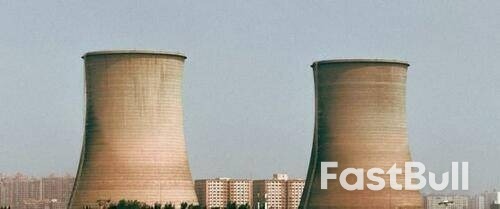
          The Nuclear Waste Problem Haunting UK Energy Expansion

          Samantha Luan

          Economic

          Forex

          Political

          ● Effective nuclear waste management is a critical global challenge, particularly for countries like the UK looking to expand their nuclear power sectors.

          ● The UK has a substantial amount of existing radioactive waste and is struggling to implement a long-term disposal solution, with the proposed underground geological disposal facility facing significant hurdles and cost concerns.

          ● Public and local community pushback against potential nuclear waste sites further complicates the development of new disposal facilities, making finding a solution an ongoing and difficult process.

          One of the biggest hurdles to expanding the global nuclear power sector is the concern over how best to manage nuclear waste.While some believe they have found sustainable solutions to dispose of nuclear waste, there is still widespread debate around how safe these methods are and the potential long-term impact of waste disposal and storage.In the United Kingdom, the government has put nuclear power back on the agenda, after decades with no new nuclear developments; however, managing nuclear waste continues to be a major barrier to development.

          Nuclear waste remains radioactive for around 10,000 years, meaning it is vital that governments dispose of all waste effectively to ensure people and the environment are kept safe in the long term.As more governments welcome a new nuclear era, they must address nuclear waste concerns and establish clear guidelines and regulations on disposal to ensure that all nuclear power companies adhere to strong safety standards and practices.

          There are three types of nuclear waste: low-, intermediate-, and high-level radioactive waste.Most of the waste produced at nuclear facilities is lightly contaminated, including items such as tools and work clothing, with a level of around 1 percent radioactivity.Meanwhile, spent fuel is an example of high-level waste, which contributes around 3 percent of the total volume of waste from nuclear energy production.However, this contains around 95 percent of the radioactivity, making adequate waste management of these products extremely important.

          In the U.K., the government continues to battle with how best to dispose of its nuclear waste, as it looks to expand the industry over the coming decades. The U.K. has 700,000 cubic metres of radioactive waste from its previous nuclear power activities, a figure that will grow as more nuclear projects come online. The government is now considering the development of a massive underground nuclear dump, known as a geological deposit facility (GDF), to safely dispose of the waste. While no site has been confirmed for development, it is expected to be developed in one of two potential sites in Cumbria, in the north of England.

          A U.K. Department for Energy Security and Net Zero spokesperson stated, “Constructing the UK’s first geological disposal facility will provide an internationally recognised safe and permanent disposal of the most hazardous radioactive waste.”They added, “Progress continues to be made in areas taking part in the siting process for this multibillion-pound facility, which would bring thousands of skilled jobs and economic growth to the local area.”

          However, the U.K. Treasury believes the government’s plan for the waste dump is “unachievable”, rating the project as “red”, or not possible, in a recent assessment. This means that, “There are major issues with project definition, schedule, budget, quality and/or benefits delivery, which at this stage do not appear to be manageable or resolvable. The project may need rescoping and/or its overall viability reassessed.” In addition, there are concerns over the projected project cost, which is expected to be anywhere up to $73 billion.Richard Outram, the secretary of Nuclear Free Local Authorities, explained, “The Nista red rating is hardly surprising. The GDF process is fraught with uncertainties, and the GDF ‘solution’ remains unproven and costly.”

          At present, the U.K. stores most of its nuclear waste at its Sellafield facility in Cumbria, which is viewed as one of the most complex and hazardous nuclear sites worldwide. However, with the planned decommissioning of several power plants and the development of new nuclear facilities, the government must address its imminent waste issue. This is a long-term problem, with it expected to take until 2150 to dispose of the country’s existing waste into a GDF, if one is developed, before disposing of new waste.

          In June, Lincolnshire County Council withdrew from being a potential site for the GDF after engaging with communities about the proposal. This is a common problem with developing nuclear waste sites, as the pushback in proposed waste regions often prevents development due to a not-in-my-backyard perspective from residents in the area. It is still unclear whether communities in Cumbria will hold a similar opinion. Corhyn Parr, the CEO of Nuclear Waste Services, said, “A GDF requires a suitable site and a willing community and will only be developed when both are in place.”

          Several countries around the globe are battling with how best to dispose of old and new nuclear waste, as a nuclear renaissance is starting to be seen, in line with global aims for a green transition. While nuclear power is now viewed as extremely safe and clean, there are pressing concerns around the adequate disposal of waste, which can be extremely harmful to human health and the environment if improperly managed, that must be rapidly addressed.

          Source: Zero Hedge

          To stay updated on all economic events of today, please check out our Economic calendar
          Risk Warnings and Disclaimers
          You understand and acknowledge that there is a high degree of risk involved in trading. Following any strategies or investment methods may lead to potential losses. The content on the site is provided by our contributors and analysts for information purposes only. You are solely responsible for determining whether any trading assets, securities, strategy, or any other product is suitable for investing based on your own investment objectives and financial situation.
          Add to Favorites
          Share

          New Thai Premier Discloses $124 Million Assets Including Jets

          Daniel Carter

          Political

          The former construction tycoon also listed 1.09 billion baht ($34.5 million) of cash and deposits in more than two dozen bank accounts among his assets worth 3.9 billion baht.
          Anutin, 58, disclosed his wealth to the National Anti-Corruption Commission as a requirement for government officials, and the agency made the record public on Tuesday.
          The leader of Bhumjaithai Party, the third largest in parliament, and champion of cannabis decriminalization policy has ascended to power after the Constitutional Court ex-premier Paetongtarn Shinawatra for ethical violations. He received the support of the People's Party, the largest bloc in parliament, in exchange for Anutin's commitment to dissolve parliament in four months to pave the way for a general election and a public referendum to amend the constitution.
          Anutin has investments of about 655 million baht and last year reported an income of more than 1.8 million baht, according to the document. Among his other assets are several deeds to land, four luxury cars, 22 watches, 24 amulets and 11 Benjarong porcelains dating back to the 13th century and initially made for royalty.
          Anutin's royalist credentials have boosted his standing, arguably even above the leaders of military-backed parties. While he insisted he did not play any role in last year's contest for a new Senate, about 75% of new senators are linked to him or Bhumjaithai, according to political analysts.

          Source: Bloomberg Europe

          Risk Warnings and Disclaimers
          You understand and acknowledge that there is a high degree of risk involved in trading. Following any strategies or investment methods may lead to potential losses. The content on the site is provided by our contributors and analysts for information purposes only. You are solely responsible for determining whether any trading assets, securities, strategy, or any other product is suitable for investing based on your own investment objectives and financial situation.
          Add to Favorites
          Share

          U.S. Job Growth Revisions Expected to Show Sharp Downward Adjustments

          Gerik

          Economic

          Significant Downward Revision of Job Growth Expected

          The U.S. is poised to release a preliminary nonfarm payrolls benchmark estimate, with economists predicting a downward revision of up to 1 million jobs for the period from April 2024 to March 2025. This follows a disappointing jobs report for August, which showed nearly stagnant growth, and a contraction in June for the first time in 4.5 years. The revisions, based on Quarterly Census of Employment and Wages (QCEW) data, are expected to underscore a labor market slowdown that predates the economic impact of tariffs and immigration policies.
          This suggests a direct cause-and-effect relationship between structural shifts in the economy particularly automation and changes in labor supply and the weakening job market. The revisions signal that the labor market was already struggling before trade-related shocks and tightening immigration policies.

          Impact of Technological Change and Policy on Labor Demand

          Sung Won Sohn, an economist at Loyola Marymount University, attributed the slowdown in job growth to a combination of technological change, rising financing costs, and uncertain policy signals. The era of rapid job gains is over, Sohn said, and businesses are recalibrating to adapt to automation and artificial intelligence, which are reducing the demand for workers. This marks a gradual adjustment rather than a sudden collapse, with businesses responding to long-term trends in technological disruption.
          The effect of tariffs and immigration restrictions, which have reduced the labor supply, is now compounded by technological adoption in key industries, indicating a correlation between policy changes and labor market shifts.

          Revisions Highlight Weakness Before Tariff Impact

          If the final revisions come closer to the higher estimate of 1 million jobs lost, it would suggest that the labor market had already been nearly stalled in early 2025, well before President Trump’s tariff policies took full effect. According to Shruti Mishra of Bank of America Securities, the revisions will underscore how the labor market was underperforming even before the economic uncertainties sparked by the trade war.
          The significant downgrades, particularly to the May and June employment numbers, have already caused friction with President Trump, who has accused the Bureau of Labor Statistics (BLS) of falsifying data.

          Monetary Policy and Economic Reactions

          Despite the downward revision, economists do not expect significant changes to monetary policy in the short term. The Federal Reserve is expected to proceed with its rate-cutting cycle next Wednesday, following its January pause. The expectation of rate cuts remains strong, particularly after weaker jobs data raised concerns about a slowing labor market.
          However, concerns have arisen around the BLS's "birth-and-death" model, which is used to estimate job changes from businesses not included in the CES survey. This model has historically overestimated job growth, and the recent decline in the rate of new business openings could suggest further inaccuracies.
          The upcoming revisions to U.S. job data signal a marked slowdown in the labor market that predates President Trump’s tariff and immigration policies. While the impact of these policies is still unfolding, the revisions suggest a deeper, longer-term issue in the labor market, exacerbated by technological change and political uncertainty. The adjustments may not only shape future policy decisions but also underscore the evolving challenges facing both businesses and workers in the U.S. economy.

          Source: Reuters

          To stay updated on all economic events of today, please check out our Economic calendar
          Risk Warnings and Disclaimers
          You understand and acknowledge that there is a high degree of risk involved in trading. Following any strategies or investment methods may lead to potential losses. The content on the site is provided by our contributors and analysts for information purposes only. You are solely responsible for determining whether any trading assets, securities, strategy, or any other product is suitable for investing based on your own investment objectives and financial situation.
          Add to Favorites
          Share

          US Dollar Index (DXY) Drops To 7-Week Low Ahead Of Key Inflation Data

          FXOpen

          Forex

          Technical Analysis

          Economic

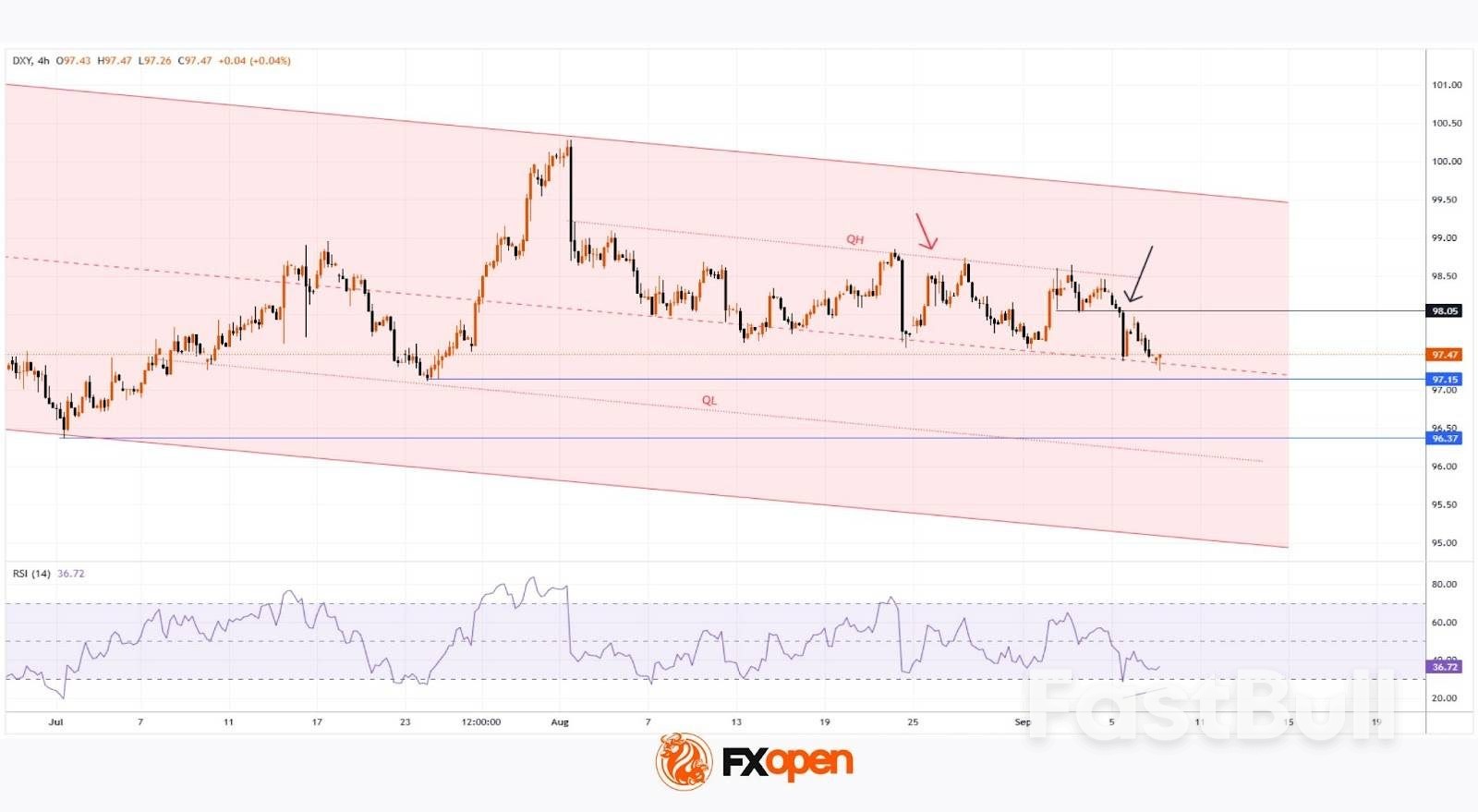
          As the US Dollar Index (DXY) chart shows, the value of the USD against a basket of other currencies has fallen below 97.30 – its lowest level since late July.

          The reasons lie in market sentiment ahead of major data releases:

          → On Wednesday at 15:30 GMT+3, Producer Price Index (PPI) figures will be published; a month ago they came in extremely high.

          → On Thursday at 15:30 GMT+3, Consumer Price Index (CPI) figures are due.

          These releases are particularly significant as next week the Federal Reserve is set to announce its decision on interest rates – a 25-basis-point cut is widely expected.

          US Dollar Index (DXY) Drops To 7-Week Low Ahead Of Key Inflation Data_1

          Technical Analysis of the DXY Chart

          On 18 August, we identified a descending channel (shown in red) based on a sequence of lower highs and lower lows → it remains valid.

          In addition, our base scenario suggested that the index might test one of the quartile lines (QL and/or QH) dividing the channel → indeed, since then the QH line has been tested several times (red arrow), convincingly acting as resistance.

          What Next?

          Bearish case:

          → Lower highs and lows throughout the second half of August indicate that sellers are in control of the DXY market.

          → The black arrow marks bearish momentum that broke through support at 98.05 last week.

          → The drop was sharp (a sign of imbalance in favour of sellers), and yesterday the 98.05 level acted as resistance.

          Bullish case:

          → The DXY has dropped into the median zone, where supply and demand often balance. Buyers may step in, viewing current levels as attractive for entry.

          → The RSI may potentially form a bullish divergence.

          → The latest candle on the right shows a long lower wick (a bullish pin bar pattern), underlining buyers’ determination.

          Given the above, we could expect the DXY to hover around the median area. However, the upcoming US inflation reports could trigger volatility across financial markets. A test of support at 97.15 could occur.

          Source: FXOpen

          To stay updated on all economic events of today, please check out our Economic calendar
          Risk Warnings and Disclaimers
          You understand and acknowledge that there is a high degree of risk involved in trading. Following any strategies or investment methods may lead to potential losses. The content on the site is provided by our contributors and analysts for information purposes only. You are solely responsible for determining whether any trading assets, securities, strategy, or any other product is suitable for investing based on your own investment objectives and financial situation.
          Add to Favorites
          Share

          U.S. Tariffs Threaten Global Petrochemical Trade With Deeper Declines

          Gerik

          Economic

          Tariffs Intensify Industry Strains

          According to Ganesh Gopalakrishnan, head of petrochemical trading at TotalEnergies, U.S. tariffs are worsening an already fragile environment in the global petrochemicals sector. The industry has faced a 34% fall in trade volumes over the last five years due to overcapacity, and tariffs could cause an additional 15% decline if they remain in place. The causal relationship is direct: higher tariffs restrict cross-border flows, pushing companies toward domestic production and undermining the viability of international trading houses.
          Trading firms without significant asset ownership face the greatest difficulty. Overcapacity has eroded margins, leaving pure traders vulnerable. With tariffs restricting market access, these firms are increasingly squeezed out of the supply chain. The combination of structural oversupply and policy-driven barriers represents a double bind, weakening the competitive landscape.

          Protectionism and Market Displacement

          Industry executives also noted that tariffs are fostering protectionist policies worldwide. Sanjiv Vasudeva of Haldia Petrochemicals highlighted that volatility and overcapacity are complicating investment planning. Meanwhile, Petronas Chemicals’ Bahrin Asmawi stressed that tariffs are pushing surplus Chinese products into Southeast Asian markets, displacing traditional suppliers. This illustrates a cause-and-effect outcome: restrictions on U.S.-bound exports force Chinese producers to redirect supply, intensifying competition in alternative regions.
          Despite the broader downturn, India’s petrochemical consumption remains a rare growth area. Vasudeva pointed out that demand growth in India has been stable, providing some relief to producers seeking to offset weaker global trade flows. This represents a correlation rather than a systemic solution: Indian growth helps mitigate losses but is not large enough to reverse global contraction.
          The petrochemicals sector remains under pressure from structural overcapacity, weak global demand, and policy-induced barriers. U.S. tariffs, in particular, are amplifying these strains by directly suppressing trade flows and indirectly fostering protectionism and supply redirection. While India’s consumption offers a modest cushion, executives caution that without policy adjustments, the industry could face a prolonged period of volatility and declining profitability. The global petrochemical trade, once a cornerstone of industrial growth, now risks further contraction as tariffs reshape market dynamics.

          Source: Reuters

          To stay updated on all economic events of today, please check out our Economic calendar
          Risk Warnings and Disclaimers
          You understand and acknowledge that there is a high degree of risk involved in trading. Following any strategies or investment methods may lead to potential losses. The content on the site is provided by our contributors and analysts for information purposes only. You are solely responsible for determining whether any trading assets, securities, strategy, or any other product is suitable for investing based on your own investment objectives and financial situation.
          Add to Favorites
          Share
          FastBull
          Copyright © 2025 FastBull Ltd

          728 RM B 7/F GEE LOK IND BLDG NO 34 HUNG TO RD KWUN TONG KLN HONG KONG

          TelegramInstagramTwitterfacebooklinkedin
          App Store Google Play Google Play
          Products
          Charts

          Chats

          Q&A with Experts
          Screeners
          Economic Calendar
          Data
          Tools
          Membership
          Features
          Function
          Markets
          Copy Trading
          Latest Signals
          Contests
          News
          Analysis
          24/7
          Columns
          Education
          Company
          Careers
          About Us
          Contact Us
          Advertising
          Help Center
          Feedback
          User Agreement
          Privacy Policy
          Business

          White Label

          Data API

          Web Plug-ins

          Poster Maker

          Affiliate Program

          Risk Disclosure

          The risk of loss in trading financial instruments such as stocks, FX, commodities, futures, bonds, ETFs and crypto can be substantial. You may sustain a total loss of the funds that you deposit with your broker. Therefore, you should carefully consider whether such trading is suitable for you in light of your circumstances and financial resources.

          No decision to invest should be made without thoroughly conducting due diligence by yourself or consulting with your financial advisors. Our web content might not suit you since we don't know your financial conditions and investment needs. Our financial information might have latency or contain inaccuracy, so you should be fully responsible for any of your trading and investment decisions. The company will not be responsible for your capital loss.

          Without getting permission from the website, you are not allowed to copy the website's graphics, texts, or trademarks. Intellectual property rights in the content or data incorporated into this website belong to its providers and exchange merchants.

          Not Logged In

          Log in to access more features

          FastBull Membership

          Not yet

          Purchase

          Become a signal provider
          Help Center
          Customer Service
          Dark Mode
          Price Up/Down Colors

          Log In

          Sign Up

          Position
          Layout
          Fullscreen
          Default to Chart
          The chart page opens by default when you visit fastbull.com