• Trade
  • Markets
  • Copy
  • Contests
  • News
  • 24/7
  • Calendar
  • Q&A
  • Chats
Trending
Screeners
SYMBOL
LAST
BID
ASK
HIGH
LOW
NET CHG.
%CHG.
SPREAD
SPX
S&P 500 Index
6848.25
6848.25
6848.25
6878.28
6833.87
-22.15
-0.32%
--
DJI
Dow Jones Industrial Average
47747.06
47747.06
47747.06
47971.51
47695.55
-207.92
-0.43%
--
IXIC
NASDAQ Composite Index
23548.09
23548.09
23548.09
23698.93
23481.60
-30.03
-0.13%
--
USDX
US Dollar Index
99.010
99.090
99.010
99.160
98.730
+0.060
+ 0.06%
--
EURUSD
Euro / US Dollar
1.16383
1.16390
1.16383
1.16717
1.16162
-0.00043
-0.04%
--
GBPUSD
Pound Sterling / US Dollar
1.33237
1.33246
1.33237
1.33462
1.33053
-0.00075
-0.06%
--
XAUUSD
Gold / US Dollar
4191.94
4192.35
4191.94
4218.85
4175.92
-5.97
-0.14%
--
WTI
Light Sweet Crude Oil
58.852
58.882
58.852
60.084
58.817
-0.957
-1.60%
--

Community Accounts

Signal Accounts
--
Profit Accounts
--
Loss Accounts
--
View More

Become a signal provider

Sell trading signals to earn additional income

View More

Guide to Copy Trading

Get started with ease and confidence

View More

Signal Accounts for Members

All Signal Accounts

Best Return
  • Best Return
  • Best P/L
  • Best MDD
Past 1W
  • Past 1W
  • Past 1M
  • Past 1Y

All Contests

  • All
  • Trump Updates
  • Recommend
  • Stocks
  • Cryptocurrencies
  • Central Banks
  • Featured News
Top News Only
Share

Zimbabwe's President Removes Winston Chitando As Mines Minister, Replaces Him With Polite Kambamura

Share

Ukraine President Zelenskiy: Ukraine Counts On Funding Based On Frozen Russian Assets In Any Form

Share

USA Commerce To Open Up Exports Of Nvidia H200 Chips To China -Semafor

Share

Ukraine: Ukraine Is Seeking Security Guarantees That Have Been Approved By The U.S. Capitol

Share

UN Spokesperson - UN Secretary General Guterres Very Concerned About Latest Developments Between Thailand And Cambodia

Share

LME Copper Futures Closed Up $15 At $11,636 Per Tonne. LME Aluminum Futures Closed Down $10 At $2,888 Per Tonne. LME Zinc Futures Closed Up $23 At $3,121 Per Tonne

Share

USA Federal Communications Commission Says It May Bar Providers From Connecting Calls From Chinese Telecom Companies To USA Networks Over Robocall Prevention Efforts - Order

Share

Ukraine President Zelenskiy: Ukraine Cannot Give Up Land, USA Is Trying To Find Compromise On The Issue

Share

Ukraine President Zelenskiy: Ukraine-Europe Plan Proposals Should Be Ready By Tomorrow To Share With USA

Share

Ukraine President Zelenskiy: Talks In London Were Productive, There Is Small Progress Towards Peace

Share

EU's Foreign Chief: Giving Ukraine The Resources It Needs To Defend Itself Doesn't Prolong The War, It Can Help End It

Share

EU's Foreign Chief: Securing Multi-Year Funding For Ukraine In December Is Absolutely Essential

Share

[Bank For International Settlements: US Tariffs Drive Record Global FX Trading Volume] Data From The Bank For International Settlements (BIS) Shows That Global FX Trading Volume Surged To A Record High This Year, With An Average Daily Trading Volume Of $9.5 Trillion In April, Amid Market Turmoil Triggered By US President Trump's Tariff Policies. On December 8, The Bank Released Its Quarterly Assessment, Citing Data From Its Triennial Survey, Stating That The Impact Of Tariffs Was "substantial," Leading To An Unexpected Depreciation Of The US Dollar And Accounting For Over $1.5 Trillion In Average Daily OTC Trading Volume In April. The Report Shows That Overall FX Trading Volume Increased By More Than A Quarter Compared To The Last Survey In 2022, Surpassing The Estimated Peak During The Market Turmoil Caused By The COVID-19 Pandemic In March 2020. This Data Is An Update Based On Preliminary Survey Results Released In September

Share

UN Secretary General Guterres Strongly Condemns Unauthorized Entry By Israeli Authorities Into UNRWA Compound In East Jerusalem

Share

Bank Of America: A Dovish Federal Reserve Poses A Key Risk To High-grade U.S. Bonds In 2026

Share

Bank CEOs Will Meet With U.S. Senators To Discuss The (regulatory) Framework For The Cryptocurrency Market

Share

The U.S. Supreme Court Has Hinted That It Will Support President Trump's Decision To Remove Heads Of Federal Government Agencies

Share

[BlackRock: The Surge Of Funds Into AI Infrastructure Is Far From Peaking] Ben Powell, Chief Investment Strategist For Asia Pacific At BlackRock, Stated That The Capital Expenditure Spree In The Artificial Intelligence (AI) Infrastructure Sector Continues And Is Far From Reaching Its Peak. Powell Believes That As Tech Giants Race To Increase Their Investments In A "winner-takes-all" Competition, The "shovel Sellers" (such As Chipmakers, Energy Producers, And Copper Wire Manufacturers) Who Provide The Foundational Resources For The Sector Are The Clearest Investment Winners

Share

[Ray Dalio: The Middle East Is Rapidly Becoming One Of The World's Most Influential AI Hubs] Bridgewater Associates Founder Ray Dalio Stated That The Middle East (particularly The UAE And Saudi Arabia) Is Rapidly Emerging As A Powerful Global AI Hub, Comparable To Silicon Valley, Due To The Region's Combination Of Massive Capital And Global Talent. Dalio Believes The Gulf Region's Transformation Is The Result Of Well-thought-out National Strategies And Long-term Planning, Noting That The UAE's Outstanding Performance In Leadership, Stability, And Quality Of Life Has Made It A "Silicon Valley For Capitalists." While He Believes The AI ​​rebound Is In Bubble Territory, He Advises Investors Not To Rush Out But Rather To Look For Catalysts That Could Cause The Bubble To "burst," Such As Monetary Tightening Or Forced Wealth Selling

Share

French President Emmanuel Macron Met With The Croatian Prime Minister At The Élysée Palace

TIME
ACT
FCST
PREV
France Trade Balance (SA) (Oct)

A:--

F: --

P: --
Euro Zone Employment YoY (SA) (Q3)

A:--

F: --

P: --
Canada Part-Time Employment (SA) (Nov)

A:--

F: --

P: --

Canada Unemployment Rate (SA) (Nov)

A:--

F: --

P: --

Canada Full-time Employment (SA) (Nov)

A:--

F: --

P: --

Canada Labor Force Participation Rate (SA) (Nov)

A:--

F: --

P: --

Canada Employment (SA) (Nov)

A:--

F: --

P: --

U.S. PCE Price Index MoM (Sept)

A:--

F: --

P: --

U.S. Personal Income MoM (Sept)

A:--

F: --

P: --

U.S. Core PCE Price Index MoM (Sept)

A:--

F: --

P: --

U.S. PCE Price Index YoY (SA) (Sept)

A:--

F: --

P: --

U.S. Core PCE Price Index YoY (Sept)

A:--

F: --

P: --

U.S. Personal Outlays MoM (SA) (Sept)

A:--

F: --

P: --
U.S. 5-10 Year-Ahead Inflation Expectations (Dec)

A:--

F: --

P: --

U.S. Real Personal Consumption Expenditures MoM (Sept)

A:--

F: --

P: --
U.S. Weekly Total Rig Count

A:--

F: --

P: --

U.S. Weekly Total Oil Rig Count

A:--

F: --

P: --

U.S. Consumer Credit (SA) (Oct)

A:--

F: --

P: --
China, Mainland Foreign Exchange Reserves (Nov)

A:--

F: --

P: --

Japan Trade Balance (Oct)

A:--

F: --

P: --

Japan Nominal GDP Revised QoQ (Q3)

A:--

F: --

P: --

China, Mainland Imports YoY (CNH) (Nov)

A:--

F: --

P: --

China, Mainland Exports (Nov)

A:--

F: --

P: --

China, Mainland Imports (CNH) (Nov)

A:--

F: --

P: --

China, Mainland Trade Balance (CNH) (Nov)

A:--

F: --

P: --

China, Mainland Exports YoY (USD) (Nov)

A:--

F: --

P: --

China, Mainland Imports YoY (USD) (Nov)

A:--

F: --

P: --

Germany Industrial Output MoM (SA) (Oct)

A:--

F: --

P: --
Euro Zone Sentix Investor Confidence Index (Dec)

A:--

F: --

P: --

Canada National Economic Confidence Index

A:--

F: --

P: --

U.K. BRC Like-For-Like Retail Sales YoY (Nov)

--

F: --

P: --

U.K. BRC Overall Retail Sales YoY (Nov)

--

F: --

P: --

Australia Overnight (Borrowing) Key Rate

--

F: --

P: --

RBA Rate Statement
RBA Press Conference
Germany Exports MoM (SA) (Oct)

--

F: --

P: --

U.S. NFIB Small Business Optimism Index (SA) (Nov)

--

F: --

P: --

Mexico 12-Month Inflation (CPI) (Nov)

--

F: --

P: --

Mexico Core CPI YoY (Nov)

--

F: --

P: --

Mexico PPI YoY (Nov)

--

F: --

P: --

U.S. Weekly Redbook Index YoY

--

F: --

P: --

U.S. JOLTS Job Openings (SA) (Oct)

--

F: --

P: --

China, Mainland M1 Money Supply YoY (Nov)

--

F: --

P: --

China, Mainland M0 Money Supply YoY (Nov)

--

F: --

P: --

China, Mainland M2 Money Supply YoY (Nov)

--

F: --

P: --

U.S. EIA Short-Term Crude Production Forecast For The Year (Dec)

--

F: --

P: --

U.S. EIA Natural Gas Production Forecast For The Next Year (Dec)

--

F: --

P: --

U.S. EIA Short-Term Crude Production Forecast For The Next Year (Dec)

--

F: --

P: --

EIA Monthly Short-Term Energy Outlook
U.S. API Weekly Gasoline Stocks

--

F: --

P: --

U.S. API Weekly Cushing Crude Oil Stocks

--

F: --

P: --

U.S. API Weekly Crude Oil Stocks

--

F: --

P: --

U.S. API Weekly Refined Oil Stocks

--

F: --

P: --

South Korea Unemployment Rate (SA) (Nov)

--

F: --

P: --

Japan Reuters Tankan Non-Manufacturers Index (Dec)

--

F: --

P: --

Japan Reuters Tankan Manufacturers Index (Dec)

--

F: --

P: --

Japan Domestic Enterprise Commodity Price Index MoM (Nov)

--

F: --

P: --

Japan Domestic Enterprise Commodity Price Index YoY (Nov)

--

F: --

P: --

China, Mainland PPI YoY (Nov)

--

F: --

P: --

China, Mainland CPI MoM (Nov)

--

F: --

P: --

Q&A with Experts
    • All
    • Chatrooms
    • Groups
    • Friends
    Connecting
    .
    .
    .
    Type here...
    Add Symbol or Code

      No matching data

      All
      Trump Updates
      Recommend
      Stocks
      Cryptocurrencies
      Central Banks
      Featured News
      • All
      • Russia-Ukraine Conflict
      • Middle East Flashpoint
      • All
      • Russia-Ukraine Conflict
      • Middle East Flashpoint
      Search
      Products

      Charts Free Forever

      Chats Q&A with Experts
      Screeners Economic Calendar Data Tools
      Membership Features
      Data Warehouse Market Trends Institutional Data Policy Rates Macro

      Market Trends

      Market Sentiment Order Book Forex Correlations

      Top Indicators

      Charts Free Forever
      Markets

      News

      News Analysis 24/7 Columns Education
      From Institutions From Analysts
      Topics Columnists

      Latest Views

      Latest Views

      Trending Topics

      Top Columnists

      Latest Update

      Signals

      Copy Rankings Latest Signals Become a signal provider AI Rating
      Contests
      Brokers

      Overview Brokers Assessment Rankings Regulators News Claims
      Broker listing Forex Brokers Comparison Tool Live Spread Comparison Scam
      Q&A Complaint Scam Alert Videos Tips to Detect Scam
      More

      Business
      Events
      Careers About Us Advertising Help Center

      White Label

      Data API

      Web Plug-ins

      Affiliate Program

      Awards Institution Evaluation IB Seminar Salon Event Exhibition
      Vietnam Thailand Singapore Dubai
      Fans Party Investment Sharing Session
      FastBull Summit BrokersView Expo
      Recent Searches
        Top Searches
          Markets
          News
          Analysis
          User
          24/7
          Economic Calendar
          Education
          Data
          • Names
          • Latest
          • Prev

          View All

          No data

          Scan to Download

          Faster Charts, Chat Faster!

          Download App
          English
          • English
          • Español
          • العربية
          • Bahasa Indonesia
          • Bahasa Melayu
          • Tiếng Việt
          • ภาษาไทย
          • Français
          • Italiano
          • Türkçe
          • Русский язык
          • 简中
          • 繁中
          Open Account
          Search
          Products
          Charts Free Forever
          Markets
          News
          Signals

          Copy Rankings Latest Signals Become a signal provider AI Rating
          Contests
          Brokers

          Overview Brokers Assessment Rankings Regulators News Claims
          Broker listing Forex Brokers Comparison Tool Live Spread Comparison Scam
          Q&A Complaint Scam Alert Videos Tips to Detect Scam
          More

          Business
          Events
          Careers About Us Advertising Help Center

          White Label

          Data API

          Web Plug-ins

          Affiliate Program

          Awards Institution Evaluation IB Seminar Salon Event Exhibition
          Vietnam Thailand Singapore Dubai
          Fans Party Investment Sharing Session
          FastBull Summit BrokersView Expo

          Investors snap nine-week buying streak in global equity funds

          Adam

          Stocks

          Summary:

          Global equity funds saw their first outflow in nine weeks as tech valuation fears grew, while bond, money-market, gold, and emerging-market funds continued to attract inflows.
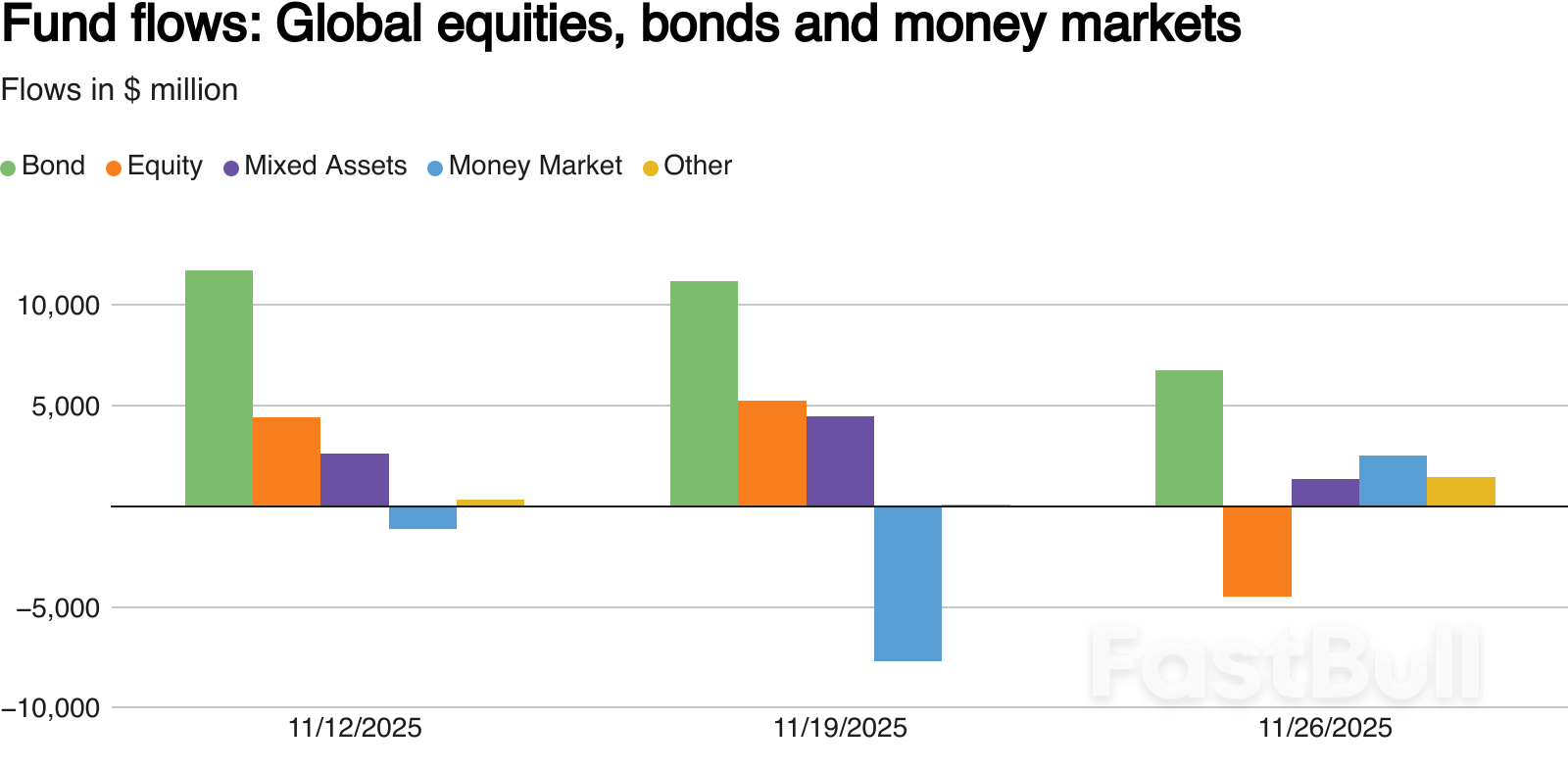
          Global equity funds saw their first weekly outflow in 10 weeks in the week to November 26, as concerns about stretched valuations, particularly in the tech sector, outweighed optimism around expected U.S. interest rate cuts next month.
          According to LSEG Lipper data, investors withdrew a net $4.48 billion from global equity funds as they registered their first weekly net sales since September 17.
          Investors snap nine-week buying streak in global equity funds_1

          Weekly flows into global equity, bond and money market funds in $ million

          In the most recent week, investors divested U.S. and European equity funds of $4.56 billion and $1.21 billion, respectively, but invested approximately $170.37 million in Asian equity funds.
          Overall, global equities had a volatile November, with fears over stretched tech valuations and a record 43-day U.S. government shutdown weighing on sentiment.
          "We continue to view AI as a market driver, but the sector will likely be assessed more selectively, and high valuations of many AI leaders carry disappointment risk," said Vincenzo Vedda, chief investment officer at asset management firm DWS Group.
          "For this reason, we remain broadly diversified and see gold as a relative hedge."
          Investors snap nine-week buying streak in global equity funds_2

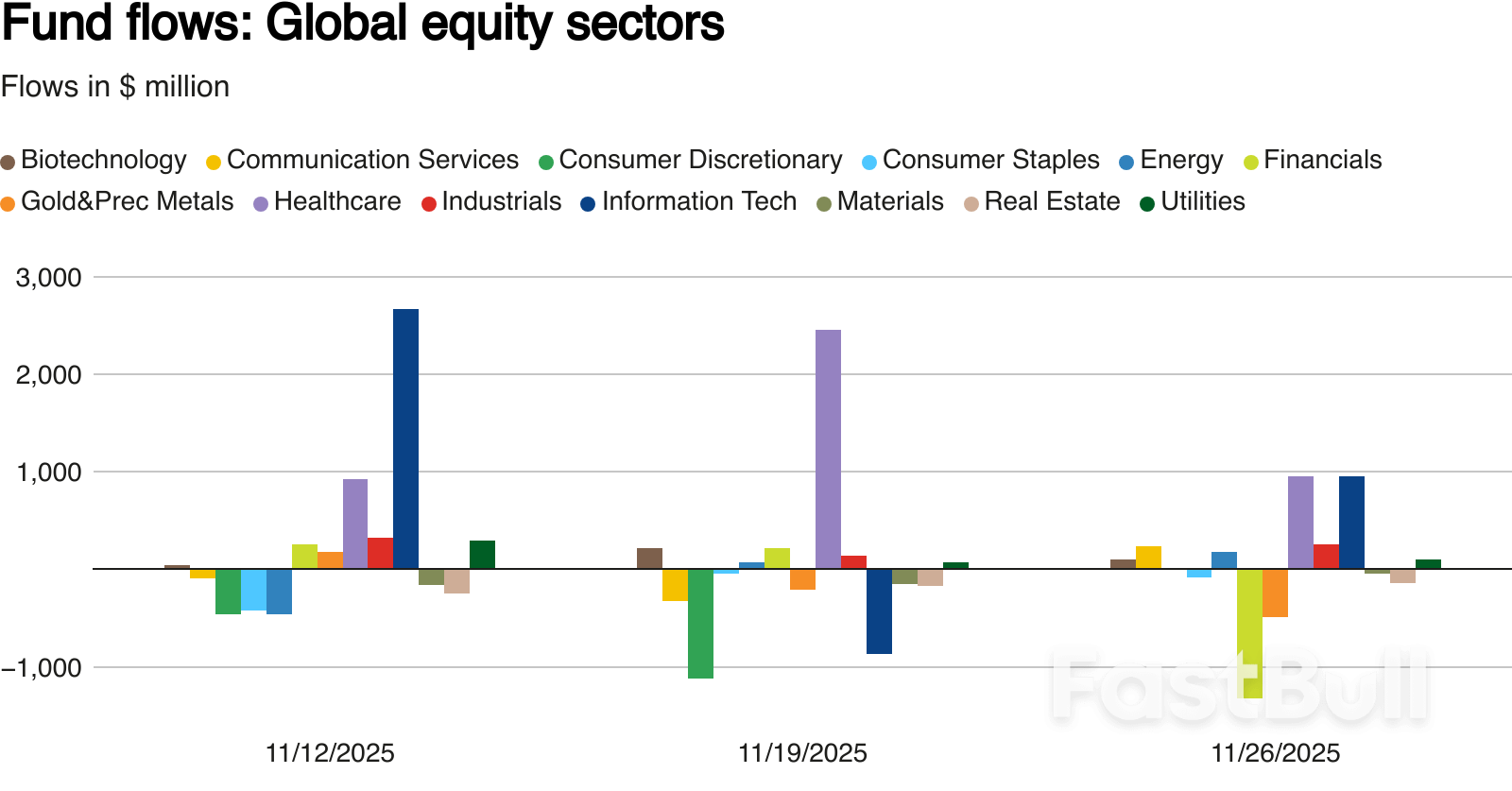
          Weekly flows into global equity sector funds in $ million

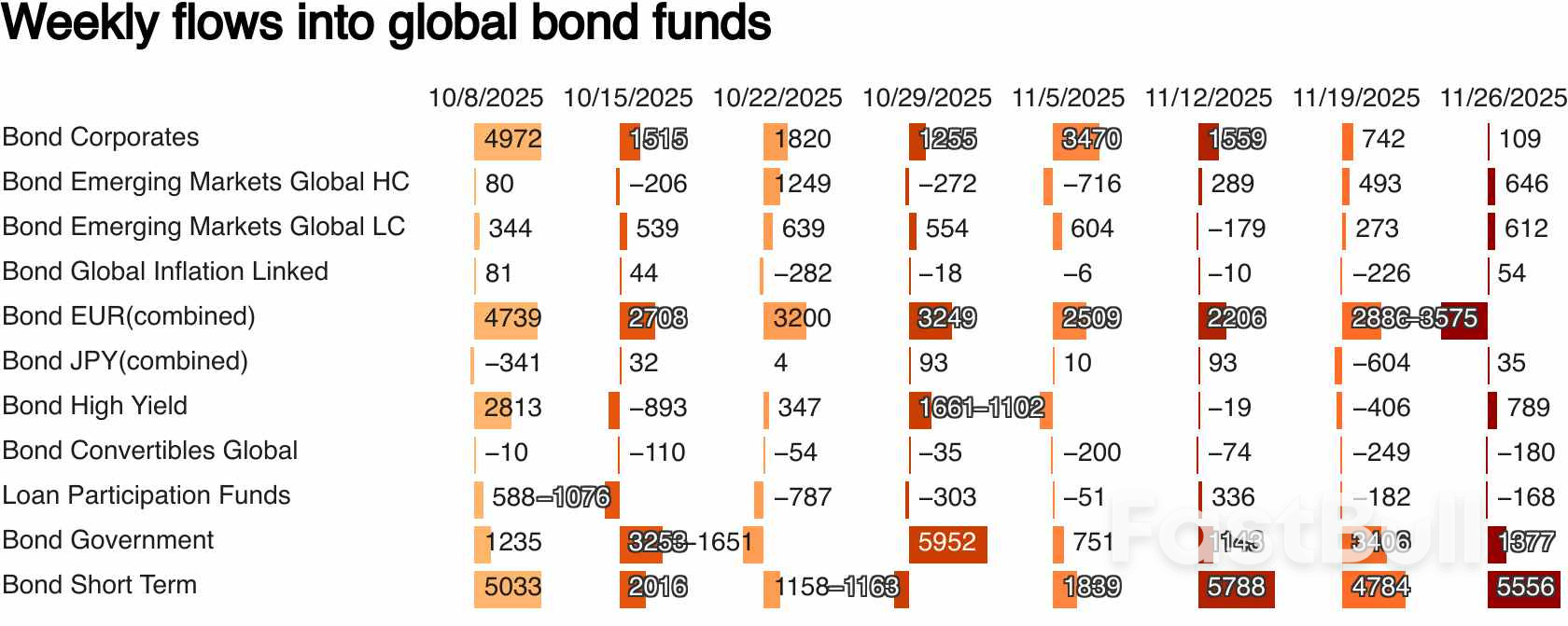
          Inflows in global bond funds, meanwhile, cooled to a 22-week low of $6.77 billion during the week.
          Euro-denominated bond funds faced a net $3.58 billion outflow, the first weekly net sales since July 9. Short-term bond funds, however, gained $5.56 billion in a fourth successive week of net purchases.
          Investors snap nine-week buying streak in global equity funds_3

          Weekly flows into global bond funds in $ million

          Investors added $2.54 billion worth of money market funds as they ended a two-week selling trend.
          Gold and precious metals commodity funds, meanwhile, stayed popular for a seventh straight week as these funds drew roughly $1.66 billion in weekly inflows.
          In emerging markets, investors snapped up $3.34 billion worth of equity funds, the most since July 9. They also added a marginal $5.98 million worth of bond funds, data for a combined 28,793 funds showed.

          Source: reuters

          Risk Warnings and Disclaimers
          You understand and acknowledge that there is a high degree of risk involved in trading. Following any strategies or investment methods may lead to potential losses. The content on the site is provided by our contributors and analysts for information purposes only. You are solely responsible for determining whether any trading assets, securities, strategy, or any other product is suitable for investing based on your own investment objectives and financial situation.
          Add to Favorites
          Share

          India’s Economic Momentum Defies U.S. Tariffs, Heads Toward $5 Trillion Milestone by 2029

          Gerik

          Economic

          India’s Resilience Amid Global Trade Pressures

          India is demonstrating exceptional economic strength, even as external challenges mount. With the implementation of 50% tariffs from the United States among the highest imposed on any major economy analysts feared a cooling in India’s growth. However, the latest GDP figures for Q3 (July–September 2025) show a robust 8.2% year-on-year increase, well above the 7.4% consensus forecast. This follows a 7.8% expansion in Q2, placing India among the world’s fastest-growing large economies.
          Bond markets responded swiftly: the yield on India’s 10-year government bond rose by 4 basis points to 6.50% following the release of the data, signaling a positive reappraisal of the growth outlook by investors.

          Policy Response: Modi Government’s Proactive Stimulus Strategy

          A major contributor to this outperformance is the Indian government's proactive fiscal stance. In response to rising global uncertainties and declining U.S. orders particularly concerning given that the U.S. is India’s largest export market Prime Minister Narendra Modi introduced a large-scale stimulus plan focused on stimulating domestic demand.
          Key among these efforts was a major cut to the Goods and Services Tax (GST) in September, timed to encourage consumer spending during India’s festive season. Since private consumption makes up nearly 60% of the nation’s GDP, preserving and stimulating household spending is a critical driver of economic expansion. This fiscal maneuver represents a direct cause-and-effect strategy to shield the domestic economy from external shocks.

          Sectoral Drivers: Manufacturing and Services Lead the Way

          Beyond consumer spending, India’s growth has been powered by strong industrial performance. The manufacturing sector grew 9.1% year-on-year in Q3, while services also contributed significantly. According to Shumita Deveshwar of GlobalData TS Lombard, this dual-engine performance exceeded expectations, though she cautioned that the momentum might ease in the coming quarters as base effects normalize and trade headwinds persist.
          This surge in manufacturing growth reflects both domestic reforms and the gradual shift of global supply chains into India, which has been positioning itself as a China-plus-one manufacturing destination.

          Export Slowdown and External Balances Under Pressure

          Despite this robust growth, trade indicators point to emerging pressures. According to the IMF, India’s merchandise exports could decline by 5.8% in FY2026, falling to $416 billion, partly due to continued delays in reaching a new trade agreement with the U.S. On the other hand, imports are expected to grow 2.4%, reaching $746 billion widening the trade deficit.
          This imbalance underscores a correlation, rather than causation, between U.S. tariffs and export contraction. While tariffs are a contributing factor, global demand cycles and exchange rate dynamics also influence trade figures.

          Long-Term Outlook: A $5 Trillion Economy Within Reach

          The IMF projects India’s real GDP will expand 6.6% in FY2026 and 6.2% in FY2027, with the moderation reflecting global uncertainties rather than domestic weakness. Still, India’s structural fundamentals remain strong: a large, youthful population, expanding digital infrastructure, and resilient financial institutions.
          Crucially, if India sustains its current growth momentum, the IMF expects it to cross the $5 trillion GDP threshold by FY2029. This trajectory aligns with New Delhi’s strategic vision to elevate India’s global economic position while bolstering domestic demand-led growth.
          India’s recent economic performance illustrates that even amid protectionist pressures and global demand fluctuations, a well-calibrated policy mix can maintain momentum. While the U.S. tariff regime presents a real threat to India’s trade growth, domestic consumption, manufacturing resilience, and strategic government interventions continue to fuel expansion. The challenge now is to convert short-term growth into sustainable development that can weather future global realignments ultimately anchoring India’s ascent to a $5 trillion economy within the decade.
          To stay updated on all economic events of today, please check out our Economic calendar
          Risk Warnings and Disclaimers
          You understand and acknowledge that there is a high degree of risk involved in trading. Following any strategies or investment methods may lead to potential losses. The content on the site is provided by our contributors and analysts for information purposes only. You are solely responsible for determining whether any trading assets, securities, strategy, or any other product is suitable for investing based on your own investment objectives and financial situation.
          Add to Favorites
          Share

          Gold glitters once more, as markets take UK Budget risks in their stride

          Adam

          Commodity

          A theme is emerging as we reach the last trading day of November, risk is back on. Global indices are a sea of green this week, after a bruising first half of the month. Although European and US indices are on track to record a loss for the entire month of November, the scene could be set for a rally in the final weeks of the year. Interestingly, the Philadelphia Semi-Conductor Index is higher in November, as Google’s shares surged by more than 20%, and other tech stocks also recovered. This sector has led financial markets since their low in April, so the fact that semi-conductors are rallying, along with broader market width, could stoke the anticipated ‘Santa rally’.
          The gold price is on track to record its fourth monthly gain and is higher by 3% so far this week. Silver is higher by 8%, as Fed rate cut bets ramp up. There is now an 82% of a rate cut from the Fed next month. This is sparking a rally in gold back above $4,000 per ounce, and the gold price is higher by $28 today. The silver price is higher by 1%. There are also gains for the oil price, as the Russia/ Ukraine peace plan remains on hold for the US’s Thanksgiving holiday.
          Trading could be more volatile than usual today, as US markets open for half day and liquidity is likely to be thin. Added to this, a disruption on the CME trading exchange, could also affect trading across FX, stocks, commodities and some bonds.
          The problem is linked to a cooling issue at one of its data centers. This closure ultimately means that liquidity will be even thinner than usual on the Friday of Thanksgiving. If there is any sensitive market news flow or events, then moves could be exacerbated by liquidity issues, and there could be more volatility as a result.
          So far, news flow has not been too disruptive to trade. Donald Trump announced plans to dramatically tighten the US’s immigration system, which appears to be in response to the shooting of two National Guard members outside the White House, has not impacted market sentiment. The President’s post on Truth Social contained little detail, and so it is unlikely to be market moving.
          Pound is resilient to Budget fears
          Interestingly, the pound is the third best performing currency in the G10 FX space this week. GBP/USD is back above $1.32, it made a high above $1.3260 on Thursday but has given back some of those gains this morning. Interestingly, the pound remains resilient in the face of Budget criticism.
          The list of concerns around the UK Budget are stacking up, including fears that the UK is at a tax tipping point, where extra revenue raising measures won’t generate as much as estimated, 2, that taxation measures are too back-dated and potentially threaten the UK's expanded fiscal headroom, 3, that spending pledges are unfair, weighing on business and consumer confidence even more, and 4, that the UK government will need to rely on short-dated debt to raise finance, which could leave UK bonds at the mercy of short term debt markets.
          Why are markets so sanguine about UK Budget?
          Although UK bonds sold off on Thursday, moves were relatively small. In the past week, UK 10-year Gilts are lower by 8 bps and are outperforming US and European peers. Does the fact that financial markets seem to be welcoming this budget mean that we are missing something? We think that financial markets have been appeased by this Budget because of the focus on building fiscal headroom, and the fact that the fiscal forecasts from the OBR were not as bad as had been feared. However, the Budget is a political disaster for the Chancellor, with YouGov reporting that the public believe it is the second most unfair Budget since 2010, a close second to the mini-Budget in 2022. Economic data backs this up, the Lloyds Business Barometer fell sharply in November to 42. From 50. This suggests that business confidence in the UK remains subdued.
          In the Eurozone, weak inflation from France and weaker than expected retail sales from Germany are weighing on the euro, which is at the lows of the day.

          Source:xtb

          Risk Warnings and Disclaimers
          You understand and acknowledge that there is a high degree of risk involved in trading. Following any strategies or investment methods may lead to potential losses. The content on the site is provided by our contributors and analysts for information purposes only. You are solely responsible for determining whether any trading assets, securities, strategy, or any other product is suitable for investing based on your own investment objectives and financial situation.
          Add to Favorites
          Share

          Tech’s AI-Fueled Debt Wave Meets Calm Credit Markets as Panelists Forecast Stability and Opportunity

          Gerik

          Economic

          Stocks

          Tech Giants Tap Debt Markets, but Credit Pressure Remains Contained

          As Meta Platforms, Alphabet, and other technology leaders ramp up borrowing to finance their artificial intelligence infrastructure and global data center ambitions, market watchers have raised alarms about oversupply and potential spread widening. However, panelists at Bloomberg Intelligence’s credit conference in London argue that these fears are overstated.
          Investment-grade spreads have widened by roughly 10 basis points due to what JPMorgan Asset Management’s Iain Stealey termed “temporary indigestion” from the sheer volume of issuance. Yet he emphasized that these companies generate substantial annual earnings and maintain robust balance sheets, reducing credit risk. Issuers like Meta are unlikely to return to markets until late 2026, suggesting that future supply will be more staggered and manageable.

          Quality Still Reigns in Credit Markets

          Meta and Alphabet’s limited debt profiles are seen as a strength, not a burden. Alphabet, in particular, boasts a credit rating superior to France’s, while Apple and Microsoft should they issue in Europe would be considered among the highest-quality corporate borrowers. Mahesh Bhimalingam of Bloomberg Intelligence noted that whenever such companies do enter the market, they typically trigger strong demand due to their profile and rarity.
          This reinforces a cause-and-effect relationship: the AI buildout necessitates more capital, which is increasingly sourced through bond markets but the resulting pressure is eased by the strength of the issuers and market appetite for quality paper.

          Credit Outlook for 2026: Carry and Structure Over Speculation

          The broader consensus from the conference was that 2026 should remain supportive for credit markets. Ashwin Palta of BNY Investments highlighted that current yields provide attractive compensation for risk, especially when investors move “up in quality.” Lower-rated names are not offering sufficient spread advantage to justify increased risk, prompting a rotation into higher-tier credits and well-structured instruments.
          Among the most appealing asset classes discussed were Additional Tier 1 (AT1), Restricted Tier 1, and hybrid securities. AT1 bonds, in particular, have delivered over 10% returns year-to-date, and expectations for continued strong performance are grounded in sound starting fundamentals.

          Metro Bank and the Case for Small-Cap Financials

          Jackie Ineke of Spring Investments pointed out an unconventional opportunity: the subordinated debt of smaller financial institutions, particularly Metro Bank Holdings Plc. Recently upgraded by Fitch and boosted by deregulatory support from UK Chancellor Rachel Reeves, Metro’s AT1 bonds now carry relatively less perceived risk than some of those issued by larger investment banks. Ineke highlighted its turnaround narrative, asserting that the issuer’s improved profitability outlook and political tailwinds position it as an appealing outlier in the financial credit space.
          This contrast underscores a key analytical insight: risk perception in credit is not always aligned with institutional size. The correlation between bond performance and issuer profile is shaped as much by trajectory and context as it is by legacy reputation.
          The message from the Bloomberg Intelligence panel is clear: the surge in tech-related debt issuance to fund AI initiatives is not destabilizing the credit market. Instead, it is creating high-grade opportunities for investors and reflecting the strategic capital needs of cash-rich, structurally important firms. With yield curves favoring quality and investor demand remaining strong, 2026 is set to offer continued resilience even as AI reshapes corporate capital flows. The credit market is absorbing the tech sector’s evolution with measured confidence.

          Source: Reuters

          To stay updated on all economic events of today, please check out our Economic calendar
          Risk Warnings and Disclaimers
          You understand and acknowledge that there is a high degree of risk involved in trading. Following any strategies or investment methods may lead to potential losses. The content on the site is provided by our contributors and analysts for information purposes only. You are solely responsible for determining whether any trading assets, securities, strategy, or any other product is suitable for investing based on your own investment objectives and financial situation.
          Add to Favorites
          Share

          US equity funds see first weekly outflow in six weeks

          Adam

          Stocks

          U.S. equity funds witnessed their first weekly outflow in six weeks in the week through November 26, as concerns over lofty tech valuations prompted investors to take profits and overshadowed optimism about a possible Federal Reserve rate cut next month.
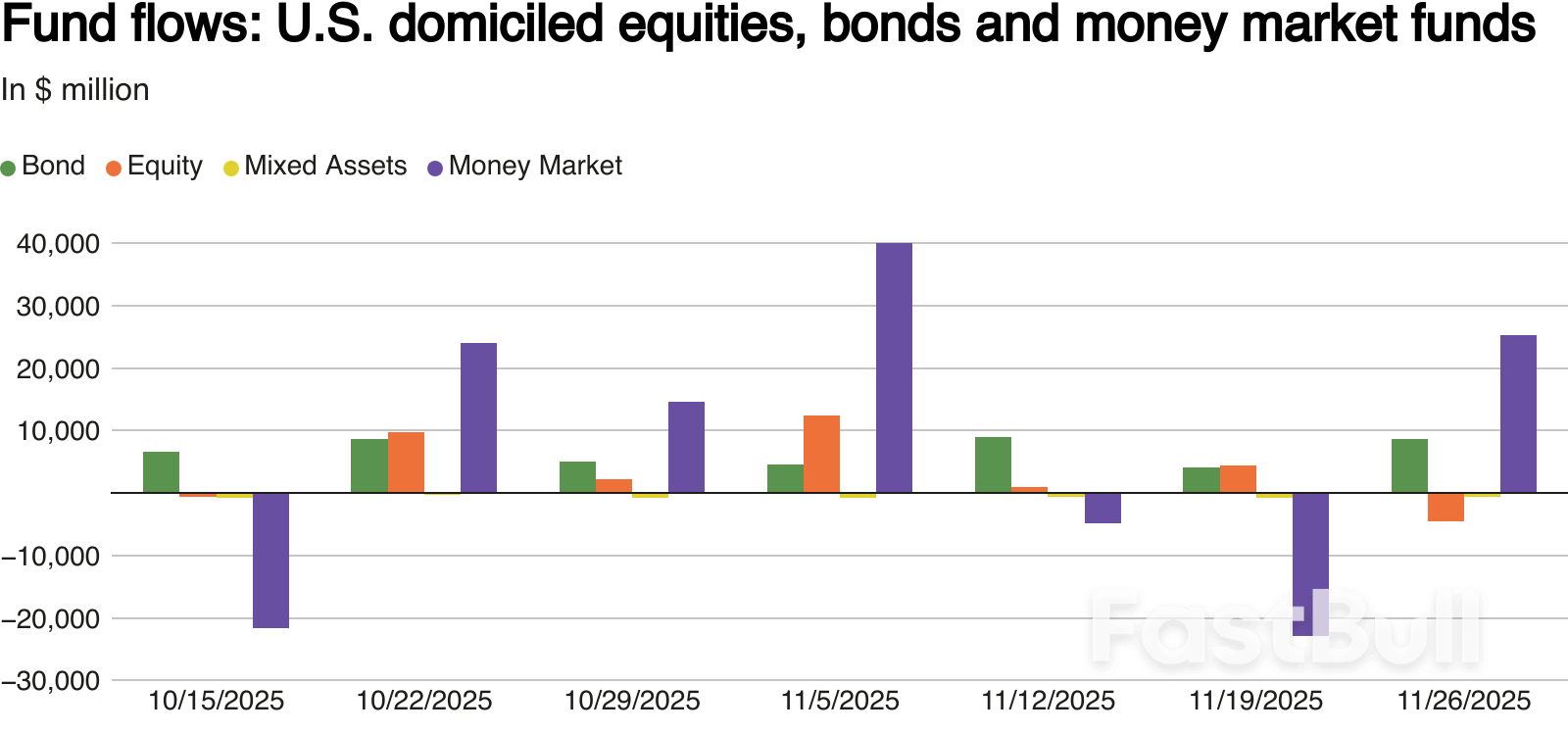
          They divested a net $4.56 billion worth of U.S. equity funds in their first weekly net sales since October 15, LSEG Lipper data showed.
          US equity funds see first weekly outflow in six weeks_1

          Weekly flows into US equity, bond and money market funds in $ million

          The S&P 500 (.SPX), opens new tab has risen more than 3% so far this week on expectations of a Federal Reserve rate cut next month. But investors remain cautious as November has been marked by heightened volatility, driven by concerns over stretched tech valuations and the economic impact of a record 43-day U.S. government shutdown.
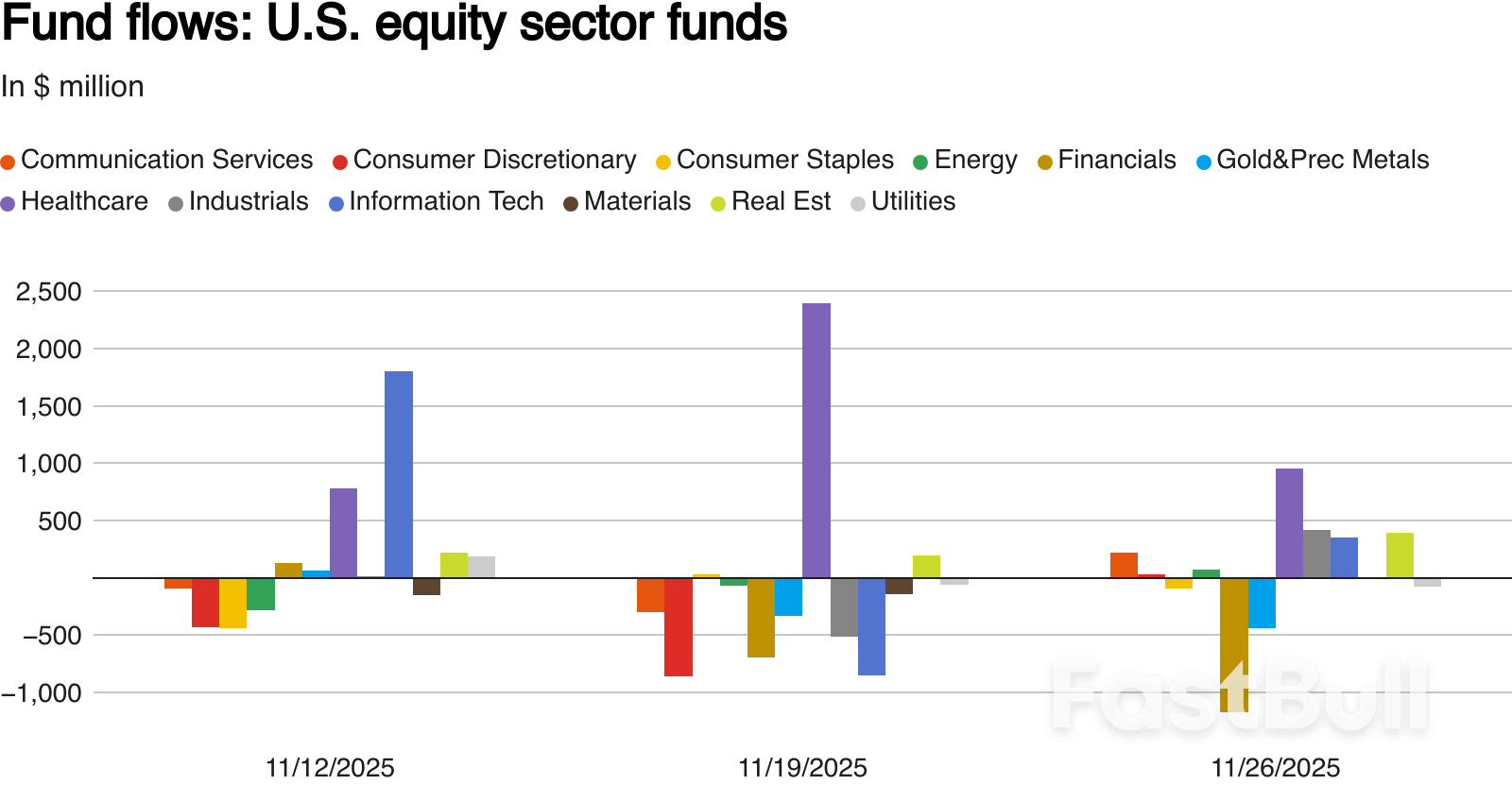
          U.S. large-cap funds saw a net $144 million weekly outflow following five successive weeks of inflows. Investors also ditched mid-cap and small-cap funds worth a total of $1.69 billion and $885 million, respectively.

          US equity funds see first weekly outflow in six weeks_2

          Weekly flows into US equity sector funds in $ million

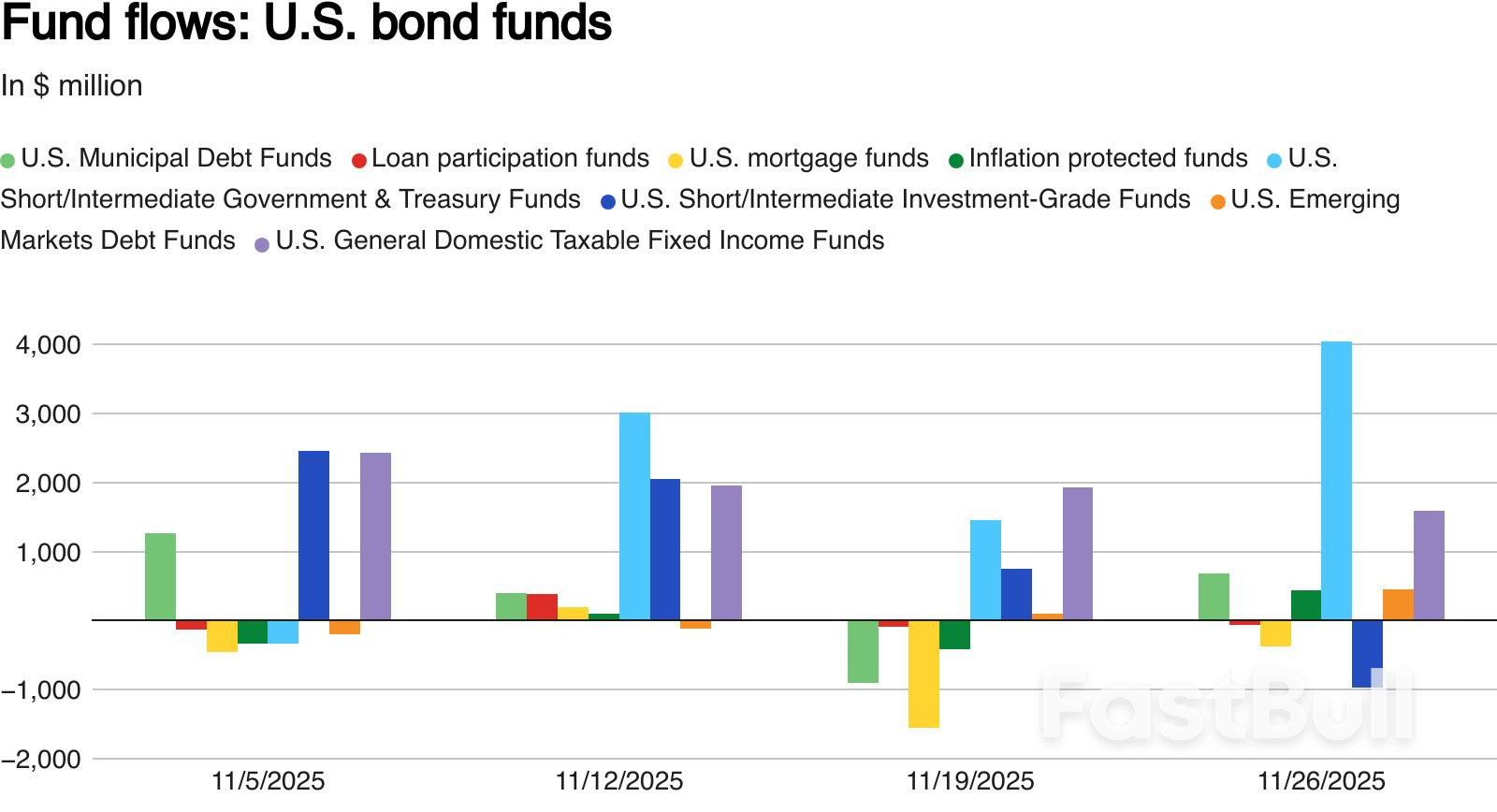
          U.S. bond funds remained popular for an eighth straight week as these funds drew approximately $8.6 billion in weekly inflows.
          Short-to-intermediate government and treasury funds secured $4.05 billion, the largest amount for a week since September 24. General domestic taxable fixed income funds also had a net $1.59 billion weekly inflow.
          US equity funds see first weekly outflow in six weeks_3

          Weekly flows into US bond funds in $ million

          U.S. money market funds, meanwhile, received $25.28 billion worth of inflows after two successive weeks of net sales.

          Source: reuters

          Risk Warnings and Disclaimers
          You understand and acknowledge that there is a high degree of risk involved in trading. Following any strategies or investment methods may lead to potential losses. The content on the site is provided by our contributors and analysts for information purposes only. You are solely responsible for determining whether any trading assets, securities, strategy, or any other product is suitable for investing based on your own investment objectives and financial situation.
          Add to Favorites
          Share

          Why US Utility Stocks Are Falling After the AI Power Surge

          Adam

          Stocks

          The artificial-intelligence boom’s promise of runaway electricity demand has jolted shares of US power companies to all-time highs. But those generators and utilities are now learning that the hype comes with an edge: Investors won’t wait forever for results.
          Companies that recently hit record valuations are returning to earth as investors realize the massive data-center deals they’d banked on are actually smaller, or slower, than expected.
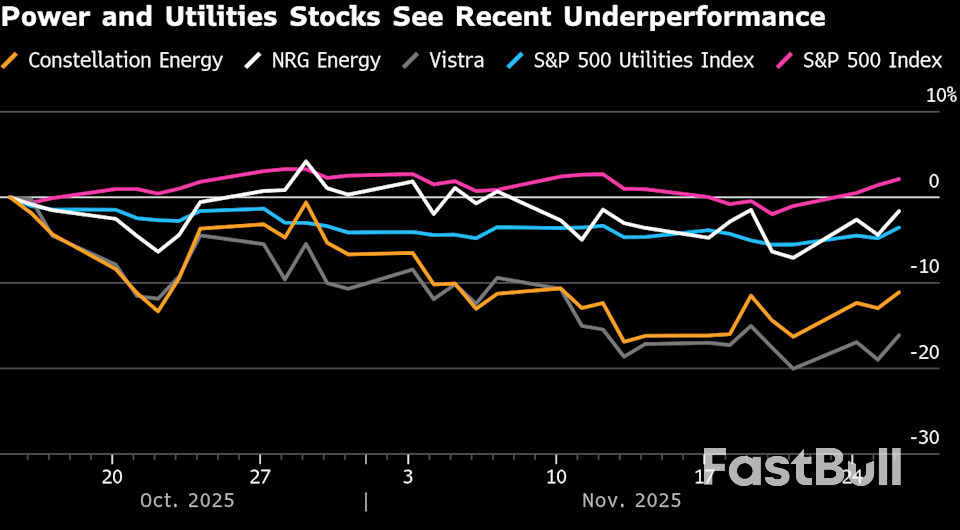
          Constellation Energy Corp. saw shares tumble 11% from an October high after a third-quarter earnings call that yielded no details on new power generation. The headline of one Jefferies analyst note read: “No Data Center Deals.” Similarly, Vistra Corp. has fallen 16% since mid-October as analysts noted a slower pace of data center announcements than they expected.
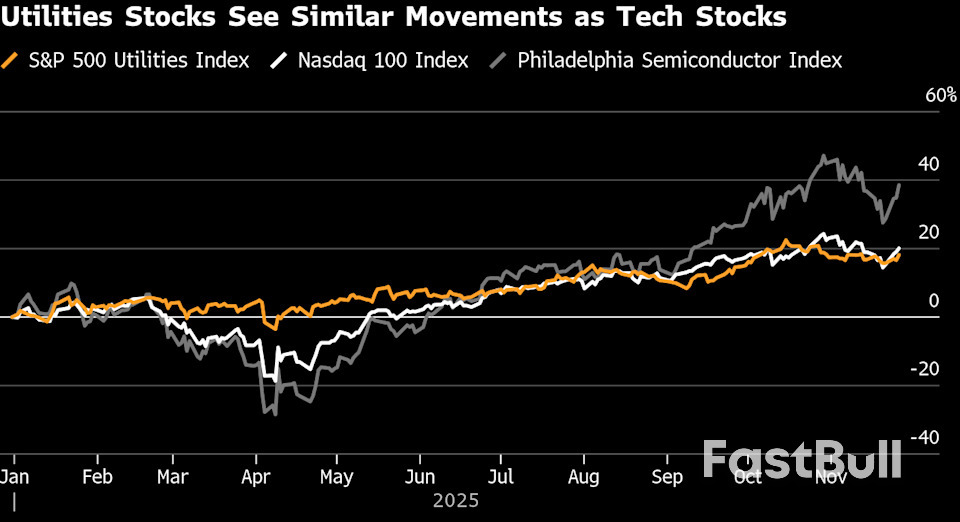
          The S&P 500 Utilities Index is now set to post the worst monthly performance since August, after reaching an all-time high in October.
          “These are not your father’s and mother’s utility stocks,” said Mark Malek, chief investment officer at Muriel Siebert & Co. “People are starting to question, ‘Can these companies scale as fast as they want to, are they throwing capital at these projects that’ll never get done?’”
          Why US Utility Stocks Are Falling After the AI Power Surge_1
          Vistra declined to comment. Constellation didn’t immediately respond to a request for comment.
          While utilities have long been regarded as safe places to park money, the massive data-center build-out being spurred by AI has triggered an avalanche of investment into the sector. Now, as reality sets in, investors are trying to figure out which companies can deliver on their big promises — and which would be able to weather the potential pop of a trillion-dollar AI bubble.
          “The AI bubble fears are playing into some of the weakness recently in utilities,” said Travis Miller, a utility analyst for Morningstar. “If the electricity demand growth doesn’t show up, then utilities look overvalued where they’re trading today.”
          The companies have already started to temper expectations. Constellation narrowed the top end of its full-year earnings per share forecast in November, while Vistra did the same with its adjusted Ebitda forecast. NRG Energy maintained its full-year Ebitda forecast in November, but investors had been expecting a guidance increase.
          Why US Utility Stocks Are Falling After the AI Power Surge_2
          Still, some analysts say the pullback is nothing to worry about, with investors simply taking profits after the huge gains of October.
          “We don’t have a bubble in utilities,” said Sophie Karp, a utility analyst at KeyBanc Capital Markets. “The market is taking a pause until we see the next leg of growth.”
          Even after recent declines, Constellation remains 60% higher this year, with NRG rising 87% and GE Vernova up 79%, outpacing even the 34% gain that Nvidia Corp. has seen this year.
          Such a development would particularly hit unregulated power sellers such as Constellation, NRG and Vistra.

          Source: Bloomberg

          Risk Warnings and Disclaimers
          You understand and acknowledge that there is a high degree of risk involved in trading. Following any strategies or investment methods may lead to potential losses. The content on the site is provided by our contributors and analysts for information purposes only. You are solely responsible for determining whether any trading assets, securities, strategy, or any other product is suitable for investing based on your own investment objectives and financial situation.
          Add to Favorites
          Share

          UN Warns On Voter Surveillance Ahead Of Myanmar Election

          Daniel Carter

          Political

          The U.N. human rights office voiced concern on Friday that the Myanmar junta was pressuring people into voting in an election next month and that electronic voting machines and AI surveillance could help authorities to identify opponents.
          International officials have already raised concerns about Myanmar's phased election from December 28 into January, calling it a sham exercise aimed at legitimising the military's rule after it overthrew a civilian democratic government in 2021.
          The electronic voting machines did not allow people to leave their ballot blank or spoil it, meaning they have to pick a candidate, said James Rodehaver, head of the Myanmar team for Office of the High Commissioner for Human Rights (OHCHR).
          "There's a real worry that this electronic surveillance technology is going to be used to monitor how people are voting," he told a Geneva press conference, saying that authorities could track if people are voting, and who for.
          The military authorities in Myanmar intend "to enable all eligible voters to exercise their franchise freely and fairly in the upcoming general election", state media reported on Friday. Reuters was unable to reach a junta spokesperson for further comment.
          Rodehaver said his team is verifying reports that locals are being forced to attend military training sessions on how to use the electronic voting machines in contested areas.
          "After such training, some participants were warned by armed groups not to vote," he said, saying civilians were caught between the two sides.
          OHCHR has also received reports of displaced people being ordered by the military to return to their villages to vote, Rodehaver said.
          Authorities have arrested three young people who hung up posters depicting a ballot box with a bullet, he added. Myanmar previously said it has pardoned thousands in order to allow them to vote.
          The country has been in turmoil since the coup overthrew the civilian government led by Nobel laureate Aung San Suu Kyi, who has been in detention ever since. Nationwide protests afterwards grew into an armed resistance.
          The Trump administration that it will end temporary legal status for Myanmar citizens in the United States, claiming they can now safely return, citing the junta's planned elections as a sign of improvement. OHCHR is urging the United States to reconsider, it said.
          Junta spokesperson Zaw Min Tun previously said that the U.S. announcement was a positive sign and citizens abroad were welcome to return to take part in the vote.

          Source: Reuters

          Risk Warnings and Disclaimers
          You understand and acknowledge that there is a high degree of risk involved in trading. Following any strategies or investment methods may lead to potential losses. The content on the site is provided by our contributors and analysts for information purposes only. You are solely responsible for determining whether any trading assets, securities, strategy, or any other product is suitable for investing based on your own investment objectives and financial situation.
          Add to Favorites
          Share
          FastBull
          Copyright © 2025 FastBull Ltd

          728 RM B 7/F GEE LOK IND BLDG NO 34 HUNG TO RD KWUN TONG KLN HONG KONG

          TelegramInstagramTwitterfacebooklinkedin
          App Store Google Play Google Play
          Products
          Charts

          Chats

          Q&A with Experts
          Screeners
          Economic Calendar
          Data
          Tools
          Membership
          Features
          Function
          Markets
          Copy Trading
          Latest Signals
          Contests
          News
          Analysis
          24/7
          Columns
          Education
          Company
          Careers
          About Us
          Contact Us
          Advertising
          Help Center
          Feedback
          User Agreement
          Privacy Policy
          Business

          White Label

          Data API

          Web Plug-ins

          Poster Maker

          Affiliate Program

          Risk Disclosure

          The risk of loss in trading financial instruments such as stocks, FX, commodities, futures, bonds, ETFs and crypto can be substantial. You may sustain a total loss of the funds that you deposit with your broker. Therefore, you should carefully consider whether such trading is suitable for you in light of your circumstances and financial resources.

          No decision to invest should be made without thoroughly conducting due diligence by yourself or consulting with your financial advisors. Our web content might not suit you since we don't know your financial conditions and investment needs. Our financial information might have latency or contain inaccuracy, so you should be fully responsible for any of your trading and investment decisions. The company will not be responsible for your capital loss.

          Without getting permission from the website, you are not allowed to copy the website's graphics, texts, or trademarks. Intellectual property rights in the content or data incorporated into this website belong to its providers and exchange merchants.

          Not Logged In

          Log in to access more features

          FastBull Membership

          Not yet

          Purchase

          Become a signal provider
          Help Center
          Customer Service
          Dark Mode
          Price Up/Down Colors

          Log In

          Sign Up

          Position
          Layout
          Fullscreen
          Default to Chart
          The chart page opens by default when you visit fastbull.com