Markets
News
Analysis
User
24/7
Economic Calendar
Education
Data
- Names
- Latest
- Prev


Signal Accounts for Members
All Signal Accounts
All Contests


France Trade Balance (SA) (Oct)A:--
F: --
Euro Zone Employment YoY (SA) (Q3)A:--
F: --
Canada Part-Time Employment (SA) (Nov)A:--
F: --
P: --
Canada Unemployment Rate (SA) (Nov)A:--
F: --
P: --
Canada Full-time Employment (SA) (Nov)A:--
F: --
P: --
Canada Labor Force Participation Rate (SA) (Nov)A:--
F: --
P: --
Canada Employment (SA) (Nov)A:--
F: --
P: --
U.S. PCE Price Index MoM (Sept)A:--
F: --
P: --
U.S. Personal Income MoM (Sept)A:--
F: --
P: --
U.S. Core PCE Price Index MoM (Sept)A:--
F: --
P: --
U.S. PCE Price Index YoY (SA) (Sept)A:--
F: --
P: --
U.S. Core PCE Price Index YoY (Sept)A:--
F: --
P: --
U.S. Personal Outlays MoM (SA) (Sept)A:--
F: --
U.S. 5-10 Year-Ahead Inflation Expectations (Dec)A:--
F: --
P: --
U.S. Real Personal Consumption Expenditures MoM (Sept)A:--
F: --
U.S. Weekly Total Rig CountA:--
F: --
P: --
U.S. Weekly Total Oil Rig CountA:--
F: --
P: --
U.S. Consumer Credit (SA) (Oct)A:--
F: --
China, Mainland Foreign Exchange Reserves (Nov)A:--
F: --
P: --
Japan Trade Balance (Oct)A:--
F: --
P: --
Japan Nominal GDP Revised QoQ (Q3)A:--
F: --
P: --
China, Mainland Imports YoY (CNH) (Nov)A:--
F: --
P: --
China, Mainland Exports (Nov)A:--
F: --
P: --
China, Mainland Imports (CNH) (Nov)A:--
F: --
P: --
China, Mainland Trade Balance (CNH) (Nov)A:--
F: --
P: --
China, Mainland Exports YoY (USD) (Nov)A:--
F: --
P: --
China, Mainland Imports YoY (USD) (Nov)A:--
F: --
P: --
Germany Industrial Output MoM (SA) (Oct)A:--
F: --
Euro Zone Sentix Investor Confidence Index (Dec)A:--
F: --
P: --
Canada National Economic Confidence IndexA:--
F: --
P: --
U.K. BRC Like-For-Like Retail Sales YoY (Nov)--
F: --
P: --
U.K. BRC Overall Retail Sales YoY (Nov)--
F: --
P: --
Australia Overnight (Borrowing) Key Rate--
F: --
P: --
RBA Rate Statement
RBA Press Conference
Germany Exports MoM (SA) (Oct)--
F: --
P: --
U.S. NFIB Small Business Optimism Index (SA) (Nov)--
F: --
P: --
Mexico 12-Month Inflation (CPI) (Nov)--
F: --
P: --
Mexico Core CPI YoY (Nov)--
F: --
P: --
Mexico PPI YoY (Nov)--
F: --
P: --
U.S. Weekly Redbook Index YoY--
F: --
P: --
U.S. JOLTS Job Openings (SA) (Oct)--
F: --
P: --
China, Mainland M1 Money Supply YoY (Nov)--
F: --
P: --
China, Mainland M0 Money Supply YoY (Nov)--
F: --
P: --
China, Mainland M2 Money Supply YoY (Nov)--
F: --
P: --
U.S. EIA Short-Term Crude Production Forecast For The Year (Dec)--
F: --
P: --
U.S. EIA Natural Gas Production Forecast For The Next Year (Dec)--
F: --
P: --
U.S. EIA Short-Term Crude Production Forecast For The Next Year (Dec)--
F: --
P: --
EIA Monthly Short-Term Energy Outlook
U.S. API Weekly Gasoline Stocks--
F: --
P: --
U.S. API Weekly Cushing Crude Oil Stocks--
F: --
P: --
U.S. API Weekly Crude Oil Stocks--
F: --
P: --
U.S. API Weekly Refined Oil Stocks--
F: --
P: --
South Korea Unemployment Rate (SA) (Nov)--
F: --
P: --
Japan Reuters Tankan Non-Manufacturers Index (Dec)--
F: --
P: --
Japan Reuters Tankan Manufacturers Index (Dec)--
F: --
P: --
Japan Domestic Enterprise Commodity Price Index MoM (Nov)--
F: --
P: --
Japan Domestic Enterprise Commodity Price Index YoY (Nov)--
F: --
P: --
China, Mainland PPI YoY (Nov)--
F: --
P: --
China, Mainland CPI MoM (Nov)--
F: --
P: --


No matching data
Latest Views
Latest Views
Trending Topics
Top Columnists
Latest Update
White Label
Data API
Web Plug-ins
Affiliate Program
View All

No data
The latest data on Initial Jobless Claims, a key indicator of the health of the U.S. labor market, showed no change from the...
The latest data on Initial Jobless Claims, a key indicator of the health of the U.S. labor market, showed no change from the previous week, with the number of individuals filing for unemployment insurance for the first time holding steady at 248K. This figure surpassed the forecasted number of 242K, potentially signaling a slower than expected recovery in the job market.
The actual number of 248K matched the previous week’s figure, indicating a stagnation in the decline of jobless claims that many economists and market watchers have been anticipating. The steady number suggests that the pace of layoffs in the U.S. economy remains unchanged, a potentially disquieting sign for those hoping for a rapid return to pre-pandemic employment levels.
The forecasted figure of 242K, which the actual number exceeded by 6K, was based on various economic indicators and projections. The fact that the actual number surpassed the forecasted one could be interpreted as a negative or bearish sign for the U.S. dollar. However, it’s worth noting that the market impact of Initial Jobless Claims varies from week to week, and this single data point should be considered in the context of broader economic trends.
Initial Jobless Claims is among the earliest economic data released in the U.S., and it provides a snapshot of the number of individuals who have filed for unemployment insurance for the first time in the past week. While the data can fluctuate from week to week, it’s a closely watched barometer of the labor market’s health and can influence decisions made by policymakers, investors, and businesses.
In summary, the unchanged number of Initial Jobless Claims at 248K, which exceeded the forecasted figure, may be cause for concern among those hoping for a quicker recovery in the job market. However, it’s important to consider this data in the context of other economic indicators and trends.

The Swiss National Bank (SNB) is likely to cut its policy rate by 50 basis points next week, bringing it back into negative territory for the first time since 2022, according to a new forecast from Capital Economics.
The SNB reduced its policy rate by 25 basis points to 0.25% at its last meeting, but inflation has since fallen into negative territory in May, significantly below the central bank’s March forecast of 0.3% for the second quarter. Core inflation dropped to just 0.5% in May, suggesting underlying price pressures are weaker than previously anticipated.
The Swiss franc has appreciated approximately 4% on a trade-weighted basis since the SNB’s March meeting, following what Capital Economics refers to as Trump’s "Liberation Day." According to an SNB working paper, this currency strength could reduce inflation by 0.5% annually over the next three years.
Capital Economics notes the risks are skewed toward the SNB undershooting its price stability target of 0-2% inflation. While there may be a short-term boost to demand as businesses front-run potential tariffs, particularly in the pharmaceutical sector, U.S. trade policy will likely have a negative impact on Swiss demand over the medium term.
If Switzerland secures a trade deal with the United States, it may include reduced barriers to agricultural trade, which could further weigh on inflation given the high level of Swiss food prices, according to the research firm.


The dollar extended its decline as worries over US tariffs increased after President Donald Trump said he would notify trading partners soon of unilateral levies.
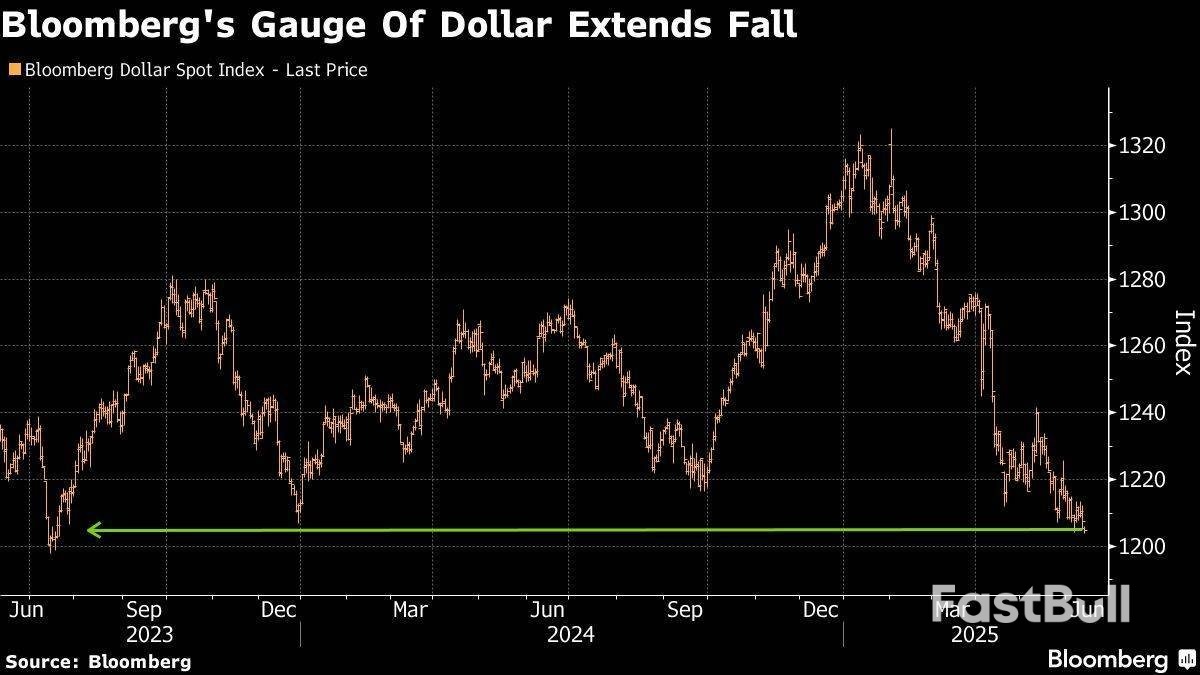
The Bloomberg Dollar Spot Index slid as much as 0.6% to the lowest level since July 2023 on Thursday, extending the previous day’s drop spurred by softer US inflation data. The euro rose to its strongest since November 2021.
Traders will be monitoring US producer-price data due later Thursday for confirmation of subdued pressures. Some of its components feed into core personal consumption expenditure, the Federal Reserve’s preferred measure of inflation. They will also watch an auction of 30-year Treasuries after yields surged last month on fiscal concerns.
“Dollar weakness has much more room to run,” said Vasileios Gkionakis, senior economist and strategist at Aviva Investors. He added the greenback’s weakness despite rising yields show eroding investor confidence in US assets.
The dollar’s decline spilled into the currency volatility market, reinforcing the inverse correlation between the greenback and hedging costs recently. Demand was particularly pronounced in the one-week tenor, which captures the Fed’s June 18 policy meeting.
“Trader pricing still favors more Federal Reserve interest rate cuts, although the precise timing flips around depending on the prevailing investor mood. But what is consistent is the US dollar ploughing a path to the downside as FX trader convictions firm.”
— Mark Cranfield, Markets Live Strategist, Singapore
Currency traders will also be watching the upcoming Group-of-Seven summit for any trade negotiation developments.
“We are watching the G-7 summit closely for pending trade deals between the US and its key trading partners (e.g., Mexico and Canada),” said Alex Loo, macro strategist at TD Securities in Singapore. “Leaks this week may boost sentiment, especially the likes of Canadian dollar and Mexican peso.”
White Label
Data API
Web Plug-ins
Poster Maker
Affiliate Program
The risk of loss in trading financial instruments such as stocks, FX, commodities, futures, bonds, ETFs and crypto can be substantial. You may sustain a total loss of the funds that you deposit with your broker. Therefore, you should carefully consider whether such trading is suitable for you in light of your circumstances and financial resources.
No decision to invest should be made without thoroughly conducting due diligence by yourself or consulting with your financial advisors. Our web content might not suit you since we don't know your financial conditions and investment needs. Our financial information might have latency or contain inaccuracy, so you should be fully responsible for any of your trading and investment decisions. The company will not be responsible for your capital loss.
Without getting permission from the website, you are not allowed to copy the website's graphics, texts, or trademarks. Intellectual property rights in the content or data incorporated into this website belong to its providers and exchange merchants.
Not Logged In
Log in to access more features

FastBull Membership
Not yet
Purchase
Log In
Sign Up