• Trade
  • Markets
  • Copy
  • Contests
  • News
  • 24/7
  • Calendar
  • Q&A
  • Chats
Trending
Screeners
SYMBOL
LAST
BID
ASK
HIGH
LOW
NET CHG.
%CHG.
SPREAD
SPX
S&P 500 Index
6851.67
6851.67
6851.67
6861.30
6843.84
+24.26
+ 0.36%
--
DJI
Dow Jones Industrial Average
48625.01
48625.01
48625.01
48679.14
48557.21
+166.97
+ 0.34%
--
IXIC
NASDAQ Composite Index
23267.40
23267.40
23267.40
23345.56
23240.37
+72.25
+ 0.31%
--
USDX
US Dollar Index
97.820
97.900
97.820
98.070
97.810
-0.130
-0.13%
--
EURUSD
Euro / US Dollar
1.17568
1.17575
1.17568
1.17596
1.17262
+0.00174
+ 0.15%
--
GBPUSD
Pound Sterling / US Dollar
1.33946
1.33955
1.33946
1.33970
1.33546
+0.00239
+ 0.18%
--
XAUUSD
Gold / US Dollar
4333.31
4333.65
4333.31
4350.16
4294.68
+33.92
+ 0.79%
--
WTI
Light Sweet Crude Oil
56.876
56.906
56.876
57.601
56.789
-0.357
-0.62%
--

Community Accounts

Signal Accounts
--
Profit Accounts
--
Loss Accounts
--
View More

Become a signal provider

Sell trading signals to earn additional income

View More

Guide to Copy Trading

Get started with ease and confidence

View More

Signal Accounts for Members

All Signal Accounts

Best Return
  • Best Return
  • Best P/L
  • Best MDD
Past 1W
  • Past 1W
  • Past 1M
  • Past 1Y

All Contests

  • All
  • Trump Updates
  • Recommend
  • Stocks
  • Cryptocurrencies
  • Central Banks
  • Featured News
Top News Only
Share

The Nasdaq Golden Dragon China Index Fell 0.9% In Early Trading

Share

The S&P 500 Opened 32.78 Points Higher, Or 0.48%, At 6860.19; The Dow Jones Industrial Average Opened 136.31 Points Higher, Or 0.28%, At 48594.36; And The Nasdaq Composite Opened 134.87 Points Higher, Or 0.58%, At 23330.04

Share

Miran: Goods Inflation Could Be Settling In At A Higher Level Than Was Normal Before The Pandemic, But That Will Be More Than Offset By Housing Disinflation

Share

Miran, Who Dissented In Favor Of A Larger Cut At Last Fed Meeting, Repeats Keeping Policy Too Tight Will Lead To Job Losses

Share

Miran: Does Not Think Higher Goods Inflation Is Mostly From Tariffs, But Acknowledges Does Not Have A Full Explanation For It

Share

Toronto Stock Index .GSPTSE Rises 67.16 Points, Or 0.21 Percent, To 31594.55 At Open

Share

Miran: Excluding Housing And Non-Market Based Items, Core Pce Inflation May Be Below 2.3%, “Within Noise” Of The Fed's 2% Target

Share

Polish State Assets Minister Balczun Says Jsw Needs Over USD 830 Million Financing To Keep Liquidity For A Year

Share

Miran: Prices Are “Once Again Stable” And Monetary Policy Should Reflect That

Share

Fed's Miran: Current Excess Inflation Is Not Reflective Of Underlying Supply And Demand In The Economy

Share

Portugal Treasury Puts 2026 Net Financing Needs At 13 Billion Euros, Up From 10.8 Billion In 2025

Share

Portugal Treasury Expects 2026 Net Financing Needs At 29.4 Billion Euros, Up From 25.8 Billion In 2025

Share

Bank Of America Says With Indonesia's Smelter Now Ramping Up, It Expects Aluminium Supply Growth To Accelerate To 2.6% Year On Year In 2026

Share

Bank Of America Expects A Deficit In Aluminium Next Year And Sees Prices Pushing Above $3000/T

Share

Fed Data - USA Effective Federal Funds Rate At 3.64 Percent On 12 December On $102 Billion In Trades Versus 3.64 Percent On $99 Billion On 11 December

Share

Brazil's Petrobras Says No Impact Seen On Oil, Petroleum Products Output As Workers Start Planned Strike

Share

Statement: US Travel Group Warns New Proposed Trump Administration Requirements For Foreign Tourists To Provide Social Media Histories Could Mean Millions Of People Opting Not To Visit

Share

Blackrock: Kerry White Will Become Head Of Citi Investment Management At Citi Wealth

Share

Blackrock: Rob Jasminski, Head Of Citi Investment Management, Has Joined With Team

Share

Blackrock: Effective Dec 15, Citi Investment Management Employees Will Join Blackrock

TIME
ACT
FCST
PREV
Japan Tankan Small Manufacturing Outlook Index (Q4)

A:--

F: --

P: --

Japan Tankan Large Non-Manufacturing Outlook Index (Q4)

A:--

F: --

P: --

Japan Tankan Large Manufacturing Outlook Index (Q4)

A:--

F: --

P: --

Japan Tankan Small Manufacturing Diffusion Index (Q4)

A:--

F: --

P: --

Japan Tankan Large Manufacturing Diffusion Index (Q4)

A:--

F: --

P: --

Japan Tankan Large-Enterprise Capital Expenditure YoY (Q4)

A:--

F: --

P: --

U.K. Rightmove House Price Index YoY (Dec)

A:--

F: --

P: --

China, Mainland Industrial Output YoY (YTD) (Nov)

A:--

F: --

P: --

China, Mainland Urban Area Unemployment Rate (Nov)

A:--

F: --

P: --

Saudi Arabia CPI YoY (Nov)

A:--

F: --

P: --

Euro Zone Industrial Output YoY (Oct)

A:--

F: --

P: --

Euro Zone Industrial Output MoM (Oct)

A:--

F: --

P: --

Canada Existing Home Sales MoM (Nov)

A:--

F: --

P: --

Canada National Economic Confidence Index

A:--

F: --

P: --

Canada New Housing Starts (Nov)

A:--

F: --

P: --
U.S. NY Fed Manufacturing Employment Index (Dec)

A:--

F: --

P: --

U.S. NY Fed Manufacturing Index (Dec)

A:--

F: --

P: --

Canada Core CPI YoY (Nov)

A:--

F: --

P: --

Canada Manufacturing Unfilled Orders MoM (Oct)

A:--

F: --

P: --

U.S. NY Fed Manufacturing Prices Received Index (Dec)

A:--

F: --

P: --

U.S. NY Fed Manufacturing New Orders Index (Dec)

A:--

F: --

P: --

Canada Manufacturing New Orders MoM (Oct)

A:--

F: --

P: --

Canada Core CPI MoM (Nov)

A:--

F: --

P: --

Canada Trimmed CPI YoY (SA) (Nov)

A:--

F: --

P: --

Canada Manufacturing Inventory MoM (Oct)

A:--

F: --

P: --

Canada CPI YoY (Nov)

A:--

F: --

P: --

Canada CPI MoM (Nov)

A:--

F: --

P: --

Canada CPI YoY (SA) (Nov)

A:--

F: --

P: --

Canada Core CPI MoM (SA) (Nov)

A:--

F: --

P: --

Canada CPI MoM (SA) (Nov)

A:--

F: --

P: --

Federal Reserve Board Governor Milan delivered a speech
U.S. NAHB Housing Market Index (Dec)

--

F: --

P: --

Australia Composite PMI Prelim (Dec)

--

F: --

P: --

Australia Services PMI Prelim (Dec)

--

F: --

P: --

Australia Manufacturing PMI Prelim (Dec)

--

F: --

P: --

Japan Manufacturing PMI Prelim (SA) (Dec)

--

F: --

P: --

U.K. 3-Month ILO Employment Change (Oct)

--

F: --

P: --

U.K. Unemployment Claimant Count (Nov)

--

F: --

P: --

U.K. Unemployment Rate (Nov)

--

F: --

P: --

U.K. 3-Month ILO Unemployment Rate (Oct)

--

F: --

P: --

U.K. Average Weekly Earnings (3-Month Average, Including Bonuses) YoY (Oct)

--

F: --

P: --

U.K. Average Weekly Earnings (3-Month Average, Excluding Bonuses) YoY (Oct)

--

F: --

P: --

France Services PMI Prelim (Dec)

--

F: --

P: --

France Composite PMI Prelim (SA) (Dec)

--

F: --

P: --

France Manufacturing PMI Prelim (Dec)

--

F: --

P: --

Germany Services PMI Prelim (SA) (Dec)

--

F: --

P: --

Germany Manufacturing PMI Prelim (SA) (Dec)

--

F: --

P: --

Germany Composite PMI Prelim (SA) (Dec)

--

F: --

P: --

Euro Zone Composite PMI Prelim (SA) (Dec)

--

F: --

P: --

Euro Zone Services PMI Prelim (SA) (Dec)

--

F: --

P: --

Euro Zone Manufacturing PMI Prelim (SA) (Dec)

--

F: --

P: --

U.K. Services PMI Prelim (Dec)

--

F: --

P: --

U.K. Manufacturing PMI Prelim (Dec)

--

F: --

P: --

U.K. Composite PMI Prelim (Dec)

--

F: --

P: --

Euro Zone ZEW Economic Sentiment Index (Dec)

--

F: --

P: --

Germany ZEW Current Conditions Index (Dec)

--

F: --

P: --

Germany ZEW Economic Sentiment Index (Dec)

--

F: --

P: --

Euro Zone Trade Balance (Not SA) (Oct)

--

F: --

P: --

Euro Zone ZEW Current Conditions Index (Dec)

--

F: --

P: --

Euro Zone Trade Balance (SA) (Oct)

--

F: --

P: --

U.S. Retail Sales MoM (Excl. Automobile) (SA) (Oct)

--

F: --

P: --

Q&A with Experts
    • All
    • Chatrooms
    • Groups
    • Friends
    Connecting
    .
    .
    .
    Type here...
    Add Symbol or Code

      No matching data

      All
      Trump Updates
      Recommend
      Stocks
      Cryptocurrencies
      Central Banks
      Featured News
      • All
      • Russia-Ukraine Conflict
      • Middle East Flashpoint
      • All
      • Russia-Ukraine Conflict
      • Middle East Flashpoint
      Search
      Products

      Charts Free Forever

      Chats Q&A with Experts
      Screeners Economic Calendar Data Tools
      Membership Features
      Data Warehouse Market Trends Institutional Data Policy Rates Macro

      Market Trends

      Market Sentiment Order Book Forex Correlations

      Top Indicators

      Charts Free Forever
      Markets

      News

      News Analysis 24/7 Columns Education
      From Institutions From Analysts
      Topics Columnists

      Latest Views

      Latest Views

      Trending Topics

      Top Columnists

      Latest Update

      Signals

      Copy Rankings Latest Signals Become a signal provider AI Rating
      Contests
      Brokers

      Overview Brokers Assessment Rankings Regulators News Claims
      Broker listing Forex Brokers Comparison Tool Live Spread Comparison Scam
      Q&A Complaint Scam Alert Videos Tips to Detect Scam
      More

      Business
      Events
      Careers About Us Advertising Help Center

      White Label

      Data API

      Web Plug-ins

      Affiliate Program

      Awards Institution Evaluation IB Seminar Salon Event Exhibition
      Vietnam Thailand Singapore Dubai
      Fans Party Investment Sharing Session
      FastBull Summit BrokersView Expo
      Recent Searches
        Top Searches
          Markets
          News
          Analysis
          User
          24/7
          Economic Calendar
          Education
          Data
          • Names
          • Latest
          • Prev

          View All

          No data

          Scan to Download

          Faster Charts, Chat Faster!

          Download App
          English
          • English
          • Español
          • العربية
          • Bahasa Indonesia
          • Bahasa Melayu
          • Tiếng Việt
          • ภาษาไทย
          • Français
          • Italiano
          • Türkçe
          • Русский язык
          • 简中
          • 繁中
          Open Account
          Search
          Products
          Charts Free Forever
          Markets
          News
          Signals

          Copy Rankings Latest Signals Become a signal provider AI Rating
          Contests
          Brokers

          Overview Brokers Assessment Rankings Regulators News Claims
          Broker listing Forex Brokers Comparison Tool Live Spread Comparison Scam
          Q&A Complaint Scam Alert Videos Tips to Detect Scam
          More

          Business
          Events
          Careers About Us Advertising Help Center

          White Label

          Data API

          Web Plug-ins

          Affiliate Program

          Awards Institution Evaluation IB Seminar Salon Event Exhibition
          Vietnam Thailand Singapore Dubai
          Fans Party Investment Sharing Session
          FastBull Summit BrokersView Expo

          Hong Kong Exchange Hits Profit Milestone Amid IPO Resurgence and Trading Boom

          Gerik

          Economic

          Stocks

          Summary:

          HKEX achieved a record HK$4.44 billion profit in Q2 2025, driven by a 41% earnings surge fueled by IPO momentum, high trading volumes, and capital flows from mainland China....

          Earnings Growth Driven by IPO Revival and Trading Activity

          Hong Kong Exchanges and Clearing Ltd. reported an unprecedented quarterly profit of HK$4.44 billion in Q2 2025, representing a 41% year-over-year increase. This performance reflects a structural improvement in core revenue, which climbed to HK$6.64 billion, underscoring the causal impact of renewed equity market activity on the exchange’s financials. A pivotal contributor to this growth was the revival of the IPO market, with total share sales reaching $46 billion so far in the year. The scale and velocity of these listings signaled a deliberate strategic shift by Chinese companies seeking to list in Hong Kong in response to ongoing geopolitical tensions abroad.
          Equity trading volume nearly doubled from the previous year, with average daily turnover hitting HK$220 billion. This surge reveals both demand-side dynamism and improved market liquidity. Cross-border capital flows further illuminate a directional asymmetry: southbound flows from mainland China into Hong Kong surged by 154%, while northbound flows into Shanghai and Shenzhen rose a modest 19%. This gap suggests not merely correlation but directional causality, with Chinese investors increasingly treating Hong Kong as a capital exit point or a hedging hub amid domestic market uncertainty.

          IPO Momentum Supported by Structural Reforms

          HKEX's strong listing pipeline further reinforces expectations of continued capital inflow. In the first half of 2025, 44 IPOs raised HK$109.4 billion, while the active IPO queue swelled to 207 applicants more than double the number from the same period in 2024. Regulatory interventions played a foundational role in this acceleration. By lowering revenue thresholds and easing minimum float requirements, HKEX reduced entry barriers, making itself more competitive vis-à-vis global exchanges. The causal link between regulatory easing and IPO volume is evidenced by the proportional increase in applications post-reform.
          Beyond operational income, HKEX’s net investment income from corporate funds rose 16% to HK$1.044 billion. This improvement was partly influenced by a one-off foreign exchange gain tied to the appreciation of the US dollar. While this FX movement is not structurally recurring, its impact on net income highlights the sensitivity of HKEX’s investment returns to currency fluctuations. In contrast, investment income from deposits declined 30% to HK$433 million, suggesting a shift in portfolio positioning. This shift culminated in the full redemption of its external portfolio in Q2 to finance a HK$6.3 billion purchase of permanent headquarters at Exchange Square, with HK$4.3 billion received already and HK$600 million anticipated in Q3.

          Share Performance Reflects Investor Confidence

          HKEX shares have surged 47% year-to-date, significantly outperforming the Hang Seng Index's 24.5% gain. This divergence reflects a market perception that HKEX is not only rebounding with the broader economy but also leading it. The performance gap suggests a causal relationship between HKEX’s strategic reforms, profitability, and investor confidence.
          Chairman Carlson Tong acknowledged that while recent financial performance is commendable, vigilance is necessary in light of external risks such as tariffs, interest rate uncertainty, and geopolitical shifts. These factors, though currently not impeding growth, remain potential disruptors. Nonetheless, HKEX's adaptive regulatory measures and robust cross-border capital links place it in a favorable position to maintain momentum in the second half of 2025, especially as more Chinese firms seek financial refuge in Hong Kong’s relatively open and reform-friendly capital environment.

          Source: Bloomberg

          To stay updated on all economic events of today, please check out our Economic calendar
          Risk Warnings and Disclaimers
          You understand and acknowledge that there is a high degree of risk involved in trading. Following any strategies or investment methods may lead to potential losses. The content on the site is provided by our contributors and analysts for information purposes only. You are solely responsible for determining whether any trading assets, securities, strategy, or any other product is suitable for investing based on your own investment objectives and financial situation.
          Add to Favorites
          Share

          UK Inflation Rises By More Than Expected To 3.8% Amid Higher Food Prices

          Samantha Luan

          Economic

          Forex

          Inflation rose again last month, to 3.8%, amid higher food and fuel prices, adding to fears that the Bank of England will delay further interest rate cuts.Figures showed the annual rate as measured by the consumer price index (CPI) climbed from June’s 3.6% figure, sitting above the central bank’s 2% target for the 10th consecutive month.

          That overshot financial market forecasts of a 3.7% figure for July and all but rules out the possibility of a further reduction in the cost of borrowing this year.The Bank of England trimmed interest rates to 4% earlier this month in line with projections of falling inflation over the next two years. However, several MPC members voted to hold interest rates until the trend became clearer and July’s jump in CPI is likely to push the timing of future cuts deeper into 2026.

          Companies have blamed employment tax rises and the uncertainty caused Donald Trump’s tariff war for an increase in domestic prices, while droughts in Spain have pushed up the cost of food.Cornwall Insight, the energy consultancy, said it expected the energy price cap covering domestic electricity and gas would go up by £17 or 1% in October, adding to domestic fuel costs.

          Source: GUARDIAN

          To stay updated on all economic events of today, please check out our Economic calendar
          Risk Warnings and Disclaimers
          You understand and acknowledge that there is a high degree of risk involved in trading. Following any strategies or investment methods may lead to potential losses. The content on the site is provided by our contributors and analysts for information purposes only. You are solely responsible for determining whether any trading assets, securities, strategy, or any other product is suitable for investing based on your own investment objectives and financial situation.
          Add to Favorites
          Share

          Thailand’s $6.5 Billion Bet on Data Infrastructure: A Bold Leap Toward AI and Cloud Dominance

          Gerik

          Economic

          Strategic Expansion of Capacity and Capital

          Thailand is poised for a transformative leap in digital infrastructure as its data center capacity is projected to rise from 350 megawatts in 2024 to 1 gigawatt by 2027. This significant expansion, quantified by the Thai Data Center Association, reflects an influx of approximately $6.5 billion in investment capital. The correlation between this capital influx and the rising capacity is both structural and causal: each megawatt demands roughly $10 million in investment, suggesting the financial commitment directly enables physical expansion.
          The exponential rise in demand for artificial intelligence and cloud services serves as the core engine behind the infrastructure buildout. Companies such as Alphabet (Google), Amazon, Microsoft, and Nvidia are spearheading this regional investment wave. Their involvement is not merely a byproduct of technological trend-following; it reflects a deliberate corporate strategy to decentralize data infrastructure. The decision to select Thailand stems from a combination of stable electricity and water supply two critical non-negotiables in data center viability. In this context, the causal link between basic infrastructure reliability and foreign direct investment becomes evident.

          Positioning Thailand in the Southeast Asian Tech Landscape

          Traditionally recognized as a manufacturing stronghold, Thailand is now asserting its ambition to rival regional cloud computing leaders such as Singapore and Malaysia. This strategic reorientation is reinforced by public sector policy. Data from the Board of Investments reveals that in the first half of 2025 alone, 36 tech-related investment proposals mostly data centers were approved, with a combined value of 322 billion baht (approximately $9.9 billion). This signals a structural shift in Thailand’s industrial policy from hardware production toward digital and high-tech ecosystems.
          One area of volatility arises from potential US regulations on AI chip exports. The Thai Data Center Association has expressed concern over how new US restrictions might affect chip availability, particularly for Nvidia's high-performance units. While the direct consequences remain speculative, the relationship between these policy changes and the operational viability of future data centers could be either causal or limiting, depending on how much Thailand relies on US-manufactured AI accelerators. In this scenario, supply chain security becomes a conditional factor in Thailand’s digital strategy.
          Thailand’s trajectory toward tripling its data center capacity reflects more than infrastructural growth it is a deliberate strategic pivot. By securing a robust base of power and water, attracting tech giants, and aligning policy with digital expansion goals, the country is positioning itself as a new digital epicenter in Southeast Asia. Whether this bet pays off will depend not only on internal execution but also on external regulatory landscapes and continued demand for AI-driven computation. The outcome will determine whether Thailand emerges as a sovereign data power or remains a secondary node in the global tech supply chain.

          Source: Reuters

          To stay updated on all economic events of today, please check out our Economic calendar
          Risk Warnings and Disclaimers
          You understand and acknowledge that there is a high degree of risk involved in trading. Following any strategies or investment methods may lead to potential losses. The content on the site is provided by our contributors and analysts for information purposes only. You are solely responsible for determining whether any trading assets, securities, strategy, or any other product is suitable for investing based on your own investment objectives and financial situation.
          Add to Favorites
          Share

          July 2025 UK Inflation: Price Pressures Intensify Further

          Pepperstone

          Economic

          Forex

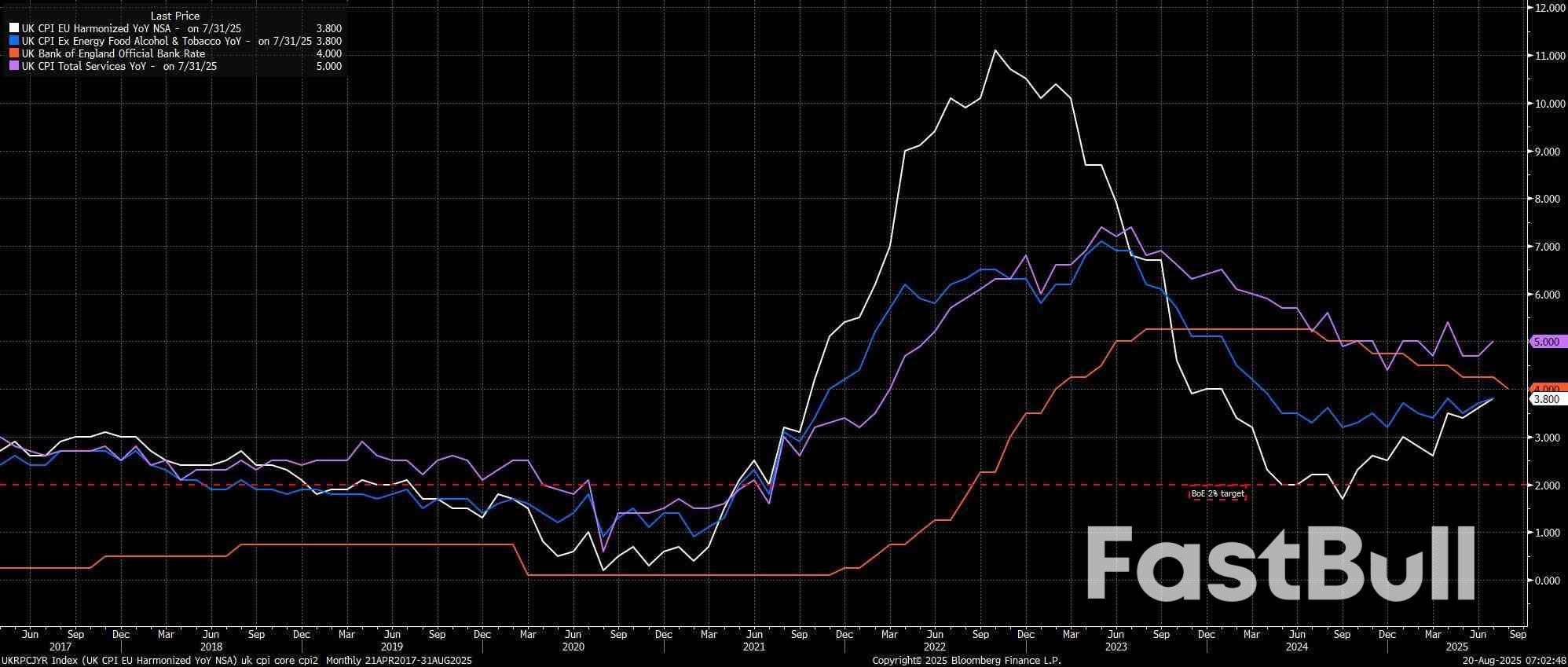
          Headline CPI rose 3.8% YoY in July, the fastest pace since January last year, albeit in line with the Bank of England's latest forecasts. Those same BoE forecasts, however, foresee a further rise in inflation in the months ahead, with CPI set to peak at 4.0% YoY in September, double the MPC's target.

          Measures of underlying inflation also pointed to price pressures having remained intense, and incompatible with the Bank's 2% inflation aim. Core CPI, excluding food and energy, rose 3.8% YoY last month, the fastest pace since April, while the closely-watched services CPI metric rose 5.0% on an annual basis, also the highest level since April, and above the Bank's 4.9% YoY forecast.

          Overall, the rise in headline prices came largely as a result of yet another chunky rise in food prices, but also by virtue of an upward impulse from consumer energy costs, with the Ofgem price cap this year seeing a much smaller drop than in July 2024, and as a result of the largest July increase in airfares since the start of the millennium. However, these one-off factors do little to allay concerns over those aforementioned underlying metrics remaining at elevated levels, though there may be some upwards skew in certain sections of the services metric, in particular, owing to the sampling having fallen in the middle of a number of major concert tours this summer.

          Frankly, though, none of this is likely to move the needle especially much for the Bank of England, with the MPC having voted in favour of a 25bp Bank Rate cut a fortnight ago, by the narrowest possible 5-4 majority.

          Today's figures are unlikely enough to persuade those 4 'hawks' that the risks of price pressures becoming embedded within the economy are subsiding in material fashion, though the next 'live' MPC meeting is now not until November, with the September meeting set to see Bank Rate held steady.

          With the MPC having retained their guidance around a 'gradual and careful' pace of easing, my base case remains that a cut will be delivered at that November confab, given the continued preference for a regular, quarterly pace of cuts if possible. That said, the bar for further policy easing is clearly now considerably higher than it was mere weeks ago, while there also remains a long way to run until that November decision, especially with the autumn Budget, and likely sizeable fiscal tightening, in the mix during this period as well.

          Source: Pepperstone

          To stay updated on all economic events of today, please check out our Economic calendar
          Risk Warnings and Disclaimers
          You understand and acknowledge that there is a high degree of risk involved in trading. Following any strategies or investment methods may lead to potential losses. The content on the site is provided by our contributors and analysts for information purposes only. You are solely responsible for determining whether any trading assets, securities, strategy, or any other product is suitable for investing based on your own investment objectives and financial situation.
          Add to Favorites
          Share

          EU prepares 19th sanctions package against Russia as conflict drags on

          Gerik

          Russia-Ukraine Conflict

          Political

          EU accelerates new sanctions plan

          European Commission Vice President Kaja Kallas announced on August 19 that the EU is preparing a fresh sanctions package against Russia, which could be finalized in September. She emphasized that the issue has been placed high on the agenda for EU foreign and defense ministers next week. The timing reflects frustration over the lack of progress in peace efforts, particularly after Russian President Vladimir Putin left the Anchorage summit with U.S. President Donald Trump and Ukrainian President Volodymyr Zelenskiy without committing to a ceasefire.
          The upcoming measures build on the EU’s 18th sanctions package, adopted on July 18. That round targeted Russia’s energy, banking, and defense industries, introducing for the first time a full ban on transactions involving the Nord Stream 1 and 2 gas pipelines. It also lowered the oil price cap from $60 to $45 per barrel, a move designed to cut deeply into Russia’s oil revenues, which account for nearly one-third of its state budget.
          Financial restrictions were tightened as well, with the EU blacklisting 22 Russian banks and threatening penalties on third-country financial institutions found to be assisting sanctions evasion. The Russian Direct Investment Fund (RDIF) was also added to the blacklist. In addition, a new €2.5 billion export ban covered machinery, metals, plastics, chemicals, and dual-use goods relevant to weapons production.

          Moscow pushes back

          The Kremlin has dismissed these measures as illegal, with spokesperson Dmitry Peskov insisting Russia has developed “a certain degree of immunity” to Western restrictions. Moscow argues that the sanctions hurt both sides, calling them a “double-edged sword” with negative repercussions for European economies as well.
          If adopted in September, the 19th package would signal the EU’s intent to keep escalating economic pressure, even as Russia demonstrates resilience. Each successive round highlights the tension between the EU’s determination to curtail Moscow’s war financing and the economic risks sanctions pose for global markets. The next measures will likely expand upon energy, banking, and export controls, with potential spillovers affecting European trade and supply chains.

          Risk Warnings and Disclaimers
          You understand and acknowledge that there is a high degree of risk involved in trading. Following any strategies or investment methods may lead to potential losses. The content on the site is provided by our contributors and analysts for information purposes only. You are solely responsible for determining whether any trading assets, securities, strategy, or any other product is suitable for investing based on your own investment objectives and financial situation.
          Add to Favorites
          Share

          Capital Flight From China Hits Record as Investors Flock to Hong Kong Assets

          Gerik

          Economic

          Record Outflows Driven by Hong Kong Purchases

          China’s State Administration of Foreign Exchange (SAFE) reported that banks transferred a net $58.3 billion abroad in July, the largest monthly outflow since records began in 2010. The bulk of these outflows were linked to mainland investors channeling funds into Hong Kong’s stock market, which has become increasingly attractive relative to domestic equities. The expansion of the Southbound Bond Connect program in July further accelerated flows into offshore bonds, providing new channels for capital allocation outside the mainland.
          This shift is causal, not coincidental: Beijing’s regulatory loosening directly enabled investors to diversify abroad, and they acted quickly to seize the opportunity amid weakening domestic conditions.

          Foreign Investors Continue to Exit Chinese Bonds

          While domestic capital sought opportunities abroad, foreign funds continued to reduce exposure to Chinese bonds. This trend stems from the relative decline in Chinese yields compared to global alternatives, particularly as risk appetite improves in other markets. The correlation between weaker domestic returns and sustained foreign bond outflows highlights China’s challenge in retaining global capital even as it seeks to internationalize the yuan.
          Analysts suggest Beijing may tolerate some degree of outflows this year, using the backdrop of a weaker U.S. dollar to advance gradual capital account liberalization. By expanding outbound quotas in June for the first time in over a year, regulators signaled an intention to encourage portfolio diversification abroad a step aligned with the long-term goal of yuan internationalization.
          Yet, the risks are twofold. While controlled liberalization supports China’s global financial ambitions, it can simultaneously undermine short-term domestic liquidity, creating a trade-off between strategic objectives and economic stability.

          Domestic Economy Shows Broad Slowdown

          The outflows coincide with fresh signs of weakness in China’s economy. Industrial output grew only 3.7% year-on-year in July, down sharply from 6.8% in June and the lowest pace since November of the previous year. Retail sales slowed to 2.5% from 3.1%, and fixed-asset investment growth in the first seven months dropped to 1.6% as the property sector’s downturn deepened. Urban unemployment also ticked higher to 5.2%.
          The causal link is evident: slowing production, weaker consumption, and property stress erode investor confidence, prompting both foreign and domestic players to reallocate capital abroad. The record capital outflow is thus not merely the product of policy easing, but also a reaction to deteriorating fundamentals at home.
          China’s record July outflows reflect the convergence of policy liberalization, investor diversification, and domestic economic strain. While Beijing may view measured capital flight as acceptable in pursuit of yuan internationalization, the sharp scale of July’s outflow signals fragility. Unless growth stabilizes and confidence returns, the risk is that what begins as controlled diversification turns into a persistent drain on domestic financial stability.
          To stay updated on all economic events of today, please check out our Economic calendar
          Risk Warnings and Disclaimers
          You understand and acknowledge that there is a high degree of risk involved in trading. Following any strategies or investment methods may lead to potential losses. The content on the site is provided by our contributors and analysts for information purposes only. You are solely responsible for determining whether any trading assets, securities, strategy, or any other product is suitable for investing based on your own investment objectives and financial situation.
          Add to Favorites
          Share

          U.S. Budget Deficit Outlook Worsens by $1 Trillion Over Next Decade, Watchdog Warns

          Gerik

          Economic

          Deficits Trend Higher Despite Short-Term Improvement

          The CRFB forecast shows a $1.7 trillion deficit in fiscal 2025, equal to 5.6% of GDP. While this is slightly lower than the $1.83 trillion deficit recorded in 2024 and below the CBO’s January projection of $1.87 trillion for 2025, deficits are set to rise steadily thereafter. By 2035, the annual shortfall is expected to reach $2.6 trillion, or 5.9% of GDP.
          The upward revision underscores how legislative and tariff changes introduced since President Donald Trump took office are shaping long-term fiscal dynamics. While the near-term decline in deficits offers a temporary reprieve, the structural trajectory points toward deeper imbalances later in the decade.

          Drivers of the Higher Deficit Outlook

          The key causal factor behind the $1 trillion increase is the One Big Beautiful Bill Act, which cuts taxes and expands spending. CRFB estimates the legislation will add $4.6 trillion to deficits through 2035, including interest costs, extending the CBO’s $4.1 trillion estimate (through 2034) by an additional year.
          Tariffs partially offset this effect, with CRFB projecting $3.4 trillion in revenue over the decade from Trump’s new import duties. However, this reliance on tariff collections introduces risk, as ongoing legal challenges could sharply reduce expected revenues.
          Other deficit-reducing measures include $100 billion in savings from tighter eligibility for health insurance subsidies and another $100 billion from rescissions in foreign aid, public broadcasting, and other programs. Yet these savings pale in comparison to the impact of large-scale tax and spending commitments.

          Net Interest Costs Balloon

          A major burden over the next decade will be interest payments on the growing national debt. CRFB projects net interest costs will total $14 trillion between 2026 and 2035, rising from just under $1 trillion (3.2% of GDP) in 2025 to $1.8 trillion (4.1% of GDP) by 2035. This reflects the compounding effect of sustained deficits and high debt levels on financing costs, making interest a leading driver of fiscal strain.
          The baseline CRFB scenario already adds $1 trillion to CBO’s January forecast, but its alternative scenario paints a far darker picture. If the Court of International Trade rules against many of Trump’s tariffs, revenue losses could reach $2.4 trillion over 10 years.
          Additional risks come from the potential extension of temporary tax breaks in the One Big Beautiful Bill Act including deductions for overtime, tips, and car loan interest, as well as full expensing of factory investments which would add $1.7 trillion in deficits. Higher-for-longer interest rates would worsen the situation further: if yields remain near 4.3% instead of falling to CBO’s 3.8% projection, interest costs alone would add $1.6 trillion.

          Debt-to-GDP Ratios Highlight Fiscal Fragility

          Under CRFB’s baseline, U.S. debt-to-GDP climbs to 120% by 2035, compared with the CBO’s January projection of 118%. Under the more pessimistic alternative scenario, debt would soar to 134% of GDP, reflecting both weaker revenue and higher borrowing costs.
          While tariffs and selective spending cuts provide short-term relief, the U.S. fiscal outlook is dominated by rising structural deficits and ballooning interest costs. CRFB’s projections highlight the trade-off between political commitments to tax cuts and spending and the long-term sustainability of federal finances. Without significant course correction, the U.S. debt burden will climb to historically high levels, amplifying risks to both economic stability and fiscal flexibility.

          Source: Reuters

          To stay updated on all economic events of today, please check out our Economic calendar
          Risk Warnings and Disclaimers
          You understand and acknowledge that there is a high degree of risk involved in trading. Following any strategies or investment methods may lead to potential losses. The content on the site is provided by our contributors and analysts for information purposes only. You are solely responsible for determining whether any trading assets, securities, strategy, or any other product is suitable for investing based on your own investment objectives and financial situation.
          Add to Favorites
          Share
          FastBull
          Copyright © 2025 FastBull Ltd

          728 RM B 7/F GEE LOK IND BLDG NO 34 HUNG TO RD KWUN TONG KLN HONG KONG

          TelegramInstagramTwitterfacebooklinkedin
          App Store Google Play Google Play
          Products
          Charts

          Chats

          Q&A with Experts
          Screeners
          Economic Calendar
          Data
          Tools
          Membership
          Features
          Function
          Markets
          Copy Trading
          Latest Signals
          Contests
          News
          Analysis
          24/7
          Columns
          Education
          Company
          Careers
          About Us
          Contact Us
          Advertising
          Help Center
          Feedback
          User Agreement
          Privacy Policy
          Business

          White Label

          Data API

          Web Plug-ins

          Poster Maker

          Affiliate Program

          Risk Disclosure

          The risk of loss in trading financial instruments such as stocks, FX, commodities, futures, bonds, ETFs and crypto can be substantial. You may sustain a total loss of the funds that you deposit with your broker. Therefore, you should carefully consider whether such trading is suitable for you in light of your circumstances and financial resources.

          No decision to invest should be made without thoroughly conducting due diligence by yourself or consulting with your financial advisors. Our web content might not suit you since we don't know your financial conditions and investment needs. Our financial information might have latency or contain inaccuracy, so you should be fully responsible for any of your trading and investment decisions. The company will not be responsible for your capital loss.

          Without getting permission from the website, you are not allowed to copy the website's graphics, texts, or trademarks. Intellectual property rights in the content or data incorporated into this website belong to its providers and exchange merchants.

          Not Logged In

          Log in to access more features

          FastBull Membership

          Not yet

          Purchase

          Become a signal provider
          Help Center
          Customer Service
          Dark Mode
          Price Up/Down Colors

          Log In

          Sign Up

          Position
          Layout
          Fullscreen
          Default to Chart
          The chart page opens by default when you visit fastbull.com