• Trade
  • Markets
  • Copy
  • Contests
  • News
  • 24/7
  • Calendar
  • Q&A
  • Chats
Trending
Screeners
SYMBOL
LAST
BID
ASK
HIGH
LOW
NET CHG.
%CHG.
SPREAD
SPX
S&P 500 Index
6827.42
6827.42
6827.42
6899.86
6801.80
-73.58
-1.07%
--
DJI
Dow Jones Industrial Average
48458.04
48458.04
48458.04
48886.86
48334.10
-245.98
-0.51%
--
IXIC
NASDAQ Composite Index
23195.16
23195.16
23195.16
23554.89
23094.51
-398.69
-1.69%
--
USDX
US Dollar Index
97.950
98.030
97.950
98.500
97.950
-0.370
-0.38%
--
EURUSD
Euro / US Dollar
1.17394
1.17409
1.17394
1.17496
1.17192
+0.00011
+ 0.01%
--
GBPUSD
Pound Sterling / US Dollar
1.33707
1.33732
1.33707
1.33997
1.33419
-0.00148
-0.11%
--
XAUUSD
Gold / US Dollar
4299.39
4299.39
4299.39
4353.41
4257.10
+20.10
+ 0.47%
--
WTI
Light Sweet Crude Oil
57.233
57.485
57.233
58.011
56.969
-0.408
-0.71%
--

Community Accounts

Signal Accounts
--
Profit Accounts
--
Loss Accounts
--
View More

Become a signal provider

Sell trading signals to earn additional income

View More

Guide to Copy Trading

Get started with ease and confidence

View More

Signal Accounts for Members

All Signal Accounts

Best Return
  • Best Return
  • Best P/L
  • Best MDD
Past 1W
  • Past 1W
  • Past 1M
  • Past 1Y

All Contests

  • All
  • Trump Updates
  • Recommend
  • Stocks
  • Cryptocurrencies
  • Central Banks
  • Featured News
Top News Only
Share

Thai Leader Anutin: Landmine Blast That Killed Thai Soldiers 'Not A Roadside Accident'

Share

Thai Leader Anutin: Thailand To Continue Military Action Until 'We Feel No More Harm'

Share

Cambodian Prime Minister Hun Manet Says He Had Phone Calls With Trump And Malaysian Leader Anwar About Ceasefire

Share

Cambodia's Hun Manet Says USA, Malaysia Should Verify 'Which Side Fired First' In Latest Conflict

Share

Cambodia's Hun Manet: Cambodia Maintains Its Stance In Seeking Peaceful Resolution Of Disputes

Share

Nasdaq Companies: Allergan, Ferrovia, Insmed, Monolithic Power Systems, Seagate Technology, And Western Digital Will Be Added To The NASDAQ 100 Index. Biogen, CdW, GlobalFoundries, Lululemon, ON Semiconductor, And Tradedesk Will Be Removed From The NASDAQ 100 Index

Share

Witkoff Headed To Berlin This Weekend To Meet With Zelenskiy, European Leaders -Wsj Reporter On X

Share

Russia Attacks Two Ukrainian Ports, Damaging Three Turkish-Owned Vessels

Share

[Historic Flooding Occurs In At Least Four Rivers In Washington State Due To Days Of Torrential Rains] Multiple Areas In Washington State Have Been Hit By Severe Flooding Due To Days Of Torrential Rains, With At Least Four Rivers Experiencing Historic Flooding. Reporters Learned On The 12th That The Floods Caused By The Torrential Rains In Washington State Have Destroyed Homes And Closed Several Highways. Experts Warn That Even More Severe Flooding May Occur In The Future. A State Of Emergency Has Been Declared In Washington State

Share

Trump Says Proposed Free Economic Zone In Donbas Would Work

Share

Trump: I Think My Voice Should Be Heard

Share

Trump Says Will Be Choosing New Fed Chair In Near Future

Share

Trump Says Proposed Free Economic Zone In Donbas Complex But Would Work

Share

Trump Says Land Strikes In Venezuela Will Start Happening

Share

US President Trump: Thailand And Cambodia Are In A Good Situation

Share

State Media: North Korean Leader Kim Hails Troops Returning From Russia Mission

Share

The 10-year Treasury Yield Rose About 5 Basis Points During The "Fed Rate Cut Week," And The 2/10-year Yield Spread Widened By About 9 Basis Points. On Friday (December 12), In Late New York Trading, The Yield On The Benchmark 10-year US Treasury Note Rose 2.75 Basis Points To 4.1841%, A Cumulative Increase Of 4.90 Basis Points For The Week, Trading Within A Range Of 4.1002%-4.2074%. It Rose Steadily From Monday To Wednesday (before The Fed Announced Its Rate Cut And Treasury Bill Purchase Program), Subsequently Exhibiting A V-shaped Recovery. The 2-year Treasury Yield Fell 1.82 Basis Points To 3.5222%, A Cumulative Decrease Of 3.81 Basis Points For The Week, Trading Within A Range Of 3.6253%-3.4989%

Share

Trump: Lots Of Progress Being Made On Russia-Ukraine

Share

NOPA November US Soybean Crush Estimated At 220.285 Million Bushels

Share

SPDR Gold Trust Reports Holdings Up 0.22%, Or 2.28 Tonnes, To 1053.11 Tonnes By Dec 12

TIME
ACT
FCST
PREV
U.K. Trade Balance Non-EU (SA) (Oct)

A:--

F: --

P: --

U.K. Trade Balance (Oct)

A:--

F: --

P: --

U.K. Services Index MoM

A:--

F: --

P: --

U.K. Construction Output MoM (SA) (Oct)

A:--

F: --

P: --

U.K. Industrial Output YoY (Oct)

A:--

F: --

P: --

U.K. Trade Balance (SA) (Oct)

A:--

F: --

P: --

U.K. Trade Balance EU (SA) (Oct)

A:--

F: --

P: --

U.K. Manufacturing Output YoY (Oct)

A:--

F: --

P: --

U.K. GDP MoM (Oct)

A:--

F: --

P: --

U.K. GDP YoY (SA) (Oct)

A:--

F: --

P: --

U.K. Industrial Output MoM (Oct)

A:--

F: --

P: --

U.K. Construction Output YoY (Oct)

A:--

F: --

P: --

France HICP Final MoM (Nov)

A:--

F: --

P: --

China, Mainland Outstanding Loans Growth YoY (Nov)

A:--

F: --

P: --

China, Mainland M2 Money Supply YoY (Nov)

A:--

F: --

P: --

China, Mainland M0 Money Supply YoY (Nov)

A:--

F: --

P: --

China, Mainland M1 Money Supply YoY (Nov)

A:--

F: --

P: --

India CPI YoY (Nov)

A:--

F: --

P: --

India Deposit Gowth YoY

A:--

F: --

P: --

Brazil Services Growth YoY (Oct)

A:--

F: --

P: --

Mexico Industrial Output YoY (Oct)

A:--

F: --

P: --

Russia Trade Balance (Oct)

A:--

F: --

P: --

Philadelphia Fed President Henry Paulson delivers a speech
Canada Building Permits MoM (SA) (Oct)

A:--

F: --

P: --

Canada Wholesale Sales YoY (Oct)

A:--

F: --

P: --

Canada Wholesale Inventory MoM (Oct)

A:--

F: --

P: --

Canada Wholesale Inventory YoY (Oct)

A:--

F: --

P: --

Canada Wholesale Sales MoM (SA) (Oct)

A:--

F: --

P: --

Germany Current Account (Not SA) (Oct)

A:--

F: --

P: --

U.S. Weekly Total Rig Count

A:--

F: --

P: --

U.S. Weekly Total Oil Rig Count

A:--

F: --

P: --

Japan Tankan Large Non-Manufacturing Diffusion Index (Q4)

--

F: --

P: --

Japan Tankan Small Manufacturing Outlook Index (Q4)

--

F: --

P: --

Japan Tankan Large Non-Manufacturing Outlook Index (Q4)

--

F: --

P: --

Japan Tankan Large Manufacturing Outlook Index (Q4)

--

F: --

P: --

Japan Tankan Small Manufacturing Diffusion Index (Q4)

--

F: --

P: --

Japan Tankan Large Manufacturing Diffusion Index (Q4)

--

F: --

P: --

Japan Tankan Large-Enterprise Capital Expenditure YoY (Q4)

--

F: --

P: --

U.K. Rightmove House Price Index YoY (Dec)

--

F: --

P: --

China, Mainland Industrial Output YoY (YTD) (Nov)

--

F: --

P: --

China, Mainland Urban Area Unemployment Rate (Nov)

--

F: --

P: --

Saudi Arabia CPI YoY (Nov)

--

F: --

P: --

Euro Zone Industrial Output YoY (Oct)

--

F: --

P: --

Euro Zone Industrial Output MoM (Oct)

--

F: --

P: --

Canada Existing Home Sales MoM (Nov)

--

F: --

P: --

Euro Zone Total Reserve Assets (Nov)

--

F: --

P: --

U.K. Inflation Rate Expectations

--

F: --

P: --

Canada National Economic Confidence Index

--

F: --

P: --

Canada New Housing Starts (Nov)

--

F: --

P: --

U.S. NY Fed Manufacturing Employment Index (Dec)

--

F: --

P: --

U.S. NY Fed Manufacturing Index (Dec)

--

F: --

P: --

Canada Core CPI YoY (Nov)

--

F: --

P: --

Canada Manufacturing Unfilled Orders MoM (Oct)

--

F: --

P: --

Canada Manufacturing New Orders MoM (Oct)

--

F: --

P: --

Canada Core CPI MoM (Nov)

--

F: --

P: --

Canada Manufacturing Inventory MoM (Oct)

--

F: --

P: --

Canada CPI YoY (Nov)

--

F: --

P: --

Canada CPI MoM (Nov)

--

F: --

P: --

Canada CPI YoY (SA) (Nov)

--

F: --

P: --

Canada Core CPI MoM (SA) (Nov)

--

F: --

P: --

Q&A with Experts
    • All
    • Chatrooms
    • Groups
    • Friends
    Connecting
    .
    .
    .
    Type here...
    Add Symbol or Code

      No matching data

      All
      Trump Updates
      Recommend
      Stocks
      Cryptocurrencies
      Central Banks
      Featured News
      • All
      • Russia-Ukraine Conflict
      • Middle East Flashpoint
      • All
      • Russia-Ukraine Conflict
      • Middle East Flashpoint
      Search
      Products

      Charts Free Forever

      Chats Q&A with Experts
      Screeners Economic Calendar Data Tools
      Membership Features
      Data Warehouse Market Trends Institutional Data Policy Rates Macro

      Market Trends

      Market Sentiment Order Book Forex Correlations

      Top Indicators

      Charts Free Forever
      Markets

      News

      News Analysis 24/7 Columns Education
      From Institutions From Analysts
      Topics Columnists

      Latest Views

      Latest Views

      Trending Topics

      Top Columnists

      Latest Update

      Signals

      Copy Rankings Latest Signals Become a signal provider AI Rating
      Contests
      Brokers

      Overview Brokers Assessment Rankings Regulators News Claims
      Broker listing Forex Brokers Comparison Tool Live Spread Comparison Scam
      Q&A Complaint Scam Alert Videos Tips to Detect Scam
      More

      Business
      Events
      Careers About Us Advertising Help Center

      White Label

      Data API

      Web Plug-ins

      Affiliate Program

      Awards Institution Evaluation IB Seminar Salon Event Exhibition
      Vietnam Thailand Singapore Dubai
      Fans Party Investment Sharing Session
      FastBull Summit BrokersView Expo
      Recent Searches
        Top Searches
          Markets
          News
          Analysis
          User
          24/7
          Economic Calendar
          Education
          Data
          • Names
          • Latest
          • Prev

          View All

          No data

          Scan to Download

          Faster Charts, Chat Faster!

          Download App
          English
          • English
          • Español
          • العربية
          • Bahasa Indonesia
          • Bahasa Melayu
          • Tiếng Việt
          • ภาษาไทย
          • Français
          • Italiano
          • Türkçe
          • Русский язык
          • 简中
          • 繁中
          Open Account
          Search
          Products
          Charts Free Forever
          Markets
          News
          Signals

          Copy Rankings Latest Signals Become a signal provider AI Rating
          Contests
          Brokers

          Overview Brokers Assessment Rankings Regulators News Claims
          Broker listing Forex Brokers Comparison Tool Live Spread Comparison Scam
          Q&A Complaint Scam Alert Videos Tips to Detect Scam
          More

          Business
          Events
          Careers About Us Advertising Help Center

          White Label

          Data API

          Web Plug-ins

          Affiliate Program

          Awards Institution Evaluation IB Seminar Salon Event Exhibition
          Vietnam Thailand Singapore Dubai
          Fans Party Investment Sharing Session
          FastBull Summit BrokersView Expo

          Chart Art: GBP/CAD Nears Key Long-Term Trend Support

          Blue River

          Forex

          Technical Analysis

          Summary:

          GBP/CAD just threw down a big red candlestick after tagging new 2025 highs! Is this just a breather or the start of a longer-term downswing?

          GBP/CAD just threw down a big red candlestick after tagging new 2025 highs!

          Is this just a breather or the start of a longer-term downswing?

          We’re eyeing a major support zone that could decide whether the bulls step back in or call it a day.
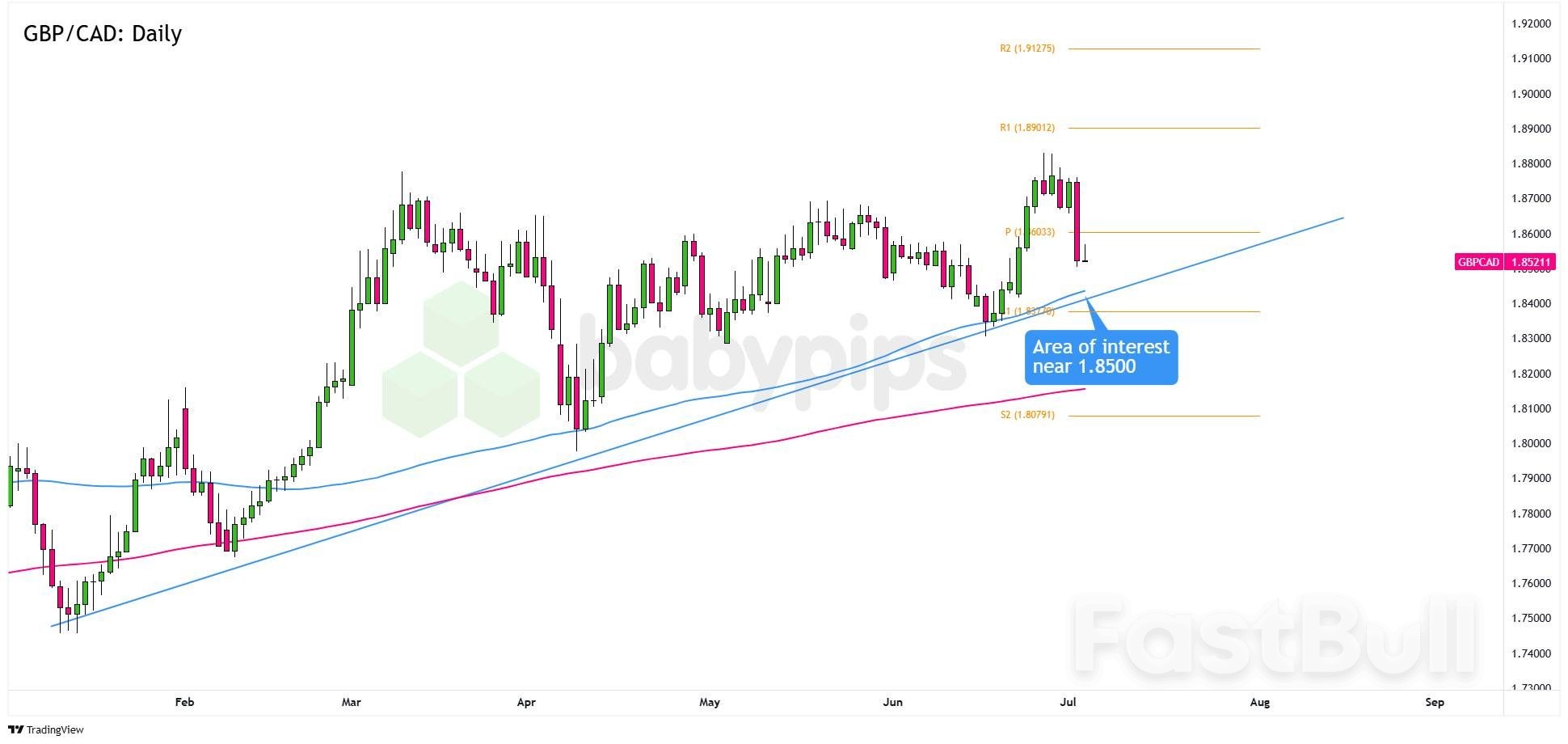
          GBP/CAD: Daily

          GBP/CAD Daily Forex Chart

          Sterling slipped across the board after traders started doubting whether Chancellor Reeves still had solid backing from the government, especially after it watered down benefit cuts she had championed to balance the budget.

          At the same time, the Canadian dollar drew strength from rising oil prices, growing hopes for Fed rate cuts, and fresh optimism over U.S. trade deals.

          Was this the start of a longer-term slide for GBP/CAD, or just a temporary stumble before the bulls regroup?

          Remember that directional biases and volatility conditions in market price are typically driven by fundamentals. If you haven’t yet done your homework on the British pound and the Canadian dollar, then it’s time to check out the economic calendar and stay updated on daily fundamental news!

          GBP/CAD is closing in on the 1.8400 to 1.8500 zone, a key support area that lines up with the S1 Pivot Point at 1.8377, the 100 SMA, and a trend line that has kept sellers in check since January.

          If buyers show up with hesitation wicks and green candlesticks, we could see a bounce from this trend line area and a possible move back toward 1.8800 or even fresh 2025 highs.

          But if the bears break through with strong red candles and hold below the trend line, the pair could slide toward the S2 Pivot at 1.8079 or the 1.8000 psychological level. That kind of move might flip the longer-term uptrend on its head!

          Whichever bias you end up trading, don’t forget to practice proper risk management and stay aware of top-tier catalysts that could influence overall market sentiment.

          Source: BabyPips

          Risk Warnings and Disclaimers
          You understand and acknowledge that there is a high degree of risk involved in trading. Following any strategies or investment methods may lead to potential losses. The content on the site is provided by our contributors and analysts for information purposes only. You are solely responsible for determining whether any trading assets, securities, strategy, or any other product is suitable for investing based on your own investment objectives and financial situation.
          Add to Favorites
          Share

          Japan Calms Market Nerves With Strong 30-Year Bond Auction Despite Yield Pressure

          Gerik

          Economic

          Bond

          Tokyo’s Strategic Bond Move: Japan Eases Market Fears With Strong 30-Year Sale

          Japan’s Ministry of Finance (MOF) pulled off a smoother-than-expected auction of 30-year government bonds on Thursday, calming market anxiety over potential turbulence in long-term debt markets. With a bid-to-cover ratio of 3.58—the highest since February—investor appetite for Japanese sovereign debt remained robust, despite recent global volatility in long-maturity bonds.
          The auction’s tail (the difference between the average and lowest accepted price) came in at 0.31, down from 0.49 in June, reinforcing market confidence in the issuance process. The result came on the heels of last month’s MOF announcement to cut the issuance of long-dated bonds—a decision aimed at reducing upward pressure on yields amid rising concerns about fiscal sustainability.

          Market Strategy: Advance Signaling Works

          Analysts had anticipated stable demand given how well the auction was telegraphed. Westpac’s Martin Whetton called the result “not stellar, but good enough,” indicating that the positive outcome was largely baked into investor expectations. In effect, the auction served as a “buy-the-rumor, sell-the-fact” event, with Japanese bond futures holding losses and yields nudging slightly higher post-auction—30-year yields rose 2 basis points to 2.901%.
          The result reflects a careful balancing act by Japanese authorities, who have managed to calm short-term volatility even as they face intense structural pressures from a globally synchronized rise in yields, especially in the U.S. and U.K.

          Policy Context: Lower Supply, Softer BoJ Exit

          The MOF’s decision to reduce long-term debt issuance by ¥3.2 trillion ($22 billion) through March 2026 has helped temper bond market fears. Meanwhile, the Bank of Japan has committed to slowing its bond purchase taper, a clear signal to avoid any abrupt tightening in domestic financial conditions.
          Earlier this week, Japan also enjoyed relatively strong demand in its 10-year bond auction, setting the stage for Thursday’s success and boosting confidence in the market's ability to absorb debt issuance even as local institutional buyers—such as life insurers—pull back from long-dated maturities.

          Political and Structural Risks Remain

          Despite the positive auction outcome, underlying structural risks linger. The upcoming upper house election is introducing new fiscal uncertainties, with Prime Minister Shigeru Ishiba campaigning on ambitious economic promises, including a ¥1 quadrillion economy and wage hikes.
          Policy chief Itsunori Onodera has already warned that Japan’s fiscal stance is under a “yellow alert,” suggesting that spending pressures could resurface regardless of recent market stability. This leaves the government with a narrow path: managing funding costs in the face of demographic pressures, rising interest rate norms globally, and a political environment prone to populist spending.

          A Tactical Win in a Strategic Battle

          Japan’s successful 30-year bond auction is a tactical victory in a broader fiscal challenge. While the Ministry of Finance and Bank of Japan have temporarily reassured investors with reduced supply and policy clarity, the structural task of maintaining long-term fiscal health in a low-growth, aging economy remains daunting.
          As elections loom and the global rate environment remains uncertain, Tokyo’s ability to navigate the long end of its bond curve without triggering yield spikes or investor flight will continue to be tested.

          Source: Bloomberg

          To stay updated on all economic events of today, please check out our Economic calendar
          Risk Warnings and Disclaimers
          You understand and acknowledge that there is a high degree of risk involved in trading. Following any strategies or investment methods may lead to potential losses. The content on the site is provided by our contributors and analysts for information purposes only. You are solely responsible for determining whether any trading assets, securities, strategy, or any other product is suitable for investing based on your own investment objectives and financial situation.
          Add to Favorites
          Share

          U.S. Eases Chip Design Restrictions on China Under New Trade Agreement

          Gerik

          Economic

          U.S. Reverses Chip Design Software Curbs in Key Shift on China Tech Policy

          In a notable policy reversal, the Trump administration has removed export license requirements for U.S. companies selling chip design software to China. The move is part of a broader trade agreement finalized last week between Washington and Beijing that seeks to de-escalate tensions in the high-tech sector and restore critical supply chains.
          The decision affects the world’s three leading providers of electronic design automation (EDA) tools—Synopsys Inc., Cadence Design Systems Inc., and Germany’s Siemens AG—all of whom had been subject to licensing restrictions imposed in May. Those curbs had disrupted commercial activities by requiring companies to seek prior U.S. government approval to sell to Chinese clients.
          According to company statements, Siemens has already restored full access to its software for Chinese customers. Synopsys and Cadence are in the process of resuming services, signaling an immediate operational impact. The U.S. Commerce Department has not issued public comments on the change.

          Part of a Broader Trade Deal Linking Tech and Resources

          The easing of EDA software restrictions forms a key pillar of the new trade accord. In exchange, China has pledged to expedite export approvals for rare earth minerals, a vital input for electronics and defense industries. The agreement also includes U.S. permission for shipments of ethane and jet engines to China—two sectors previously facing increasing regulatory scrutiny.
          This marks a strategic trade-off: the U.S. regains access to critical mineral flows and commercial stability for major tech firms, while China regains access to essential design tools for its semiconductor ambitions.

          Reversing a Short-Lived But Symbolic Escalation

          The May restrictions on EDA tool sales were part of a broader campaign by the Trump administration to curb China’s progress in advanced computing and artificial intelligence. They followed years of export controls on high-end chips and semiconductor manufacturing equipment. While short-lived, the EDA restrictions signaled a willingness to broaden the tech blockade to upstream, software-based chokepoints in the chip design process.
          EDA tools are vital for the creation of everything from Nvidia’s most advanced GPUs to more basic analog components. Their importance lies in the fact that without access to tools from Synopsys, Cadence, and Siemens, China’s domestic chip industry would be severely hampered—even with physical manufacturing capacity.

          Strategic Implications: Tech Detente or Tactical Pause?

          The removal of these curbs is a significant gesture but may reflect a tactical pause more than a lasting detente. While the move benefits U.S. firms with significant exposure to China, such as Synopsys and Cadence, it also opens a narrow window for China’s semiconductor ecosystem to regain access to essential design software.
          It remains unclear how long this policy stance will last, especially with political pressure mounting around national security and tech dominance. The balance of trade-offs—minerals for software—indicates that both sides are trying to stabilize a strategically fragile supply chain landscape without compromising on core security red lines.

          A Reset in Tech Trade, Not a Repeal of Rivalry

          The U.S. lifting of chip design software restrictions is a calculated concession in a broader trade agreement aimed at restoring a degree of cooperation in tech and critical resources. While the move brings temporary relief to both U.S. suppliers and Chinese buyers, the broader rivalry in semiconductors, AI, and digital sovereignty remains intact.
          With the Biden-Trump policy continuum still evolving and technology remaining central to global economic power, this rollback signals more of a realignment than a retreat. The real test will be whether mutual access is preserved or re-constrained as broader geopolitical dynamics shift.

          Source: Reuters

          To stay updated on all economic events of today, please check out our Economic calendar
          Risk Warnings and Disclaimers
          You understand and acknowledge that there is a high degree of risk involved in trading. Following any strategies or investment methods may lead to potential losses. The content on the site is provided by our contributors and analysts for information purposes only. You are solely responsible for determining whether any trading assets, securities, strategy, or any other product is suitable for investing based on your own investment objectives and financial situation.
          Add to Favorites
          Share

          Oil Retreats After Trade-Driven Rally as Market Awaits OPEC+ Output Decision

          Gerik

          Commodity

          Oil Pulls Back as Trade Momentum Meets Supply Uncertainty

          Oil prices declined on Thursday following their biggest single-day gain in nearly two weeks. Brent crude hovered near $69 per barrel, and West Texas Intermediate (WTI) remained above $67, as market sentiment shifted from geopolitical risk to ongoing trade developments and the upcoming OPEC+ meeting.
          President Donald Trump’s announcement of a new trade agreement with Vietnam—following similar deals with the UK and China—helped fuel Wednesday’s 3% oil price surge. The agreements come ahead of the July 9 deadline to finalize trade terms, easing investor fears of widespread tariff escalations that could dampen global energy demand.
          However, analysts suggest the trade-driven rally may be short-lived as attention now pivots to OPEC+ negotiations, where the cartel is expected to raise production quotas in August.

          OPEC+ Decision Looms Large Over Price Direction

          Market participants are exercising caution ahead of Sunday’s OPEC+ meeting. The alliance, led by Saudi Arabia and Russia, is widely expected to approve a substantial increase in output, responding to seasonal demand strength and recent supply constraints.
          ING’s Head of Commodities Strategy, Warren Patterson, noted that while trade optimism gave oil prices a temporary lift, "the sustainability of this move will likely be short-lived" due to the market’s reluctance to build positions ahead of the U.S. holiday weekend and the OPEC+ decision.
          Any aggressive supply expansion could offset recent gains driven by Middle East tensions and U.S. trade progress, making the weekend’s outcome a key inflection point for market direction into mid-July.

          U.S. Inventory Trends Signal Mixed Fundamentals

          On the supply side, the latest data from the U.S. Energy Information Administration revealed that nationwide crude inventories rose by 3.8 million barrels last week—marking the first increase since May. However, stockpiles at Cushing, Oklahoma—the primary U.S. oil hub—fell for the fourth consecutive week and are now at their lowest seasonal level since 2014.
          This divergence highlights a complex demand picture. While national builds suggest some softening, regional draws and ongoing heat waves across the U.S. are propping up short-term consumption. The current driving season, coupled with elevated air conditioning usage, has lent support to gasoline and fuel demand.

          Market Structure Reflects Lingering Tightness

          Despite Thursday’s price decline, forward curves continue to signal underlying tightness. Brent’s prompt spread—the price gap between the nearest two contracts—rose to $1.21 per barrel in backwardation, up from $0.69 a month ago. Although this remains below the levels seen during last month’s Israel-Iran conflict, the structure still suggests strong prompt demand relative to future deliveries.
          Backwardation in oil markets typically reflects supply constraints or heightened immediate demand, indicating that while macroeconomic risks linger, physical market dynamics remain firm.
          Oil’s recent price action reflects the market’s balancing act between easing trade tensions and looming supply increases. While new U.S. trade deals have helped stabilize demand expectations, the potential for OPEC+ to flood the market with more barrels poses a fresh challenge for bulls.
          With the U.S. holiday limiting trading volumes and OPEC+ poised to announce new production targets, investors are treading carefully. The outcome of the weekend’s meeting will likely define the direction of crude markets into the second half of July, as traders weigh geopolitical developments against the fundamentals of supply and demand.

          Source: Bloomberg

          Risk Warnings and Disclaimers
          You understand and acknowledge that there is a high degree of risk involved in trading. Following any strategies or investment methods may lead to potential losses. The content on the site is provided by our contributors and analysts for information purposes only. You are solely responsible for determining whether any trading assets, securities, strategy, or any other product is suitable for investing based on your own investment objectives and financial situation.
          Add to Favorites
          Share

          Asian Markets Edge Higher as Investors Brace for U.S. Jobs Data and Trump’s Tax Bill Vote

          Gerik

          Economic

          Stocks

          Asian Markets Cautiously Advance Amid Critical U.S. Economic Developments

          Asian equities moved modestly higher on Thursday as investors turned their attention to two key U.S. events: the June payrolls report and the congressional vote on President Donald Trump’s sweeping tax and spending bill. These developments are expected to shape near-term expectations for Federal Reserve policy and broader market sentiment.
          The MSCI Asia-Pacific index (excluding Japan) edged up 0.2%, nearing a four-year high, while Japan’s Nikkei remained flat. In China, blue-chip stocks added 0.2%, but Hong Kong’s Hang Seng index slipped 0.6% following weaker-than-expected growth in China’s services sector, which expanded at its slowest pace in nine months.

          Wall Street Rallies on Vietnam Trade Deal, Eyes India Next

          U.S. equity markets closed at record highs after Trump announced a trade agreement with Vietnam, which includes a 20% tariff on exports to the U.S. The move was interpreted as part of a broader push to finalize trade pacts with key Asian economies, with India reportedly next in line.
          This momentum lifted hopes that trade clarity might buffer recent global volatility. S&P 500 and Nasdaq futures were little changed in Asia, signaling that investors are in wait-and-see mode ahead of the critical U.S. labor data.

          U.S. Jobs Data: A Key Test for Fed Policy Expectations

          The U.S. nonfarm payrolls report, due later today, is the central risk event. Economists forecast a gain of 110,000 jobs for June and an increase in the unemployment rate to 4.3%. However, a surprise contraction in private sector payrolls earlier this week has raised fears of a more pronounced labor market slowdown.
          According to IG analyst Tony Sycamore, if the jobless rate spikes to 4.4%—its highest since October 2021—it could significantly increase the likelihood of a July rate cut, with probabilities climbing toward 70%. Current market pricing implies only a 25% chance of a July cut.
          The Federal Reserve has not lowered interest rates in 2025 despite pressure from President Trump, who continues to demand aggressive easing. On Wednesday, he reiterated his call for Fed Chair Jerome Powell to resign and repeated his view that rates should be slashed to 1%, down from the current 4.25%–4.50% target.

          Bond Yields and the Dollar Reflect Policy Tensions

          U.S. Treasury yields fell slightly ahead of the data. The 10-year yield dipped 2 basis points to 4.265%, while the 2-year yield dropped to 3.77%. These modest declines reflect market hesitancy, as a weaker-than-expected jobs print could trigger a sharper repricing in rate expectations.
          The U.S. dollar remains under pressure amid mounting political criticism of the Fed’s independence. The Bloomberg Dollar Index has slipped to its lowest level in over three years. The euro inched up 0.1% to $1.1807, nearing a four-year high, while the British pound also gained 0.1% after heavy losses the previous day.
          UK markets remain volatile after the government’s reversal on welfare reforms sparked concerns about fiscal stability. Gilt yields spiked nearly 23 basis points at one point—the sharpest jump since October 2022.

          Oil, Gold Ease After Volatile Moves

          Oil prices retreated slightly after surging 3% overnight on geopolitical tensions. U.S. crude fell 0.4% to $67.20 per barrel, while Brent dipped to $68.84. The overnight spike was triggered by Iran’s decision to halt cooperation with the U.N. nuclear agency, adding a layer of supply risk to energy markets.
          Gold slipped 0.4% to $3,342 an ounce, following recent gains driven by fiscal and inflation uncertainties.
          Thursday’s trading session encapsulates a moment of global market tension. The combination of a potentially soft U.S. labor report and a controversial tax bill could redefine monetary policy expectations and shape asset flows. While equities are holding up on hopes for policy stimulus and international trade progress, downside risks persist if data disappoints or fiscal dynamics further unsettle bond markets.
          Investors are navigating a narrow path, balancing short-term optimism with the structural concerns of inflation, central bank credibility, and rising public debt. The U.S. payrolls report could be the catalyst that tips sentiment one way or the other.

          Souce: Reuters

          To stay updated on all economic events of today, please check out our Economic calendar
          Risk Warnings and Disclaimers
          You understand and acknowledge that there is a high degree of risk involved in trading. Following any strategies or investment methods may lead to potential losses. The content on the site is provided by our contributors and analysts for information purposes only. You are solely responsible for determining whether any trading assets, securities, strategy, or any other product is suitable for investing based on your own investment objectives and financial situation.
          Add to Favorites
          Share

          AustralianSuper Expands Private Equity Strategy With Four New Manager Deals

          Gerik

          Economic

          AustralianSuper Strengthens Private Equity Push With New Partnerships

          AustralianSuper, the country’s largest pension fund managing over A$365 billion (US$240 billion), is intensifying its commitment to private equity. The fund is on track to onboard four new private equity managers by the end of 2025, according to Mark Delaney, the fund’s Chief Investment Officer. This strategic pivot is part of a broader push to increase exposure to unlisted assets amid subdued capital raising activity and persistent market volatility.
          Delaney emphasized that these new partnerships are with managers the AustralianSuper team has worked with previously and who have consistently delivered returns through conventional private equity strategies. While specific names were not disclosed, the selection appears grounded in trust, familiarity, and proven track records—factors critical in private market investing.

          New York Expansion Supports Global Private Equity Strategy

          AustralianSuper’s growing presence in the U.S., particularly through its New York office, has been pivotal in facilitating access to high-quality private equity relationships. The office now has around 60 staff, several of whom are focused on strengthening partnerships with private market firms. Delaney confirmed that his recent visits to New York included direct meetings with prospective private equity managers.
          The timing of these deals is strategic. Delaney noted that capital raising in the private equity space is currently low—a condition that historically produces strong returns for investors who commit during these quieter periods. This view aligns with the fund’s philosophy of investing counter-cyclically, capitalizing on opportunities when market enthusiasm is tempered.

          Shift From Listed to Unlisted Assets Amid Tech-Heavy Market Bias

          AustralianSuper has faced challenges in its listed equities portfolio this year, largely due to the outsized performance of the so-called “Magnificent Seven” mega-cap tech stocks, which skewed global equity returns. The fund’s diversified investment approach, which does not overweight individual high-growth sectors, underperformed in this environment. However, Delaney remains confident in the long-term benefits of broad-based diversification.
          In May, the fund signaled its intent to increase the private equity allocation of its balanced investment option from 5% to potentially 8%. This recalibration reflects both a tactical response to near-term equity market imbalances and a structural shift toward long-horizon, illiquid asset classes.

          Tariff Volatility Doesn’t Derail Equity Exposure

          Despite trade-related market turbulence triggered by President Donald Trump’s “Liberation Day” tariffs and continued global uncertainty, Delaney stated that AustralianSuper does not plan to reduce its equity exposure. While acknowledging that tariffs are expected to slow U.S. growth and compress corporate earnings, he noted that consensus forecasts stop short of predicting a recession.
          “We don’t think it’s enough for us to go underweight stocks,” Delaney explained, suggesting that the current environment still supports a neutral-to-positive equity allocation over the long term.

          Strategic Rebalancing to Navigate Market Complexity

          AustralianSuper’s expanding focus on private equity marks a calculated pivot toward stability and long-term performance in a fragmented global market. With four new private equity manager deals in progress and a deepening footprint in the U.S., the fund is positioning itself to capitalize on low fundraising cycles and diversify away from the volatility of listed markets.
          This move, set against a backdrop of trade tensions and sectoral concentration in public equities, reflects AustralianSuper’s evolving investment strategy—one that blends disciplined risk management with targeted asset class expansion to safeguard and grow member wealth over decades.

          Source: Bloomberg

          To stay updated on all economic events of today, please check out our Economic calendar
          Risk Warnings and Disclaimers
          You understand and acknowledge that there is a high degree of risk involved in trading. Following any strategies or investment methods may lead to potential losses. The content on the site is provided by our contributors and analysts for information purposes only. You are solely responsible for determining whether any trading assets, securities, strategy, or any other product is suitable for investing based on your own investment objectives and financial situation.
          Add to Favorites
          Share

          House Republicans Say They Expect To Vote On Wednesday Night On Trump's Tax-cut Bill

          Grace Montgomery

          Republicans in the House of Representatives on Wednesday struggled to pass President Donald Trump's massive tax-cut and spending bill as a handful of hardliners withheld their support over concerns about its cost.

          As lawmakers shuttled in and out of closed-door meetings, House Speaker Mike Johnson said he was trying to convince the holdouts to back Trump's signature bill, telling reporters, "We are planning on a vote today."

          With a narrow 220-212 majority, Johnson can afford no more than three defections from his ranks, and sceptics from the party's right flank said they had more than enough votes to block the bill.

          “He knows I am a ‘no’. He knows that I don't believe there are the votes to pass this rule the way it is,” Republican Representative Andy Harris of Maryland, leader of the hardline Freedom Caucus, told reporters.

          Trump, who is pressing lawmakers to get him the bill to sign into law by the July 4 Independence Day holiday, met with some of the dissenters at the White House. But with the outcome uncertain, Republican leaders delayed a procedural vote for hours as they worked to shore up support.

          The Senate passed the legislation, which nonpartisan analysts say will add US$3.4 trillion to the nation's US$36.2 trillion in debt over the next decade, by the narrowest possible margin on Tuesday after intense debate on the bill's hefty price tag and US$900 million in cuts to the Medicaid healthcare programme for low-income Americans.

          Representative Lisa McClain, who chairs the House Republican Conference, told Reuters she expected her colleagues to work through procedural votes and bring the bill to a vote before the full House on Wednesday night.

          “I think we will put it on the floor tonight. It may be 10 or 11 o'clock," McClain said.

          Democrats are united in opposition to the bill, saying that its tax breaks disproportionately benefit the wealthy while cutting services that lower- and middle-income Americans rely on. The non-partisan Congressional Budget Office estimated that almost 12 million people could lose health insurance as a result of the bill.

          "This bill is catastrophic. It is not policy, it is punishment," Democratic Representative Jim McGovern said in debate on the House floor.

          Trump effect

          Republicans in Congress have struggled to stay united in recent years, but they also have not defied Trump since he returned to the White House in January.

          Representative Chip Roy of Texas was leading three holdouts who have raised concerns about increasing the deficit and high levels of spending.

          Asked why he expects the bill to pass, Republican Representative Derrick Van Orden told reporters: “Because 77 million Americans voted for Donald Trump, not Chip Roy. That's why.”

          Any changes made by the House would require another Senate vote, which would make it all but impossible to meet the July 4 deadline.

          The legislation contains most of Trump's top domestic priorities, from tax cuts to immigration enforcement.

          The bill would extend Trump's 2017 tax cuts, cut health and food safety net programmes, fund Trump's immigration crackdown, and zero out many green-energy incentives. It also includes a US$5 trillion increase in the nation's debt ceiling, which lawmakers must address in the coming months or risk a devastating default.

          The Medicaid cuts have also raised concerns among some Republicans, prompting the Senate to set aside more money for rural hospitals.

          Source: Theedgemarkets

          Risk Warnings and Disclaimers
          You understand and acknowledge that there is a high degree of risk involved in trading. Following any strategies or investment methods may lead to potential losses. The content on the site is provided by our contributors and analysts for information purposes only. You are solely responsible for determining whether any trading assets, securities, strategy, or any other product is suitable for investing based on your own investment objectives and financial situation.
          Add to Favorites
          Share
          FastBull
          Copyright © 2025 FastBull Ltd

          728 RM B 7/F GEE LOK IND BLDG NO 34 HUNG TO RD KWUN TONG KLN HONG KONG

          TelegramInstagramTwitterfacebooklinkedin
          App Store Google Play Google Play
          Products
          Charts

          Chats

          Q&A with Experts
          Screeners
          Economic Calendar
          Data
          Tools
          Membership
          Features
          Function
          Markets
          Copy Trading
          Latest Signals
          Contests
          News
          Analysis
          24/7
          Columns
          Education
          Company
          Careers
          About Us
          Contact Us
          Advertising
          Help Center
          Feedback
          User Agreement
          Privacy Policy
          Business

          White Label

          Data API

          Web Plug-ins

          Poster Maker

          Affiliate Program

          Risk Disclosure

          The risk of loss in trading financial instruments such as stocks, FX, commodities, futures, bonds, ETFs and crypto can be substantial. You may sustain a total loss of the funds that you deposit with your broker. Therefore, you should carefully consider whether such trading is suitable for you in light of your circumstances and financial resources.

          No decision to invest should be made without thoroughly conducting due diligence by yourself or consulting with your financial advisors. Our web content might not suit you since we don't know your financial conditions and investment needs. Our financial information might have latency or contain inaccuracy, so you should be fully responsible for any of your trading and investment decisions. The company will not be responsible for your capital loss.

          Without getting permission from the website, you are not allowed to copy the website's graphics, texts, or trademarks. Intellectual property rights in the content or data incorporated into this website belong to its providers and exchange merchants.

          Not Logged In

          Log in to access more features

          FastBull Membership

          Not yet

          Purchase

          Become a signal provider
          Help Center
          Customer Service
          Dark Mode
          Price Up/Down Colors

          Log In

          Sign Up

          Position
          Layout
          Fullscreen
          Default to Chart
          The chart page opens by default when you visit fastbull.com
