• Trade
  • Markets
  • Copy
  • Contests
  • News
  • 24/7
  • Calendar
  • Q&A
  • Chats
Trending
Screeners
SYMBOL
LAST
BID
ASK
HIGH
LOW
NET CHG.
%CHG.
SPREAD
SPX
S&P 500 Index
6827.42
6827.42
6827.42
6899.86
6801.80
-73.58
-1.07%
--
DJI
Dow Jones Industrial Average
48458.04
48458.04
48458.04
48886.86
48334.10
-245.98
-0.51%
--
IXIC
NASDAQ Composite Index
23195.16
23195.16
23195.16
23554.89
23094.51
-398.69
-1.69%
--
USDX
US Dollar Index
97.950
98.030
97.950
98.500
97.950
-0.370
-0.38%
--
EURUSD
Euro / US Dollar
1.17394
1.17409
1.17394
1.17496
1.17192
+0.00011
+ 0.01%
--
GBPUSD
Pound Sterling / US Dollar
1.33707
1.33732
1.33707
1.33997
1.33419
-0.00148
-0.11%
--
XAUUSD
Gold / US Dollar
4299.39
4299.39
4299.39
4353.41
4257.10
+20.10
+ 0.47%
--
WTI
Light Sweet Crude Oil
57.233
57.485
57.233
58.011
56.969
-0.408
-0.71%
--

Community Accounts

Signal Accounts
--
Profit Accounts
--
Loss Accounts
--
View More

Become a signal provider

Sell trading signals to earn additional income

View More

Guide to Copy Trading

Get started with ease and confidence

View More

Signal Accounts for Members

All Signal Accounts

Best Return
  • Best Return
  • Best P/L
  • Best MDD
Past 1W
  • Past 1W
  • Past 1M
  • Past 1Y

All Contests

  • All
  • Trump Updates
  • Recommend
  • Stocks
  • Cryptocurrencies
  • Central Banks
  • Featured News
Top News Only
Share

Incoming Czech Prime Minister Babis: Czech Republic Will Not Take On Guarantees For Ukraine Financing, European Commission Must Find Alternatives

Share

Turkey President Erdogan: Hopes To Discuss Ukraine-Russia Peace Plan With Trump After Meeting With Putin

Share

Turkey President Erdogan: Peace Is Not Far Away, Black Sea Should Not Be Used As A Battleground, Safe Navigation Needed

Share

IAEA: Ukraine's Znpp Temporarily Lost All Offsite Power Overnight Due To Widespread Military Activities Affecting The Electrical Grid

Share

Iranian Media Says 18 Crew Members Of Foreign Tanker Seized In Gulf Of Oman Over Carrying 'Smuggled Fuel' Detained

Share

Regional Governor: Two Killed In Ukrainian Drone Strike On Russia's Saratov

Share

Chinese Foreign Ministry - China Foreign Minister Met With United Arab Emirates Counterpart On Dec 12

Share

China's Central Financial And Economic Affairs Commission Deputy Director: Will Expand Export And Increase Import In 2026

Share

Thai Leader Anutin: Landmine Blast That Killed Thai Soldiers 'Not A Roadside Accident'

Share

Thai Leader Anutin: Thailand To Continue Military Action Until 'We Feel No More Harm'

Share

Cambodian Prime Minister Hun Manet Says He Had Phone Calls With Trump And Malaysian Leader Anwar About Ceasefire

Share

Cambodia's Hun Manet Says USA, Malaysia Should Verify 'Which Side Fired First' In Latest Conflict

Share

Cambodia's Hun Manet: Cambodia Maintains Its Stance In Seeking Peaceful Resolution Of Disputes

Share

Nasdaq Companies: Allergan, Ferrovia, Insmed, Monolithic Power Systems, Seagate Technology, And Western Digital Will Be Added To The NASDAQ 100 Index. Biogen, CdW, GlobalFoundries, Lululemon, ON Semiconductor, And Tradedesk Will Be Removed From The NASDAQ 100 Index

Share

Witkoff Headed To Berlin This Weekend To Meet With Zelenskiy, European Leaders -Wsj Reporter On X

Share

Russia Attacks Two Ukrainian Ports, Damaging Three Turkish-Owned Vessels

Share

[Historic Flooding Occurs In At Least Four Rivers In Washington State Due To Days Of Torrential Rains] Multiple Areas In Washington State Have Been Hit By Severe Flooding Due To Days Of Torrential Rains, With At Least Four Rivers Experiencing Historic Flooding. Reporters Learned On The 12th That The Floods Caused By The Torrential Rains In Washington State Have Destroyed Homes And Closed Several Highways. Experts Warn That Even More Severe Flooding May Occur In The Future. A State Of Emergency Has Been Declared In Washington State

Share

Trump Says Proposed Free Economic Zone In Donbas Would Work

Share

Trump: I Think My Voice Should Be Heard

Share

Trump Says Will Be Choosing New Fed Chair In Near Future

TIME
ACT
FCST
PREV
U.K. Trade Balance Non-EU (SA) (Oct)

A:--

F: --

P: --

U.K. Trade Balance (Oct)

A:--

F: --

P: --

U.K. Services Index MoM

A:--

F: --

P: --

U.K. Construction Output MoM (SA) (Oct)

A:--

F: --

P: --

U.K. Industrial Output YoY (Oct)

A:--

F: --

P: --

U.K. Trade Balance (SA) (Oct)

A:--

F: --

P: --

U.K. Trade Balance EU (SA) (Oct)

A:--

F: --

P: --

U.K. Manufacturing Output YoY (Oct)

A:--

F: --

P: --

U.K. GDP MoM (Oct)

A:--

F: --

P: --

U.K. GDP YoY (SA) (Oct)

A:--

F: --

P: --

U.K. Industrial Output MoM (Oct)

A:--

F: --

P: --

U.K. Construction Output YoY (Oct)

A:--

F: --

P: --

France HICP Final MoM (Nov)

A:--

F: --

P: --

China, Mainland Outstanding Loans Growth YoY (Nov)

A:--

F: --

P: --

China, Mainland M2 Money Supply YoY (Nov)

A:--

F: --

P: --

China, Mainland M0 Money Supply YoY (Nov)

A:--

F: --

P: --

China, Mainland M1 Money Supply YoY (Nov)

A:--

F: --

P: --

India CPI YoY (Nov)

A:--

F: --

P: --

India Deposit Gowth YoY

A:--

F: --

P: --

Brazil Services Growth YoY (Oct)

A:--

F: --

P: --

Mexico Industrial Output YoY (Oct)

A:--

F: --

P: --

Russia Trade Balance (Oct)

A:--

F: --

P: --

Philadelphia Fed President Henry Paulson delivers a speech
Canada Building Permits MoM (SA) (Oct)

A:--

F: --

P: --

Canada Wholesale Sales YoY (Oct)

A:--

F: --

P: --

Canada Wholesale Inventory MoM (Oct)

A:--

F: --

P: --

Canada Wholesale Inventory YoY (Oct)

A:--

F: --

P: --

Canada Wholesale Sales MoM (SA) (Oct)

A:--

F: --

P: --

Germany Current Account (Not SA) (Oct)

A:--

F: --

P: --

U.S. Weekly Total Rig Count

A:--

F: --

P: --

U.S. Weekly Total Oil Rig Count

A:--

F: --

P: --

Japan Tankan Large Non-Manufacturing Diffusion Index (Q4)

--

F: --

P: --

Japan Tankan Small Manufacturing Outlook Index (Q4)

--

F: --

P: --

Japan Tankan Large Non-Manufacturing Outlook Index (Q4)

--

F: --

P: --

Japan Tankan Large Manufacturing Outlook Index (Q4)

--

F: --

P: --

Japan Tankan Small Manufacturing Diffusion Index (Q4)

--

F: --

P: --

Japan Tankan Large Manufacturing Diffusion Index (Q4)

--

F: --

P: --

Japan Tankan Large-Enterprise Capital Expenditure YoY (Q4)

--

F: --

P: --

U.K. Rightmove House Price Index YoY (Dec)

--

F: --

P: --

China, Mainland Industrial Output YoY (YTD) (Nov)

--

F: --

P: --

China, Mainland Urban Area Unemployment Rate (Nov)

--

F: --

P: --

Saudi Arabia CPI YoY (Nov)

--

F: --

P: --

Euro Zone Industrial Output YoY (Oct)

--

F: --

P: --

Euro Zone Industrial Output MoM (Oct)

--

F: --

P: --

Canada Existing Home Sales MoM (Nov)

--

F: --

P: --

Euro Zone Total Reserve Assets (Nov)

--

F: --

P: --

U.K. Inflation Rate Expectations

--

F: --

P: --

Canada National Economic Confidence Index

--

F: --

P: --

Canada New Housing Starts (Nov)

--

F: --

P: --

U.S. NY Fed Manufacturing Employment Index (Dec)

--

F: --

P: --

U.S. NY Fed Manufacturing Index (Dec)

--

F: --

P: --

Canada Core CPI YoY (Nov)

--

F: --

P: --

Canada Manufacturing Unfilled Orders MoM (Oct)

--

F: --

P: --

Canada Manufacturing New Orders MoM (Oct)

--

F: --

P: --

Canada Core CPI MoM (Nov)

--

F: --

P: --

Canada Manufacturing Inventory MoM (Oct)

--

F: --

P: --

Canada CPI YoY (Nov)

--

F: --

P: --

Canada CPI MoM (Nov)

--

F: --

P: --

Canada CPI YoY (SA) (Nov)

--

F: --

P: --

Canada Core CPI MoM (SA) (Nov)

--

F: --

P: --

Q&A with Experts
    • All
    • Chatrooms
    • Groups
    • Friends
    Connecting
    .
    .
    .
    Type here...
    Add Symbol or Code

      No matching data

      All
      Trump Updates
      Recommend
      Stocks
      Cryptocurrencies
      Central Banks
      Featured News
      • All
      • Russia-Ukraine Conflict
      • Middle East Flashpoint
      • All
      • Russia-Ukraine Conflict
      • Middle East Flashpoint
      Search
      Products

      Charts Free Forever

      Chats Q&A with Experts
      Screeners Economic Calendar Data Tools
      Membership Features
      Data Warehouse Market Trends Institutional Data Policy Rates Macro

      Market Trends

      Market Sentiment Order Book Forex Correlations

      Top Indicators

      Charts Free Forever
      Markets

      News

      News Analysis 24/7 Columns Education
      From Institutions From Analysts
      Topics Columnists

      Latest Views

      Latest Views

      Trending Topics

      Top Columnists

      Latest Update

      Signals

      Copy Rankings Latest Signals Become a signal provider AI Rating
      Contests
      Brokers

      Overview Brokers Assessment Rankings Regulators News Claims
      Broker listing Forex Brokers Comparison Tool Live Spread Comparison Scam
      Q&A Complaint Scam Alert Videos Tips to Detect Scam
      More

      Business
      Events
      Careers About Us Advertising Help Center

      White Label

      Data API

      Web Plug-ins

      Affiliate Program

      Awards Institution Evaluation IB Seminar Salon Event Exhibition
      Vietnam Thailand Singapore Dubai
      Fans Party Investment Sharing Session
      FastBull Summit BrokersView Expo
      Recent Searches
        Top Searches
          Markets
          News
          Analysis
          User
          24/7
          Economic Calendar
          Education
          Data
          • Names
          • Latest
          • Prev

          View All

          No data

          Scan to Download

          Faster Charts, Chat Faster!

          Download App
          English
          • English
          • Español
          • العربية
          • Bahasa Indonesia
          • Bahasa Melayu
          • Tiếng Việt
          • ภาษาไทย
          • Français
          • Italiano
          • Türkçe
          • Русский язык
          • 简中
          • 繁中
          Open Account
          Search
          Products
          Charts Free Forever
          Markets
          News
          Signals

          Copy Rankings Latest Signals Become a signal provider AI Rating
          Contests
          Brokers

          Overview Brokers Assessment Rankings Regulators News Claims
          Broker listing Forex Brokers Comparison Tool Live Spread Comparison Scam
          Q&A Complaint Scam Alert Videos Tips to Detect Scam
          More

          Business
          Events
          Careers About Us Advertising Help Center

          White Label

          Data API

          Web Plug-ins

          Affiliate Program

          Awards Institution Evaluation IB Seminar Salon Event Exhibition
          Vietnam Thailand Singapore Dubai
          Fans Party Investment Sharing Session
          FastBull Summit BrokersView Expo

          Gold (XAUUSD) Rises, But Outlook Remains Uncertain

          Golden Gleam

          Economic

          Commodity

          Summary:

          Gold (XAUUSD) prices strengthened to 3,300 USD, rebounding from a two-week low. Discover more in our analysis for 25 June 2025.

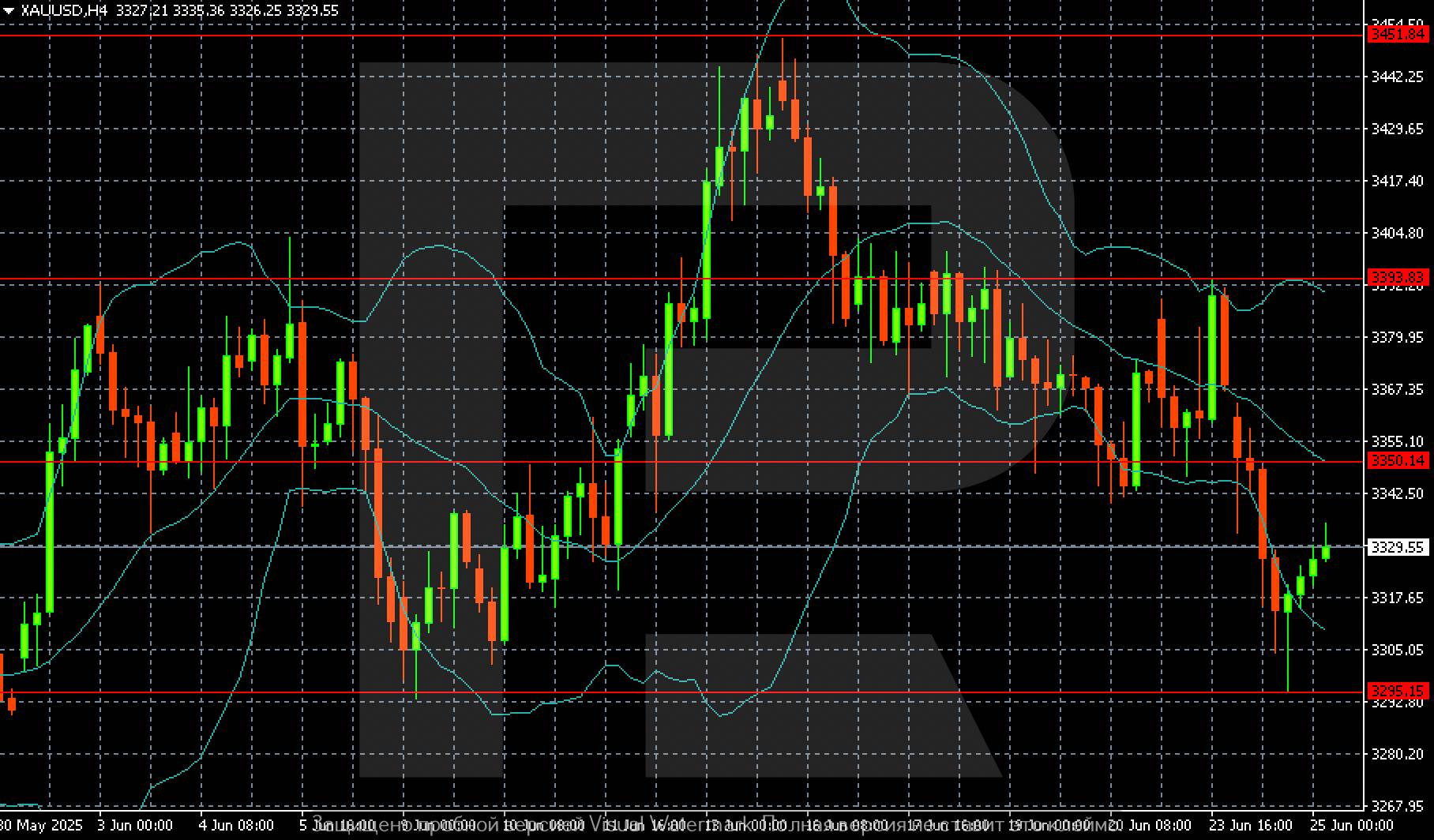
          Gold (XAUUSD) quotes are forming grounds for a rebound, although the outlook remains mixed. The gold (XAUUSD) forecast for today, 25 June 2025, suggests a potential recovery with growth towards 3,350 USD.

          Gold (XAUUSD) prices strengthened to 3,300 USD, rebounding from a two-week low. Discover more in our analysis for 25 June 2025.

          XAUUSD forecast: key trading points

          ●Gold (XAUUSD) prices are recovering after hitting a two-week low
          ●The Fed interest rate outlook could be a growth point
          ●XAUUSD forecast for 25 June 2025: 3,350

          Fundamental analysis

          Gold (XAUUSD) quotes recovered to 3,300 USD per troy ounce on Wednesday, moving away from their lowest level in two weeks. Market participants are evaluating the durability of the ceasefire between Iran and Israel.

          Today, preliminary US intelligence assessments revealed that the recent strikes on three Iranian nuclear sites only temporarily stalled Tehran's nuclear programme, which fuels concerns over possible escalation.

          The ceasefire brokered by the US appears fragile, with both parties accusing each other of attacks shortly after the truce began.

          On the monetary policy front, US Federal Reserve Chairman Jerome Powell said that interest rates will likely remain unchanged until the impact of new tariffs becomes clearer. However, he did not rule out a possible rate cut in July.

          These comments contrast with statements from other Fed officials who earlier supported policy easing amid signs of slowing inflation and a weakening labour market.

          The gold (XAUUSD) forecast is mixed.

          XAUUSD technical analysis

          On the H4 chart, gold (XAUUSD) is recovering, although sellers still hold the initiative. XAUUSD rebounded from the lower boundary of the descending channel at 3,295, but to strengthen this momentum, prices must consolidate above 3,350. This would also confirm the emergence of bullish sentiment in the market. If so, the next upside target could be 3,393.

          If the rebound fails to gain traction, the market may retreat back to 3,295, increasing market pressure.
          Source: RoboForex

          To stay updated on all economic events of today, please check out our Economic calendar
          Risk Warnings and Disclaimers
          You understand and acknowledge that there is a high degree of risk involved in trading. Following any strategies or investment methods may lead to potential losses. The content on the site is provided by our contributors and analysts for information purposes only. You are solely responsible for determining whether any trading assets, securities, strategy, or any other product is suitable for investing based on your own investment objectives and financial situation.
          Add to Favorites
          Share

          Asian Markets Rise as Fed Patience, Ceasefire Boost Risk Appetite

          Gerik

          Economic

          Stocks

          Regional Markets Respond to Ceasefire and Fed Signals

          Investor relief over the Israel-Iran ceasefire and comments from Federal Reserve Chair Jerome Powell helped lift Asian equities midweek. The Nikkei 225 gained 0.3%, the Hang Seng Index rose 0.9%, and Taiwan's Taiex advanced 1.1%. Mainland China's Shanghai Composite added 0.5%, while South Korea's Kospi rose 0.2%. Australia’s ASX 200 was up 0.1%, and India’s Sensex rose 0.7%. Only Bangkok’s SET saw a modest decline of 0.4%.
          The regional uptick followed a strong U.S. session where the S&P 500 rose 1.1% to 6,092.18—just 0.8% shy of its all-time high—while the Dow gained 1.2% and the Nasdaq surged 1.4%. The rally was fueled by both the ceasefire announcement and optimism that the Fed will remain patient on interest rate decisions.

          Oil Retreats Supports Risk Sentiment, Fed Leeway

          Brent crude and West Texas Intermediate both bounced over 1% on Wednesday morning after falling sharply by around 6% on Tuesday, bringing prices below pre-conflict levels. Brent traded at $66.95 and WTI at $65.16 per barrel. Analysts attributed the sharp decline to the de-escalation of military tensions and the assumption that energy supply routes—especially the Strait of Hormuz—would remain open.
          Lower oil prices ease inflationary pressure, potentially giving central banks more room to cut rates. Powell, in testimony to Congress, reiterated a cautious stance, noting the Fed is “well positioned to wait” before altering policy, a message that counters Trump’s calls for immediate rate cuts.

          Focus Shifts to Tariffs and Consumer Confidence

          With energy markets stabilizing, attention is turning toward trade policy, particularly U.S. tariff enforcement. Trump’s recent moves—both announcing a ceasefire and suggesting openness to trade adjustments—have left markets wondering how future tariff hikes might impact inflation and global growth.
          Despite the easing in oil prices, the Fed remains wary. Powell emphasized the need to observe the broader economic impact of higher tariffs. Consumer confidence data released Tuesday came in below expectations, hinting at underlying fragility in household sentiment.

          Risk-On Mode Returns, But Fragility Lingers

          While markets have welcomed the ceasefire and Fed patience, risks remain. The ceasefire between Iran and Israel, while holding for now, is fragile. Furthermore, the expiry of the U.S.’s tariff pause on July 9 may reignite trade uncertainty, especially if retaliatory measures follow.
          Still, the easing of geopolitical tensions and signs of inflation stabilization are shifting the macroeconomic outlook toward cautious optimism. With U.S. equities nearing record highs and Asian markets rebounding, investors appear willing to reengage in risk assets—at least temporarily—until the next round of economic data or geopolitical developments forces a reassessment.

          Source: AP

          To stay updated on all economic events of today, please check out our Economic calendar
          Risk Warnings and Disclaimers
          You understand and acknowledge that there is a high degree of risk involved in trading. Following any strategies or investment methods may lead to potential losses. The content on the site is provided by our contributors and analysts for information purposes only. You are solely responsible for determining whether any trading assets, securities, strategy, or any other product is suitable for investing based on your own investment objectives and financial situation.
          Add to Favorites
          Share

          Australia's Inflation Hits 3.5-Year Low, Strengthening Case for July Rate Cut

          Gerik

          Economic

          Inflation Eases Sharply, Strengthening Monetary Easing Expectations

          Australia’s monthly inflation data for May revealed a significant cooling of price pressures, with both headline and core measures falling below expectations. The consumer price index rose just 2.1% from a year earlier, down from April’s 2.4%, and lower than the 2.3% forecast. More notably, the RBA’s preferred trimmed mean core inflation gauge dropped to 2.4%—the lowest since late 2021—moving beneath the central bank’s 2–3% target midpoint.
          On a monthly basis, CPI declined 0.4%, driven by easing fuel and housing costs. Services inflation, a stubborn contributor to core inflation, also decelerated to 3.3% from 4.1%, while rent growth moderated to 4.5%, its slowest pace since December 2022. Prices for new dwellings were flat, and holiday-related costs saw a sharp monthly drop of 7% following a seasonal spike.

          Markets Firm Up July Rate Cut Bets as Growth Slows

          The inflation report significantly boosted rate cut bets. Interest rate swaps now imply a 90% probability of a 25-basis-point cut at the RBA’s July 8 policy meeting, up from 81% prior to the release. Analysts from TD Securities, citing the “big downside miss” in the inflation data, moved their forecast for the next cut forward from August to July and revised their terminal rate estimate from 3.35% to 3.10%.
          Economists warn that faint consumer demand and sluggish GDP growth in Q2 suggest the RBA has room—and reason—to act swiftly. “We are tracking faint consumption and growth in Q2, and hence, the bank may do well to frontload the cut to July,” said Krishna Bhimavarapu of State Street Global Advisors.

          Domestic Resilience Meets Global Headwinds

          Despite cooling inflation, Australia’s labour market has shown resilience. The unemployment rate remains low at 4.1%, and job postings are holding above pre-COVID averages. Wage growth, particularly in the private sector, has stayed moderate, allowing the RBA to shift focus from inflation control to growth support.
          Still, the broader context is marked by uncertainty. The July 8 decision will arrive just before a major international policy shift—the expiration of the U.S.’s 90-day pause on reciprocal tariffs. With global trade frictions still unresolved and geopolitical tensions lingering, the RBA may find additional justification for a preemptive policy easing.

          July Cut Highly Likely, Further Easing Expected

          With headline and core inflation trending down, and services inflation showing clear signs of deceleration, the case for further easing is now stronger than at any time since the start of the rate-cut cycle in February. Markets are pricing in as much as 78 basis points of total easing by year-end, with further reductions likely in August and later depending on the trajectory of global trade, domestic growth, and labor market stability.
          As inflation retreats from the spotlight, the RBA’s primary challenge now shifts to fostering a fragile recovery and shielding the economy from escalating global risks.

          Source: Reuters

          To stay updated on all economic events of today, please check out our Economic calendar
          Risk Warnings and Disclaimers
          You understand and acknowledge that there is a high degree of risk involved in trading. Following any strategies or investment methods may lead to potential losses. The content on the site is provided by our contributors and analysts for information purposes only. You are solely responsible for determining whether any trading assets, securities, strategy, or any other product is suitable for investing based on your own investment objectives and financial situation.
          Add to Favorites
          Share

          Trump’s Surprise Iran Oil Move Sends Shockwaves Through Sanctions Policy

          Gerik

          Commodity

          Middle East Situation

          Sanctions Undermined as Trump Softens on Iranian Oil Sales to China

          In a startling shift from long-standing U.S. foreign policy, President Donald Trump announced on social media Tuesday that China may “continue to purchase oil from Iran,” upending years of sanctions aimed at cutting off Tehran’s primary revenue stream. The message, posted on Truth Social, appeared to contradict current Treasury enforcement and caught many within the administration off guard.
          The timing of Trump’s announcement came on the heels of a shaky ceasefire between Iran and Israel—brokered and announced by Trump earlier this week—and follows a major U.S. airstrike on Iranian nuclear facilities. Markets reacted swiftly, with WTI crude dropping 6% to near $64 a barrel as geopolitical fears eased and prospects of increased Iranian exports returned.

          White House Sends Mixed Signals, Treasury Remains Cautious

          Despite the president’s remarks, U.S. Treasury officials say sanctions remain in force. One official noted that enforcement will continue, though admitted that they were uncertain how to interpret Trump’s post. A senior White House source attempted to clarify, claiming the statement was meant to emphasize that Trump’s military actions helped keep the Strait of Hormuz open, indirectly benefiting China.
          The State Department offered no additional clarity, with spokesperson Tammy Bruce declining to interpret the president’s words. “Things happen quickly,” she said, acknowledging the lack of formal alignment within the administration.

          Analysts See Strategic Move in China Relations

          Experts suggest Trump’s gesture may be a calculated effort to offer China a concession as the two countries navigate toward a potential new trade agreement. By offering a carve-out on Iranian oil purchases, the president could be signaling goodwill to Beijing amid the ongoing tariff war, while also rewarding Iran for participating in ceasefire talks.
          While the move may reduce legal risks for China, actual oil flows are unlikely to shift significantly in the short term. Chinese refiners have long used covert supply chains to import over 1 million barrels of Iranian crude daily, often disguised as shipments from third countries such as Malaysia or the UAE, and paid in yuan to avoid U.S. oversight.

          Policy Uncertainty Clouds Future Enforcement

          Trump’s reversal contradicts his own hardline stance from just weeks ago, when he threatened sanctions on any buyer of Iranian oil. The abrupt pivot casts doubt on the U.S.’s commitment to its “maximum pressure” campaign and raises questions about enforcement consistency moving forward.
          While Iran stands to benefit economically, uncertainty persists over the long-term strategy. Sanctions are still officially in place, and many buyers may remain cautious until a formal policy shift is confirmed. The White House’s ambiguity may have broader implications, potentially weakening the effectiveness of future U.S. sanctions and emboldening sanctioned actors to test enforcement limits.

          Strategic Consequences: Ceasefire at What Cost?

          Though designed to reinforce the Middle East truce and stabilize markets, the move may carry unintended consequences. It risks eroding trust in U.S. commitments to its allies and sanctions regime, while also emboldening both China and Iran. Furthermore, it complicates global oil markets at a time when prices are already volatile due to geopolitical risks.
          As the situation evolves, all eyes will be on upcoming briefings and policy clarifications—particularly from the Treasury and State Departments—to determine whether Trump’s post signals a symbolic gesture or a major realignment of U.S. foreign policy.

          Source: Bloomberg

          Risk Warnings and Disclaimers
          You understand and acknowledge that there is a high degree of risk involved in trading. Following any strategies or investment methods may lead to potential losses. The content on the site is provided by our contributors and analysts for information purposes only. You are solely responsible for determining whether any trading assets, securities, strategy, or any other product is suitable for investing based on your own investment objectives and financial situation.
          Add to Favorites
          Share

          Fed’s Schmid Urges Patience on Rate Cuts Amid Tariff Uncertainty

          Gerik

          Economic

          Schmid Backs ‘Wait-and-See’ Policy Amid Economic Resilience

          Speaking at an agricultural summit in Nebraska on Tuesday, Kansas City Federal Reserve President Jeff Schmid supported the Fed’s current cautious approach to monetary policy. Despite growing political pressure for immediate rate cuts, especially from President Donald Trump, Schmid emphasized that the U.S. economy remains resilient enough to justify taking more time to analyze the impact of new import tariffs on inflation and growth.
          Schmid, who holds a voting seat on the Federal Open Market Committee (FOMC) this year, reinforced that “the current posture of monetary policy, which has been characterized as ‘wait-and-see,’ is appropriate.” He noted that maintaining interest rates in the 4.25% to 4.5% range since December has given the Fed the flexibility to observe how both prices and output evolve.

          Tariff Effects Could Delay Rate Easing

          The central issue raised by Schmid is the uncertain impact of rising tariffs—recently announced by President Trump—on both inflation and economic activity. While Fed projections still anticipate two rate cuts by the end of 2025, these plans are being re-evaluated in light of shifting trade dynamics and their downstream economic consequences.
          Schmid acknowledged that business contacts “almost uniformly expect increased tariffs to push up prices and to weigh on activity.” He suggested that this may put the Fed in a challenging position where its twin goals—controlling inflation and supporting employment—may soon come into conflict. The ambiguity surrounding both the scale and timing of the tariff effects, however, means that acting prematurely would be risky.

          Cautious Optimism, But Risks Remain

          Although current economic indicators point to slowing growth and stubborn inflation, Schmid’s remarks reflect broader Fed sentiment favoring data-dependent decisions. His argument echoes Fed Chair Jerome Powell’s earlier position that the central bank needs more clarity before adjusting rates.
          Markets are currently pricing in about an 18% probability of a rate cut in July, with expectations for cuts later in the year if economic softness persists. However, Schmid's comments likely reinforce the notion that any rate reduction will be gradual and contingent on the actual economic fallout from tariff policies and broader macroeconomic shifts.
          While Schmid's message is consistent with institutional caution, it could disappoint market participants hoping for swift rate relief amid geopolitical and trade-related uncertainty. At the same time, it subtly pushes back against political pressure from the White House, signaling that the Fed remains committed to its independent, inflation-focused mandate. As the FOMC prepares for its July 29–30 meeting, all eyes will remain on incoming inflation data, labor market trends, and the real economic cost of trade disruption.

          Source: Reuters

          To stay updated on all economic events of today, please check out our Economic calendar
          Risk Warnings and Disclaimers
          You understand and acknowledge that there is a high degree of risk involved in trading. Following any strategies or investment methods may lead to potential losses. The content on the site is provided by our contributors and analysts for information purposes only. You are solely responsible for determining whether any trading assets, securities, strategy, or any other product is suitable for investing based on your own investment objectives and financial situation.
          Add to Favorites
          Share

          Geopolitical Tensions Escalate, Policy Shifts Toward Caution, and the Global Economy Swings in Uncertainty

          FastBull Featured

          Daily News

          [Quick Facts]

          1. The EU is preparing to take further tariff countermeasures to put pressure on the US
          2. The Republican Party in the US Senate plans to begin voting on the tax bill on Friday
          3. Netanyahu: Israel will take action if Iran attempts to restart its nuclear program
          4. Initial US assessment indicates that Iranian nuclear facilities have not been "completely destroyed"
          5. Fed's Williams: Tariffs and uncertainty will slow US economic growth and push up inflation this year
          6. Powell suggests waiting a little longer
          7. U.S. consumer confidence unexpectedly declines, constrained by widespread concerns about the economy
          8. Israel launches psychological warfare with death threats against senior Iranian officials
          9. Guindos: Oil price fluctuations will not disrupt the process of inflation falling
          10. Hammack: Policies are likely to remain unchanged for some time
          11. Canada's inflation rate remained stable in May, with core indicators slowing slightly

          [News Details]

          The EU is preparing to take further tariff countermeasures to put pressure on the US
          The Financial Times reported on 24th that European Commission President von der Leyen's Chief of Staff, Björn Seibert, stated that prior to the July 9 deadline for EU-US trade negotiations, the European Union must coordinate its position and prepare for the possibility of implementing additional tariffs as a strategic leverage against the United States. Seibert indicated that von der Leyen is prepared to escalate tariff retaliations to secure a more favorable agreement. She seeks the support of EU member states for a comprehensive tariff package targeting US goods valued at €95 billion and is also preparing measures affecting the services sector, including taxing American technology firms and restricting US companies' access to public procurement contracts.
          The Republican Party in the US Senate plans to begin voting on the tax bill on Friday
          According to reports, Senate Majority Leader Thune indicated on Tuesday that he anticipates a vote on Trump's "Big, Beautiful Bill" will commence by Friday, extending through the weekend and disrupting the House's scheduled recess next week. However, Thune remains confident that Congress will submit the legislation to the President before the July 4th deadline. He met with House Speaker Johnson around midday on Tuesday; prior to the meeting, Thune stated he had not recently discussed the bill with Johnson. Reports suggest that House leadership has expressed concerns about the likelihood of the Senate version passing, with the most significant issues centered on modifications to state and local tax (SALT) deductions and Medicaid provider taxes. Regarding SALT, Schumer remarked, "I understand this will be the final issue to resolve, and the reality will be the same."
          Netanyahu: Israel will take action if Iran attempts to restart its nuclear program
          Israeli Prime Minister Netanyahu stated in a broadcast address that Israel will take action if Iran attempts to resume its nuclear program. He declared, "Israel has eliminated two direct existential threats from Iran: the nuclear threat and the ballistic missile threat," adding that "early Tuesday morning, Israel launched its most severe strike since the outbreak of hostilities with Iran, eliminating hundreds of Iranian regime personnel." He characterized the US' involvement as a historically significant event. Netanyahu emphasized that Israel has never had a better ally in the White House than President Trump. He concluded by asserting, "We must now defeat Hamas."
          Initial US assessment indicates that Iranian nuclear facilities have not been "completely destroyed"
          Initial intelligence assessment indicates that US military strikes against Iran did not destroy its nuclear facilities, likely only delaying its nuclear program by several months. According to a report by CNN on the same day, three informed sources described an early US intelligence evaluation revealing that previous military attacks on three Iranian nuclear sites did not dismantle the core components of Iran's nuclear program, potentially only postponing its development for a few months. One source stated that the report was based on battle damage assessments conducted by US Central Command following airstrikes. The report also notes that ongoing analysis of the extent of damage to Iran's nuclear infrastructure and the impact of the airstrikes on its nuclear activities is underway, and further intelligence disclosures may alter the conclusions. Two sources confirmed that Iran's uranium enrichment stockpiles remain intact, with one indicating that the centrifuges at the nuclear facilities are essentially undamaged. The White House acknowledged the existence of the assessment but did not endorse its findings.
          Fed's Williams: Tariffs and uncertainty will slow US economic growth and push up inflation this year
          Federal Reserve Williams forecasts a slowdown in US economic growth this year, accompanied by rising inflation, largely attributable to trade tariffs. Williams states, "I anticipate that uncertainty and tariffs will suppress consumer spending, reduce immigration, and consequently decelerate labor force growth," leading to an expected economic expansion of approximately 1%, with the unemployment rate rising from the current 4.2% to 4.5% by year-end. He also projects that, as tariffs under the Trump administration drive up prices, inflation will reach 3%, then gradually decline to the 2% target over two years. Williams did not offer any forward guidance on monetary policy. Regarding the FOMC meeting, he remarked, "Maintaining this moderately restrictive monetary stance is entirely appropriate for achieving maximum employment and price stability." The Federal Reserve's current policy stance "allows us to closely analyze incoming data, assess the evolving outlook, and evaluate the risks to our dual mandate objectives."
          Powell suggests waiting a little longer
          On Tuesday, Federal Reserve Chairman Powell indicated during the congressional hearing that the committee's current stance is to advise patience and await further economic signals. Presently, there are no signs of labor market softening. Should labor market weakness emerge, appropriate policy adjustments will be implemented. As long as the economy remains robust, a temporary pause in rate adjustments is justified. The future trajectory of interest rates remains uncertain, with inflation potentially underperforming expectations. In such a scenario, early rate cuts would be advisable. Similarly, if labor market conditions weaken, early easing would be prudent. Conversely, if inflation and labor market strength persist, rate reductions may be delayed.
          U.S. consumer confidence unexpectedly declines, constrained by widespread concerns about the economy
          U.S. consumer confidence unexpectedly declined in June, driven by concerns over trade policies impacting economic outlook, labor market stability, and personal financial prospects. Data released by the World Federation of Large Enterprises on Tuesday indicated a 5.4-point decrease in the Consumer Confidence Index to 93, surpassing economists' expectations. The forward-looking sentiment indicator, reflecting expectations for the next six months, fell by 4.6 points to 69, while the current conditions index declined by 6.4 points to 129.1. This retreat nearly erases nearly half of the previous month's rebound, highlighting ongoing consumer anxiety regarding the potential economic repercussions of increased U.S. import tariffs. Despite moderate inflation over the past quarter, some consumers have adopted a more cautious approach to spending.
          Israel launches psychological warfare with death threats against senior Iranian officials
          The Washington Post exclusively reported on the 23rd that Israeli intelligence personnel launched a psychological operation against Iran on the 13th. The report states that Israeli agents directly contacted over twenty senior Iranian military commanders, issuing explicit threats. This operation reportedly took place within hours of Israel's airstrikes on Iranian nuclear facilities and the killing of multiple high-ranking Iranian military and nuclear scientists. Three informed sources revealed that this action was not merely an extension of Israel's military strikes but a carefully orchestrated psychological campaign aimed at destabilizing Iran's decision-making elite. A recorded phone conversation obtained by The Washington Post offers a glimpse into this psychological operation. In the recording, a fluent Persian-speaking Israeli operative tells a senior Islamic Revolutionary Guard Corps official, "We are closer to you than your own carotid artery. Think about that." The operative also requests the official to record a video publicly severing ties with the Iranian government and to upload it via the Telegram platform. Additionally, the operative threatens assassination if cooperation is not forthcoming.
          Guindos: Oil price fluctuations will not disrupt the process of inflation falling
          The Vice President of the European Central Bank, Guindos, stated in his speech on Tuesday that recent fluctuations in commodity prices caused by the Israel-Iran conflict will not alter the euro area's inflation outlook. "If oil prices rise—though they appear to be somewhat contained—we will need to factor that into our considerations," Guindos said in Santander, Spain. "However, the disinflation process is already locked in. Based on what we observe today, this trajectory remains on track—completely." Guindos expressed satisfaction with the progress of consumer price trends, noting that inflation has retreated from historic highs to slightly below the ECB's 2% target. While sustained achievement of the inflation target may be possible in the coming months, he emphasized that the Iran situation adds an additional layer of complexity to an already strained global trade environment. "We believe we will fulfill our price stability mandate, but we must always consider the severity of uncertainties," the Spanish official remarked. "This compels us to exercise extra caution."
          Hammack: Policies are likely to remain unchanged for some time
          Cleveland Federal Reserve Bank President Hammack stated in a speech on Tuesday that current interest rates are at a modest restrictive level, and policymakers may maintain borrowing costs unchanged for an extended period. She noted that despite recent progress, the Federal Reserve remains "some distance" from achieving its inflation target. Hammack also emphasized that official data are lagging indicators and may not fully capture the current economic conditions, including recent oil price increases that could elevate inflation expectations. "The policy may remain unchanged for quite some time, and then the committee will begin to implement very moderate interest rate cuts to return the policy to a neutral stance," Hammack said in a speech prepared for a conference in London. This refers to the Federal Open Market Committee, which is responsible for setting interest rate policy.
          Canada's inflation rate remained stable in May, with core indicators slowing slightly
          The Canadian Consumer Price Index (CPI) for May remained steady at an annual rate of 1.7% as of Tuesday's release, with declining gasoline prices continuing to exert deflationary pressure on the overall index. Additionally, housing, food, and transportation costs have shown signs of moderation.
          Market concerns persist regarding the potential inflationary impact of tariffs imposed by the US on Canadian steel, aluminum, and automotive exports, as well as Canada's retaliatory measures. However, these concerns have yet to be reflected in the consumer price data, as the gasoline tax repeal in April is expected to keep fuel prices stable over the next year.
          The persistently low interest rates have alleviated mortgage financing costs, while declining demand has contributed to a decrease in rental prices over recent months.
          According to Statistics Canada, the monthly inflation rate for May was 0.6%, primarily driven by seasonal increases in travel, accommodation, and energy expenses. Gasoline prices fell 15.5% year-over-year in May, following an 18.1% decline in April. Housing costs, which account for the largest share (30%) of the Consumer Price Index, increased by 3% in May, down from 3.4% in April, with both mortgage interest expenses and rents experiencing monthly declines. The Bank of Canada closely monitors core inflation measures—CPI-trim and CPI-median—both of which have decreased to 3%, reaching the upper limit of the central bank's 1% to 3% inflation target range.

          [Today's Focus]

          UTC+8 16:45 Deputy Governor of the Bank of England Lombardelli Speaks
          UTC+8 17:00 Chief Economist of the Bank of England Pill Speaks
          UTC+8 22:00 US May New Home Sales Annualized Total
          UTC+8 22:00 Federal Reserve Chairman Powell Testifies before the Senate Committee on the Semiannual Monetary Policy Report
          Risk Warnings and Disclaimers
          You understand and acknowledge that there is a high degree of risk involved in trading. Following any strategies or investment methods may lead to potential losses. The content on the site is provided by our contributors and analysts for information purposes only. You are solely responsible for determining whether any trading assets, securities, strategy, or any other product is suitable for investing based on your own investment objectives and financial situation.
          Add to Favorites
          Share

          Oil Prices Rebound Modestly as Market Digests Iran-Israel Truce and U.S. Inventory Drop

          Gerik

          Economic

          Commodity

          Oil Markets Rebalance After Geopolitical Shockwaves

          After a dramatic plunge triggered by easing fears of full-scale war between Iran and Israel, oil prices regained some ground on Wednesday. Brent crude futures climbed by 75 cents (1.1%) to $67.89 per barrel, while West Texas Intermediate (WTI) rose by 71 cents to $65.08. This modest rebound follows a selloff that had pushed both benchmarks to multi-week lows—the lowest since early June—just days after prices had surged to five-month highs on news of U.S. airstrikes on Iran.
          The price retreat earlier this week came as investors welcomed signs of de-escalation following the 12-day conflict. With both Iran and Israel lifting civilian restrictions and U.S. President Donald Trump stepping in as a mediator, the ceasefire has so far held, calming fears of an imminent energy supply disruption.

          Geopolitical Calm Weighs on Risk Premiums

          The initial spike in oil prices had been fueled by concerns over potential supply bottlenecks in the Strait of Hormuz, a critical maritime chokepoint through which roughly 20% of global oil passes daily. Direct U.S. military involvement in the region had amplified those concerns. However, the latest U.S. intelligence assessments suggest Iran's nuclear infrastructure, while damaged, remains largely intact—implying the airstrikes were more of a temporary setback than a game-changing escalation.
          This muted outcome, coupled with the current fragile truce, has led markets to discount the risk of a prolonged conflict that would materially threaten oil flows.

          Fundamental Data Offers Fresh Support

          In parallel with geopolitical developments, supply-side fundamentals also contributed to Wednesday's price recovery. The American Petroleum Institute (API) reported a significant 4.23 million-barrel drawdown in U.S. crude inventories for the week ending June 20, signaling stronger-than-expected domestic demand or lower supply. Traders now await confirmation from official U.S. Energy Information Administration (EIA) data, which could further validate this trend.
          If EIA numbers confirm the inventory drop, it would support a tighter short-term supply outlook, potentially preventing prices from falling further despite the easing of Middle East tensions.

          Stability Hinges on Truce and U.S. Demand Trends

          While Wednesday’s gains signal a partial recovery, markets remain wary. The truce between Iran and Israel is fragile, and any renewed provocation could trigger another price spike. At the same time, macroeconomic signals from the U.S.—including consumer confidence and inflation expectations—will continue to guide market sentiment.
          For now, oil is likely to trade in a narrow band, with geopolitical developments and U.S. stockpile figures acting as key catalysts. Investors are advised to watch closely for updates on Middle East stability and domestic fuel demand trends as summer driving season intensifies.

          Source: Reuters

          To stay updated on all economic events of today, please check out our Economic calendar
          Risk Warnings and Disclaimers
          You understand and acknowledge that there is a high degree of risk involved in trading. Following any strategies or investment methods may lead to potential losses. The content on the site is provided by our contributors and analysts for information purposes only. You are solely responsible for determining whether any trading assets, securities, strategy, or any other product is suitable for investing based on your own investment objectives and financial situation.
          Add to Favorites
          Share
          FastBull
          Copyright © 2025 FastBull Ltd

          728 RM B 7/F GEE LOK IND BLDG NO 34 HUNG TO RD KWUN TONG KLN HONG KONG

          TelegramInstagramTwitterfacebooklinkedin
          App Store Google Play Google Play
          Products
          Charts

          Chats

          Q&A with Experts
          Screeners
          Economic Calendar
          Data
          Tools
          Membership
          Features
          Function
          Markets
          Copy Trading
          Latest Signals
          Contests
          News
          Analysis
          24/7
          Columns
          Education
          Company
          Careers
          About Us
          Contact Us
          Advertising
          Help Center
          Feedback
          User Agreement
          Privacy Policy
          Business

          White Label

          Data API

          Web Plug-ins

          Poster Maker

          Affiliate Program

          Risk Disclosure

          The risk of loss in trading financial instruments such as stocks, FX, commodities, futures, bonds, ETFs and crypto can be substantial. You may sustain a total loss of the funds that you deposit with your broker. Therefore, you should carefully consider whether such trading is suitable for you in light of your circumstances and financial resources.

          No decision to invest should be made without thoroughly conducting due diligence by yourself or consulting with your financial advisors. Our web content might not suit you since we don't know your financial conditions and investment needs. Our financial information might have latency or contain inaccuracy, so you should be fully responsible for any of your trading and investment decisions. The company will not be responsible for your capital loss.

          Without getting permission from the website, you are not allowed to copy the website's graphics, texts, or trademarks. Intellectual property rights in the content or data incorporated into this website belong to its providers and exchange merchants.

          Not Logged In

          Log in to access more features

          FastBull Membership

          Not yet

          Purchase

          Become a signal provider
          Help Center
          Customer Service
          Dark Mode
          Price Up/Down Colors

          Log In

          Sign Up

          Position
          Layout
          Fullscreen
          Default to Chart
          The chart page opens by default when you visit fastbull.com
