
• Trade
  • Markets
  • Copy
  • Contests
  • News
  • 24/7
  • Calendar
  • Q&A
  • Chats
Trending
Screeners
SYMBOL
LAST
BID
ASK
HIGH
LOW
NET CHG.
%CHG.
SPREAD
SPX
S&P 500 Index
6827.42
6827.42
6827.42
6899.86
6801.80
-73.58
-1.07%
--
DJI
Dow Jones Industrial Average
48458.04
48458.04
48458.04
48886.86
48334.10
-245.98
-0.51%
--
IXIC
NASDAQ Composite Index
23195.16
23195.16
23195.16
23554.89
23094.51
-398.69
-1.69%
--
USDX
US Dollar Index
97.950
98.030
97.950
98.500
97.950
-0.370
-0.38%
--
EURUSD
Euro / US Dollar
1.17394
1.17409
1.17394
1.17496
1.17192
+0.00011
+ 0.01%
--
GBPUSD
Pound Sterling / US Dollar
1.33707
1.33732
1.33707
1.33997
1.33419
-0.00148
-0.11%
--
XAUUSD
Gold / US Dollar
4299.39
4299.39
4299.39
4353.41
4257.10
+20.10
+ 0.47%
--
WTI
Light Sweet Crude Oil
57.233
57.485
57.233
58.011
56.969
-0.408
-0.71%
--

Community Accounts

Signal Accounts
--
Profit Accounts
--
Loss Accounts
--
View More

Become a signal provider

Sell trading signals to earn additional income

View More

Guide to Copy Trading

Get started with ease and confidence

View More

Signal Accounts for Members

All Signal Accounts

Best Return
  • Best Return
  • Best P/L
  • Best MDD
Past 1W
  • Past 1W
  • Past 1M
  • Past 1Y

All Contests

  • All
  • Trump Updates
  • Recommend
  • Stocks
  • Cryptocurrencies
  • Central Banks
  • Featured News
Top News Only
Share

Incoming Czech Prime Minister Babis: Czech Republic Will Not Take On Guarantees For Ukraine Financing, European Commission Must Find Alternatives

Share

Turkey President Erdogan: Hopes To Discuss Ukraine-Russia Peace Plan With Trump After Meeting With Putin

Share

Turkey President Erdogan: Peace Is Not Far Away, Black Sea Should Not Be Used As A Battleground, Safe Navigation Needed

Share

IAEA: Ukraine's Znpp Temporarily Lost All Offsite Power Overnight Due To Widespread Military Activities Affecting The Electrical Grid

Share

Iranian Media Says 18 Crew Members Of Foreign Tanker Seized In Gulf Of Oman Over Carrying 'Smuggled Fuel' Detained

Share

Regional Governor: Two Killed In Ukrainian Drone Strike On Russia's Saratov

Share

Chinese Foreign Ministry - China Foreign Minister Met With United Arab Emirates Counterpart On Dec 12

Share

China's Central Financial And Economic Affairs Commission Deputy Director: Will Expand Export And Increase Import In 2026

Share

Thai Leader Anutin: Landmine Blast That Killed Thai Soldiers 'Not A Roadside Accident'

Share

Thai Leader Anutin: Thailand To Continue Military Action Until 'We Feel No More Harm'

Share

Cambodian Prime Minister Hun Manet Says He Had Phone Calls With Trump And Malaysian Leader Anwar About Ceasefire

Share

Cambodia's Hun Manet Says USA, Malaysia Should Verify 'Which Side Fired First' In Latest Conflict

Share

Cambodia's Hun Manet: Cambodia Maintains Its Stance In Seeking Peaceful Resolution Of Disputes

Share

Nasdaq Companies: Allergan, Ferrovia, Insmed, Monolithic Power Systems, Seagate Technology, And Western Digital Will Be Added To The NASDAQ 100 Index. Biogen, CdW, GlobalFoundries, Lululemon, ON Semiconductor, And Tradedesk Will Be Removed From The NASDAQ 100 Index

Share

Witkoff Headed To Berlin This Weekend To Meet With Zelenskiy, European Leaders -Wsj Reporter On X

Share

Russia Attacks Two Ukrainian Ports, Damaging Three Turkish-Owned Vessels

Share

[Historic Flooding Occurs In At Least Four Rivers In Washington State Due To Days Of Torrential Rains] Multiple Areas In Washington State Have Been Hit By Severe Flooding Due To Days Of Torrential Rains, With At Least Four Rivers Experiencing Historic Flooding. Reporters Learned On The 12th That The Floods Caused By The Torrential Rains In Washington State Have Destroyed Homes And Closed Several Highways. Experts Warn That Even More Severe Flooding May Occur In The Future. A State Of Emergency Has Been Declared In Washington State

Share

Trump Says Proposed Free Economic Zone In Donbas Would Work

Share

Trump: I Think My Voice Should Be Heard

Share

Trump Says Will Be Choosing New Fed Chair In Near Future

TIME
ACT
FCST
PREV
U.K. Trade Balance Non-EU (SA) (Oct)

A:--

F: --

P: --

U.K. Trade Balance (Oct)

A:--

F: --

P: --

U.K. Services Index MoM

A:--

F: --

P: --

U.K. Construction Output MoM (SA) (Oct)

A:--

F: --

P: --

U.K. Industrial Output YoY (Oct)

A:--

F: --

P: --

U.K. Trade Balance (SA) (Oct)

A:--

F: --

P: --

U.K. Trade Balance EU (SA) (Oct)

A:--

F: --

P: --

U.K. Manufacturing Output YoY (Oct)

A:--

F: --

P: --

U.K. GDP MoM (Oct)

A:--

F: --

P: --

U.K. GDP YoY (SA) (Oct)

A:--

F: --

P: --

U.K. Industrial Output MoM (Oct)

A:--

F: --

P: --

U.K. Construction Output YoY (Oct)

A:--

F: --

P: --

France HICP Final MoM (Nov)

A:--

F: --

P: --

China, Mainland Outstanding Loans Growth YoY (Nov)

A:--

F: --

P: --

China, Mainland M2 Money Supply YoY (Nov)

A:--

F: --

P: --

China, Mainland M0 Money Supply YoY (Nov)

A:--

F: --

P: --

China, Mainland M1 Money Supply YoY (Nov)

A:--

F: --

P: --

India CPI YoY (Nov)

A:--

F: --

P: --

India Deposit Gowth YoY

A:--

F: --

P: --

Brazil Services Growth YoY (Oct)

A:--

F: --

P: --

Mexico Industrial Output YoY (Oct)

A:--

F: --

P: --

Russia Trade Balance (Oct)

A:--

F: --

P: --

Philadelphia Fed President Henry Paulson delivers a speech
Canada Building Permits MoM (SA) (Oct)

A:--

F: --

P: --

Canada Wholesale Sales YoY (Oct)

A:--

F: --

P: --

Canada Wholesale Inventory MoM (Oct)

A:--

F: --

P: --

Canada Wholesale Inventory YoY (Oct)

A:--

F: --

P: --

Canada Wholesale Sales MoM (SA) (Oct)

A:--

F: --

P: --

Germany Current Account (Not SA) (Oct)

A:--

F: --

P: --

U.S. Weekly Total Rig Count

A:--

F: --

P: --

U.S. Weekly Total Oil Rig Count

A:--

F: --

P: --

Japan Tankan Large Non-Manufacturing Diffusion Index (Q4)

--

F: --

P: --

Japan Tankan Small Manufacturing Outlook Index (Q4)

--

F: --

P: --

Japan Tankan Large Non-Manufacturing Outlook Index (Q4)

--

F: --

P: --

Japan Tankan Large Manufacturing Outlook Index (Q4)

--

F: --

P: --

Japan Tankan Small Manufacturing Diffusion Index (Q4)

--

F: --

P: --

Japan Tankan Large Manufacturing Diffusion Index (Q4)

--

F: --

P: --

Japan Tankan Large-Enterprise Capital Expenditure YoY (Q4)

--

F: --

P: --

U.K. Rightmove House Price Index YoY (Dec)

--

F: --

P: --

China, Mainland Industrial Output YoY (YTD) (Nov)

--

F: --

P: --

China, Mainland Urban Area Unemployment Rate (Nov)

--

F: --

P: --

Saudi Arabia CPI YoY (Nov)

--

F: --

P: --

Euro Zone Industrial Output YoY (Oct)

--

F: --

P: --

Euro Zone Industrial Output MoM (Oct)

--

F: --

P: --

Canada Existing Home Sales MoM (Nov)

--

F: --

P: --

Euro Zone Total Reserve Assets (Nov)

--

F: --

P: --

U.K. Inflation Rate Expectations

--

F: --

P: --

Canada National Economic Confidence Index

--

F: --

P: --

Canada New Housing Starts (Nov)

--

F: --

P: --

U.S. NY Fed Manufacturing Employment Index (Dec)

--

F: --

P: --

U.S. NY Fed Manufacturing Index (Dec)

--

F: --

P: --

Canada Core CPI YoY (Nov)

--

F: --

P: --

Canada Manufacturing Unfilled Orders MoM (Oct)

--

F: --

P: --

Canada Manufacturing New Orders MoM (Oct)

--

F: --

P: --

Canada Core CPI MoM (Nov)

--

F: --

P: --

Canada Manufacturing Inventory MoM (Oct)

--

F: --

P: --

Canada CPI YoY (Nov)

--

F: --

P: --

Canada CPI MoM (Nov)

--

F: --

P: --

Canada CPI YoY (SA) (Nov)

--

F: --

P: --

Canada Core CPI MoM (SA) (Nov)

--

F: --

P: --

Q&A with Experts
    • All
    • Chatrooms
    • Groups
    • Friends
    Connecting
    .
    .
    .
    Type here...
    Add Symbol or Code

      No matching data

      All
      Trump Updates
      Recommend
      Stocks
      Cryptocurrencies
      Central Banks
      Featured News
      • All
      • Russia-Ukraine Conflict
      • Middle East Flashpoint
      • All
      • Russia-Ukraine Conflict
      • Middle East Flashpoint
      Search
      Products

      Charts Free Forever

      Chats Q&A with Experts
      Screeners Economic Calendar Data Tools
      Membership Features
      Data Warehouse Market Trends Institutional Data Policy Rates Macro

      Market Trends

      Market Sentiment Order Book Forex Correlations

      Top Indicators

      Charts Free Forever
      Markets

      News

      News Analysis 24/7 Columns Education
      From Institutions From Analysts
      Topics Columnists

      Latest Views

      Latest Views

      Trending Topics

      Top Columnists

      Latest Update

      Signals

      Copy Rankings Latest Signals Become a signal provider AI Rating
      Contests
      Brokers

      Overview Brokers Assessment Rankings Regulators News Claims
      Broker listing Forex Brokers Comparison Tool Live Spread Comparison Scam
      Q&A Complaint Scam Alert Videos Tips to Detect Scam
      More

      Business
      Events
      Careers About Us Advertising Help Center

      White Label

      Data API

      Web Plug-ins

      Affiliate Program

      Awards Institution Evaluation IB Seminar Salon Event Exhibition
      Vietnam Thailand Singapore Dubai
      Fans Party Investment Sharing Session
      FastBull Summit BrokersView Expo
      Recent Searches
        Top Searches
          Markets
          News
          Analysis
          User
          24/7
          Economic Calendar
          Education
          Data
          • Names
          • Latest
          • Prev

          View All

          No data

          Scan to Download

          Faster Charts, Chat Faster!

          Download App
          English
          • English
          • Español
          • العربية
          • Bahasa Indonesia
          • Bahasa Melayu
          • Tiếng Việt
          • ภาษาไทย
          • Français
          • Italiano
          • Türkçe
          • Русский язык
          • 简中
          • 繁中
          Open Account
          Search
          Products
          Charts Free Forever
          Markets
          News
          Signals

          Copy Rankings Latest Signals Become a signal provider AI Rating
          Contests
          Brokers

          Overview Brokers Assessment Rankings Regulators News Claims
          Broker listing Forex Brokers Comparison Tool Live Spread Comparison Scam
          Q&A Complaint Scam Alert Videos Tips to Detect Scam
          More

          Business
          Events
          Careers About Us Advertising Help Center

          White Label

          Data API

          Web Plug-ins

          Affiliate Program

          Awards Institution Evaluation IB Seminar Salon Event Exhibition
          Vietnam Thailand Singapore Dubai
          Fans Party Investment Sharing Session
          FastBull Summit BrokersView Expo

          Gold Price Sharply Higher Following Israeli Attacks on Iran

          Michelle

          Commodity

          Political

          Summary:

          Gold prices are solidly up and hit a five-week high in early U.S. trading Friday, on strong safe-haven demand following the overnight Israeli attacks on Iran that are being called major. Silver prices are modestly up. August gold was last up $41.90 at $3,444.30. July silver prices were last up $0.095 at $36.39.

          Gold prices are solidly up and hit a five-week high in early U.S. trading Friday, on strong safe-haven demand following the overnight Israeli attacks on Iran that are being called major. Silver prices are modestly up. August gold was last up $41.90 at $3,444.30. July silver prices were last up $0.095 at $36.39.

          Risk aversion in highly elevated Friday amid the most severe military escalation between Israel and Iran in decades. Targeted Israeli airstrikes overnight killed several of Iran’s top generals and nuclear officials, paralyzing Tehran’s command structure and leaving the regime reeling. Israel said it is preparing for further military action.

          Gold prices rose to a five-week high and crude oil prices surged after Israel launched a wave of military strikes against Iranian nuclear and missile sites, raising fears of a broader Middle East conflict that could severely disrupt global energy supplies.

          In a post on Truth Social, Trump declared, “Iranian leaders didn’t know what was about to happen. They are all DEAD now, and it will only get worse! There has already been great death and destruction, but there is still time to make this slaughter, with the next already planned attacks being even more brutal, come to an end. Iran must make a deal, before there is nothing left, and save what was once known as the Iranian Empire.”Asian and European stocks were mostly lower overnight. U.S. stock indexes are pointed to sharply lower openings today in New York.

          The key outside markets today see the U.S. dollar index solidly up. Nymex crude oil futures prices are sharply higher, hit a five-month high and trading around $74.00 a barrel. The yield on the benchmark 10-year U.S. Treasury note is presently at 4.34%.

          U.S. economic data due for release Friday is light and includes the University of Michigan consumer sentiment survey.
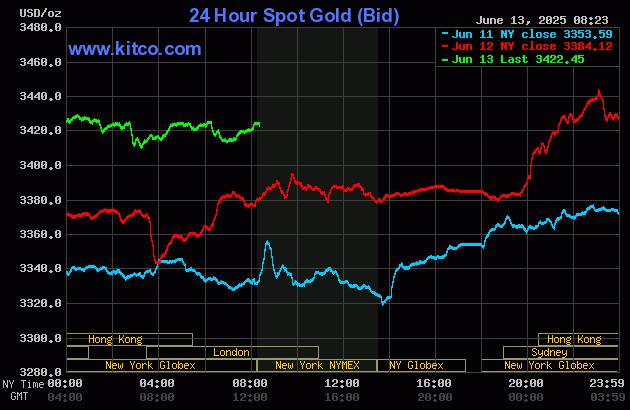
          Technically, August gold futures bulls have the solid overall near-term technical advantage. Bulls’ next upside price objective is to produce a close above solid resistance at last week’s high of $3,427.70. Bears' next near-term downside price objective is pushing futures prices below solid technical support at $3,250.00. First resistance is seen at the overnight high of $3,467.00 and then at $3,477.30. First support is seen at $3,400.00 and then at Thursday’s low of $3,358.50. Wyckoff's Market Rating: 8.0.
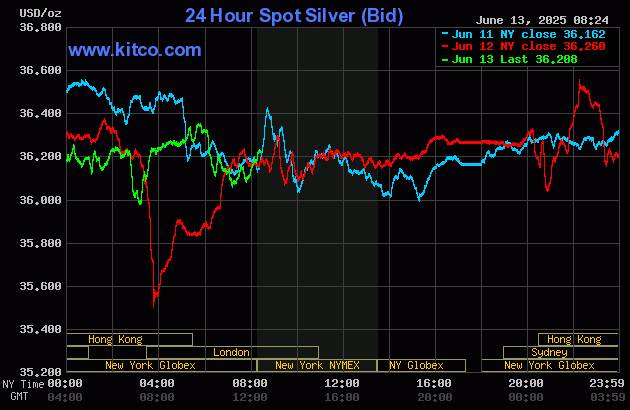
          July silver futures bulls have the solid overall near-term technical advantage. Prices are trending higher on the daily bar chart. Silver bulls' next upside price objective is closing prices above solid technical resistance at $40.00. The next downside price objective for the bears is closing prices below solid support at $34.00. First resistance is seen at this week’s high of $37.03 and then at $37.50. Next support is seen at $36.00 and then at this week’s low of $35.58. Wyckoff's Market Rating: 7.5.

          Source: Kitco

          Risk Warnings and Disclaimers
          You understand and acknowledge that there is a high degree of risk involved in trading. Following any strategies or investment methods may lead to potential losses. The content on the site is provided by our contributors and analysts for information purposes only. You are solely responsible for determining whether any trading assets, securities, strategy, or any other product is suitable for investing based on your own investment objectives and financial situation.
          Add to Favorites
          Share

          U.S. Equity Outflows Slow as Inflation Cools and Trade Optimism Returns

          Gerik

          Economic

          Easing CPI and Trade Progress Stabilize Equity Fund Flows
          Investors showed signs of renewed confidence in U.S. markets, evidenced by the smallest weekly equity fund outflow in a month. According to LSEG Lipper data, U.S. equity funds saw net redemptions of just $212 million for the week ending June 11—a sharp improvement from previous weeks, driven largely by two key macroeconomic developments: cooler-than-expected consumer price index (CPI) figures for May and tentative progress on a U.S.-China trade accord.
          This shift marks a reversal from the significant equity sell-offs observed earlier in the year, reflecting reduced anxiety over potential interest rate hikes and protectionist shocks. The May CPI print helped ease fears of persistent inflation, reinforcing expectations that the Federal Reserve may stay on hold or even pivot to rate cuts later in the year.

          Sectoral Funds Lead with Targeted Inflows

          While overall equity fund flows remained slightly negative, U.S. sector-specific funds attracted considerable investor interest. Communication services, financials, and industrials led the gains, pulling in $529 million, $399 million, and $388 million, respectively. These sectors often perform well when economic sentiment stabilizes, as they tend to benefit from improved consumption, lending, and infrastructure activity.
          In contrast, broader market exposure through large-cap, mid-cap, and small-cap segments continued to experience net redemptions, with outflows of $2.65 billion, $1.35 billion, and $100 million respectively. This disparity suggests that investors are opting for more targeted exposure over general market allocation, possibly to mitigate perceived downside risks.

          Bond Funds and Yield-Hungry Investors Show Strength

          U.S. bond funds extended their winning streak to an eighth consecutive week, attracting $4.08 billion in net new capital. The inflows were concentrated in short-to-intermediate investment-grade corporate bonds ($2.37 billion), government and Treasury funds ($1.02 billion), and municipal debt ($523 million). The persistence of bond inflows points to investors continuing to seek relative safety and predictable income, particularly as expectations mount for potential Fed easing later this year.
          This trend is aligned with the view that bond markets are pricing in a plateau or even a decline in interest rates, particularly with inflation readings becoming more subdued. These allocations also highlight investor demand for assets with defensive characteristics in a still-uncertain macroeconomic landscape.

          Money Market Funds See Profit-Taking After Spike

          In a noteworthy shift, money market funds recorded net outflows of $15.18 billion, partially unwinding the massive $66.24 billion in inflows from the previous week. This suggests that investors may be reallocating capital from ultra-liquid holdings into higher-yielding or more opportunistic assets such as bonds and select equities. The move may also reflect positioning ahead of the upcoming Federal Reserve meeting, with some investors anticipating reduced short-term rate pressure.
          The combination of a softer inflation outlook and tentative trade stability appears to have triggered a pause in broader equity fund withdrawals. However, the uneven flows between general equity segments and specific sectors, along with robust bond inflows, suggest that investors remain cautious and selective. The upcoming Fed meeting will likely determine whether this cautious optimism turns into a more sustained rotation back into risk assets or if further defensive repositioning will be necessary.

          Source: Reuters

          To stay updated on all economic events of today, please check out our Economic calendar
          Risk Warnings and Disclaimers
          You understand and acknowledge that there is a high degree of risk involved in trading. Following any strategies or investment methods may lead to potential losses. The content on the site is provided by our contributors and analysts for information purposes only. You are solely responsible for determining whether any trading assets, securities, strategy, or any other product is suitable for investing based on your own investment objectives and financial situation.
          Add to Favorites
          Share

          Oil Prices Surge, Wall Street and Global Markets Retreat After Israel’s Strike on Iran

          Warren Takunda

          Commodity

          Economic

          Middle East Situation

          Oil surged, stocks fell and investors sought safety in the U.S. dollar and government bonds Friday after Israel struck Iranian nuclear and military targets in an attack that raised the risk of war between the two countries and broader instability in the Middle East.
          Futures for the S&P 500 fell 0.9% before the opening bell, while futures for the Dow Jones Industrial Average were down 1%. Nasdaq futures slid 1.1%.
          U.S. benchmark crude oil rose by $4.73, or 6.9%, to $72.77 per barrel, its biggest gain since the early days of Russia’s attack on Ukraine more than three years ago. Brent crude, the international standard, climbed $4.58 to $73.94 per barrel, also the largest single-day jump since the Russian invasion.
          Oil prices are likely to rise in the short term but the key question is whether exports are affected, said Richard Joswick, head of near-term oil at S&P Global Commodity Insights. “When Iran and Israel exchanged attacks previously, prices spiked initially but fell once it became clear that the situation was not escalating and there was no impact on oil supply,” he wrote in an emailed analysis.
          “Oil price risk premiums could rise sharply if Iran conducts broader retaliatory attacks, especially if on targets other than in Israel,” Joswick said.
          China is the only customer for Iranian oil but could seek alternative supplies from Middle Eastern exporters and Russia, he said.
          Iran’s oil trade is restricted by Western sanctions and import bans, and Israel exports only small amounts of oil and oil products.
          Boeing shares are down 1% after falling nearly 5% Thursday when one of the aerospace giant’s planes crashed in India, killing all but one of the 242 people on board as well as several on the ground. The plane operated by Air India was the first fatal crash of a Boeing 787 Dreamliner since it went into service in 2009.
          The cause of the crash is unknown.
          GE Aerospace, which makes engines for Boeing, is down close to 2% after it announced it was postponing next week’s investor day in light of the tragic crash.
          In Europe at midday, Germany’s DAX dropped 1.3% and the CAC 40 in Paris gave up 0.9%. Britain’s FTSE 100 slipped 0.2%.
          The yield on the 10-year Treasury fell to 4.35% from 4.41% late Wednesday and from roughly 4.80% early this year.
          In currency trading early Friday, the U.S. dollar rose to 144.12 yen, while the euro eased to $1.1511. The yield on U.S. 10-year Treasurys fell to 4.35%. Bond yields and prices move in opposite directions.
          Treasurys and the dollar often rise when investors feel less inclined to take risks.
          Coming later Friday is the University of Michigan’s consumer sentiment report.
          Next week brings the Federal Reserve’s two-day policy meeting where it will make a decision on its benchmark interest rate. The nearly unanimous expectation on Wall Street is that the U.S. central bank will stand pat again.
          The Fed has been hesitant to lower interest rates, and it’s been on hold this year after cutting at the end of last year, because it’s waiting to see how much President Donald Trump’s tariffs will hurt the economy and raise inflation.
          In Asia, Tokyo’s Nikkei 225 fell 0.9% to 37,834.25 while the Kospi in Seoul edged 0.9% lower to 2,894.62. Hong Kong’s Hang Seng retreated 0.6% to 23,892.56 and the Shanghai Composite Index lost 0.8% to 3,377.00. Australia’s S&P/ASX 200 drifted 0.2% lower to 8,547.40.
          “An Israeli attack on Iran poses a top ten of our global risk, but Asian markets are expected to recover quickly as they have relatively limited exposure to the conflict and growing ties to unaffected Saudi Arabia and the UAE,” said Xu Tiachen of The Economist Intelligence.

          Source: AP

          To stay updated on all economic events of today, please check out our Economic calendar
          Risk Warnings and Disclaimers
          You understand and acknowledge that there is a high degree of risk involved in trading. Following any strategies or investment methods may lead to potential losses. The content on the site is provided by our contributors and analysts for information purposes only. You are solely responsible for determining whether any trading assets, securities, strategy, or any other product is suitable for investing based on your own investment objectives and financial situation.
          Add to Favorites
          Share

          Fed to Hold Rates Steady as Tariff Turbulence Clouds Policy Path

          Gerik

          Economic

          China–U.S. Trade War

          Fed Poised to Pause Amid Murky Trade and Growth Signals

          With the federal funds rate currently set at 4.25%-4.50%, the Federal Reserve is widely expected to leave interest rates unchanged during its June 17–18 meeting. While recent inflation data suggest progress toward the 2% target—particularly when excluding volatile food and energy prices—Fed officials remain hesitant to pivot aggressively. The central bank’s challenge now lies not just in inflation but in interpreting the broader consequences of U.S. trade policy and fiscal risks.
          President Donald Trump’s tariff-driven trade approach and a large budget and tax proposal still in flux continue to cloud the economic outlook. Though the administration postponed a new wave of global tariffs until next month, the policy overhang contributes to what Fed Chair Jerome Powell once described as a justification for “inertia”—waiting for clarity before shifting policy direction.

          Mixed Signals: Inflation Slows, But Risks Remain

          Recent data show both consumer and producer prices rose less than expected in May, easing concerns that tariffs would lead to an inflationary spike. The core PCE price index, the Fed’s preferred gauge, has hovered near 2% over the past three months, bolstering the argument for eventual rate cuts. Meanwhile, unemployment has stabilized at 4.2% for three consecutive months, suggesting that the labor market, while not accelerating, remains resilient.
          Nonetheless, policymakers appear divided over the weight to assign these developments. While the March projections pointed to two rate cuts in 2025, some analysts—such as Tim Duy of SGH Macro Advisors—believe that due to the passage of time and lingering uncertainty, the updated forecast may downgrade to a single rate cut this year unless more dovish sentiment takes hold.

          Tariffs: Inflation Catalyst or Demand Dampener?

          A key debate is whether tariffs will exert more upward pressure on prices or act as a drag on consumer demand. The retail sales data for May, due just before the Fed’s meeting, could shed light on this dynamic. Some economists, notably from Citigroup, argue that early signs of demand softening—potentially driven by consumers cutting back on services in response to higher imported goods prices—could keep inflation in check but risk triggering higher unemployment.
          This creates a complex dilemma for the Fed: whether to prioritize inflation containment or to act preemptively in defense of labor market stability. As EY-Parthenon’s Gregory Daco put it, the Fed is likely to stick with a “cautious patience” narrative, reinforcing a wait-and-see posture in the absence of compelling evidence on either front.

          Markets Lean Toward September as Rate Cut Start Point

          Investor sentiment remains tilted toward rate cuts beginning in September. Fed funds futures continue to price in at least two cuts by year-end, though shifts in inflation or labor data could quickly adjust expectations. Goldman Sachs recently lowered its recession probability to 30% and sees modest inflation and growth improvements. Still, the bank expects summer inflation prints to delay Fed action until late 2025.
          In contrast, Citi foresees a faster pivot, with cuts beginning in September and continuing into 2026, driven by persistent demand-side weakness. According to their view, “markets have yet to internalize” the possibility that inflation moderation will come at the cost of employment deterioration.
          The June Fed meeting will likely underscore the central bank’s strategic dilemma. While inflation appears to be under control for now, the potential fallout from unresolved tariffs, a fragile global trade environment, and uncertain domestic fiscal conditions make any immediate move risky. The Fed's updated projections may hint at an eventual easing cycle, but the path forward depends heavily on evolving data—and clarity from policymakers in Washington. For now, "staying put" remains the prudent course.

          Source: Reuters

          To stay updated on all economic events of today, please check out our Economic calendar
          Risk Warnings and Disclaimers
          You understand and acknowledge that there is a high degree of risk involved in trading. Following any strategies or investment methods may lead to potential losses. The content on the site is provided by our contributors and analysts for information purposes only. You are solely responsible for determining whether any trading assets, securities, strategy, or any other product is suitable for investing based on your own investment objectives and financial situation.
          Add to Favorites
          Share

          Strait of Hormuz Is Vital, And Risky, for Shipping

          Glendon

          Political

          Commodity

          The Strait of Hormuz, a narrow waterway at the mouth of the Persian Gulf, handles around 26% of the world’s oil trade and is rarely far from the center of global tensions.

          Iran has targeted merchant ships traversing the choke point in the past, and has even threatened to block the strait. The route’s vulnerability was back in focus after Israel launched airstrikes targeting Iran’s nuclear facilities and killed senior military commanders, raising the risk of a wider regional conflict.

          The UK had issued a rare warning to mariners days earlier, saying increased tensions in the region could impact shipping. Frontline Ltd., one of the world’s largest oil-tanker operators, said it would be more cautious about offering its vessels to haul cargoes from the Persian Gulf.

          The waterway connects the Persian Gulf to the Indian Ocean, with Iran to its north and the United Arab Emirates and Oman to the south. It’s almost 100 miles (161 kilometers) long and 21 miles wide at its narrowest point, with the shipping lanes in each direction just two miles wide. Its shallow depth makes ships potentially vulnerable to mines, and the proximity to land — Iran, in particular — leaves vessels open to attack from shore-based missiles or interception by patrol boats and helicopters.

          It’s essential to the global oil trade. Tankers hauled almost 16.5 million barrels per day of crude and condensate from Saudi Arabia, Iraq, Kuwait, the United Arab Emirates and Iran through the strait in 2024, according to data compiled by Bloomberg. The strait is also crucial for liquefied natural gas, or LNG, with more than one-fifth of the world’s supply — mostly from Qatar — passing through during the same period.

          Iran has used harassment of ships in the Gulf for decades to register its dissatisfaction with sanctions against it, or as leverage in disputes.

          Not so far. During the 1980-88 war between Iraq and Iran, Iraqi forces attacked an oil export terminal at Kharg Island, northwest of the strait, in part to provoke an Iranian retaliation that would draw the US into the conflict. Afterward, in what was called the Tanker War, the two sides attacked 451 vessels between them. That significantly raised the cost of insuring tankers and helped push up oil prices. When sanctions were imposed on Iran in 2011, it threatened to close the strait, but ultimately backed off.

          Oil traders doubt Iran would ever close the strait entirely because that would prevent it from exporting its own petroleum. Moreover, Iran’s navy is no match for the US Fifth Fleet and other forces in the region. Commodore Alireza Tangsiri, head of Iran’s Islamic Revolutionary Guard Corps naval forces, said shortly before the MSC Aries seizure that Iran has the option of disrupting traffic through the Strait of Hormuz, but chooses not to.

          During the Tanker War, the US Navy resorted to escorting vessels through the Gulf. In 2019, it dispatched an aircraft carrier and B-52 bombers to the region. The same year, the US started Operation Sentinel in response to Iran’s disruption of shipping. Ten other nations — including the UK, Saudi Arabia, the United Arab Emirates, and Bahrain — later joined the operation, known now as the International Maritime Security Construct. Since late 2023, much of the focus on protecting shipping has switched away from the Strait of Hormuz and onto the southern Red Sea, the region’s other vital waterway, and the Bab el-Mandeb Strait that connects it to the Gulf of Aden and the Indian Ocean. Attacks by Iran-backed Houthi rebels on shipping entering or exiting the Red Sea have become a greater concern than the Strait of Hormuz. A US-led force in the Red Sea is seeking to protect shipping in the area.

          Saudi Arabia exports the most oil through the Strait of Hormuz, though it can divert shipments to Europe by using a 746-mile pipeline across the kingdom to a terminal on the Red Sea, allowing it to avoid both the Strait of Hormuz and the southern Red Sea. The UAE can export some of its crude without relying on the strait, by sending 1.5 million barrels a day via a pipeline from its oil fields to the port of Fujairah on the Gulf of Oman to the south of Hormuz.

          With its oil pipeline to the Mediterranean closed, all of Iraq’s oil exports are currently shipped by sea from the port of Basra, passing through the strait, making it highly reliant on free passage. Kuwait, Qatar and Bahrain have no option but to ship their oil through the waterway. Most of the oil passing through the Strait of Hormuz heads to Asia.

          Iran also depends on transit through the Strait of Hormuz for its oil exports. It has an export terminal at Jask, at the eastern end of the strait, which was officially opened in July 2021. The facility offers Tehran a means to get a little of its oil into the world without using the waterway and its storage tanks were slowly being filled with crude late last year.

          Source: Bloomberg Europe

          Risk Warnings and Disclaimers
          You understand and acknowledge that there is a high degree of risk involved in trading. Following any strategies or investment methods may lead to potential losses. The content on the site is provided by our contributors and analysts for information purposes only. You are solely responsible for determining whether any trading assets, securities, strategy, or any other product is suitable for investing based on your own investment objectives and financial situation.
          Add to Favorites
          Share

          Dollar’s Crisis-Haven Image Falters Amid Mideast Escalation and Economic Doubts

          Gerik

          Economic

          Forex

          Muted Dollar Response Challenges Haven Narrative

          The dollar's muted response to Israel’s military strike on Iran—historically the type of geopolitical shock that would send it soaring—has surprised investors. Instead of rallying sharply, the greenback initially slipped and only partially recovered, with Bloomberg’s dollar index still hovering near a three-year low. While U.S. status as the world’s top oil producer provided some price support during a 13% crude price surge, it wasn’t enough to restore the dollar’s traditional defensive strength.
          Analysts highlight a broader erosion of the dollar’s foundation as a crisis hedge, rooted in what Vantage Markets’ Hebe Chen describes as the breakdown of its “three pillars”: economic stability, liquidity, and credibility. Each of these has come under pressure in 2025.
          President Trump’s aggressive trade agenda and fiscal expansion, including tax legislation projected to balloon the federal deficit, have raised doubts about the U.S. economy’s long-term trajectory. Meanwhile, growing concerns about the Federal Reserve’s independence and America’s retreat from multilateral alliances are chipping away at the perception of U.S. institutional reliability.
          The result has been an 8% year-to-date decline in the Bloomberg dollar index, with safe-haven flows now appearing to favor alternatives such as gold and occasionally the yen or Swiss franc, depending on the risk event.

          Markets Rethink Dollar Allocations Amid Shifting Dynamics

          FX strategists at Citigroup note that although traditional correlations remain in play—with mild gains against the yen and franc—investor sentiment has become more skeptical. The reaction to Israel’s strike, coupled with the U.S.’s decision to distance itself from the operation, may suggest that geopolitical risk is no longer an automatic boon for the dollar.
          Meanwhile, macro hedge fund managers such as Paul Tudor Jones forecast a significant decline in the dollar, projecting a potential 10% drop over the next year due to expectations of deep rate cuts. This outlook reflects a broader "sell America" trend that has affected U.S. equities and bonds alike.

          Safe-Haven Rotation: Gold and Treasuries Regain Appeal

          While the dollar faltered, other traditional havens gained traction. Gold rose as much as 1.7%, pushing toward new highs, and U.S. Treasuries advanced modestly. This suggests that market participants may still seek safety but are diversifying their refuge preferences away from the greenback.
          Mark Cudmore of Bloomberg suggests that the dollar’s small rebound may be more technical than fundamental, driven by short-covering after it hit multi-year lows. This implies the move could be self-sustaining in the short term, but not reflective of renewed trust in the dollar’s haven status.
          The dollar's limited upside in the face of a major geopolitical event reveals growing investor hesitance. Structural shifts in U.S. policy direction, rising debt, and increased global competition for capital may continue to dilute its safe-haven appeal. Unless the U.S. can reestablish macroeconomic and institutional credibility, the greenback risks ceding more ground in moments of global distress—an unsettling trend for currency markets and reserve managers alike.

          Source: Reuters

          To stay updated on all economic events of today, please check out our Economic calendar
          Risk Warnings and Disclaimers
          You understand and acknowledge that there is a high degree of risk involved in trading. Following any strategies or investment methods may lead to potential losses. The content on the site is provided by our contributors and analysts for information purposes only. You are solely responsible for determining whether any trading assets, securities, strategy, or any other product is suitable for investing based on your own investment objectives and financial situation.
          Add to Favorites
          Share

          U.S. stock futures slump after Israeli strike; Dow futures fall 500 points

          Adam

          Stocks

          U.S. stock futures slumped Friday after Israel carried out a large‑scale airstrike on Iran, escalating geopolitical risks, sending oil prices soaring and threatening global growth.
          At 05:45 ET (09:45 GMT), Dow Jones Futures slid 500 points, or 1.2%, S&P 500 Futures fell 70 points, or 1.2%, and Nasdaq 100 Futures plunged 315 points, or 1.4%.
          The main Wall Street indices all closed marginally higher on Thursday, with the broad-based S&P 500 index creeping closer to the all-time high reached in February, being less than 2% off that level.
          Global stocks have posted an near-continuous rally since early April, with traders largely hoping that President Donald Trump’s tariff agenda may not be as aggressive as originally thought.

          Geopolitical risks rise on Israeli strike

          However, that positive tone disappeared overnight after Israel carried out a military strike on Iran, hitting “dozens” of military and nuclear targets in what has been described as the largest attack on the Islamic Republic since the Iran-Iraq war of the 1980s.
          The move came just days before U.S. and Iranian officials were set to attend a sixth round of nuclear deal talks.
          U.S. Secretary of State Marco Rubio said that Israel carried out its military action against Iran independently, citing self-defense as the driving motive behind the strikes.
          The White House had earlier warned it would consider military measures should nuclear negotiations fail, with a key response deadline ending Thursday.
          Iran responded by launching more than 100 drones toward Israeli territory, an Israeli military spokesman said. Sirens and a state of emergency were declared across Israel amid warnings of an imminent missile and drone counter‑strike from Tehran.
          The prospect of escalating tensions in the Middle East -- a critical hub for oil production -- added to uncertainty for investors already grappling with heightened trade tensions that some fear could dent global growth.

          Michigan consumer sentiment due

          The economic data slate is largely empty Friday, with only the preliminary June reading of the University of Michigan’s consumer sentiment report to catch investors’ attention.
          The May producer price index came in cooler than expected on Thursday, restrained by lower costs for services like air fares, matching the consumer price index release the prior day, suggesting the impact of Trump’s tariffs have yet to be fully felt.
          On the note, Trump warned on Thursday that he could raise auto tariffs soon, stoking fresh angst over trade just a day after claiming that the U.S.-China trade deal was "done."
          The president also said he will send letters to major U.S. trading partners in the next two weeks outlining his planned trade tariffs, ahead of a July 9 deadline to strike trade deals with his administration.

          Adobe raises annual guidance

          In the corporate sector, Adobe (NASDAQ:ADBE) raised its annual guidance after reporting better-than-expected fiscal second-quarter revenue, as its core digital media business continued to ride an artificial intelligence-led demand wave.
          But shares in the company edged slightly lower in premarket trading Friday. Analysts at Vital Knowledge flagged that while investors "should come away relatively happy" with Adobe’s returns, its outlook "isn’t nearly as impressive" as cloud-computing group Oracle (NYSE:ORCL), which reported earlier this week.
          Elsewhere, Apple’s (NASDAQ:AAPL) iPhone sales rose to the top spot in China in May, with global sales growing 15% year-on-year during April and May in the tech giant’s strongest performance for the two-month period since the COVID-19 pandemic, data from Counterpoint Research showed.

          Crude surges on Israeli strike

          Oil prices surged on Friday in the wake of Israel’s large‑scale airstrike on Iran early Friday, which hit “dozens” of military and nuclear targets, according to media reports.
          At 05:45 ET, Brent futures climbed 7.2% to $74.32 a barrel and U.S. West Texas Intermediate crude futures rose 7.6% to $73.19 a barrel.
          These contracts had earlier seen the largest intraday moves for both contracts since 2022 after Russia invaded Ukraine, with both climbing to their highest levels since late January, as traders worried that any conflict could disrupt shipping routes or oil infrastructure across the Gulf.

          Source: investing

          Risk Warnings and Disclaimers
          You understand and acknowledge that there is a high degree of risk involved in trading. Following any strategies or investment methods may lead to potential losses. The content on the site is provided by our contributors and analysts for information purposes only. You are solely responsible for determining whether any trading assets, securities, strategy, or any other product is suitable for investing based on your own investment objectives and financial situation.
          Add to Favorites
          Share
          FastBull
          Copyright © 2025 FastBull Ltd

          728 RM B 7/F GEE LOK IND BLDG NO 34 HUNG TO RD KWUN TONG KLN HONG KONG

          TelegramInstagramTwitterfacebooklinkedin
          App Store Google Play Google Play
          Products
          Charts

          Chats

          Q&A with Experts
          Screeners
          Economic Calendar
          Data
          Tools
          Membership
          Features
          Function
          Markets
          Copy Trading
          Latest Signals
          Contests
          News
          Analysis
          24/7
          Columns
          Education
          Company
          Careers
          About Us
          Contact Us
          Advertising
          Help Center
          Feedback
          User Agreement
          Privacy Policy
          Business

          White Label

          Data API

          Web Plug-ins

          Poster Maker

          Affiliate Program

          Risk Disclosure

          The risk of loss in trading financial instruments such as stocks, FX, commodities, futures, bonds, ETFs and crypto can be substantial. You may sustain a total loss of the funds that you deposit with your broker. Therefore, you should carefully consider whether such trading is suitable for you in light of your circumstances and financial resources.

          No decision to invest should be made without thoroughly conducting due diligence by yourself or consulting with your financial advisors. Our web content might not suit you since we don't know your financial conditions and investment needs. Our financial information might have latency or contain inaccuracy, so you should be fully responsible for any of your trading and investment decisions. The company will not be responsible for your capital loss.

          Without getting permission from the website, you are not allowed to copy the website's graphics, texts, or trademarks. Intellectual property rights in the content or data incorporated into this website belong to its providers and exchange merchants.

          Not Logged In

          Log in to access more features

          FastBull Membership

          Not yet

          Purchase

          Become a signal provider
          Help Center
          Customer Service
          Dark Mode
          Price Up/Down Colors

          Log In

          Sign Up

          Position
          Layout
          Fullscreen
          Default to Chart
          The chart page opens by default when you visit fastbull.com