• Trade
  • Markets
  • Copy
  • Contests
  • News
  • 24/7
  • Calendar
  • Q&A
  • Chats
Trending
Screeners
SYMBOL
LAST
BID
ASK
HIGH
LOW
NET CHG.
%CHG.
SPREAD
SPX
S&P 500 Index
6861.85
6861.85
6861.85
6878.28
6858.25
-8.55
-0.12%
--
DJI
Dow Jones Industrial Average
47876.14
47876.14
47876.14
47971.51
47771.72
-78.84
-0.16%
--
IXIC
NASDAQ Composite Index
23583.82
23583.82
23583.82
23698.93
23579.88
+5.71
+ 0.02%
--
USDX
US Dollar Index
99.080
99.160
99.080
99.110
98.730
+0.130
+ 0.13%
--
EURUSD
Euro / US Dollar
1.16280
1.16288
1.16280
1.16717
1.16245
-0.00146
-0.13%
--
GBPUSD
Pound Sterling / US Dollar
1.33156
1.33165
1.33156
1.33462
1.33087
-0.00156
-0.12%
--
XAUUSD
Gold / US Dollar
4191.38
4191.81
4191.38
4218.85
4175.92
-6.53
-0.16%
--
WTI
Light Sweet Crude Oil
59.033
59.063
59.033
60.084
58.892
-0.776
-1.30%
--

Community Accounts

Signal Accounts
--
Profit Accounts
--
Loss Accounts
--
View More

Become a signal provider

Sell trading signals to earn additional income

View More

Guide to Copy Trading

Get started with ease and confidence

View More

Signal Accounts for Members

All Signal Accounts

Best Return
  • Best Return
  • Best P/L
  • Best MDD
Past 1W
  • Past 1W
  • Past 1M
  • Past 1Y

All Contests

  • All
  • Trump Updates
  • Recommend
  • Stocks
  • Cryptocurrencies
  • Central Banks
  • Featured News
Top News Only
Share

The S&P 500 Opened 4.80 Points Higher, Or 0.07%, At 6875.20; The Dow Jones Industrial Average Opened 16.52 Points Higher, Or 0.03%, At 47971.51; And The Nasdaq Composite Opened 60.09 Points Higher, Or 0.25%, At 23638.22

Share

Reuters Poll - Swiss National Bank Policy Rate To Be 0.00% At End-2026, Said 21 Of 25 Economists, Four Said It Would Be Cut To -0.25%

Share

USGS - Magnitude 7.6 Earthquake Strikes Misawa, Japan

Share

Reuters Poll - Swiss National Bank To Hold Policy Rate At 0.00% On December 11, Said 38 Of 40 Economists, Two Said Cut To -0.25%

Share

Traders Believe There Is A 20% Chance That The European Central Bank Will Raise Interest Rates Before The End Of 2026

Share

Toronto Stock Index .GSPTSE Rises 11.99 Points, Or 0.04 Percent, To 31323.40 At Open

Share

Japan Meteorological Agency: A Tsunami With A Maximum Height Of Three Meters Is Expected Following The Earthquake In Japan

Share

Japan Meteorological Agency: A 7.2-magnitude Earthquake Struck Off The Coast Of Northern Japan, And A Tsunami Warning Has Been Issued

Share

Japan Finance Minister Katayama: G7 Expected To Hold Another Meeting By The End Of This Year

Share

The Japan Meteorological Agency Reported That An Earthquake Occurred In The Sea Near Aomori

Share

Japan Finance Minister Katayama: The G7 Finance Ministers' Meeting Discussed The Critical Mineral Supply Chain And Support For Ukraine

Share

Japan Finance Minister Katayama: Held Onlinemeeting With G7 Finance Ministers

Share

Fed Data - USA Effective Federal Funds Rate At 3.89 Percent On 05 December On $88 Billion In Trades Versus 3.89 Percent On $87 Billion On 04 December

Share

Chinese Foreign Minister Wang Yi: One-China Principle Is An Important Political Foundation For China-Germany Relations, And There Is No Room For Ambiguity

Share

Chinese Foreign Minister Wang Yi: Hopes Germany To Understand, Support China's Position Regarding Japan Prime Minister's Remark On Taiwan

Share

Chinese Foreign Minister Wang Yi: Hopes Germany Will View China More Objectively And Rationally, Adhere To The Positioning Of China-Germany Partnership

Share

China Foreign Ministry: China's Foreign Minister Wang Yi Meets German Counterpart

Share

Israeli Government Spokesperson: Netanyahu Will Meet Trump On December 29

Share

Stc Did Not Ask Internationally-Government To Leave Aden - Senior Stc Official To Reuters

Share

Members Of Internationally-Recognised Government, Opposed To Northern Houthis, Have Left Aden - Senior Stc Official To Reuters

TIME
ACT
FCST
PREV
France Trade Balance (SA) (Oct)

A:--

F: --

P: --
Euro Zone Employment YoY (SA) (Q3)

A:--

F: --

P: --
Canada Part-Time Employment (SA) (Nov)

A:--

F: --

P: --

Canada Unemployment Rate (SA) (Nov)

A:--

F: --

P: --

Canada Full-time Employment (SA) (Nov)

A:--

F: --

P: --

Canada Labor Force Participation Rate (SA) (Nov)

A:--

F: --

P: --

Canada Employment (SA) (Nov)

A:--

F: --

P: --

U.S. PCE Price Index MoM (Sept)

A:--

F: --

P: --

U.S. Personal Income MoM (Sept)

A:--

F: --

P: --

U.S. Core PCE Price Index MoM (Sept)

A:--

F: --

P: --

U.S. PCE Price Index YoY (SA) (Sept)

A:--

F: --

P: --

U.S. Core PCE Price Index YoY (Sept)

A:--

F: --

P: --

U.S. Personal Outlays MoM (SA) (Sept)

A:--

F: --

P: --
U.S. 5-10 Year-Ahead Inflation Expectations (Dec)

A:--

F: --

P: --

U.S. Real Personal Consumption Expenditures MoM (Sept)

A:--

F: --

P: --
U.S. Weekly Total Rig Count

A:--

F: --

P: --

U.S. Weekly Total Oil Rig Count

A:--

F: --

P: --

U.S. Consumer Credit (SA) (Oct)

A:--

F: --

P: --
China, Mainland Foreign Exchange Reserves (Nov)

A:--

F: --

P: --

Japan Trade Balance (Oct)

A:--

F: --

P: --

Japan Nominal GDP Revised QoQ (Q3)

A:--

F: --

P: --

China, Mainland Imports YoY (CNH) (Nov)

A:--

F: --

P: --

China, Mainland Exports (Nov)

A:--

F: --

P: --

China, Mainland Imports (CNH) (Nov)

A:--

F: --

P: --

China, Mainland Trade Balance (CNH) (Nov)

A:--

F: --

P: --

China, Mainland Exports YoY (USD) (Nov)

A:--

F: --

P: --

China, Mainland Imports YoY (USD) (Nov)

A:--

F: --

P: --

Germany Industrial Output MoM (SA) (Oct)

A:--

F: --

P: --
Euro Zone Sentix Investor Confidence Index (Dec)

A:--

F: --

P: --

Canada National Economic Confidence Index

A:--

F: --

P: --

U.K. BRC Like-For-Like Retail Sales YoY (Nov)

--

F: --

P: --

U.K. BRC Overall Retail Sales YoY (Nov)

--

F: --

P: --

Australia Overnight (Borrowing) Key Rate

--

F: --

P: --

RBA Rate Statement
RBA Press Conference
Germany Exports MoM (SA) (Oct)

--

F: --

P: --

U.S. NFIB Small Business Optimism Index (SA) (Nov)

--

F: --

P: --

Mexico 12-Month Inflation (CPI) (Nov)

--

F: --

P: --

Mexico Core CPI YoY (Nov)

--

F: --

P: --

Mexico PPI YoY (Nov)

--

F: --

P: --

U.S. Weekly Redbook Index YoY

--

F: --

P: --

U.S. JOLTS Job Openings (SA) (Oct)

--

F: --

P: --

China, Mainland M1 Money Supply YoY (Nov)

--

F: --

P: --

China, Mainland M0 Money Supply YoY (Nov)

--

F: --

P: --

China, Mainland M2 Money Supply YoY (Nov)

--

F: --

P: --

U.S. EIA Short-Term Crude Production Forecast For The Year (Dec)

--

F: --

P: --

U.S. EIA Natural Gas Production Forecast For The Next Year (Dec)

--

F: --

P: --

U.S. EIA Short-Term Crude Production Forecast For The Next Year (Dec)

--

F: --

P: --

EIA Monthly Short-Term Energy Outlook
U.S. API Weekly Gasoline Stocks

--

F: --

P: --

U.S. API Weekly Cushing Crude Oil Stocks

--

F: --

P: --

U.S. API Weekly Crude Oil Stocks

--

F: --

P: --

U.S. API Weekly Refined Oil Stocks

--

F: --

P: --

South Korea Unemployment Rate (SA) (Nov)

--

F: --

P: --

Japan Reuters Tankan Non-Manufacturers Index (Dec)

--

F: --

P: --

Japan Reuters Tankan Manufacturers Index (Dec)

--

F: --

P: --

Japan Domestic Enterprise Commodity Price Index MoM (Nov)

--

F: --

P: --

Japan Domestic Enterprise Commodity Price Index YoY (Nov)

--

F: --

P: --

China, Mainland PPI YoY (Nov)

--

F: --

P: --

China, Mainland CPI MoM (Nov)

--

F: --

P: --

Q&A with Experts
    • All
    • Chatrooms
    • Groups
    • Friends
    Connecting
    .
    .
    .
    Type here...
    Add Symbol or Code

      No matching data

      All
      Trump Updates
      Recommend
      Stocks
      Cryptocurrencies
      Central Banks
      Featured News
      • All
      • Russia-Ukraine Conflict
      • Middle East Flashpoint
      • All
      • Russia-Ukraine Conflict
      • Middle East Flashpoint
      Search
      Products

      Charts Free Forever

      Chats Q&A with Experts
      Screeners Economic Calendar Data Tools
      Membership Features
      Data Warehouse Market Trends Institutional Data Policy Rates Macro

      Market Trends

      Market Sentiment Order Book Forex Correlations

      Top Indicators

      Charts Free Forever
      Markets

      News

      News Analysis 24/7 Columns Education
      From Institutions From Analysts
      Topics Columnists

      Latest Views

      Latest Views

      Trending Topics

      Top Columnists

      Latest Update

      Signals

      Copy Rankings Latest Signals Become a signal provider AI Rating
      Contests
      Brokers

      Overview Brokers Assessment Rankings Regulators News Claims
      Broker listing Forex Brokers Comparison Tool Live Spread Comparison Scam
      Q&A Complaint Scam Alert Videos Tips to Detect Scam
      More

      Business
      Events
      Careers About Us Advertising Help Center

      White Label

      Data API

      Web Plug-ins

      Affiliate Program

      Awards Institution Evaluation IB Seminar Salon Event Exhibition
      Vietnam Thailand Singapore Dubai
      Fans Party Investment Sharing Session
      FastBull Summit BrokersView Expo
      Recent Searches
        Top Searches
          Markets
          News
          Analysis
          User
          24/7
          Economic Calendar
          Education
          Data
          • Names
          • Latest
          • Prev

          View All

          No data

          Scan to Download

          Faster Charts, Chat Faster!

          Download App
          English
          • English
          • Español
          • العربية
          • Bahasa Indonesia
          • Bahasa Melayu
          • Tiếng Việt
          • ภาษาไทย
          • Français
          • Italiano
          • Türkçe
          • Русский язык
          • 简中
          • 繁中
          Open Account
          Search
          Products
          Charts Free Forever
          Markets
          News
          Signals

          Copy Rankings Latest Signals Become a signal provider AI Rating
          Contests
          Brokers

          Overview Brokers Assessment Rankings Regulators News Claims
          Broker listing Forex Brokers Comparison Tool Live Spread Comparison Scam
          Q&A Complaint Scam Alert Videos Tips to Detect Scam
          More

          Business
          Events
          Careers About Us Advertising Help Center

          White Label

          Data API

          Web Plug-ins

          Affiliate Program

          Awards Institution Evaluation IB Seminar Salon Event Exhibition
          Vietnam Thailand Singapore Dubai
          Fans Party Investment Sharing Session
          FastBull Summit BrokersView Expo

          Gold on pace for its best year since 1979 — but one analyst thinks prices have peaked

          Adam

          Commodity

          Summary:

          Gold is still near $4,000 and on track for its best year since 1979, but some analysts say prices may have peaked. Others argue long-term demand and geopolitical risks could keep pushing it higher.

          Gold (GC=F) futures sat near $4,000 per ounce on Friday, remaining steady after last month's sharp sell-off but raising questions over where the precious metal is headed next.
          Gold remains on pace for its best year since 1979, driven by central bank purchasing, increased inflows into exchange-traded funds (ETFs), and bar and coin purchases. But the yellow metal is off roughly 9% from its all-time high north of $4,350 last month.
          Analysts at Macquarie Group said Thursday they believe gold prices have likely peaked, noting that other central banks began cutting rates ahead of the Federal Reserve, which has remained noncommittal about another move in December. Rate cuts typically boost the metal's appeal over yield-bearing assets.
          "With global growth beginning to rebound, central bank easing cycles near an end, real interest rates still relatively high and tensions between the US and China easing (at least for now), we suspect the near-term peak is in, with prices likely to fall over the coming year," chief economist Ric Deverell wrote on Thursday.
          "However, the decline will likely be slower than seen after previous peaks, with prices remaining well above the end-2023 level through the current US Presidential term," he added. Gold was sitting near $2,000 per troy ounce almost two years ago.
          The analysts noted that if geopolitical tensions reescalate or concerns about the size of the US government return, gold may rally further.
          Gold saw its biggest daily drop in more than a decade in October, bringing a stunning rally to a sudden stop. It still ended the month with a roughly 5% gain.
          A World Gold Council report released earlier this week said that a stronger dollar fueled gold's seesaw from its recent all-time high.
          "With no long-term momentum 'sell' signals seen thus far, our view is that an October decline will likely provide a healthy and much needed breather in the core long-term uptrend," the report said.
          Even if a peak is reached, some Wall Street analysts still expect gold to rise from current levels by the end of the year.
          "Despite the recent pullback in gold to around USD 4,000 an ounce from a peak above USD 4,300/oz, our target remains USD 4,200/oz for the next 12 months; a rise in political and financial market risks could lead gold to our upside target of USD 4,700/oz," UBS analysts said in a note on Thursday.
          Meanwhile, Goldman Sachs analysts predicted last month that gold would reach $4,900 per troy ounce by the end of next year.
          "While a correction in speculative upside call options structures likely contributed to the selloff, we believe sticky, structural buying will continue further, and still see upside risk to our $4,900 end-2026 forecast from growing interest in gold as a strategic portfolio diversifier," Goldman Sachs analysts said in October.

          Source: finance.yahoo

          Risk Warnings and Disclaimers
          You understand and acknowledge that there is a high degree of risk involved in trading. Following any strategies or investment methods may lead to potential losses. The content on the site is provided by our contributors and analysts for information purposes only. You are solely responsible for determining whether any trading assets, securities, strategy, or any other product is suitable for investing based on your own investment objectives and financial situation.
          Add to Favorites
          Share

          Consumer Sentiment Tumbles Close to Record Lows in Latest U Michigan Survey

          Manuel

          Economic

          Consumer sentiment dropped to a three-year low and close to the lowest point ever recorded by the University of Michigan one month into the government shutdown, with pessimism over personal finances and anticipated business conditions weighing on Americans.
          The November survey showed the index of consumer sentiment at 50.4, down a startling 6.2% from last month and it plunged nearly 30% from a year ago.
          Economists were caught off guard. Those polled had expected a slight month-to-month increase for a reading of 54.2.
          “With the federal government shutdown dragging on for over a month, consumers are now expressing worries about potential negative consequences for the economy," said Joanne Hsu, Surveys of Consumers Director at University of Michigan. “This month’s decline in sentiment was widespread throughout the population, seen across age, income, and political affiliation.”
          The one exception, Hsu said, were those with large stock holdings. Big tech companies, particularly in artificial intelligence, have driven explosive returns for investors. The tech-heavy Nasdaq is up 17% this year.
          “The top 20% of households by income drive 40% of consumer spending, and we think the wealth effect from the buoyant stock market has strengthened this year,” according to Michael Pearce, deputy chief U.S. economist at Oxford Economics.
          The nation's largest retail trade group on Thursday forecast a trillion-dollar Christmas, with sales during November and December seen growing up to 4.2%.
          The UMich survey showed that year-ahead inflation expectations inched up to 4.7% in November from 4.6% last month, and long-run inflation expectations declined to 3.6% from 3.9% last month.
          James Knightley, chief international economist at ING, said the report's key takeaway is jobs.
          “Seventy-one percent of households now expect unemployment to rise over the coming (12 months) while only 9% expect unemployment to fall. That gives a net reading of 62% predicting higher unemployment versus 52% last month," Knightley said. "A huge increase which ... has historically been the prelude to an ugly outcome for jobs.”
          The first Friday of the month is typically when the government releases its key jobs report, but all data reports are on hold during the shutdown. Economists have turned to private sources which are showing that job seekers are taking longer to land a job in a " low hires, low fires " market.
          At least one economist noted a change in methodology may have impacted the survey results.
          “These numbers should be taken with a grain of salt, given the likely temporary drag on confidence from the ongoing government shutdown, plus the Michigan survey’s switch to online rather than phone-based sampling last year, which seems to have introduced a structural break that produces more downbeat results," said Oliver Allen, senior U.S. economist for Pantheon Macroeconomics.

          Source: AP

          To stay updated on all economic events of today, please check out our Economic calendar
          Risk Warnings and Disclaimers
          You understand and acknowledge that there is a high degree of risk involved in trading. Following any strategies or investment methods may lead to potential losses. The content on the site is provided by our contributors and analysts for information purposes only. You are solely responsible for determining whether any trading assets, securities, strategy, or any other product is suitable for investing based on your own investment objectives and financial situation.
          Add to Favorites
          Share

          How inflation is catching up with Donald Trump

          Adam

          Economic

          "Trump will fix it." That was the slogan hammered home last fall, in the final stretch of the presidential election. Donald Trump had it easy then. With Americans facing a return of inflation since 2021, it was easy for him to denounce "Biden's inflation" and say that he would solve the problem.
          We know what happened next: he won the election hands down, with the added bonus of control of the House of Representatives and the Senate.
          Control of Congress, a majority in the Supreme Court, and a willingness to push the limits of executive power allowed him to roll out his agenda: tariffs, tax cuts, tougher immigration policy, renovation of the White House... he was able to advance his priorities without encountering much resistance.
          But just over a year after his re-election, his popularity has fallen significantly in the polls. While he may claim a number of victories (reduced immigration, tax cuts, trade deals), the results are more mixed on his main promise - that of lower prices.
          Inflation is still around 2.5%-3%. This is a form of stabilization, of course. But prices are still much higher than they were four or five years ago. Only gasoline prices have fallen, in line with oil prices. And tariffs could keep inflation at slightly higher levels (the goods component of inflation indices has been rising for several months, offsetting the decline in energy and housing prices).
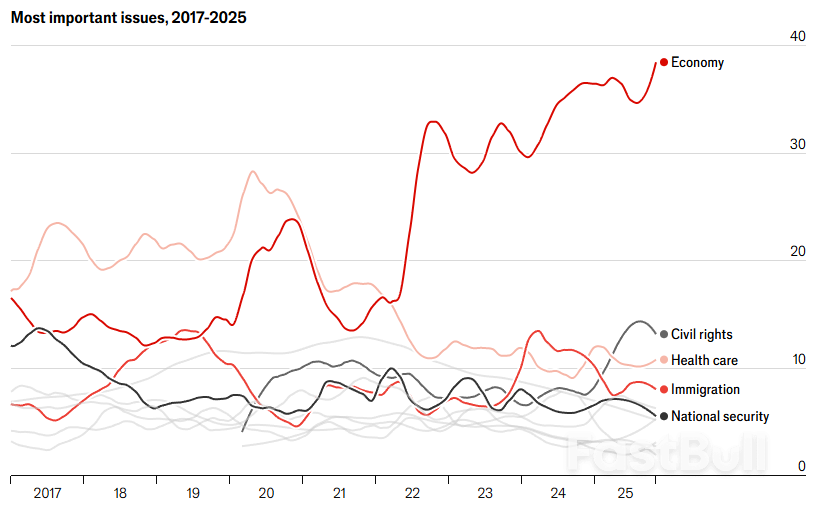
          The economy is the primary concern for Americans. And when we say the economy, we are not referring to macro statistics. Otherwise, with 3% growth and 4% unemployment at the end of his term, Joe Biden would have been re-elected hands down. It is more about the cost of living. In other words, how households feel on a daily basis.

          How inflation is catching up with Donald Trump_1

          The economy is by far the number one concern for Americans.

          For Republicans, the issue of the cost of living has come back to haunt them with the Democrats' victory in several local elections this week.
          First, there was Zohran Mamdani's triumph in New York. Although the city is a Democratic stronghold, Mamdani identifies himself as a socialist (and therefore very left-wing in the United States). Above all, he made affordability the focus of his campaign, promising free buses, rent freezes, municipal grocery stores, and more...
          Then there was the victory of two Democratic governors, in Virginia and New Jersey. This did not come as a huge surprise, but the gap with the Republicans is notable. Their campaigns also focused on the cost of living.
          The case of Virginia is interesting. It is a state where many civil servants live. A population affected by DOGE layoffs and now the shutdown.
          Donald Trump directly links the government shutdown to the Republicans' setbacks: "Trump not being on the ballot and the shutdown are the two reasons Republicans lost the election tonight," he wrote on Truth Social after the results were announced.
          In any case, these local elections are a first warning for Republicans a year before the midterms. Donald Trump wants to avoid a repeat of the scenario from his first term: in 2018, he lost the majority in the House of Representatives, which then slowed down his legislative agenda.

          Source: marketscreener

          To stay updated on all economic events of today, please check out our Economic calendar
          Risk Warnings and Disclaimers
          You understand and acknowledge that there is a high degree of risk involved in trading. Following any strategies or investment methods may lead to potential losses. The content on the site is provided by our contributors and analysts for information purposes only. You are solely responsible for determining whether any trading assets, securities, strategy, or any other product is suitable for investing based on your own investment objectives and financial situation.
          Add to Favorites
          Share

          Silver Is Entering A Once-In-A-Decade Accumulation Phase – Don’t Miss This Opportunity

          Adam

          Commodity

          Since then, prices have eased roughly 13.5%, slipping from over $54 to just below $47 an ounce. For some, that pullback looks like fatigue. But for seasoned traders at The Gold & Silver Club, this is no sign of weakness – it’s what they call “healthy bull-market digestion” – a brief pause before the next explosive leg higher.
          “This isn’t the end of the move,” says Lars Hansen, Head of Research at The Gold & Silver Club. “It’s the reset before the next acceleration. Savvy traders see pullbacks like this for what they are – opportunities to reload before the next phase begins.”

          Smart Money Is Quietly Positioning for the Next Breakout

          Silver’s investment case differs sharply from Gold’s. Beyond its monetary heritage, Silver’s modern strength lies in its industrial utility – and that is precisely where demand is surging.
          The white metal sits at the centre of transformative global industries: Clean Energy, Artificial Intelligence, Defence and High-Tech manufacturing. According to data from The Silver Institute, global demand climbed from 993 million ounces in 2016 to 1.16 billion in 2024, while supply slipped from 1.06 billion to 1.02 billion over the same period – flipping a surplus into a structural deficit.
          “Structural deficits are now colliding with a once-in-a-generation demand boom,” notes Hansen. “A clean break above $50 – a key historical resistance level – unlocks a direct path back to the $54.50 record high. Once that level gives way, $75 and even $100 an ounce will become the next long-term Supercycle targets.”

          Dollar Crash Fuels Flight to Hard Assets

          A crucial tailwind behind Silver’s meteoric rise is the ongoing collapse of the U.S dollar. The greenback has already fallen more than 11% in 2025 – its steepest annual decline since the early 1970s – and Morgan Stanley expects another 10% drop by 2026 as global confidence erodes.
          Trump’s so-called “Liberation Day” policies, combined with record fiscal deficits and mounting political pressure on the Federal Reserve to slash rates, have undermined the dollar’s long-standing safe-haven appeal.
          In a recent market note, The Gold & Silver Club observed: “The U.S dollar has entered a long-term bear market, igniting a seismic shift into hard assets. Gold and Silver – unlike fiat currency – cannot be devalued, duplicated or destroyed by monetary policy.”

          A Strategic Reclassification Changes the Game

          In a landmark decision, the United States has officially added Silver, Copper and Uranium to its critical minerals list – elevating Silver from an industrial Commodity to a strategic resource vital to national security and technological independence.
          “This reclassification could trigger government stockpiling and tax incentives,” says Hansen. “With over 70% of U.S Silver refined overseas and China dominating global capacity, Washington’s move adds a powerful new bullish catalyst to Silver’s long-term outlook.”
          By joining the same tier of strategic importance as Lithium and Rare Earths, Silver now carries a geopolitical premium unseen in decades.

          The Most Critical Accumulation Window Since 2011

          With rate cuts looming, the U.S dollar under pressure and supply deficits deepening, analysts at The Gold & Silver Club believe Silver is entering its most lucrative accumulation phase in over a decade.
          “From now until year-end could be the most rewarding stretch for precious metals since the post-pandemic boom,” Hansen concludes. “The last time Silver looked this cheap, it doubled within months. History could be about to repeat.”
          This is the moment decisive traders have been waiting for. The next historic move in Silver is already unfolding – and those still waiting on the sidelines won’t just miss a rally – they’ll miss the greatest wealth transfer of our generation.

          Source: fxempire

          Risk Warnings and Disclaimers
          You understand and acknowledge that there is a high degree of risk involved in trading. Following any strategies or investment methods may lead to potential losses. The content on the site is provided by our contributors and analysts for information purposes only. You are solely responsible for determining whether any trading assets, securities, strategy, or any other product is suitable for investing based on your own investment objectives and financial situation.
          Add to Favorites
          Share

          How Analyst Views Are Shaping The Evolving Story For East West Bancorp

          Justin

          Economic

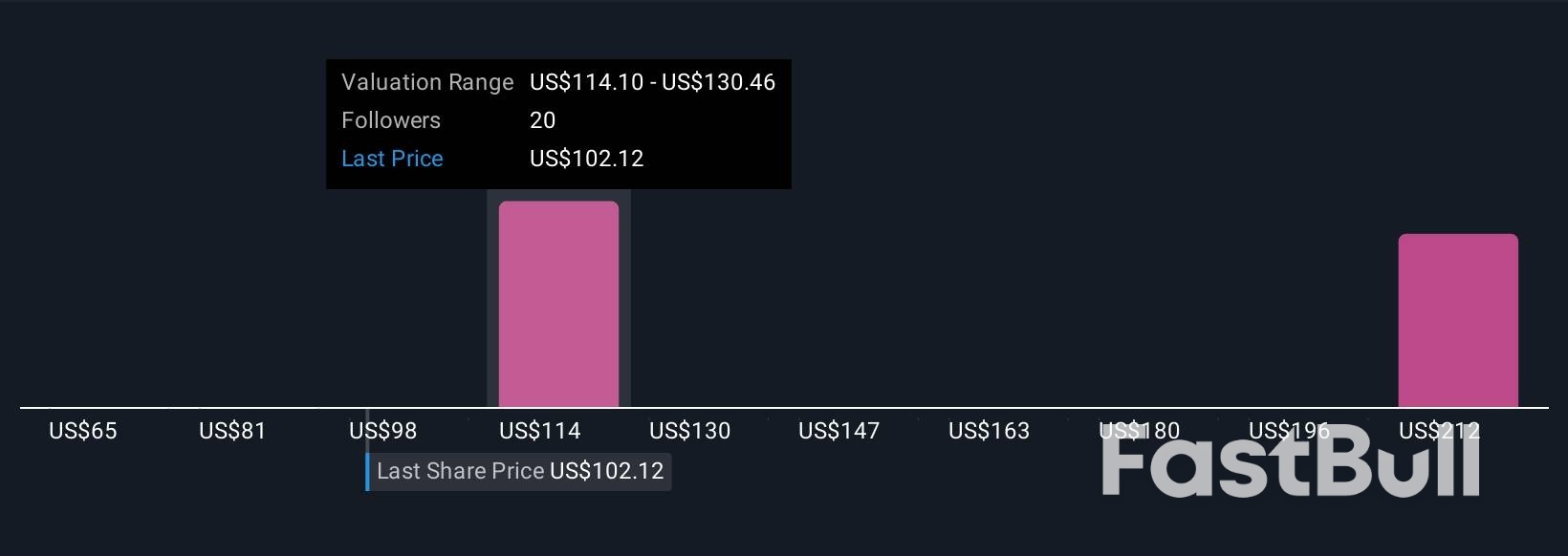
          East West Bancorp's consensus analyst price target edged down marginally from $125.40 to $125.20, reflecting evolving views on the company's outlook. The modest adjustment comes as analysts weigh the impact of continued strong fundamentals against ongoing challenges in the sector. Stay tuned to discover how investors and observers can stay ahead as the narrative around East West Bancorp evolves.

          Stay updated as the Fair Value for East West Bancorp shifts by adding it to your watchlist or portfolio. Alternatively, explore our Community to discover new perspectives on East West Bancorp.

          What Wall Street Has Been Saying

          Analyst sentiment for East West Bancorp has generally leaned positive in recent weeks, with several firms raising their price targets following solid quarterly results and improved bank guidance. However, not all views are uniformly bullish, and some firms remain cautious or maintain a more neutral outlook, citing broader sector risks and valuation considerations.

          Bullish Takeaways:

          • BofA raised its price target to $133 from $128 after what it described as "another beat and raise quarter." This reflects increased confidence in earnings growth and forward guidance.

          • Citi lifted its price targets twice, most recently to $137 from $124. Analysts cited strong deposit growth and higher net interest income, and emphasized improved management execution and outlook transparency.

          • Cantor Fitzgerald initiated coverage with an Overweight rating and a $124 price target. The firm noted a "constructive view" on the macro backdrop that could support continued upside and robust loan growth across US banks.

          • Morgan Stanley hiked its price target to $126 from $111, seeing a steepening yield curve and lower short-term rates as an ideal backdrop for midcap banks like East West Bancorp. The firm also upgraded the industry view to Attractive.

          Bearish Takeaways:

          • Despite positive results and upward price target revisions, both Truist and Piper Sandler maintained neutral or Hold ratings. They suggested that upside may already be reflected in the current share price and that near-term risks persist.

          • Truist, while raising its target to $116 from $112, continues to flag sector challenges including skewed investor preference toward larger banks and limited catalysts for near-term outperformance.

          • Piper Sandler increased its target to $104 from $100 but keeps a Neutral rating, noting that revised guidance is broadly in line with previous expectations and that the outlook for further estimate increases remains muted.

          Do your thoughts align with the Bull or Bear Analysts? Perhaps you think there's more to the story. Head to the Simply Wall St Community to discover more perspectives or begin writing your own Narrative!

          NasdaqGS:EWBC Community Fair Values as at Nov 2025

          What's in the News

          • BofA raised its price target for East West Bancorp to $133 from $128 after the company posted another strong quarter and delivered higher forecasts for earnings per share through 2026.

          • Truist increased its price target to $116 from $112, citing greater confidence in East West Bancorp's higher net interest income, increased fee revenues, lower expenses, and expanded share buybacks after the third quarter report.

          • East West Bancorp completed the repurchase of 258,000 shares for $25 million in the third quarter of 2025, bringing the total to 7.37% of outstanding shares repurchased since 2020.

          • East West Bank announced a new partnership with Worldpay to expand payment solutions and enhance transaction capabilities for commercial and business customers in-store and online.

          How This Changes the Fair Value For East West Bancorp

          • Consensus Analyst Price Target edged down marginally from $125.40 to $125.20.

          • Discount Rate increased slightly from 6.78% to 6.96%.

          • Revenue Growth projection declined modestly from 10.22% to 10.15%.

          • Net Profit Margin expanded a touch from 44.17% to 44.30%.

          • Future P/E ratio inched up from 13.45x to 13.48x.

          Never Miss an Update: Follow The Narrative

          Narratives offer a smarter way to invest by telling the story behind a company's numbers and forecasts. On Simply Wall St, any investor can craft or follow a Narrative, an easy-to-read, constantly updated summary that connects East West Bancorp's business story, financial projections, and current fair value. This helps you compare fair value to the latest market price and decide when to buy or sell. Narratives adapt quickly as news or results come in, giving you a living, actionable insight on the Community page.

          Discover why following the original East West Bancorp Narrative keeps you ahead of market moves:

          • See how rising net interest income and digital banking partnerships are driving resilience and growth.

          • Understand the risks of heavy commercial real estate exposure and rapid sector change in banking technology.

          • Track updated forecasts and analyst assumptions for revenue, profit margins, and fair value, refreshed as new data arrives.

          This article by Simply Wall St is general in nature. We provide commentary based on historical data and analyst forecasts only using an unbiased methodology and our articles are not intended to be financial advice. It does not constitute a recommendation to buy or sell any stock, and does not take account of your objectives, or your financial situation. We aim to bring you long-term focused analysis driven by fundamental data. Note that our analysis may not factor in the latest price-sensitive company announcements or qualitative material. Simply Wall St has no position in any stocks mentioned.

          Source: Yahoo Finance

          To stay updated on all economic events of today, please check out our Economic calendar
          Risk Warnings and Disclaimers
          You understand and acknowledge that there is a high degree of risk involved in trading. Following any strategies or investment methods may lead to potential losses. The content on the site is provided by our contributors and analysts for information purposes only. You are solely responsible for determining whether any trading assets, securities, strategy, or any other product is suitable for investing based on your own investment objectives and financial situation.
          Add to Favorites
          Share

          Bitcoin dips below $100K as US liquidity dries up

          Adam

          Cryptocurrency

          The US government shutdown has many consequences — and this time, bitcoin’s price is one of them. Now stretching past 36 days and marking the longest shutdown in US history, the standoff has quietly drained liquidity from the financial markets.
          The reaction was swift. In a market already dominated by fear, BTC dropped 10.5% between Monday and Tuesday to $99,000, before recovering to nearly $103,000. Whether this proves to be the start of a deeper correction or simply another mid-cycle shakeout will depend on three things: how quickly liquidity returns once Washington reopens, and whether investor attention and technical strength can follow.

          How the shutdown drains liquidity

          Bitcoin has long mirrored global liquidity cycles, typically lagging the global M2 money supply by two to three months. With M2 still expanding — partly driven by China’s record 8.4% y-o-y M2 expansion in September 2025 — the broader macro backdrop remains supportive. Yet on shorter timeframes, local liquidity shocks in the US can override global trends.
          The shutdown has pushed the Treasury General Account (TGA) above $1 trillion, which has drained cash reserves from the Federal Reserve and tightened conditions in overnight funding markets. Short-term borrowing rates, such as SOFR (Secured Overnight Financing Rate) and repo, remain high, reflecting ongoing market volatility. With reserves now below $2.9 trillion, funding stress is approaching levels last seen in late 2018, when overnight rates briefly spiked out of control.
          This dynamic matters because when money moves into the TGA, it leaves the banking system. The longer the government remains shut, the less cash circulates — exactly the opposite of what risk assets like bitcoin thrive on.
          Some near-term relief may come as month-end pressures fade, but reserve levels are already so low that volatility is likely to persist. The latest Treasury announcement, issued on November 3rd, showed that the Treasury expected to end the year with approximately $850bn in its account. When the government finally reopens, the TGA should decline again, injecting at least $150bn of liquidity back into the system.

          Bitcoin momentum needs to return

          Simply restoring liquidity to normal levels may not be enough to ignite a new bitcoin rally. The asset also needs to regain momentum and investor attention.
          According to the latest Wintermute report, even as global liquidity expands and central banks pivot toward rate cuts, most new capital is flowing into equities and AI, not crypto. Analysts highlight two key indicators to watch: the behavior of ETF investors and Digital Asset Treasuries (DATs) — companies that hold significant bitcoin reserves on their balance sheets.
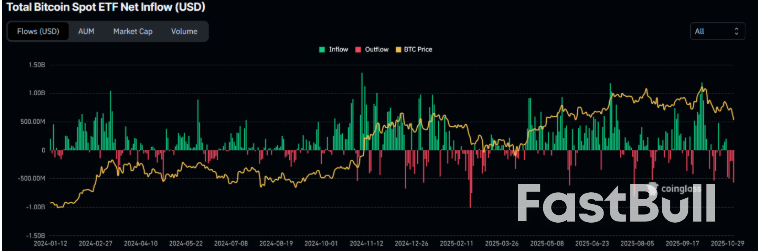
          So far, the picture isn’t encouraging for funds. Bitcoin ETFs have experienced steady outflows, with between $200m and $500m exiting daily since last Wednesday, according to data from Coinglass.
          Bitcoin dips below $100K as US liquidity dries up_1
          On the DAT front, however, there may be a glimmer of optimism. Strategy Inc. ($MSTR), founded by Michael Saylor, announced on November 3 a new preferred stock offering called STRE — a euro-denominated, 10 % coupon instrument. The company plans to issue 3.5 million shares at €100 each, potentially injecting fresh liquidity into the bitcoin ecosystem while opening its “digital credit factory” to the euro markets.

          BTC technical signals promise resilience

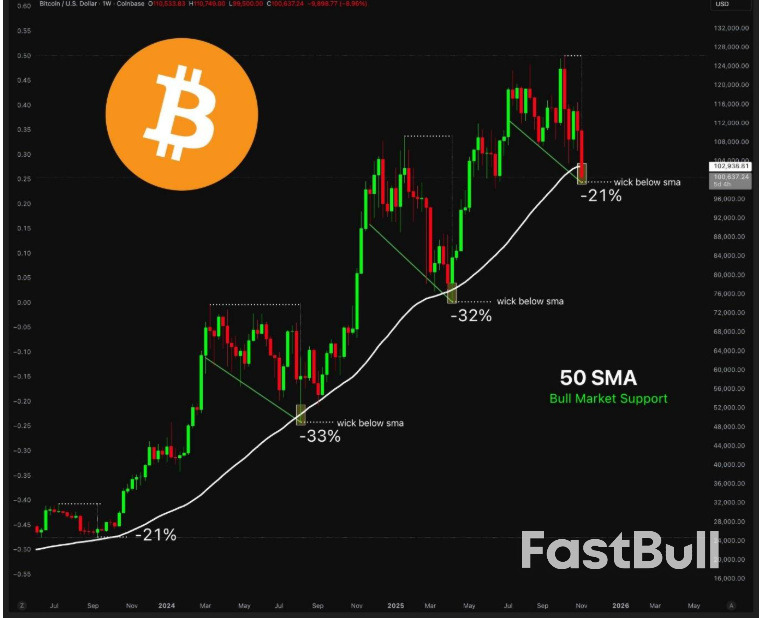
          A 21 % pullback from October 6’s all-time high of $126,400 is hardly alarming given bitcoin’s typical volatility. What concerns traders more are rare technical signals now flashing.
          One is the 50-week moving average, a key long-term support line. Analyst Kevin Svensen notes that bitcoin has tested this level twice in the current cycle without breaking its trend. “This is the lowest BTC can go without doing critical damage,” he wrote, adding that a weekly close above the 50-week SMA (around $103 K) would confirm the uptrend’s survival.
          Bitcoin dips below $100K as US liquidity dries up_2
          At the time of writing, BTC is resisting above that threshold, offering some relief to traders who hope that a strong weekly close could mark the start of another leg higher.
          Others view the recent correction as a mid-cycle reset, rather than the start of a bear market. Trader Merlijn The Trader, who tracks 30 top-cycle indicators, including the Pi Cycle Top, Puell Multiple, and MVRV Z-score, notes that none have triggered yet. He argues that the market has not experienced its usual “euphoria phase” that typically precedes a cycle peak. In his words, “This is mid-cycle energy, not exit-liquidity season.”

          Source: marketscreener

          Risk Warnings and Disclaimers
          You understand and acknowledge that there is a high degree of risk involved in trading. Following any strategies or investment methods may lead to potential losses. The content on the site is provided by our contributors and analysts for information purposes only. You are solely responsible for determining whether any trading assets, securities, strategy, or any other product is suitable for investing based on your own investment objectives and financial situation.
          Add to Favorites
          Share

          Wall Street falls as concerns over economy, tech valuations weigh

          Adam

          Economic

          Wall Street's main indexes extended losses to a second session on Friday, and were set for weekly declines, as concerns about the economy and sky-high valuations in the technology sector soured sentiment.
          The tech-heavy Nasdaq (.IXIC) declined almost 2% on Thursday after Wall Street executives earlier this week warned a market correction could be on the way.
          The S&P 500 and the Dow are both set for their steepest weekly loss in four, while the Nasdaq is poised for its worst weekly performance since March.
          "There is a continuation of the concern of a possible pullback... it's traditional early November weakness triggered by elevated valuations and the running out of catalysts to support or propel the market," said Sam Stovall, chief investment strategist at CFRA Research.
          Optimism around artificial intelligence has pushed markets to all-time highs this year, but concerns over monetization of the technology and circular spending within the industry has dampened enthusiasm for U.S. stocks in recent days.
          Tech stocks such as Nvidia (NVDA.O) and Broadcom (AVGO.O) fell 2.8% and 2.2%, respectively. The information technology sector (.SPLRCT), and the broader semiconductor index (.SOX), were set for their biggest weekly declines in seven months.
          At 10:01 a.m. ET, the Dow Jones Industrial Average (.DJI) fell 138.50 points, or 0.30%, to 46,773.80, the S&P 500 (.SPX) lost 46.63 points, or 0.69%, to 6,673.69 and the Nasdaq Composite (.IXIC) lost 278.31 points, or 1.21%, to 22,775.68.
          The CBOE Volatility Index (.VIX) , Wall Street's fear gauge, hit its highest level in more than two weeks.
          Tesla (TSLA.O) shareholders approved the largest corporate pay package in history for CEO Elon Musk. Shares fell 3.3% tracking broader market sentiment and weighed down the consumer discretionary (.SPLRCD) sector.
          On the earnings front, data compiled by LSEG until Thursday showed 83% of 424 companies in the S&P 500 that have reported results so far have beaten Wall Street expectations, the highest rate of better-than-expected results since the second quarter of 2021.
          Expedia (EXPE.O) jumped 16% to top the S&P 500 after the online travel platform boosted its forecast for full-year revenue growth and posted third-quarter profit above expectations.
          ECONOMIC CONCERNS LINGER
          The longest U.S. government shutdown in history has led to an information gap, with Federal Reserve policymakers divided on the future of monetary policy as private data paints a mixed picture of the economy.
          The economic impact of the shutdown was far worse than expected, White House economic advisor Kevin Hassett said in an interview with Fox Business Network.
          Meanwhile, the preliminary reading of the University of Michigan's Consumer Sentiment Index was 50.3 this month, compared with estimates of 53.2 according to economists polled by Reuters.
          "The question is, will it exacerbate an economic slowdown within the U.S.? There is a lot of uncertainty... it's not just the Fed that is flying blind, it is the American consumer and investor as well," said Stovall.
          Among others, Block (XYZ.N) slumped 10.5% after missing third-quarter profit expectations, and Take-Two Interactive (TTWO.O) declined 6.6% after delaying its popular video game GTA VI to November 2026.
          Declining issues outnumbered advancers by a 1.29-to-1 ratio on the NYSE and by a 1.99-to-1 ratio on the Nasdaq.
          The S&P 500 posted 8 new 52-week highs and 10 new lows while the Nasdaq Composite recorded 18 new highs and 211 new lows.

          Source: reuters

          To stay updated on all economic events of today, please check out our Economic calendar
          Risk Warnings and Disclaimers
          You understand and acknowledge that there is a high degree of risk involved in trading. Following any strategies or investment methods may lead to potential losses. The content on the site is provided by our contributors and analysts for information purposes only. You are solely responsible for determining whether any trading assets, securities, strategy, or any other product is suitable for investing based on your own investment objectives and financial situation.
          Add to Favorites
          Share
          FastBull
          Copyright © 2025 FastBull Ltd

          728 RM B 7/F GEE LOK IND BLDG NO 34 HUNG TO RD KWUN TONG KLN HONG KONG

          TelegramInstagramTwitterfacebooklinkedin
          App Store Google Play Google Play
          Products
          Charts

          Chats

          Q&A with Experts
          Screeners
          Economic Calendar
          Data
          Tools
          Membership
          Features
          Function
          Markets
          Copy Trading
          Latest Signals
          Contests
          News
          Analysis
          24/7
          Columns
          Education
          Company
          Careers
          About Us
          Contact Us
          Advertising
          Help Center
          Feedback
          User Agreement
          Privacy Policy
          Business

          White Label

          Data API

          Web Plug-ins

          Poster Maker

          Affiliate Program

          Risk Disclosure

          The risk of loss in trading financial instruments such as stocks, FX, commodities, futures, bonds, ETFs and crypto can be substantial. You may sustain a total loss of the funds that you deposit with your broker. Therefore, you should carefully consider whether such trading is suitable for you in light of your circumstances and financial resources.

          No decision to invest should be made without thoroughly conducting due diligence by yourself or consulting with your financial advisors. Our web content might not suit you since we don't know your financial conditions and investment needs. Our financial information might have latency or contain inaccuracy, so you should be fully responsible for any of your trading and investment decisions. The company will not be responsible for your capital loss.

          Without getting permission from the website, you are not allowed to copy the website's graphics, texts, or trademarks. Intellectual property rights in the content or data incorporated into this website belong to its providers and exchange merchants.

          Not Logged In

          Log in to access more features

          FastBull Membership

          Not yet

          Purchase

          Become a signal provider
          Help Center
          Customer Service
          Dark Mode
          Price Up/Down Colors

          Log In

          Sign Up

          Position
          Layout
          Fullscreen
          Default to Chart
          The chart page opens by default when you visit fastbull.com