• Trade
  • Markets
  • Copy
  • Contests
  • News
  • 24/7
  • Calendar
  • Q&A
  • Chats
Trending
Screeners
SYMBOL
LAST
BID
ASK
HIGH
LOW
NET CHG.
%CHG.
SPREAD
SPX
S&P 500 Index
6827.42
6827.42
6827.42
6899.86
6801.80
-73.58
-1.07%
--
DJI
Dow Jones Industrial Average
48458.04
48458.04
48458.04
48886.86
48334.10
-245.98
-0.51%
--
IXIC
NASDAQ Composite Index
23195.16
23195.16
23195.16
23554.89
23094.51
-398.69
-1.69%
--
USDX
US Dollar Index
97.850
97.930
97.850
98.070
97.810
-0.100
-0.10%
--
EURUSD
Euro / US Dollar
1.17550
1.17558
1.17550
1.17596
1.17262
+0.00156
+ 0.13%
--
GBPUSD
Pound Sterling / US Dollar
1.33914
1.33921
1.33914
1.33961
1.33546
+0.00207
+ 0.15%
--
XAUUSD
Gold / US Dollar
4341.52
4341.86
4341.52
4350.16
4294.68
+42.13
+ 0.98%
--
WTI
Light Sweet Crude Oil
56.916
56.946
56.916
57.601
56.878
-0.317
-0.55%
--

Community Accounts

Signal Accounts
--
Profit Accounts
--
Loss Accounts
--
View More

Become a signal provider

Sell trading signals to earn additional income

View More

Guide to Copy Trading

Get started with ease and confidence

View More

Signal Accounts for Members

All Signal Accounts

Best Return
  • Best Return
  • Best P/L
  • Best MDD
Past 1W
  • Past 1W
  • Past 1M
  • Past 1Y

All Contests

  • All
  • Trump Updates
  • Recommend
  • Stocks
  • Cryptocurrencies
  • Central Banks
  • Featured News
Top News Only
Share

Peru Energy And Mines Ministry: Copper Production Up 4.8% Year-On-Year In October To 248192 Metric Tons

Share

Security Source: Ukrainian Drones Hits Russian Oil Infrastructure In Caspian Sea For Third Time

Share

Spot Palladium Extends Gains, Last Up 5% To $1562.7/Oz

Share

Mexico's Economy Ministry Announces Start Of Anti-Dumping Investigation And Anti-Subsidy Investigations Into USA Pork Imports

Share

Canada Nov CPI Common +2.8%, CPI Median +2.8%, CPI Trim +2.8% On Year

Share

NY Fed's Empire State Prices Paid Index +37.6 In December Versus+49.0 In November

Share

Canada Nov Consumer Prices +0.1% On Month, +2.2% On Year

Share

Canada Nov CPI Core -0.1% On Month, +2.9% On Year

Share

Canada Nov Core CPI, Seasonally Adjusted +0.2% On Month, Oct +0.3% (Unrevised)

Share

UK Health Minister Streeting On Doctors' Strike: Vote To Go Ahead Reveals The Bma's Shocking Disregard For Patient Safety

Share

Venezuelan State Oil Company Pdvsa Says Was Subject To Cyber Attack But Operations Unaffected

Share

Russia Central Bank Says January-October Current Account Surplus At $37.1 Billion

Share

Polish Current Account Balance At +1924 Million Euros In October Versus+130 Million Euros Seen In Reuters Poll

Share

Statement: Germany, Ukraine Propose 10-Point Plan To Strengthen Armament Cooperation

Share

London Metal Exchange Three Month Copper Falls More Than 3% To $11541.50 A Metric Ton

Share

[Market Update] Spot Silver Surged $2.00 During The Day, Returning To $64/ounce, A Gain Of 3.23%

Share

European Central Bank: Italy's Recurrent Ad Hoc Tax Provisions Cause Uncertainty, Damage Investor Confidence, And May Affect Banks' Funding Costs

Share

Stats Office: Nigeria Consumer Inflation At 14.45% Year-On-Year In November

Share

European Central Bank: Italy's Budget Measures Weighing On Domestic Banks Could Have "Negative Implications" On Their Credit Liquidity

Share

Azerbaijan's January-November Oil Exports Via Btc Pipeline Down 7.1% Year-On-Year Data Shows

TIME
ACT
FCST
PREV
Japan Tankan Small Manufacturing Outlook Index (Q4)

A:--

F: --

P: --

Japan Tankan Large Non-Manufacturing Outlook Index (Q4)

A:--

F: --

P: --

Japan Tankan Large Manufacturing Outlook Index (Q4)

A:--

F: --

P: --

Japan Tankan Small Manufacturing Diffusion Index (Q4)

A:--

F: --

P: --

Japan Tankan Large Manufacturing Diffusion Index (Q4)

A:--

F: --

P: --

Japan Tankan Large-Enterprise Capital Expenditure YoY (Q4)

A:--

F: --

P: --

U.K. Rightmove House Price Index YoY (Dec)

A:--

F: --

P: --

China, Mainland Industrial Output YoY (YTD) (Nov)

A:--

F: --

P: --

China, Mainland Urban Area Unemployment Rate (Nov)

A:--

F: --

P: --

Saudi Arabia CPI YoY (Nov)

A:--

F: --

P: --

Euro Zone Industrial Output YoY (Oct)

A:--

F: --

P: --

Euro Zone Industrial Output MoM (Oct)

A:--

F: --

P: --

Canada Existing Home Sales MoM (Nov)

A:--

F: --

P: --

Canada National Economic Confidence Index

A:--

F: --

P: --

Canada New Housing Starts (Nov)

A:--

F: --

P: --
U.S. NY Fed Manufacturing Employment Index (Dec)

A:--

F: --

P: --

U.S. NY Fed Manufacturing Index (Dec)

A:--

F: --

P: --

Canada Core CPI YoY (Nov)

A:--

F: --

P: --

Canada Manufacturing Unfilled Orders MoM (Oct)

A:--

F: --

P: --

U.S. NY Fed Manufacturing Prices Received Index (Dec)

A:--

F: --

P: --

U.S. NY Fed Manufacturing New Orders Index (Dec)

A:--

F: --

P: --

Canada Manufacturing New Orders MoM (Oct)

A:--

F: --

P: --

Canada Core CPI MoM (Nov)

A:--

F: --

P: --

Canada Trimmed CPI YoY (SA) (Nov)

A:--

F: --

P: --

Canada Manufacturing Inventory MoM (Oct)

A:--

F: --

P: --

Canada CPI YoY (Nov)

A:--

F: --

P: --

Canada CPI MoM (Nov)

A:--

F: --

P: --

Canada CPI YoY (SA) (Nov)

A:--

F: --

P: --

Canada Core CPI MoM (SA) (Nov)

A:--

F: --

P: --

Canada CPI MoM (SA) (Nov)

A:--

F: --

P: --

Federal Reserve Board Governor Milan delivered a speech
U.S. NAHB Housing Market Index (Dec)

--

F: --

P: --

Australia Composite PMI Prelim (Dec)

--

F: --

P: --

Australia Services PMI Prelim (Dec)

--

F: --

P: --

Australia Manufacturing PMI Prelim (Dec)

--

F: --

P: --

Japan Manufacturing PMI Prelim (SA) (Dec)

--

F: --

P: --

U.K. 3-Month ILO Employment Change (Oct)

--

F: --

P: --

U.K. Unemployment Claimant Count (Nov)

--

F: --

P: --

U.K. Unemployment Rate (Nov)

--

F: --

P: --

U.K. 3-Month ILO Unemployment Rate (Oct)

--

F: --

P: --

U.K. Average Weekly Earnings (3-Month Average, Including Bonuses) YoY (Oct)

--

F: --

P: --

U.K. Average Weekly Earnings (3-Month Average, Excluding Bonuses) YoY (Oct)

--

F: --

P: --

France Services PMI Prelim (Dec)

--

F: --

P: --

France Composite PMI Prelim (SA) (Dec)

--

F: --

P: --

France Manufacturing PMI Prelim (Dec)

--

F: --

P: --

Germany Services PMI Prelim (SA) (Dec)

--

F: --

P: --

Q&A with Experts
    • All
    • Chatrooms
    • Groups
    • Friends
    Connecting
    .
    .
    .
    Type here...
    Add Symbol or Code

      No matching data

      All
      Trump Updates
      Recommend
      Stocks
      Cryptocurrencies
      Central Banks
      Featured News
      • All
      • Russia-Ukraine Conflict
      • Middle East Flashpoint
      • All
      • Russia-Ukraine Conflict
      • Middle East Flashpoint
      Search
      Products

      Charts Free Forever

      Chats Q&A with Experts
      Screeners Economic Calendar Data Tools
      Membership Features
      Data Warehouse Market Trends Institutional Data Policy Rates Macro

      Market Trends

      Market Sentiment Order Book Forex Correlations

      Top Indicators

      Charts Free Forever
      Markets

      News

      News Analysis 24/7 Columns Education
      From Institutions From Analysts
      Topics Columnists

      Latest Views

      Latest Views

      Trending Topics

      Top Columnists

      Latest Update

      Signals

      Copy Rankings Latest Signals Become a signal provider AI Rating
      Contests
      Brokers

      Overview Brokers Assessment Rankings Regulators News Claims
      Broker listing Forex Brokers Comparison Tool Live Spread Comparison Scam
      Q&A Complaint Scam Alert Videos Tips to Detect Scam
      More

      Business
      Events
      Careers About Us Advertising Help Center

      White Label

      Data API

      Web Plug-ins

      Affiliate Program

      Awards Institution Evaluation IB Seminar Salon Event Exhibition
      Vietnam Thailand Singapore Dubai
      Fans Party Investment Sharing Session
      FastBull Summit BrokersView Expo
      Recent Searches
        Top Searches
          Markets
          News
          Analysis
          User
          24/7
          Economic Calendar
          Education
          Data
          • Names
          • Latest
          • Prev

          View All

          No data

          Scan to Download

          Faster Charts, Chat Faster!

          Download App
          English
          • English
          • Español
          • العربية
          • Bahasa Indonesia
          • Bahasa Melayu
          • Tiếng Việt
          • ภาษาไทย
          • Français
          • Italiano
          • Türkçe
          • Русский язык
          • 简中
          • 繁中
          Open Account
          Search
          Products
          Charts Free Forever
          Markets
          News
          Signals

          Copy Rankings Latest Signals Become a signal provider AI Rating
          Contests
          Brokers

          Overview Brokers Assessment Rankings Regulators News Claims
          Broker listing Forex Brokers Comparison Tool Live Spread Comparison Scam
          Q&A Complaint Scam Alert Videos Tips to Detect Scam
          More

          Business
          Events
          Careers About Us Advertising Help Center

          White Label

          Data API

          Web Plug-ins

          Affiliate Program

          Awards Institution Evaluation IB Seminar Salon Event Exhibition
          Vietnam Thailand Singapore Dubai
          Fans Party Investment Sharing Session
          FastBull Summit BrokersView Expo

          Global Gold Demand Rises 3% in Q2 as Investment Surges Despite Jewelry Slump

          Gerik

          Economic

          Commodity

          Summary:

          Global gold demand climbed to 1,248.8 metric tons in the second quarter of 2025, up 3% year-on-year, driven primarily by a 78% surge in investment activity...

          Investment Demand Drives Market Growth Amid Uncertainty

          According to the World Gold Council (WGC), total global gold demand including over-the-counter (OTC) transactions rose 3% in Q2 2025 compared to the same period last year. The primary driver was a dramatic 78% increase in investment demand, as gold emerged once again as a preferred hedge against geopolitical instability and volatile trade policy. Spot prices soared 26% year-to-date, peaking at a record $3,500 per ounce in April, drawing large flows into gold-backed exchange-traded funds (ETFs) and physical bars.
          This rise reflects a strong causal relationship between macroeconomic uncertainty particularly related to tariffs, inflation risks, and policy divergence and investor appetite for safe-haven assets. ETFs experienced their largest semi-annual inflow since H1 2020, while bar demand alone rose 21% year-on-year, underscoring a shift toward long-term physical holdings in a high-volatility environment.

          Jewelry Demand Falters as Prices Deter Traditional Buyers

          While investment demand soared, the same cannot be said for jewelry. Consumption dropped 14% to 341.0 tons, the lowest level since the COVID-19 era. The steep decline was most notable in China and India markets that typically account for more than half of global jewelry demand. In Q2, their combined share fell below 50% for only the third time in five years, marking a significant deviation from historical norms.
          This downturn is directly attributable to elevated gold prices, which pushed traditional buyers to the sidelines. The inverse relationship between price level and jewelry demand is a well-established dynamic in physical markets, and this quarter’s data reaffirms that link.
          Central Bank Demand Softens but Strategic Reallocation Persists
          Another major pillar of gold demand central bank buying fell 21% in the second quarter to 166.5 tons. While some of this pullback reflects reduced reported purchases, the WGC noted that unreported buying remains a component of the broader trend. The Council downgraded its full-year estimate for central bank gold purchases, though it emphasized that the longer-term strategic shift away from US-dollar-denominated assets toward gold reserves remains intact.
          The decline in quarterly purchases highlights a correlation rather than a causality. Central banks may be timing their purchases amid high prices or geopolitical shifts, but their broader objective of reserve diversification still underpins medium- to long-term accumulation patterns.

          Recycling and Mine Production Steady, Supply Matches Demand

          On the supply side, global gold availability also increased by 3% year-on-year in Q2, aligning with demand. Mine production rose slightly to 908.6 tons, while recycled gold added 347.2 tons up 4% from last year. Despite record prices, recycling remained relatively subdued, especially in India, where consumers often chose to exchange gold for new jewelry or use it as loan collateral rather than sell it outright.
          This behavior reflects a cultural and financial strategy common in Asian markets where gold serves as both adornment and economic security. As such, elevated prices have not yet triggered a broad recycling wave, despite favorable conditions.

          Investment to Sustain Market Strength, Jewelry Still Under Pressure

          The WGC anticipates continued momentum in ETFs during the second half of 2025, supported by market volatility and geopolitical events. However, it expects a moderate softening in retail investment and continued pressure on jewelry demand, especially if prices remain above $3,200 per ounce.
          Given the macroeconomic context, further divergence between price-sensitive physical demand and price-driven investment flows seems likely. Central banks may also resume purchases in later quarters if price volatility subsides or currency diversification pressures intensify.
          The gold market’s performance in Q2 2025 reflects a decisive pivot toward financial and strategic uses of the metal. While traditional demand from jewelry and central banks softened under high prices, investment appetite surged in response to economic and geopolitical turbulence. The 3% rise in total demand, mirroring a proportional increase in supply, suggests that gold remains well-balanced but increasingly financialized in nature. As global uncertainties persist, gold’s role as a reserve and risk-hedge asset is only expected to grow in the quarters ahead.

          Source: Reuters

          To stay updated on all economic events of today, please check out our Economic calendar
          Risk Warnings and Disclaimers
          You understand and acknowledge that there is a high degree of risk involved in trading. Following any strategies or investment methods may lead to potential losses. The content on the site is provided by our contributors and analysts for information purposes only. You are solely responsible for determining whether any trading assets, securities, strategy, or any other product is suitable for investing based on your own investment objectives and financial situation.
          Add to Favorites
          Share

          Jet Fuel Exports from Asia to Europe Surge to Multi-Year High on Strong Arbitrage and Demand

          Gerik

          Economic

          Commodity

          Asian Jet Fuel Flows Redirected to Europe Amid Surging Demand

          Jet fuel exports from Asia to Europe have climbed sharply in July, as traders moved to capitalize on favorable arbitrage margins amid a growing supply glut in the East and rising consumption in the West. According to Vortexa and several shipping sources, total shipments are estimated between 600,000 and 775,000 metric tons for the month equivalent to roughly 4.7 to 6.1 million barrels. This marks the highest volume in nearly three years, and some industry participants suggest it may be the most significant export level in five years.
          The volume represents a substantial increase from June, when exports from Northeast Asia to Europe stood near 500,000 tons. This consistent month-on-month growth illustrates a strong causal relationship between regional oversupply in Asia and the profitable export opportunities offered by European price premiums.

          Favorable Arbitrage, Lower Freight Costs Drive Trade Surge

          The key driver behind July’s export boom lies in the favorable arbitrage economics. According to LSEG, physical jet fuel prices in Northwest Europe maintained a $65-per-ton premium over Asia in July up from $50 in June. This pricing gap incentivized Asian refiners and traders to move surplus fuel westward, offsetting weaker margins at home.
          At the same time, falling freight rates enhanced arbitrage profitability. The average cost to ship 90,000 tons of jet fuel on LR2 tankers declined to $3.75 million in July, down from $4.4 million in June. The easing of geopolitical tensions following the Iran-Israel conflict contributed to this drop, creating a more favorable shipping environment for exporters.
          This combination of higher margins and reduced transportation costs directly stimulated export activity, illustrating a classic case of causality between improved netback economics and elevated shipping volumes.

          European Aviation Demand Fuels Import Appetite

          The sharp increase in imports also reflects robust European demand. Eurocontrol data shows the average number of daily flights in July rose 4% year-on-year and 3% higher than 2019 pre-pandemic levels, signaling a full recovery and renewed momentum in the aviation sector. As a result, stockpiles at the key ARA (Amsterdam-Rotterdam-Antwerp) hub fell to 745,000 tons the lowest since February and well below both 2025 and 2024 averages.
          This tight supply environment further reinforced Europe's appetite for imports, creating a feedback loop where increased demand in the West alleviates oversupply in the East.

          China and South Korea Lead Export Growth

          China, the world’s largest refining hub, played a central role in July’s export surge. The country is on track to ship out more than 2.3 million tons of aviation fuel in both July and August, according to industry estimates. Analysts at FGE suggest that while domestic demand has plateaued, Chinese refiners particularly Sinopec are ramping up output due to high profitability in the export market.
          South Korea also contributed significantly to the flow, leveraging its large-scale refining capacity and geographic advantage to supply Europe more aggressively.
          From a profitability standpoint, jet fuel remains the most lucrative product for Chinese refiners compared to alternatives, prompting a clear shift in refining strategies. The export decision is thus causally tied to comparative product margins rather than just geopolitical or logistical considerations.
          The dramatic surge in jet fuel exports from Asia to Europe in July underscores the powerful interaction between regional imbalances, arbitrage incentives, and recovering global aviation demand. While exports may moderate in August due to narrowing margins, the July data reflect a moment when trade flows, refinery economics, and transport costs aligned to produce a near-record redistribution of global jet fuel supply. For Asian refiners, the European market remains a critical outlet particularly when domestic demand stagnates and margin optimization becomes paramount.

          Source: Reuters

          To stay updated on all economic events of today, please check out our Economic calendar
          Risk Warnings and Disclaimers
          You understand and acknowledge that there is a high degree of risk involved in trading. Following any strategies or investment methods may lead to potential losses. The content on the site is provided by our contributors and analysts for information purposes only. You are solely responsible for determining whether any trading assets, securities, strategy, or any other product is suitable for investing based on your own investment objectives and financial situation.
          Add to Favorites
          Share

          Trump’s New Tariff Doctrine Reshapes Global Trade Landscape Ahead of August Deadline

          Gerik

          Economic

          South Korea Secures 15% Tariff Deal with Investment Pledge

          President Trump’s announcement of a new trade agreement with South Korea sets a 15% flat tariff on most South Korean goods while exempting US products from reciprocal tariffs. In exchange, Seoul committed to a $350 billion investment package in the US, including substantial purchases of American liquefied natural gas and other energy products.
          Trump portrayed the agreement as a win for American industries, declaring on Truth Social that “South Korea will be completely OPEN TO TRADE” and will increase imports of US vehicles, agricultural goods, and energy. Although the 15% tariff rate formalizes a protectionist posture, South Korea’s investment is intended to offset its impact by strengthening ties in critical sectors such as autos and semiconductors.
          This agreement illustrates a clear cause-and-effect mechanism: the avoidance of more punitive tariffs comes at the cost of capital commitments and strategic market access. However, the asymmetry where the US imposes tariffs without facing any in return suggests unequal leverage, with Seoul opting for economic pragmatism over confrontation.

          India Targeted with 25% Tariff as Trade Talks Falter

          In sharp contrast, India failed to secure a deal before Trump’s August 1 deadline. Trump announced a 25% tariff on Indian goods, accusing New Delhi of excessive tariffs and “obnoxious” non-monetary barriers, especially on agricultural imports. India’s long-standing defense ties with Russia and reluctance to liberalize key markets also contributed to the breakdown.
          While India hopes to finalize a broader trade deal by fall, the punitive tariffs possibly accompanied by additional penalties reflect a growing strategic divergence between the two countries. Despite multiple rounds of talks, the absence of meaningful reciprocity in US demands and India's domestic sensitivities have stalled progress.
          This escalation suggests a causal deterioration in bilateral relations, with tariffs used as both leverage and punishment. The political context India’s ties with Russia, its high tariff profile feeds directly into Trump's rationale, aligning trade policy with foreign policy priorities.

          Brazil Hit with 50% Tariffs Amid Political Overtones

          Trump also signed an executive order imposing 50% tariffs on Brazilian imports, citing economic emergency grounds under a 1977 law. The justification centered on political persecution of former President Jair Bolsonaro adds a new layer of subjectivity to tariff policy. While key sectors like orange juice and aircraft parts received exemptions, the sweeping measure rattled Brazilian exporters and triggered emergency consultations with the US.
          This move, while framed in economic terms, is more correlated with ideological alignment and domestic political narratives. The causal connection between Bolsonaro’s legal troubles and broad economic measures reflects Trump’s tendency to merge trade tools with personal diplomacy.

          Copper and De Minimis Orders Expand Tariff Reach

          In addition to country-specific deals, Trump unveiled a 50% tariff on semi-finished copper products and derivatives, effective August 1, following a Section 232-style investigation. The measure excludes copper inputs such as cathodes and scrap but targets pipes, wires, and electrical components highlighting the administration’s focus on value-added imports in strategic supply chains.
          Trump also signed an order ending the de minimis exemption for low-value imports under $800, a move that will affect online retailers like Shein and Temu. These policies aim to close loopholes in tariff collection and reinforce the US's tariff wall across consumer and industrial goods.
          These decisions show a structural reorientation in trade enforcement: from selectively applied tariffs to comprehensive control over import mechanisms. While not all measures reflect direct cause-and-effect logic, they contribute to a pattern of trade policy consolidation that amplifies market friction.

          Global Reactions and Market Fallout

          Reverberations from Trump’s tariff strategy are being felt worldwide. Luxury brands like Aston Martin and Porsche downgraded forecasts, citing US tariff exposure. Harley-Davidson missed profit expectations, blaming policy uncertainty. Meanwhile, Fed Chair Jerome Powell warned of early signs of “tariff inflation,” as companies begin to raise prices collectively to protect margins an outcome with causal links to import cost increases.
          Ongoing US-China trade talks in Sweden ended without a tariff extension agreement, and the US-EU deal remains vague despite headline investment figures. Critics in Europe, including leaders from Germany and France, have labeled their negotiations rushed and one-sided.
          President Trump’s latest trade maneuvers signal a return to aggressive unilateralism. By setting 15% as a new baseline for tariff expectations and escalating actions against India, Brazil, and online imports the administration is redrawing the global trade map with bold and unpredictable strokes. While some countries, like South Korea, have opted for compromise through investment and diplomacy, others now face direct penalties tied to broader geopolitical tensions. As the August 1 deadline looms, markets, central banks, and corporations are preparing for further volatility, driven not just by economics, but by a politically charged trade agenda with long-term structural implications.

          Source: Yahoo Finance

          To stay updated on all economic events of today, please check out our Economic calendar
          Risk Warnings and Disclaimers
          You understand and acknowledge that there is a high degree of risk involved in trading. Following any strategies or investment methods may lead to potential losses. The content on the site is provided by our contributors and analysts for information purposes only. You are solely responsible for determining whether any trading assets, securities, strategy, or any other product is suitable for investing based on your own investment objectives and financial situation.
          Add to Favorites
          Share

          South Korea Secures Trade Stability with US Deal, but Uncertainties Remain Beneath the Surface

          Gerik

          Economic

          A Deal Framed as Stability Over Shock

          The newly concluded trade agreement between South Korea and the United States, featuring a 15% US tariff on most South Korean goods, has been broadly welcomed in Seoul as a pragmatic outcome. The alternative escalated tariffs or exclusion from key US markets had raised fears across industries and financial markets. Now, with the deal finalized, sentiment has shifted from anxiety to guarded relief.
          Kathleen Oh, Chief Korea Economist at Morgan Stanley, characterized the outcome as “the worst avoided.” Her analysis points to the removal of Korea-specific tariff risks as a stabilizing factor, especially in comparison to export competitors like Japan. The deal is expected to allow the Bank of Korea to revise its growth forecast upward, reflecting optimism driven by new fiscal commitments and continued housing market recovery.
          This shift from uncertainty to cautious optimism is not a direct causal transformation but a correlation anchored in the resolution of previously disruptive variables namely, unpredictability around US tariff policy.

          Corporate Reactions Emphasize Investment Security

          Hyundai Motor Group and Samsung Electronics both responded positively to the deal, citing improved clarity for their business strategies in the US. Hyundai reinforced its ambitious plan to invest $21 billion by 2028, emphasizing the creation of over 100,000 jobs and a broader economic footprint supporting over half a million positions across the US. The statement underscores Hyundai’s framing of the agreement as validation for its long-standing commitment to American manufacturing.
          Samsung, while measured in tone, echoed the sentiment of reduced uncertainty. CFO Park Soon-Cheol noted that Samsung is monitoring the agreement’s specifics closely, signaling that while the headline terms provide relief, execution details remain critical.
          These corporate responses reflect a relationship where tariff clarity directly impacts strategic planning. The correlation between policy predictability and capital commitment is especially pronounced in globally integrated sectors like semiconductors and automobiles.

          Critical Views Probe Long-Term Trade-Offs

          While many analysts praised the deal for averting a worst-case scenario, some political and trade figures voiced concerns about the agreement's substance and implications. Former trade minister Cheong In-Kyo framed the 15% tariff as an acceptable compromise, but cautioned that the real impact will hinge on how and where the promised $350 billion investment is deployed. If these funds primarily support Korean firms expanding in the US filling the void left by retreating Chinese investment it may yield long-term strategic advantages. However, if the investments serve broader US objectives with limited feedback into Korean industry, the deal could be seen as one-sided.
          Kim Gunn, a former diplomat and current opposition lawmaker, echoed these concerns, emphasizing that the balance of the agreement depends on “the devil in the details.” His comment highlights the possibility of asymmetric concessions where Korea agrees to high investment obligations in return for parity in access, rather than genuine preferential treatment.
          This perspective introduces a cautionary interpretation, suggesting that while the correlation between the deal and immediate market relief is evident, the longer-term causality whether the agreement genuinely supports South Korean industry or merely repositions it within US strategic interests remains to be assessed.
          South Korea’s trade agreement with the US has succeeded in defusing short-term risks by formalizing tariff terms and investment expectations. Businesses now face a more predictable environment for strategic planning, and the broader economy stands to benefit from improved policy visibility. However, the underlying concessions and investment flows require close scrutiny to determine whether the deal enhances Korea’s global competitiveness or merely stabilizes it under new constraints. The next phase of bilateral engagement and how the $350 billion is mobilized will reveal whether this is a win of strategic balance or a costly compromise.

          Source: Reuters

          To stay updated on all economic events of today, please check out our Economic calendar
          Risk Warnings and Disclaimers
          You understand and acknowledge that there is a high degree of risk involved in trading. Following any strategies or investment methods may lead to potential losses. The content on the site is provided by our contributors and analysts for information purposes only. You are solely responsible for determining whether any trading assets, securities, strategy, or any other product is suitable for investing based on your own investment objectives and financial situation.
          Add to Favorites
          Share

          India’s Oil Refiners Face Mounting Pressure as US-EU Clampdown on Russian Crude Escalates

          Gerik

          Economic

          Commodity

          TS and EU Tactics Force Rapid Supply Realignment

          Indian oil refiners are under growing pressure as coordinated actions by the United States and European Union disrupt long-standing crude supply chains with Russia. The country, which has become one of the largest buyers of Russian oil since 2022, is now facing diplomatic and trade repercussions, with President Donald Trump announcing a 25% import tariff on Indian exports starting Friday. This move, tied to India’s continued importation of Russian energy and military supplies, introduces direct economic consequences for New Delhi’s strategic positioning.
          The relationship between these events is clearly causal: India’s alignment with Russian energy flows has led to increased friction with Western powers, resulting in retaliatory trade barriers and restricted access to previously available crude. The fallout is being felt most acutely in India’s refining sector.

          Tightening Procurement Deadlines Reflect Urgency

          In response, state-owned refiners such as Indian Oil Corp. and Bharat Petroleum Corp. are accelerating their procurement efforts. Tenders typically issued for mid-to-late October deliveries are now being advanced for late September to early October arrivals. This shift signals a scramble to diversify away from Russian barrels, with refiners turning to alternative suppliers in the Middle East and West Africa.
          The urgency in tender timelines is correlated with the shrinking availability of Russian supply and the anticipation of tightening enforcement from both the US and EU. The geopolitical squeeze is directly reshaping procurement behavior, driving up short-term demand in secondary markets and contributing to upward pressure on global oil prices.

          EU Diesel Ban Adds Further Constraints

          The refining dilemma deepened earlier when the EU moved to ban imports of diesel made in India from Russian-origin crude. This policy change, while not immediately halting Indian exports, has created significant uncertainty for product buyers and sellers alike. The policy indirectly curtails India’s ability to process Russian crude for profitable resale, thereby undercutting a key arbitrage strategy.
          As a result, refiners are left navigating multiple layers of disruption: tighter feedstock availability, rising crude costs, and limited flexibility in product exports. The convergence of these pressures is not coincidental rather, it reflects a coordinated effort by Western policymakers to enforce energy sanctions with secondary consequences for Russia’s trading partners.

          Tariff Threats Compound Refining Sector Strains

          The US tariff decision compounds the economic challenges facing Indian refiners. Although the duties apply broadly to Indian exports, the timing and justification tied explicitly to Russian energy signal a punitive posture. The 25% tariff will erode price competitiveness in critical export categories, including refined petroleum products and petrochemical derivatives.
          India's refiners now face the dual burden of reduced import flexibility and weakened export channels. This causal chain highlights how energy policy is being weaponized in global trade and how nations like India, despite being neutral players, become collateral actors in great power struggles.
          Indian oil refiners are at the center of a widening geopolitical contest over Russian energy. As the US and EU ramp up enforcement measures and use economic tools to isolate Moscow, India’s reliance on Russian oil is becoming a strategic liability. The current disruptions from abrupt changes in sourcing timelines to punitive trade tariffs are not isolated incidents, but interconnected outcomes of a broader shift in global energy policy enforcement. Navigating this new terrain will require swift adjustments in procurement strategy, diplomatic agility, and long-term investment in diversified energy partnerships.

          Source: Bloomberg

          To stay updated on all economic events of today, please check out our Economic calendar
          Risk Warnings and Disclaimers
          You understand and acknowledge that there is a high degree of risk involved in trading. Following any strategies or investment methods may lead to potential losses. The content on the site is provided by our contributors and analysts for information purposes only. You are solely responsible for determining whether any trading assets, securities, strategy, or any other product is suitable for investing based on your own investment objectives and financial situation.
          Add to Favorites
          Share

          Trump's Aug. 1 Tariff Deadline Is Near. Here Are Those Who Have And Haven't Signed A Deal

          Winkelmann

          Political

          China–U.S. Trade War

          Economic

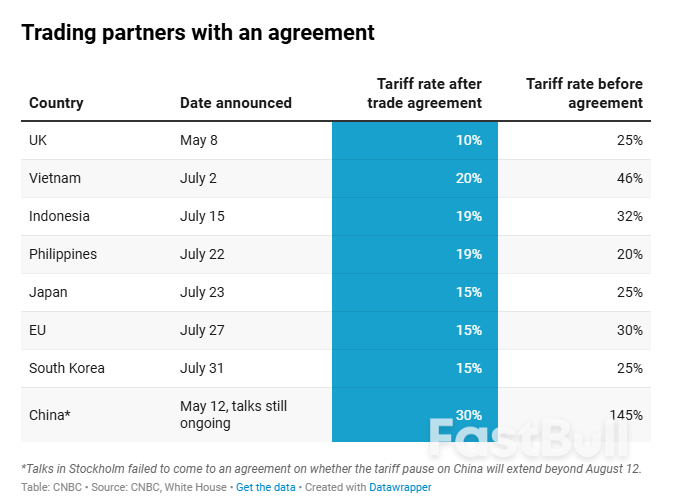
          Come Friday, the world will have to contend with higher tariff rates from the Trump administration, raising the specter of even more economic uncertainty.For most countries, that can of worms has been kicked twice down the road, from "Liberation Day" on April 2, to July 9, and now to Aug. 1.Back in April, Trump had claimed to have done "over 200 deals" in an interview with Time Magazine, and trade advisor Peter Navarro had said that "90 deals in 90 days" was possible. The country has fallen far short of that, with only eight deals in 120 days, including one with the 27-member European Union.

          Here are where things stand in global trade.

          Trump's Aug. 1 Tariff Deadline Is Near. Here Are Those Who Have And Haven't Signed A Deal_1

          UK first to a deal

          The U.K. led the charge on trade agreements with the U.S., striking one as early as May. The framework includes a 10% baseline tariffs on U.K. goods, as well as various quotas and exemptions for products such as autos and aerospace goods.But even after U.S. President Donald Trump met with Prime Minister Keir Starmer in Scotland recently, some points in their trade agreement remain uncertain. That includes tariffs on U.K. steel and aluminum, which the U.S. agreed to slash. Talks about the U.K.'s digital services tax, which Trump wants scrapped, also seem to be continuing.

          Vietnam: tariffs more than halved

          Vietnam was the second to cross the line with the Trump administration, with Trump announcing a trade agreement on July 2 that saw the tariff imposed on Vietnam slashed from 46% to 20%.

          One point with Vietnam was a 40% "transshipping" tariff on goods originating in another country and transferred to Vietnam for final shipment to the U.S, although it is not clear how this will be applied. Trump also claimed that there would be full market access to the country for U.S. goods.Chinese manufacturers have used transshipping to sidestep the hefty tariffs on its direct shipments to the United States, using Vietnam as a major transshipment hub.However, it seems that Vietnam was blindsided by the 20% rate imposed, according to a report by Politico. Politico said negotiators had expected a 11% levy, but Trump unilaterally announced the 20% rate.

          Indonesia: bringing down barriers

          Indonesia's tariff rate was cut to 19% from 32% in its agreement with Trump, announced on July 15.The White House said Indonesia will eliminate tariff barriers on over 99% of U.S. products exported to Indonesia across all sectors, including agricultural products and energy.The framework also says the countries will also address various "non-tariff barriers" and other obstacles that the U.S. faces in Indonesian markets.

          Philippines: marginal decrease

          Unlike its ASEAN counterparts above, which had sizable reductions to its tariff duties, the Philippines saw a decrease of a single percentage point to 19% from 20% on July 22.Manila will not impose tariffs on U.S. goods as part of the agreement, according to Trump, who praised the country for what he described as "going OPEN MARKET with the United States."In addition, Trump also said that the Philippines will work together "Militarily," without specifying any details. The two countries are already treaty allies, with Manila hosting U.S. troops and having a mutual defense treaty going back to 1951.

          Japan: rice and autos

          Japan was the second major Asian economy to come to an agreement with the U.S. after China, seeing its tariff rate cut to 15% from 25% on July 23, and being the first economy to see a lower preferential tariff rate for its key automobile sector.

          Trump called the agreement "perhaps the largest Deal ever made," while adding that Japan would invest $550 billion in the United States and the U.S. would "receive 90% of the Profits."The path to this agreement was fraught with uncertainty, with Trump saying days before the agreement that he did not expect the two countries to reach a deal.He described Japan on separate occasions as "very tough" in trade talks and suggested the country was "spoiled" for not accepting U.S. rice despite facing a domestic rice shortage.

          EU: some discontent remains

          The European Union's agreement with the U.S. was struck just days ago, after long negotiations. EU goods are now facing a 15% baseline tariff rate, half the 30% Trump had previously threatened the bloc with. Existing duties on autos will be reduced to 15%, and levies on some products like aircraft and certain drug generics will go back to pre-January levels.But the deal has been met with criticism, including from some European leaders. French Prime Minister Francois Bayrou went as far as saying it was an act of "submission" and a "dark day." EU Trade Commissioner Maros Sefcovic, however, called it "the best deal we could get under very difficult circumstances."

          South Korea: also at 15%

          South Korea is the latest country to reach an agreement, on Thursday, with the terms being somewhat similar to the one Japan received.The country will see a blanket 15% tariff on its exports, while duties on its auto sector are also lowered to 15%. South Korea "will give to the United States $350 Billion Dollars for Investments owned and controlled by the United States, and selected by myself, as President," Trump said.

          U.S. Commerce Secretary Howard Lutnick said "90% of the profits" from that $350 billion investment will be "going to the American people."However, South Korean President Lee Jae Myung said the $350 billion fund will play a role in facilitating the "active entry" of Korean companies into the U.S. market into industries such as shipbuilding and semiconductors.

          China: talks still ongoing

          The Trump administration's trade talks with China has taken a different tack than the rest of the world. The world's second largest economy was firmly in Trump's trade crosshairs from the moment he took office.Rather than a deal, China has reached a series of suspensions over its "reciprocal" tariff rate. It was initially hit with a 34% tariff from "Liberation Day," before a series of back-and-forth measures between the two sides saw the duties skyrocket to 145% duties for Chinese imports to the U.S. and 125% for U.S. imports to China.

          However, both sides agreed to reduced tariffs in May, after their first trade meeting in Geneva, Switzerland. The truce was agreed to last till Aug. 12. China currently faces a 30% combined tariff rate, while the U.S. is looking at 10% duties.The countries' most recent meeting in Stockholm ended without a truce extension, but U.S. Treasury Secretary said that any truce extension will not be agreed to until Trump signs off on the plan.For countries without a deal, it appears that a higher global baseline tariff of about 15%-20% will be slapped on them, according to Trump, higher than the 10% baseline announced on "Liberation Day."Countries with a trade surplus with the U.S. will most likely see a higher "reciprocal" tariff rate.Here are some key trading partners that have not agreed to a deal with the U.S.

          India: tariffs and a penalty

          On Wednesday, Trump announced a 25% tariff on India, with an additional unspecified "penalty" for what he views as unfair trade policies and for India's purchase of military equipment and energy from Russia."While India is our friend, we have, over the years, done relatively little business with them because their Tariffs are far too high, among the highest in the World," Trump said in a post on Truth Social.The 25% tariff rate is modestly lower than what Trump imposed on India on "Liberation Day," when he announced a 26% rate on the key trading partner, but at the high end of the 20%-25% range that the U.S. president said he was considering.

          Canada: an 'intense phase'

          There has been frequent back-and-forth between Canada and the U.S. over tariffs in recent months, with the country being hit by duties even before Trump announced his so-called "reciprocal" tariffs.Canada is now facing 35% tariffs on various goods from Aug. 1, with Trump also threatening to increase that rate in case of retaliation. The rate is separate from any sectoral tariffs.Trump has repeatedly cited drugs flowing from Canada to the U.S. as a reason for his move to impose tariffs. Canadian Prime Minister Mark Carney said earlier this week that the partners were in an "intense phase" of talks, noting that it would be unlikely for an agreement not to include any tariffs, Reuters reported.

          Mexico: no sign of progress

          Like Canada, Mexico has also long been a U.S. tariff target, with Trump citing drugs and illegal migration as factors in his decision to announce levies on the U.S.' southern neighbor.The president has said that Mexico has not done enough to secure the border. Mexico is set to be hit with a 30% tariff, with any retaliation set to be met with an even higher rate from the U.S.The Mexican government has stressed that it is important for the trading partners to resolve their issues ahead of Aug. 1, but there have not been many signs of progress toward an agreement in recent weeks.

          Australia: sticking to the baseline

          Australia currently faces the baseline 10% as it runs a trade deficit with the United States. However, the country could be facing a higher tariff rate if Trump decides to raise his baseline rate to 15%-20%.Canberra has not been publicly known to be in trade talks with Washington, with Prime Minister Anthony Albanese reportedly arguing that Australia's deficit with the U.S. and its free trade agreement should mean there should be no tariff on Australian imports.Most recently, Australia relaxed restrictions on U.S. beef, a move which the office of the U.S. trade representative credited to Trump, but Albanese had reportedly said the move was not prompted by Trump.

          Source: CNBC

          To stay updated on all economic events of today, please check out our Economic calendar
          Risk Warnings and Disclaimers
          You understand and acknowledge that there is a high degree of risk involved in trading. Following any strategies or investment methods may lead to potential losses. The content on the site is provided by our contributors and analysts for information purposes only. You are solely responsible for determining whether any trading assets, securities, strategy, or any other product is suitable for investing based on your own investment objectives and financial situation.
          Add to Favorites
          Share

          Trump’s Copper Exemption Triggers Market Chaos and Shatters Trader Expectations

          Gerik

          Economic

          Massive Market Dislocation After Trump’s Refined Copper U-Turn

          The copper market has been rocked by an unexpected shift in US trade policy, as President Donald Trump confirmed a steep 50% tariff on copper imports but excluded refined copper, the cornerstone of global copper trade. This abrupt decision came less than 48 hours before the tariffs were set to take effect and blindsided traders who had rushed to ship refined copper to the US, betting on a price surge. The reversal dismantled those strategies, triggering the largest price collapse ever recorded on the Comex exchange.
          Comex copper futures tumbled more than 20%, with prices falling to $4.450 per pound, while London Metal Exchange (LME) prices were only modestly down at $9,670 per ton. The arbitrage premium between US and global copper prices plummeted from over 30% just a week ago to near parity at 1%. This movement illustrates a direct cause-and-effect relationship: the tariff exemption removed the expected supply squeeze in the US market, invalidating speculative positions that had driven domestic prices up.

          ‘Wasted Efforts’: Traders Confront Sudden Policy Reversal

          The consequences were severe for traders who had spent months executing a strategy to profit from the anticipated tariff-induced price gap. Shipping routes were realigned, inventories surged, and at least one vessel loaded with copper rushed toward US ports in July, trying to beat the expected tariff deadline. As Li Xuezhi of Chaos Ternary Futures noted, those efforts now appear futile, with market participants facing “wasted efforts” as the anticipated payoff has evaporated.
          The policy shift revealed the volatility inherent in President Trump’s trade approach. His surprise announcement not only invalidated speculative supply chains but also introduced instability to global trade planning, particularly for metals. The resulting volatility in copper pricing and logistics reflects the deep vulnerability of market participants to last-minute political decisions.

          Implications for Trade Flows and Supply Dynamics

          The exemption of refined copper is likely to redirect trade flows back toward equilibrium. Massive volumes that were redirected toward the US are now contributing to an overstocked inventory environment, potentially leading to re-exports or prolonged warehouse storage. This correction is expected to reestablish normal global copper movement, but the financial loss and market dislocation incurred highlight the costs of politically driven distortions.
          The move to target semi-finished copper products such as wires, pipes, and fittings while sparing less-processed goods like cathodes and anodes, reflects a compromise shaped by lobbying from US industry. Many stakeholders had warned that the US lacked the capacity to immediately substitute for refined imports, forcing a carve-out in the final policy.

          Future Uncertainty Lingers as Deferred Tariff Plan Remains on Table

          Although refined copper is exempt for now, the White House has left the door open to future tariffs. A proclamation from the administration noted that the Department of Commerce recommended phased tariffs starting in 2027 at 15%, increasing to 30% in 2028. Trump has requested an update on domestic copper market conditions by mid-2026 to determine whether further protectionist measures are warranted.
          This deferred plan introduces an element of strategic uncertainty. While the current impact is clearly causal with the exemption collapsing speculative premiums the longer-term direction will hinge on evolving domestic capacity, political pressures, and global market developments.
          Trump’s abrupt exclusion of refined copper from punitive tariffs has delivered a staggering blow to copper traders and dramatically reshaped short-term global price dynamics. While the market now begins to correct from one of the most extreme price distortions in recent memory, lingering questions about future tariff policy leave traders and industrial users navigating an uncertain landscape. The episode stands as a cautionary tale about the risks of speculative positioning in politically sensitive commodities and the unpredictable consequences of last-minute policy decisions.

          Source: Reuters

          To stay updated on all economic events of today, please check out our Economic calendar
          Risk Warnings and Disclaimers
          You understand and acknowledge that there is a high degree of risk involved in trading. Following any strategies or investment methods may lead to potential losses. The content on the site is provided by our contributors and analysts for information purposes only. You are solely responsible for determining whether any trading assets, securities, strategy, or any other product is suitable for investing based on your own investment objectives and financial situation.
          Add to Favorites
          Share
          FastBull
          Copyright © 2025 FastBull Ltd

          728 RM B 7/F GEE LOK IND BLDG NO 34 HUNG TO RD KWUN TONG KLN HONG KONG

          TelegramInstagramTwitterfacebooklinkedin
          App Store Google Play Google Play
          Products
          Charts

          Chats

          Q&A with Experts
          Screeners
          Economic Calendar
          Data
          Tools
          Membership
          Features
          Function
          Markets
          Copy Trading
          Latest Signals
          Contests
          News
          Analysis
          24/7
          Columns
          Education
          Company
          Careers
          About Us
          Contact Us
          Advertising
          Help Center
          Feedback
          User Agreement
          Privacy Policy
          Business

          White Label

          Data API

          Web Plug-ins

          Poster Maker

          Affiliate Program

          Risk Disclosure

          The risk of loss in trading financial instruments such as stocks, FX, commodities, futures, bonds, ETFs and crypto can be substantial. You may sustain a total loss of the funds that you deposit with your broker. Therefore, you should carefully consider whether such trading is suitable for you in light of your circumstances and financial resources.

          No decision to invest should be made without thoroughly conducting due diligence by yourself or consulting with your financial advisors. Our web content might not suit you since we don't know your financial conditions and investment needs. Our financial information might have latency or contain inaccuracy, so you should be fully responsible for any of your trading and investment decisions. The company will not be responsible for your capital loss.

          Without getting permission from the website, you are not allowed to copy the website's graphics, texts, or trademarks. Intellectual property rights in the content or data incorporated into this website belong to its providers and exchange merchants.

          Not Logged In

          Log in to access more features

          FastBull Membership

          Not yet

          Purchase

          Become a signal provider
          Help Center
          Customer Service
          Dark Mode
          Price Up/Down Colors

          Log In

          Sign Up

          Position
          Layout
          Fullscreen
          Default to Chart
          The chart page opens by default when you visit fastbull.com