Markets
News
Analysis
User
24/7
Economic Calendar
Education
Data
- Names
- Latest
- Prev


Signal Accounts for Members
All Signal Accounts
All Contests


France HICP Final MoM (Nov)A:--
F: --
P: --
China, Mainland Outstanding Loans Growth YoY (Nov)A:--
F: --
P: --
China, Mainland M2 Money Supply YoY (Nov)A:--
F: --
P: --
China, Mainland M0 Money Supply YoY (Nov)A:--
F: --
P: --
China, Mainland M1 Money Supply YoY (Nov)A:--
F: --
P: --
India CPI YoY (Nov)A:--
F: --
P: --
India Deposit Gowth YoYA:--
F: --
P: --
Brazil Services Growth YoY (Oct)A:--
F: --
P: --
Mexico Industrial Output YoY (Oct)A:--
F: --
P: --
Russia Trade Balance (Oct)A:--
F: --
P: --
Philadelphia Fed President Henry Paulson delivers a speech
Canada Building Permits MoM (SA) (Oct)A:--
F: --
P: --
Canada Wholesale Sales YoY (Oct)A:--
F: --
P: --
Canada Wholesale Inventory MoM (Oct)A:--
F: --
P: --
Canada Wholesale Inventory YoY (Oct)A:--
F: --
P: --
Canada Wholesale Sales MoM (SA) (Oct)A:--
F: --
P: --
Germany Current Account (Not SA) (Oct)A:--
F: --
P: --
U.S. Weekly Total Rig CountA:--
F: --
P: --
U.S. Weekly Total Oil Rig CountA:--
F: --
P: --
Japan Tankan Small Manufacturing Outlook Index (Q4)A:--
F: --
P: --
Japan Tankan Large Non-Manufacturing Diffusion Index (Q4)A:--
F: --
P: --
Japan Tankan Large Non-Manufacturing Outlook Index (Q4)A:--
F: --
P: --
Japan Tankan Large Manufacturing Outlook Index (Q4)A:--
F: --
P: --
Japan Tankan Small Manufacturing Diffusion Index (Q4)A:--
F: --
P: --
Japan Tankan Large Manufacturing Diffusion Index (Q4)A:--
F: --
P: --
Japan Tankan Large-Enterprise Capital Expenditure YoY (Q4)A:--
F: --
P: --
U.K. Rightmove House Price Index YoY (Dec)A:--
F: --
P: --
China, Mainland Industrial Output YoY (YTD) (Nov)A:--
F: --
P: --
China, Mainland Urban Area Unemployment Rate (Nov)A:--
F: --
P: --
Saudi Arabia CPI YoY (Nov)A:--
F: --
P: --
Euro Zone Industrial Output YoY (Oct)--
F: --
P: --
Euro Zone Industrial Output MoM (Oct)--
F: --
P: --
Canada Existing Home Sales MoM (Nov)--
F: --
P: --
Euro Zone Total Reserve Assets (Nov)--
F: --
P: --
U.K. Inflation Rate Expectations--
F: --
P: --
Canada National Economic Confidence Index--
F: --
P: --
Canada New Housing Starts (Nov)--
F: --
P: --
U.S. NY Fed Manufacturing Employment Index (Dec)--
F: --
P: --
U.S. NY Fed Manufacturing Index (Dec)--
F: --
P: --
Canada Core CPI YoY (Nov)--
F: --
P: --
Canada Manufacturing Unfilled Orders MoM (Oct)--
F: --
P: --
U.S. NY Fed Manufacturing Prices Received Index (Dec)--
F: --
P: --
U.S. NY Fed Manufacturing New Orders Index (Dec)--
F: --
P: --
Canada Manufacturing New Orders MoM (Oct)--
F: --
P: --
Canada Core CPI MoM (Nov)--
F: --
P: --
Canada Trimmed CPI YoY (SA) (Nov)--
F: --
P: --
Canada Manufacturing Inventory MoM (Oct)--
F: --
P: --
Canada CPI YoY (Nov)--
F: --
P: --
Canada CPI MoM (Nov)--
F: --
P: --
Canada CPI YoY (SA) (Nov)--
F: --
P: --
Canada Core CPI MoM (SA) (Nov)--
F: --
P: --
Canada CPI MoM (SA) (Nov)--
F: --
P: --
Federal Reserve Board Governor Milan delivered a speech
U.S. NAHB Housing Market Index (Dec)--
F: --
P: --
Australia Composite PMI Prelim (Dec)--
F: --
P: --
Australia Services PMI Prelim (Dec)--
F: --
P: --
Australia Manufacturing PMI Prelim (Dec)--
F: --
P: --
Japan Manufacturing PMI Prelim (SA) (Dec)--
F: --
P: --
U.K. Unemployment Claimant Count (Nov)--
F: --
P: --
U.K. Unemployment Rate (Nov)--
F: --
P: --
U.K. 3-Month ILO Unemployment Rate (Oct)--
F: --
P: --


No matching data
Latest Views
Latest Views
Trending Topics
Top Columnists
Latest Update
White Label
Data API
Web Plug-ins
Affiliate Program
View All

No data
With the creation of “special funds” and shadow budgets, the German government is evading fiscal transparency and undermining parliamentary control – a practice now sharply criticized by both the Bundesbank and the Federal Audit Office.
With the creation of “special funds” and shadow budgets, the German government is evading fiscal transparency and undermining parliamentary control – a practice now sharply criticized by both the Bundesbank and the Federal Audit Office.France, meanwhile, offers a warning of where this path leads. Political chaos in Paris culminated in fiscal humiliation last week when Fitch Ratings downgraded French sovereign debt from AA– to A+. France has maneuvered itself into a debt spiral, fueled by unchecked government spending and a misguided attempt to paper over social fractures with cheap credit.
Germany, instead of avoiding France’s mistakes, appears determined to follow them. The fiscal discipline that characterized the postwar era is long gone. Across party lines, there is consensus in Berlin: with creative accounting tricks in the form of “special funds,” the debt brake can simply be ignored. The pinnacle of this new strategy is Chancellor Friedrich Merz’s trillion-euro debt package, which includes a €500 billion special fund.The official justification is noble: defense spending must not be constrained by the bond market, and Germany’s crumbling infrastructure must be modernized. Packaged nicely in the media, the German public is expected to accept this new mountain of debt. After all, it is supposedly “for the greater good.”
But the German Taxpayers’ Association has labeled these special funds exactly what they are: a colossal debt-shuffling scheme. In practice, spending that should be tax-financed is quietly offloaded into shadow budgets that rely on new borrowing.
The bond market itself has become little more than a derivative of monetary policy. Berlin, like its European neighbors, is clearly relying on the European Central Bank to keep the debt pile liquid and to step in whenever investors retreat.Together with Brussels’ interventionism, this has created a political framework that openly encourages state overreach. Parliamentary oversight has all but disappeared. More than half of Germany’s GDP already passes through state hands – a level of intervention unthinkable a generation ago.
Berlin’s strategic consensus is striking: the very state that manufactured the crisis – through suffocating regulation, a self-inflicted energy disaster, bloated public finances, and crushing taxation – now claims it will solve the crisis by doubling down on intervention. The logic is that of a kleptocratic alcoholic in a bar: he runs a tab, borrows from his neighbors, and when generosity runs out, steals directly from the counter. Ultimately, it is this debt binge, this addiction to central planning, that will bring Germany down as both a political and economic model.
There is little meaningful opposition. Whether in parliament or in the intellectual sphere, critics lack the resonance to form a powerful public phalanx against this destructive policy path.
Now, however, criticism has emerged from an unexpected source: the German Bundesbank. Rarely intervening in day-to-day politics, the central bank used its August monthly report to criticize the use of special funds. It warned bluntly that billions earmarked for local governments would likely be diverted to fill existing budget gaps rather than finance infrastructure and climate projects, as promised.The Bundesbank also pointed to the absence of effective structures for efficiency control. By outsourcing vast parts of the federal budget into special funds, Berlin is obscuring the country’s true fiscal position and undermining budget discipline.
Criticism of runaway statism is nothing new. What is striking, however, is that core state institutions such as the Bundesbank are now joining the chorus. The Bundesbank projects Germany’s deficit will climb to 4% of GDP over the next two years – and that is under the optimistic assumption that the economy does not deteriorate further.Its report leaves little doubt: the €100 billion in funds allocated to states and municipalities will likely be misused, rather than going into the infrastructure investments so loudly promised to the public.
Meanwhile, ordinary citizens – at least those still in the productive economy – waste their days in crumbling public transport, endless traffic jams on decaying highways, or waiting at the foot of collapsing bridges.Germany, according to the Bundesbank, is operating in “firefighting mode” – patching up budgetary gaps and social spending programs instead of addressing structural problems. Much of the new spending, it warns, risks being consumed by short-term consumption rather than long-term investment.
The central bank has therefore proposed reforms to strictly limit borrowing capacity and to enforce transparency. At best, it sees special funds with their own borrowing authority as a temporary solution – one that would still require strict parliamentary oversight.
The Bundesbank’s stance is reinforced by the Federal Audit Office, which for months has been calling for tighter, more targeted use of new credit funds. It has demanded that Berlin reserve the right to claw back funds that are misused – a measure based on bitter experience. Past budgets, from integration funds to inflated COVID-19 aid packages, were set high precisely so that excess money could later be diverted to plug welfare deficits.The trick is simple: new debt is hidden from the public, while the true costs are shifted into the future. A short-term stimulus effect may provide the ruling coalition with breathing space against rising opposition – but at the price of structural decline.
That Berlin is using shadow budgets to buy time is hardly surprising. There is bipartisan conviction in the capital that creative accounting and oversized state demand can somehow solve both the fiscal crisis and the economic malaise.But this is pure Keynesian delusion. The state as Leviathan, pretending to be omnipotent – and yet repeatedly colliding with reality. When central planning fails, the blame is always shifted onto the bond market, which stubbornly refuses to accept the illusion that debt-financed interventions can solve everything.
Regardless of how it is structured, the “special fund” is nothing but a monument to political failure. Responsibility lies squarely with Chancellor Friedrich Merz, who endorsed the scheme both for coalition reasons and out of personal conviction.The principle remains clear: every euro siphoned from private capital markets and funneled into the redistribution machine of the state is a lost euro. And every debt-financed state policy leaves behind nothing but new liabilities – to be paid later through taxes or inflation.
There is no free lunch. Only bad policy.
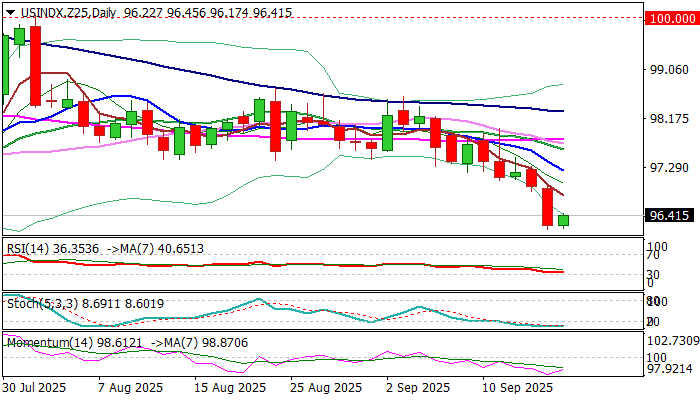
Bears take a breather above new 11-week low on Wednesday, as markets await the verdict from Fed at the end of two-day policy meeting.
The dollar index extended the bear-leg from early Aug peak at 100 zone, a part of larger downtrend from early January peak at 110.00 (down around 12% for the year) and registered 1% loss in in the latest acceleration lower in past two days.
Wide expectations for Fed’s 0.25% rate cut today and high probability that the central bank would keep dovish stance and remain on track for further policy easing in coming months, added to factors that continued to pressure the US dollar.
Today’s upticks should stay capped under 96.80/97.20 zone (former low of July 24 / falling 10DMA) to keep broader bears intact.
Bears eye key support at 95.97 (2025 low, posted on July 1), loss of which will confirm a completion of 95.97/100.04 corrective phase and signal continuation of larger downtrend and expose immediate target at 95.18 (Fibo 76.4% of 89.15/114.72 uptrend.
Stronger acceleration lower cannot be ruled out (depending on Powell’s rhetoric) and may unmask psychological 90.00 level and 89.15 (2021 low).
Daily studies remain in full bearish configuration (boosted by the latest 20/55DMA bear cross) and support negative scenario, although oversold conditions should not be ignored.
Res: 96.82; 97.21; 97.42; 97.61.Sup: 96.16; 95.97; 95.01; 94.41.
All eyes are on the Federal Reserve this week as policymakers prepare to deliver the first rate cut of 2025. Markets widely expect a 25-basis-point move, ending months of waiting. Yet, the real question for investors is not the cut itself but the pace of what comes next. The FED’s dot plot, set to be released alongside the decision, will reveal how many additional cuts officials expect before year-end. With weak job growth, sticky inflation near 3%, and political pressure from Washington, the central bank faces a delicate balancing act.
President Trump has pushed for more aggressive easing and reshaped the Fed’s board with new appointees. Still, Chair Jerome Powell has resisted larger cuts, preferring a cautious “meeting-by-meeting” approach. Former policymakers warn that inflation risks remain, while Wall Street traders are betting on multiple cuts through December. For now, investors are bracing for Powell’s press conference, which could set the tone for the stock market into the winter.
The stock market has been climbing steadily, with the S&P 500 and Nasdaq posting record highs in recent weeks. Investors are betting that rate cuts will extend the rally and support corporate earnings. Fund managers have raised equity exposure to the highest level since February, according to Bank of America’s survey. This confidence reflects hopes that lower borrowing costs will fuel growth, even as the economy slows. Nearly half of managers now expect four or more cuts in the next 12 months.
Yet, the rally is fragile. A narrow group of megacap tech stocks still drives most of the gains, leaving the broader market exposed. Consumer sentiment is weakening, with households squeezed by tariffs and inflation. Unemployment among young workers is rising, and recent graduates face a tough job market. Analysts warn that optimism may have run ahead of fundamentals, creating risks if the FED proves less aggressive than investors hope.
The FED decision is not just a U.S. story. Global markets from Europe to Asia are tuned in. European stocks opened higher on Wednesday, led by Germany’s DAX, as traders positioned for the expected rate cut. Investors also focused on the FED’s longer-term outlook, knowing that the dot plot will shape capital flows worldwide. At the same time, U.S.-China tensions remain a key variable. Trade talks between Washington and Beijing continue, with tariffs looming in November unless a deal is struck.
China itself is flexing its strength in critical industries. Beijing recently tightened control over rare earth exports, underscoring its leverage in global supply chains. Meanwhile, Chinese tech firms like Baidu are surging, signaling resilience despite trade and political headwinds. For global investors, this mix of U.S. monetary policy and China’s economic maneuvers creates both opportunity and risk. Any shift on either front could send waves through the stock market.
Another layer of uncertainty comes from the growing debate over the FED’s independence. Trump has not only criticized Powell but also placed close advisers on the board. This has raised questions about political influence on monetary policy at a time when credibility matters most. Investors are keenly aware that confidence in the FED’s independence underpins trust in U.S. markets. If politics overshadows data, volatility could rise.
Still, Powell and his colleagues insist that decisions remain data-driven. They must weigh two mandates: stable prices and maximum employment. With inflation stuck above target and the job market showing cracks, neither side is easy. Investors, therefore, expect Powell to strike a cautious tone. A clear signal of too few cuts could disappoint stocks, while overly dovish guidance could stoke inflation fears. The challenge lies in maintaining balance.
Looking forward, the stock market faces a complex road. On one hand, lower rates should support valuations, particularly for tech and growth names. Analysts at Wells Fargo and Deutsche Bank have raised their S&P 500 forecasts, pointing to resilient earnings and the AI investment cycle. On the other hand, tariffs, slowing global trade, and a weakening U.S. labor market could dampen momentum. Consumer spending has held up, but economists warn that tariff effects will deepen later this year.
For investors, the coming months will test both patience and conviction. Rate cuts may provide fuel, but they are not a cure for structural challenges. The stock market’s narrow leadership, shaky job data, and fragile consumer sentiment leave little room for error. Meanwhile, China’s economic strategies and Washington’s political pressures add to the uncertainty. In this environment, careful positioning is key. Diversification, risk management, and close attention to FED signals will define success as 2025 unfolds.
The US Federal Reserve began a two-day meeting on Tuesday, with a new governor on leave from the Trump administration joining the deliberations and a second policymaker at the table still facing efforts by US President Donald Trump to oust her.The unusual circumstances, both historic in their own right, have changed what would have been a meeting focused on risks to the job market into a benchmark of Trump's efforts to gain influence over monetary policy.
Trump said on Tuesday that he had signed documents allowing Stephen Miran, who is on leave as head of the White House's Council of Economic Advisers, to join the US central bank's Board of Governors. Miran was sworn into his Fed position later on Tuesday morning and the policy meeting began at 10:30am EDT (1430 GMT).A White House spokesperson also said the administration would ask the US Supreme Court to allow the president's effort to fire Fed governor Lisa Cook "for cause" to proceed.A federal appeals court on Monday blocked Cook's firing, paving the way for the Biden appointee to participate fully in the policy meeting this week. The Fed is widely expected to cut its benchmark overnight interest rate by a quarter of a percentage point to the 4.00%-4.25% range.
The timeline of any Supreme Court appeal and decision is unclear. The Fed will release a policy statement and updated quarterly economic projections at 2pm EDT on Wednesday. Fed chair Jerome Powell will hold a press conference half an hour later.Markets have not reacted much so far to the Fed's personnel drama, which despite the potential implications for central bank independence, has yet to show Trump's imprint on monetary policy, keep Cook from office, or force Powell out of his position.
New data released on Tuesday highlighted the policy dilemma the Fed is facing this week, with stronger-than-expected import prices, still-healthy consumer spending, and better-than-anticipated industrial output countering concerns among rate-cut advocates that the economy is at risk of a fast slowdown and rising unemployment.Updated economic projections due to be issued after the end of the Fed's policy meeting will show how its 19 policymakers evaluate inflation risks, now that Trump's final tariff schedule is largely known, how they anticipate unemployment to evolve in coming months, and how interest rates may need to adapt.
Investors currently expect three quarter-percentage-point rate cuts this year; Fed officials as of June anticipated two, but the evaluation of risks to the economy has been shifting."There are increasing divergent views on how much monetary policy should be eased over the coming months," Kathy Bostjancic, chief economist at Nationwide, wrote in a note, with multiple dissents possible on a policy-setting committee that may be split over those who still feel rates should be held steady until inflation eases further towards the Fed's 2% target, and those who feel faster cuts are appropriate.
Miran's economic and rate projections in particular could show whether he backs the ultra-low interest rates and sunny economic outlook Trump has insisted on — with a forecast that lies outside that of his colleagues, or whether his views meld more indistinguishably with the others.
Trump on Tuesday said he agreed that the Fed needs to be independent. Through much of this year, he has berated Powell for not lowering the central bank's policy rate, which he feels should be slashed to around 1% to make government borrowing cheaper and buoy the housing market, and pushed him to resign.In a 2-1 ruling on Monday, a federal appeals court in Washington said Cook could remain in her job while litigation over Trump's effort to fire her proceeds, a decision that absent a last-minute intervention by the Supreme Court means she will participate fully at the meeting this week.
White House spokesperson Kush Desai said the administration would appeal, but gave no other details."The President lawfully removed Lisa Cook for cause. The administration will appeal this decision and looks forward to ultimate victory on the issue," he said.The fact that courts have so far sided with Cook, avoiding the potentially disruptive ouster of an independent policymaker by a sitting president, has limited any market fallout from Trump's unprecedented decision to say he had "cause" to fire Cook because of allegations she misrepresented information on a mortgage application.Cook denies any wrongdoing and has not been charged with any offence. The Fed has said it would follow any court ruling on Cook's status.
A divided three-judge appeals panel ruled that Cook is likely to succeed with her argument that she did not receive constitutionally required due process when Trump fired her in a social media post."Before this court, the government does not dispute that it provided Cook no meaningful notice or opportunity to respond to the allegations against her," judge Bradley Garcia wrote for the two-judge majority on the appeals court. He did not, however, address what constitutes "cause" for a presidential removal of a Fed governor — a central issue in the case.
With the substance of the Cook case pending and Trump considering replacements for Powell when his term atop the central bank expires in May, the political turmoil surrounding the usually staid and technocratic central bank will continue — keeping investors on edge.Indeed, Miran's approach to the job could offer a telling look at the Trump administration's plans for the Fed.Absent a board majority to approve any sweeping changes, Miran, whose term in theory only runs until Jan 31, may have his largest impact through how often and how intently he speaks publicly about monetary policy, the Fed's operations, the state of the economy, and things he thinks should change — even down to a Fed culture he has criticised sharply in past writings.
Japan’s exports fell in August for the fourth consecutive month as higher US tariffs continued to hit commerce, especially from carmakers, even after a July trade deal.
Overall, cross-border shipments edged down 0.1%, which was better than a 2.0% drop estimated by analysts. Asia and Europe helped cushion a US decline. But the damage of tariffs was clear in that exports to the US, measured by value, slumped around 14% from a year ago, the most in more than four years. (Read the full story from Wednesday’s trade numbers here.)
The drop in shipments to America was led by a 28.4% slide in cars, which was somewhat expected as Washington continued to slap a 27.5% tariff on Japanese vehicles through August. While the US agreed to cut the rate to 15% in the July trade deal, the new level didn’t take effect until Sept. 16.
The latest data also confirmed a worrisome trend for the Japanese economy. While the value of car shipments to the US plunged that much, the number of units fell only 9.5%. That means Japanese automakers are continuing to slash prices to preserve market share there. That’s cutting into their profit margins, which economists say could compromise their ability to keep raising wages.
Any doubts over pay growth bode ill for the economy as it tries to fully depart from years of falling prices, or deflation. The Bank of Japan continues to pay close attention to the fallout of US tariffs as it mulls when to raise the benchmark interest rate again.
After the data, Masanori Katayama, chair of the Japan Automobile Manufacturers Association, met with top trade negotiatorRyosei Akazawa, who led the July deal with the US. The accord enables the Japanese auto industry to avoid “catastrophic impact” from the tariffs, Katayama said. He also pledged that carmakers will strive to keep up the virtuous cycle of wage increases.
To be sure, Japan had a ¥324 billion trade surplus against the US in August, meaning it will remain under pressure from Donald Trump to close the gap, which the US president has long criticized.
White Label
Data API
Web Plug-ins
Poster Maker
Affiliate Program
The risk of loss in trading financial instruments such as stocks, FX, commodities, futures, bonds, ETFs and crypto can be substantial. You may sustain a total loss of the funds that you deposit with your broker. Therefore, you should carefully consider whether such trading is suitable for you in light of your circumstances and financial resources.
No decision to invest should be made without thoroughly conducting due diligence by yourself or consulting with your financial advisors. Our web content might not suit you since we don't know your financial conditions and investment needs. Our financial information might have latency or contain inaccuracy, so you should be fully responsible for any of your trading and investment decisions. The company will not be responsible for your capital loss.
Without getting permission from the website, you are not allowed to copy the website's graphics, texts, or trademarks. Intellectual property rights in the content or data incorporated into this website belong to its providers and exchange merchants.
Not Logged In
Log in to access more features

FastBull Membership
Not yet
Purchase
Log In
Sign Up