
Markets
News
Analysis
User
24/7
Economic Calendar
Education
Data
- Names
- Latest
- Prev


Signal Accounts for Members
All Signal Accounts
All Contests


France Trade Balance (SA) (Oct)A:--
F: --
Euro Zone Employment YoY (SA) (Q3)A:--
F: --
Canada Part-Time Employment (SA) (Nov)A:--
F: --
P: --
Canada Unemployment Rate (SA) (Nov)A:--
F: --
P: --
Canada Full-time Employment (SA) (Nov)A:--
F: --
P: --
Canada Labor Force Participation Rate (SA) (Nov)A:--
F: --
P: --
Canada Employment (SA) (Nov)A:--
F: --
P: --
U.S. PCE Price Index MoM (Sept)A:--
F: --
P: --
U.S. Personal Income MoM (Sept)A:--
F: --
P: --
U.S. Core PCE Price Index MoM (Sept)A:--
F: --
P: --
U.S. PCE Price Index YoY (SA) (Sept)A:--
F: --
P: --
U.S. Core PCE Price Index YoY (Sept)A:--
F: --
P: --
U.S. Personal Outlays MoM (SA) (Sept)A:--
F: --
U.S. 5-10 Year-Ahead Inflation Expectations (Dec)A:--
F: --
P: --
U.S. Real Personal Consumption Expenditures MoM (Sept)A:--
F: --
U.S. Weekly Total Rig CountA:--
F: --
P: --
U.S. Weekly Total Oil Rig CountA:--
F: --
P: --
U.S. Consumer Credit (SA) (Oct)A:--
F: --
China, Mainland Foreign Exchange Reserves (Nov)A:--
F: --
P: --
Japan Trade Balance (Oct)A:--
F: --
P: --
Japan Nominal GDP Revised QoQ (Q3)A:--
F: --
P: --
China, Mainland Imports YoY (CNH) (Nov)A:--
F: --
P: --
China, Mainland Exports (Nov)A:--
F: --
P: --
China, Mainland Imports (CNH) (Nov)A:--
F: --
P: --
China, Mainland Trade Balance (CNH) (Nov)A:--
F: --
P: --
China, Mainland Exports YoY (USD) (Nov)A:--
F: --
P: --
China, Mainland Imports YoY (USD) (Nov)A:--
F: --
P: --
Germany Industrial Output MoM (SA) (Oct)A:--
F: --
Euro Zone Sentix Investor Confidence Index (Dec)A:--
F: --
P: --
Canada National Economic Confidence IndexA:--
F: --
P: --
U.K. BRC Like-For-Like Retail Sales YoY (Nov)--
F: --
P: --
U.K. BRC Overall Retail Sales YoY (Nov)--
F: --
P: --
Australia Overnight (Borrowing) Key Rate--
F: --
P: --
RBA Rate Statement
RBA Press Conference
Germany Exports MoM (SA) (Oct)--
F: --
P: --
U.S. NFIB Small Business Optimism Index (SA) (Nov)--
F: --
P: --
Mexico 12-Month Inflation (CPI) (Nov)--
F: --
P: --
Mexico Core CPI YoY (Nov)--
F: --
P: --
Mexico PPI YoY (Nov)--
F: --
P: --
U.S. Weekly Redbook Index YoY--
F: --
P: --
U.S. JOLTS Job Openings (SA) (Oct)--
F: --
P: --
China, Mainland M1 Money Supply YoY (Nov)--
F: --
P: --
China, Mainland M0 Money Supply YoY (Nov)--
F: --
P: --
China, Mainland M2 Money Supply YoY (Nov)--
F: --
P: --
U.S. EIA Short-Term Crude Production Forecast For The Year (Dec)--
F: --
P: --
U.S. EIA Natural Gas Production Forecast For The Next Year (Dec)--
F: --
P: --
U.S. EIA Short-Term Crude Production Forecast For The Next Year (Dec)--
F: --
P: --
EIA Monthly Short-Term Energy Outlook
U.S. API Weekly Gasoline Stocks--
F: --
P: --
U.S. API Weekly Cushing Crude Oil Stocks--
F: --
P: --
U.S. API Weekly Crude Oil Stocks--
F: --
P: --
U.S. API Weekly Refined Oil Stocks--
F: --
P: --
South Korea Unemployment Rate (SA) (Nov)--
F: --
P: --
Japan Reuters Tankan Non-Manufacturers Index (Dec)--
F: --
P: --
Japan Reuters Tankan Manufacturers Index (Dec)--
F: --
P: --
Japan Domestic Enterprise Commodity Price Index MoM (Nov)--
F: --
P: --
Japan Domestic Enterprise Commodity Price Index YoY (Nov)--
F: --
P: --
China, Mainland PPI YoY (Nov)--
F: --
P: --
China, Mainland CPI MoM (Nov)--
F: --
P: --


No matching data
Latest Views
Latest Views
Trending Topics
Top Columnists
Latest Update
White Label
Data API
Web Plug-ins
Affiliate Program
View All

No data
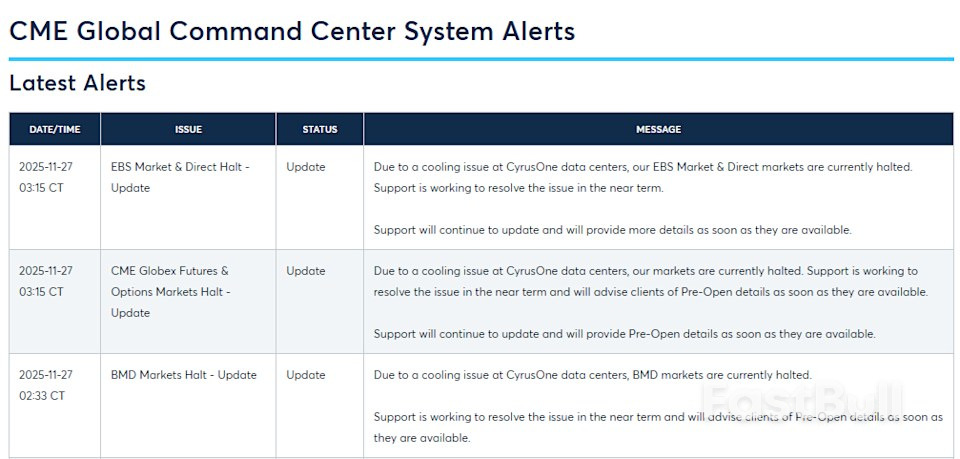
A CME data-center outage froze global futures trading, disrupting liquidity and hedging and causing widespread frustration across markets.
Inflation figures from the eurozone's major economies paint a mixed picture of the bloc's price prospects. In Germany, the region's biggest economy, the inflation rate unexpectedly rose to the highest level in nine months.
Mainly driven by food prices, as energy prices fell modestly, EU-harmonised inflation in Germany was 2.6% higher in November compared with the previous year, after inflation hit 2.3% in October of 2025. This is according to preliminary results from the Federal Statistical Office (Destatis).
Month-on-month, the harmonised inflation rate showed that German prices fell by 0.5% in November, from a 0.3% rise in October.
Elsewhere, it appears that Europe's price pressure is cooling following the region's post-pandemic cost-of-living crisis. Preliminary data released on Friday suggests French inflation remains subdued. According to flash estimates from INSEE, the country's EU-harmonised price index is projected to rise by 0.8% year-on-year in November, unchanged from the previous month and down from 1.7% a year earlier.
Economists had expected a stronger increase of 1%.
The stable reading reflects contrasting movements across spending categories: a slowdown in service prices, driven down by communication services, and a more pronounced decrease in manufactured goods prices, offset by a smaller decline in energy prices and a slight acceleration in food prices.
Month-over-month, French prices fell by 0.2% in November, after a 0.1% increase in October. The consensus forecast had pointed to no change.
The decline was driven by lower service prices, particularly in transport and communications, and to a lesser extent by cheaper manufactured goods. Energy prices are expected to rebound, led by petrol products, while tobacco prices are projected to edge higher. Food prices are expected to remain broadly stable.
The EU's third-largest economy showed a similar pattern. Italy's harmonised index of consumer prices fell by 0.2% in November, matching October's decline, according to preliminary figures from the national statistics agency ISTAT.
Annual inflation eased to 1.1% from 1.3% in the previous month, which is its lowest level since October 2024.
Italian inflation remained low as falling energy prices and softer services inflation offset modest rises elsewhere. The largest downward pressures came from steep declines in regulated energy and communication services, alongside slower increases in transport and recreational services.
Only a few categories — mainly processed food and some unregulated energy products — added mild upward pressure.
Spain, the eurozone's fourth-largest economy, recorded somewhat stronger price pressures. The EU-harmonised index of consumer prices was flat in November following a 0.5% rise in October, defying expectations of a 0.2% monthly fall, according to preliminary data from the National Statistics Institute.
However, annual inflation came in higher than expected. The harmonised rate eased to 3.1% from 3.2% in October, compared with a forecast of 2.9%. Price rises for food, transport and other non-energy goods continued to drive inflation.
Friday's figures from the eurozone's major economies will inform the European Central Bank ahead of its meeting in December. The ECB is not expected to cut its key interest rate from the current 2%, with policymakers judging that medium-term inflation targets are broadly being met.
Eurozone inflation stood at 2.1% in October, slightly above the ECB's 2% target, reinforcing the bank's view that price pressures are largely under control after the surge to double-digit highs caused by post-pandemic supply shocks and the energy crisis triggered by Russia's invasion of Ukraine.
Meanwhile, inflation expectations have edged higher. According to a new ECB survey published on Friday, median consumer inflation expectations for the next year rose to 2.8% in October from 2.7% in September. Expectations for three years ahead were unchanged at 2.5%, while five-year-ahead expectations remained steady at 2.2%.
The International Monetary Fund (IMF) released an explanatory video on its X account, highlighting the potential of tokenized markets to speed up asset trading while introducing severe risks, such as intensified flash crashes.
Tokenization removes the need for intermediaries by automating clearing and settlement directly in code, which early pilots have shown can cut costs and enable near-instant execution. While this paves the way for cheaper, programmable financial services, it can also amplify volatility, since automated trades fire off immediately with no buffers in between.
Researchers note that tokenized systems allow near-instant settlement and more efficient use of collateral, reshaping how assets can trade around the clock. But the IMF warns that these benefits come with familiar risks: past episodes of automated trading have shown how quickly flash crashes can unfold, and layered smart contracts could make those shocks even sharper by triggering chain reactions under stress. On top of that, if platforms remain fragmented and don't interoperate, liquidity could get stuck in silos, undercutting the broader vision of unified, always-on markets.
The video points to historical precedents, such as the 1944 Bretton Woods system, in which governments fixed currencies to the U.S. dollar and gold, only for it to collapse into fiat and floating rates by the 1970s.
Such interventions shaped global finance for decades, signalling that regulators may soon embed tokenized assets under tighter regulatory oversight. BlackRock's BUIDL fund has surged to become the largest tokenized Treasury product, outpacing rivals like Franklin Templeton's fund through 2025.
This public video signals tokenization moving from a niche topic to a mainstream policy focus for the IMF, which has been following digital money developments for a while. Historically, governments don't stay on the sidelines when money evolves; they step in to regulate. As tokenized markets reach multibillion-dollar sizes, platforms will need to tackle these risks head-on to avoid heavy-handed interventions that could change the entire landscape.
Key points:
Kenya and two Chinese state firms are launching construction of a $1.5 billion highway expansion on Friday, marking Beijing's return to major infrastructure development in the East African economy after a years-long hiatus.
The project, split into two phases, will be financed by the partners through a mix of debt and equity using a model that is gaining traction after China's traditional lending model raised concerns over borrowers' debt burdens.
"We don't have any room to borrow any more money," Kefa Seda, director general of the Public-Private Partnerships directorate at Kenya's finance ministry told Reuters ahead of the official launch ceremony.
The project will improve a key transport corridor that links Kenya's port of Mombasa with its western region and neighbouring landlocked states like Uganda, via Nairobi.
After pumping billions of dollars into infrastructure projects, China cut its lending in Africa around 2019 as worries grew over debt sustainability in countries like Kenya.
Beijing pledged $50 billion in credit and investments over three years, however, at a summit with African leaders last year as it moves to reposition itself on the continent.
Kenya terminated a deal with a consortium led by France's Vinci SAfor the highway expansion project earlier this year.
The new agreement was announced during a state visit by Kenya's President William Ruto to Beijing in April.
Kenya is among Washington's closest African allies. And the rapprochement between Nairobi and Beijing angered U.S. PresidentDonald Trump, prompting Ruto to issue a public defence of the strategy, saying Kenya needed to boost exports into markets like China.
One phase of the highway project will cost $863 million and see China Road and Bridge Corporation partner with Kenya's state pension fund NSSF to expand two existing stretches of a single-lane, 139-kilometre (86-mile) highway into four- and six-lane dual-carriage roads, the Kenya National Highways Authority said.
In the second phase, Shandong Hi-Speed Road and Bridge International, a subsidiary of China's Shandong Hi-Speed Group, will develop an existing single-lane, 94-kilometre stretch of highway into a six-lane carriageway at a cost of $678.56 million.
Both total cost estimates include financing costs, KENHA said.
Deals for the two portions of the project will be split into 75% debt and 25% equity. NSSF will contribute 45% of the equity funding in the phase it is involved in.
The borrowing could come from Chinese commercial lenders and state entities like Export-Import Bank of China, Seda said.
The firms have until the end of 2027 to complete construction followed by a 28-year concession to collect tolls to recoup their investment and make a return.
White Label
Data API
Web Plug-ins
Poster Maker
Affiliate Program
The risk of loss in trading financial instruments such as stocks, FX, commodities, futures, bonds, ETFs and crypto can be substantial. You may sustain a total loss of the funds that you deposit with your broker. Therefore, you should carefully consider whether such trading is suitable for you in light of your circumstances and financial resources.
No decision to invest should be made without thoroughly conducting due diligence by yourself or consulting with your financial advisors. Our web content might not suit you since we don't know your financial conditions and investment needs. Our financial information might have latency or contain inaccuracy, so you should be fully responsible for any of your trading and investment decisions. The company will not be responsible for your capital loss.
Without getting permission from the website, you are not allowed to copy the website's graphics, texts, or trademarks. Intellectual property rights in the content or data incorporated into this website belong to its providers and exchange merchants.
Not Logged In
Log in to access more features

FastBull Membership
Not yet
Purchase
Log In
Sign Up