


Markets
Analysis
User
24/7
Economic Calendar
Education
Data
- Names
- Latest
- Prev















Caught between political demands and dollar risks, the Fed maintains rates, signaling a tough stance.
The Federal Reserve is navigating a minefield of political tension, prompting it to hold interest rates steady as a defense of its institutional independence. While the U.S. labor market remains stable, its fragility supports the central bank's cautious stance, even as inflation runs above target.
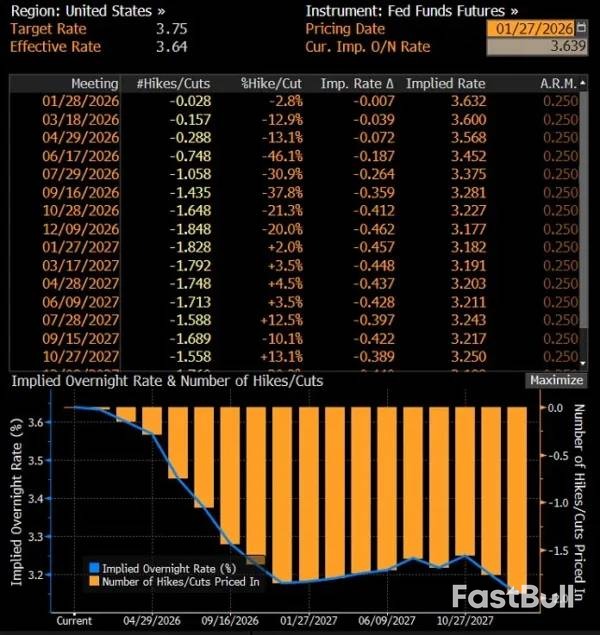
Meanwhile, futures markets are not pricing in any rate cuts in the immediate future, with expectations for meaningful easing pushed out to mid-year. This delicate balancing act comes as the risk of a confidence crisis in the U.S. dollar grows, potentially triggering a self-reinforcing depreciation if the Fed's credibility is undermined.
The Fed is operating in an increasingly fraught political environment, with the administration consistently pushing for substantial interest rate cuts. This has turned monetary policy into a political battleground, a conflict that recently escalated with legal action taken against Fed Chair Jerome Powell. This move is widely seen as a direct attempt to pressure the central bank's leadership.
Powell's firm and public response signals that the Fed is not prepared to yield. In this climate, a pause in rate cuts is more than just a policy decision; it is a clear signal of institutional independence.
Maintaining unity among policymakers is now critical. This may prove challenging, with Governor Miran expected to dissent in favor of aggressive cuts and Governor Bowman also signaling a preference for lower interest rates.
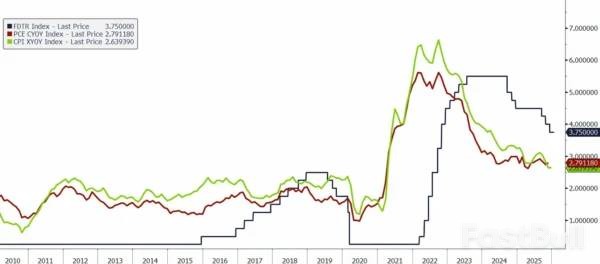
Against this backdrop, the upcoming Federal Reserve meeting will almost certainly conclude with interest rates remaining unchanged. The Fed has already signaled its intention to pause after implementing three consecutive rate cuts in January, which brought the federal funds rate target to a range of 3.50% to 3.75%. Since the start of 2024, rates have been lowered by a total of 175 basis points.
According to Powell and other policymakers, interest rates are now close to a neutral level. This view supports a "wait and see" approach, allowing the Fed to rely more on incoming data before making further policy adjustments.
What Futures Markets Are Pricing In
The federal funds futures market aligns with this assessment. Market pricing indicates a very low probability of another rate cut in January, with limited chances for a move in March or April. Traders only begin to see meaningful odds of further monetary easing in June.
The labor market has become a central focus of the Fed's analysis. Despite solid economic growth last year, employment momentum has weakened, a slowdown amplified by layoffs in federal agencies. At the same time, private companies have shown little appetite for new hiring, even while avoiding large-scale redundancies.
This dynamic has kept the labor market stable but fragile. An economic slowdown could cause conditions to deteriorate quickly. From this perspective, the recent rate cuts—despite inflation staying above the 2% target—can be seen as insurance against a sharper downturn rather than a reaction to immediate weakness.
Recent Data Provides a Breather
Recent labor market data has temporarily eased fears of further deterioration. Job creation exceeded 50,000 in both November and December, enough to prevent the unemployment rate from rising. This gives the Fed more time to assess economic trends at the start of the new year.
In the coming months, more inflation data will also become available, including the PCE deflator, the Fed’s preferred measure. The release of this data, delayed by last year's government shutdown, will be crucial in shaping monetary policy expectations.
The foreign exchange market is highlighting a risk that was flagged repeatedly last year: a potential loss of confidence in the U.S. dollar. This risk appears particularly underestimated by proponents of the "TACO" (Trump Always Chickens Out) strategy, which assumes President Trump will ultimately back away from his most confrontational policies.
The problem is that the unpredictable nature of the current administration creates a genuine danger that markets could cross a threshold where a loss of confidence becomes irreversible. For investors, this means even a later softening of the political stance might not be enough to halt a negative market trend.
Self-Reinforcing Depreciation and Eroding Credibility
Two potential tipping points have long been discussed: the risk of the U.S. dollar losing its safe-haven status and the perceived erosion of the Federal Reserve's independence. If investors begin to price in a scenario where these pillars are permanently weakened, the dollar's depreciation could become self-reinforcing.
Recent events suggest this scenario is increasingly plausible. President Trump’s attempt to de-escalate tensions over Greenland by backing away from tariff threats against parts of the European Union gave the dollar only brief relief. Downward pressure on the USD has since intensified, underscoring that ad hoc measures are failing to rebuild investor confidence.
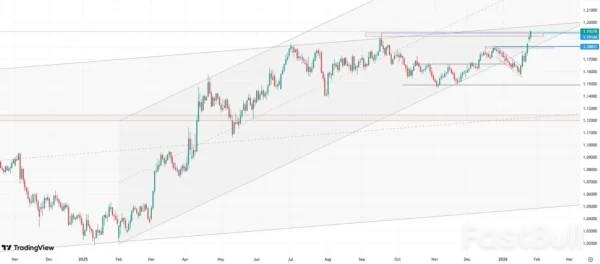
Given the current market dynamics, a break above 1.19 in the EUR/USD pair now appears highly likely. The currency pair has moved back into its medium-term upward channel, with the declines seen in late December 2025 and early January proving to be a temporary disruption. For now, the uptrend in EUR/USD remains intact.

728 RM B 7/F GEE LOK IND BLDG NO 34 HUNG TO RD KWUN TONG KLN HONG KONG


The risk of loss in trading financial instruments such as stocks, FX, commodities, futures, bonds, ETFs and crypto can be substantial. You may sustain a total loss of the funds that you deposit with your broker. Therefore, you should carefully consider whether such trading is suitable for you in light of your circumstances and financial resources.
No decision to invest should be made without thoroughly conducting due diligence by yourself or consulting with your financial advisors. Our web content might not suit you since we don't know your financial conditions and investment needs. Our financial information might have latency or contain inaccuracy, so you should be fully responsible for any of your trading and investment decisions. The company will not be responsible for your capital loss.
Without getting permission from the website, you are not allowed to copy the website's graphics, texts, or trademarks. Intellectual property rights in the content or data incorporated into this website belong to its providers and exchange merchants.
Not Logged In
Log in to access more features


Log In
Sign Up


